 (1)
(1)
The past twenty-five years have seen a tremendous
increase in interventions by state governments into local public
service provision through mandates related to employee compensation
and production processes and tax and spending limitations. Reflecting
this phenomena, a substantial literature has arisen examining
the impact of these mandates on both spending on and the quality
of public services. Here, we focus on another impact of mandates
on public services, the use of volunteers and fund-raising by
local governments. We develop a model of contributions to local
public services, which predicts that tax limits increase both
the use of volunteers and fund-raising and mandates increase the
use of volunteers. These predictions are then tested using data
on 1,846 fire-protection departments in twenty-eight states in
1993. Specifically, we examine how the existence of mandates
and tax limits influences the type of department (volunteer; paid;
or combined) as well as on the extent of fund-raising. The results
of our empirical work generally support our theoretical predictions.
The existence a tax limit makes it 11% more likely that a department
(of mean characteristics) is volunteer and 10% more likely that
it engages in fund-raising. A mandated pension increases the
probability that a department is volunteer by 13% and increases
the likelihood that it engages in fund-raising by approximately
7%.
Corresponding Author: Douglas Bice (Address before
8/1/97 Department of Economics, Gatton College of Business and
Economics, University of Kentucky, Lexington, KY 40506-0034; after
8/1/97: Eastern New Mexico University, College of Business, Station
49, Portales, NM 88130.
This research is based on Bice's doctoral dissertation. The authors wish to thank Bice's dissertation committee, Eugenia F. Toma, John Garen, Frank Scott, Weiren Wang, and Jeffery Talbert for guidance and insight; participants at workshops at the University of Kentucky for thoughtful feedback; Rich Steinberg, John Benoit, Ken Perkins, and Sandy Thompson for advice at a preliminary stage of the research; and the large number of individuals associated with the fire protection service who took time to answer questions concerning fire departments and related topics.
The 1970's and '80's saw both the increased intervention of the federal government in state and local government policies and the state government in local policies through mandates and tax/expenditure limits. From 1971-1978 an estimated total of 1,440 mandates were imposed by state governments; in the thirty preceding years only 1078 were passed. Of the mandates passed from 1971 to 1978, 137 were revenue constraints (tax and expenditure limits). This is was a dramatic increase from the 78 revenue constraints imposed in the preceding thirty years. While the pace diminished somewhat, during the '80's and '90's, there still continued to be growth in mandates and tax limitations on local governments with over twenty states imposing tax limitations from 1983-1988 and eight states imposing limits from 1990-1994. In many respects, the choices of local governments have been restricted by state interventions on two fronts. Tax and expenditure limits (henceforth, TEL), particularly on property taxes rates and rate increases, have dramatically changed the revenue options for local governments in some states. At the same time, state mandates, by restricting the production process of local public services or compensation of local government employees have probably increased the cost of providing public services.
Reflecting this rapid growth in the use of mandates and TEL, a large literature has emerged that evaluates the impact of limits and mandates on the growth (or level) of government spending at the local level. We offer a brief review of this literature in the next section. An issue that has attracted less attention is how mandates and TEL may affect how local public services are produced. Many of the mandates imposed by state governments on local governments not only affect how much of the public service is provided but how it is produced. For example, in education, state governments frequently mandate a maximum student/teacher ratios as well as training requirements for the teachers. Similar training requirements are found for police and fire protection. In addition to mandates that may result in higher quality inputs, state mandates regarding compensation such as mandatory pensions may increase the cost of labor relative to other inputs (capital) and, when possible, result in more intensive use of capital.
Another potential substitute for paid, professional personnel is the use of volunteers by the local government. While a growing literature has examined how government policies have influenced private contributions, there has been much less analysis of the use of volunteer labor services and fund-raising practices in local public agencies and services. The few studies that have looked at volunteer labor (time), including Mechik and Weisbrod (1987); Brown and Lankford (1992); Andreoni et. al. (1994); and Freeman (1996), have focused on who volunteers and how much volunteer labor they provide, rather than on the type of organizations for which they volunteer. The limited analysis on volunteerism in the public sector, should not, however, be interpreted as evidence that contributions play an insignificant role in public service provision. Volunteers are used in numerous public services including education, museums, recreation programs, and security. Based on a survey of administrators in 736 municipalities, Sydney Duncombe (1985) reports that almost three-fourths of municipalities use volunteers in some capacity. The focus of our empirical analysis, fire protection services, has traditionally employed volunteer services. There are between 1 and 1.5 million volunteer fire fighters staffing between 25,000 and 28,000 fire departments in the United States (Simpson, 1996). Fire protection services involve volunteers in approximately three-fourths of the geographic area of the country.
Given that volunteers are frequently used in the public sector and fund-raising is often a significant source of revenue for some public services, we might expect that these contributions might be affected by mandates and TEL. Specifically constraints imposed on tax revenues or mandates that increase the cost of professional employees in the public sector might lead to increased use of voluntary contributions of labor and money. If mandates change the use of volunteers in public services as well as shift the revenue source from taxes to contributions, studies focusing on the impact of mandates on budgets may overestimate the impact of mandates on service quality. In addition, with substitution of volunteers, the costs and benefits of mandates become more difficult to discern since we must consider the relative cost and productivity of voluntary and paid labor. Finally, if contributions across households are not proportional to their local tax payments, then increases in contributions resulting from mandates effectively redistribute the burden of supporting the local public service.
It is this type of potential impact of TEL and mandates on the use of voluntary labor and fund-raising by local governments that is the focus of our paper. After developing a model of contributions of money and labor to local public services, we use the model to predict the impact of mandates and TEL on the use of voluntary labor and fund-raising. These predictions are tested with data on 1,846 fire departments in 28 states in the year 1993. The results of our empirical analysis generally confirm our theoretical predictions -- mandated pension plans and TEL reduce the likelihood that a department employs paid firefighters. In addition, we find that TEL increases both the likelihood that a department engages in fund-raising and the level of fund-raising by departments that engage in it.
In Section 2 we review several branches of the public finance literature that are germane to this issue. Our model of monetary and labor contributions to local government services is presented in Section 3. Section 4 develops the empirical model and discusses the data. Section 5 presents our findings. Caveats, extensions, and policy implications are discussed in Section 6.
This study merges the insights and methodologies of three distinct strands of literature in public finance. This study, like a number of others, examines the impact of mandates on local public service provision. Unlike these studies, it considers how these mandates affect the use of voluntary labor and funds in public services. This study is also related to a large literature on the impact of government policies and programs on charitable contributions. Unlike these studies, however, the contributions are in the public, not the non-profit, sector and the government interventions we examine are mandates and tax limits, not changes in tax rates or increases in government spending. Finally, this study is related to a smaller literature on the provision of fire protection, though its focus on the impact of state regulations and limitations on the use of volunteers or fund-raising in fire protection services has not, to our knowledge, previously been examined.
The majority of the literature on the impact of mandates on local public services has examined the impact of TEL on the growth rate of local government expenditures (see Abrams and Dougan (1986), Preston and Ichniowski (1989), Doyle (1994), Elder (1992), Poterba and Rueben (1995), and O'Sullivan et al. (1995) as examples). These studies generally found an inverse relationship between limitations and the growth rate of expenditures. Fewer studies have attempted to measure the impact of mandates on the quality or output of local public services (see Rhine (1989), Doyle (1994), Figlio (1996), and Figlio and O'Sullivan (1997)). These studies generally suggest, contrary to the opinion of TEL supporters, that these limits do reduce service quality. Perhaps most relevant to our study is Doyle (1994), which finds evidence that tax limits reduce the quality of fire protection services.
Perhaps the study that most clearly parallels ours is Brunner and Sonstelie (1997) who note that since the passage of Proposition 13 more affluent districts are turning to contributions of labor and money to increase the resources devoted to local education. Our work is in a similar vein; TEL and mandated benefits may encourage localities to increase reliance on voluntary contributions of time and money for the provision of fire protection.
The literature on mandated employee benefits generally supports the proposition that mandated benefits are less distortionary than public provision financed through general taxation; the wages of benefit recipients decrease to substantially off-set the cost of providing the benefit. Gruber and Krueger (1991) examines the incidence of mandated worker's compensation insurance and finds that about 87% of the cost of worker's compensation insurance is off-set by wage reduction. Gruber (1994) also finds evidence that the incidence of mandated maternity benefits is shifted to the wages of women of childbearing age and their husbands.
The literature on the private provision of public goods frequently focuses on the influence of government policy on donations to nonprofit organizations and the connection between contributions of time and contributions of money (Clotfelter (1985) provides a comprehensive survey). While numerous studies have focused on estimating the price and income elasticities of contributions, other studies have examined the influence of government spending on private contributions. Schiff (1985) and Kingma (1989), for example, find evidence that while government spending "crowds out" private contributions, the substitution of public funds for private contributions is not complete. Andreoni (1989,1990) suggest that incomplete "crowding out" may be explained in part by assuming that donors receive a "warm-glow" from their contribution. In a similar vein, Freeman (1996) introduces the concept of a conscience good to account for the importance of requests in generating contributions of labor.
Work examining fire protection can be divided into papers focusing directly on some aspect of fire protection itself, such as McChesney (1986), Perkins (1987), and Perkins and Benoit (1995), and papers using fire protection as an empirical application, such as Ahlbrandt (1973a, 1973b), Stinson (1978), Vehorn (1979), Brueckner (1981), Thompson and Bono (1992 and 1993), Doyle (1994), Duncombe (1991, 1992), Ducombe and Yinger (1993) and Ducombe and Brudney (1995). A number of the papers involving fire protection have built on the foundations laid by Borcherding and Deacon (1972) and Bergstrom and Goodman (1973) concerning the estimation of reduced-form demand equations for publicly provided goods. Duncombe and Yinger (1993) note that the emprical validity of much of the work on local public goods is suspect because of an unclear conception of economies of scale and the implicit assumption that service outcomes are independent of the local environment. Only two papers of which we are aware, Stinson (1978) and Duncombe and Brudney (1995), examine the choice between volunteers and paid labor in the provision of fire protection.
Stinson (1978) assumes that volunteer activity is valued strictly for its tax reduction benefits. Using a sample of 43 municipalities in Minnesota, his results generally support the predictions that the opportunity cost of potential volunteers influences the ability/decision of a municipality to maintain a volunteer fire department. Duncombe and Brudney (1995) argue that volunteers impose non-trivial costs on the recipient agencies, in this case fire departments, implying that the differing productivity of volunteers and professional fire fighters must be weighted against their differing impacts on the department's budget to determine the appropriate mix. Using data on municipal fire departments in New York state during the mid-eighties they find an inelastic factor demand for volunteers, consistent with the conjecture that volunteers impose non-trivial costs on their employers.
In the next section we develop a model of individual donations of both labor and money to a public service similar to the models of Andreoni (1989) and Andreoni et. al. (1994). In addition, following Duncombe and Brudney (1995), we incorporate a cost of using volunteer labor and fund-raising into the budget for the locality. Using this model we then generate predictions of the impact of mandates and TEL on the use of volunteers and monetary contributions in the provision of public services.
In this section we present a simple model that characterizes the decision of households to contribute labor and money to a public service as well as the decision of the government to use voluntary labor or accept monetary donations (fund-raise). We develop this model to generate testable predictions of how voluntary contributions to public services may be affected by tax limits and mandates. Since this is our motivation, we try to keep the model as simple as possible while still incorporating what we believe are some of the important factors that determine contributions to public services.
3.1 The Model Structure
The Household Decision
Each household chooses its contributions of labor and money towards provision of the public service. Following Andreoni (1989), we assume that households derive some intrinsic benefit or "warm glow" from their contributions of labor and money. In addition, each household considers the impact its contributions have on the quality of the public service. Let household i's utility function be given by
(1)
where xi, Vi, Di
denote, respectively, individual i's consumption of the private
good, its volunteer labor and monetary donation. The level of
public service is given by G. Each household i earns a wage of
wi and has an endowment of labor of  that
it allocates between labor (li) or for volunteering.
Each household also pays a lump sum tax of T in the locality
to finance the services. The budget constraint for individual
i is thus given by
that
it allocates between labor (li) or for volunteering.
Each household also pays a lump sum tax of T in the locality
to finance the services. The budget constraint for individual
i is thus given by
 (2)
(2)
Public Service Production
We assume that the public service is produced using paid and volunteer labor according to the production function
 (3)
(3)
where P denotes paid (professional) employees. This production function implies constant marginal product of labor, which is clearly unrealistic. We make this assumption to ensure that the decision to change the tax rate or contributions of labor and money does not depend on relative changes in the marginal productivity of professional versus volunteer labor. The budget constraint for the locality is given by
 (4)
(4)
where N is the number of households in the
locality;  , j = V, D is a fixed
cost associated with having volunteers or engaging in fund-raising.
The term
, j = V, D is a fixed
cost associated with having volunteers or engaging in fund-raising.
The term  denotes the marginal cost associated
with employing paid employees. These costs include wages, training
costs, and fringe benefits. The existence of a fixed cost
for fundraising (donations) and employing volunteers explains,
within the context of this model, why many localities do not use
voluntary labor or have any fundraising activities at all.
denotes the marginal cost associated
with employing paid employees. These costs include wages, training
costs, and fringe benefits. The existence of a fixed cost
for fundraising (donations) and employing volunteers explains,
within the context of this model, why many localities do not use
voluntary labor or have any fundraising activities at all.
3.2 The Determination of the Voluntary Contributions
We assume that the tax rate (and public expenditures on the public service) are chosen to maximize the utility of the median voter, that is, the voter with the median demand for the public service given the contributions of labor and money (donations). Each household in the locality chooses how much it wants to contribute given the contributions of other households in the locality and the tax rate. More formally, we have a Nash equilibrium in donations and volunteer labor. When deciding how much to contribute, each household assumes that its contributions increase public service quality, but do not influence the tax rate or the contributions of other households. The problem facing each household is
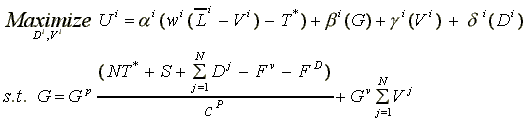 (5)
(5)
The first order conditions for (5) are:
 (6)
(6)
 (7)
(7)
Our formulation of the first order conditions does not assume an interior solution; that is, we allow for the very real and empirically relevant possibility that households opt to contribute nothing to the public service. Note that each household, when considering how much to contribute, considers both the intrinsic value of the donation as well as the impact it will have on the level of the public service.
As our budget constraint suggests, it may not be optimal to use any volunteer labor or undertake any fund-raising if the fixed costs of doing so are very high relative to the expected contributions. We assume the government has a choice of not using any voluntary labor and/or doing any fund-raising (receiving donations) or accepting all contributions it receives. The government thus accepts voluntary contributions of labor if
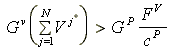 (8)
(8)
and accepts monetary contributions if
 (9)
(9)
where the superscript * refers to the values that satisfy (6) - (7). If (8) and (9) are satisfied, then (6) - (7) gives the equilibrium values for contributions. If (8) is not satisfied then contributions of labor equal zero for all households and equilibrium values of donations are given by (6); if (9) is not satisfied then (7) gives the equilibrium value for volunteer labor.
3.3 The Impact of Mandates and Tax and Expenditure Limits
The model's purpose is to predict the impact of state imposed mandates and tax and spending limits on contributions of labor and money to the public service. To keep the analysis relatively simple and to provide concrete results we assume that all households are identical. Therefore each provides an identical amount of labor and monetary contributions in equilibrium. While this is obviously not observed, particularly for labor contributions, we can think of this as the impacts of mandates and tax limits on the "average" or representative household.
We begin by considering the impact of a tax limit on donations. Let (D*,V*) denote the utility received by the representative household with the policies that satisfy (5) - (6). Then differentiating (5)-(6) with respect to D, V, and T we have
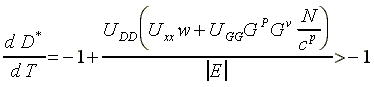 (10a)
(10a)
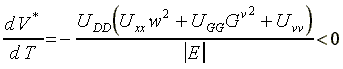 (10b)
(10b)
where 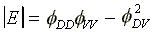 > 0 to ensure stability.
These comparative statics indicate that both donations and voluntary
labor increase as a result of a tax limit that reduces the tax
rate below that desired by the residents. If households contribute
strictly for reasons of "altruism", that is, for the
impact it will have on the public service (UD=0), then
a tax limit will have no impact on the budget as donations will
completely replace the tax revenue. However, if there is some
"warm glow" (UD>0) contributions will
not entirely replace the lost tax revenue because of diminishing
marginal utility from contributions. Voluntary labor unambiguously
increases as a result of the imposition of a tax limit. We summarize
these predictions in the following proposition:
> 0 to ensure stability.
These comparative statics indicate that both donations and voluntary
labor increase as a result of a tax limit that reduces the tax
rate below that desired by the residents. If households contribute
strictly for reasons of "altruism", that is, for the
impact it will have on the public service (UD=0), then
a tax limit will have no impact on the budget as donations will
completely replace the tax revenue. However, if there is some
"warm glow" (UD>0) contributions will
not entirely replace the lost tax revenue because of diminishing
marginal utility from contributions. Voluntary labor unambiguously
increases as a result of the imposition of a tax limit. We summarize
these predictions in the following proposition:
Proposition 1. The imposition of a tax limit that reduces the tax rate below that determined in the absence of the tax limit will: A) increase private donations; B) increase voluntary labor if used in the absence of the tax limit; C) decrease expenditures on the public service but less than the reduction in tax revenue.
In addition to the imposition of tax and expenditure
limits, state government intervene in the provision and production
of local public services through mandates that often constrain
the production process used by localities or the compensation
structure received by the local employees. We model these mandates
as increasing the marginal cost of employing professional staff,
 . The analysis of mandates is more complicated
than TEL because the tax rate chosen in the locality, in
addition to the donations and volunteer labor, may also change.
Rather than attempting to model how local taxes may respond as
the result of a mandate we evaluate the impacts of these state
actions in the absence of changes in local taxes. We then discuss,
in a less formal way, the expected impact of these state policies
when local taxes also respond.
. The analysis of mandates is more complicated
than TEL because the tax rate chosen in the locality, in
addition to the donations and volunteer labor, may also change.
Rather than attempting to model how local taxes may respond as
the result of a mandate we evaluate the impacts of these state
actions in the absence of changes in local taxes. We then discuss,
in a less formal way, the expected impact of these state policies
when local taxes also respond.
While we treat mandates as simply increases in  ,
this may not be the result of a mandate if the mandated benefit
(pension, for example) is capitalized into wages (see Summers
(1989) and Gruber and Krueger (1990)). Analogously, mandates
on the mix of inputs and training of personnel may not have any
effect on employment costs if the mandate is not binding, that
is, if in the absence of the mandate the locality would meet the
requirements of the mandate. Our empirical work related to mandates
is, in part, an examination of whether mandates imposed on local
services are binding.
,
this may not be the result of a mandate if the mandated benefit
(pension, for example) is capitalized into wages (see Summers
(1989) and Gruber and Krueger (1990)). Analogously, mandates
on the mix of inputs and training of personnel may not have any
effect on employment costs if the mandate is not binding, that
is, if in the absence of the mandate the locality would meet the
requirements of the mandate. Our empirical work related to mandates
is, in part, an examination of whether mandates imposed on local
services are binding.
We obtain the impact of mandates on contributions by totally differentiating (6)-(7). The results for the impact of an increase in the cost of professional employees are ambiguous for monetary contributions. For donations we have
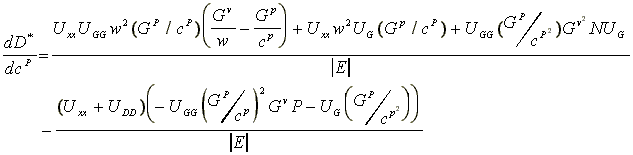 , (11a)
and for voluntary labor we have
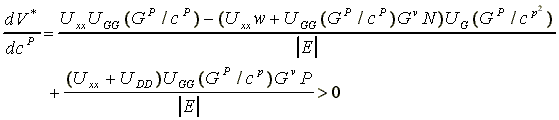 . (11b)
The increase in the cost of professional employees
unambiguously increases the use of voluntary
labor. Because voluntary labor is a substitute for
professional labor and the "marginal product per dollar"
of voluntary labor,  , increases relative
to the marginal product of a donation,
, increases relative
to the marginal product of a donation,  ,
we should expect substitution from monetary contributions to labor
contributions.
,
we should expect substitution from monetary contributions to labor
contributions.
The impact of the increase in costs on monetary contributions is ambiguous. The increase in cP reduces the return on a dollar of contributions. However, if tax revenue is unchanged then the return on a dollar of contributions is increased because the level of public service must be lower, which increases its marginal product.
Expressions (11a) and (11b) are derived assuming that local taxes do not change as a result of the mandate. It is probably more reasonable to assume that local expenditures and taxes increase as a result of the mandate, though theoretically this need not be the case. Increases in local taxes should reduce the increase in volunteer labor and reduce the increase (or increase the reduction) in monetary donations as suggested by (10a) and (10b). At the extreme, if tax increases fully offset the increase in cP then the only impact on volunteer labor would be a reduction attributable to lower after-tax income because of the tax increase. The impact on monetary contributions would clearly be negative as the marginal product of a monetary contribution has decrease when cP increases.
Proposition 2 A. Increases in the cost of professional employees will increase volunteer labor contributions. B. The increase in labor contributions due to the increase in cost of professional employees is greater, the less the locality is able to increase its taxes as a result of the increase in costs.
In summary, then, we expect tax and spending limits to decrease both monetary contributions and volunteering. Mandates, to the extent that they increase the cost of using professional employees are predicted to increase the use of volunteer labor even if taxes also increase. The impact of mandates on monetary contributions is less clear, though likely to be negative as people substitute to labor contributions and tax increases with the increase in the cost of professional employees. These predictions form the basis of the empirical tests that are developed in the next section.
4.1 A Model of Department Choice and the Use of Fund-Raising
In Section 3 we developed our model of contributions in a framework in which there were fixed costs of using any volunteer labor at all or engaging in any fund-raising. These fixed costs may lead many fire departments to choose not to use any volunteers or to engage in any fund-raising. In our sample of fire departments, approximately 20% of all departments employ no volunteers and 54% of all departments do not regularly pursue monetary donations. The presence of the fixed cost implies that if contributions of labor and money are used, they will generally comprise a meaningful percentage of the resources devoted to provision of the public service.
To integrate our comparative static analysis into a discrete-choice model that motivates our empirical analysis, we distinguish between observed volunteer labor contributions, (V) and donations (D) and "latent" volunteer contributions, (V*), and donations, (D*). The "latent" contributions, V*, and D*, are the amounts (for the locality) that satisfy (6) and (7). However, for these to be the actual contributions, V = V* and D = D*, it must also be the case that (8) and (9), the fixed cost conditions, must be satisfied. Representing V* and D* as linear expressions gives
 (12a)
(12a)
 (12b)
(12b)
where Xij denotes characteristics
of locality i in state j; Mj
is a vector of mandates in state j that
affect fire protection services; and Tj
is a measure of the existence and extent of tax limitations.
The error terms j and j are distributed
with N(0,), 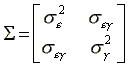 . Let
. Let 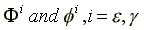 denote the cumulative distribution (cdf) and probability density
functions (pdf) for these two error terms. Then our theoretical
results suggest that 2 =
denote the cumulative distribution (cdf) and probability density
functions (pdf) for these two error terms. Then our theoretical
results suggest that 2 =  >
0 (increase in cost of professional employees increases potential
volunteers), and 3 =
>
0 (increase in cost of professional employees increases potential
volunteers), and 3 =  > 0
and 3 =
> 0
and 3 = > 0 (tax limits increase
both the potential volunteers and desired monetary contributions).
Then actual contributions are determined by
> 0 (tax limits increase
both the potential volunteers and desired monetary contributions).
Then actual contributions are determined by
 (13a)
(13a)
 (13b)
(13b)
where 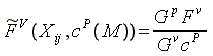 . Then using (13a)
and (13b) we have
. Then using (13a)
and (13b) we have
P(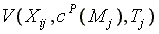 >0))=
>0))= (14a)
(14a)
and
P(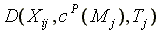 >0))=
>0))= (14b)
(14b)
where P(.) refers to the probability (cdf) function. Then differentiating (13a) with respect to Tj and Mj gives
 =
= (15a)
(15a)
and
 =
=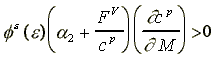 (15b)
(15b)
An increase in the level of taxes allowed (less stringent limits) will decrease the probability that a department uses voluntary labor. The adoption of a mandate, if it is binding, should increase the cost of professional employees and therefore increase the probability that a department is volunteer. If we differentiate (13b) with respect to Tj we have
 =
=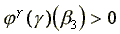 (15c)
(15c)
An increase in the level of taxes allowed will reduce the probability that a department engages in fund-raising.
Fire departments are categorized as volunteer, combined, or professional based on the extent that they use volunteers, with volunteer departments using volunteers almost exclusively and professional departments using, at the most, only a very few relative to the number of professionals they employ. Let TYPEi, denote department type with i =1 denoting volunteer; i =2, combined; and i = 3 is paid. Assume that for a department to be classified as professional the number of volunteers must exceed some number, , or V > Then modifying (13a) to model the determination of departmental type gives
P(TYPEi=1) =  (16a)
(16a) 
P(TYPEi=2)=
 (16b)
(16b)

P(TYPEi=3)=1- (16c)
(16c) 
4.2 Data
To estimate the impact of state mandates on voluntary contributions to public services, a random sample of 2,970 fire departments in 28 states was compiled from several sources. The variables include measures for characteristics of the fire department, the service area, and the state in which the department is located. Omission of incomplete observations leaves a sample of 1,846 complete observations on fire departments and their service areas. The summary statistics reported in Table 1 apply to this subset of complete observations.
Data were compiled from several sources. The 1994 Fire Engineering Directory of Municipal Fire Departments provided information on specific fire departments. From the 1990 Census of Population and Housing data on the service area were collected. Tax and Expenditure Limits on Local Governments by Mullins and Cox (1995) provided detailed information on the state-imposed restrictions on local government taxation and expenditures. State codes and conversations with individuals in state Fire Marshal offices provided information on pension requirements and served as an informal check for the information compiled from other sources.
Inspection of Table 1 reveals significant differences in the localities employing different types of departments. Important local characteristics appear to be the community population, population density, median age of housing structures, and the percentage of housing that is owner occupied. Areas relying completely on volunteer labor tend to be less populous, have slightly older housing stocks, and have a higher percentage of owner-occupied housing than areas employing other types of departments. The areas employing a combination of volunteer and paid labor are relatively younger, more affluent areas. The areas employing solely paid fire fighters are the most urban. Kruskall-Wallace tests for equality of distributions across department types confirm a systematic relationship between local characteristics and the type of department employed.
55% of the fire departments in the sample classify themselves as volunteer departments. Another 25% of the departments classify themselves as employing a combination of paid and volunteer labor. The remaining 20% of the sample identify themselves as paid departments. This breakdown is quite similar to the distribution reported in the 1994 Fire Engineering Directory of Municipal Fire Departments. The process of merging census data with observations from the directory seems to have slightly increased the percentages of combination and paid departments in the sample at the expense of volunteer departments.
The South, Southwest, and Midwest contain generally similar breakdowns of department types, with around 55% volunteer, 25% combination, and 20% paid. The Northwest contains the highest percentage of combination departments, with almost 50% of departments employing both volunteers and professional fire fighters. The region with the smallest percentage of paid departments is the Northeast, where only 10% of the departments are paid. All empirical work includes categorical variables to control for these differences across regions.
4.3 Variable Definitions and Expected Results
We include a number of explanatory variables to control for the impact of state and local level characteristics. The variables of primary interest are Pension and Limit. Both categorical variables indicate the presence or absence of mandates applying to fire protection or local government spending.
The categorical variable Pension is equal to one for the eight states that require a pension plan solely for paid fire fighters. Mandated pensions are predicted to decrease the probability that a department employs any paid fire fighters and increase the probability that a department employs volunteers. Controlling for department type, the existence of mandated pension requirements is predicted to decrease the employment of paid fire fighters in paid and combination departments. We expect that combination departments will substitute volunteer labor for at least some of the foregone paid labor. The theoretical impact of pension mandates on monetary contributions is ambiguous. If there are economies of scope to fund-raising and volunteer recruitment, then pension mandates may increase the ability of departments to engage in fund-raising. Conversely, residents that have increased their labor contributions in response to pension mandates may desire to decrease their monetary contributions.
Following Poterba and Rueben (1995), Limit is equal to one for the twenty-one states that limit any of the following aspects of municipal government's financing decisions: the overall property tax rate, property tax revenues, or general revenues and expenses. We do not count limits on the rate of property tax increases as effective limits. TEL are predicted to increase reliance on local contributions of both labor and money.
A number of local level characteristics including community demographics and income measures are also included. These characteristics are included as measures of both determinations of the relative costs of using volunteers versus paid fire-protection in the area and the extent of the volunteer base as suggested by the work of Stinson (1978) and Ducombe and Brudney (1995) on the determinants of the use of volunteers in fire protection. Table 1 contains brief definitions of these local level variables. State level characteristics are included as Paid-Departments, Districts, and State Income. The variables Paid-Departments and Districts record the percentage of departments that are paid and organized as fire protection districts, respectively. These variables are included to control for neighbor or "copycat" effects (Case, et. al. 1993) as the departmental choice of other localities in the state may influence the department choice of a locality. State Income records the state's per capita disposable income, measured in thousands of dollars. This variable controls for differences across states correlated with mean income in the state, such as the cost of employing paid fire fighters. As previously mentioned, a set of categorical variables -- South, Midwest, Northwest, Northeast and Southwest -- is also included to control for unobserved characteristics correlated with geographic region.
5. Empirical Results and Discussion
Tables 2 summarizes the results for a two specifications of probit and ordered probit equations, respectively, on the determinants of the use of volunteers by departments. The specifications differ in the treatment of fire protection districts. In one specification for the probit and ordered probit, a categorical variable is included for departments organized as special taxing districts while another specification omits this variable. We include Fire Protection District because departments organized as special taxing districts may have advantages in raising revenue through taxes or bonds. However, there is some concern that Fire Protection District is endogenous as it is a choice of departments given their state allows for special districts. Alternative specifications we estimated include having a categorical variable for whether special districts were allowed in the state and specifications in which we only use departments not in fire protection districts. Generally we find that in both the probit and ordered probit equations while Fire Protection District may be statistically significant, the influence of mandates and TEL are qualitatively invariant to the treatment of these districts.
The probit equations reported in Table 2 (specifications 2.1-2.2) estimate the impact of mandates on the probability that an area employs volunteer fire fighters. While our results confirm the theoretical prediction that mandated pensions and TEL should increase the likelihood that a department uses volunteers, only for mandated pensions is the impact statistically significant. The coefficients on other variables generally conform to our expectations. Both population and population density are inversely related to the probability that a department employs volunteers. The percentage of housing owner-occupied is directly related to the probability that a department employs volunteers. Areas with a higher percentage of college graduates are less likely to employ volunteers in their fire department, consistent with Stinson (1978) finding that volunteer use is inversely related to opportunity cost. There appear to be strong neighbor effects with the percentage of departments in the state that are paid inversely related to the probability of a given department employing volunteers.
2.3 and 2.4 present the estimates of ordered probit equations consistent with (16a) - (16c). For these equations we order departments by their reliance on volunteers into three types: volunteer, combination, and paid. As predicted, both mandated pensions and TEL are inversely related to the probability of employing paid fire fighters. Furthermore, both effects are statistically significant and qualitatively meaningful. As reported in Table 5, computing the probability changes at the sample means, we find that the existence of pension mandates increases the probability of a typical area employing a volunteer department by 13%. TEL increase the probability by 11%. Furthermore, the existence of pension mandates decrease the probability of the typical area possessing a combination department by 10%. TEL decrease the probability by 8%. Both pension mandates and TEL decrease the probability of the typical observation employing a paid department by 3% each. Given the substantial differences between the average area and the average area with a paid department this impact is rather surprising. If we limit our attention to an area with the typical characteristics of a paid department's jurisdiction, the impact of pension mandates and TEL are even more striking. Pension mandates decrease the probability of such an area having a paid department by almost 13%. TEL decrease this probability by 10%. The impact of local characteristics and other state-level variables on the determination of departmental type generally conforms to the results of the probit equations as well as our prior expectations.
To examine the impact of pension mandates and TEL on the number of personnel employed in a given department we regress the natural log of the number of department personnel on our set of local and state level explanatory variables with our results reported in Table 3. Each equation is estimated conditional on the department's type and contains a selectivity correction, l, calculated from the ordered probit equation reported as 3.1. While, as predicted, mandated pensions and TEL decrease the size of paid fire departments and increase the size of combination departments, only for paid fire departments are the estimated coefficients statistically significant. The point estimates imply that mandated pensions decrease the size of paid fire departments by 14% while TEL decrease their size by 18%. Unexpectedly, our results suggest that volunteer departments in states with mandated pension laws tend to be 9% larger than similar volunteer departments in states without these mandates. While it is tempting to view this as a result of selectivity bias, the inclusion of l should control for the influence of pension laws on the department's type.
Finally, it should be noted that the results of Tables 2-3 suggest that the cost of providing mandated pensions are not fully capitalized into wages, that is, fire fighters value these pensions at less than the cost of provision. We find this somewhat surprising given that other mandated benefits, such as workman's compensation (Gruber and Krueger (1991)) and maternity leave (Gruber (1994)) are almost entirely capitalized into wages.
Table 4 presents the results of probit estimations of the decision to engage in fund-raising activities as well as Tobit estimates of the amount of fund-raising. We report one specification in which we estimate fund-raising unconditional on the use of volunteer labor (4.1 and 4.3). In addition, we incorporate a selectivity correction, l, to incorporate the probable correlation between the decision to rely on volunteer labor and the decision to seek monetary contributions (4.2 and 4.4). In our probit results, as expected, TEL are directly related to the probability of engaging in fund-raising. TEL increase the probability of a typical community engaging in fund-raising by 10%. There is also some evidence that mandated pensions are directly related to probability of engaging in fund-raising. However, the statistical significance of the coefficient for Pension varies across specifications. The selectivity correction, l, in 4.2 is statistically significant, suggesting that these decisions to use volunteers and raise funds are related. We interpret the significance of TEL across all four specifications as strong evidence that TEL impact the decision to engage in fund-raising.
The theoretical model predicts that TEL will not only increase the probability of engaging in fund-raising, but will also increase the level of fund-raising. We test this proposition by estimating two specifications of a tobit equation 4.3 and 4.4. By performing the tobit procedure, we account for the fact that many departments do not engage in fund-raising at all. As expected, the coefficient on TEL is statistically significant and indicates that TEL increase the level of fund-raising activity of departments. From 4.3, we find the existence of TEL increase local fund-raising by about $24,000. Given the theoretical ambiguity of the prediction of the impact of mandates on fund-raising, it is not surprising that the estimated coefficients on Pension are not statistically significant in either 4.3 or 4.4.
Our investigation of pension mandates and TEL generally confirms the theoretical predictions of the model. TEL increase both the probability of engaging in fund-raising and the level of fund-raising activity under taken. Legally constrained local governments turn to monetary contributions to make-up lost revenue to maintain service quality at levels consistent with that desired by the median voter. The model does not predict an impact of pension mandates on fund-raising and our empirical work does not generally find a relationship.
The impact of pension mandates and TEL on department budgets is investigated in Table 6. The dependent variable for these regressions is the natural log of the department's operating budget, reported in thousands. The regression equations are performed conditional on department type and include a selectivity correction, l. These regressions are perhaps the most difficult to interpret because departments may react to pension mandates and TEL on at least two margins that are not held constant in these regression. First, pension mandates and TEL may influence the department's decisions concerning capital and service quality. Thus decreases in the operating budget may be due to decreases in quality, substitution into capital (not in the operating budgets), or substitution into volunteer labor. Given the lack of a direct measure of fire protection service quality, we are unable to determine if, for example, a decrease in the budget implies a reduction in quality or whether an increase in the use of volunteer labor (for volunteer and combination departments) offsets the reduction in the budget.
For paid departments, mandated pensions are predicted to increase the department's budget by about 12%. This occurs despite the reduction in personnel (department size) reported in Table 3. However, the estimated coefficient is not statistically significant. TEL decrease the budget of a fully paid department by about 28%, consistent with the 18% reduction in personnel reported in Table 3. However, the estimated coefficient is only significant at 13%. For combination departments, the estimated coefficients are significant at the 5% level. Both pension mandates and TEL decrease the department's budget by about 33%, suggesting that these departments engage in substantial switching between paid and volunteer labor.
The estimated equations for volunteer departments yield unexpected results. Pension mandates, which do not apply to volunteer departments, increase the department's budget by almost 30%. TEL also increase the department's budget, by about 36%. While the estimated coefficients may suggest an endogeneity problem, the selectivity correction () should control for this effect.
7. Conclusions
Our examination of TEL and pension mandates suggests that local authorities increase reliance on volunteer labor and monetary contributions in response to TEL and increase reliance on volunteer labor in response to pension mandates. The notion that fiscally constrained local governments seek to supplement budgets with voluntary contributions strikes us as intuitively appealing. Furthermore, it accords with recent work by Brunner and Sonstelie (1997), who find that school districts in California turn to voluntary contributions to by-pass de facto spending caps created by the post-Proposition 13 system of financing public education.
It is our impression that conventional wisdom in the fire fighting community is that local population drives decisions concerning the use of volunteers and reliance on fund-raising. We find that controlling for the important influence of both population and population density, state restrictions on local fiscal autonomy do influence local choice over provision and funding methods. While the probability changes reported in Table 6 are not overwhelming, they are not trivial either. A rich data set of variables allows for the inclusion of many details of the local service environment. Given the vast differences between areas relying solely on volunteer labor and those funding departments fully staffed with professionals, the significance of mandates on the mix of labor inputs and on funding decisions for local fire protection is striking.
Our findings seem consistent with those of Kingma (1989) and Schiff (1985), who find evidence that public spending does "crowd out" private contributions to related activities. Here, we find that other government policies, specifically TEL and mandates, that reduce government spending or increase the costs of public services increase both monetary and labor (time) contributions; rather than the crowding out of private contributions with government spending, we find that reductions in public spending imposed from outside the local jurisdiction result in partial replacement by increases in private contributions. Our findings on volunteering might thus be considered extensions to the existing literature on "crowding out" as they suggest that contributions of time, as well as money, respond to government policies.
We also interpret our results as evidence that volunteering and monetary contributions to public services are sensitive to public service quality and therefore cannot be entirely explained by a "warm glowing" feeling alone. However, the fact that contributions to fire protection do not entirely offset budget reductions also implies that the "warm glowing" must play some role in the decision to volunteer or contribute to fire services.
Finally, the results suggest that evaluation
of the impacts of mandates and TEL, both in terms of their
impacts on public service quality and their social costs, are
complicated by changes in both contributions of time and money
that may not be considered insignificant. If the impacts of
mandates and TEL on public service are at least partially
offset by increases in volunteering by individuals with high opportunity
costs, these interventions by the state may be much more costly
than an examination of their impact on public service quality
or budgets might suggest. Given both the extensive use of mandates
and spending limits and a significant use of volunteers in many
public services, research on the use of volunteers and fund-raising
in other public services, particularly education, seems warranted.NotesReferences
Abrams, Burton A. and William R. Dougan. 1986.
"The Effects of Constitutional Restraints on Governmental
Spending," Public Choice, 49: 101-116.
Advisory Commission on Intergovernmental Relations.
(1995) Tax and Expenditures Limits on Local Governments.
Ahlbrandt, Roger. 1973a. "Municipal Fire Protection
Services: Comparison of Alternative Organizational Forms,"
Sage Professional Papers in Administration and Policy Studies.
____________. 1973b. "Efficiency in the Provision
of Fire Services," Public Choice, 16:1-15.
Andreoni, James. 1989. "Giving with Impure
Altruism: Applications to Charity and Ricardian Equivalence,"
Journal of Political Economy 97: 1147-1458.
_____________, William Gale, and J. Karl Scholz.
1994. "Charitable Contributions of Time and Money."
Working paper.
Bergstrom, Theodore and R. Goodman. 1973. "Private
Demands for Public Goods," American Economic Review
63: 280-296.
Bogart, William. 1991. "Observable Heterogeneity
and the Demand for Local Public Spending," National Tax
Journal 44: 213-223.
Borcherding T. and R. Deacon. 1972. "The
Demand for the Services of Non-Federal Government," American
Economic Review 62: 891-901.
Brown, Eleanor and Hamilton Lankford. 1992. "Gifts
of Money and Gifts of Time: Estimating the Effects of Tax Prices
and Available Time," Journal of Public Economics,
47: 321-341.
Brueckner, Jan. 1981. "Congested Public Goods:
The Case of Fire Protection," Journal of Public Economics
15: 45-58.
Brunner, Eric and Jon Sonstelie. (forthcoming) "Coping
with Serrano: Voluntary Contributions to California's Local Public
Schools," National Tax Journal.
Case, Anne, Harvey Rosen, and James Hines. 1993.
"Budget Spillovers and Fiscal Policy Interdependence: Evidence
from the States," Journal of Public Economics 52:
285-307.
Clotfelter, Charles. 1985. Tax Incentives and
Charitable Giving. Chicago: University of Chicago Press.
Doyle, Maura. 1994. "Property Tax Limitations
and the Delivery of Fire Protection Services." Working paper,
Federal Reserve Board of Governors.
Duncombe, Sydney. 1985. "Volunteers in City
Government: Advantages, Disadvantages, and Uses." National
Civic Review 74: 356-364.
Duncombe, William. 1991. "Demand for Local
Public Services Revisited: The Case of Fire Protection."
Public Finance Quarterly 19: 412-436.
________________. 1992. "Costs and Factor
Substitution in the Provision of Local Fire Services." The
Review of Economics and Statistics : 180-184.
________________ and John Yinger. 1993. "An
Analysis of Returns to Scale in Public Production, with an Application
to Fire Protection," Journal of Public Economics
52: 49-72.
________________ and Jeffrey Brudney. 1995. "The
Optimal Mix of Volunteer and Paid Staff in Local Governments:
An Application to Municipal Fire Departments," Public
Finance Quarterly 23: 356-384.
Elder, Harold. 1992. "Exploring the Tax Revolt:
An Analysis of the Effects of State Tax and Expenditure Limitation
Laws," Public Finance Quarterly 20: 47-63.
Figlio, David. 1996. "Did the `Tax Revolt'
Reduce School Performance?" forthcoming, Journal of Public
Economics
___________ and Arthur O'Sullivan. 1996. "Do
Local Governments Respond Strategically to Tax Limits?"
Working Paper.
Freeman, Richard. 1996. "Working for Nothing:
The Supply of Volunteer Labor" National Bureau of Economic
Research. Working Paper 5435.
Gold, Steven D. and Martha A. Fabricius. (1989).
(1989) How States Limit City and County Property Taxes and
Spending, National Conference of State Legislatures, LFP
#67, Denver, CO.
Greene, William. 1993. Econometric Analysis,
New York: Macmillan Publishing Company
Gruber, Jonathan, and Alan Krueger. 1991. "The
Incidence of Mandated Employer-provided Insurance: Lessons from
Workers' Compensation Insurance," in. David Bradford, ed.
Tax Policy and the Economy Cambridge, MA: MIT Press, 1991.
pp 111-144.
Gruber, Jonathan. 1994. "The Incidence of
Mandated Maternity Benefits," American Economic Review
84: 622-641.
Jeon, B. Phillip and Mark Berger. 1996. "The
Demographic Cycle and Optimal Schooling Choices," Southern
Economic Journal, 63: 301-311.
Kingma, Bruce Robert. 1989. "An Accurate Measurement
of the Crowd-out Effect, Income Effect, and Price Effect for Charitable
Contributions," Journal of Political Economy, 97:
1197-1207.
Lovell, Catherine and Charles Tobin. 1981. "The
Mandate Issue," Public Administration Review, 318-331.
Maddala, G.S. 1983. Limited Dependent and Qualitative
Variables in Econometrics. Cambridge: Cambridge University
Press.
McChesney, Fred. 1986. "Government Prohibitions
on Volunteer Fire Fighting in Nineteenth-century America: A Property
Rights Perspective," Journal of Legal Studies 15:
69-92.
Menchik, Paul L. and Burton A. Weisbrod. 1987. "Volunteer
Labor Supply," Journal of Public Economics, 32: 159-83.
Mullins, Daniel and Kimberly Cox. 1995. State
Tax and Expenditure Limits on Local Governments. Washington,
DC: Advisory Commission on Intergovernmental Relations.
O'Sullivan, Arthur, Terri Sexton, and Steven Sheferin.
1995. Property Taxes and Tax Revolts: The Legacy of Proposition
13. New York: Cambridge University Press.
Perkins, Ken. 1987. "Volunteer Fire Departments:
Community Integration, Autonomy and Survival," Human
Organization 46: 342-348.
Perkins, Ken and John Benoit. 1995. The Future
of Volunteer Fire and Rescue Services: Taming the Dragons of
Change. Oklahoma State University: Fire Protection
Publications.
Poterba, James and Kim Rueben. 1995. "The
Effect of Property-Tax Limits on Wages and Employment in the
Local Public Sector," American Economic Review 85:384-389.
Preston, Anne, and Casey Ichniowski, 1991. "A
National Perspective on the Nature and Effects of the Local Property
Tax Revolt, 1976-1986," National Tax Journal 44:123-145.
Rhine, Sherrie L. 1989. "The Effect of State
Mandates on Student Performance," American Economic Association
Papers and Proceedings, 79(2): 231-235.
Schiff, Jerald. 1985. "Does Government Spending
Crowd Out Charitable giving?" National Tax Journal
38: 535-546.
Simpson, Charles R. 1996. "A Fraternity of
Danger: Volunteer Fire Companies and the Contradictions of Modernization,"
American Journal of Economics and Sociology 55: 17-52.
Stinson, Thomas. 1978. "Household Allocation
of Voluntary Labor in the Production of Fire Protection: Minnesota
Evidence," American Journal of Agricultural Economics
60: 331-337.
Summers, Lawrence. 1989. "Some Simple Economics
of Mandated Benefits." American Economic Review.
79: 177-183.
Thompson, Alexander and Barbara Bono. 1992. "Alienation,
Self-Actualization and the Motivation for Volunteer Labor,"
Review of Radical Political Economics. 24:115-123.
________________________________. 1993. "Work
Without Wages: The Motivation of Volunteer Fire Fighters,"
American Journal of Economics and Sociology July: 323-343.
|
|
|
| ||
|
|
|
| ||
|
|
|
| ||
|
|
|
| ||
|
|
|
| ||
|
|
|
| ||
|
|
|
|
| |
|
|
|
| ||
|
|
|
| ||
|
|
|
| ||
|
|
|
| ||
|
|
|
| ||
|
|
|
| ||
|
|
|
| ||
|
|
|
| ||
|
|
|
| ||
|
|
|
|
|
|
|
| |
|
| |||
|
|
|
| |
|
|
|
| |
|
| |||
|
|
|
| |
|
|
|
| |
|
|
|
| |
|
|
|
| |
|
|
|
| |
|
|
|
| |
|
|
|
| |
|
|
|
| |
|
|
|
| |
|
|
|
| |
|
|
|
| |
|
|
|
| |
|
|
|
| |
|
|
|
| |
|
| |||
|
|
| ||
|
|
| ||
1All equations also included categorical variables for regions. Sample size in all specifications is 1846.2 In all tables *** denotes significance at 1%; ** at 5%; and * at 10* in two-tailed tests.
|
|
| |
|
|
| |
|
|
| |
|
|
| |
|
|
| |
|
|
| |
|
|
| |
|
|
| |
|
|
| |
|
|
| |
|
|
| |
|
|
| |
|
|
| |
|
|
| |
|
|
| |
|
|
| |
|
|
| |
|
|
| |
1All equations also included categorical variables for regions. 2 House Age is omitted for identification purposes. 3The appropriate l for each department type is computed using specification 2.3.
|
|
|
| |
Y = 1 if fund-raising>0; 0 else |
| |||
|
|
|
| |
|
|
|
| |
|
|
|
| |
|
|
|
| |
|
|
|
| |
|
|
|
| |
|
| |||
|
|
|
| |
|
|
|
| |
|
|
|
| |
|
|
|
| |
|
|
|
| |
|
|
|
| |
|
|
|
| |
|
|
|
| |
|
|
|
| |
|
|
|
| |
|
|
|
| |
|
| |||
|
|
| ||
1All equations also contain categorical variables for region. 2House Age is excluded from specifications (2) and (4) for identifications purposes. 3l is computed from 2.1.Table 5: Impact of Mandates and TEL on Department Type and Fund-raising
| ||||
| ||||
| ||||
| ||||
|
|
| |
|
|
| |
|
|
| |
|
|
| |
|
|
| |
|
|
| |
|
|
| |
|
|
| |
|
|
| |
|
|
| |
|
|
| |
|
|
| |
|
|
| |
|
|
| |
|
|
| |
|
|
| |
|
|
| |
|
|
| |
1All equations also contain categorical variables to denote region. House Age is omitted to ensure identification. 2The appropriate l for each department type is computed from 2.3.