 and
and  . We assume that the housing production
function is same for both cities. Then we can normalize the price
of x and capital to unity and let pi denote the price
of housing in city i.
. We assume that the housing production
function is same for both cities. Then we can normalize the price
of x and capital to unity and let pi denote the price
of housing in city i.
Caution to the wind, we leave this html file here, but caveat emptor, 'betas', 'deltas', 'epsilons', etc. are missing below. Makes for difficult reading to say the least. Better to grab the pdf or ps or original Word .doc file.
Beginning with Tiebout (1956), numerous studies have argued that
we should expect to see differences in public services among localities
as a result of people "voting with their feet". Here,
we consider differentiation in public services as a way of reducing
competition among localities (cities). If cities finance their
public services with a property tax that generates "tax competition",
we find that adoption of quality differentiation in the public
services will change the amount of services provided. If the
cities maximize property values, this means a reduction in the
level of public services provided for both the city that provides
high quality as well as with low quality. The reduction in public
services in both cities means that under certain conditions property
values in both cities can increase. Thus in a two-stage game
of adoption, we can observe quality differentiation in the services
when the property tax is used. This is in sharp contrast to the
case with a head tax in which we should never observe this type
of differentiation. We believe quality differentiation might be
particularly relevant to the provision of primary and secondary
education. We argue that the extent of the differentiation in
the quality and type of educational services provided among school
districts might be in part a response to the detrimental effects
of tax competition rather than entirely a "Tiebout-like"
response to differences in tastes.
JEL Classifications: H71, I22
Numerous articles have examined the issue of "tax competition" in the past fifteen years. The majority, though not all, of the literature on tax competition focuses on the inefficiencies that might be created because local governments independently and competitively choose their tax policies. As first argued by Oates (1972), competition for business investment, a large share of the tax base for localities, may lead to localities underproviding public services to keep taxes low and business investment high. Wildasin (1989) refers to this as a "fiscal" externality - local governments, when setting their tax policies, ignore the fact that while an increase in their taxes reduces business capital in their city it will increase it in other cities. Since this is a positive externality that is being ignored, we have an underprovision of public services.
Numerous extensions have been made to the early formal analysis of tax competition made by Zodrow and Mieszkowski (1986) and Wilson (1986) which focused on tax competition among a large number of regions with mobile capital and immobile labor. Some of these extensions include consideration of labor mobility as well as capital mobility (Wilson (1992)), "metropolitan" models in the decision to work is independent of where to reside (Hoyt (1991, 1992, 1993), Krelove (1993)); and models with imperfect mobility (Wildasin and Wilson (1996), Myers (1990), Burbidge and Myers (1994), Wellisch (1994)). In addition, tax competition has been considered in the context of local governments having more than two tax or financing instruments (Wilson (1992); Hoyt (1991); Krelove (1993); Bucovetsky and Wilson (1991); and Jensen and Toma (1991)).
In this paper, we, too, extend the literature on tax competition, but in a very different direction than previous work. We borrow from the industrial organization literature and consider the impact of "product" differentiation on tax competition, where the product is the locally provided public service. As has been well-known within the context of competition among firms since Hotelling (1929), when firms differentiate products, profits can increase. In fact, even in Bertrand price competition, product differentiation can create positive profits in an industry where none would exist without that differentiation (Shaked and Sutton (1982)). We wish to see if this analogy can be applied to the public sector within the context of tax competition. We consider vertical differentiation of public services, where one (or both) cities can offer a high or low quality of the public service. Within the context of this simple model, we are interested in examining whether differentiating public services ameliorate the adverse impacts of tax competition and increase the welfare of constituents of the local government. We then consider the question of "If differentiation does reduce the adverse affects of tax competition, will (and under what conditions) local governments offer different qualities of public services?" within the context of a two stage "adoption" game.
We examine the issue of quality differentiation of public services using a model with capital and residents that is mobile among the cities in the metropolis. Each city provides, and finances through taxation, a single public service. Residents, then, choose where to live based upon the tax/public service mix and housing prices in the cities. For simplicity, we have only two cities, though with appropriate modifications, our results could be extended to models with more than two cities. We assume that local governments, when choosing their tax/public service policies and what type of quality to offer, are maximizing the value of the immobile asset within their city, land (property) value. Later, we discuss how our analysis and the primary implications of our results, that quality differences can both exist and reduce the adverse impacts of tax competition, can be extended to with alternative government objectives including utility and revenue maximization.
We believe quality differentiation might be particularly relevant to the provision of primary and secondary education. In addition to being the 43% of direct general expenditures of local governments, numerous studies have found evidence that educational provision influences locational decisions in metropolitan areas. Unlike many other locally-provided public services such as roads, sewers, and waste removal, quality differences across jurisdictions in public education are more apparent, frequent, and likely to be of greater concern to residents.
One interesting implication of our analysis, discussed in more detail later, is how educational quality might be affected by state intervention in the financing and provision of education, particularly the use of tax limits and fiscal equalization plans. While one of the explicit intents of this type of legislation is to reduce educational quality differences related to the income or tax base of the locality, our analysis suggests that this analysis will also reduce quality differences among districts with similar incomes and tax bases.
In Section 2 we provide an outline of our model, focusing on the equilibrium conditions and the structure of our two-stage game of almost perfect information. To serve as a basis of comparison, in Section 3 we consider the quality adoption game when the public service is financed using a head tax. Section 4 considers the impacts of quality differences on property values and quality adoption when the property tax finances public services. In Section 5 we discuss some possible extensions and policy implications.
The model that we develop is similar to models of "imperfect" mobility in which individuals derive utility from attachment to a region (see DePalma and Papageourgiou (1988), Myers (1990), Burbidge and Myers (1994), and Wellisch (1994)). However, our model differs in two important respects. First, the models in these studies are best interpreted as models of "regions" where residents both work and consume public services. Thus when making a decision about where to live, individuals consider both labor market conditions and the tax/public service mix in the region. Equilibrium in these models requires clearing in each region's labor market. Our model, similar to those of Epple and Zelenitz (1981), Henderson (1985), Hoyt (1991,1992,1993), and Krelove (1993) is best interpreted as a model of a metropolitan area in which the decision about where to reside is independent of the decision of where to work. Residents, when choosing among the alternative providers of public services, "cities", consider the tax/public service mix and housing prices. Equilibrium requires clearing in each city's housing market. Since we are interested in applying our analysis to an understanding of differentiation in public education, a good provided in school districts that are generally much smaller than labor markets in which they are located, a model in which income is independent of locational choice seems appropriate. Our model also allows us to focus on the impact of differences in public services (and quality) in migration without having confounding impacts on migration due to labor market conditions.
A second distinction is that imperfect mobility in our model is the result of the strategic actions of city governments and not exogenously determined. In the absence of any differences in the quality of services mobility is perfect, that is, there is no distinction in the preferences for the two cities among the residents. Only when one city chooses to be high quality will residents differ in their relative valuations of the two cities. Another distinction between our model and those of Burbidge and Myers (1994) and Wellisch (1994) is that, following the industrial organization literature, we have "vertical" differentiation in our cities while the cities in their studies might be best considered to be "horizontally" differentiated. In our model all residents, ceteris paribus, prefer high to low quality but some have a stronger taste for quality than others. In Burbidge and Myers (1994), for example, cities can not be ranked by quality as the "preferred" city differs among the residents. We discuss the implications of this distinction between vertical and horizontal differentiation later.
Two cities in the economy each provide a public service (education) denoted by g of quality (q) of 0 or 1 to the N individuals in the economy. All individuals have the same subutility function U(x,h,g) where x is a private traded good and h is housing. Following Burbidge and Myers (1994) and Wellisch (1994), individuals differ in the utility they receive from quality with individual n receiving utility of n if q = 1.
So enjoy but you probably are going to loose a lot of the content here since the symobls like
a b g d e m n are missing. If someone has Word 7.0,
and would like to convert the .doc file, let me know
and maybe we can get this replaced with a good copy.
We let p denote the net-of-tax price of housing, the ad-valorem (property) tax on housing, and h(p(1+)) the demand for housing. While we are primarily interested in examining the provision of services and quality when the cities use a property tax, we also consider financing using a head tax (T) to serve as a basis of comparison.
Capital is used to produce all three goods with K units of capital in the economy. One unit of capital produces one unit of the private good x. Providing g units of education to N individuals requires Ng units of capital. Providing education quality of q=1 requires N units of
capital. Housing is a non-traded good with F(ki)
units produced in city i where
and . We assume that the housing production
function is same for both cities. Then we can normalize the price
of x and capital to unity and let pi denote the price
of housing in city i.
To formalize the question of the choice of quality, we model the provision of the education as a two stage game of almost perfect information. In stage one, each city simultaneously chooses the quality of its public good, high (q=1) or low (q=0). Then in stage two, after the outcome of stage one is observed, each city simultaneously chooses its tax. Note that this dynamic structure implicitly assumes the cities must credibly commit to the level of quality they intend to provide before they choose taxes, and thus choose the level of education they provide. Alternatively, this simply assumes that the quality of education is less easily adjusted than its quantity (so quality is chosen first, just as a firm must adopt a production technology before deciding how much to produce with that technology).
As is standard, we focus on the subgame perfect equilibria. The solution technique is, of course, backward induction. We first determine the Nash equilibrium for each of the two-stage subgames: both cities adopt high quality, both adopt low quality, and the two quality differentiation outcomes in which one city adopts high quality and the other adopts low quality. The equilibrium payoffs from these subgames then are used to define a "reduced-form" single-stage game in which each city can adopt either high quality or low quality. Because these payoffs embody Nash equilibrium behavior in stage two by construction, it follows that a Nash equilibrium in qualities of the reduced-form game (together with the corresponding stage two taxes) is also a subgame perfect equilibrium of the dynamic game of providing education.
3. Provision of Education with Head Taxation
To provide a context in which to better understand the impact of property taxation on the decision to differentiate quality, we first consider as a benchmark the provision of education when the cities can use lump sum taxes.
3.1 Market Clearing Conditions in Stage Two with Head Taxation
With a head tax city i's balanced budget constraint is
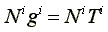 , i = 1, 2.
(1)
, i = 1, 2.
(1)
where Ni is the population of city i. For the moment, we ignore the financing of quality. Equilibrium also requires that at least one individual is indifferent between the two cities or
 .(2)
.(2)
We arbitrarily assume that if q1 q2
then q1 > q2. If q1 >
q2 then the N1 individuals
with the highest taste for quality will live in city 1,
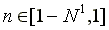 . Note that if q1 = q2
all residents are indifferent between the two cities. Equilibrium
in the housing market requires
. Note that if q1 = q2
all residents are indifferent between the two cities. Equilibrium
in the housing market requires
 (3)
(3)
where 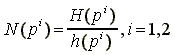 and
and is
the supply of housing in city i with
is
the supply of housing in city i with  >
0. Finally, if there are differences in the quality between the
two cities then it must be the case that
>
0. Finally, if there are differences in the quality between the
two cities then it must be the case that
N1= N(p1), (4)
where N(p1) of the population with the strongest taste for quality live in city 1.
3.2 Determination of Housing Prices with Head
Taxation
We first consider how balanced budget changes in the public service and tax rate affect housing prices when quality is the same (q1=q2=0 or q1=q2=1) in both cities. In this case individuals are not sorted among the two cities by their preference for quality. Since both cities are assumed to have the same housing production function and government objective, we are interested in the price changes in a symmetric equilibrium when T1 = T2 and therefore p1 = p2. Then totally differentiating (1) - (3) with respect to T1 gives
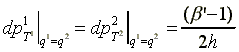 , (5)
, (5)
where  denotes
 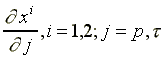 and the superscripts on , , and p are suppressed since we are
considering a symmetric equilibrium. Note that
and the superscripts on , , and p are suppressed since we are
considering a symmetric equilibrium. Note that 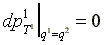 when
' = 1, the first-best level of public service.
when
' = 1, the first-best level of public service.
We now consider the impact of a balanced-budget increase
in T1 on housing prices when
the two cities have different qualities of public
services but the same housing prices and popula-
tions, p1 = p2 and N1
= N2. For these conditions to be satisfied, we assume
an additional head tax of  is assessed.
Our purpose in maintaining this symmetry with differentiation
is so that we can easily compare tax policies with and without
differentiation. When q1 = 1 and q2 = 0
is assessed.
Our purpose in maintaining this symmetry with differentiation
is so that we can easily compare tax policies with and without
differentiation. When q1 = 1 and q2 = 0
we have to also consider the equilibrium condition,
(4), the distribution of individuals according to
their taste for quality. Then differentiating (1)
- (4) gives
 . (6)
. (6)
where < 0 and > 0 are the price elasticities
of demand for and supply of housing. Note that again 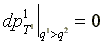 when
' = 1.
when
' = 1.
3.3 Property Value Maximization with Head Taxation
Following numerous other studies, we assume each city's objective is to maximize the value of property (land) in the city, or, in our framework, to maximize the price of housing. While with a small number of localities, this objective is not equivalent to maximizing utility for land-owning residents, it enables us to illustrate how quality differentiation affects government policies in a relatively direct and interpretable way. We discuss discuss the impacts of quality differentiation with alternative objectives in Section 5.
The first order condition for maximizing the price of housing is simply
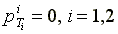 .
(7)
.
(7)
Comparing the balanced-budget impact of the head tax on the price of housing without quality differences (5) and with quality differences (6) allows us to make some statements regarding housing prices and government policies when cities use head taxes.
For notational convenience, hereafter let  denote
the price of housing in each city when both provide education
of the same quality (either high or low). Similarly, if they
provide education of different quality, denote the price of housing
by
denote
the price of housing in each city when both provide education
of the same quality (either high or low). Similarly, if they
provide education of different quality, denote the price of housing
by  in the city with high quality and
 in the city with low quality.
Proposition 1: When the cities use head taxes to finance education, product differentiation in educational quality necessarily results in a higher price of housing in one city, but a lower price of housing in the other. In particular:
 then
then
 <
<  <
< ;
;
 then
then
 >
>  >
>  ;
;
 then
then  =
=  =
=  .
.
Proof. Let TH and TL denote the tax rates in the high and low quality cities. Then since T1=T2, in equilibrium we must have
 (2')
(2')
as well as (3) and (4) satisfied. For these conditions
to be satisfied when > (part
a), we must have
(part
a), we must have  . Further, to maintain
equilibrium in housing market it has to be the case that
. Further, to maintain
equilibrium in housing market it has to be the case that
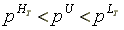 . Part b follows analogously.
Figure 1 provides a graphical interpretation of Proposition 1. In Figure 1 the equilibrium conditions, the equal utility condition (2) and clearance in the housing market (3), are depicted. Equilibrium with no quality differentiation is given by pU, the price (for both cities) that satisfies both (2) and (3). The locus of prices that give equilibrium in the housing market, (3), is unaffected by the quality differentiation. However, quality differentiation will change the locus of
prices that give equal utility condition ( refer to the price locus that supports equal utility without quality
differentiation (U) and with it (D)). If <
refer to the price locus that supports equal utility without quality
differentiation (U) and with it (D)). If < the equal utility frontier shifts to the northwest, while
if >
the equal utility frontier shifts to the northwest, while
if > it shifts to the southeast.
Then as the figure clearly shows with <
it shifts to the southeast.
Then as the figure clearly shows with <  ,
we have pH> pU and pL <
pU. But when >
,
we have pH> pU and pL <
pU. But when > ,
we have pH< pU and pL >
pU.
,
we have pH< pU and pL >
pU.
3.4 Quality Adoption with Head Taxation
Under the assumption of property value maximization,
the reduced-form game of quality
adoption can be most easily described by the payoff
matrix below.
| 2 | ||||||||||||||
| High | pU,pU | pH,pL | ||||||||||||
| Low | pL,pH | pU,pUUU | ||||||||||||
The equilibrium result then follows immediately from Proposition 1.
Proposition 2. If education is financed by a head tax, then both cities adopt the same quality of education (there is no product differentiation in educational quality). In particular:
Proof: Formally, let Hi(q1,q2)
be city i's reduced-form payoff (embodying stage two Nash equilibrium
behavior) when city 1 adopts quality q1 and city 2
adopts q2. Then under the assumption of property value
maximization, as shown in the matrix above these payoffs are:
Hi(1,1) = Hi(0,0) = for
i=1,2; H1(1,0) = H2(0,1) =
for
i=1,2; H1(1,0) = H2(0,1) = ;
and H1(0,1) = H2(1,0) =
;
and H1(0,1) = H2(1,0) =  .
.
If >/2, then H1(0,1) > H1(1,1) and
H1(0,0) > H1(1,0) from Proposition
1, which implies that q1 = 0 is a strongly dominant
strategy for city 1 in the reduced-form game. By symmetry, q2
= 0 is a strongly dominant strategy for city 2 as well. Hence,
(q1,q2) = (0,0) is the unique Nash equilibrium
of the reduced-form game, and so both provide low quality in the
unique subgame perfect equilibrium. Similarly, if < /2, then
H1(1,0) > H1(0,0) and H1(1,1)
> H1(0,1) from Proposition 1, which implies
that q1 = 1 is a strongly dominant strategy for city
1 in the reduced form game. By symmetry, q2 = 1 is
also a strongly dominant strategy for city 2. Hence, (q1,q2)
= (1,1) is the unique Nash equilibrium of the reduced-form game.
Finally, for the sake of completeness, we note that anything
can be a Nash equilibrium of the reduced-form game in the "razor's-edge"
case where = /2, because Hi(q1,q2)
= for all (q1,q2)
and all i.
for all (q1,q2)
and all i.
With head taxation, the efficient level of the public good will be provided in stage two, whatever the level of quality chosen in stage one. The same is true of the choice of quality. Both cities provide low quality when the cost of quality is high, > /2, and high quality when the cost of quality is low, < /2.
4. Provision of Education with Property Taxation
We now replicate the analysis of the preceding section for the case where education is financed by property taxation. As expected, the level of education does not maximize property values in the economy when the property tax is used. However, we shall also show that this reduction in the value of land can be, and is in equilibrium, mitigated by quality differentiation in education.
4.1 Market Clearing Conditions in Stage Two with Property Taxation
With a property tax, city i's budget constraint is
 , i = 1, 2. (8)
Again, equilibrium also requires one individual be indifferent between the two jurisdictions or
 (9)
(9)
and clearing in the housing market, or
 (10)
(10)
where the population of city i, N(pi,i), i=1, 2 is a function of the property tax rate since the property tax affects the housing purchased by a resident. Again, if there are differences in the quality between the two cities, with q1= 1 and q2= 0, then it must be the case that
N1 = N(p1,1). (11)
4.2 Determination of Housing Prices with Property Taxation
As with head taxation, we first consider how balanced budget changes in the public service and tax rate impact housing prices when quality is the same in both cities. Again, individuals are not sorted among the two cities by their preference for quality. Since the equilibrium we consider is a Nash equilibrium in tax rates, we also are assuming that as a result of changes in the tax/service mix in city 1, city 2 alters its level of public service in response and not its tax rate. Again, we focus on a symmetric equilibrium. Then differentiating (8) - (10) with respect to 1 when q1 = q2 = 0 gives
 . (12)
The first term of (12) can be considered the effect on housing
prices that arises from the mobility
of capital and residents. An increase in the tax rate due to
this effect can increase or decrease housing prices depending
on whether 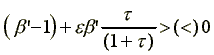 as (1+) - '(1+) > 0. Intuitively,
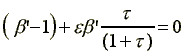 when the level of public service is chosen
to maximize residents' utility and
when the level of public service is chosen
to maximize residents' utility and  --
there is no capitalization. The second term of (12) is always
nega-
--
there is no capitalization. The second term of (12) is always
nega-
tive. This is the effect of increasing the tax rate independent
of mobility and is due to the reduction in housing demand brought
about by the increase in the tax rate. More specifically, this
reduction would occur even if both cities raised their tax rates.
Note that unlike the head tax, if ' =1,  .
.
We now consider the impacts of changes in the public service
and tax rate when city 1 has high quality while city 2 has low
quality. Again we assume a head tax  to ensure equal prices and populations with quality differentiation.
As with the head tax anyone with
to ensure equal prices and populations with quality differentiation.
As with the head tax anyone with  will
reside in city 1 while anyone with
will
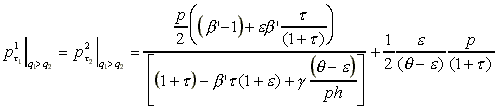
reside in city 1 while anyone with  resides in city 2. Totally differentiating (8)-(11) gives
 (13)
(13)
Inspect of (13) suggests that quality differences reduce the mobility of individuals among the two cities thereby decreasing the magnitude of the price changes that occur as a result of changes in tax and public service policies. More formally, we have:
Proposition 3: If  .
.
This proposition follows from comparing (12) and (13).
4.3 Property Value Maximization with Property Taxation
Consistent with our derivation of  , we
consider property value maximization in a Nash equilibrium in
tax rates. We assume that while the city uses the property tax
to finance the public service it uses a head tax to finance quality.
This assumption does not change our qualitative results and keeps
our analysis tractable. Then the property value maximizing tax
rate for city i must satisfy
, we
consider property value maximization in a Nash equilibrium in
tax rates. We assume that while the city uses the property tax
to finance the public service it uses a head tax to finance quality.
This assumption does not change our qualitative results and keeps
our analysis tractable. Then the property value maximizing tax
rate for city i must satisfy
 . (14)
Let the tax rate that satisfies (14) for both cities when q1
= q2 = 0 be denoted by  and
the associated price of housing by
and
the associated price of housing by  .
Using (12) it is relatively easy to show that ' > 1 - the public
service is underprovided. Before considering the policies chosen
when quality is different in the two cities, we first present
a proposition to help understand our later results.
.
Using (12) it is relatively easy to show that ' > 1 - the public
service is underprovided. Before considering the policies chosen
when quality is different in the two cities, we first present
a proposition to help understand our later results.
Proposition 4. Let q1 = q2 = 0 or q1 = q2 = 1 and 1 = 2 = U, the property-value maximizing rate with no quality differences. Then a balanced-budget decrease in the property tax in both cities will increase the price of housing in both cities.
Proof. Proposition 4 can be seen immediately by inspection of (3), equilibrium in the housing market. The competition among the two city leads to higher tax rate and public service level than they would have if there were a single city (which would choose = 0). Then reducing competition should decrease taxes.
We now can compare the tax rates chosen in the equilibrium without
quality differences to those chosen with differences. Since at
U it must be the case that  for
for  by Proposition 3 it follows
that
by Proposition 3 it follows
that
 <0, i = 1,2. (15)
When the two cities have different levels of quality it is the
case that  is above the property value-maximizing
rate for both cities. Let the superscripts H and L denote the
equilibrium tax rates with high and low quality. Then with well-behaved
reaction functions we have the following result.
is above the property value-maximizing
rate for both cities. Let the superscripts H and L denote the
equilibrium tax rates with high and low quality. Then with well-behaved
reaction functions we have the following result.
Proposition 5.  .
.
Both cities will set lower tax rates if they differ in quality of the public service. In addition to having different tax rates, quality differences will lead to differences in property values in the two cities. These differences are summarized next.
Proposition 6. Assume the cities use property taxes to finance education. If the marginal cost of quality is either high enough or low enough, product differentiation in educational quality necessarily results in a higher price of housing in one city, but a lower price of housing in the other. However, for intermediate values of the marginal cost of quality, product differentiation in educational quality can result in a higher price of housing in both cities. In particular, there exist an H > 0 and L > 0 such that:
 + H, then
  ;
;
 < <
< <  +
H then
+
H then  ;
;
 = then
 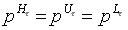 ;
;
 - L < <
  then
then 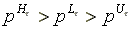 ; and
; and
 - L , then
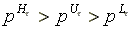 .
.
Proof. That  when >
 follows from the fact that if the
cost of quality is greater than the marginal quality with equal
populations in both cities (
follows from the fact that if the
cost of quality is greater than the marginal quality with equal
populations in both cities ( )
then the city that adopts the quality is at a disadvantage
relative to the city that does not adopt quality. Therefore its
housing prices can not be higher. If <
)
then the city that adopts the quality is at a disadvantage
relative to the city that does not adopt quality. Therefore its
housing prices can not be higher. If <  ,
the reverse is true. The more interesting result is (ii)
which suggests that quality adoption could increase housing prices
in both cities even when >
,
the reverse is true. The more interesting result is (ii)
which suggests that quality adoption could increase housing prices
in both cities even when > . To see
this, consider the case when =
. To see
this, consider the case when = . In this
case it can easily be shown that in equilibrium the tax rate in
the high and low quality cities are the same, H = L
< U which implies that
. In this
case it can easily be shown that in equilibrium the tax rate in
the high and low quality cities are the same, H = L
< U which implies that  .
Now suppose we have a change in , , from =
.
Now suppose we have a change in , , from =  to =
to =  + H or =H.
Then, as discussed earlier,
+ H or =H.
Then, as discussed earlier,  . Further
assume there exists some k
. Further
assume there exists some k
such that H < k and there also exists some c such
that NH >c. Then since is small
we can use (4) to obtain the following first-order approximation
for the p:
 (16)
(16)
Since H can be arbitrarily small we can have  also arbitrarily small so that
  (=
(= +H)
=
+H)
= (=
(= )-
)- >
> .
An analogous argument would apply to part (iv) of the
proposition.
.
An analogous argument would apply to part (iv) of the
proposition.
Figure 2 provides a graphical depiction of Proposition
6. In Figure 2, analogous to Figure 1 for the
head tax, the equal utility condition (9) and clearance in the
housing market (10) are depicted. The equilibrium prices without
differentiation are pU. With the property tax, quality
differentiation will decrease the tax rates in the two cities
(Proposition 5). Since the housing market clearing, N1
+ N2 = 1, is equal to 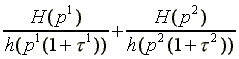 =1,
a reduction in the cities' tax rates will shift the locus of prices
that support clearing in the housing market to the northeast.
If
=1,
a reduction in the cities' tax rates will shift the locus of prices
that support clearing in the housing market to the northeast.
If  the locus of prices that support
the equal utility condition is unchanged. Then from Figure
2 it is clear that housing prices in both cities increase
as a result of differentiation when
the locus of prices that support
the equal utility condition is unchanged. Then from Figure
2 it is clear that housing prices in both cities increase
as a result of differentiation when  .
Figure 2 also illustrates the conditions that determine
H and L.
.
Figure 2 also illustrates the conditions that determine
H and L.
4.4 Quality Adoption with Property Taxation
The payoff matrix for the reduced-form game with property taxation is also described by the payoff matrix in Section 3.4 above. The difference is that now the relationships between the property values in the various subgames are given by Proposition 6. The equilibrium result then follows immediately.
Proposition 7. If education is financed by a property tax, then both cities adopt the same quality if its marginal cost is either high or low enough. However, for intermediate values of the marginal cost of quality, the cities adopt different qualities of education. In particular:
Proof. Formally define the payoffs to the reduced-form
game with property taxation as Pi(1,1) = Pi(0,0)= for each i, P1(1,0) = P2(0,1) =
 ,
and P1(0,1) = P2(1,0)=
,
and P1(0,1) = P2(1,0)=  .
.
If > /2 + H, then P1(0,0) > P1(1,0) and P1(0,1) > P1(1,1) from Proposition 5, which implies that q1 = 0 is a strongly dominant strategy for city 1 in the reduced-form game. By symmetry, q2 = 0 is also a strongly dominant strategy for city 2. Hence, (q1,q2) = (0,0) is the unique Nash equilibrium of the reduced-form game.
If /2 - L< </2 + H, then from Proposition
5, P1(0,0) < P1(1,0), P1(0,1)
> P1(1,1), P2(0,0) < P2(0,1),
and P2(1,0) > P2(1,1). It therefore
follows that (q1,q2) = (1,0) and (q1,q2)
= (0,1) are the only Nash equilibria of the reduced-form in pure
strategies. However, in this case there is also a mixed strategy
equilibrium in which each city chooses high quality with probability
H= ( -
- )/(
)/( -
- +
+ -
- ).
).
Finally, if < /2 - L, then P1(1,0) > P1(0,0), P1(1,1) > P1(0,1), P2(0,1) > P2(0,0), and P2(1,1) > P2(1,0). Thus, qi = 1 is a strongly dominant strategy for each i, which implies the Nash equilibrium of the reduced-form game is unique and has both cities adopting high quality, (q1,q2) = (1,1).
Therefore, subgame perfect adoption of quality may be very different
with property taxation in that it can result in product differentiation
in educational quality. For example, suppose the cost of quality
is just below the median utility from quality, /2 - L
< < /2. Then one city adopts high quality and the other
adopts low quality, despite the fact that both would adopt high
quality under head taxation. The reason is that  >
> >
> for these costs, so property values are higher in both
cities if they provide education of different quality than if
they both provide high quality education. The reduced-form game
of quality adoption in this case is essentially the same as the
well-known game of "Chicken." This game has two Nash
equilibria. In each of them one player "chickens out"
(adopts low quality) and the other does not chicken out (adopts
high quality), and the player who does not chicken out earns a
higher payoff (
for these costs, so property values are higher in both
cities if they provide education of different quality than if
they both provide high quality education. The reduced-form game
of quality adoption in this case is essentially the same as the
well-known game of "Chicken." This game has two Nash
equilibria. In each of them one player "chickens out"
(adopts low quality) and the other does not chicken out (adopts
high quality), and the player who does not chicken out earns a
higher payoff ( >
> ).
However, the player that chickens out still earns a higher payoff
than if it also had not chickened out (
).
However, the player that chickens out still earns a higher payoff
than if it also had not chickened out ( >
> ). This game-theoretic analysis
cannot, of course, predict which city actually adopts high quality
education. Nevertheless, it does predict that the cities provide
education of different quality (just as it predicts that the equilibrium
outcome of the game of chicken cannot be that neither player chickens
out).
). This game-theoretic analysis
cannot, of course, predict which city actually adopts high quality
education. Nevertheless, it does predict that the cities provide
education of different quality (just as it predicts that the equilibrium
outcome of the game of chicken cannot be that neither player chickens
out).
When the cost of quality is low, it is not surprising that quality differentiation results in a higher property value in the city with the high quality public good. What is surprising is that it also results in a higher property value in the city with low quality education. Clearly, the cities can diminish the distorting effects of property taxation on property values by differentiating their products.
Similarly, under property taxation cities adopt education of
different quality when the cost of quality is just above the median
utility from quality, /2 + H > > /2, despite
the fact that both would adopt low quality under head taxation.
Again, for these costs, property values are higher in both cities
if they provide education of different qualities than if they
both provide low equality. The only difference is that now  >
> >
> , so
property value is higher in the city that adopts low quality than
the one that adopts high quality, which is not unexpected because
these costs are higher than the median utility from quality.
In fact, the analogy to the game of Chicken still applies, although
now the strategies are chicken out (adopt high quality) and not
chicken out (adopt low quality). Quality differentiation in
education allows the cities to diminish the distortionary effects
of property value taxation.
, so
property value is higher in the city that adopts low quality than
the one that adopts high quality, which is not unexpected because
these costs are higher than the median utility from quality.
In fact, the analogy to the game of Chicken still applies, although
now the strategies are chicken out (adopt high quality) and not
chicken out (adopt low quality). Quality differentiation in
education allows the cities to diminish the distortionary effects
of property value taxation.
It is worthwhile to note that these results are somewhat reminiscent of the results from the industrial organization literature on vertical (quality) product differentiation (see, for example, Shaked and Sutton (1982, 1983)). Briefly, this literature notes that, when firms compete in prices, producing goods of the same quality condemns them to zero profit, whereas they could earn positive profit by producing goods of different quality. Analogously, in those cases above where the cities provide education of different quality, they have higher property values than if they had both provided the same quality.
To give some indication of the extent to which quality differences might occur in our two-stage game with property taxation, we provide a simple numerical example. The additively separable sub-utility function for this example is U(x,h,g) = x + ah + bg. The sub-utility function is parameterized so that for an efficient allocation, 25% of spending is on housing and 10% of spending is on the public service, g. Income is normalized to 100 and the model is calibrated so that the price of housing, p, equals unity with a head tax. The elasticity of supply for housing is .5 in all specifications and the parameter b=31.54 and = .2 in all specifications. We consider two alternative specifications for the elasticity of demand for housing, one of which gives = -1.25 and on that gives = -2.
The results of these numerical simulations are found in Table 1. In addition to considering two alternative demand elasticities for housing we also consider different magnitudes of the taste for quality, = 10 and = 5. For each specification of (,) we report simulation results for the case in which both localities have the same quality and both have different qualities with = /2. In addition, we solve for H and L and report the results for these two cases as well. In all four alternative specifications we find, as predicted, that having quality differences when = /2 will indeed increase property values in both cities. This increase in property values is due to the reduction in property taxes that occurs with quality differences. The reduction in property taxes ranges from 3% ( = -1.25 and = 5) to 14.7% (=-2 and = 10). The increase in property values is more modest, ranging from 0.4% to 1.6%.
What may be the most informative and useful result of the numerical example is a indication of the range [/2-L, /2-H] in which it is possible to obtain quality differences. To get an indication of the magnitude of this range we report H (or L since they are equal in all specifications) as a percentage of /2, the utility from high quality for the median household. This range, as a percentage of /2 , varies from 24% (12% on both sides of /2) when (,)= (-1.25,5) to 52% when (,) = (-2,10). One way to interpret this range is context of the distribution of tastes among the households. For example, if (,) =(-2,5), for quality differences to exist the range for must be such that no more than 60% of the population would gain from high quality (.4 < ) and no more than 40% would lose (.6> ). While, logically, quality differences among the cities do not occur with everyone having the same preference for high versus low quality, they can occur even if a significant majority (60% in this case) prefer one level of quality to another. Quality differences in education do not, by any means, require households being evenly divided between those who want higher quality and those who do not want it.
5. Extensions and Policy Implications
Beginning with Tiebout (1956), numerous studies have argued that we should expect to see differences in public services among localities as a result of people "voting with their feet" and selecting the locality that has the most desirable mix of services for them. Here, we consider differentiating in public services across localities that arises in part for a different reason, as a way of reducing competition among these localities. If cities finance their public services through a tax such as the property tax that generates "tax competition", we find that adoption of quality differences in public services will change the amount of services provided. In the case of property value maximization, this means a reduction in the level of public services provided for both the city that provides high quality as well as with low quality. The reduction in public services in both cities means that under certain conditions property values in both cities can increase. Thus in a two-stage game of adoption, we can observe quality differentiation in the services when the property tax is used. This is in sharp contrast to the case with a nondistorting head tax in which we should never observe this type of differentiation.
We have examined quality differentiation in education within the context of property-value maximizing governments. This case was chosen both because of the frequent use of property-value maximization as a determinant of local government policies and because the analysis was straightforward. However, if the objective of the government is to maximize the utility of land-owning residents or government revenues, quality differences may still exist if the property tax is used. Under both of these objectives, however, quality differentiation, by reducing competition, increases property taxes. Because of this increase in taxes it is possible, as it was with property-value maximization, for both cities to be better off. Thus while the observed relationship between quality differentiation and the level of property taxation is reversed from the case with property-value maximization, quality differentiation still increases the value of the government objective.
In the past twenty-five years the role of state governments in primary and secondary education has increased dramatically. One way in which state governments have intervened in primary and secondary education is through the imposition of tax limits such as Proposition 13 in California and Proposition 2½ in Massachusetts. Another way is through "fiscal equalization" plans that increase the amount of financing of education that comes from the state government. While the motivation for the tax limits may have primarily been taxpayer resentment and dislike of property taxes, certainly legislation (and court decisions) related to fiscal equalization legislation has been motivated by the desire to reduce "inequities" in education. While the primary focus of this legislation has been to equalize the quality of education between high and low income (and tax base) districts, this legislation and tax limits may also be responsible for reducing quality differences among districts with similar incomes and tax bases. The greater the extent that state funding replaces local funding, the less reliance there is on the property taxation. Then adverse impacts of "tax competition" should also be reduced, thereby reducing the gains to differentiating quality. Thus we might expect that even among districts with very similar income distributions and tax bases, that fiscal equalization will reduce quality differentiation.
A similar argument applies to the enactment of tax limits when governments are setting policies to increase property values. In this case, the limit places a tax ceiling that means that cities can not raise educational spending (and taxes) in an attempt to attract residents and increase property values. The tax limit eliminates competition among localities that leads to overspending relative to the property-maximizing level. Then because the tax limit can effectively eliminate tax competition, there is no reason for districts to differentiate quality to do so.
One interesting implication of our results that we have not discussed is that quality differentiation does not occur in some cases in which it would be socially beneficial for there to be both a high and low quality provider of the public service. Perhaps even more interesting is the fact that this socially beneficial differentiation will never occur when a head tax is used and the socially efficient level of public services is provided but may occur when the distorting property tax is used.
A modification of our model would be to consider the impacts of quality differences when the differentiation in horizontal rather than vertical. In terms of public education, this would mean that the education was not high or low quality in districts, but simply "different" with some residents prefer one type of quality while others prefer another type. We believe that our results on the impact of differentiation on the level of public services should be robust to this modification but the implications for quality adoption might be far different, with differentiation more likely to occur in this setting.
References
Brennan, Geoffrey H. and James M. Buchanan. (1980)
The Power to Tax: Analytical Foundations of a Fiscal Constitution,
Cambridge, Cambridge University Press.
Burbidge, John B. and Gordon M. Myers. (1994) "Population
Mobility and Tax Competition," Regional Science and Urban
Economics, 24: 441-459.
Brueckner, Jan K. (1982) "Property Values,
Local Public Expenditure, and Economic Efficiency," Journal
of Public Economics, 11: 223-245.
_______________ (1982) "A Test for Allocative
Efficiency in the Public Sector," Journal of Public Economics,
19: 331-331.
Bucovetsky, Sam and John D. Wilson. (1991) "Tax
Competition with Two Tax Instruments," Regional Science
and Urban Economics, 21: 333-350.
Edwards, Jeremy and Michael Keen. (1996) "Tax
Competition and Leviathan," European Economic Review,
40:113-134.
Epple, Dennis and Alan Zelenitz. (1981) "The
Implications of Competition among Cities: Does Tiebout Need
Politics?" Journal of Political Economy, 89: 1197-1217.
Henderson, J. Vernon. (1985) "The Tiebout
Hypothesis: Bring back the Entrepeneurs," Journal of
Political Economy, 93: 248-264.
Hotelling, Harold. (1929) "Stability in Competition,"
Economic Journal, 39:41-57.
Hoyt, William H. (1991) "Competitive Cities,
Congestion, and the Henry George Theorem," Regional Science
and Urban Economics, 21, 351-370.
_______________. (1992) "Market Power of Large
Cities and Policy Differences in Metropolitan Areas," Regional
Science and Urban Economics, 22, 539-558.
_______________. (1993) "Tax Competition,
Nash Equilibria, and Residential Mobility," Journal of
Urban Economics, 24: 358-379.
Jensen, Richard and Eugenia F. Toma. (1991) "Debt
in a Model of Tax Competition," Regional Science and Urban
Economics, 21: 371-392.
Krelove, Russell. (1993) "The Persistence
and Inefficiency of Property Tax Finance of Local Public Expenditures,"
Journal of Public Economics, 51: 415-435.
Myers, Gordon M. (1990) "Optimality, Free Mobility,
and the Regional Authority in a Federation," Journal of
Public Economics, 43: 107-121,
________________ and John B. Burbidge. (1994) "Population
Mobility and Capital Tax Competition," Regional Science
and Urban Economics, 24: 441-459.
Oates, Wallace E. (1969) "The Effects of Property
Taxes and Local Public Spending on Property Values: An Empirical
Study of Tax Capitalization and the Tiebout Hypothesis,"
Journal of Political Economy, 77: 957-971.
_______________. (1972) Fiscal Federalism,
Harcourt, Brace, Jovanovich, New York.
Shaked, Avner and John Sutton. (1982) "Relaxing
Price Competition Through Product Differentiation," Review
of Economic Studies, 49: 3-13.
_______________. (1983) "Natural Oligopolies,"
Econometrica, 51: 1469-1483.
Sonstelie, Jon C. and Paul R. Portney. (1978) "Profit
Maximizing Communities and the Theory of Local Public Expenditures,"
Journal of Urban Economics, 5: 263-277.
Tiebout, Charles M. (1956) "A Pure Theory
of Local Public Expenditures," Journal of Political Economy,
64: 416-424.
Wellisch, Dietmar. (1994) "Interregional Spillovers
in the Presence of Perfect and Imperfect Household Mobility,"
Journal of Public Economics, 55: 167-184.
Wildasin, David E. (1989) "Interjurisdictional
Capital Mobility: Fiscal Externality and a Corrective Subsidy,"
Journal of Urban Economics, 25: 193-212.
________________. and John D. Wilson. (1996) "Imperfect
Mobility and Local Government Behaviour in an Overlapping-Generations
Model," Journal of Public Economics 60: 177-198.
Wilson, John D. (1985) "A Theory of Interregional
Tax Competition" Journal of Urban Economics, 19:
296-315.
______________. (1995) "Mobile Labor, Multiple
Tax Instruments, and Tax Competition," Journal of Urban
Economics, 38: 333-356.
Zodrow, George R and Paul Mieszkowski. (1989) "Pigou, Tiebout, Property Taxation, and the Underprovision of Local Public Goods," Journal of Urban Economics, 19: 356-370.
Notes Figure
1: Equilibrium with the Head Tax
|
| ||||||||
|
|  |
|
|
| ||||
| Same Quality | ||||||||
| =/2 | ||||||||
| =/2+H | 12(%) | |||||||
 |
=/2+L | -12 | ||||||
| Same Quality | ||||||||
| =/2 | ||||||||
| =/2+H | 16 | |||||||
| =/2+L | -16 | |||||||
| Same Quality | ||||||||
| =/2 | ||||||||
| =/2+H | 20 | |||||||
 |
=/2+L | -20 | ||||||
| Same Quality | ||||||||
| =/2 | ||||||||
| =/2+H | 26 | |||||||
| =/2+L | -26 | |||||||
| 1. Simulations were based on the utility function U=x + ah + bg where b = 31.54 and = .2. The parameters a and vary to adjust for the price elasticity of housing. | ||||||||