Abstract:
Charities publicize the amounts donors give to them, generally
according to dollar categories rather than the exact amount.
Donors in turn tend to give the minimum amount necessary to get
into a category. These facts suggest that donors have a taste
for having their donations made public. This paper models the
effects of such a taste for "prestige", in combination
with a purely internal taste for giving, or "warm glow",
on the behavior of donors and charities. I show how charities
can increase donations by using categories. The paper also shows
conditions under which tithing, or reporting donations as percentages
of income, can maximize donations. Last, the effect of a taste
for prestige on competition between charities for donations is
examined.
Acknowledgements:
I would like to thank Kate Krause, Doug Young, Wayne Harbaugh, Jim Andreoni, Arik Levinson, and Larry Samuelson. This research was supported by a Bullis Dissertation Fellowship at the University of Wisconsin - Madison.
What Do Gifts Buy? A Model of Philanthropy and
Tithing Based on Prestige and Warm
Glow.
1. Introduction.
I begin with some observations about the behavior of charities and donors which the model presented in this paper is designed to explain. First, many charities publicize the donations they receive. Cultural charities and colleges are familiar examples, typically listing the names of donors in performance programs or alumni giving reports. The donations are almost always reported using categories. Donors are told that all donations between, say, $500 and $999 will make them a "Patron", and the charity then reports the names of these Patrons. Donations from $1,000 to $2,499 make the giver a "Benefactor", and so on. The dollar amounts of the brackets bounding the categories are quite explicit and public, either printed directly above the list of names or at the front of the report. Alternative ways of recognizing donors, such as reporting the exact amount of a donation, or just reporting the fact that the donor gave something, are relatively rare.
Donors respond to these recognition categories by giving more. One piece of evidence for this is that they are so widespread. Another is that "how to" books on fundraising specifically recommend these plans as devices for increasing donations.
Sometimes charities solicit and report donations as percentages of income rather than as dollar amounts. Many churches recommend "tithing" of this sort. Local United Way groups often also ask for donations as percentages of incomes, and sometimes make donations of a certain percentage a condition for certain types of recognition.
Charities often distributing rewards to those who donate certain amounts. These generally give public evidence about the fact that the donor gave to a certain charity. Coffee cups and tote-bags printed with the charity's name are obvious examples. University buildings and named chairs are similar phenomena, for somewhat larger donations.
Another fact is that donors tend to give exactly the minimum amounts
necessary to get into a certain category. This tendency can be
quite extreme, as shown in Figure 1, which gives the distribution
of alumni donations to a prestigious law school. The dollar amounts
on the horizontal axis show the minimum donations needed to be
recognized as a certain category of donor. For this charity,
64 percent of all donations are made at one of these 8 minimum
levels. Other charities report that their donors behave similarly.
Greenfield (1994) states AInquiries
about the amount required to add a name to a donor recognition
display are usually followed by new gifts of just these amounts.@
Before reviewing the economic literature on charitable giving, which has generally not addressed the above facts, I will mention some ideas from other disciplines. George Bernard Shaw argued in 1896 that
"...a millionaire does not really care whether his money does good or not, provided he finds his conscience eased and his social status improved by giving it away..."
Anthropologists have used variations on the social status effect to explain giving in many cultures, while psychologists have argued for the importance of an internal effect along the lines of conscience. Literature written by and for practicing fundraisers simply assumes that both these effects exist and then proceeds directly to the matter of how to use them to best advantage, with statements such as "Attention to annual donors through recognition and reward should be a proactive part of every nonprofit organization."
In contrast, the modern economic analysis of why people give started with the assumption that they do so out of "pure altruism", or because they get utility from the level of the public good which donations are purchasing. Olson (1965) is an example, which demonstrates that this assumption implies free-riding will result in under-provision of public goods. Andreoni (1988) showed that many of the observable facts about giving could not be explained by pure altruism. In particular, the altruistic model predicts nearly complete crowding out of voluntary contributions by government expenditures, that only the richest will contribute, and that average donations should approach zero. None of these things are commonly observed.
An alternative model, where people give because the act of giving itself brings the donor benefits, was probably given its first formal economic expression in Becker (1974). Andreoni (1989) showed that a model where giving provided a "warm glow" to givers could explain facts about giving, such as wide participation across income levels, that the pure altruism model could not. Hollander (1990) developed a model where people behave altruistically because doing so brings them valued social approval, which in turn depends on the difference between their own donations and average donations.
The model in this paper explicitly separates the motivation for giving into both the effects Shaw mentions, and addresses the behavior of both donors and charities. Both these appear to be new to the theoretical literature. Empirically, Kiesling (1994) discusses the two effects and develops estimates of their effects based on public listings of donations to poor relief in England in the 1860's, while YoungDay (1978) appears to be the first to suggest the possibility of isolating a social status effect, by looking at anonymous responses to mail solicitations.
In this paper I use the term "warm glow" to refer to the first effect, a purely internal satisfaction that comes from the act of giving. I use "prestige" to mean the utility that comes from having the amount of a donation publicly known. Prestige could be valuable to individuals because it directly enters their utility, or because being known as a donor increases income or business opportunities. Giving could do this by serving as a signal of wealth or reliability. Any of these interpretations would be basically consistent with the model I develop.
The distinction between these two reasons for giving seems intrinsically interesting. It is also important because it allows for a formal model of the interaction between the charity and the donor. While warm glow is obtained through the act of giving, and is therefore largely outside the charity's control, prestige is acquired when the charity actually reports the amount of the donation. If donors are motivated by a prestige effect, charities may have an incentive to manipulate their reports about who gave what so as to increase donations. Charities play a natural role in issuing these reports: if prestige is important self-reported claims about donations will naturally be suspect. (In addition the charity may be the most efficient distributor of reports because of economies of scale.) Making the donations public is the most obvious form such manipulation can take. Another form is reporting donations by categories, rather than by the exact amount of the donation, as discussed above. In this paper I assume that charities set reporting plans that maximize donations. Modeling the response of donors to these reporting plans and the donation maximizing plans given that response, will provide testable implications that do not follow from the existing models.
Most of the analysis of giving has been done on contributions toward the purchase of public goods. Since even small populations are large enough to reduce the effect of a person's donation on their consumption of the public good to a negligible level, I assume that donors ignore the effect that their donations have on the quantity of the good. It is also possible that donors derive no utility from the good at all, but merely donate because they get utility from the warm glow and the prestige. The model I will develop is therefore more general than other models of voluntary provision of public goods, in that it can explain why, say, a tone-deaf businessman might make contributions to an opera which he has no intention of ever attending. On the other hand it is less general in that the free-riding result relies on the assumption of many donors. This model would have difficulty explaining, say, the case of children providing support to their parents, unless it were modified to include the level of the public good in utility.
Last, throughout this paper I maintain the assumption that warm glow and prestige are not functions of how much others donate. An alternative model would allow glow and prestige to be functions of one individual's donation relative to the average donation.
Section 2 of this paper begins with a solution to the donor's
problem, given tastes for a private good, warm glow, and prestige.
Section 3 models the behavior of a single charity soliciting
donations from heterogenous donors. The charity knows the distribution
of preferences and incomes, but does not know these for any particular
donor. The characteristics of optimal category plans are derived,
showing that the charity can get more donations by using a category
plan than by reporting the exact amount of donations. I compare
the characteristics of these optimal plans with some actual practices
of charities. Section 4 models tithing, or reporting donations
in terms of fractions of income. In this section I assume the
charity does know the income of particular donors, but again knows
only the distribution of preferences. The conclusion discusses
some possible extensions of this work, including a method for
estimating the relative importance of the prestige and warm glow
effects, and discusses the implications of relaxing the single
charity assumption maintained in section 3.
2. A Model of the Donor.
In this section I solve the optimization problem for the donor
under three different reporting plans, and develop some results
that will be used later in the paper, when modeling the charity's
behavior.
2.1. The Donor's Problem.
The donor has the utility function U = U(x,p,d), where
x is the private good, p is prestige, and d is
actual donations. The amount of warm glow is assumed to be equal
to the amount of donations. Prestige is supplied by the charity,
in a manner to be explained below. The donor faces the budget
constraint w = x + d, setting both prices to 1. Substituting
this into utility gives U = U(w-d,p,d) or U = V(p,d;w).
Solving this for a given level of utility and w gives
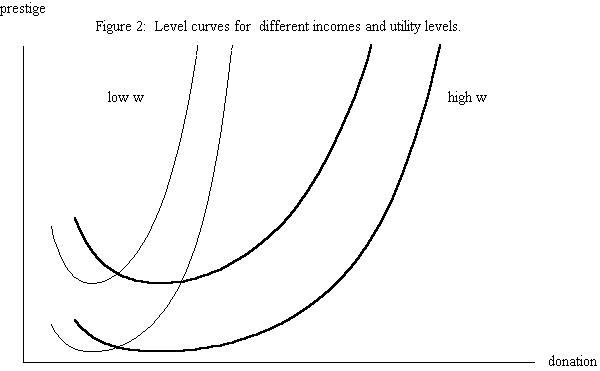
level curves in d, p space. These curves can be
thought of as projections of the intersection between the 3 dimensional
indifference surface in x,p,d space and the
budget constraint onto p,d space. Sample level
curves for two incomes and two levels of utility are shown in
Figure 2. Putting these curves into p,d space makes it
possible to visualize the relationships between the amount people
donate and the prestige they receive.
Note that, as with regular indifference curves, utility is constant along these curves, and changes in utility will shift the curves. However, unlike indifference curves the budget constraint must be satisfied along these curves, so they will also shift with changes in w. Further, while increases in p will always move the person to a higher level of utility, increases in d will cause decreases in x, and so will increase or decrease utility according to whether Ud is greater or less than Ux. (Where Ui = MU / MI.)
The following characteristics of these level curves will be useful later in the paper. By the implicit function theorem, the slope of the level curves is given by
By the chain rule,
and since
by assumption, the slope is also
Equation 1 can be thought of as a marginal rate of substitution between the goods d and p, subject to the constraint that changes in d require adjustments to x to satisfy the budget constraint. It is the fact that the budget constraint must be satisfied along these curves that causes them to slope up. Movement along a given level curve can be interpreted as follows. Before the inflection point, d is small and x is large, so Ud is greater than Ux. An increase in d and a decrease in x would raise utility, so p must be decreased to keep utility constant. After the inflection point, Ux is greater than Ud. Further increases in d decrease utility, and so must be balanced by increases in p. Since increases in p always increase utility, level curves to the north represent higher levels of utility.
Last, so long as d is a normal good, an increase in w
will shift the curve and the inflection point out and down in
p,d space. If p is fixed, then we can draw the
higher income person=s
level curve as an outward shift. Note that, while movement to
the right along a given level curve means d is rising and
x falling according to the budget constraint, the shift
to the right discussed here actually is associated with an increase
in both d and x.
2.2. Prestige.
I have discussed how prestige enters the donor's utility, now I explain how donors get prestige. The charity makes a report ri about the size of the ith individual's donation, and "society" then awards prestige according to the function pi = p(ri). In Section 2 I assume this prestige function has the form pi = ri. It is also possible that society considers income in awarding prestige. I will model this situation in Section 3, by assuming
pi = ri / wi. These assumptions are innocuous in some ways, but not in others.
The first assumption made above is that society bases prestige solely on the report made by the charity. It is also possible that society instead forms expectations about the true donation, conditional on the charity's report, the donor's claim, and other pertinent information such as the wealth of the donor, and then awards prestige based on that expectation. Harbaugh (1995) proposes a model with such expectations and an equilibrium where the expectations are correctly realized as an explanation for voting behavior. In this paper I make the assumption above, which greatly simplifies the model. It seems reasonable for the following reasons. First, charities seldom report information, such as mean donations conditional on the different reporting categories, needed to form such expectations. Second, in practice donations do bunch up at the lower bracket, so in fact the mean is close to that bracket. (Although it could also be argued that this would be a natural equilibrium in a model where society actually does form conditional expectations.)
The more obvious assumption made above is about the functional
form of the prestige function. This assumption can be defended
by the following argument. Substituting the prestige function
into utility gives U = U(w,p(r),d). So long as the prestige
function is continuous, monotonic, and not too convex, any particular
functional form for it can be undone in the utility function without
violating the properties of utility functions. Since this model
will be unable to distinguish the effect of the prestige function
from that of the utility function, there is no further restriction
imposed by the assumption that the prestige function is linear.
2.3. Characteristics of the Reporting Plans.
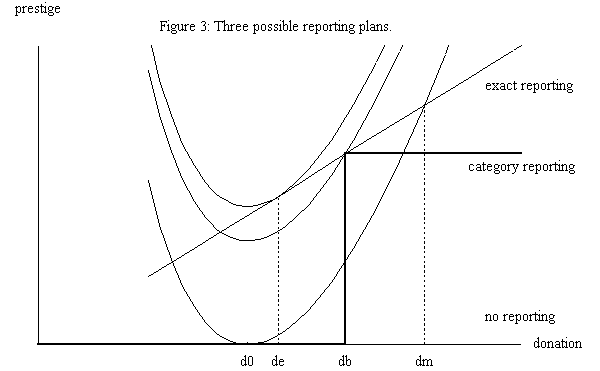
Reporting plans are simply functions relating the report r that the charity makes to the donation d that was given. Society then takes r and converts it to p, which enters the utility function of the donors. This chain of events could also be given as p = p(r(d)), or simply as p = f(d), so the relationship can be shown in d,p space. The three basic plans I consider are shown in Figure 3, which also includes level curves for a single donor with fixed wealth and preferences. In the first plan, no reports are made, and the prestige function is a horizontal line at zero. In the second, charities report the exact amount of the donation, so the prestige function is the 45E line where p = d. In the third plan, the charity sets a category with a minimum amount, or bracket, needed to gain classification into that category. (Later I will examine situations where the charity sets more than one such category.) Those donating less than the amount of the lower bracket of the category get zero prestige, those donating the bracket amount or more get credit for the amount of the category, as shown by the step function in Figure 3.
There is no theoretical reason to limit the charity to these three types of reporting plans. The charity could, for example, offer a point plan, saying "donate d = x and we will report r = y, donate anything else and we will report nothing." It could offer a menu of such points, or offer to report half, or twice the actual amount donated, or any other nonlinear reporting plan. I do not consider these alternatives in this model because of a desire for simplicity, and because I have not found many examples of them in practice. In nearly all the plans I have found charities variously report nothing, report the exact donation, or report using categories. One exception is where very high donations are reported exactly, while smaller donations are reported with categories. I show later in the paper that this can be modeled as individual categories for the high donors. A second possible exception is where the charity reports donations by means that seem intentionally designed to obscure the dollar amount given. Examples are such practices as naming a chair after a large donor, or offering him an honorary degree. I do not consider these in this paper.
Charities may restrict themselves to the three types of reporting
plans I consider for simplicity or because, if the plans are public
knowledge, society will discount reports that they know are exaggerated,
leaving the charity no reason to exaggerate.
2.4. Effects of Reporting Plans on Donors.
Under no reporting, donors will maximize utility by donating where the MRS given in Equation 1 is equal to zero, or where Ux = Ud. I call this amount d0.
Reporting the exact donation, in combination with the assumption that p = r, changes the constraint on the donor from p = 0 to p = d. The donor will now maximize utility at the point where the MRS equals 1, the slope of this new constraint. So the donor will set Ux = Ud + Up. I call this donation de. Since a dollar donated now buys prestige as well as warm glow, donations can be expected to increase, unless the prestige reduces Ud or increases Ux by a lot. In the sections below I assume that MUp/Md and MUx/Md are both zero.
Under category reporting, an individual is in one of four situations with different effects on donations. If the bracket is below d0, donors would get less utility from giving the bracket amount than from donating d0. Even without prestige, the warm glow effect leaves them with higher utility by doing so. The charity receives only as much as it would have without any reporting. If the bracket is above d0 but below or equal to de donors will maximize their utility by giving the bracket amount and receiving credit for it. The charity will receive more than under no reporting, but less than under exact reporting. (Unless the bracket is just equal to de.) If the bracket is above de but below dm, donors give the bracket amount and the charity receives more than under exact reporting. If the bracket is above dm, the charity again receives only d0.
In later sections of this paper I will address the characteristics of a donation maximizing reporting plan with more than one type of donor. For now, notice that exact reporting will always yield more donations than no reporting, and that depending on the category, category reporting can do better, as good as, or worse than exact reporting. If there is only one type of donor, say the type in Figure 3, the charity will maximize donations by setting a bracket at dm. dm is the maximum incentive compatible donation, where all rents from prestige are extracted from the donor and he is left with only the amount of utility he could have got had donations not been reported at all. Of course, the donor is still better off than he would have been without the opportunity of making any donation.
Figure 3 also allows a first look at the possible effect of a
taste for prestige on the quantity of donations. The level curves
shown are derived from the utility function
U = 20 log x + 3 log (p + 1) + 1 log d,
with wealth equal to 1 and the prestige function p = r. Such a person would donate 4.6% of their wealth with no reporting, 5.3% with exact reporting, and 8.5% if the bracket were set at dm, to extract the maximum possible donation. Increases in the marginal utility of prestige will have the effect of flattening these level curves, thereby increasing the effects of prestige and donations. Increases in the marginal utility for the private good and for warm glow will make them steeper.
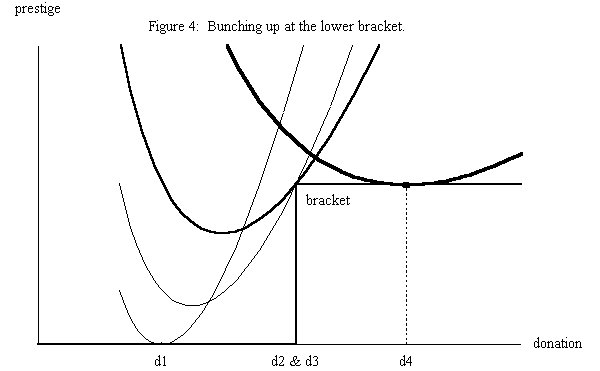
Last, Figure 4 shows that if there are many types of donors, differentiated
by say income, it can be optimal for different types to donate
the bracket amount. This bunching up of donations at the brackets
is typical of the actual pattern of donations, as was shown in
Figure 1. In Figure 4, only the optimal level curves for each
type are shown, with higher income types given thicker curves.
(This convention is generally followed in the remaining diagrams.)
Types 2 and 3 will both donate the bracket amount.
3. Donation Maximizing Reporting Plans.
In this section I develop donation maximizing strategies for a single charity facing a variety of donor types. I assume the charity knows the distribution of types, but not the type of any given donor. I showed in Section 1.4 that, given a reasonable restriction on preferences, exact reporting will increase donations over no reporting. In this section I show that the charity can do better than exact reporting by adopting a category reporting plan.
3.1. Categories Can Beat Exact Reporting
I show that under rather general assumptions the charity will get more donations by using categories than it could by reporting exactly. I again assume that preferences are such that de is greater than d0 for each type, and that there are at least two types, differing in either income or preferences, or both.
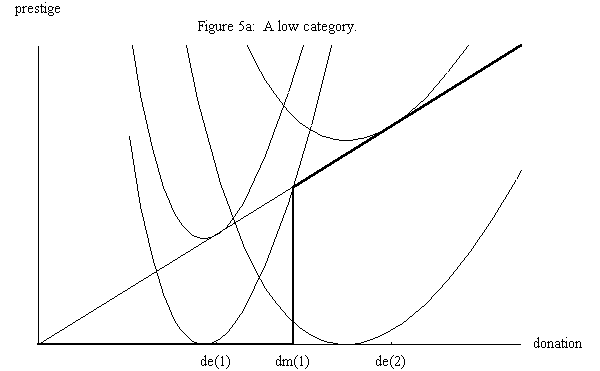
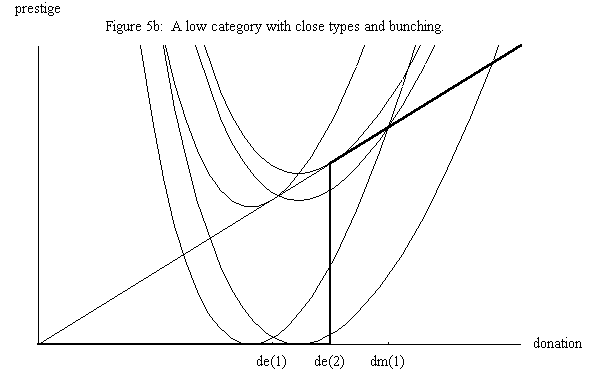
First I show, in Figures 5a and 5b, that the charity can increase donations by setting a category at the bottom of the distribution of gifts. For comparison, suppose that the charity is initially reporting donations exactly. Each type will then donate de(i), where i indexes the types in ascending order according to de, so that type 1 is the type with the lowest de.
For Figure 5a, suppose that there are no types with de's that fall between de(1) and dm(1). By setting a category for gifts bounded by brackets of zero and dm(1), the low type can be induced to give dm(1), rather than the de(1) he gives under exact reporting. (I assume that when indifferent between two options, the donor makes the larger one.) Types above 1 can still get donations of de(i) reported exactly, so their donations will be unchanged, so total donations have increased.
For Figure 5b, suppose that there are types for whom de
is below dm(1). Set the low bracket at zero and the high
at de(2). Type 1 now gets higher utility by donating and
receving credit for de(2) than from donating nothing and
receiving no report. Since by the way types are indexed, de(2)
is greater than de(1), this change is an increase. Types
with de(i) at or above de(2) will continue to have
their donations reported exactly, leaving their donations unchanged,
so this category again increases donations.
These results establish that a category will increase donations above exact reporting, but not that this is the optimal category. In Figure 5a, for example, raising the upper bracket above dm(1), will cause the lowest type to reduce his donation to d0(1), below the exact reporting level, but it may also increase donations from higher types, depending on the particular preferences and distribution of types, and this may increase total donations.
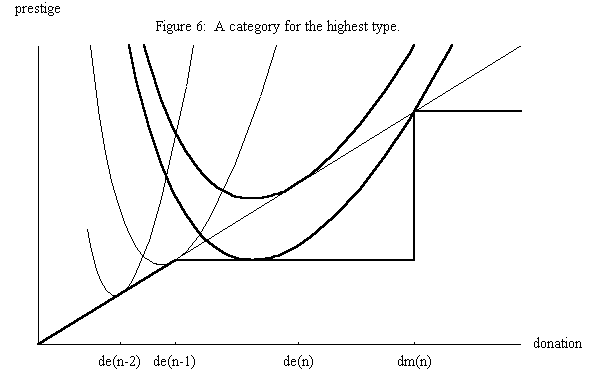
In Figure 6, I show that the charity can always increase donations
above the exact reporting level by setting a category for the
highest type that is above de for that type. Suppose the
charity reports all donations up to type n-1 exactly.
The charity can then set a category with a lower bracket of de(n-1)
and an upper bracket of dm(n). This upper bracket amount
will always be more than de(n), because de(n-1)
is below de(n), by the definition of types. So donations
from type n increase, while donations from the other types
are unchanged, establishing the result. (As with the lower category,
it is possible that the charity could increase donations still
further, this time by lowering the upper bracket and thus inducing
larger numbers of donors to increase their gifts, albeit by smaller
amounts.)
3.2. Optimal Categories under Different Preferences and Distributions of Types.
I have shown above that the charity should use category reporting at the top and bottom of the distribution of gifts. Actual reporting plans typically report all gifts using categories, not just those at the bottom and top. Table 1 gives some simulation results for specific preferences and distributions of types showing that such a strategy can indeed be optimal, and showing how the optimal reporting plan can change as those factors do.
Table 1: Optimal category simulations.
Total donations under | ||||||||||
Income dist'nmean, s. dev. | k | No rep. | Exact rep. | Cat. rep. | Optimal category plan: category, number below category, number bunching | |||||
140, 118 | 4 |
33.88 | 135.53 | 156.53 | 2.2654, 22 | 2.950, 8 | 6.530, 3 | 6.810, 1 | 16.11, 1 | |
140, 118 | 8 |
33.88 | 77.20 | 88.26 | 1.0353, 31 | 1.210, 7 | 2.370, 5 | 4.330, 2 | 6.030, 1 | 10.80, 1 |
140, 118 | 16 |
33.88 | 49.63 | 55.50 | 0.8264, 24 | 0.840, 4 | 1.350, 3 | 1.871, 3 | 7.380, 1 | |
140, 84 | 8 | 34.31 | 70.65 | 82.46 |
1.0950, 40 | 1.750, 4 | 1.990, 3 | 3.730, 2 | 7.450, 1 | |
70, 84 | 8 | 16.43 | 27.39 | 31.16 |
0.4370, 21 | 0.680, 5 | 1.640, 3 | 7.030, 1 |
These categories are calculated for a population of 100 donors
distributed with a Singh-Maddala distribution function, commonly
used to describe the distribution of income. The mean and standard
deviation of the particular distribution used are given in column
1. The donors have identical utility functions
U = 20 log x + 0.5 log (p + k) + 0.05 log
d,
with k given in the second column. The second block of columns show how reporting plans affect donations. These plans increase donations above the exact reporting level by about 15 percent. The last columns give the optimal categories, and it is clear that a relatively small number of categories can be optimal for the charity. Large proportions of the donors do bunch up at the lower brackets of these optimal categories, as is observed with real data.
The first three rows of the table show what happens as k increases, decreasing the relative importance of prestige and increasing the slope of the level curves. Intuitively, this change would suggest that the charities will be less able to extract high donations by using categories, and indeed the categories do fall.
Rows four and five show the effect of changes in the distribution
of donors. They should be compared to the second row, which uses
the same preferences. Row four shows that a decrease in the standard
deviation brings the optimal brackets closer together, while row
five shows that a lower mean income will reduce the optimal brackets.
These results seem intuitive.
3.3. Conclusions About Categories.
I have shown that the existence of category reporting is consistent with the existence of tastes for prestige and warm glow, and with donation maximizing behavior on the part of the charity. As well, the simulations show that donation maximizing reporting plans have the following characteristics, which correspond to those found in practice. First, I find that charities should report using a limited number of categories. Solicitations typically use three to eight. Second, Table 1 shows that the lower categories should induce large amounts of bunching. This is seen for real data in Figure 1. Third, the higher brackets in Table 1 are often set to extract the maximum donation from a single donor. In practice, schools typically do set a price, say $25 million for a business school, and then issue press releases to ensure that the person donating that amount has his exact donation recognized.
Charities can alter the amount of prestige a donor receives by doing more than simply changing the dollar report of the donation. They can also alter the number of people to whom reports are made. Without formally incorporating this into the model, some implications of the effects of this additional margin on the reporting plans of charities seem clear.
The potential audience for reports about donations would be all those who might give prestige to the donor based on that report. The donors presumably would like to have this entire group told about their donation. The charity, on the other hand, has several kinds of costs to consider. One is simply the cost of sending out mailings or press releases. Another is caused by natural limitations: a university may have only one new building to name. A similar cost is imposed if there is a dilution effect: If a college issues a press release for every donor, few are going to make it into the news. Last, just as with category reports, rewarding intermediate donors with lots of publicity harms the charity's ability to increase donations among the wealthy: They may decide that the intermediate donation and publicity is good enough.
In some cases there is a natural, limited audience for the reports of donations. Alumni donations to colleges are an example. The general public will not be in a position to award much prestige to alumni making donations to these. The usual practice of mailing a report to the other alumni seems reasonable. These reports typically list donors by the class year, avoiding the dilution effect: It is easy for your classmates to find you. Large donors typically get special mention on a page at the beginning. Presumably people donating these large amounts believe they can expect prestige from people other than just their classmates.
Another characteristic of charitable solicitations that fits with
this model is the often seen "If you cannot afford to give
$20, please give whatever you can afford." This is directed
at those for whom the bracket and associated recognition exceeds
their willingness to pay. In Figure 4, for example, their level
curve from no report would lie always to the left of the bracket.
This model explains this appeal as a reminder to these people
that they will get more utility from donating d0 than from
donating nothing.
4. Tithing.
Historically, a tithe means a donation or tax of a tenth of one's
income, given for the support of the church, the clergy, and their
charitable works. I define a tithe as reporting plan in which
the charity specifies a specific fraction of income which must
be donated in order for the charity to award some kind of recognition
to the donor. The United Way and religious groups are the major
charities using tithes. United Way pledge cards make statements
such as
"If you earn this: ($50,000 +)
Please consider a gift of: (2.0% of income)"
Religious calls for tithing are common. An example is
"When you have finished paying all the tithe of your produce
in the third year, which is the year of tithing, giving it to
the Levite, the sojourner, the fatherless, and the widow, that
they may eat within your towns and be filled, ..."
These are category tithes. If you donate 2 percent or more to the United Way of Northeast Florida, you are a member of the "Keel Club." If you donate 10 percent or more to the church you are a church member in good standing. Donate less and you are not. Tithing appears to have vanished from many churches. In the United States the Latter-Day Saints (Mormons) may be the most prominent exception. LDS members fill out a card every week in duplicate, with their name and the amount of their donation, keeping one copy and putting one in an envelope with the donation. At the end of the year they are asked to attend a "tithing settlement" with their local bishop, where they declare whether or not they paid an "honest tithe" of ten percent of their income. In this section I incorporate the practice of tithing into the model of donors presented in Section 1 to see if the observed facts of tithing plans support that model.
One interesting characteristic of tithes is that they are predominately used by charities that have some knowledge of incomes. The United Way, for example, solicits donations in the workplace and will actually calculate (and then deduct) the dollar amount of the donation from a donor=s paycheck, once the donor has specified the percentage of income they will give. Likewise churches are typically tightly knit groups, where a reasonably accurate estimate of a donor's true income can be made. This was certainly true in the past, and the fact that it holds less now may be a reason for the decline in religious tithing. The LDS church, in comparison, is still tightly organized and geographically concentrated, factors which limit a donor's ability to exaggerate their tithe by under-reporting their income. Since a charity that uses tithes could always use exact or category reporting instead, this suggests that tithing yields more donations when incomes are known. I now prove this for a special case.
4.1. A Model of Tithes When Incomes Are Public Knowledge, with
Restrictions on Preferences.
In this section I show that under certain assumptions tithing can maximize donations. When incomes are known, and prestige is determined by the dollar amount of the donation, tithes can be easily translated into dollar amounts before prestige is awarded. If prestige is determined by d/w, tithes are equal to prestige. I now show that in either such situation, when donors have identical preferences that are weakly separable between d,x and p, and the subutility for d,x is homothetic, the charity can do no better than set a single category tithe. An example of such preferences would be the Stone-Geary utility function U = a log x + b log ( k + p) + c log d.
By the definition of weakly separable (and since p does not enter the budget constraint), changes in p will not affect the optimal amounts of d and x. Because the subutility function for d,x is homothetic, the share of income spent on d, or d/w, will be the same for all w.
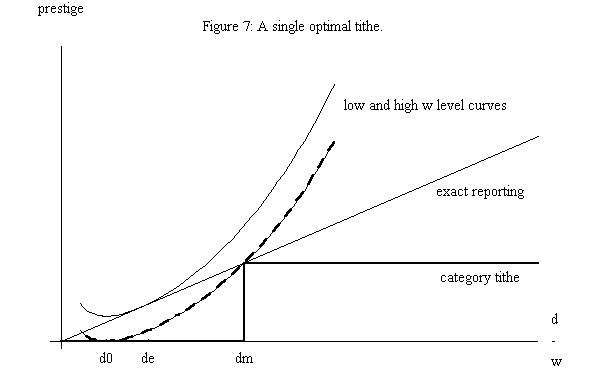
Graphically, when plotted in d/w, r/w space, given their budget constraints, the level curves for all different incomes will coincide. This is illustrated in Figure 7. Reporting of donations by the charity now takes the form of the fraction of income donated. Suppose p = d / w. As before, no reporting will lead donors to give d0, exact reporting de, and the maximum individually rational bracket will result in donations of dm. Now, of course, since the horizontal axis is d/w, these labels refer to fractions of income given. Clearly setting the upper bracket for the tithe at dm will maximize d/w for all income levels, and therefore also maximize total donations. On the other hand I have already demonstrated (Figure 6, for example) that with dollar categories the charity will be unable to extract the maximum donation from every donor, because setting a high bracket for intermediate types limits the bracket that can be set for high types.
If p = d, this result still holds. As above, changes in
p do not affect the optimal level of d, because
utility is separable in p, and, since p does not
appear in the budget constraint it does not affect the amount
of money available for d. The rest of the argument is
as above. So under the above assumptions about separability and
homotheticity of the subutility function, tithing is better than
category reporting, whether p is awarded according to the
amount of the donation or according to the fraction of income
donated.
4.2. Tithes When the Restriction on Preferences Is Relaxed.
If the preferences of donors do not follow the restrictions assumed above, then it is no longer true that a single tithe will extract all possible donations. Such a situation creates some interesting issues. One is when the charity should set the tithe high enough to discourage some types from membership. The fact that tithes are sometimes set discouragingly high is supported by the abundance of appeals to donors to tithe the full amount. Exclusion of some donors will be better than inclusion if types are reasonably different, because a low inclusive tithe will not extract the full possible amount from more willing donors.
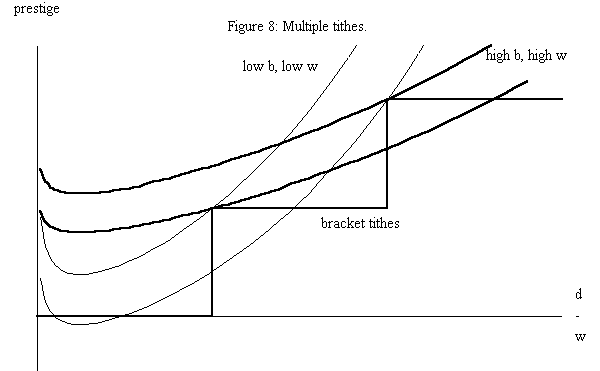
A similar question is whether, or under what conditions, multiple category tithes will increase donations. Such tithes are commonly observed. A United Way pledge form might, for example, suggest contributions of either 1 percent or 2 percent of income, with the higher percentage giving the donor special recognition of some kind. Clearly such a practice will be most attractive to the charity when it can get the higher income people to select the 2 percent pledge. It is easy to see, from Figure 8, that when d0 (the fraction of income donated without any prestige) does not change with income, the necessary and sufficient condition for such sorting to be possible is single crossing. In p,d/w space, the MRS is w ( Ux - Ud ) / Up, and single crossing requires that this be decreasing in w. This is equivalent to saying that additional prestige provides more benefits, (relative to those from private consumption and warm glow), to wealthier people, perhaps because of kinds of jobs they hold and the kinds of social networking in which they engage. Note that I have only shown that this condition makes sorting possible, not that sorting is optimal. That will depend on preferences and the distribution of types.
4.3. Summary Remarks About Tithes.
The above sections show that category tithes such as those used
by religious groups and by the United Way can be an optimal plan
for maximizing donations. I have also shown that these tithes
can yield more donations than the usual alternatives - category
and exact reporting by dollar amounts - under a condition that
does seem to prevail where they are used, namely when donor's
incomes are verifiable. A further result was that exclusion of
some donors and multiple category tithes could increase donations,
under plausible assumptions about preferences. These conclusions
about tithes provide support for my model of preferences. It
is also interesting to note that, while charities often call for
tithing on grounds of fairness, this section has shown that the
more obvious objective of donation maximization may also explain
their calls for tithing.
5. Conclusion.
The model used in this paper has three main implications for the behavior of donors and charities. First, if charities report using category plans, and donors are in part motivated by prestige, donations will bunch up at the lower brackets. Second, if donors are motivated by prestige, charities can increase donations by using category reporting plans. Third, if charities know incomes, they may be able to increase donations by using tithes. This conclusion discusses some further implications, considers alternative explanations, and proposes topics for further research.
When it comes to fundraising, charities seem to fall into three categories. First, there are the charities that solicit large donations. These are usually educational or cultural organizations. The donations are publicized to the limited number of other people with ties to the charity. The charities devote considerable space in their publications to reporting who gave what. These charities almost always use categories, and the categories are quite far apart: often 200 percent or more. Second are national charities, which solicit small donations from large numbers of people who have no other connections to each other. They almost always list recommended donations, but often these are very close together, perhaps as close as $5 or 20%. They often do not give different labels to these categories or otherwise distinguish donors. When they do, it is often on the basis of the kind of premium that a donor will receive. They typically do not report donations. Their mailings are primarily devoted to descriptions of the problems the charity is concerned with, and how a donation will help alleviate these problems. Third are United Way type charities, which organize a single fund drive and distribute the proceeds to multiple charities. I now provide a brief explanation for why I believe these three types of charities use the techniques they do.
Two important differences between charities arise because of the nature of the prestige effect: there is complementarity in the provision of prestige between the amount of the donation and the ability of others to reward the giver. This means that donations made to charities that can provide publicity to friends, classmates, customers, and clients will, all else equal, buy more prestige than those that cannot. This effect can give a charity monopoly power. For example, donations by a lawyer to his alma mater presumably buy prestige from fellow alumni (and more referrals) that donations to no other charity could earn. Perhaps they also provide a unique nostalgic kind of warm glow.
Since the categories clearly reduce the welfare of the donors below what they could get with exact reporting, I would expect that one form which competition by charities for donations would take would be reductions in the spread between categories, making reports more exact. This competition should be more extreme among charities which are good substitutes for each other. In fact this seems to be the case, and I argue that this is an explanation for the differences between the first two types of charities noted above. Colleges are the most obvious examples of charities with few good substitutes, and their categories are far apart. Charities such as environmental and social welfare groups, of which there are many and to which donors have comparably less permanent ties, ask for small donations and make little effort to distinguish between donors. (Although another explanation for this difference in behavior could simply be the relative unimportance of prestige for the second type of charities.)
The third kind of charities are the United Way type charities. One obvious explanation for the existence of groups such as the United Way is that they reduce solicitation costs through economies of scale. This model suggests another reason: such a group can serve as a cartel, charging high prices (large donations or percentages of income) in return for recognition. In fact, the United Way has acted as such a cartel would be expected to do, by imposing limitations on the fundraising practices of member charities. This behavior is difficult to reconcile with the economies of scale explanation. The United Way structure also seems ideally suited to take advantage of the prestige effect. First, by working locally, United Way groups insure that they are able to distribute reports on giving to those with the highest ability to provide prestige. Then, by forming a cartel, the United Way can increase donations by the use of categories. Of course, if the money collected is being used to provide otherwise inefficiently under-provided public goods, this kind of cartel may well be socially desirable.
Colleges do not have an incentive to form a United Way type cartel for alumni donations, because each college already has a natural monopoly on prestige for its alumni. The model does suggest that colleges should attempt to form cartels when looking for contributions outside their alumni, because those potential donors will have many alternative colleges to give to, and so should be able to obtain a given level of publicity and prestige with smaller donations. The United Negro College Fund, which collects donations from the general public and then distributes them to a group of colleges, may be an example of such a cartel. But monopoly power should not always be enough to cause nationally based general welfare charities to form cartels. Because some of these groups cannot provide much prestige to their donors, there is little that they can gain by attempting to use prestige to increase donations.
If prestige is truly the important effect I am claiming, people should not make anonymous contributions. In fact, large anonymous donations to charities where prestige matters are rare. Perhaps those anonymous donations that are observed can be explained with a more general version of this model. In such a model people might recognize that the public component of their donations is self serving, and so only derive glow from the anonymous part. Or this could be true of prestige, and people could play out some complicated game where they make anonymous gifts, hoping that at least some others will notice that they made them, and made them anonymously. A model based on prestige does suggest that, all else equal, there should be few anonymous contributions when the reward from prestige is high.
This model suggests an obvious explanation for the rewards to donors mentioned in the introduction. The prototypical such reward is a coffee cup emblazoned with the charity=s name. What better way to inform your colleagues of your contribution toward the public good than to walk around the office holding a cup that everyone knows "is not available in any store." Similarly, consider the reward offered to blood donors: a lapel pin saying "Be nice to me, I gave blood today." The Red Cross even manages to distinguish between donors of different amounts of blood, by issuing different colors of pins to those giving different numbers of pints. Such rewards can be explained as efforts to increase giving by increasing the public part of the benefits. They can be expected to be particularly important to charities that cannot otherwise take advantage of the prestige effect.
Matching contributions are another interesting issue. Many firms match the donations of their employees. Such policies seem difficult to explain without assuming prestige is important. If the benefits from a donation spill over to the firm, or to the other employees of the firm, matching donations are an obvious means of internalizing this externality. Research could be done about these matching policies. Are anonymous donations covered? Are certain types of firms in certain businesses more likely to have these policies? Another interesting question concerns how these matching contributions are reported. If the spillover effect is the reason for matching, then it seems clear that the charity should report the donation as coming from the corporation. But doing so reduces the individual's incentive to give. In practice, college giving reports typically list the corporations that made the matches separately from the alumni donors, and provide no indication as to which individual gift was, in part, a gift from a corporation. This maintains the incentives of alumni to give and employers to match, though perhaps at the expense of some dilution in the prestige awarded to all donors.
Last, it is possible to exploit the category reporting of donations to estimate the importance of the tastes for prestige and for warm glow as motivations for giving. With category reporting, that portion of a donation that is above the lower bracket is not reported by the charity, and so provides no additional prestige, only additional warm glow. When the proportion of such donations is relatively small, the taste for prestige is relatively large. When donations in total are large, the preferences for prestige and warm glow in sum are large. In combination, these facts identify both tastes. Once these tastes have been measured, it will be possible to calculate optimal reporting plans and then compare these to actual practice.
Andreoni, James, 1988, "Privately Provided Public
Goods in a Large Economy: The Limits of Altruism." Journal
of Public Economics, 35: 57-73.
Andreoni, James, 1989, "Giving with Impure Altruism:
Applications to Charity and Ricardian Equivalence." Journal
of Political Economy, 97: 1447-1458.
Becker, Gary, 1974, "A Theory of Social Interactions."
Journal of Political Economy 82: 1063-1094.
Bible, King James Version, on the World Wide Web at
"http://www.biologie.unifreiburg.de/~amueller/religion/"
Ensign of the Church of the Latter-Day Saints,
Salt Lake City, Utah: The Church of the
Latter-Day Saints, magazine.
Goldberg, David, 1989, Genetic Algorithms in Search,
Optimization & Machine Learning. Reading MA: Addison-Wesley.
Greenfield, James, 1994, Fund-Raising Fundamentals.
New York: John Wiley and Sons.
Harbaugh, Bill, 1995, "If People Vote Because
They Like to, Then Why Are They Lying About It?" Public
Choice, forthcoming.
Hollander, Heinz, 1990, "A Social Exchange Approach
to Voluntary Cooperation." American Economic Review
80: 1157-1167.
Kiesling, L. Lynne, 1994, "Moral Sentiments
and Conspicuous Donation: Social Approval and Altruism in Private
Charity". Working paper, Department of Economics, College
of William and Mary, Williamsburg, VA.
Lansdell, Henry, D.D., F.R.G.S., M.R.A.S., 1906,
The Sacred Tenth or Studies in Tithe-Giving Ancient and Modern.
London: Society for Promoting Christian Knowledge.
McDonald, James B., 1984, "Some Generalized Functions for the Size Distribution of Income",
Econometrica 52: 647-663.
Olson, Mancur, 1965, The Logic of Collective Action,
Cambridge, MA: Harvard University Press.
Shaw, George Bernard, 1896, "Socialism for Millionaires."
In Essays in Fabian Socialism. London, Constable &
Company Ltd., reprint 1949.
YoungDay, Doug, 1978, Voluntary Provision of Public Goods: A Theory of Donations. Unpublishe Ph.D. dissertation, University of Wisconsin-Madison.