JEL Code: J17, J31, Q25
Key Words: Global Warming, Amenity Values, Value of Life, death
rates.
I would like to thank Michael S. Bernstam, Milton Friedman, Harry
Gilman, Kenneth L. Judd, Eddie Lazear, Charles G. Moore, and S.
Fred Singer for helpful comments and suggestions on earlier drafts
of this paper.
Thomas G. Moore
Hoover Institution
Stanford, CA 94305-6010
(415) 723-1411
Moore@Hoover.Stanford.edu
A somewhat warmer climate would probably reduce mortality in the United States and provide Americans with valuable benefits. Regressions of death rates in Washington, DC, and in some 89 urban counties scattered across the nation on climate and demographic variables demonstrate that warmer temperatures reduce deaths. The results imply that a 2.5° Celsius warming would lower deaths in the United States by about 40,000 per year. Although the data on illness are poor, the numbers indicate that warming might reduce medical costs by about $20 billion annually. Utilizing willingness to pay as a measure of preference, this paper regresses wage rates for a few narrowly defined occupations in metropolitan areas on measures of temperature and size of city and finds that people prefer warm climates. Workers today would be willing to give up between $40 billion and $61 billion in wages for a 2.5°C increase in temperatures.
Many researchers, environmentalists, and politicians are forecasting that rising world temperatures in the next century will have devastating effects on humans (Committee on Science, Engineering, and Public Policy, et al 1991; Mitchell 1991; Cline 1992; Gore 1992; IPCC 1992). Although the calamities are barely spelled out, some scholars and writers have pointed to a warmer climate's being less healthful. Referring to the world as a whole, Working Group II of the Intergovernmental Panel on Climate Change (IPCC 1995, p. SPM-10) asserted: "Climate change is likely to have wide-ranging and mostly adverse impacts on human health, with significant loss of life." The IPCC report feared that increases in heat waves would cause a rise in deaths from cardiorespiratory complications. It also foresaw a rise in vector-borne diseases, such as malaria and dengue and yellow fevers. The report did acknowledge briefly that in colder regions there would be fewer cold-related deaths. The few studies that have examined the relation between warming and human health or mortality in depth have focused either on increases in the number of days of very hot weather and the resulting mortality or on the spread of infectious diseases by such vectors as mosquitoes, flies, and snails (Smith and Tirpak 1989; Stone 1995). Several major studies of the implications of global warming for the United States have neglected or claimed a lack of data on the effects on health or human welfare (National Research Council 1978; Nordhaus 1991; Cline 1992). This study examines the overall effect of climate and, in particular, temperatures on mortality in the United States and the value people put on a warmer environment.
Rarely has any research explored people's preferences for less chilly weather. Given the circumstantial evidence that people prefer warm climates over cold, it is somewhat surprising that the effects of warming on human well-being have essentially been ignored. We do know that many people upon retiring flee to southern and warmer locales. Presumably retirees, at least, find that higher temperatures improve their welfare. As air-conditioning has mitigated the rigors of hot summers, the population of the United States has been moving South and West, towards climates that enjoy less extreme cold weather. Most Americans and Canadians taking vacations in the winter head to Florida, the Caribbean, Mexico, Hawaii, or southern California. Exceptions crowd the ski slopes, but they are a minority. To my knowledge only one study (Hoch and Drake 1974) - summarized in the U.S. Department of Transportation research described below - has examined the preferences of people for various climates, an important measure of how weather affects human welfare. As a gauge of preferences, that research and this paper both use workers' willingness to pay for a better climate as measured by the differential in wages among cities.
In the early 1970s, the U.S. Department of Transportation sponsored a series of conferences on climate change that examined, among other things, the effect of climate on health care expenditures and on preferences of workers for various climates. At that time, the government and most observers were concerned about possible cooling of the globe. The Department organized the meetings because it planned to subsidize the development and construction of a large fleet of supersonic aircraft that environmentalists contended would affect the world's climate.
The third gathering, held in February 1974, examined the implications of climate change for the economy and people's well-being and included a study of the costs to human health from cooling, especially any increased expenses for doctors' services, visits to hospitals, and additional medication (see Anderson 1974). For that meeting, the Department asked the researchers to consider a cooling of 2°C and a warming of 0.5°C. Robert Anderson, Jr., the economist who calculated health care outlays, made no estimate of the costs or savings should the climate warm; but his numbers show that for every 5 percent reduction in the annual number of degree days, a measure of heating costs, health care costs would fall by $0.6 billion (1971 dollars). In his paper summarizing the various studies on economic costs and benefits of climate change, Ralph D'Arge (1974), the principal economist involved in the DOT project, indicated that a 10 percent shift in degree days would be equivalent to a 1°C change in temperature. Thus the gain in reduced health costs from a warming of 2.5°C would be on the order of $3.0 billion in 1971 dollars or $21.7 billion in 1994 dollars, adjusting for population growth and price changes (using the price index for medical care).
Other studies of the influence of climate change on human health have examined a rather narrow set of potential medical areas. The underlying research has generally referred to Lyme disease, malaria, dengue and yellow fevers, and encephalitis, none of which is a major health problem in the United States. The IPCC (1995, p. SPM-10) has asserted that the "geographical zone of potential malaria transmission in response to world temperature increases at the upper part of the IPCC-projected range (3-5°C by 2100) would increase from approximately 45% of the world population to approximately 60% by the latter half of the next century." Work concerned with "killer" heat waves has generally ignored the reduction in mortality that warmer winter months would bring (e.g. Stone 1995). Interestingly cities with the highest average number of summer deaths are found in the Midwest or Northeast while those with the lowest number are in the South (Smith and Tirpak 1989, Chapter 12, pp. 224-5). Perhaps people adapt to warm weather.
Concern about tropical and insect-spread diseases seems overblown. Inhabitants of Singapore, which lies almost on the equator, and of Hong Kong and Hawaii, also in the tropics, enjoy life spans as long as or longer than those of people living in Western Europe, Japan, and North America. Modern sanitation in advanced countries prevents the spread of many scourges found in hot climates. Such low tech devises as window screens can slow the spread of insect vectors.
Malaria was endemic in the southern portion of the United States prior to World War II, the development of insecticides, and the installation of screening. Even without warming, it is certainly possible that dengue fever or malaria could invade North America. Unfortunately some of the government's well meaning environmental policies may make the vector more likely. The preservation of wetlands, although useful in preserving species diversity, also provides prime breeding ground for mosquitoes that can carry these diseases. If the United States does in the future suffer from such insect borne scourges, their infestation may have less to do with global warming than with the preservation of swampy areas.
Moreover, if climate change were to manifest itself as warmer winters without much of an increase in temperatures during the hot months, which some climate models predict (Gates et al 1992), the change in weather could be especially beneficial to human health. The IPCC reports (Folland et al 1992) that over this century the weather in much of the world has been consistent with such a pattern: winter and night temperatures have risen while summer temperatures have fallen.
A warmer globe would likely result in the polar jet stream's retreating towards higher latitudes; in the Northern Hemisphere the climate belt would move North (Lamb 1972, p. 117-118; Giles 1990). Thus an average annual 3.7°C increase in temperature for New York City, for example, would give it the climate of Atlanta. NYC's summertime temperatures, however, would not go up commensurably: the average high temperature in Atlanta during June, July, and August is only 2.2°C warmer than New York City's and the latter city has on record a higher summer temperature than does the capital of Georgia. Summer temperatures generally differ less than winter temperatures on roughly the same longitude and differ less than average temperatures.
A sample of 45 metropolitan areas in the United States shows that for each increase of a degree in the average annual temperature, July's average temperatures go up by only 0.5 degrees while January's average temperatures climb by 1.5°. Since warming will likely exert the maximum effect during the coldest periods but have much less effect during the hottest months, the climate change should reduce deaths even more than any summer increase might boost them.
| ||
| Diseases of the respiratory system | 10% | 149% |
| Mental disorders | 1% | 123% |
| Diseases of the nervous system and sense organs | 2% | 123% |
| Diseases of the circulatory system | 46% | 122% |
| Endocrine and metabolic diseases and immunity disorders | 3% | 121% |
| Diseases of the genitourinary system | 2% | 120% |
| Diseases of the digestive system | 3% | 113% |
| Infectious and parasitic diseases | 2% | 112% |
| Neoplasms | 22% | 103% |
| Homicides | 4% | 88% |
| Suicides | 1% | 94% |
| Accidents | 1% | 97% |
| 100% | 116% |
* Adjusted for differences in the number of days in each month.
Source: The National Center for Health Statistics, Vital Statistics of the United States, 1989.
In addition, as Table 1 documents, even deaths traceable to parasitic and infectious diseases are somewhat higher in the winter than in the summer. Respiratory and heart diseases, which kill many more people annually and which the IPCC Working Group II Summary singled out (1995, p. SPM-10) as increasing under a warmer climate, peak during winter months, not summer months. The table shows that respiratory problems, such as pneumonia and influenza, are a particular problem in cold months, but even the leading causes of death - diseases of the circulatory system - kill more people in the winter. Except for accidents, suicides, and homicides, which are slightly higher in the summer, death rates from virtually all other major causes rise in winter months; overall mortality in the three years 1987 to 1989 was 16 percent greater when it was cold than during the warm season. Other years show similar patterns. Rather than increasing mortality, these data suggest that warmer weather should reduce it; but this possibility is rarely discussed.
To examine more closely the relationship of temperature to mortality, I regressed various measures of warmth on deaths in Washington, DC, from January 1987 through December 1989. The results support the proposition that climate influences mortality. Washington was chosen because it is the only city for which the National Center for Health Statistics has published monthly data on deaths. To explain: the National Center for Health Statistics publishes monthly data on deaths only by state; since temperatures are recorded for major urban areas only, it is impossible to compare these numbers with monthly state death rates. Fortunately, the National Center treats Washington, DC, as a state, making it possible to pair the numbers for that city with monthly temperature records. Using a city has an advantage in that many demographic variables affecting the death rate, such as age, race, income, and religion, are held reasonably constant over a three year period. Moreover, it seems likely that many environmental factors also remain fixed during much of the period. Seasonal changes, especially warm weather, do, of course, affect smog levels. Warm summers producing ozone could partially outweigh any beneficial effects of heat by itself. Since we are interested in the net effect of warming on human mortality, however, it is desirable to include any effect temperature had on creating high levels of ozone that might add to deaths.
I adjusted the reported monthly number of deaths for the number of days in the month and then divided by Washington's estimated population for that month to produce a death rate per day series. Yearly population figures, which declined for the three years, were calculated on the basis that the population declined linearly between each June population estimate. Regressing the death rate in the nation's capital for each month from 1987 through 1989 on the average maximum, minimum or mean monthly temperatures measured at National Airport for those 36 months showed that mortality declined with rising temperatures. All three temperature measures, shown in Table 2, give similar results; but the variable for the average high temperature gives a slightly better fit. Since 1987 and especially 1988 were very hot summers in Washington, with the average high temperature during July 1987 and 1988 being 4.3 and 4.5 degrees Fahrenheit above normal, if heat waves were real killers, those summers should have biased the coefficient towards zero. Moreover, ozone becomes a much greater problem in hotter weather, which should also have raised the coefficient of temperature towards the positive.
Although deaths peak in the winter, factors other than cold, such as less sunlight, could induce the higher mortality. The peaking itself does not prove that warming would lengthen lives; it could be that the length of the days affects mortality. The day's length is closely correlated with temperature, of course, but the latter variable varies from year to year. As regression (4) in Table 2 shows, the length of the day is correlated with the death rate but is less significant than temperature. Moreover, if temperature measures are combined with the length of the day - regressions (5) and (6) - the latter variable loses its statistical significance, although the sign of the coefficient is still negative. Temperature remains the most significant variable.
| Average Low Temperature | -0.032
(-5.56) | |||||
| Mean Monthly Temperature | -0.032
(-5.64) | -0.029
(-2.46) | ||||
| Average High Temperature | -0.031
(-5.73) | -0.029
(-2.56) |
||||
| Hours of Daylight | -0.240
(-4.67) |
-0.026
(-0.26) | -0.019
(-0.19) | |||
| R Square | 0.476 | 0.484 | 0.491 | 0.390 | 0.485 | 0.492 |
| F Statistic | 30.94 | 31.86 | 32.79 | 21.78 | 15.53 | 15.95 |
The relationship of deaths to temperature is probably underestimated since some elderly from the Capital winter in warm climates and die there. Nevertheless, using the coefficients for any one of the temperature measures implies that a 2.5°C rise - this is the IPCC's "best estimate" (1992, p. 16) under CO2 doubling - would cut deaths for the country as a whole by about 37,000 annually.
If death rates were lower in warm climates, however, that would provide further support for the proposition that a rise in average temperature would reduce mortality. Clearly many factors affect mortality. Within any population the proportion that are old affects death rates. Since African-Americans have lower life expectancies than whites, the proportion that is black affects mortality rates. Income and education are also closely related to life expectancy. As is well known, smoking shortens lives. Severe air pollution has pushed up mortality, at least for short periods.
To examine further the relationship of climate to mortality, I regressed the death rate in 89 large counties - those with over 2,000 deaths in 1979 that made up all or a portion of the 50 largest metropolitan areas in 1979 - on the percent of the population which was over 65 in 1980; the percent black in 1980; the percent with 16 years or more of schooling; the median household income in 1979; per capita income in 1979; various health imputs, such as hospital beds and physicians per 100,000; and various weather variables. The weather variables were the actual average temperatures during 1979 (all temperature variables were in Celsius), the highest temperature in the summer, the lowest temperature during the winter, the number of heating degree days during 1979, and the number of cooling degree days. To examine whether it was temperature or sunlight that reduced mortality, I used the latitude and the elevation of the counties as well as the proportion of the sky that was cloudy (82 counties).
The health imputs, the latitude, the elevation, and the cloudiness were not statistically different from zero, added nothing to the results, and are not shown here. It would be useful to include data on smoking rates, but there is no such data by counties or even metropolitan areas circa 1979. However, state data, which exist for 1955 and 1985, show that smoking rates are higher in the south (Cohen and Colditz 1994, p. 70). Thus smoking should be positively correlated with temperature and bias the temperature variables towards zero.
Assuming that the smoking rates of people in each of the counties matched that of the state as a whole and that smoking in 1985 was a good measure of smoking rates in 1979, I included a smoking variable in the regression. The latter assumption would seem to be reasonably valid as smoking rates vary only slowly over time, although there has been a trend downward in male smoking. Since the territories included in this study consist of the counties with the largest populations in the fifty largest metropolitan areas, they represent in most cases a significant portion of the state's population. Thus the smoking rate for the state as a whole may be a fair proxy for the county smoking rate. The results show that while the smoking rate is positively correlated with the death rate, statistically it is insignificantly different from zero. More important from the point of view of this study, inclusion of this measure of smoking leaves the size and significance of the other variables virtually unaffected.
Although data for all 89 counties on air pollution were unavailable,
the Statistical Abstract has published data (1982-83, Table
352, p. 205) on the Pollutant Standard Index (PSI) - a measure
of air pollutants that affect health - for a group of standard
metropolitan statistical areas. From this group I collected data
on days in which PSI exceeded 200 for a sample of 22 of the counties.
The results failed to show any significant effect of pollution
on mortality.
| 49.84
(28.47) | 45.27
(25.87) | 46.32
(25.55) | 50.00
(29.67) | |||||
| 4.35
(9.55) | 2.92
(6.25) | 2.73
(5.80) | 4.05
(8.71) | |||||
| -2.76
(-2.72) | ||||||||
| -0.119
(-6.12) | -0.119
(-6.24) | |||||||
| ||||||||
| -0.052
(-3.37) | -0.062
(-4.61) | 0.089
(1.09) | -0.055
(-3.59) | |||||
| ||||||||
| 0.929 | 0.946 | 0.949 | 0.931 | |||||
| 274.41 | 371.44 | 306.67 | 284.08 | |||||
As Tables 3A and 3B show, the proportion over 65 and the proportion black are highly significant in explaining death rates across counties. Regression (1) and regression (2) are the same except that the first employs a measure of education while the second uses median household income. Median income gives the best fit and, as expected, higher incomes reduce deaths. It is interesting to note that, at the mean, the elasticity of death rates with respect to median income is -0.26; that is, a 10 percent rise in income would reduce death rates by 2.6 percent. On the other hand, the elasticity of death rates with respect to percent of the population with 16 years of education is only -0.06. Evidently it is better to be rich than well educated. In both these regressions the average temperature in 1979 is highly significant (more so in the income regression) and shows unambiguously that warmer weather leads to lower deaths. Regression (2) explains 95 percent of the variance in death rates.
Regression (3), which includes temperatures squared - a variable highly correlated with temperature - is intended to test whether the rate at which deaths are reduced falls at higher temperatures. Given the multicollinearity, neither variable is significant at the 5 percent level and the signs are reversed. Regression (4) simply substitutes per capita income for median household income. The result is less significant than the regression with household income. The remaining regressions use other measures of climate and demonstrate that warmer is healthier, or at least extends life expectancies - once the age structure is held constant there is a well established direct relationship between death rates and life expectancies. Equation (5) substitutes heating degree days in 1979 for average temperature and finds that the colder the winter, the higher the death rate. Regression (6) employs cooling degree days and finds that the hotter the summer, the lower the death rate. Regression (7) employs both variables together. While their significance goes down as a result of multicollinearity, the signs still indicate that warmer winters and warmer summers reduce deaths. Regressions (8), (9), and (10) use the extremes recorded during the year - the highest temperature and the lowest temperature - and find the same pattern evinced by the degree day data, that is, warmer temperatures reduce mortality in both the winter and the summer (note that the higher the lowest temperature, the lower the death rate).
Since the objective is to measure the effect of a warmer climate,
it is simplest to use regression (2) because its measure of temperature
is the mean during the year. (It is also the regression with the
highest F Statistic and the greatest R Square.) The coefficient
for average temperature implies that if the United States were
enjoying temperatures 2.5° Celsius warmer than today, mortality
would be 41,000 less. This savings in lives is quite close to
the number estimated based on the Washington, DC, data for the
period 1987 through 1989.
| 44.92
(25.46) | 45.33
(25.07) | 45.37
(25.64) | 42.56
(24.13) | 44.76
(24.92) | 43.46
(24.13) | |||||||
| 2.89
(6.10) | 2.85
(5.96) | 2.93
(6.23) | 2.91
(6.14) | 2.79
(5.80) | 2.92
(6.27) | |||||||
| -0.117 | -0.117
(-5.96) | -0.118
(-5.91) | -0.119
(-6.10) | -0.114
(-5.80) | -0.116
(-5.79) | -0.117
(-6.03) | ||||||
| -0.099 | -0.072 | -0.099
(-4.30) | -0.072
(-2.66) |
|||||||||
| -0.022 | -0.013 | -0.022
(-3.81) | -0.013
(-1.90) | ||||||||
| 0.217 | 0.145 | 0.217
(4.28) | 0.145
(2.17) | |||||||||
| -0.451 | -0.239 | -0.451
(-3.99) | -0.239
(-1.63) | |||||||||
| 0.945 | 0.944 | 0.947 | 0.945 | 0.943 | 0.947 | |||||||
| 360.50 | 351.52 | 294.59 | 361.02 | 346.41 | 298.52 |
In summary, the figures for Washington, DC, indicate that a warmer climate of about 2.5° Celsius would reduce deaths nationwide by about 37,000; the regressions on 89 counties for 1979 point towards a saving in lives of about 41,000. These data sets produce roughly the same conclusion: a warmer climate would reduce mortality by about the magnitude of highway deaths, although the latter deaths are more costly in that they probably involve a much higher proportion of young men and women.
Presumably, if a warmer climate reduced deaths, it would also
cut disease. Unfortunately data on health care costs do not exist
by county. However, the County and City Data Book publishes
figures on physicians and hospital beds per 100,000. Since medical
facilities tend to be concentrated, these numbers have a lot of
random noise. Some counties in a region may have a considerable
concentration of hospitals and attendant physicians while nearby
counties may have only a few. Nevertheless, I regressed hospital
beds per 100,000 and physicians per 100,000 on household income,
percent black, percent over 65, and average annual temperature.
The results are given in Table 4 below.
Although these regressions do not have the statistical significance of the regressions on death rates, the hospital bed regressions and the coefficients for temperature in those regressions are significant at better than one in a thousand. The physicians regression is significant at the 99 percent level but the temperature variable is significant only at the 90 percent level. Nevertheless, all the temperature coefficients have a negative sign. The elasticity of hospital beds and physicians at the mean with average temperatures is -0.39 and -0.33. Assuming that the number of hospital beds and physicians reflected correctly the health care needs of their communities in 1979 and are an index of health care costs, the numbers suggest that private expenditures on health care would have been lower by $22 or $19 billion in 1994 had the climate been warmer. These numbers are remarkably close to the updated figures reported by Robert Anderson ($22 billion). They also understate the benefits of warming since they do not include gains from the reduction in suffering or from a reduction in working days lost from disease. Nor do they include any lowering of government expenditures on health care.
In The Wealth of Nations, Adam Smith (1937, pp. 100-118) pointed out that workers must be paid more to work in an unpleasant place or to do nasty jobs. A casual examination of the job market illustrates the truth of that proposition. Oil companies must pay their workers premiums to cope with the climate on the North Slope of Alaska. Even in central and southern Alaska, labor commands higher wages than it does in the lower 48 states. These differentials reflect the desirability of jobs in one area over another. For example, those who have the least distaste for cold and darkness can be lured for the smallest premium to Prudhoe Bay, Alaska, to work in the oil fields. The differential in this case reflects the marginal valuation of the unpleasantness of work in that harsh environment of those with the least aversion to the conditions.
There is a large and growing economic literature on such amenity values (see e.g. Rosen 1979; Graves 1980; Roback 1982; Blomquist et al 1988; Graves and Waldman 1991; Gyourko and Tracy 1991). Locational advantage can be reflected in the willingness of workers to accept lower wages or in the bidding up by business and home owners of land values. If land values are raised enough, wages could even be forced higher to maintain real incomes. However, it is likely that if workers willingly work for less in a region with positive amenity values, this sum understates the benefits of the location. Some benefits have probably been capitalized into land values and are reflected in rents. Thus living costs are raised, making the reduction in wages that workers will accept smaller.
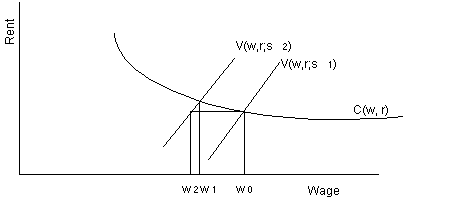
A simple algebraic model based on Roback's (1982) paper may clarify the relationship. Assume workers have identical tastes and skills and that their utility is a function of wages (w), rents (r), and amenity values (s), with dU/dw>0, dU/dr<0, and S2 >S1. Assume also that firms are indifferent to the amenity but face the usual production function with land and labor. Their cost is a function of w and r. The figure below shows a firm's constant cost as a function of wages and rents and the worker's equilibrium conditions for two cities with differing amenity values. Wages and rents adjust so that workers and employers have no incentive to move. As can be seen, rents will be higher and wages lower for the city with the better amenity. The distance W0 - W2 measures the amount of wages the worker would be willing to give up to receive S2 over S1, while the measured wage reduction would be only W1 - W0, since the employee must also pay a higher rent. The lower value of the wages will, therefore, underestimate the value of the amenity.
The relationship of wages to amenity values becomes more complicated if the amenity value affects the costs of the firm either positively or negatively. If S2 raises the costs of the firm over S1, wages will be lower in equilibrium but the effect on rents will be ambiguous. In effect, workers must accept a lower wage to induce employers to locate in the city that imposes higher costs on them. Alternatively if the amenity lowers costs for the firm, rents will rise enough to discourage both employers and employees from locating in that favorable environment with an uncertain effect on equilibrium wages.
Roback (1982, Table 3, p.1272) found that none of the climate variables had any statistically significant relationship to land values, although heating degree days had a positive coefficient. Blomquist et al (1988) reported that precipitation, humidity, heating degree days, and cooling degree days were negatively related to housing expenditures - a proxy for land values - while wind speed, sunshine, and being close to the coast were positively related. Even though statistically significant, both cooling and heating degree days had very small effects on housing expenditures. Taking into account the effects of heating and cooling days on both wages and housing costs, the full implicit price of these variables was trivial. Gyourko and Tracy (1991) reported that the more precipitation, the greater the number of cooling degree days, the more heating degree days, and the higher the wind speed, the lower their measure of housing expenditures. On the other side, they also found that the higher the relative humidity and the closer to the coast (t=1.94), the higher the housing costs.
In sum existing studies have reported mixed correlations between housing costs and weather-related amenity values. Gyourko and Tracy (1991, p. 784) conclude their analysis of amenities by finding that "for many city traits, the full price largely reflects capitalization in the labor rather than in the land market." The rest of this paper, therefore, will assume that climate amenities do not affect production costs and, as a result, any wage reduction underestimates the benefits from warming, although most of the amenity values do appear in the labor market.
The DOT's third conference on global climate change, referred to above, used differences in occupational wages among urban areas to estimate the value of climate to humans. One of the tables, presented by Ralph C. D'Arge (1974, p. 569) in his overview of the economic research, drew on the work of Irving Hoch to supply estimates of the costs and benefits of a 0.5°C warming. Hoch's work (1974) implies that a rise in temperature would have bestowed on workers an implicit gain of $1.6 billion in 1971 dollars. In other words, workers would have been willing to accept $1.6 billion less in wages for employment in regions that were 0.5°C warmer.
Roback (1982, p. 1270) found that heating degree days, total snowfall, and the number of cloudy days was positively correlated with wages, suggesting these are disamenities. As expected, the number of clear days was negatively correlated with wages. Gyourko and Tracy (1991, Table 1, p. 782) reported that heating degree days were positively correlated with weekly hedonic wages. The coefficient for cooling degree days was also positive but not significantly different from zero. Both precipitation and wind speed were significantly negatively correlated with the hedonic wage variable, a somewhat puzzling result. Blomquist et al (1988, Table 1, p. 95), on the other hand, found that both heating degree days and cooling degree days were negatively correlated with their hourly wage equation, implying that workers prefer both cold and hot weather.
To confirm and update Hoch's work, I collected data for 1987 from the Bureau of Labor Statistics on wage rates for a handful of occupations in metropolitan areas. Except for Hoch, most of the other studies of amenity values have employed data on individuals and attempted to hold human capital constant. Hoch and this paper employ wage rates for a narrow group of occupations. Although there are advantages from utilizing the census data on individuals (sample size), measures to capture human capital are never perfect. In addition, hourly wages are typically estimated from annual earnings divided by estimates of hours worked during the year. Typically the hedonic wage regression involves a substantial number of variables attempting to capture human capital. Not only do these equations include such poorly measured attributes of workers as education; but they employ a host of variables, such as occupation, industry, labor union affiliation, marital status, gender, and race, designed to eliminate all wage differentials except those related to amenity values. It is my opinion that reported wage rates for specific occupations from major urban areas, when the jobs are carefully defined and in general demand, measure compensating differentials more accurately.
Of the occupations surveyed, data were available from the largest number of cities (49) for secretaries, auto mechanics, and computer programmers. If the agreeableness of the regions were the only factor affecting the difference in wages among the cities, the pay for these workers would be highly correlated. However, the correlation coefficient between secretaries and auto mechanics, to take one example, is only 0.66 (see Appendix Table 2). Regressing secretaries salaries on auto mechanics and computer programmers (see Appendix Table 1) and using the resultant coefficients to estimate secretaries salaries on the basis of the wages of auto mechanics and computer programmers produces a simulated-secretary series which reflects the common core among secretaries wages, auto mechanics pay, and computer programmers salaries. This procedure eliminates variation in demand for labor of one occupation relative to the others. The simulated-secretary series then became the dependent variable.
Unfortunately it was possible to match salary and published climate
data for only 41 metropolitan areas. The equations that fit the
data the best employed as independent variables one of the measures
of annual temperature, together with the log of the population
of the metropolitan area in 1990, and the difference between the
average maximum temperature in July and the average minimum temperature
in January (Seasonal Change). To measure differences in the rate
of growth of demand by cities, I included the change in population
from 1980 to 1990 but found that it added nothing to the results.
In addition, a number of independent variables that might plausibly
affect the desirability of various metropolitan regions were tried,
including the crime rate, days that the city was in violation
of EPA's ozone standard, heating days, cooling days, proportion
of the population in the central city that was black, annual precipitation,
plus a dummy variable for the south. None of these was significant.
In contrast, each of the variables shown in Table 5 is significant
at better than the 0.5 percent level. If seasonal variation and
population are held constant, the average low temperature explains
51 percent of the remaining variance in the simulated-secretary
series.
|
|
| |
|
|
| |
|
|
| |
These regressions support the proposition that workers value climate and are willing to sacrifice wages for a more pleasant place to live. They also suggest that winter temperatures matter the most. If the United States experienced a 2.5°C rise in average minimum temperatures with no change in seasonal variations, so that summer temperatures rose by the same amount, secretaries would be willing to accept $7.46 lower weekly salary or a reduction in earnings at the mean of 1.88 percent. (If the average annual temperature or the average maximum regression coefficients were used, workers would be willing to accept 1.54 or 1.21 percent less.) Thus if all wage and salary workers in 1993 had generally the same relative tastes for climate as secretaries, auto mechanics, and computer programmers, they would have been willing to pay, that is, to give up, $61 ($50 or $40) billion to secure a warmer climate.
As the first part of this paper has demonstrated, a warmer climate would reduce deaths. These amenity values may simply reflect premiums workers are willing to pay to reduce their risks of premature mortality. If the warming were 2.5° Celsius and deaths were reduced by about 40,000 annually, as predicted above, these amenity values suggest that workers value lives at between $990 thousand and $1.5 million - rather modest figures. Since most of the weather-related deaths, however, are probably among the elderly or the very young, the low value placed on avoiding deaths may be valid. Compare these values with the Statistical Abstract of the United States 1994 (Table 138, p. 102) report of an average value of life for all people in the United States based on their future earnings of only $113,487.
In addition to the figures on earnings for secretaries, motor vehicle mechanics, and computer programmers, the BLS had collected data on word processors (43 cities) and tool and die makers (36 cities). The Area Wage Survey published some of these earnings as weekly and others as hourly; moreover, some require more human capital and earn more annually. Consequently, as an alternative to the simulated-secretary approach discussed above, I converted all earnings to percentage differences from the mean. In other words, for each occupation the percent earnings in each city was expressed as a percent of the mean earnings for that occupation in all cities. After eliminating areas without published temperatures, there were 224 observations of earning differentials. Average annual temperatures existed for only 221 observations. Table 6 gives the results for the various regressions.
These regressions indicate that workers prefer warm climates to cool and that they also prefer climates with substantial seasonal changes in temperatures. Annual temperatures appear to be more significant than summer (cooling days) or winter (heating days), although regressions with those variables have slightly higher R squares. The overall significance, as measured by the F statistic, is higher with annual temperatures than with cooling days. Although not shown in Table 6, these regressions were also run using average July temperatures and average January temperatures with similar but less significant results. Precipitation has a small and marginally significant effect in the cooling and heating equations. The last line in the table presents the gains from warmings, assuming that seasonal variation and precipitation remain unchanged. As can be seen the gains might be as low as $30 billion or as high as $100 billion. If these benefits simply reflect lower death rates, they indicate a value of life saved between $750,000 and $2.5 million.
The amenity analysis employing the simulated-secretaries wages shows differential effects for maximum, average, and minimum temperatures while the death rate data suggest that rises in any one of these have roughly the same impact on deaths. This implies that the amenity values may include something more than the value of reduced mortality. The unpleasantness of harsh winters may be reflected in the much higher coefficient for minimum temperatures in the first set of amenity regressions, although cooling days is more significant when all the data are employed.
As mentioned above, amenities may affect land values. In addition well paid individuals prefer to live in pleasant climates, typically raising average incomes even of those less skilled in the area. These two effects imply that these regressions probably underestimate the value of amenities to workers.
| Seasonal Variation | |||||||
| Normal Annual Temp- | |||||||
| eratures | |||||||
| Elasticity | |||||||
| Annual Precipitation | |||||||
| Log of Annual Temp- | |||||||
| eratures | |||||||
| Elasticity | |||||||
| Log of Population | |||||||
| Log of Cooling Days | |||||||
| Elasticity | |||||||
| Log of Heating Days | |||||||
| Elasticity | |||||||
| Log of Precipitation | |||||||
| Log Seasonal Variation | |||||||
| R Square | |||||||
| Adjusted R Square | |||||||
| F Statistic | |||||||
| Number of Observations | |||||||
| 1994 Gains (Billions) |
Should warming lead to a bigger boost in winter temperatures and a smaller rise in summer, as suggested above, the gain from higher temperatures would be offset in part by a decline in seasonal variation, leading to a smaller dollar benefit. If all the rise in temperatures came in the nighttime (5°C), thus boosting winter lows with no rise in the day, seasonal variation would fall by 5° and average temperatures would rise by 2.5°. In that case, based on the simulated-secretaries regression, workers would value this change at only 0.6 percent of their earnings or $20 billion dollars. Using the whole data set suggests that the workers would be made worse off because of the decline in seasonal variation. On the other hand, if the rise in temperatures reflected the current relationship of average temperature to average winter temperature (rises by 1.5° for every degree the annual mean goes up) and average summer temperature (rises by only 0.5°) as mentioned above, using regression (1) in Table 6 indicates a gain of $41 billion annually.
Although it is impossible to measure the gains exactly, a moderately warmer climate would be likely to benefit Americans in many ways, especially in health and in satisfying people's preference for more warm weather. Most people would enjoy higher temperatures, especially in the winter, and the evidence supports the proposition that humans would live longer and avoid some sickness. Less cold weather would mean less snow shoveling, fewer days of driving on icy roads, lower heating bills, and reduced outlays for clothing.
No doubt many drawbacks to global warming exist, the most notable being the possibility of a rising sea level. In addition, the beneficial results described above apply strictly only to the United States, although it seems likely that the advanced industrial countries in the middle latitudes would benefit as well. These regressions provide no information on the effect of warming on health or mortality in tropical or poor countries, which could suffer health impairment from warming. Moreover, it should be stressed that the evidence presented here is for a moderate rise in temperatures. If warming were to continue well beyond 2.5°C, the costs would mount and at some point the health and welfare effects would undoubtedly turn negative. Contrary to many dire forecasts, however, the temperature increase predicted by the IPCC under a doubling of greenhouse gases would yield both health and welfare benefits for Americans.
Construction of the simulated-secretary series was calculated from the regression of secretary salaries (weekly earnings, all industries) on computer programmers weekly earnings and auto mechanics hourly wages. The regression results were as follows:
| 119.92 | 0.260 | 10.70 | |
| 41.14 | 0.081 | 2.45 | |
| .536 | |||
| 26.62 |
Note: the metropolitan areas were: Bergen-Passaic, NJ; Boston;
Lawrence-Haverhill, MA; Monmouth-Ocean, NJ; Nassau-Suffolk, NY;
Newark; New York; Philadelphia; Pittsburgh; Rochester; Worcester
MA-CT; Atlanta; Baltimore; Charlotte-Gastonia-Rockhill, NC; Corpus-Christi,
TX; Dallas-Fort Worth; Houston; Huntsville, AL; Jackson, MS; Louisville,
KY; Memphis; Miami-Hialeah; New Orleans; Richmond, VA; Tampa-St
Petersburg-Clearwater, FL; Washington, DC-MD-VA; Wilmington, DE-NJ-MD;
Chicago; Cincinnati; Cleveland; Columbus, OH; Detroit; Gary-Hammond,
IN; Kansas City, MO; Milwaukee; Minneapolis-St. Paul; St. Louis;
South Bend; Anaheim-Santa Ana, CA; Denver-Boulder, CO; Fresno,
CA; Los Angeles-Long Beach; Oakland, CA; Phoenix; Portland, OR;
San Diego; San Francisco; San Jose, CA; Seattle, WA.
| Secretaries | 1 | ||
| Computer Programmers | 0.586 | 1 | |
| Motor Vehicle Mechanics | 0.658 | 0.455 | 1 |
| |||||
| Mean | 8.65 | 11.2% | 15.3% | $18,966 | 13.1 |
| Standard Error | 0.22 | 0.4% | 1.4% | $405 | 0.44 |
| Median | 8.5 | 10.9% | 11.7% | $18,364 | 12.3 |
| Standard Deviation | 2.04 | 0.038 | 0.135 | 3819.7 | 4.12 |
| Minimum | 4.1 | 4.5% | 0.75% | $10947 | 6.3 |
| Maximum | 16.5 | 30.7% | 70.24% | $30011 | 24.3 |
| Standard Dev/Mean | 0.24 | 0.34 | 0.88 | 0.20 | 0.31 |
| Count | 89 | 89 | 89 | 89 | 89 |
|
|
| |||
| Mean | 698 | 2546 | 19.6% | -16.7 | 35.4 |
| Standard Error | 54 | 116 | 0.7% | 1.0 | 0.2 |
| Median | 583 | 2657 | 18.8% | -18.9 | 35 |
| Standard Deviation | 510.98 | 1093.9 | 0.062 | 9.65 | 2.34 |
| Minimum | 69 | 108 | 6.8% | -33.3 | 31.1 |
| Maximum | 2344 | 4679 | 42.8% | 5.6 | 47.2 |
| Standard Dev/Mean | 0.73 | 0.43 | 0.32 | -0.58 | 0.07 |
| Count | 89 | 89 | 89 | 89 | 89 |
|
|
| ||||
| Mean | $398 | 3.241 | 57 | 67 | 58 | 48 |
| Standard Error | $3.70 | 0.060 | 1.23 | 1.30 | 1.99 | 1.22 |
| Median | $396 | 3.287 | 55 | 65 | 63 | 46 |
| Standard Deviation | $23.69 | 0.386 | 7.90 | 8.328 | 12.75 | 7.796 |
| Minimum | $344 | 2.393 | 44.7 | 54.2 | 27.3 | 35.2 |
| Maximum | $486 | 3.948 | 75.6 | 85.1 | 81.2 | 68.7 |
| Standard Dev/mean | 0.06 | 0.12 | 0.14 | 0.13 | 0.22 | 0.16 |
| Count |
| Mean | |||||
| Standard Error | |||||
| Median | |||||
| Standard Deviation | |||||
| Sample Variance | |||||
| Minimum | |||||
| Maximum | |||||
| Count |
A. Wage Data:
Bureau of Labor Statistics, Area Wage Surveys, Specific Metropolitan Areas, 1987. The data are for all industries.
B. Weather and Climate Data:
James Ruffner and Frank E. Bair, eds. Weather of U.S. Cities, Third Edition, Detroit: Gale Research Co. 1987.
U.S. Department of Commerce, NOAA, National Climatic Data Center, Climatological Data: Virginia . January 1987 - December 1989, Vol. 97, No 1 - Vol. 99, No 12, Washington National WSCMO AP, Average Maximum, Average Minimum, Average Temperatures; and National Summary, Annual Summary 1979, Vol. 30, No 13.
Statistical Abstract of the United States, 1991.
C. Death Rates:
The National Center for Health Statistics, Vital Statistics of the United States, 1979, 1987, 1988, and 1989.
D. Demographic Variables:
Statistical Abstract of the United States, 1983, 1984, 1987, 1991 and 1994.
County and City Data Book 1983 and 1988
Anderson, Robert J. Jr. "The Health Costs of Changing Macro-Climates." In Proceedings of the Third Conference on the Climatic Impact Assessment Program, edited by Anthony Broderick and Thomas M. Hard, Conference proceedings 1974, held at DOT Transportation System Center, Feb. 26-March 1, sponsored by the Department of Transportation, DOT-TSC-OST-74-15, 1974, pp. 582-592.
D'Arge, Ralph C. "Economic Impact of Climate Change: Introduction and Overview." In Proceedings of the Third Conference on the Climatic Impact Assessment Program, edited by Anthony Broderick and Thomas M. Hard, Conference proceedings 1974, held at DOT Transportation System Center, Feb. 26-March 1, sponsored by the Department of Transportation, DOT-TSC-OST-74-15, 1974, pp. 564-574.
Blomquist, Glenn C., Mark C. Berger, and John P. Hoehn. "New Estimates of Quality of Life in Urban Areas." The American Economic Review 78 (March 1988): 89-107.
Cline, William. The Economics of Global Warming. Washington, DC: Institute for International Economics, 1992..
Cohen, Bernard L. and Graham A. Colditz "Tests of the Linear-No Threshold Theory for Lung Cancer Induced by Exposure to Radon," Environmental Research 64 (1994): 65-89.
Committee on Science, Engineering, and Public Policy, National Academy of Sciences, National Academy of Engineering, and Institute of Medicine. Policy Implications of Greenhouse Warming: Scientific Assessment. Washington, DC: National Academy Press, 1991.
Folland, C.K., T.R. Karl, N. Nicholas, B.S. Nyenzi, D.E. Parker, and K.Ya. Vinnikov. "Observed Climate Variability and Change." InClimate Change 1992: The Supplementary Report to the IPCC Scientific Assessment, edited by J.T.Houghton, B.A. Callander and S.K. Varney. Cambridge, Eng.: Cambridge University Press, 1992.
Gates, W.L., Mitchell, J.F.B. Boer, G.J. Cubasch, U. Meleshko, V.P. "Climate Modeling, Climate Prediction and Model Validation." InClimate Change 1992: The Supplementary Report to the IPCC Scientific Assessment, edited by J.T.Houghton, B.A. Callander and S.K. Varney. Cambridge, Eng.: Cambridge University Press, 1992.
Giles, Bill. The Story of Weather. London: HMSO, 1990
Gore, Albert. Earth in Balance. Boston: Houghton Mifflin, 1992.
Graves, Philip E. "Migration and Climate." Journal of Regional Science 20(2) (1980): 227-237.
Graves, Philip E. and Donald M. Waldman. "Multimarket Amenity Compensation and the Behavior of the Elderly." The American Economic Review 81 (December 1991): 1374-1381.
Gyourko, Joseph and Joseph Tracy. "The Structure of Local Public Finance and the Quality of Life." Journal of Political Economy 99 (August 1991): 774-806.
Hoch, Irving with Judith Drake. "Wages, Climate, and the Quality of Life." Journal of Environmental Economics and Management 1 (1974): 268-296.
Intergovernmental Panel on Climate Change. Climate Change 1992 The Supplementary Report to the IPCC Scientific Assessment, Report Prepared by Working Group I, edited by J.T.Houghton, B.A. Callander and S.K. Varney. Cambridge, Eng.: Cambridge University Press, 1992.
Intergovernmental Panel on Climate Change. Working Group II Second Assessment Report, Summary for Policy Makers: Impacts, Adaptation and Mitigation Options, Approved October 20, 1995, Montreal, Canada.
Lamb, Hubert H. Climate: Present, Past and Future, Fundamentals and Climate Now, Vol. 1. London: Methuen, 1972.
Mitchell, George J. World on Fire: Saving an Endangered Earth. New York: Charles Scribner's Sons, 1991.
National Research Council. International Perspectives on the Study of Climate and Society. Washington, DC: National Academy Press, 1978.
Nordhaus, William. "To Slow or Not to Slow: The Economics of the Greenhouse Effect." The Economic Journal 101 (July 1991): 920-937.
Roback, Jennifer. "Wages, Rents, and the Quality of Life." Journal of Political Economy 90 (December 1982): 1257-1279.
Rosen, Sherwin. "Wages-based Indexes of Urban Quality of Life." Current Issues in Urban Economics, Peter Mieszkowski and Mahlon Straszheim, eds. Baltimore: Johns Hopkins Univ. Press, 1979.
Smith, Adam. The Wealth of Nations, Modern Library, Random House, 1937.
Smith, Joel B. and Tirpak, Dennis, editors. The Potential Effects of Global Climate Change on the United States. U.S. Environmental Protection Agency, Office of Policy, Planning and Evaluation, Office of Research and Development, Report to Congress. 1989.
Stone, Richard. "Cities could Face Killer Heat Waves," Science 267 (17 February 1995): 958