Please do not cite without written permission of the authors.
The effect of monetary policy on the farm sector remains controversial. Studies attempting to quantify the effects of monetary disturbances on real farm prices report conflicting results: some find that positive monetary shocks increase real farm prices in the short run, while others detect no such effect.
We offer a resolution of these conflicting findings by re-estimating
existing models on a common data set. When sample periods corresponding
to the original studies are used, the conflicting results are
confirmed. In contrast, when samples are updated through 1993,
all models supply the same result: monetary shocks do not affect
real farm prices. (JEL E50, C32, Q10)
Please address correspondence to:
Alan G. Isaac and David E. Rapach
Department of Economics
The American University
Washington, D.C. 20016-8029
*The authors wish to thank Fred Graham, Walter Park, and Jeffrey Wharff for their comments and suggestions.
MONETARY SHOCKS AND REAL FARM PRICES:
A RE-EXAMINATION
Introduction
Disparate sectoral responses are a common theme in monetary policy discussions. The responses of housing, consumer durables, and agriculture receive particular attention. We focus on agriculture. Specifically, we re-examine whether money affects the relative prices faced by the agricultural sector.
Events of the early 1980s--tight money coupled with falling real farm prices--suggested to many economists that monetary policy affects relative farm prices. Both theoretical and empirical responses followed. The theoretical work describes channels through which monetary shocks can generate short-run fluctuations in the relative price of agriculture commodities (real farm price, henceforth RFP). There are two primary stories: overshooting of flexible agricultural prices in the presence of sticky prices for non-agricultural goods, based on the Dornbusch (1976) overshooting model, and shifts in relative prices due to imperfect signal extraction, based on the Barro (1976) monetary misperceptions model. The standard theoretical prediction is that positive monetary shocks increase RFP. A corresponding body of empirical work attempts to verify this theoretical prediction, but it is marked by conflicting results.
The empirical controversy motivates our work. Our primary goal is to reconcile the conflicting empirical results. We want to emphasize this difference between our research and that of Belongia (1991), who shows that a variety of model specifications fail to support the importance of money for RFP over his sample period. In our view, a reconciliation must show how existing empirical models produce their conflicting results. We therefore estimate a set of models that are tied very closely to the prominent models in the literature. We focus on four well-known empirical studies that characterize the controversy: Chambers (1984), Devadoss and Meyers (1987), Lapp (1990), and Belongia (1991). The first two find that positive M1 shocks increase RFP; the last two find that M1 shocks leave RFP unaffected. The studies differ in specification, data definition, sample frequency, and sample period. This suggests a variety of possible approaches to attempting reconciliation, and it is far from our intent to explore these systematically. Instead, we wish to emphasize that sample period extension reduces the likelihood of misleading correlations. We therefore focus on demonstrating that sample period alone can account for the divergence in results.
In order to discount the role of data differences (e.g., differences in sample frequency and variable definition) in generating divergent results across existing studies, we begin by reproducing the controversy with a common data set. Using a quarterly data set and samples corresponding to the original studies, we replicate the conflicting results and in this sense "verify" the controversy. We then update all samples through 1993. After updating, all specifications yield the same result: monetary shocks do not affect RFP. Since this finding is robust to specification once samples are updated, we have found a resolution of the controversy.
The paper is organized as follows. Section 1 summarizes four existing
studies, Section 2 presents our empirical results, and Section
3 concludes.
1. Four Existing Empirical Studies
Chambers (1984), Devadoss and Meyers (1987), Lapp (1990), and Belongia (1991) estimate dynamic systems containing M1 and RFP. Each study tests the influence of monetary shocks on RFP. The first two studies find important monetary effects, while the last two find none. A brief overview follows.
Devadoss and Meyers estimate several vector autoregressions (VARs) with monthly data (1960:01-1985:12) in log-levels. We focus on their bivariate VAR in M1 and RFP. (We label the M1-RFP and RFP-M1 orderings DM I and DM II.) The authors find that the RFP impulse responses to an M1 shock are positive and significant for up to two years in both DM I and DM II. This constitutes evidence that money affects RFP.
Using monthly data (1976:05-1982:05) in log-levels, Chambers estimates a four-variable VAR(4) containing M1, the net value of nominal agricultural exports, RFP, and nominal farm income. He includes a time trend in his regressions, and the variables are ordered as listed.
Chambers uses a block exogeneity test to assess the influence of M1. He rejects the null hypothesis that the parameters on lagged M1 are jointly zero in the three agricultural-aggregate equations--M1 "causes" the agricultural variables. RFP impulse responses to an M1 shock are positive for all periods reported, and the variance decompositions show that M1 innovations account for approximately 2%-6% of the variability in RFP at various horizons. So, like Devadoss and Meyers, Chambers finds significant monetary effects.
Lapp estimates monetary misperceptions models using a standard two-step procedure. He considers a variety of data generating processes for M1, and his RFP equation regressors are lagged RFP, lagged relative farm output, and unexpected money. (The residuals from models of M1 growth proxy unexpected money.) Using first differences of log-levels of quarterly data, he estimates a number of RFP equations for the 1951-1972 and 1973-1985 periods. For the later period, the coefficients on unexpected money are jointly insignificant in all the RFP equations.
Belongia's approach to the monetary misperceptions model is similar to Lapp's. None of the coefficients on his unexpected M1 shocks (lags 0-3) are significant in his RFP equations.
In addition, Belongia estimates a VAR(2) composed of RFP, M1, the real exchange rate, and industrial production. He uses quarterly data (1976:1-1990:4), and all variables are transformed to first differences of log-levels. Belongia cannot reject the null hypothesis that the sum of the lagged M1 coefficients in the RFP equation is zero. Furthermore, M1 shocks account for less than 1% of the variability in RFP at the four-, eight-, and twelve-quarter-ahead horizons. The results are qualitatively unchanged when he replaces the real exchange rate with real farm exports.
In sum, these studies capture the controversy in the literature.
Some find that monetary shocks affect RFP, while others conclude
the opposite. Unfortunately, direct comparisons between the studies
are difficult given the variation in specification, data definition,
sample frequency, and sample period (see Table 1). We therefore
re-estimate versions of the models described above with a common
data set. Section 2 describes our results and suggests a resolution
of the controversy.
2. Re-Estimation of Existing Empirical Models
Our data are quarterly observations (1960:1-1993:4) for M1, RFP, real farm business GDP (FGDP), real farm exports (RFX), and real business GDP (BGDP). An appendix describes the data in detail.
Since Devadoss and Meyers (1987) and Chambers (1984) use monthly
data, we match the month to the corresponding quarter to specify
a lag length. The Devadoss and Meyers VAR has a lag length of
14, so we report a quarterly VAR(5). Similarly, we report a quarterly
VAR(2) to conform to Chambers's monthly VAR(4).
2.1. Devadoss and Meyers DM I and DM II Models
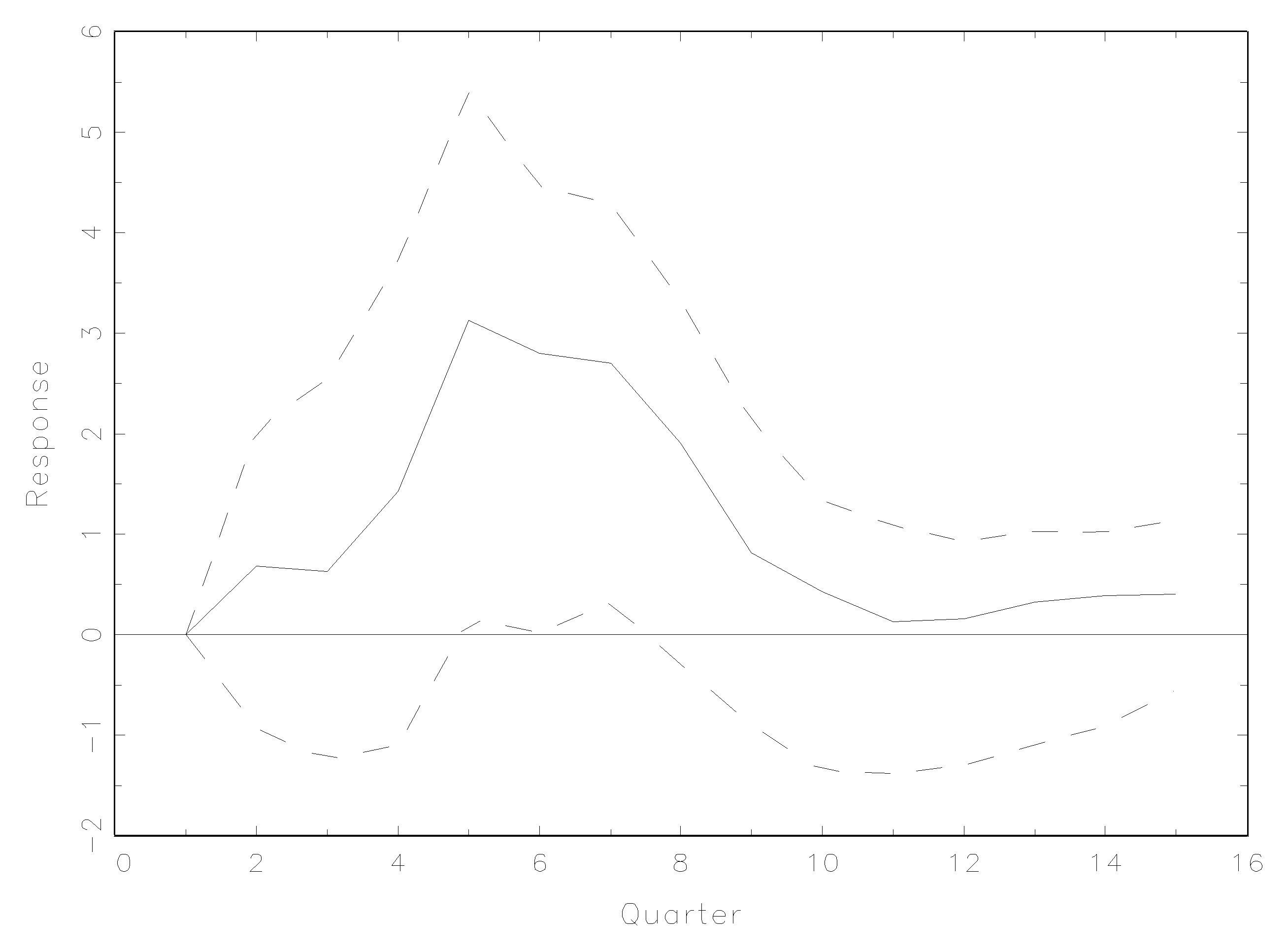
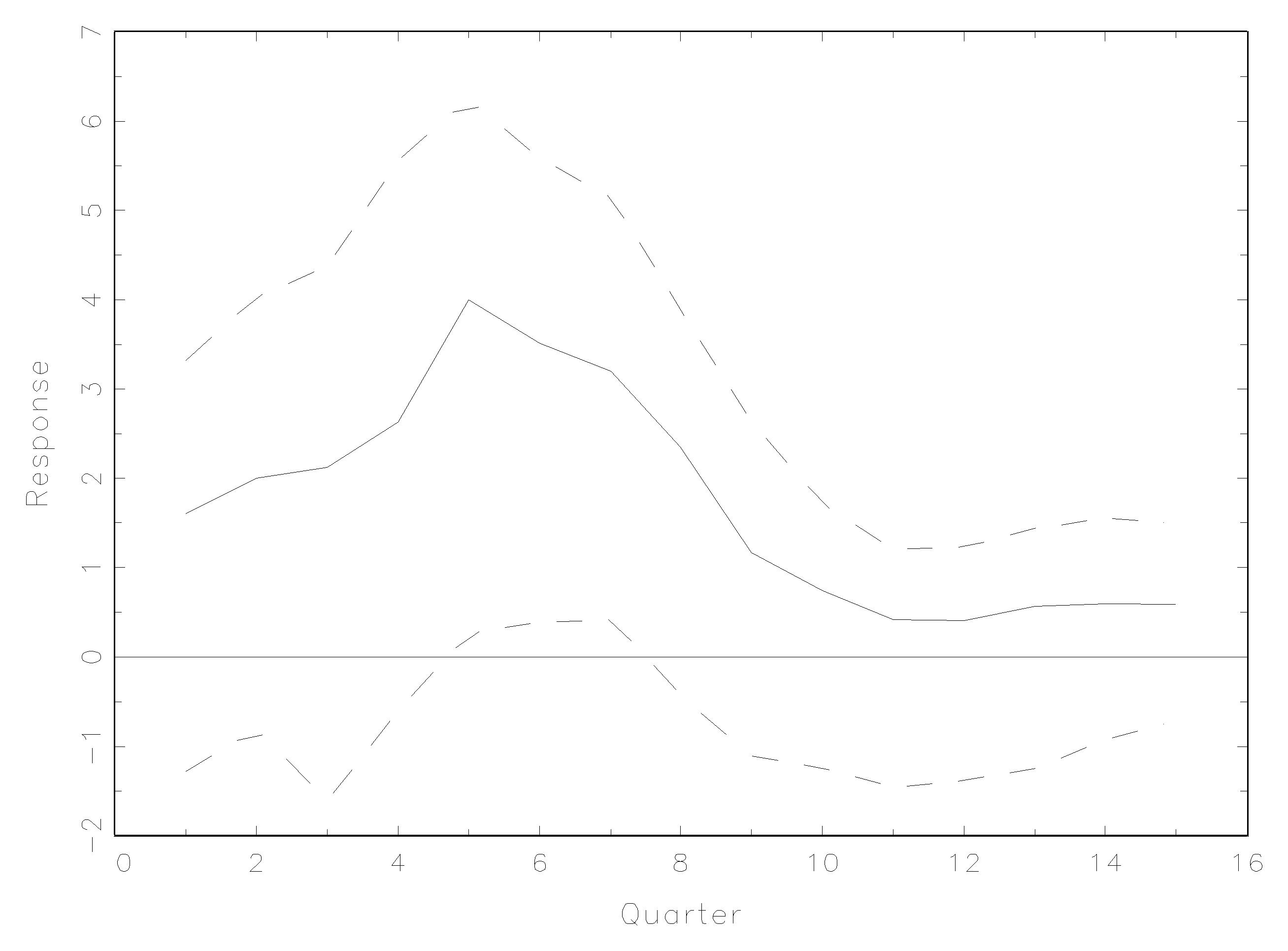
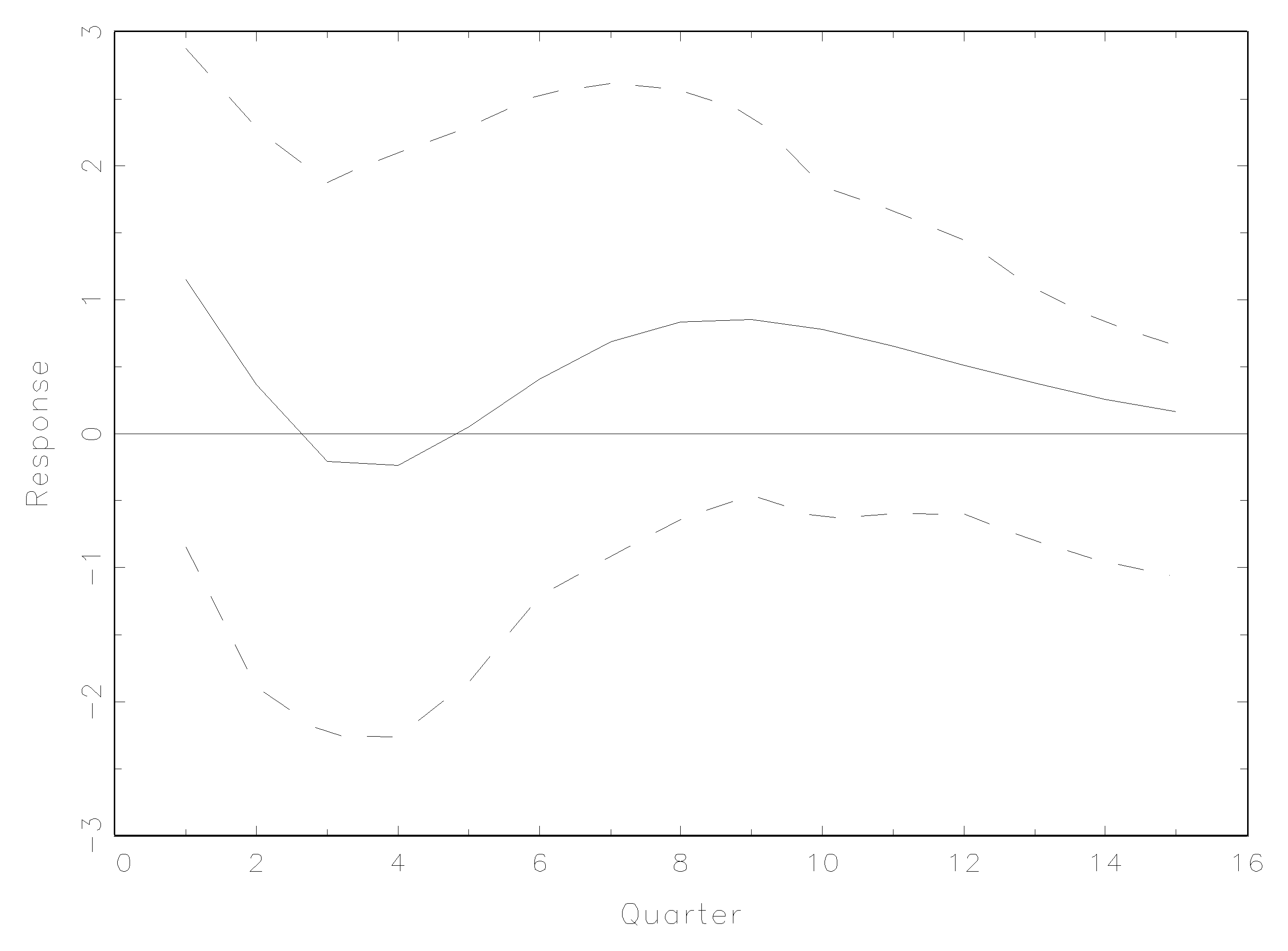
We estimate a VAR(5) from 1960:1-1985:4. The variables are first transformed to log-levels, as in the original. As above, the DM I and DM II models correspond to the M1-RFP and RFP-M1 orderings. Figure 1 gives the RFP impulse responses to an M1 shock in each of the models, and the results are very similar to those found by Devadoss and Meyers. RFP impulse responses are positive and a number are significant (or nearly significant) for up to two years in both models. We also report RFP variance decompositions in Table 2, although these were not reported in original study. These provide an additional gauge of the importance of M1 shocks. The impulse responses and variance decompositions both indicate that M1 shocks play a significant role in determining RFP.
We next estimate the VAR with an updated sample, extending the
end of the sample period to 1993:4. Figure 2 and Table 3 give
the new RFP impulse responses to an M1 shock and RFP variance
decompositions. Using the extended sample, none of the RFP responses
are significant. The peak responses fall from 4.00 to 1.48 in
the DM I model and from 3.13 to 1.22 in the DM II model. The proportion
of RFP variance due to M1 shocks shrinks at all horizons considered.
The largest M1 shares of RFP variance (for the horizons considered)
drop from 21.59 to 4.35 and from 10.94 to 2.32. Simply extending
the sample vitiates the result that M1 shocks affect RFP.
2.2. Chambers VAR Model
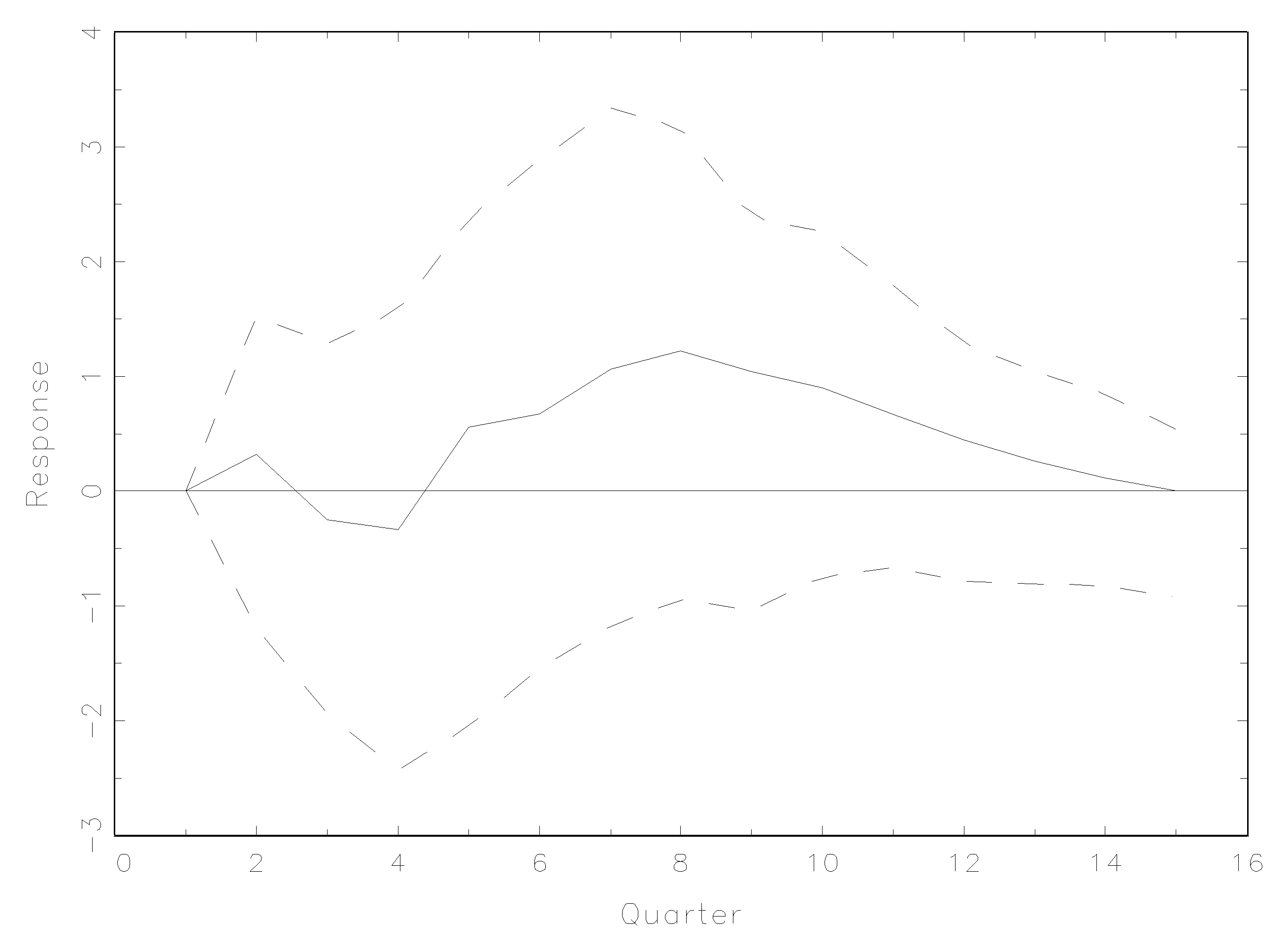
To match Chambers's study, we estimate a M1-RFX-RFP-FGDP VAR(2) with a time trend for 1976:2-1982:2, where the variables are transformed to log-levels. Following Chambers, we test the null hypothesis of zero restrictions on the lagged values of M1 in the farm equations. Our data fail to support Chambers's result with this test: the null cannot be rejected at any usual significance level (a standard likelihood ratio test yields a p-value of 0.31). However, the RFP impulse responses and variance decompositions, given in Figure 3 and Table 4, reveal that monetary shocks have significant effects in this VAR. The initial responses are positive and the first period response is significant. In Table 4, the percentage of RFP variance attributable to M1 shocks at various horizons is even larger than Chambers's.
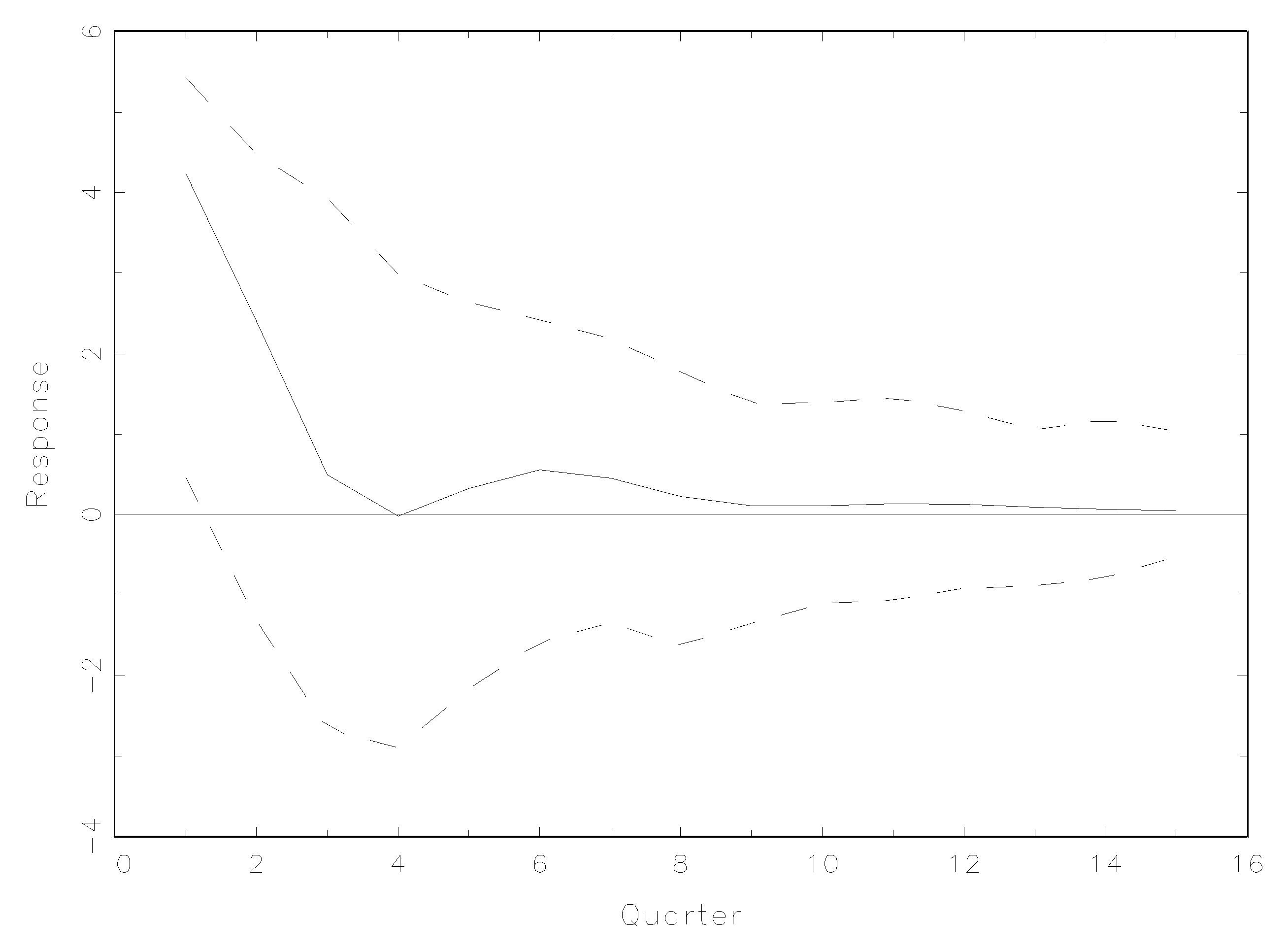
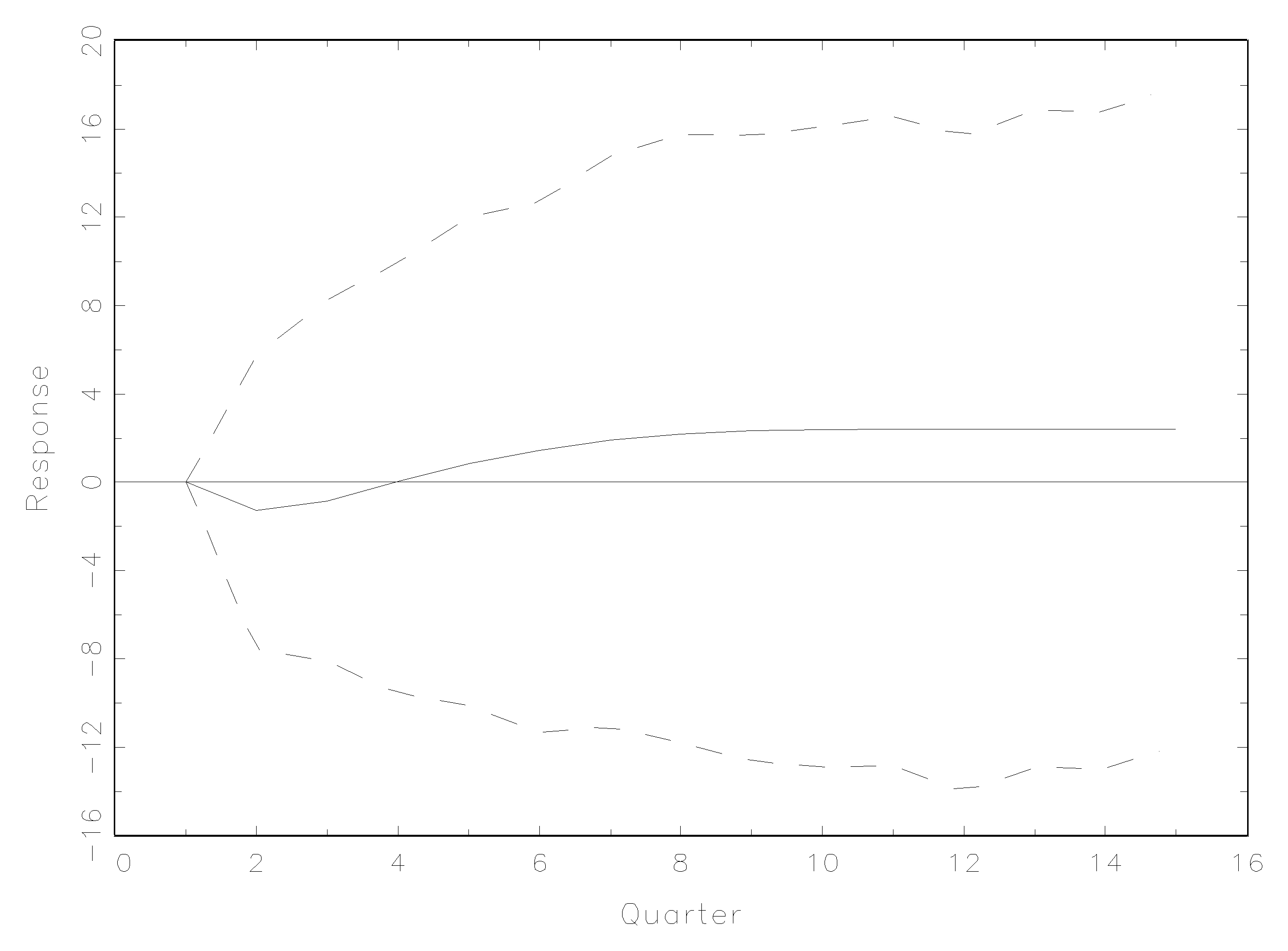
Updating the sample through 1993:4 once again revises our conclusions. Results are given in Figure 4 and Table 5. No impulse response is significant, and the M1 percentages of RFP variance decompositions generally fall below those reported by Chambers. This fall is noteworthy: whereas M1 shocks account for between approximately 17%-52% of RFP variability using the shorter sample, they account for less than 4% using the updated sample. As in the Devadoss and Meyers model, the finding that M1 is an important determinant of RFP is sample specific.
Can the overturning of the original results be explained? Belongia
(1991, p. 31) observes that in contrast with the early 1980s,
"real farm income [and RFP] rose during the late 1980s, a
period some analysts would characterize as one of substantial
monetary contraction." Furthermore, monetary policy eased
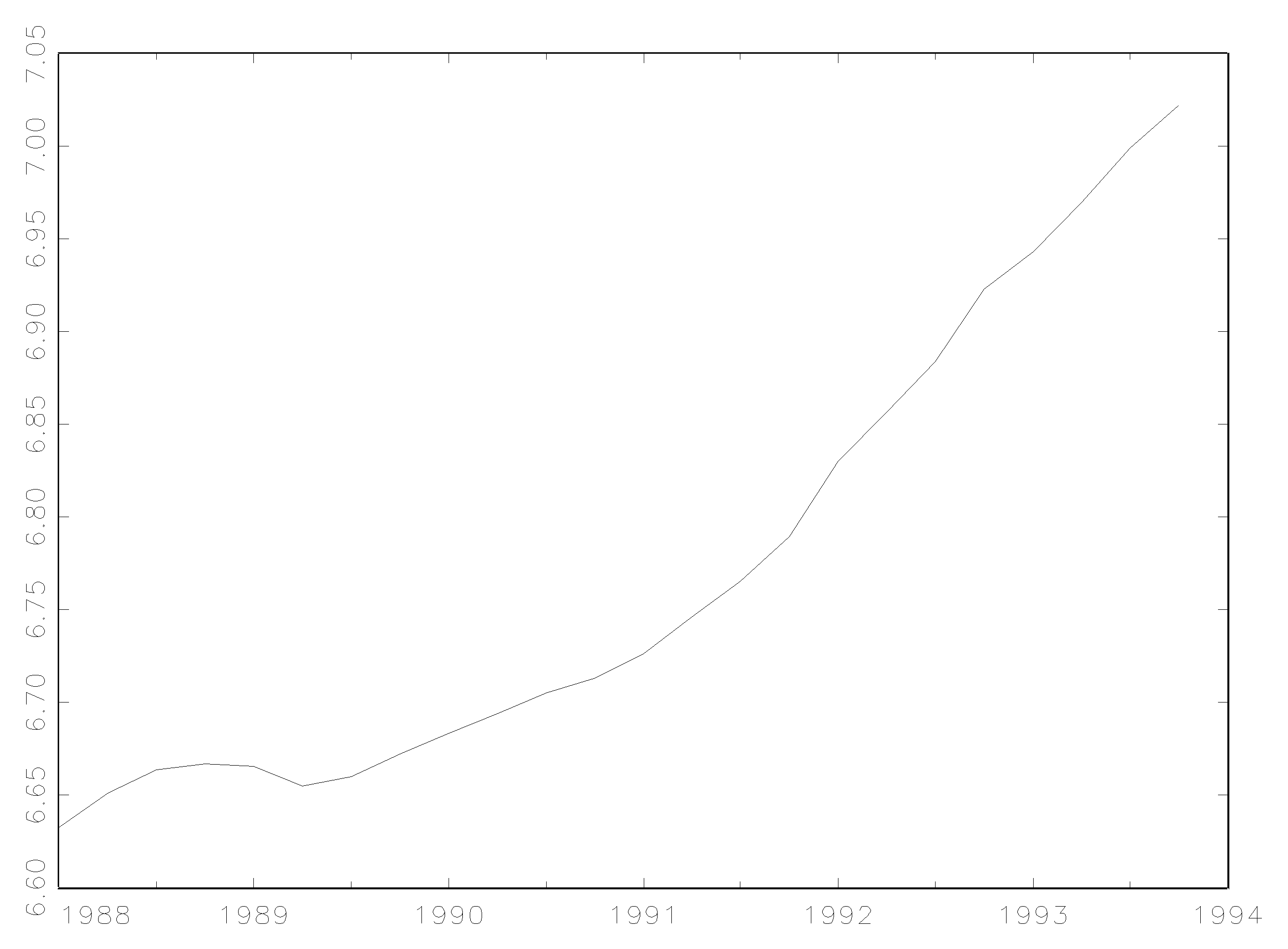
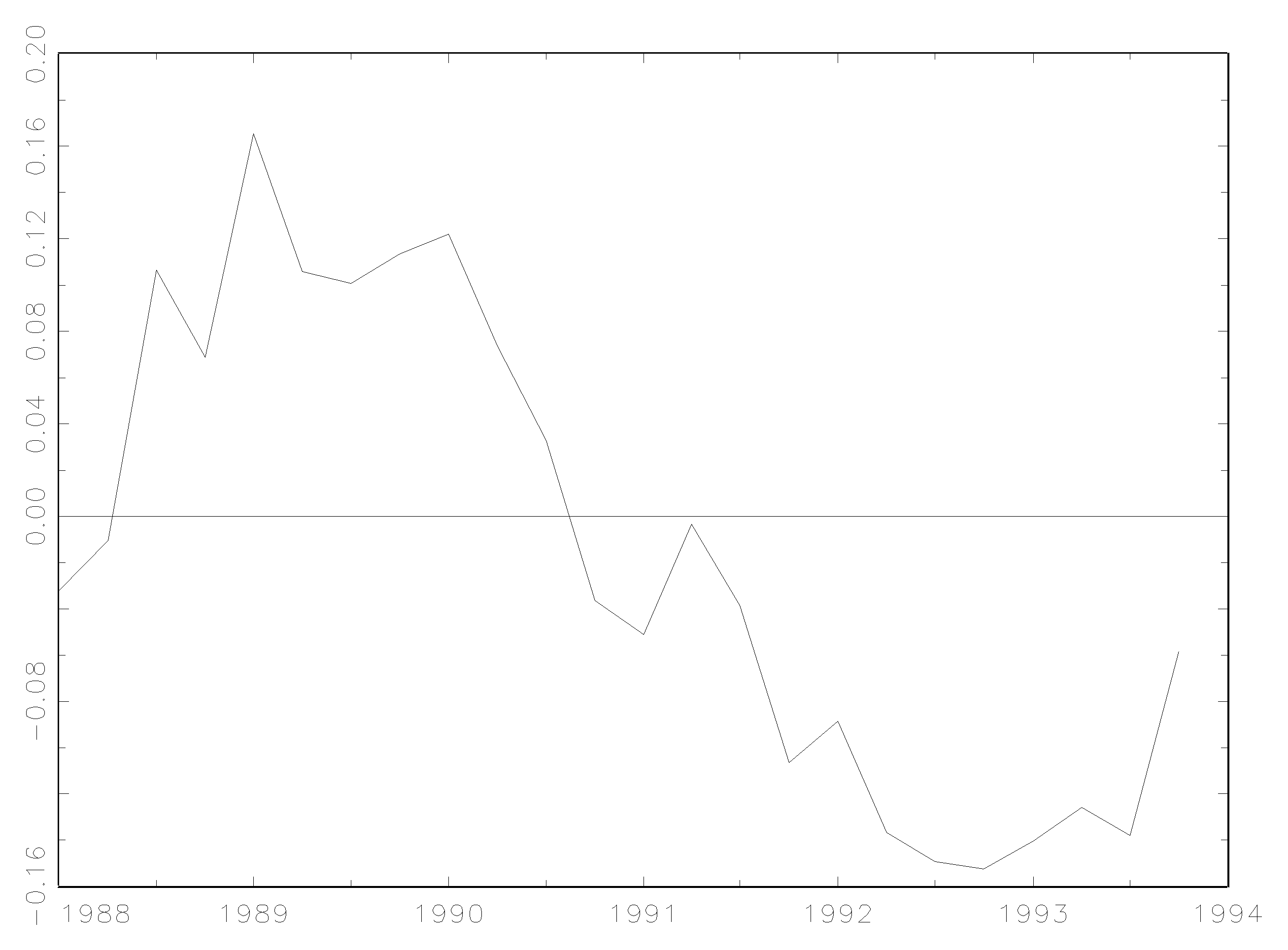
during the early 1990s, and RFP dropped. A close inspection of
Figure 5, which plots the log-levels of M1 and RFP from 1988:1-1993:4,
reveals these co-movements. In this sense, recent history works
against the story about monetary policy and agricultural prices
that emerged in the early 1980s. Our work with an updated sample
confirms the impression left by Figure 5: early evidence that
money influences RFP is an artifact of the sample period.
2.3. Belongia VAR Model
The Belongia sample covers 1976:1-1990:4; we extend the sample through 1993:4 to see if updating affects his main conclusions. Belongia estimates a RFP-M1-real exchange rate-industrial production VAR(2). He obtains qualitatively similar results using RFX instead of the real exchange rate. We focus on RFX since that increases comparability with our other models. This emphasis on comparability also led us to replace industrial production with BGDP, which is our choice for a real output measure in our data set. We estimate a VAR(2) in annualized percentage growth rates (the first differences of log-levels multiplied by 400). As in Belongia, the sum of the coefficients on lagged M1 in the RFP equation is not significantly different from zero. Furthermore, the coefficients are not jointly different from zero, so M1 does not Granger-cause RFP.
The RFP impulse responses to an M1 shock (not reported in Belongia)
and variance decompositions are given in Figure 6 and Table 6.
None of the RFP responses are significant. As in Belongia, M1
shocks account for less than 1% of the forecast-error variance
in RFP at various horizons; RFP variability is dominated by RFP's
own shocks.
2.4. Belongia Monetary Misperceptions Model
We also re-estimate the Belongia monetary misperceptions model.
As noted above, Belongia first estimates an AR(6) M1 growth rate
model as represented by (1).
(1) DM1t = ac
+ S=1aiDM1t-i
+ DM1Rt
Here DM1t is the growth rate of M1t and DM1Rt, the unanticipated component of M1 growth, is white noise. Following a standard two-step procedure, Belongia uses the OLS residuals from (1) in the RFP growth rate equation. As discussed earlier, the motivation is a standard monetary misperceptions model, which he represents by (2).
(2) DRFPt = bc
+ S=0biDM1Rt-i
+ ut
Here DRFPt is RFP growth rate at time t and ut is the associated white noise error. Following Belongia, we estimate (1) and (2) using the two-step procedure.
In Table 7, the Belongia+ column presents our estimation results
over the 1976:1-1993:4 sample. For concision, we report only the
sensitivity of RFP to monetary shocks. Since the shocks are generated
regressors, we report corrected standard errors based on Pagan
(1984). Considering the coefficients individually, not one is
significant at the 5% level. Furthermore, using the Pagan (1984)
correction to the parameter covariance matrix, we can construct
an asymptotic Chi-Square(4) test (from the Wald form of the F-test)
of the null hypothesis that b0=b1=b2=b3=0;
the null hypothesis is not rejected (p-value=0.74).
2.5. Lapp Monetary Misperceptions Model
Here, we estimate a model based on Lapp's (1990) monetary misperceptions
models. We simply retain (1), since we take the primary difference
between the Belongia and Lapp models to be that Lapp adds lagged
RFP and lagged relative farm output as regressors in (2). We compute
relative farm output (RFGDP) as the difference between FGDP and
BGDP. (Lapp uses the difference between FGDP and GDP.) Following
Lapp, we include four lagged values of each variable, so (2) becomes
(2").
(2") DRFPt = bc
+ S=0biDM1Rt-i
+ S=1giDRFPt-i
+ S=1diDRFGDPt-i
+ ut
Here DRFGDP is the growth rate of relative farm GDP. Following Lapp, we again use the two-step procedure to estimate (1) and (2"). The results for 1973:1-1985:4, which corresponds to Lapp's later period, are found in the Lapp-A column of Table 7. Corrected standard errors are reported due to the generated regressors problem. The results are consistent with those of Lapp. None of the coefficients on unexpected money are individually significant, and our asymptotic Chi-Square(4) test again fails to reject the null hypothesis that b0=b1=b2=b3=0 (p-value=0.48).
As evinced by the Lapp-B column of Table 7, when the sample is updated to 1993:4, all of the coefficients on expected money shrink in absolute size and remain individually insignificant. Again, the null hypothesis that b0=b1=b2=b3=0 is not rejected by our asymptotic Chi-Square(4) test (p-value=0.20).
2.6. Alternative VAR Data Transformations
Finally, since all the VARs considered here use different data transformations, we re-estimate each of the VARs using alternative transformations. Table 8 summarizes our findings on the updated samples.
Devadoss and Meyers use log-levels; hence, we now re-estimate using detrended log-levels and first differences. The results are qualitatively unchanged from Section 2.1. Chambers employs detrended log-levels, so we re-estimate using log-levels and first differences. With first differences, the results are qualitatively unchanged from Section 2.2. Using log-levels, impulse responses from period six and later are significant and negative (one of the percentages of RFP variance due to M1 shocks is insignificant). For the Belongia VAR, we now re-estimate using log-levels and detrended log-levels, since he uses first differences. The pattern is similar to the Chambers case: impulse responses are insignificant for detrended log-levels but significant and negative for log-levels (some of the percentages of RFP variance due to M1 shocks are significant for log-levels).
The significance of money when data are in log-levels and are not detrended is readily explained. M1 trends up and RFP generally trends down over the updated Chambers and Belongia samples. When this trend is not accounted for in the data transformation, a negative relationship is detected. Thus, the results of Sections 2.1-2.3 are robust to alternative data transformations when allowances are made for the apparent trends in M1 and RFP.
3. Conclusion
An empirical controversy has developed around the question of whether money affects the relative prices faced by the agricultural sector. We illustrate this controversy by estimating a set of models based on four prominent studies. We then offer a reconciliation of conflicting empirical results. When our versions of the Devadoss and Meyers (1987) and Chambers (1984) models are estimated using samples ending in the mid-1980s, M1 shocks have significant effects, as reported in the original studies. However, when the samples are extended through 1993:4, these shocks cease to be important. Updating samples does not alter the conclusion that monetary shocks have no significant effects in our versions of the Belongia (1991) and Lapp (1990) models. These results suggest that the controversy over the effects of monetary shocks is an artifact of the sample periods used in existing studies.
Belongia (1991) is the first to eclectically seek a consensus on the effects of monetary shocks on RFP. He proceeds by estimating alternative RFP models using a common sample period and common data transformations. In this setting, Belongia finds monetary shocks are not important for RFP. However, Belongia's paper merely contributes to one side of the controversy and does not investigate the reasons for the divergent results in the literature. Since we wish to shed light on the source of the controversy, our exploration is tied much more closely to existing studies. In contrast with Belongia, we retain the data transformations used in existing studies, and we even maintain the beginning-of-sample date. We then demonstrate that updating samples alone can explain the divergent findings in the literature. While we corroborate Belongia's and Lapp's findings, our results go much further: we resolve the conflict and explain its basis.
To our core exploration, we add a supplementary discussion of the role of the various data transformations used in the literature. (In the process, we explore the role of sample-specific trends in the data.) Re-estimating our VARs with updated samples under alternative data transformations, we provide further evidence that monetary shocks are unimportant for RFP.
Since updating the samples proves crucial for resolving the empirical controversy, recent M1-RFP events clearly warrant attention. Belongia observes that the late 1980s witnessed tight money and rising RFP. We add that the early 1990s saw easy money and falling RFP. These recent outcomes contrast with the conventional view that positive monetary shocks boost RFP.
The attention paid to the effect of money on the agricultural
sector is a fairly recent phenomenon. Given the size and number
of real agricultural shocks, real shocks obviously account for
much of RFP volatility. The view that has emerged in the last
decade, however, is that monetary shocks have also contributed
significantly to the variability in RFP. We believe that the available
data indicate otherwise: monetary shocks are not an important
determinant of RFP.
REFERENCES
Barro, Robert J. "Rational Expectations and the Role of Monetary
Policy," Journal of Monetary Economics 2 (January
1976): 1-33.
Belongia, Michael T. "Monetary Policy and the Farm/Nonfarm
Price Ratio: A Comparison of Effects in Alternative Models,"
Federal Reserve Bank of St. Louis Review 73 (July/August
1991): 30-46.
Chambers, Robert G. "Agricultural and Financial Market Interdependence
in the Short Run," American Journal of Agricultural Economics
66 (February 1984): 12-24.
Davidson, Russell, and James G. MacKinnon. Estimation and Inference
in Econometrics. New York: Oxford University Press, 1993.
Devadoss, S. and William H. Meyers. "Relative Prices and
Money: Further Results for the United States," American
Journal of Agricultural Economics 69 (November 1987): 838-42.
Dornbusch, Rudiger. "Expectations and Exchange Rate Dynamics,"
Journal of Political Economy 84 (December 1976): 1161-76.
Frankel, Jeffrey A. "Expectations and Commodity Price Dynamics:
The Overshooting Model," American Journal of Agricultural
Economics 68 (May 1986): 344-48.
Isaac, Alan G., and David E. Rapach, "Monetary Shocks and
Real Farm Prices: A Re-Examination," Economics Department
Working Paper 95-101, The American University, 1995.
Lapp, John S. "Relative Agricultural Prices and Monetary
Policy," American Journal of Agricultural Economics
72 (August 1990): 622-30.
Pagan, Adrian, "Econometric Issues in the Analysis of Regressions
with Generated Regressors," International Economic Review
25 (February 1984): 221-47.
Runkle, David E. "Vector Autoregressions and Reality,"
Journal of Business and Economic Statistics 5 (October
1987): 437-42.
Stamoulis, Kostas G. and Gordon C. Rausser. "Overshooting
of Agricultural Prices." In Macroeconomics, Agriculture,
and Exchange Rates, ed. Philip L. Paarlberg and Robert G.
Chambers, 163-89. Boulder, Colo.: Westview Press, 1988.
DATA APPENDIX
The data set is constructed from the National Economic, Social,
and Environmental (NESE) database. Each of the five time series
comprising the data set is described below. Each series, except
for real farm exports, covers 1960:1-1993:4. The original time
series used to construct the data set are prepared by the Bureau
of Economic Analysis. Each original series, except for nominal
agricultural exports, is measured in billions of dollars. The
date given for each series is May 13, 1994.
M1: This series is item EA BUSTAT S06116. The observations
are monthly and seasonally adjusted. The series is made quarterly
by averaging over the monthly observations comprising each quarter.
Real Farm Price: Real farm price is measured as the ratio
of the implicit farm business GDP price deflator and the implicit
GDP price deflator (item EA NIPA 701-008). The implicit farm business
GDP price deflator is obtained by dividing farm business GDP (item
EA NIPA 107-006) by farm business GDP in constant 1987 dollars
(item EA NIPA 108-006) and multiplying this quotient by 100. Each
of the original series is quarterly and seasonally adjusted.
Real Farm Exports: Nominal agricultural exports (item EA
CYCIND A0M604) are first converted from millions to billions of
dollars. Real farm exports are obtained by dividing nominal agricultural
exports by the implicit farm business GDP price deflator. (The
implicit farm business GDP price deflator is first divided by
100.) The original nominal agricultural series is monthly and
seasonally adjusted, and begins in January 1965. The quarterly
series is obtained by summing over the monthly observations comprising
each quarter.
Real Farm Business GDP: This is the farm business GDP in
constant 1987 dollars series cited above.
Real Business GDP: This series, item EA NIPA 108-002, is measured in constant 1987 dollars, and observations are quarterly and seasonally adjusted.
TABLE 1
SUMMARY OF EXISTING M1-RFP EMPIRICAL MODELS
Study; Data transformation | Sample | Does money matter for RFP?; Important findings |
Devadoss and Meyers (1987); Log-levels | 1960:01-1985:12 | Yes; VAR model: Positive and significant RFP impulse responses to an M1 shock |
Chambers (1984); Detrended log-levels | 1976:05-1982:05 | Yes; VAR model: Coefficients on lagged M1 jointly significant in agricultural aggregate equations and positive RFP impulse responses to an M1 shock |
Belongia (1991); First differences, log-levels | 1976:1-1990:4 | No;
VAR model: M1 shocks explain small percentage of RFP variance; |
Lapp (1990); First differences, log-levels | 1973:1-1985:4 | No; Monetary misperceptions models: Coefficients on unexpected M1 shock jointly insignificant in RFP equations |
TABLE 2
RFP VARIANCE DECOMPOSITIONS AND 95% CONFIDENCE INTERVALS
IN THE DM VAR MODELS, 1960:1-1985:4 SAMPLE:
(A) DM I MODEL; (B) DM II MODELa
A.
|
| |
|
| |
|
| |
|
| |
B.
|
| |
|
| |
|
| |
|
| |
Notes: aThe DM I and DM II models correspond to the M1-RFP and RFP-M1 orderings.
bThe RFP-M1 ordering restricts this value to 0.
cThe RFP-M1 ordering restricts this value to 100.
TABLE 3
RFP VARIANCE DECOMPOSITIONS AND 95% CONFIDENCE INTERVALS
IN THE DM VAR MODELS, 1960:1-1993:4 SAMPLE:
(A) DM I MODEL; (B) DM II MODELa
A.
|
| |
|
| |
|
| |
|
| |
B.
|
| |
|
| |
|
| |
|
| |
Notes: aThe DM I and DM II models correspond to the M1-RFP and RFP-M1 orderings.
bThe RFP-M1 ordering restricts this value to 0.
cThe RFP-M1 ordering restricts this value to 100.
TABLE 4
RFP VARIANCE DECOMPOSITIONS AND 95% CONFIDENCE INTERVALS
IN THE CHAMBERS VAR MODEL, 1976:2-1982:2 SAMPLE
|
|
|
| |
|
|
|
| |
|
|
|
| |
|
|
|
| |
Note: aThe M1-RFX-RFP-FGDP ordering restricts this
value to 0.
TABLE 5
RFP VARIANCE DECOMPOSITIONS AND 95% CONFIDENCE INTERVALS
IN THE CHAMBERS VAR MODEL, 1976:2-1993:4 SAMPLE
|
|
|
| |
|
|
|
| |
|
|
|
| |
|
|
|
| |
Note: aThe M1-RFX-RFP-FGDP ordering restricts this value to 0.
TABLE 6
RFP VARIANCE DECOMPOSITIONS AND 95% CONFIDENCE INTERVALS
IN THE BELONGIA VAR MODEL, 1976:1-1993:4 SAMPLE
|
|
|
| |
|
|
|
| |
|
|
|
| |
|
|
|
| |
Notes: aThe RFP-M1-RFX-BGDP ordering restricts this value to 100.
bThe RFP-M1 ordering restricts this value to 0.
TABLE 7
ESTIMATION RESULTS FOR THE MONETARY MISPERCEPTIONS MODEL:
BELONGIA+, 1976:1-1993:4 SAMPLE; LAPP-A, 1973:1-1985:4
SAMPLE; LAPP-B, 1973:1-1993:4 SAMPLE
Note: Corrected standard errors given in parentheses.
TABLE 8
SUMMARY OF EFFECTS OF M1 SHOCKS ON RFP IN VAR MODELS UNDER
ALTERNATIVE DATA TRANSFORMATIONS
Model Alternative data transformation | Updated sample | Effects of M1 shocks |
Devadoss and Meyers | 1960:1-1993:4 | |
Detrended log-levels | Insignificant RFP impulse responses; insignificant variance decompositions | |
First differences, log-levels | Insignificant RFP impulse responses; insignificant variance decompositions | |
Chambers | 1976:2-1993:4 | |
Log-levels | Some significant and negative impulse responses; one significant variance decomposition | |
First differences, log-levels | Insignificant RFP impulse responses; insignificant variance decompositions | |
Belongia | 1976:1-1993:4 | |
Log-levels | Some significant and negative impulse responses; some significant variance decompositions | |
Detrended log-levels | Insignificant RFP impulse responses; insignificant variance decompositions |
Note: Impulse responses are RFP responses to an M1 shock and variance
decompositions are the percentages of RFP variance accounted for
by M1 shocks.
Figure 1. RFP impulse responses to a one-standard-deviation M1 shock in the Devadoss and Meyers VAR models, 1960:1-1985:4 sample: (A) DM I model; (B) DM II model.
Note: The DM I and DM II models correspond to the M1-RFP and RFP-M1
orderings; dashed lines delineate 95% confidence intervals.
Figure 2. RFP impulse responses to a one-standard-deviation M1 shock in the Devadoss and Meyers VAR models, 1960:1-1993:4 sample: (A) DM I model; (B) DM II model.
Note: The DM I and DM II models correspond to the M1-RFP and RFP-M1
orderings; dashed lines delineate 95% confidence intervals.
Figure 3. RFP impulse responses to a one-standard-deviation M1 shock: Chambers VAR model, 1976:2-1982:2 sample.
Note: Dashed lines delineate 95% confidence intervals.
Figure 4. RFP impulse responses to a one-standard-deviation M1 shock: Chambers VAR model, 1976:2-1993:4 sample.
Note: Dashed lines delineate the 95% confidence intervals.
Figure 5. Time series (log-levels), 1988:1-1993:4: A. M1; B. RFP
Figure 6. RFP impulse responses to a one-standard-deviation M1 shock: Belongia VAR model, 1976:1-1993:4 sample.
Note: Dashed lines delineate 95% confidence intervals.