 as then the expected return of a bet on h1,
Abstract
A well-documented anomaly in racetrack betting is that the expected return per dollar bet on a horse
increases with the probability of the horse winning. This so-called favorite-longshot bias is at odds
with the presumptions of market efficiency. We show that the bias is consistent with betters having
myopic beliefs. If betters neglect the fact that the popularity of a horse indicates that other people
have favorable information about that horse, then they bet less on the favorite than they should. This
myopia is related to, though stronger than, the judgmental bias that leads to the winner's curse in
auctions.
Correspondence:
J.J.M. Potters, Department of Economics, Tilburg University, P.O.Box 90153, 5000 LE Tilburg, the Netherlands, Email potters@kub.nl,
J.N.M Wit, Department of Economics, University of Amsterdam, Roetersstraat 11, 1018 WB
Amsterdam, the Netherlands, Email joergen@fee.uva.nl.
* We are grateful to Eric van Damme, Catherine Eckel, Dan Friedman, Uri Gneezy, Ron Harstad, Arthur Schram, and Frank Verboven for suggestions.
A prime concern of economists is the efficiency of financial markets. For example, when traders are expected value maximizers, market efficiency requires that the expected return on investments should be the same across different assets. In another (weaker) form, efficiency requires that no asset offers a positive expected return. Unfortunately, many asset markets offer a less than ideal setting to test (the various forms of) market efficiency. One of the difficulties is that most securities are infinitely lived and that the 'true' underlying value of an asset does not reveal itself at any point in time to be compared with its price. Therefore, to test efficiency, economists have turned to settings which are less important in itself, but which are more promising for empirical inquiry. One such setting is the market for racetrack bettings.
Comforting in some sense, is the finding that these betting markets exhibit a relatively high degree of efficiency. Market odds are good predictors of winning chances. Nevertheless, there is one robust finding which is incongruous with market efficiency: the favorite-longshot bias (for a brief exposition, see Thaler and Ziemba, 1988). The implied winning probabilities of the market odds underestimate the winning chances of horses with a high winning probability and overestimate those with a low winning probability. Too few bets are placed on the favorites, the horses which are popular among the betters, and too many on the longshots, the horses which are unpopular. As a consequence, the expected return per dollar bet is not equal across bets.
Several explanations for this anomaly have been offered. Some argue that betters are locally risk seeking, as a consequence of which the usual preference over the return's variance is reversed (Quandt, 1986). An explanation in line with prospect theory (Kahneman and Tversky, 1979), is that people tend to overweigh small probabilities when calculating expected utility. Thaler and Ziemba (1988) propose another explanation along the lines of prospect theory. Betters evaluate bets in terms of gains and losses over the day, and they are risk averse in the domain of gains and risk loving in the domain of losses. In the course of the day, a majority of the betters will be at a loss due to the transaction costs. In an attempt to recoup these losses they will take more risks by betting on the longshot, thereby driving up its price. We do not wish to discuss these explanations at length or argue with their potential validity.(1) Suffice it to say that the issue is far from settled. What we wish to do, however, is offer a new explanation.(2) Whereas most of the previous explanations rest on the motivations of betters, our explanation rests on their expectations.
A central question for market efficiency is informational efficiency. Do markets aggregate and disseminate all relevant information? This efficiency concept is stringent and requires that prices always correctly reflect all the information that is dispersed among the traders. The idea that markets satisfy this condition dates back to Hayek (1945), and has received more serious theoretical attention since the mid seventies (Grossman and Stiglitz, 1976). It was established that fully revealing rational expectations equilibria are possible, but only under rather restrictive (dimensionality) assumptions (Radner, 1979, Jordan, 1983). Moreover, the rational expectations model requires traders to forecast the equilibrium price under all possible states and to make an inverse inference from this price to deduce the prevailing state. As some have pointed out this "seems to require of the traders a capacity for imagination and computation far beyond what is realistic" (Radner, 1982).(3) In addition, there is the no-trade paradox. In purely speculative markets, with no 'real' gains from trade (a feature which may well apply to the betting market), a rational expectations equilibrium is one in which no trader has an incentive to trade. Others have critized the rational expectations equilibrium because of its expanded definition of price-taking behavior. "Traders ignore their information because they see it reflected in the prices. But how does private information come to be reflected in prices if no trader uses his information" (Milgrom, 1981). Therefore, analyzing the consequences of non-rational expectations seems to be a sensible candidate if one tries to explain anomalies or paradoxes.(4)
We will assume that bets are motivated by different expectations or beliefs about the winning probabilities. However, we do not assume that betters have rational expectations, but rather that they have 'ordinary' expectations. Each better uses his own private information in a Bayesian way, but does not infer information of other betters from the odds.(5) Betters neglect the fact that attractive odds for a horse imply that other betters do not have very favorable information about that horse. As a consequence, these myopic betters tend to bet too much on the longshot and too little on the favorite.
Our key assumption about betters' expectations is related to the judgmental failure which leads to the winner's curse in common value auctions (McAfee and McMillan, 1987). There also, traders condition there bids only on their private information and fail to infer additional information from market events. In particular, they do not take into account that the mere fact of winning the auction reveals information about other bidders' information, namely, that the winning bidder's sample information of the item's worth is the maximum of these samples. If all bidders had rational expectations they could avoid the winner's curse by conditioning their bids on the event of winning the auction. Hence, the behavioral assumption we offer to explain the anomaly in racetrack betting is related to (but stronger than) the myopia which drives the winner's curse in auctions.
In the next section we present a static model of racetrack betting which shows that ordinary
expectations lead to the favorite-longshot bias. The model has a fully symmetric setup, but leads to an
asymmetric result. For the intuition to be as transparent as possible, the model will have only two
betting options and no transaction costs. The final section contains a more detailed discussion of the
model's assumptions.
There are N betters, and each better can bet 1 dollar. There are 2 horses, h1 and h2, and Qj is the amount bet on hj (j = 1,2). Under the American parimutuel payoff system, and neglecting transaction costs, the total amount wagered on the losing horse is distributed evenly over the winning bets. Thus the net payoff of a dollar bet on h1 is equal to Q2/Q1 if h1 wins and -1 if h1 loses. In racetrack terms, horse h1 has odds of Q2/Q1 to 1. The true probability of horse hj winning the race is denoted by Wj, and we define W := W1 = 1-W2.
Market efficiency would require that the true winning probability is equal to the proportion of bets wagered on the horse,
as then the expected return of a bet on h1,
 and the expected return of a bet on h2,
 are equal (and equal to zero). Therefore, the proportion of bets wagered on a horse can be interpreted
as the market's prediction of the winning probability of the horse. This proportion can also be
interpreted as the market's implied price for the horse. Hence, the implied price for hj is pj :=
Qj/(Q1+Q2), and we define p := p1 = 1-p2. Finally, note that when the odds are x to 1, the implied price
is p = 1/(1+x).
are equal (and equal to zero). Therefore, the proportion of bets wagered on a horse can be interpreted
as the market's prediction of the winning probability of the horse. This proportion can also be
interpreted as the market's implied price for the horse. Hence, the implied price for hj is pj :=
Qj/(Q1+Q2), and we define p := p1 = 1-p2. Finally, note that when the odds are x to 1, the implied price
is p = 1/(1+x).
In contradiction with market efficiency, the favorite-longshot bias entails that too much is bet on the longshot and too little on the favorite. This implies that the winning chances of the favorite are underestimated by the market price, and those of the longshot are overestimated. It is this empirical fact that we set out to explain.
We assume that racetrack bets are motivated, not by differences in taste, but by different
beliefs about the winning probabilities. To characterize the information possessed by the betters we
make the following assumption. We borrow this assumption from Kagel and Levin's (1986) model of
the winner's curse.
Assumption 1.
(i) It is common knowledge that the winning probability W is a random draw from a uniform (0,1) distribution. The actual value W is unknown to each better.
(ii) Each better i (i = 1,...,N) receives a private information signal si. This signal is a random
draw from a uniform (W-,W+) distribution, where [0,] is known to the betters.(6)
With this information structure every individual better possesses a small piece of information. A better knows that this information is an unbiased estimate of the winning probability, and that the signal is monotonically correlated with the winning probability. Low signals are supported by low winning probabilities and high signals indicate high winning probabilities. At the same time, the collection of betters has superior knowledge about the winning probability. If they could share their information, a large number of betters would be able to estimate the winning probability consistently.
We introduce three behavioral assumptions. The first assumption concerns the motivation of
betters. The second assumption describes betters' price-taking behavior. The third specifies betters'
naive expectations. Whereas the first two assumptions are standard, the third one imposes bounded
rationality on the betters. Together they specify betters' strategies.
Assumption 2. Betters are risk-neutral; they try to maximize expected payoffs.
Assumption 3. Betters are odds-takers; they ignore the consequences of their individual bets on the odds.
Assumption 4. Betters are myopic; they base their expectations solely on their private information
about the winning probability W.
The equilibrium concept that we employ is the standard Walrasian market clearing condition. By the
parimutuel payoff system of the betting market this requires that the odds implied by the bets
coincide with the odds which induce these same bets.
Definition. A price p is an equilibrium price if and only if

We will first derive a better's strategy, and show that an informationally efficient equilibrium price cannot exist if the number of betters is large. Then we will show more specifically that the unique equilibrium under assumptions 1-4 exhibits a bias that is consistent with the favorite-longshot bias.
By assumption 1, each signal si is an unbiased estimate of the winning probability W of horse 1. By assumption 4, each better will base his expectation about the winning probability exclusively on this estimate si. Hence, when the odds for h1 are x to 1, the (net) payoff that a better expects from a dollar bet on h1 is: si(x) + (1-si)(-1). From a dollar bet on h2 he expects a payoff of si(-1) + (1-si)(1/x). By assumptions 2 and 3 then, a better with signal si will bet on h1 if
 In other words, he will bet on h1 if si > 1/(x+1) = p and bet on h2 if si < p.
Now suppose that the price p correctly reflects the true winning probability: p = W. Then betters with private signals si > p = W would place their bet on h1, and betters with private signals sj < W would place their bet on h2. As each better has unbiased private information, the proportion of betters in both groups would tend to be equal. With a large number of betters we would have Q1 = Q2. But then the parimutuel payoff system would give odds of 1 to 1 and a price of p = . This contradicts the supposition p = W (unless W = ). Hence, under the maintained assumptions, the price cannot reflect the true winning probability. For example, with W > we would have too few bets on h1 and too many on h2 to support the unbiased equilibrium price of p = W. This will give a downward pressure on the price for h1 leading to a price p < W, as will shown be below.
This result fully rests on assumption 4. Betters treat their private signal as a kind of reservation price. They simply compare the price to their private information, and bet accordingly. They ignore the fact that a relatively high price for a horse implies that many betters support this horse. If many betters support a horse, this means that many betters have favorable information about that horse, and, rationally, a better should deviate and revise his beliefs about the horse's winning probability. Assumption 4, however, prescribes that they stick to their prior subjective information and disregard the information contained in the prices. As a consequence, they bet too much on the 'cheap' longshot and too little on the 'expensive' favorite.
Having showed that an efficient equilibrium price is not feasible under assumption 4, we will now derive some further properties of the unique inefficient equilibrium price. For any given price p, all betters with si > p will bet on h1. Hence, the total fraction of bets on h1 will be equal to
 where I[.] is the indicator function. In equilibrium (eq. 6), we must have that the price is equal to the
fraction of bets on h1: p = Q1/(Q1+Q2). As the number of betters goes to infinity this equilibrium
condition requires that
where I[.] is the indicator function. In equilibrium (eq. 6), we must have that the price is equal to the
fraction of bets on h1: p = Q1/(Q1+Q2). As the number of betters goes to infinity this equilibrium
condition requires that
 where G(.W) is the conditional distribution of private signals si. Since G(.W) is uniform on (W-,W+), this equilibrium equation becomes
 Simple calculation then gives us the following result.
Theorem. Under Assumptions 1-4, with a large number of betters, the unique equilibrium price(7) for h1 is
 The theorem gives us four results. First, there is a positive relation between the subjective (p) and the
objective probability (W) that a horse will win. Furthermore, the odds correctly indicate who is the
favorite and who is the longshot (p > iff. W > ). Second, the bets wagered give a correct
reflection of the true winning probabilities only if the winning changes of the horses are equal (p = W
iff. W = ). Otherwise we will have a favorite-longshot bias. For example, with p > we will have
< p < W. The odds of the favorite underestimate its true winning probability. Third, for fixed , the
theorem predicts a negative relation between the prediction bias and the equilibrium price (p-W is
decreasing in p). The more favorite or longshot a horse, the larger the bias implied by the betting
odds. Consequently, the return per dollar bet on a horse rises monotonically with the probability that
the horse will win. Finally, the prediction bias decreases with the accuracy of the private information
(p-W is increasing in ). In other words, the more betters disagree on the winning probabilities, the
larger the favorite-longshot bias will be.
The theorem gives us four results. First, there is a positive relation between the subjective (p) and the
objective probability (W) that a horse will win. Furthermore, the odds correctly indicate who is the
favorite and who is the longshot (p > iff. W > ). Second, the bets wagered give a correct
reflection of the true winning probabilities only if the winning changes of the horses are equal (p = W
iff. W = ). Otherwise we will have a favorite-longshot bias. For example, with p > we will have
< p < W. The odds of the favorite underestimate its true winning probability. Third, for fixed , the
theorem predicts a negative relation between the prediction bias and the equilibrium price (p-W is
decreasing in p). The more favorite or longshot a horse, the larger the bias implied by the betting
odds. Consequently, the return per dollar bet on a horse rises monotonically with the probability that
the horse will win. Finally, the prediction bias decreases with the accuracy of the private information
(p-W is increasing in ). In other words, the more betters disagree on the winning probabilities, the
larger the favorite-longshot bias will be.
The first three of these implications are fully borne out by the empirics of racetrack betting
markets (see, e.g., Thaler and Ziemba, 1988). There is the high correlation between subjective and
objective probabilities of winning. There is a consistent favorite-longshot bias. And the return on a
dollar bet on a horse decreases with the odds (increases with the winning probability). We do not
know of any solid empirics that shed light on the final prediction, although Snyder (1978) finds that
"there is some evidence that the better bias is accentuated at smaller tracks where greater uncertainty
exists".
In this section, we first discuss four parametric assumptions of our model that might seem restrictive. Then we address the more substantive assumption about betters' expectations.
First, our model has only two betting options. We do not have an analytic proof that the bias carries over to a model with more horses, but we offer the following intuition. Assume that the winning probabilities are a random draw from an n-dimensional uniform distribution and that each better receives an unbiased n-dimensional signal. Now suppose that the prices reflect the true winning probabilities. Then again for each horse, signals above and below the price would be symmetrically distributed. As a consequence, the proportion of bets would tend to be uniformly distributed over the n horses. However, such bets would lead to uniform prices and can only be an equilibrium if also the true winning probabilities are uniform. Otherwise, the horses with a low chance of winning would tend to be overbet and those with a high chance of winning would be underbet, again leading to a favorite-longshot bias.
Second, we examined several other (non-uniform) distributions of the private information signals. It appears that the implications of the model survive these other distributional assumptions. We do not have a formal proof that the favorite-longshot bias occurs under all distributional assumptions, but definitely it is not an artifact of the uniform distribution. This is easiest to understand if one realizes that a sufficient (though not necessary) condition for the favorite-longshot bias in our model, is that the signals lead to private beliefs which are symmetric around the true winning probability.
Third, the assumption that betters can only spend 1 dollar at this parimutuel market is easy to generalize to the case that betters possess a finite individual-specific endowment. The only restriction is that there is no structural relation between the distribution of endowments and the distribution of private information.
Finally, it can be shown that the introduction of transaction costs does not fundamentally change the results. The only condition necessary to establish an equilibrium is sufficient disagreement among betters.
In the Introduction we pointed out that the myopia that we use to explain the favorite-longshot bias is related to myopia that leads to the winner's curse.(8) It should be noted though, that the boundedness of rationality that we assume in the betting market, is stronger than the one leading to the winner's curse. We assume that betters fail to learn from the betting odds, which are readily observable to them. The winner's curse only requires that bidders do not learn from an event (winning the auction) which has yet to take place. Therefore, it should be easier to avoid the favorite-longshot bias than it is to avoid the winner's curse.
A reasonable objection to our model then is, that it is hard to believe that all betters are as naive as we assume them to be. What would happen if some betters are not characterized by ordinary expectations? Could the presence of a fraction of betters with rational expectation restore market efficiency? The answer to the question is affirmative. If the fraction of rational betters is large enough, an efficient equilibrium price can be supported in our model. However, a small fraction of rational betters will not do. An informal derivation may illustrate this.
Suppose a fraction f of the betters is characterized by rational expectations, and assume that h1 is the favorite: W > . Now, suppose that the price correctly reflects the winning probability: p = W. Can this efficient price be supported? Since all betters have unbiased information, equal proportions of betters will have signals below and above this price. The naive betters (1-f) will distribute themselves evenly over the favorite and the longshot. Hence, a fraction (1-f) of the betters will bet on h1 and a fraction (1-f) will bet on h2. Rational betters know that they can take advantage of the favorite-longshot bias created by the naive betters. The maximum the rational betters can then do, is to all bet for the favorite. This would give a total fraction of bets on h1 of at most f + (1-f) and, hence, a maximum price of p = f + (1-f). As long as this maximum price is larger than W, an efficient price can be supported. In equilibrium, the rational traders fully offset the bias created by the naive betters. However, if the true winning probability exceeds this maximum price, a favorite-longshot bias would still exists. In particular, if W > f + (1-f), or equivalently f < 2(W-), the rational betters will all back the favorite but the favorite-longshot bias will not vanish. Summarizing, there is minimum fraction of rational betters needed for efficiency, and this minimum fraction is larger if the horses have more disparate winning probabilities.(9)
Moreover, the fact that arbitrage opportunities exist in our model, is partly due to our neglect of transaction costs. In the equilibrium characterized by the Theorem, even moderate favorites offer a positive return. At the racetrack, however, there is a "breakage" and a "track take", which together take about 18% of the wagers. Favorites still offer a higher return than longshots, but only the very extreme favorites offer a strictly positive expected return.(10) Hence, the possibilities for arbitrage are very limited at the track.
Nevertheless, the question remains whether the myopia we attribute to (a large fraction of)
the betters is reasonable. In our model, the myopic betters completely rely on their own subjective
information. This is perhaps too extreme an assumption. However, it is a well-established fact that
people often tend to be overconfident (e.g., Lichtenstein et al., 1982). They overestimate the
reliability of their own knowledge. This effect is particularly strong in fields where people think
themselves to be experts (Heath and Tversky, 1991). One such field could be the racetrack. In
addition, one of the joys of betting is to rely on one's own judgement. In particular, 'beating the odds'
delivers pride and respect. Hence, we believe it is not unreasonable to assume that a large fraction of
betters at least places too much weight on their own private information.
Ali, Mukhtar, "Probability and Utility Estimates for Racetrack Bettors", Journal of Political Economy, 85, (1977), 803-815.
Copeland, Thomas E., and Daniel Friedman, "The Effect of Sequential Information Arrival on Asset Prices: An Experimental Study", Journal of Finance, 42, (1987), 763-797.
Grossman, Sanford J., and Joseph Stiglitz, "Information and Competitive Price Systems", American Economic Review, 66, (1976), 246-253.
Hayek, Friedrich A., "The Use of Knowledge in Society", American Economic Review, 35 (1945), 519-530.
Heath, Chip, and Amos Tversky, "Preferences and Belief: Ambiguity and Competence in Choice Under Uncertainty", Journal of Risk and Uncertainty, 4, (1991), 5-28.
Hurley, William, and Lawrence McDonough, "A Note on the Hayek Hypothesis and the Favorite-Longshot Bias in Parimutuel Betting", American Economic Review, 85, (1995), 949-955.
Jordan, J.S., "On the Efficient Market Hypothesis", Econometrica, 51, (1983), 1325-1343.
--------, "Learning Rational Expectations: The Finite Case", Journal of Economic Theory, 36, (1985), 257-276.
Kagel, John H., and Dan Levin, "The Winner's Curse and Public Information in Common Value Auctions", American Economic Review, 76, (1986), 894-920.
Kahneman, Daniel, and Amos Tversky, "Prospect Theory: An Analysis of Decision Under Risk", Econometrica, 47 (1979), 263-291.
Lichtenstein, Sarah, Baruch Fischhoff, and Ahron Rosenfeld, "Calibration of Probabilities: The State of the Art to 1980", in Judgement Under Uncertainty: Heuristics and Biases, Daniel Kahneman et al., eds. (Cambridge MA: Cambridge University Press, 1982).
McAfee, R. Preston, and John McMillan, "Auctions and Bidding", Journal of Economic Literature, 25 (1987), 699-738.
Milgrom, Paul R., "Rational Expectations, Information Acquisition, and Competitive Bidding", Econometrica, 49, (1981), 921-943.
O'Brien, John, and Sanjay Srivastava, "Dynamic Stock Markets with Multiple Assets: An Experimental Analysis", Journal of Finance, 46, (1991), 1811-1838.
Plott, Charles, and Shyam Sunder, "Rational Expectations and the Aggregation of Diverse Information in Laboratory Security Markets", Econometrica, 56, (1988), 1085-1118.
Quandt, Richard E., "Betting and Equilibrium", Quarterly Journal of Economics, 101 (1986), 201-207.
Radner, Roy, "Rational Expectations Equilibrium: Generic Existence and the Information Revealed by Prices", Econometrica, 47, (1979), 655-678.
----------, "Equilibrium Under Uncertainty", in Handbook of Mathematical Economics, Vol. II, K. Arrow and M. Intriligator, eds. (Amsterdam, North-Holland, 1982).
Shin, Huyn Song, "Prices of State Contingent Claims with Insider Traders, and the Favorite-Longshot Bias", Economic Journal, 102 (1992), 426-435.
Snyder, Wayne W., "Horse Racing: Testing the Efficient Markets Models", Journal of Finance, 33, (1978), 1109-1118.
Thaler, Richard H., and William T. Ziemba, "Parimutuel Betting Markets: Racetracks and Lotteries", Journal of Economic Perspectives, 2 (1988), 161-174.
In this appendix a more formal proof of the Theorem is given along standard lines (excess demand
analysis) to solve for Walrasian equilibria. In addition, we deal with the 'border problems' that arise if
the winning probability lies outside the interval [2,1-2].
Assumption 1 describes the information possessed by the betters. The prior belief with respect to the winning probability W is described by the uniform (0,1) distribution. The private information signal si is an independent draw from a uniform (W-,W+). Hence, for better i, the belief about the winning probability, given his private information signal, is uniformly distributed on the interval (max(0,si-),min(1,si+)). Thus, the conditional expectation about the winning probability, given i's private information signal, denoted by w(si), is an increasing function of the information signal si:
 Assumptions 2 and 3, enable us to write down the utility maximization problem for better i. Let qi,1
and qi,2 denote i's demand for bets on h1 and h2. Furthermore, let B1 and B2 denote i's net payoff of a
dollar bet on horse h1 and h2, respectively. These payoffs can be written as,
Assumptions 2 and 3, enable us to write down the utility maximization problem for better i. Let qi,1
and qi,2 denote i's demand for bets on h1 and h2. Furthermore, let B1 and B2 denote i's net payoff of a
dollar bet on horse h1 and h2, respectively. These payoffs can be written as,
 and
and
 It is easier to rewrite these expressions in the implied price p. Then, by definition of p the payoffs can
be written as
It is easier to rewrite these expressions in the implied price p. Then, by definition of p the payoffs can
be written as
 and
and
 Using this notation, the individual's maximization problem can be written as
 Using Assumption 4, that tells us that i's expectations are based on the private information about the
winning probability, one can rewrite this problem as:
Using Assumption 4, that tells us that i's expectations are based on the private information about the
winning probability, one can rewrite this problem as:
 The corner solutions of this problem give the individual demand correspondences
 and
and
 The aggregate demand correspondence for bets on horse 1 can be denoted by:
 and aggregate demand for bets on horse 2 by:
 By the parimutuel payoff system, the equilibrium price must be equal to the fraction of bets on h1.
Denote this equilibrium price by pN, where N represents the number of betters. Then, pN satisfies,
By the parimutuel payoff system, the equilibrium price must be equal to the fraction of bets on h1.
Denote this equilibrium price by pN, where N represents the number of betters. Then, pN satisfies,
 where the correspondence Z() is defined as
 The equilibrium price pN is uniquely defined, as Z() is strictly increasing in its argument, and
limp0Z(p)<0 and limp1Z(p)>0. We would like now to establish the relation between the winning
probability and the equilibrium price for a large number of betters. Therefore, the equilibrium
condition will be examined, conditional on the winning probability W. Limit behavior can be
established by using Kolmogorov's weak law of large numbers. For a fixed p one can find:
The equilibrium price pN is uniquely defined, as Z() is strictly increasing in its argument, and
limp0Z(p)<0 and limp1Z(p)>0. We would like now to establish the relation between the winning
probability and the equilibrium price for a large number of betters. Therefore, the equilibrium
condition will be examined, conditional on the winning probability W. Limit behavior can be
established by using Kolmogorov's weak law of large numbers. For a fixed p one can find:
 Thus,
Thus,
 Define p* as the solution in p of
 To find this solution, notice that the function w() is strictly increasing in its argument. Accordingly,
it is possible to define an inverse function w-1() at a well-defined domain. A similar argument relates
to the cumulative distribution function of the signals, given the winning probability W. This enables
us to simplify the equation to
To find this solution, notice that the function w() is strictly increasing in its argument. Accordingly,
it is possible to define an inverse function w-1() at a well-defined domain. A similar argument relates
to the cumulative distribution function of the signals, given the winning probability W. This enables
us to simplify the equation to
 Now, the inverse cumulative distribution function G-1(xW) can be written as
 Substitute this expression in the former equation to obtain,
 After straightforward calculations, it is easily shown that the unique solution of this equation is,
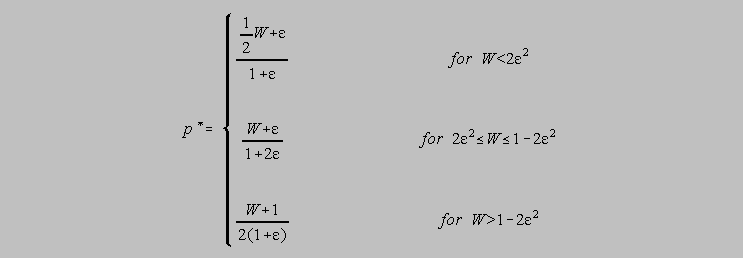 To complete the proof, it is shown that pN, conditional on the winning probability W, converges in
probability to p*. As Z(p) is strictly increasing in p, this can be established by using the equivalence
To complete the proof, it is shown that pN, conditional on the winning probability W, converges in
probability to p*. As Z(p) is strictly increasing in p, this can be established by using the equivalence
 Now, for every >0, one can find 1,2>0 such that
 and
and
 Combination of these expressions yields
 which is equivalent to
 Q.E.D.
1. 1. Recently, Hurley and McDonough (1995) hypothesized that the presence of transaction costs and informational asymmetries causes the bias, but their empirical results of two parimutuel-betting experiments are not consistent with this hypothesis. In addition, for the betting market in the U.K., which is somewhat different from the American system, insider trading has been hinted at as a potential source for biases (Shin, 1992).
2. 2. It was pointed to us that our explanation shows similarities to a result derived by Ali (1977). However, we try to be more careful about explaining the nature of the assumptions about better behavior that drive the result. Moreover, we shall make the link between our result and results derived from rational expectations theories.
3. 3. Of course, assuming rational expectations in a static model, is just a short cut for a more elaborate dynamic model in which traders can learn rational expectations from repeated observations of market data. However, such a learning process towards rational expectations, though possible, is by no means trivial (Jordan, 1985).
4. 4. The efficient market hypothesis has also invoked the attention of experimentalists. On the positive side, Plott and Sunder (1988) demonstrate that aggregation and dissemination of diverse information through the market can take place. After some learning, the price moves quickly towards the informationally efficient price. This positive result, however, is obtained in relatively simple environments. In more complex settings, convergence to rational expectations appears to be much more difficult or even unlikely. For example, in the laboratory markets studied by O'Brien and Srivastava (1991), final prices are closer to the ones predicted under ordinary expectations (like the ones we will assume) than to those predicted under rational expectations, even with experienced traders and much feedback.
5. 5. `Ordinary' is the label used by Copeland and Friedman (1987) for the expectations assumed in this model. Others refer to the `Prior Information' model, stressing the fact that expectations are exclusively based on prior (private) information (Plott and Sunder, 1988). Hence, applying this assumption to (financial) markets is not an innovation of the present paper. The innovation lies in its application to the betting market, and in thinking through it's consequences.
6. 6. We also assume that the winning probability lies in the interval [2,1-2]. It is straightforward to handle the 'border problems' that arise for winning probabilities outside this interval, but they burden the presentation considerably.
7. 7. More precisely, as the number of betters goes to infinity, the equilibrium price converges in probability to (W+)/(1+2).
8. In an auction for an item with a common value of W, a bidder with private signal si will base his bids on the expectation E[Wsi] = si if he falls prey to the judgement bias described by Assumption 3. A rational bidder who avoids the winner's curse, however, will base her bids on E[Wsi = maxkNsk] = si - (N-1)/(N+1). See Kagel and Levin (1986).
9. 9. Note, however, that at the efficient price p = W, rational betters are indifferent between the two bets, as they give equal expected payoffs of zero. Hence, if all betters were rational (f=1), assumptions 1-3 would give a no-trade equilibrium. Only due to the presence of enough naive traders (f < 2(W-)), rational traders can make a positive profit.
10. 10. At this point, opinions are not unanimous. Thaler and Ziemba (1988) support this claim, whereas Snyder (1978) concludes that the bias is not large enough to overcome track takes.