
What will people bid when they compare values to expected price?
Leon Taylor
Instructor
Division of Finance and Economics
Lewis College of Business
Marshall University
400 Hal Greer Boulevard
Huntington, West Virginia, USA 25755-2320
Taylorleon@aol.com(304) 523-6637
Abstract
Consider an auction where the auctioneer begins at a maximum price and where every bidder knows her own valuation of the object. Suppose that her valuation exceeds her expectation of the price. Then she might plan to bid more than she would have bid had she used some linear positive function of the valuation in which the bid would also have increased with the number of bidders. Such a revision of the Vickrey strategy is most likely in a small auction, where it may affect the expected price. (JEL D44)
I. Introduction
In path-breaking work, William Vickrey (1961) showed that bidders in an auction might all follow a simple strategy when they know that valuations of the object follow a uniform probability distribution. More bidders in such an auction will probably produce a proportionally higher price. Suppose that a bidder knows that. If she expects to bid against more rivals, then she will benefit by raising her bid closer to her valuation. Her bid is thus a simple function of her valuation and of her number of rivals.
One can conceive, however, that the bid in a Dutch auction might also depend on the expected price computed by the bidder. The Dutch auctioneer begins at a maximum price and then works his way down. Suppose that the bidder's price expectation exceeds the bid that she would enter with a linear (or Vickrey) strategy. Then she does not expect her bid to win. If she greatly values the object, then she can gain by bidding above her price expectation. In that case, the linear strategy is not an equilibrium: Given other bids, she can improve her expected welfare by raising her bid.
This paper seeks to trace some consequences of auction bidding that deviates from an initial Vickrey strategy. The results might also apply to surveys that seek to identify contingent valuations of non-market goods by suggesting to the respondent incremental changes in value.
II. Analytics
Consider a Dutch auction with N bidders. For simplicity, assume that their valuations vi range over [0,1] according to a uniform distribution. Also assume that their valuations are independent of one another. Under a Vickrey strategy, bidder i would bid
Now consider another strategy. A bidder – denote her as j -- computes the expected bid that her rivals would enter; then she decides whether to raise her bid above this expectation. Vickrey’s reasoning guides the following computations. The probability that the highest valuation among N-1 bidders falls in the interval between v and v + dv is (N-1) vN-2 dv. Each bid has a given probability of being the highest. Since each bid is linear in the bidder’s valuation, bidder j can compute the expected price that would emerge from rival bids as
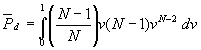
or

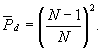
Equation 1
Bidder j’s valuation is vj. She will abandon the Vickrey strategy if she expects that it would cause her to lose a highly valued object to another bidder. She will expect this if her valuation exceeds the expected price – which, in turn, exceeds her Vickrey bid:
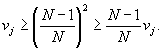
Restating the condition,
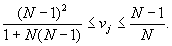
Equation 2
The condition suggests that a bidder is more likely to defect from the Vickrey strategy when facing fewer rivals. In an auction with two bidders, j will defect when her valuation satisfies 1/3 ≤ vj ≤ 1/2. That would occur with probability 1/6. To characterize an auction with many bidders, let N→∞. Taking limits in (2) suggests that j will defect only when 1≈ vj.
The bidder satisfying (2) may substitute any of many strategies for Vickrey’s. Two seem most likely, depending on the number of bidders.
When bidders are many, a small share of them will defect from Vickrey’s strategy. The rare defector may thus assume that the bulk of her rivals will stick to the Vickrey strategy. The expected price from their bidding will approximate (2). The defector may thus set her bid just above (2).
When bidders are few, a large share will defect. The expected price no longer will approximate (2). The bidder must recompute the expectation. Only the bids of those whose valuations exceed the initial expected price will matter, since they must include the winning bid. A simple assumption is that all defectors will set a bid just above the initial expected price.
The amount by which the bid exceeds the expected price -- that is, the premium -- depends on two factors. The first is whether the initial expected price is close to the maximum value of 1. If it is close, then no large premium seems necessary. The second factor is the total number of bidders. This may affect either what the auctioneer does or what bidders do. The analysis now turns to each of these two cases.
Case I: Number of bidders affects auctioneer. The auctioneer must determine the size of the increment for his price offers: Whether, for example, to decline from $100 to $99, or from $100.00 to $99.90. If the increments are too small, then the auction may take a long time, and he may lose bidders. If the increments are too large, then he may not receive the highest price possible.
Assume that the auctioneer reduces price offers by smaller increments when there are more bidders. This improves his chances of receiving a higher price; one may assume that low-value bidders are the ones most likely to be disaffected by the lengthening auction. The size of the premium relates to the size of the increment set by the auctioneer; the bidders are presumed to know the increment. Then one may model the size of the premium simply as

The revised expected price becomes
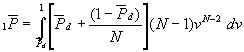
or

With two bidders,
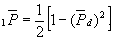
Relative to the initial expected price,  , the defector sets her bid above a low . Also, she sets her bid below a high . Her valuation exceeds the initial expected price; since there is only one other bidder, his valuation likely falls below her own, connoting that his bid would be low. She may thus choose to underbid.
Generally, when the bidder recalculates her bid, she is aware that other bidders may also recalculate their bids. The recalculations reshape the expected price and prompt a new calculation. Let t denote the number of recalculations of the expectation (t = 0 for
 ). Then the recursive expectation is

Equation 3
For a huge auction, such as one conducted over the Internet,

As in Vickrey bidding, the limit of the expectation for the equilibrium price in a huge auction is 1. This limit provides an equilibrium expectation.
In fact, N is finite for any auction, so one must consider other conditions that may characterize an equilibrium expectation. It is not feasible for the bidder to calculate the price expectation an infinite number of times. One may then assert an equilibrium expectation  where
where  in (3). Then
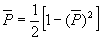
Solving yields , which is independent of the number of bidders.
The equilibrium bidding strategy, however, remains dependent on N, since the premium depends on the increment chosen by the auctioneer, smaller in larger auctions:
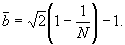
That strategy is feasible only for finite N > 3.
Case II: Bidders respond to number of bidders. A bidder may feel psychological pressure to bid more when she faces more rivals. She may thus increase the premium in her bid when N increases. Her bid becomes

where 0 ≤ f(N) ≤ 1 and f’(N) > 0.
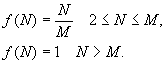
For concreteness, let
Equation 4
M measures the bidder’s perception of the minimum number of rivals that is too large to estimate accurately.
With (4), the expected price in the auction becomes

Simplifying yields
 .
.
Generally,

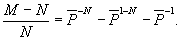
Asserting an equilibrium expectation,  , and simplifying leads to
Equation 5
From (5), a large M is feasible only when N is large or  is small. Here is an interpretation. Suppose that the bidder can accurately assess a large auction. Then, in a small auction, either the price expectation is low or no equilibrium expectation exists. This suggests that an accurate bidder may not feel pressed by her number of rivals to bid much more until that number burgeons to the limits of what she can estimate.
If N = M,

When M = N = 2, the equilibrium expectation of price is 
In computer simulations, when M = N,  rises smoothly with the number of bidders and converges on 1. is .8 for 8 bidders and .9 for 22 bidders. The price expectation of a pressured bidder thus increases rapidly with the size of an auction that strikes her as large.
III. Conclusions
In a smaller Dutch auction, a bidder is more likely to bid more than is proportional to her valuation. Indeed, if she is easily pressured by the number of rival bidders, then she may bid close to her valuation in an auction with just two dozen bidders or so. One may speculate that the Dutch auction could well deliver the object to the person who values it the most, even when she expects to pay her own bid in full.
Appendix
I. How changes in number of bidders affects chance of defection from Vickrey strategy
A bidder would abandon a Vickrey strategy if her valuation vj satisfied (1). That would happen with probability
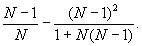
The impact of a change in the number of bidders on this probability is
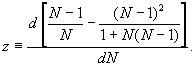
Manipulations yield

Dropping the 1 in the second bracketed expression and simplifying yields

This is negative for N > 1.
References
Vickrey, William (1961). Counterspeculation, auctions, and competitive sealed tenders. Journal of Finance 16: 8-37.