 =
=
 ,
,

Abstract
Presented here the mathematical model with one commodity that describes the acceleration of commodity production as a linear function of commodity's deficit on market. The solution of derived differential equation gives the required fluctuations of the commodity's production.
JEL classification: E 32
Keywords: Business fluctuations
Consider model with one commodity, and suppose for simplicity that its consumption is developing with the fixed rate rc. For the volume Vc of consumption we can write:
Vc =,
where 
 is the volume
of consumption at the initial time t = 0.
is the volume
of consumption at the initial time t = 0.
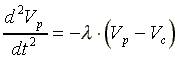
For the volume  of production assume
that it depends on the volume of consumption as a
of production assume
that it depends on the volume of consumption as a
 , (1)
, (1)
where  is a constant and
  > 0.
> 0.
In accordance with (1) acceleration (deceleration) of production
at the time t is directly proportional to the deficiency
(surplus) of commodity on the market.
Analysis and solutions of differential equations in the rest
of the article are realized ordinary (e.g. see Piskunov, 1965).
Case one
Let rc = 0. Then (1) transforms in
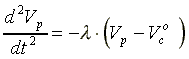
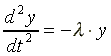
or if we use the change of variables  =
= 
 (2)
(2)
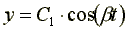
and the solution of (2) is
 + C2 sin (
t)
+ C2 sin (
t)
where  ,
,  Thus,
we obtained the so-called equation of harmonic oscillations.
Thus,
we obtained the so-called equation of harmonic oscillations.
If we reserve the change of variables and replace,
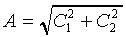 ,
,  arctg
(C1 / C2)
arctg
(C1 / C2)
we obtain another form of the same equation,
 .
.
The value A is called the amplitude of oscillations, the
value  is called the initial phase, and
the value
is called the initial phase, and
the value  is called the period of oscillations.
If the volume of production at time t = 0 was  ,
and its rate of change at that time was
,
and its rate of change at that time was  then the values of constants are,
 ,
,
 ,
,
where 

Since the amplitude of harmonic oscillations remains constant
with elapsing of time we can consider the value  as
a "potential" component of the initial energy of economical
system and the value
as
a "potential" component of the initial energy of economical
system and the value  as a "kinetic"
component of that energy at the same time t = 0.
as a "kinetic"
component of that energy at the same time t = 0.
Case two
Suppose  . Using the change of variables
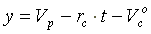
we get the same equation (2) like in case one.
Therefore the solution is
 ,
,
and for initial values  and
and  we can find the constants,
 ,
,
 ,
,
where 

Case three
It is known from Microeconomics that the change of size of commodity
deficiency (surplus) has as a consequence the change of commodity
price that draws the change of commodity consumption and hence
the change in the size of deficiency (surplus).
To take into account this impact we introduce the force Fr
of resistance that is directly proportional to the rate of change
of deficiency (surplus), and is oriented to the opposite direction
to the change of deficiency (surplus).
Thus,
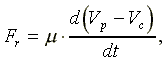
 0.
0.
Introduction of that force transforms (1) into

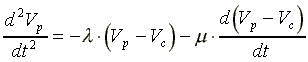 . (3)
. (3)
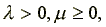
Using the change of variables  , and
taking into account
, and
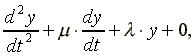
taking into account 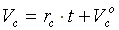 we get the so-called
equation of free oscillations,
we get the so-called
equation of free oscillations,
 (4)
(4)
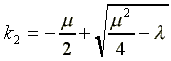
that has the following roots of its characteristic equation,
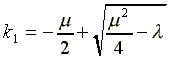 ,
,
 .
.
Subcase One
If  the solution of (4) is


and granting the change of variables the solution of (3) is
Vp 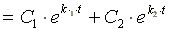 +
+  (5)
(5)
Taking into account that k1 < 0, k2
< 0 and k1 , k2  the
volume Vp of production according to (5) does
not have oscillations. It asymptotically approaches to the volume
of consumption
the
volume Vp of production according to (5) does
not have oscillations. It asymptotically approaches to the volume
of consumption 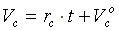 under the condition
  .
.
Subcase Two
If  the solution of (4) is

and the solution of (3) is
 + rc
t +
+ rc
t +
Here the volume Vp of production also approaches
to the volume Vc of consumption for  (slowly that in subcase one), and the process of oscillations
doesn't take place.
(slowly that in subcase one), and the process of oscillations
doesn't take place.
Subcase three
If  we arrive to the case two.
Subcase four
If  and
and  then
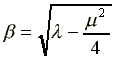
the roots of characteristic equation are complex values
then
the roots of characteristic equation are complex values
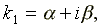
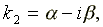
where 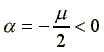 ,
,  , and
the solution of (4) is
, and
the solution of (4) is

Thus the solution of (3) is
 .
.
Since  the value (
 ) approaches to zero for
  , and we have
the so-called equation of damped oscillations for the volume Vp
of production relative to the volume of consumption
, and we have
the so-called equation of damped oscillations for the volume Vp
of production relative to the volume of consumption 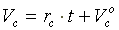 .
.
For the initial values  and
and  the values of constants are
 ,
,
 ,
,
where  ,
, 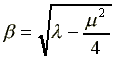 .
.
Acknowledgments
I am indebted to M. Wooders from the University of Toronto for
useful discussion and to my sister I. Cayward for help in preparation
of this article.
References
Piskunov, Nikolai S., 1965, Differential and integral calculus (Groningen P. Noordhoff).