 .
.
Abstract
For the purpose of determining the influence of the amount of savings circulating in national economy on that economy's growth or drop, a discrete mathematical model with one commodity was developed describing its production as a function of joint investments, depreciation, and introduction of technical novelties, and its consumption as a function of current production discounted by the amount of savings repouring into the next phase of commodity's production.
JEL classification: E 27
Keywords: Circulation of savings
1. Introduction
Significant sectors of Western population have been attracted
by the persistent promises of numerous mutual funds for quick
returns, especially from the funds specializing in the so-called
global investments all around the world. Few people realize the
danger associated with pouring money out of national economy:
specifically, its effect of slowing down the production in their
own country with all the following consequences of possible recession.
My intuitive idea that somewhat is wrong with the economic concept
of mutual funds forced me to develop a simplified mathematical
model which served as a good instrument for the determination
of the Lower and Upper bounds of Savings' values setting the ultimate
growth or drop.
2. Description of the Mathematical model
Consider a simple model with the production and consumption of one commodity and set up the ideal situation when there are no external impacts affecting that model. Production and consumption in such model according to the laws of nature would be developing with fixed rate. Now, we move from the natural model of continuous production to the model where commodity goes for consumption only every definite discrete instant.
We continue to suppose that commodity's production and consumption are developing at an equal and fixed rate.
On time to = 0 we have the volume Vp of commodity produced equal to the value Vo , and it becomes at that time the value Vc of commodity's volume intended for consumption until the next supply of commodity at the consecutive discrete time.
If we have determined that period of time between two consecutive
moments is equal to then the rates of production and
consumption both are equal to r = .
On the next discrete time t1 = to + we have the same volume Vp = Vo of commodity produced, and it becomes the volume going for consumption Vc = Vo during the next period of time equal to .
Thus we can describe our first discrete model summarizing the above statements in the following expressions,
Vc (tn + 0) = Vp (tn) = Vo ,
Vc (tn) = 0 , (1)
Vp (tn +0) = 0
where tn = to + n , n = 0, 1, 2, ...
Let us take into account the natural phenomenon that there doesn't exist a Perpetual Motion at all. We reflect this by introducing the impact of depreciation in the production's process by installing the multiplier (1 - d) with 0 < d 1 into the first statement of system (1). This imposes the decelerating effect on the production. I dare say that at each interval ( tk, tk + 1 rate rk+1 of production remains fixed, and that rate is reduced with the permanent coefficient (1 - d) regarding to the similar rate rk of the previous interval of time.
Thus, we can write,
rk+1 = (1 - d) rk
where ro =  and k
= 0, 1, ..., n-1.
and k
= 0, 1, ..., n-1.
This produces the second discrete mathematical model with the effect of depreciation on the commodity's production,
Vc (tn + 0) = Vp (tn) = (1 - d )n Vo ,
Vc (tn) = 0 , (2)
Vp (tn + 0) = 0
where tn = to + n , n = 0, 1, 2, ... and 0 < d 1.
We see that elapsing of time causes the diminishing of commodity's production, and to cope with this negative effect let us consider the economic concept of savings.
For the sake of continuing their operations businesses are enforced to remove some portion Vs from the commodity's current consumption and to employ it in the next consecutive period's production.
Thus, we can write the following statements for the values of savings' volume and consumption's volume respectively on the discrete time tk ,
Vs (tk) = s Vp (tk) ,
Vc (tk + 0) = Vp (tk) - Vs (tk) = (1 - s) Vp (tk)
where 0 s < 1.
The volume Vs removed from the consumption on time tk is pouring into the next period's production producing the result,
Vp (tk+1) = (1 - d) 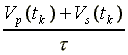
or obviously
Vp (tk+1) = (1 - d) (Vp (tk) + Vs (tk)) = (1 - d) (1 + s) Vp (tk) .
Thus, we obtained a third discrete mathematical model considering the effects of depreciation and savings' investment on the commodity's production,
Vp (tn) = (1 - d)n (1 + s)n Vo ,
Vc (tn + 0) = (1 - s) (1 - d)n (1 + s )n Vo , (3)
Vc (tn) = 0 ,
Vp (tn + 0) = 0
where tn = to + n , n = 0, 1, 2 ... and 0 s < 1 , 0 < d 1.
It would be interesting to look at the efficiency of using the savings Vs for the production in consecutive period. To detect its value we subtract the presumptive volume of production on time tk+1 without using of savings' investment Vs (tk) from the volume Vp(tk+1) of production on time tk+1 with using of mentioned investment, and divide the obtained remainder by the value of investment Vs (tk). The result would be,
 = 1 - d < 1.
Thus, the third discrete model gives us the result differing from the real situation because it is able to provide the only negative return on savings invested into economy.
To reconcile the model with our expectations we are going to overcome this neglect and put in the model the impact of productivity's increase induced both by enlargement in production's scale, and mostly by reasonable investments in the technical novelties. We will obtain this effect by applying the multiplier (1+) with 0 to the using of investments' impact on the volume of commodity's production.
The new formula for the value Vp(tk+1) would be,
Vp(tk+1) = (1 -d) (Vp(tk) + (1+) Vs(tk)) = (1 - d) (1+(1+)s) Vp(tk),
where 0, that will produce the efficiency on investment's value equal to (1+)(1-d).
Thus, the fourth and the last discrete model at this paper which includes depreciation, savings' investment, and productivity's increase enforced by the technical novations would look like,
Vp(tn) = (1-d)n (1+(1+)s)nVo ,
Vc(tn+0) = (1-s) (1-d)n (1+(1+)s)nVo , (4)
Vc(tn) =0 ,
Vp(tn+0) = 0
where tn = to + n , n=0, 1, 2, ... and 0 s <1 , 0 < d 1, 0.
From here we will restrict our discussion with the only case (1+)(1-d) > 1 where investments produce the positive efficiency, and for that case we will analyze the impact of coefficients s , d and on the ultimate growth or drop of commodity's production.
We can get the following expressions from the positive efficiency on investments' statement,
1 + >  or >
or >

where 0 < d < 1.
Let us determine now the value of savings s sufficient for ensuring the growth of production in consecutive periods.
From the expressions,
Vp(tk+1) = (1-d) (1 + (1+) s) Vp(tk)
> (1-d) (1 +  s) Vp(tk)
=
s) Vp(tk)
=
=(1 - d + s) Vp(tk)
we can conclude that condition s d will guarantee the fulfillment Vp(tk+1) > Vp(tk) provided that positive efficiency on investments (1+)(1-d) > 1 is implemented. In other words the minimal possible amount of savings Vs(tk) removed from the current consumption to be poured into consecutive period's production to guarantee the production's growth has to be equal to the value d Vp(tk).
Similarly we can find out the amount of savings s necessary to be out of the field of the guaranteed drop in the commodity's production.
Obviously that condition
Vp(tk+1) = (1-d) (1 + (1+) s) Vp(tk) < Vp(tk)
is accomplished if s < 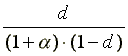 .
.
Thus, for the case of positive efficiency on investments there are three intervals for the amounts of savings s ,
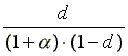 we belong to
the zone of falling production.
we belong to
the zone of falling production.
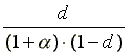 s < d we can't
make definite conclusion about the production's growth or drop
without going into further details.
s < d we can't
make definite conclusion about the production's growth or drop
without going into further details.
3. Conclusion
We can conclude even from this simplified discrete mathematical
model that it has to be always kept some minimal level of savings
invested into the national economy to guarantee the production's
growth. Also, there is a certain level of such investments dropping
below which will cause the definite permanent fall of economic
production.
4. Acknowledgments
I am indebted to my sister I. Cayward for her help in preparation
of this article.