New Result in Theory of Consumption:
Changes in Savings and Income Growth
May 1994
Copyright 1993 Cheng K. Wu
New Result in Theory of Consumption:
Changes in Savings and Income Growth
Introduction
In extending the Life Cycle-Permanent Income hypothesis, where an agent maximizes its utility based upon its assets, present and expected future labor income, Hall (1978) theorized that future consumption could be written only as a function of its current consumption; in effect, weakening the link between changes in income and consumption. One consequence of his result is that consumption theory has being slow to systematically incorporate research on factors affecting income, such as productivity and foreign trade. Our article examines this discontinuity. To help explain changes in savings, we show the Modigliani and Brumberg's proposition (1952, published 1979) that changes in savings are also a function of income growth.
Following the works of Hall (1978) and Sargent (1978), Flavin (1981) made a "convincing" derivation showing that, under the permanent income hypothesis (PIH) and rational expectations, changes in permanent income, or consumption should depend only upon revisions in expectations of future income (when these terms are assumed to be zero, Hall's martingale holds). However, from the start, this theoretical result was questioned by Flavin (1981) - and Hayashi (1982) - who found evidence that consumption is "excess-sensitive" to current income. Similarly, Deaton (1987) found evidence that changes in consumption are "excess-smooth" compared with changes in labor income. The causes of this discrepancy have been the subject of an extensive literature. Some authors, such as Deaton (1987) on aggregate consumption behavior and indefinitely lived agent, Zeldes (1989) on liquidity constraints, Campbell and Mankiew (1987) and Koenig (1990) on nonseparabilities of the utility function of consumers and Deaton (1991) on rate of time preference and interest rates, have examined the microfoundations of the PIH's and rational expectations; while others, Hall and Mishkin (1982) on current consumption response to an innovation in income, Quah (1991) on agent's information of its permanent and transitory components of labor income and Deaton (1991) on income growth as the income process, have emphasized the nature of the income process.
Since many of the above mentioned authors have employed Flavin's derivation as the starting point, we also think appropriate to examine this increasing divergence between theory and evidence based upon her original approach. In section I, we show her three basic equations, and in section II, we replaced one of her equations. Under the same initial conditions, we show that the permanent income for the period t+1 should have the sum of incomes varying from period 1 to infinite instead of 0 to infinite, i.e. the loss of one labor income should be partially compensated for by an increase in assets (in the Appendix, we derive a generic permanent income equation and also discuss Flavin's possible mispecification). Graphically,
Flavin Our Approach
Sum of Labor Income varying from 0 to infinite varying from 0 (or 1) to infinite
at period t |---------- -----> |---------- ----->
at period t+1 |---------- -----> |------ ----->
0 infinite 0 1 infinite
(loss of 1 labor income due to aging)
With this adjustment for the period t+1, we show that changes in consumption should also
depend upon labor income and change in assets. In section III, we apply this result to savings and
show that its change may depend upon interest rate and growth of labor income.
I The Three Basic Equations
Following Flavin (1981), an agent's permanent income can be expressed as
At is the agent's real non-human wealth at the beginning of the period t,
r is the real rate of return, assumed constant,
is (1 + r)-1
yt is labor income at the end of period t,
Et is the agent's expectation at period t.
Assets varying according to:
 And, Flavin (1981) considered agents consuming exactly their permanent income,
 where consumption, ct, is also paid at the end of period t.
(From the seminal works of Friedman (1957), Modigliani and Brumberg (1954), Muth (1961)
and the already mentioned authors, these equations basically assume a quadratic utility with constant
risk, infinitely lived and forward-looking agents, little or no liquidity constraints, and rate of time
preference equal to interest rate. It also assumes rate of interest and income exogenous to
consumption.)
II What, However, Is Permanent Income for Period t+1?
While Flavin (1981) wrote permanent income at t+1 as,

in the Appendix A, we show that, assuming interest rates were to remain constant, an agent's permanent incomes over time should be:


 Specifically, under an "Euler equation approach," if there is a change in the reference system,
from t to t+1, permanent income at t+1 should be written as
Specifically, under an "Euler equation approach," if there is a change in the reference system,
from t to t+1, permanent income at t+1 should be written as

If, as in eq. (3), the change in consumption with stochastic, or transitory components of consumption were,

Substituting eq. (6) and (1) into (7), we find that,
 and since,
 eq. (8) can be written as
 Eq. (9) shows that changes in consumption depend upon more than just changes caused by
revisions in expectations on income. Note that, by working out the variances on eq. (9), it easy to
see that the addition of the changes in assets less current income may help explain why changes in
consumption are "excessively smooth" compared with the changes in income, i.e. the Deaton's
paradox (see Flavin 1992).
Eq. (9) shows that changes in consumption depend upon more than just changes caused by
revisions in expectations on income. Note that, by working out the variances on eq. (9), it easy to
see that the addition of the changes in assets less current income may help explain why changes in
consumption are "excessively smooth" compared with the changes in income, i.e. the Deaton's
paradox (see Flavin 1992).
Furthermore, if we simplify eq. (9) assuming that,

then changes in consumption are given by

III Was the Decline of Savings Caused by a Slower Growth of Income?
From the definition of total income or "measured" income,

eq. (11) can be written as

thus,

From eq. (13), we could conclude that, for constant rates, the recent decline of savings may, in theory, be partially attributed to a slower growth in labor income. This result was anticipated by Modigliani and Brumberg (1952, published 1979). The striking innovation of their model over earlier ones - and advantage over more recent ones - was to rationalize zero-negative saving in terms of the stationary-dynamic state of the economy.
For the past two decades, this decline in growth seems to be supported by a growing number
of research. Among them, Levi (1989) found evidence of slower growth of family income and
inequalities in income distribution; Bosworth, Burtless and Sabelhaus (1991), after an extensive
discussion on demographics, income distribution and capital gains, also raised the possibility of
savings decline being related to a slower growth of income. In practice, to derive its optimal
consumption model, Deaton (1991) has also accepted the growth of income as the income process.
Appendix A
A.1 A consumer maximizes
Thus, under the "Euler equation approach," which is found in many textbooks, including
Sargent (1987) - chapters IX and XII, optimal consumption for period t is given by
Obviously, repeating the same optimization technique applied for eq. (iii), one should find
that consumption, ct+1, ct+2, . . . , ct+n, should be given by,
Assuming Rb = 1, the difference between (vi) and (iii) is,
and since,
writing equation (vii) in terms of their power series results in,
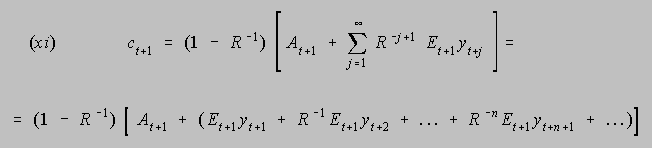
A.2 On the other hand, though Flavin provided no explanation on how she arrived at equation (4),
it would be a mispecification to reach her conclusion based upon "shifting forward one period and
writing out the polynomial in L explicitly." That is, dividing eq. (iii) by L results in
or,
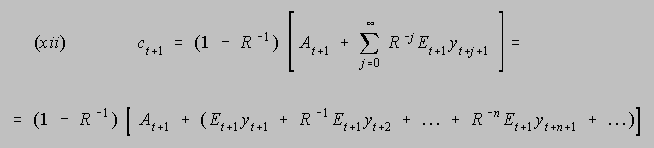
which may be confused with Flavin's equation (4):
Eq. (xii) is clearly not a particular case of eq. (vi). The flaw is that, multiplying eq. (iii), which
is a particular optimal consumption, either by a constant or variable, or worse, utilizing the lag
operator definition to establish beforehand that there is a relationship between ct and ct+1 , will not
necessarily result in another optimal solution.
Ando, A. and Modigliani, F. (1963), "The life-cycle hypothesis of saving: aggregate implications and tests" American
economic review.
Auerbach, A. J. and Poterba, J. M. (1987), "Why Have Corporate Tax Revenues Declined?," in Tax Policy and the Economy,
vol. 1, edited by Lawrence H. Summers, MIT Press.
Barro, R. J. and Grossman, H. I. (1971), "A General Disequilibrium Model of Income and Employment," The American
Economic Review, March, p. 82-93.
Barro, R. J. (1989), "The Ricardian Approach to Budget Deficits," Journal of Economic Perspectives, Spring 1989, p. 37-54.
Baumol, W. J. (1989), "Is There a U.S. Productivity Crisis?," Science.
Baumol, W. J., Blackman, S. A. B. and Wolff, E. N. (1989), "Productivity and American Leadership: The Long View," The
MIT Press.
Bell, L. A. (1989), "Union Concessions in the 1980's," Federal Reserve Bank of New York, Quarterly Review (Summer).
Blecker, R. A. (1989), "International Competition, Income Distribution and Economic Growth," Cambridge Journal of
Economics, 1989, 13, p. 395-412.
Blecker, R. A. (1990), "Are Americans on a Consumption Binge?," Economic Policy Institute
Bourguignon, F. and Morrison, C. (1989), "External Trade and Income Distribution," OECD Development Centre Studies.
Bosworth, B., Burtless, G. and Sabelhaus, J. (1991), "The Decline in Saving: Evidence from Household Surveys," The
Brookings Institution.
Campbell, J. Y. (1987), "Does Saving Anticipate Declining Labor Income? An Alternative Test of the Permanent Income
Hypothesis," Econometrica, November, vol. 55.
Campbell, J. Y. and Deaton, A. (1989), "Why is Consumption So Smooth," Review of Economic Studies, vol. 56.
Campbell, J. Y. and Mankiw, N. G. (1987), "Permanent Income, Current Income, and Consumption," Working Paper 2436,
NBER, Cambridge, MA.
Campbell, J. Y. and Mankiw, N. G. (1989), "Consumption, Income, and Interest Rates: Reinterpreting the Times Series
Evidence," NBER Macroeconomics Annual 1989, p. 185-245.
Clower, R. W. (1965), "The Keynesian Counterrevolution: A Theoretical Appraisal," in The Theory of Interest Rates, ed.
F.H. Hahn and F.P.R. Brechling, Macmillan, p. 103-25.
Darby, M. R. (1987), "Consumption function," The New Palgrave.
Dean, A., Durand, M., Fallon, J. and Hoeller, P. (1989), "Saving Trends and Behavior in OECD Countries," OECD working
paper No. 67.
Deaton, A. (1987), "Life-Cycle Models of Consumption: Is the Evidence Consistent with the Theory?" In Advances in
Econometrics: Fifth World Congress, vol. 2, edited by Truman F. Bewley. Cambridge Univ. Press.
Deaton, A. (1991), "Saving and Liquidity Constraints," Econometrica, Vol. 59, No. 5, p. 1221-48.
Englander, A. S. and Steindel, C. (1989), "Evaluating Recent Trends in Capital Formation," Federal Reserve Bank of New
York, Quarterly Review (Autumn).
Feldstein, M. (1974), "Social Security, Induced Retirement, and Aggregate Capital Accumulation," Journal of Political
Economy 82: 905-26.
Flavin, M. A. (1981), "The Adjustment of Consumption to Changing Expectations about Future Income," Journal of Political
Economy, vol. 89, no.5.
Flavin, M. A. (1992), "The Excess Smoothness of Consumption: Identification and Interpretation," Review of Economic
Studies, forthcoming.
Friedman, M. (1957), A Theory of the Consumption Function, Princeton University Press.
Fuhrer, J. C. (1992), "Do Consumers Behave as the Life-Cycle/Permanent-Income Theory of Consumption Predicts?," New
England Economic Review, Sept./Oct.
Hall, R. E. (1978), "Stochastic Implications of the Life Cycle-Permanent Income Hypothesis: Theory and Evidence," Journal
of Political Economy, p. 971-87, October 1978.
Hall, R. E. and Mishkin, F. S. (1982), "The Sensitivity of Consumption to Transitory Income: Estimates from Panel Data
on Households," Econometrica, 50, 461-481.
Hansen, L. P. and Singleton, K. J. (1982), "Generalized Instrumental Variables Estimation of Nonlinear Rational
Expectations Models," Econometrica, vol. 50, no. 5.
Harrod, R. F. (1957), International Economics, The University of Chicago Press.
Hatsopoulos, G., Krugman, P., and Poterba, J. (1989), "Overconsumption: the Challenge to U.S. Economic Policy,"
American Business Conference.
Hayashi, F. (1982), "The Permanent Income Hypothesis: Estimation and Testing by Instrumental Variables," Journal of
Political Economy, vol. 90.
Helpman, E. and Krugman, P. R. (1985), Market Structure and Foreign Trade, The MIT Press.
Hooper, P. and Mann, C. L. (1989), "The Emergence and Persistence of the U.S. External Imbalance, 1980-87," Princeton
Studies in International Finance, No. 65, October 1989.
Keynes, J. M. (1936), The General Theory of Employment, Interest, and Money, Hartcourt Brace Jovanovich.
Koenig, E. F. (1990), "Real Money Balances and the Timing of Consumption: An Empirical Investigation," The Quarterly
Journal of Economics, May 1990.
Kotlikoff, L. J. and Summers, L. (1981), "The Role of Intergenerational Transfers in Aggregate Capital Accumulation,"
Journal of Political Economy.
Leijonhufvud, A. (1981), Information and Coordination: Essays in Macroeconomic Theory, Oxford University Press, p. 119.
Levy, F. (1989). "Recent Trends in U.S. Earnings and Family Incomes," NBER Macroeconomics Annual 1989, p. 73-120.
Lipsey, R. E. and Kravis, I. B. (1987), Saving and Economic Growth: Is the United States Really Falling Behind?, American
Council of Life Insurance and The Conference Board.
Lucas, R. E. (1976), "Econometric Policy Evaluation: A Critique," in The Phillips Curve and Labor Markets, ed. K. Brunner
and A. Meltzer, Carnegie-Rochester Conference on Public Policy 1, Amsterdam: North Holland.
Machlup, F. (1943), International Trade and the National Income Multiplier, Augustus M. Kelley.
McCauley, R. N. and Zimmer, S. A. (1989), "Explaining International Differences in the Cost of Capital," Federal Reserve
Bank of New York, Quarterly Review (Summer).
McKenzie, R. B., Klein, C. (1992), "The 1980s: A Decade of Debt?," Center for the Study of American Business,
Washington University.
Meltzer, A. H. (1988), Keynes's Monetary Theory, A Different Interpretation, Cambridge University Press.
Mishel, L. (1988), "Manufacturing Numbers: How Inaccurate Statistics Conceal U.S. Industrial Decline," Economic Policy
Institute.
Modigliani, F. (1975), "The Life Cycle Hypothesis of Saving Twenty Years Later," Contemporary Issues in Economics.
Modigliani, F. (1985), "Life Cycle, Individual Thrift and the Wealth of Nations," Nobel lecture.
Modigliani, F. (1988), "The Role of Intergenerational Transfers and Life Cycle Saving in the Accumulation of Wealth,"
Journal of Economic Perspectives.
Modigliani, F. and Brumberg R. (1954), "Utility Analysis and the Consumption Function: An Interpretation of Cross-Section
Data," in K.K. Kurihara, ed., Post-Keynesian Economics. Rutgers University Press.
Modigliani, F. and Brumberg R. (unpublished manuscript 1952, published 1979), "Utility Analysis and Aggregate
Consumption Functions: An Attempt at Integration," in The Collected Papers of Franco Modigliani, ed. A. Abel, Vol. 2, MIT
Press.
Muth, J. F. (1960), "Optimal Properties of Exponentially Weighted Forecasts," Journal of the American Statistical
Association, vol. 55, no. 290.
Muth, J. F. (1961), "Rational Expectations and the Theory of Price Movements," Econometrica, vol. 29, no. 6.
Patinkin, D. (1987), "Walras's Law," The New Palgrave.
Sargent, T. J. (1978), "Rational Expectations, Econometric Exogeneity, and Consumption," Journal of Political Economy,
vol. 86, no. 4.
Sargent, T. J. (1987), Macroeconomic Theory, 2nd edition, Academic Press.
Sraffa, P. (1961), Production of Commodities by Means of Commodities, Cambridge University Press.
Sturm, P. H. (1983), "Determinants of Saving: Theory and Evidence," OECD Economic Studies No.1.
Zeldes, S. P. (1989), "Consumption and Liquidity Constraints: An Empirical Investigation," Journal of Political Economy,
vol. 97, no. 2.