 where c is real consumption, L is labor supply, 0<1 is the
discount factor, and Et[] is the expectation operator
conditional on information at time t. We assume(1):
where c is real consumption, L is labor supply, 0<1 is the
discount factor, and Et[] is the expectation operator
conditional on information at time t. We assume(1):
EFFICIENCY OF THE PAYMENTS SYSTEM, VELOCITY OF CIRCULATION
OF MONEY, AND FINANCIAL MARKETS
by
Flavio Padrini
Ministry of the Treasury, Italy
ABSTRACT
The paper presents a general equilibrium monetary production
model to illustrate the influence of unexpected changes in
the efficiency of the payments system on the velocity of
circulation of money and on the financial markets, in the
presence of uncertainty. In this model, households face a
cash-in-advance constraint and use a part of current income
for present consumption. The results depend critically on
the magnitude of the changes in the payment process relative
to the monetary injections in the economy. If such changes
are small, then the velocity of money is exogenously
determined by the level of efficiency of the payments
system. Moreover, the financial markets are affected by
unexpected changes both in the money supply and in the
velocity of money. In contrast, if the relative changes in
the payment process are large, then the velocity of money is
endogenously determined by households' decisions regarding
cash-holding, lending, consumption, and labor. Moreover, it
appears that the financial markets are affected only by
changes in the rate of growth of money.
EFFICIENCY OF THE PAYMENTS SYSTEM, VELOCITY OF CIRCULATION
OF MONEY, AND FINANCIAL MARKETS*
by
Flavio Padrini
Ministry of the Treasury, Italy
First draft: May 1995
This draft: November 1996
* The opinions expressed in this paper are those of the author and do not necessarily represent the views of the Italian Ministry of the Treasury. I am indebted to Behzad Diba for encouragement and guidance during countless meetings, and to Matthew Canzoneri for suggestions and stimulating discussions. Thanks to Riccardo Fiorito, Pamela Labadie, and Chul Woo Park for comments, and to seminar participants at Georgetown University and at the Conference on "Payment Systems Research and Public Policy: Risk, Efficiency, and Innovation", sponsored by the Board of Governors of the Federal Reserve System and by the Journal of Money, Credit, and Banking, Washington D.C., 7-8 December 1995. All the remaining errors are mine.
1. Introduction.
In standard general equilibrium cash-in-advance models, as developed since the influential work of Lucas (1980), the income earned by households in the present period is unavailable for spending until next period. Woodford (1991) and Canzoneri and Dellas (1993) relax this assumption by allowing a portion of current earned income to be immediately available to households for spending in the present period. Underlying the models of Woodford (1991) and Canzoneri and Dellas (1993) is the assumption that the more efficient the payments system in the economy, the higher is the fraction of earned income available for current spending.
This paper presents a general equilibrium model that investigates the effect of innovations in the payments system on the velocity of circulation of money and on the financial markets in the presence of uncertainty about the efficiency of the payments system itself. As in Lucas (1980), households hold money for transaction reasons by imposing a cash-in-advance constraint on consumption purchases. As in Lucas (1990) and Fuerst (1992), households' decisions regarding cash-holding for consumption and financial investment reasons are made before observing the changes in productivity, money supply, and efficiency in the payments system. This assumption is equivalent to the hypothesis that portfolio decisions are slow in the short run, and full adjustment of the portfolio in response to exogenous shocks occurs after some lag.
The Lucas-Fuerst set-up incorporates both the Fisherian fundamentals and the liquidity effect in the determination of the nominal interest rate. The Fisherian fundamentals are represented by the real rate (the intertemporal marginal rate of substitution) and the premium due to expected inflation. As long as the exogenous shocks are serially correlated, the expected inflation premium will be different from zero not only in the present period but also afterwards. In contrast, the liquidity effect of an exogenous shock lasts only one period. A positive (negative) "liquidity effect" premium arises if cash in the financial market is more (less) valuable than in the goods market.
The model developed below differs from the Lucas-Fuerst set-up in two respects. First, households own equity shares of the firms. These equities entitle the owner to a share of the dividend payment distributed by the firms in each period. Thus, the model can be used to analyze the effect of exogenous shocks not only on the interest rate in the loan market, but also on the price of equities in the stock market.
In addition, it is assumed that a part of the dividends and income from labor can be used immediately by households for current consumption. As in Woodford (1991), it is assumed that a larger income immediately available for purchases implies a more efficient payments system in the economy. Therefore, it is possible to assess the temporary effect of unexpected changes in the efficiency of the payments system on the velocity of money and on financial markets.
The main result of the paper indicates that the response of money velocity and financial markets to exogenous disturbances depends crucially on the relative magnitude of the shocks themselves. If the change in the efficiency of the payments system is small relative to money injection, then all the cash held for consumption reasons will be spent. This results in the velocity of money being exogenously determined by the level of efficiency in the payment structure. Moreover, the interest rate and equity prices are affected by both monetary expansion and the velocity of money. A money injection increases liquidity in the financial market, whereas a higher velocity of money raises liquidity in the goods market. Hence, the two shocks have opposing effects: the nominal interest rate decreases when the money injection hits the economy, whereas it increases if the velocity of money unexpectedly increases. The opposite holds true for the price of equity shares.
If the shock in the efficiency of the payments system is high relative to the money shock, then not all the money that was held for consumption reasons will be spent, and part of it will be held idle and carried over to the next period. Thus, the velocity of money is not exogenously determined by the payments system technology in the economy but endogenously determined by the households' decisions regarding cash-holding, lending, consumption, and labor. In addition, the financial markets are affected only by the monetary shocks. Indeed, neither the nominal interest rate nor the price of equities are influenced by changes in the payments system. However, the effect of monetary injections is identical to the previous case.
Section 2 reviews the literature on the relationship
between the efficiency of the payment structure and the
velocity of money circulation. Section 3 describes the model
economy. Section 4 solves the optimization problem faced by
households and firms, and discusses the Fisherian
determinants of the nominal interest rates. Sections 5 and
6 discuss the liquidity effect of payments system
innovations and monetary injections. In particular, Section
5 analyzes the solution for the case when all the money is
used for transactions, whereas Section 6 analyzes the
solution for the case of positive cash balances kept unused
during the period. Section 7 contains the conclusions.
2. The Relationship between the Efficiency of the Payments
System and the Velocity of Money.
The characterization of the velocity function given in this paper is close to the description given by Knut Wicksell's Interest and Prices (1898).
Wicksell states: "It is at once clear that the purely physical conditions under which money can be paid and transported set a definite limit to the magnitude of the velocity of circulation" (p.54). In other words, the degree of efficiency of the payments system in the economy defines an upper limit for the velocity of circulation of money.
Nonetheless, immediately afterwards Wicksell observes: "There is...an important factor that sets both upper and lower limits to the magnitude of the velocity of circulation. It is the time during which each piece of money has to lie unused in the till between two successive payments"(p.55).
Wicksell describes three reasons why money lies unused in the till. The first is what is now called the transaction motive. This depends on "technical and natural features which sometimes cause a concentration of receipts at one time and of payments at another time..."(p.56). Another reason is what the modern literature defines as the precautionary motive: "...we have to consider those more or less unforeseen disbursements which occur in every business. To meet them, a larger or smaller amount of money must be kept in reserve"(p.57). The third reason is the excess amount of money temporarily accumulated by wealthy people as a result of the sale of blocks of capital.
The share of money used for transaction reasons was later called "active money" by Angell (1936,1937) and "working balances" by Ellis (1938), whereas the share kept unused in the till was called "idle money" by the same authors.
In this paper, the efficiency of the payments system is studied under a cash-in-advance economy along the lines of Woodford (1991) and Canzoneri and Dellas (1993). These authors assume that a fraction of current revenues can be spent by the households immediately in the same period, while the remaining fraction can be spent only in the following period. This means that the same cash can be used more than once in each period to finance the purchase of goods by the households. A higher fraction of current revenues that can be spent immediately implies a higher degree of efficiency in the payments system.
They also assume that households choose the amount of cash for present period consumption after being fully informed about the efficiency of the payments system in the economy. Then, an increase in efficiency leads to an increase in the velocity of money. Indeed, knowing that a greater fraction of current revenues can be spent immediately, households will save on cash and velocity will go up.
This paper shows that an increase in efficiency does not necessarily lead to an increase in velocity. Indeed, it is assumed that households will choose the amount of cash for present period consumption while being uncertain about the payments system in the economy and, as a result, uncertain about the fraction of current revenues immediately available for consumption. Thus, a certain amount of cash held by households for consumption reasons will actually reflect the uncertainty they face in the payments system. This feature, together with the assumption of sluggish portfolio decision from the households, may actually result in part of the cash balances held for present period consumption not being spent by the households so that velocity of money will not be affected by the change in the payments system.
As stated by Wicksell, the efficiency of the payments
system sets an upper limit to the rate of circulation of
money. However, the velocity of money also depends on the
amount of balances that households decide to keep idle.
3. The Model.
The economy is inhabited by identical, atomistic, infinitely-lived households and by identical, atomistic firms.
Each household is composed of a shopper, a worker, and a financial intermediary. In each period t one unit of time and one equity share of the representative firm's profits represent the endowment of the household.
In each period, the state of the economy determines a vector of random shocks (zt xt t) where z is a productivity parameter affecting the firms' technology, x is the rate of monetary expansion, and is an index of the efficiency of the payments system in the economy.
The timing in each period is as follows:
1) The household chooses the amount of money given to the financial intermediary for securities trading, and the portion given to the shopper for consumption purposes. After this decision is made, monetary balances cannot be transferred from the shopper to the financial intermediary, or vice versa;
2) Afterwards, the state of the economy is revealed, at which point the shopper decides how much to consume, the worker determines how many hours to work, the financial intermediary specifies the amount of money to lend to the firm as well as the number of equity shares to buy, and, finally, the firm decides on its labor and loan demand;
3) At the end of the period, the financial, labor, and goods markets clear. Furthermore, the components of the household reunite to pool together their consumption goods and monetary income.
At time t the preferences over uncertain consumption and leisure of the representative household are described by:
where c is real consumption, L is labor supply, 0<1 is the
discount factor, and Et[] is the expectation operator
conditional on information at time t. We assume(1):
 The firms use labor from the household to produce the
consumption good according to the technology described by
the function:
The firms use labor from the household to produce the
consumption good according to the technology described by
the function:
 where H is the labor demand from the firm(2).
Following Lucas (1990), the shopper and the financial intermediary face the respective cash-in-advance constraints given below:

 In the above inequalities M is money-holding from the
previous period, N is the amount of money that the household
chooses for financial trading, X is an exogenous monetary
injection to the financial intermediary, s and Q are the
holding and the price of the equity share, P is the price of
the consumption good, and W is the nominal wage. Following
Woodford (1991), and Canzoneri and Dellas (1993), 0<1 is
the fraction of current revenue net of labor cost from the
sale of goods produced by the firm and also the fraction of
labor income that is available to the shopper for
consumption purchases at time t. Therefore, can be
considered as an index of the efficiency of the payments
system in the economy.
In the above inequalities M is money-holding from the
previous period, N is the amount of money that the household
chooses for financial trading, X is an exogenous monetary
injection to the financial intermediary, s and Q are the
holding and the price of the equity share, P is the price of
the consumption good, and W is the nominal wage. Following
Woodford (1991), and Canzoneri and Dellas (1993), 0<1 is
the fraction of current revenue net of labor cost from the
sale of goods produced by the firm and also the fraction of
labor income that is available to the shopper for
consumption purchases at time t. Therefore, can be
considered as an index of the efficiency of the payments
system in the economy.
In Eq.(5) it is assumed that the financial intermediary can use N + X and the value of the equity shares from the previous period to either buy new equity shares to carry into the next period or lend money directly to the firm at the nominal interest rate I. The firm's repayment must be made at the end of the current period.
As in Fuerst (1992), the firm borrows from the financial intermediary in order to finance the labor cost needed for production. In other words, the firm faces the following credit-in-advance constraint:
 where B is the firm's demand for loans.
The state variables are the holdings of nominal money
and equity shares by the household as well as the per capita
nominal money stock in the economy  . The evolution of the
household's money holdings and of the per capita nominal
stock are given, respectively, by:
. The evolution of the
household's money holdings and of the per capita nominal
stock are given, respectively, by:

 On the right hand side of Eq.(7) the expression in the first
bracket represents the nominal income from the shopper-worker, whereas the second bracket is the income from the
financial intermediary.
On the right hand side of Eq.(7) the expression in the first
bracket represents the nominal income from the shopper-worker, whereas the second bracket is the income from the
financial intermediary.
As in Lucas and Stokey (1987), it is convenient to normalize all the nominal variables, except the nominal interest rate, by the per capita beginning-of-period nominal money stock in the economy. Lower case letters denote these normalized variables, so that, after normalization, Eqs. (4)-(7) become, respectively:



 Here, xt is the growth rate of money at date t.
Moreover, as in Lucas (1978),in equilibrium s = 1 at all
periods so that the constraint in Eq.(10) becomes n+x 0.
It is assumed that this constraint never binds, i.e. the
financial intermediary always lends a positive amount of
cash to the productive unit(3).
Here, xt is the growth rate of money at date t.
Moreover, as in Lucas (1978),in equilibrium s = 1 at all
periods so that the constraint in Eq.(10) becomes n+x 0.
It is assumed that this constraint never binds, i.e. the
financial intermediary always lends a positive amount of
cash to the productive unit(3).
4. Optimization of Households and Firms, and Velocity of
Circulation of Money.
Let the symbols with the prime denote the variables at time t+1, and the symbols without the prime denote the variables in period t. In addition, let functions with a variable as a subscript denote the first derivative of the functions with respect to that variable.
At time t the household chooses n, c, L, and s' so as
to maximize the expected lifetime utility function given by
Eq.(1) subject to the cash-in-advance constraint Eq.(9) and
the evolution of money Eq.(12). The Bellman equation
corresponding to the above optimization problem is:
 subject to (9) and (12).
In solving the above maximization problem, the first order conditions are:




 where denotes the multiplier associated with the cash-in-advance constraint.
The envelope conditions are:

 In period t the firm decides b and H so as to maximize
profits subject to the constraint Eq.(11). In solving the
firm's maximization problem, the first order conditions are:
In period t the firm decides b and H so as to maximize
profits subject to the constraint Eq.(11). In solving the
firm's maximization problem, the first order conditions are:

(22) = I
 where is the multiplier for the constraint.
The stationary, rational expectation equilibrium is given by non-negative functions for n, c, L, s', Vm, Vs, , , p, w, I, and q, with p, q, and w strictly positive and n and L between zero and one, that solve the system of equations (14)-(23), and satisfy the market-clearing conditions in the goods, labor, and financial markets.
It is important to notice that from Eqs. (22)-(23) the credit-in-advance constraint will be binding in each period, given a strictly positive nominal interest rate. Indeed, if I is strictly positive, it is costly for the firm to carry over cash from this period to the next. In the rest of the paper, it will be assumed that the nominal interest rate is strictly positive so that all the cash borrowed will be entirely used by the firm to finance labor costs in the present period.
More importantly, recall from Lucas (1978) that in equilibrium s=1. Moreover, in equilibrium m=1, H=L, c=f(L,z) so that the resulting inequality in Eq.(18) gives:
 where v is the velocity of money in the economy. It is clear
then that the expression 1/(1-) represents an upper bound
for the velocity of circulation of money in the economy. As
the efficiency of the payments system increases, so does
this upper bound for velocity.
where v is the velocity of money in the economy. It is clear
then that the expression 1/(1-) represents an upper bound
for the velocity of circulation of money in the economy. As
the efficiency of the payments system increases, so does
this upper bound for velocity.
When the cash-in-advance constraint binds, v = 1/(1-) so that velocity reaches the upper bound. Applying Wicksell's intuition, in this case all the money in the economy is active and the velocity of money is exogenously determined by the state of the payments system in the economy.
The household, however, when allocating the money shares between the shopper and the financial intermediary, faces uncertainty due to the stochastic structure that characterizes productivity, the rate of money expansion, and the efficiency of the payments system in the economy. As a result, once the state is revealed, the shopper may choose to keep some of the cash idle during the period and carry it over into the next period. If this is the case, then the cash-in-advance constraint does not bind and the velocity of money will be below its upper bound: v < 1/(1-).
Let us assume for the moment that the cash-in-advance constraint is binding so that v = 1/(1-).
Eqs.(15), (19), and (22) give:
 As in Fuerst (1992), the nominal interest rate can be
decomposed into a "liquidity effect" component, and a
Fisherian component. The expression in the second square
bracket of Eq.(25) represents the Fisherian determinants of
the nominal interest rate composed of the real rate (the
intertemporal marginal rate of substitution), and a premium
due to expected inflation.
As in Fuerst (1992), the nominal interest rate can be
decomposed into a "liquidity effect" component, and a
Fisherian component. The expression in the second square
bracket of Eq.(25) represents the Fisherian determinants of
the nominal interest rate composed of the real rate (the
intertemporal marginal rate of substitution), and a premium
due to expected inflation.
If at time t a positive money growth shock hits the economy, the expected inflation premium will be positive so that the Fisherian component of the interest rate will be higher. Moreover, if the money shocks exhibit positive serial correlation, the expected inflation premium will be positive also after period t.
If at time t a velocity shock hits the economy, the expected inflation premium will be positive, negative or null if velocity growth exhibits positive, negative or zero autocorrelation, respectively. The same is true for the periods after time t.
Christiano (1994) illustrates for the US economy that money growth shows persistence in the period 1959-1984. Then, when the money growth shock hits the economy, the expected inflation premium is positive and tends to raise the Fisherian component of nominal interest rates at time t and afterwards.
As for velocity, Figure 1 shows quarterly data from 1959:1 to 1995:1 of consumption velocity of money for the US economy. Consumption velocity of money is measured as the ratio between the sum of non durable consumption goods and services and M1. From 1959:1 to 1980:2 the variable exhibits an upward trend, whereas from 1980:3 to the end of the sample velocity shows an erratic behavior around a mean value of 1.34.
 The behavior of the variable suggests velocity growth
persistence be examined by dividing the sample into two
subsamples, the first one spanning from 1959:1 to 1980:2 and
the second one spanning from 1980:3 to 1995:1. Thus, I
regress one equation for each subsample. In the equation for
the first subsample, velocity growth at time t is regressed
on a constant and on velocity growth at time t-1. In the
equation for the second subsample, velocity growth at time
t is regressed only on velocity growth at time t-1(4).
The behavior of the variable suggests velocity growth
persistence be examined by dividing the sample into two
subsamples, the first one spanning from 1959:1 to 1980:2 and
the second one spanning from 1980:3 to 1995:1. Thus, I
regress one equation for each subsample. In the equation for
the first subsample, velocity growth at time t is regressed
on a constant and on velocity growth at time t-1. In the
equation for the second subsample, velocity growth at time
t is regressed only on velocity growth at time t-1(4).
Table 1 shows the results of the two regressions. The
first-order autoregressive coefficient is significantly
greater than zero in both subsamples. As a consequence, for
the US economy the expected inflation premium is positive
when a velocity shock hits the economy so that the Fisherian
component of the nominal interest rate is higher. Moreover,
the expected inflation premium will persist after time t due
to the persistence of velocity growth.
___________________________________________________________
Table 1
ESTIMATED VELOCITY GROWTH ( ) PERSISTENCE
Subsample 1959:1-1980:2
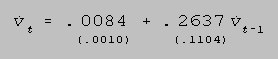 Standard error of estimate = .0067
Subsample 1980:3-1995:1
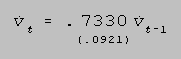 Standard error of estimate = .0087
Note: The values in parentheses below the parameter estimates represent the standard error of the parameters.
____________________________________________________________
The expression in the first square bracket of Eq.(25) represents the liquidity effect of exogenous shocks to nominal interest rates.
The following sections will analyze the liquidity effect of temporary disturbances in the growth rate of money supply and in the efficiency of the payments system on the financial markets and on the velocity of money(5). For this purpose, it is useful to assume that the state variables are i.i.d. across time and that x, , and z are mutually independent shocks. Consequently, the expectations Et(Vm') and Et(Vs') are constant and independent of time. Denote E(Vm') = A and E(Vs') = D.
As in Svensson (1985), the cases can be separated into two regions in (x )-space: one in which the cash-in-advance constraint binds, and the other in which the constraint is not binding. The border between the two regions can be calculated by allowing the constraint to hold with equality and assuming that = 0. Thus, Eqs. (15) and (18) give in equilibrium:
 If < (x), then the cash-in-advance constraint binds,
whereas if > (x), then the constraint does not bind.
Intuitively, if the fraction of current revenues available
for today's consumption is high relative to the monetary
injection in the economy, then households may choose to hold
some of the cash idle and carry it over into the next
period. Indeed, a relatively high means that a large
amount of revenues is available for current consumption;
alternatively, a relatively small x means that the cost of
holding money for the next period is low. The opposite holds
true if is small relative to the monetary expansion(6).
If < (x), then the cash-in-advance constraint binds,
whereas if > (x), then the constraint does not bind.
Intuitively, if the fraction of current revenues available
for today's consumption is high relative to the monetary
injection in the economy, then households may choose to hold
some of the cash idle and carry it over into the next
period. Indeed, a relatively high means that a large
amount of revenues is available for current consumption;
alternatively, a relatively small x means that the cost of
holding money for the next period is low. The opposite holds
true if is small relative to the monetary expansion(6).
The next section studies the effects of changes in x and
on the financial markets when all the cash in the economy
is active. Section 6 focuses on the implications of the
presence of a positive amount of idle balances.
5. Efficiency of the Payments System, Velocity of Money, and
Financial Markets.
Proposition 1. Assume that the payments system and money growth processes are such that:
 Further, assume that in period t, <(x). Then, in period t
the velocity of money is exogenously determined by the state
of the payments system in the economy. Additionally, the
velocity of money and money growth innovations exert
opposite effects in the financial markets.
Further, assume that in period t, <(x). Then, in period t
the velocity of money is exogenously determined by the state
of the payments system in the economy. Additionally, the
velocity of money and money growth innovations exert
opposite effects in the financial markets.
Proof. Assume that >0. Then, the cash-in-advance constraint is binding and the velocity of money is given by the expression v=1/(1-).
As in Lucas (1978), s=s'=1. Moreover, the equilibrium conditions give m=1, H=L, c=f(L,z), and b=n+x. Combining these conditions with Eqs. (16), (18), and (23) gives the following:


 Thus, by using the above expressions with Eqs. (21)-(22), it
is straightforward to show that:
Thus, by using the above expressions with Eqs. (21)-(22), it
is straightforward to show that:
 Substituting the result obtained from Eq.(31) into Eq. (17)
gives the following:
Substituting the result obtained from Eq.(31) into Eq. (17)
gives the following:
 Substituting the results of Eq. (28) in Eq.(15) leads to the
following expression for :
Substituting the results of Eq. (28) in Eq.(15) leads to the
following expression for :
 Eq. (33) says that is strictly positive if < 1-[A(1-n)/(1+x)] = (x).
Finally, the use of the expressions for I and , from Eqs. (31) and (33), into Eq.(14) gives the following implicit solution for n:
 In Eq.(34), the left hand side is strictly increasing in n.
Moreover, when n=1 the limit of the expression goes to
infinity and when n=0 the expression is equal to E[(1/v) -
Av/(1+x)x]. As a result, a unique n (0,1) exists for
this model if the shocks to money growth and the payments
system are such that:
In Eq.(34), the left hand side is strictly increasing in n.
Moreover, when n=1 the limit of the expression goes to
infinity and when n=0 the expression is equal to E[(1/v) -
Av/(1+x)x]. As a result, a unique n (0,1) exists for
this model if the shocks to money growth and the payments
system are such that:

Eq. (31) reveals that an unexpected monetary injection and an unexpected increase in the velocity of money exert opposite effects on the nominal interest rate. As in Fuerst (1992), a monetary injection to the financial intermediary leads to an excess of liquidity in the loan market. Therefore, in order to re-establish equilibrium in that market, the nominal interest rate has to decrease enough so that firms are willing to absorb the excess liquidity.
In contrast, a shock in the velocity of money leads to an excess of liquidity in the goods market. Given the slow adjustment of the households' portfolio, the excess liquidity is reflected by an increase in the demand for consumption goods, thus causing a rise in current-period prices. This has a positive effect on the value of the marginal product of labor. As a result, the firm's demand for labor and demand for loans go up creating a rise in the nominal interest rate.
Eq.(32) shows that an unexpected increase in money growth leads to an increase in the price of the equity share, whereas the opposite holds with an unexpected increase in the velocity of money. Indeed, the fall (rise) of the nominal interest rate caused by the increase in the money growth rate (velocity of money) leads the financial intermediary to invest more (less) in the stock market and less (more) in the loan market. In equilibrium, however, s=s'=1, so that this shift in demand for equity shares just results in higher (lower) equity prices.
In addition, it is straightforward to show that, at
time t, the firm's profit is equal to v(1-)(1-n). As a
result, the effects of unexpected increases in money growth
and money velocity on the returns of equity shares are the
same as their effects on the nominal interest rate. Namely,
the returns on stocks are lower when the economy faces a
shock in money growth and rise when a velocity shock is
observed.
6. Efficiency in the Payments System and Idle Balances.
Proposition 2. Assume that the money growth process is such that:
 Further, assume that in period t > (x). Then, in period
t, the velocity of money will be below the upper bound set
by the efficiency of the payments system. Moreover, the
financial markets are affected by the monetary injection,
but not by the payments system innovation.
Further, assume that in period t > (x). Then, in period
t, the velocity of money will be below the upper bound set
by the efficiency of the payments system. Moreover, the
financial markets are affected by the monetary injection,
but not by the payments system innovation.
Proof: From the proof of Proposition 1, it follows that if in period t >(x), then =0 so that the cash-in-advance constraint does not bind and v<1/(1-).
=0 and the equilibrium conditions, together with Eqs. (15)-(16) and (23), give:


 By using the above expressions with Eqs. (21)-(22), it is
straightforward to show that:
By using the above expressions with Eqs. (21)-(22), it is
straightforward to show that:
 The above expression combined with Eq.(17) gives:
 Finally, the solution for n is given by the following
implicit expression:
Finally, the solution for n is given by the following
implicit expression:
 In Eq.(42) the left hand side is strictly decreasing in n.
Moreover, when n=0 the expression is equal to E[/x-A/(1+x)] and when n=1 the expression is equal to E[(-A)/(1+x)]. As a result, a unique 0<n<1 exists if the shock
to money growth satisfies the following inequalities:
In Eq.(42) the left hand side is strictly decreasing in n.
Moreover, when n=0 the expression is equal to E[/x-A/(1+x)] and when n=1 the expression is equal to E[(-A)/(1+x)]. As a result, a unique 0<n<1 exists if the shock
to money growth satisfies the following inequalities:

Eqs.(40)-(41) show that only unexpected money expansion affects the financial markets. Neither the nominal interest rate nor the price of equity shares are influenced by unexpected innovations in the payments system. Indeed, liquidity in the goods market is not affected by current revenues from dividends and labor income. Rather, such revenues determine a certain amount of idle balances held by consumers. Hence, the change in the payments system affects neither prices nor the firm's demand for labor and loans.
When =0, from Eq.(15) velocity can be expressed as:
 Eq.(44) shows the velocity of money circulation being
determined endogenously. In particular, since n is chosen
before the state of the economy is revealed, it follows that
velocity is affected by the uncertainty characterizing the
monetary growth and the payments system in the economy.
Eq.(44) shows the velocity of money circulation being
determined endogenously. In particular, since n is chosen
before the state of the economy is revealed, it follows that
velocity is affected by the uncertainty characterizing the
monetary growth and the payments system in the economy.
Moreover, Eq.(44) shows that an unexpected monetary
expansion has a direct positive effect on velocity. Indeed,
a stronger monetary injection makes the marginal benefit of
holding one more unit of idle balances lower. Accordingly,
both households' present consumption and the velocity of
money will rise in response to the shock.
7. Conclusions.
The main findings of the paper can be summarized as follows. In the presence of uncertainty regarding the efficiency of the payments system, and when the volume of transfers that the payments system makes possible is relatively high, it is likely that a positive amount of cash will be left unused by the public. If this is the case, the velocity of money stays below its upper bound indicating that the payments technology is not used at its maximum capacity. Moreover, changes in the payments system do not exert any direct effect on the financial markets.
In contrast, if the changes in the payments technology are relatively small, then these changes have a direct effect on the financial markets by increasing the nominal interest rates in the loan market and reducing equity prices in the stock market. Moreover, all the cash in the economy is active and the velocity of circulation of money is at the maximum level determined by the existing payments technology.
These results contribute to the explanation of the empirical findings in Padrini (1996), where I estimate a five-variable VAR system with money supply, consumption velocity of money, prices, output and interest rates equations for the US economy in the 1959-1994 period.
The impulse response functions from the VAR system show that innovations in money supply tend to reduce interest rates, whereas innovations in the velocity of money tend to raise them. These empirical findings support the results described in the present study of differential effects of money supply and velocity innovations on the financial markets. These results are in contrast to the traditional view according to which velocity and money supply innovations should lead to the same outcome.
The theoretical results of the present study, together with the empirical findings in Padrini (1996), suggest that further research is necessary to explore the effects of velocity innovations on the financial markets.
Angell, James W. (1936): The behavior of money, McGraw-Hill.
----- (1937): The components of the circular velocity of money, Quarterly Journal of Economics 51.
Canzoneri, Matthew B. and Harris Dellas (1993): Real interest rates and Central Bank operating procedures, Georgetown University Working Paper # 93-19.
Christiano Lawrence J. (1994) "Modeling the Liquidity Effect of a Money Shock." In Inventory, Business Cycles and Monetary Transmission, edited by Riccardo Fiorito, pp. 61-124. Springer-Verlag.
Ellis, H.S. (1938): Some fundamentals in the theory of velocity, Quarterly Journal of Economics 52.
Fuerst, Timothy. S. (1992): Liquidity, loanable funds, and real activity, Journal of Monetary Economics 29, 3-24.
Lucas, Robert E. Jr (1978): Asset prices in an exchange economy, Econometrica 46, 1429-1445.
---- (1980): Equilibrium in a pure currency economy, in Kareken J.H. and Wallace N. (eds.): Models of monetary economics, Federal Reserve Bank of Minneapolis.
----- (1990): Liquidity and interest rates, Journal of Economic Theory 50, 237-264.
Lucas, Robert E. and Nancy L. Stokey (1987): Money and interest in a cash-in-advance economy, Econometrica 55, 491-514.
Padrini, Flavio (1996): Velocity innovations and short-term interest rates: An empirical investigation, Ministry of the Treasury, Italy.
Svensson, Lars E.O. (1985): Money and asset prices in a cash-in-advance economy, Journal of Political Economy 93, 919-944.
Wicksell, Knut (1898): Interest and prices, translated by Kahn R.F., Macmillan, 1936.
Woodford, Michael (1991): Currency competition and the transition to monetary union: Does competition between currencies lead to price level and exchange rate stability?, in Giovannini A. and Mayer C. (eds.): European Financial Integration, Cambridge University Press.
1. As in Fuerst (1992), it is assumed that the instantaneous utility function is linear in leisure. Moreover, the paper will concentrate only on the interior solutions for the households' optimization problem. These assumptions simplify the calculations and allow us to find closed-form solutions for the optimization problem. The main findings, however, do not depend on either of these two assumptions.
2. For simplicity, I assume indivisibility of the firms. In fact, without this assumption and given the decreasing returns to labor, each individual firm would have an incentive to break into smaller productive units, and share the profits. As a result, the number of the firms would be indeterminate. The main results of the paper, however, do not depend on this assumption.
3. Notice that the paper considers positive monetary injections to the economy, so that x is strictly positive. Furthermore, by assuming that the nominal interest rate is strictly positive, the financial intermediary will be willing to lend at least the entire monetary injection at the current nominal rate to the firm. Therefore, in this paper, the above constraint is necessarily non-binding.
4. Formal Augmented Dickey-Fuller (ADF) tests were performed to examine whether velocity (in level) followed a random walk with drift, or a random walk without drift in the two subsamples. The tests showed that:
1) in the first subsample the null hypothesis of velocity following a random walk with drift could not be rejected at a significance level of 10%, whereas the null hypothesis of velocity following a random walk without drift was rejected at the 1% significance level;
2) in the second subsample the null hypothesis of velocity following a random walk without drift could not be rejected at a significance level of 10%.
Complete results of the tests are available from the author.
5. In this model, changes in productivity do not exert any effect on the financial market and on the velocity of circulation of money. Indeed, when all the money is active so that the cash-in-advance constraint is binding, the velocity of money is exogenously determined by the efficiency of the payments system. Moreover, we will see that the positive shift in the productivity of labor is offset by a decrease in prices so that the value of the marginal product of labor does not change and the interest rate is not affected. On the other hand, when there is a positive amount of idle balances so that the cash-in-advance constraint is not binding, the productivity shock is neutral because of the logarithmic specification of utility from consumption. Of course, in this case, the neutrality of the productivity shocks is a result that does not hold if a more general specification for the utility function is used.
6. This intuitive result will be formally confirmed in section 5.