1. The Broken Road
1.1 September 26, 1983
The date September 26, 1983 is of unusual significance
to the field of monetary economics. The now widespread views
on the "instability of money demand" find their origins
in a conspicuous error made on that day. On that day, Newsweek
magazine published on p. 84 a misguided full page article that
has dramatically altered the way in which the public, the press,
and the economics profession look at monetary data. The article
contains a photograph of its author and a title, "A Case
of Bad Good News." At the center of the page is a highlighted
statement in bold print stating: "The monetary explosion
leaves no satisfactory way out of our present situation."
The author explains in further detail within his article:
"The monetary explosion from July 1982 to July 1983 leaves no satisfactory way out of our present situation. The Fed's stepping on the brakes will appear to have no immediate effect. Rapid recovery will continue under the impetus of earlier monetary growth. With its historical shortsightedness, the Fed will be tempted to step still harder on the brake---just as the failure of rapid monetary growth in late 1982 to generate immediate recovery led it to keep its collective foot on the accelerator much too long. The result is bound to be renewed stagflation---recession accompanied by rising inflation and high interest rates...The only real uncertainty is when the recession will begin."
The author of that article was Milton Friedman. Others who identified themselves as "monetarists" at the time sounded the same alarm. The recession never came. "Monetarism" has never recovered. While stability of money demand is necessary but not sufficient for the "monetarist" view, the damaged monetarist policy position was equated in the minds of many academic researchers with the view that the money demand function had "broken down."
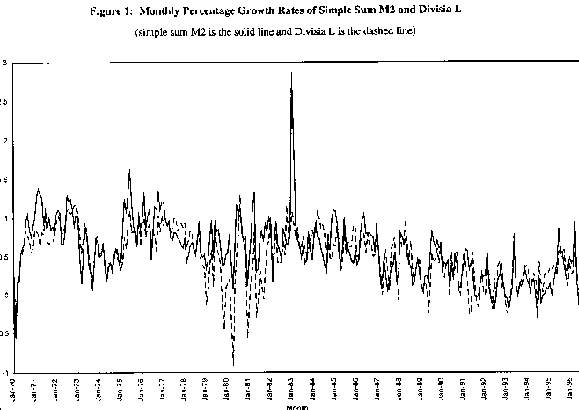
The favored monetary aggregate among monetarists at that time, including especially Friedman, was simple sum M2. In retrospect, it is interesting to ask whether subsequent retroactive revisions in the Federal Reserve Board's simple sum monetary aggregate can shed any new light on the source of Friedman's September 26, 1983 public forecast error. The most recent such revision appears in a Federal Reserve Board staff working paper by Whitesell and Collins (1996), in which they provide plots of the old M2 and a revised simple sum M2 over the period of 1980-1987. Their paper displays the same immense spike in late 1982 and early 1983, as with the earlier unrevised series. The growth rate spike jumps from under 10% to over 30% and then back down again.
The monetarist view of the time was that a surge in inflation was unavoidably on the way, as the inflationary shock worked its way through the economy, and a subsequent recession produced by a Federal Reserve contractionary "overreaction" was also unavoidable. The prediction of an unavoidable eventual recession is very much "monetarist" and was therefore controversial among nonmonetarists, but the forecast of inflation seemed undeniable. Under virtually every view in macroeconomics, a correlation between money growth and neutral or near-neutral changes in nominal variables is predicted. Hence that aspect of Friedman's prediction should concern everyone.
There are only two possible conclusions: either money growth has no effect on prices, and hence all macroeconomic theory is wrong, or simple sum M2 is a terribly defective measure of monetary service flow.
1.2 September 26, 1983 Once Again
September 26, 1983 was indeed a significant date
in the history of economic thought. But there is another reason
to remember that day. On precisely that same day, another
article appeared in a magazine with a public "on the record"
forecast by an economist, a photograph of that economist, and
a boldface article title. The title of that article was "What
Explosion?" The article, which appeared on p. 196 of Forbes
magazine on that day explains further
"that people have been panicking unnecessarily about money supply growth this year. The new bank money funds and the super NOW accounts have been sucking in money that was formerly held in other forms, and other types of asset shuffling also have occurred. But the Divisia aggregates are rising at a rate not much different from last year's... the "apparent explosion" can be viewed as a statistical blip."
Yes, you have guessed it. The subject of the article was the Divisia monetary aggregates, which I had developed and advocated in earlier work, and which were the basis for my statements to Forbes magazine. A controlled "experiment" of this sort is rare in the field of economics. Friedman and I went on the record on the exact same day with the dramatically different forecasts implied by the two different methods of monetary aggregation.
While those magazine articles were both about M2, an even more enlightening illustration is now available from comparison of simple sum M2 with Divisia L, where L is the broadest monetary aggregate made available by the Federal Reserve System. As has been emphasized by Poterba and Rotemberg (1987) and Rotemberg, Driscoll, and Poterba (1995), properly weighted monetary aggregates are most informative, when computed at the broadest level of aggregation, since such aggregates capture the contribution of all monetary assets to the economy's monetary service flow. On the other hand, simple sum aggregates deteriorate in quality as the level of aggregation increases, since growing amounts of nonmonetary services are included in those unweighted aggregates as distant substitutes for money are introduced into the aggregate. While the broadest simple sum monetary aggregates therefore have never been influential, and were not advocated by monetarists, we have no reason to exclude properly weighted distant substitutes for money in a Divisia monetary aggregate. In Figure 1, I provide plots of both simple sum M2 and Divisia L from the recently available new data made available online by the Federal Reserve Bank of St. Louis. The simple sum M2 giant spike is conspicuous, although Divisia L evidences no spike at all.
It is unfortunate and perhaps puzzling that Milton Friedman's name has become attached to this dramatic failure of the simple sum monetary aggregates, since Friedman and Schwartz (1970, pp. 151-152) were among the first to recognize the need for properly weighted monetary aggregates, and in recent tests of blockwise weak separability, Swofford (1995) has shown that Friedman and Schwartz's preferences in monetary component groupings were unusually astute. In addition, the views contained in Friedman's Newsweek article were widely shared by the monetarists of the time. Rather than being too critical of the central bank, the monetarists were perhaps too trusting of the Federal Reserve, since the monetarists uncritically based their conclusions on data published by the Federal Reserve.
The direction in which monetary economists, the press, central banks, and public policy have moved since September 26, 1983 might have been very different, if the readership of Forbes exceeded the readership of Newsweek, rather than visa versa.
1.3 The "Monetarist Experiment" of November 1979 to August 1982
It is perhaps worth asking why the field was so vulnerable and so fragile in 1983. While Friedman's forecast error was indeed conspicuous and created a disturbing anomaly to believers in simple sum monetary aggregation, economists historically have had a healthy (if unscientific) "sense of humor" about forecasts. But in fact the September 26, 1983 failure followed shortly after another serious blow to "monetarism" and to advocates of stable simple sum money demand equations: the three year "monetarist experiment" period of November 1979 to August 1982. That experiment resulted in a serious recession, despite the fact that the behavior of the simple sum monetary aggregates during the period indicate an intent by the Federal Reserve to produce a gradual disinflation rather than a severe disinflationary shock.
I was on the staff of the Federal Reserve Board in Washington, DC from July 1973 through December 1981. As a result, I had more than average exposure to what led up to the "monetarist experiment," and I was a personal witness to many of the activities at the Federal Reserve during most of that period. Without unnecessarily getting into the controversies about what happened at the Federal Reserve during the "experiment," I do wish to observe that the data itself tells a very enlightening story, and it is that message from the data, rather than personal anecdotal information, that I shall discuss below.
As I reported in Barnett (1984), the growth rate of simple sum M2 during the period of the "monetarist experiment" averaged 9.3%, while the growth rate of Divisia M2 during the period averaged 4.5%. Similarly the growth rate of simple sum M3 during the period averaged 10%, while the growth rate of Divisia M3 during the period averaged 4.8%. This period followed double digit growth rates of all simple sum and Divisia monetary aggregates. In short, believers in simple sum monetary aggregation, who had been the advocates of the "monetarist experiment," were put in the embarrassing position of witnessing an outcome (the subsequent recession) that was inconsistent with the intent of the prescribed policy and with the behavior during the period of the simple sum monetary aggregates. This unwelcome and unexpected outcome rendered vulnerable those economists who advocated a policy based upon the assumption of a stable simple sum demand for money function .
Friedman's very visible forecast error on September 26, 1983 followed closely on the heels of the end of the monetarist experiment in August 1982 and the recession that it produced. The road buckled and collapsed below the monetarists and those who believed in stable simple sum demand for money functions. Those two associated groups have never recovered.
But the recession that followed the monetarist experiment was no surprise to anyone who had followed the Divisia monetary aggregates, since those aggregates indicated that a severe deflationary shock had occurred. To those who were using data based upon valid index number and aggregation theory, rather than the obsolete simple sum monetary aggregates, the road remained smooth---no bumps, no breaks. Nothing unexpected had happened.
2. The Low Road
2.1 Where is the Low Road?
The two dramatic failures of simple sum money demand theory set the stage for the "controversy" that is the subject of this Economic Journal exchange. Badly shaken by the two failures in the early 1980s, monetary economists had two choices of roads to follow: the high road or the low road. Along the high road there were no paradoxes, no puzzles, no unexplained instabilities. There was, however, a very deep and difficult research agenda ahead, if the quality of monetary economics research was to be raised to a level consistent with principles accepted in other areas of economic research, such as index number and aggregation theory---two of the most disturbingly challenging areas of economic research. The high road insists upon internal coherence among data, theory, and econometrics, and it is that internal consistency that defines the high road. As I shall argue below, internal coherence is conspicuously lacking in the empirical literature on money demand "instability."
Along the low road, researchers can play fast and loose with data, theory, and econometrics. Paradoxes, puzzles, and "controversies" appear at every turn. Most empirical monetary economists took the low road. In most other areas of applied economics, including capital theory, labor economics, consumer demand systems modeling, production modeling, economic growth modeling, and agricultural economics, the profession chose the high road long ago, and has remained there.
Pointing fingers at the drivers who took the low road is perhaps not constructive, but it indeed is worthwhile to understand the nature of the low road, so that it can be recognized when encountered. For that reason, this section will concentrate primarily upon a description of the low road, rather than a discussion of individual papers or authors. The basic point to be made is that the low road research is filled with internal logical inconsistencies, to a degree that is perhaps unparalleled in any other area of applied economic research. For reasons that I prefer not to try to rationalize, the route from the broken road to the low road seemed more convenient to some than the route from the broken road to the high road.
2.2 The Price of Money
To make this as clear as possible, let us begin by assuming that the simple sum monetary aggregates, which are the subject of most of this research, are correct. Let us then determine how a model could be structured so that the research would be internally consistent and methodologically coherent. First let us consider the correct price that should be imputed to a simple sum quantity index. As is well known in index number theory, every quantity index has a dual price index, and visa versa. For example, Laspeyres quantity indexes and Paasche price indexes are dual. In fact much governmental data is produced from those dual pairs. The simple sum quantity index is a special case (equal coefficients) of the linear index, and the price dual to the linear quantity index is the Leontief price index. If we then set the coefficients of the linear quantity index equal to each other, so that the quantity index becomes simple sum, the dual Leontief price index becomes the minimum price over the set of prices of component goods.
This result should not be surprising. Linear quantity aggregator functions, whether for consumers or firms, imply perfect substitutability among components. In the special case of equal coefficients within the linear aggregator function, the isoquants or indifference curves of the quantity aggregator function will be at 45 degree angles to the axes. The components will not only be perfect substitutes, but will be perfect substitutes in identical ratios. In short, they will be indistinguishable. Corner solutions will result. Only the lowest priced component of an aggregate will be held or consumed.
To produce that dual price index, we need now to determine how to measure the price of a component monetary asset. The derivation is in Barnett (1978,1980). The price of the services of a monetary asset is the asset's user cost, which is its opportunity cost. The formula for the user cost is in terms of foregone interest. In discrete time, that discounted foregone interest formula in real terms is pit=(Rt-rit)/(1+Rt), where rit is the own rate of return on monetary asset i, and Rt is the rate of return on the benchmark asset, defined to be that asset which is held solely as an investment. In continuous time, the denominator does not appear in the real user cost formula, which reduces to the rate differential Rt-rit. We conclude that the correct price to impute to the simple sum monetary aggregate is pt=min {pit: i=1,...,n}, where n is the number of monetary assets included in the aggregate.
2.3 Ancient History
Many decades ago, "money" was defined to include only monetary assets that yielded no interest. Those component monetary assets were currency plus demand deposits, and demand deposits yielded no interest. Since interest yield is not a monetary service, any asset that yielded interest was excluded from consideration as a monetary aggregate's component. In that long-gone world, rit=0 for all i. Hence pit=Rt for all i in continuous time, and thereby the price of the simple sum monetary aggregate was pt=min {pit: i=1,...,n}=Rt. The correct price to insert into the right hand side of a money demand function was Rt, which was the opportunity cost of money and was "the" interest rate of classical macroeconomic theory.
As we see, once upon a time long ago, the use of simple sum aggregation to aggregate over assets that all had the same zero yield made sense, since under those circumstances of continually equal user cost prices, the implicit assumption of perfect substitutability among components was credible, and under those same circumstances the use of "the" interest rate as the price of money indeed was correct, at least in continuous time. But that was long, long ago. Yet most of the literature on the "unstable" demand for money function is based upon the assumed duality between the simple sum as quantity aggregate and "the" interest rate as its dual price.
2.4 We All Are Suffering from Delusions
As argued above, the measurement and modeling methods used in the literature on "unstable" money demand made good sense in the financial environment that existed a long time ago (well over 40 years ago). But let us assume that somehow these models still are correct in the current world. We then must reason through the implications of the model when in fact many monetary assets yield interest, and the interest yields are not the same on all component monetary assets.
Again simple sum quantity aggregator functions imply perfect substitutability of one unit of any component for one unit of any other component. But in reality the component assets' yields are not the same. Hence we must conclude that there is a corner solution with only the highest yielding asset remaining in existence. All other assets are dominated and hence have disappeared from existence. We may think that we have observed the existence of more than one monetary asset, but we are deluded. Furthermore for the user cost price pit=Rt-rit of the one non-dominated asset i to be Rt, that asset's own rate of return rit must be zero. Hence the dominated assets, that have disappeared from existence, must have even lower rates of return. In short, their nominal rates of return must be negative.
Large literatures exist on demands for nonmonetary goods, such as automobiles, food, services, physical capital, and labor. In none of those areas would economists take seriously a conclusion of function instability based upon theory implying mass delusions among economists and the public, although monetary economists who use a simple sum monetary aggregate with an interest rate as its price are implicitly accepting precisely such a view.
2.5 Income and Velocity
An income variable exists, along with "the" interest rate, in most of the papers claiming instability of money demand. Such an income variable also is needed to define velocity in those studies that concentrate on velocity rather than money demand. The variable that most commonly appears in those equations as income is gross national product. But GNP does not appear as the right hand side of anyone's budget constraint. In addition, GNP does not include user-cost-evaluated expenditure on the services of monetary assets. Hence the right hand side of the "constraint" does not include part of the left hand side. To make sense, a demand function that has income on its right hand side must imply the existence of a constraint containing that income variable on the right hand side of the constraint. The measure of income used in those models is internally inconsistent with the rest of the model.
2.6 Functional Form
The demand for money studies that report unstable demand for money functions use an erroneous measure of monetary services on the left hand side and erroneous measures of the price of money and income on the right hand side. None of the variables used in these studies connects in a valid manner with economic theory. In addition, little if any consideration is given to the nonlinear functional forms implied by demand theory.
The usual rationalization for ignoring the implications of economic theory for functional structure is the potential damage to economic theory produced by aggregation over economic agents. Here we have another internal contradiction. It has long been well known in aggregation theory that the absence of distribution effects implies the existence of a representative consumer, where absence of distribution effects means that only the first moment of the income distribution appears in demand functions. If only per capita income or total income appears in demand functions and not any second or higher order moments of the distribution, we get the existence of a representative consumer "for free." No further assumptions are needed. Hence, if we assume away distribution effects, as is very common in the literature on "unstable" money demand, there can be no justification for not using representative agent theory, since the maintained assumption is sufficient for the existence of a representative agent.
2.7 Evaluation of the Low Road
The techniques currently being used in the low road literature are to be preferred to those methods used to produce the broken road discussed in section 1 above. But the faults that caused the road to break in the earlier literature remain in the low road literature. The low road empirical literature is so contaminated by bad data and internally inconsistent logic as to be devoid of scientific merit. Faced by such a disturbing literature, I am less than surprised by the growing "rebellion" of some real business cycle theorists against much of current econometrics.
A small group of economists have taken a detour off of the low road to a very old unpaved road. They have sought to emphasize outside money, the base, total reserves, or nonborrowed reserves. Those variables undoubtedly have a connection with the transmission mechanism starting far back near its source at the central bank, but the demand for such a variable is no substitute in any reasonable macroeconomic model for the demand for money.
3. The High Road
The message in sections 1 and 2 above is a negative one, and unfortunately the alternative does not produce easy answers. The alternative is the high road, where the air is thin, and work is hard. The demand for money should be modeled using the same tools that are reputable in modeling the demand for other goods and services. No one who works in those areas would take seriously the statement that the demand for a good or service has "broken down" based upon the research methods that have produced that view about money demand. As explained above, the root source of the failure of so many demand for money models is the payment of interest on monetary assets. Demand for money functions that ignore the theoretical implications of that fact have performed increasingly poorly as more and more deregulated, interest-bearing assets have been entered into monetary aggregates.
3.1. The Dependent Variable
The use of simple sum monetary aggregates in demand for money functions has been indefensible for decades. Who would measure transportation services by adding subway trains and roller skates? A vast literature exists on capital aggregation, and is directly relevant to measuring the flow of monetary services, when some or all monetary assets yield interest. See, e.g., Barnett (1980,1987,1995). On the general subject of capital aggregation, see Diewert (1978,1980). Recently vast data bases of Divisia monetary aggregate data have become available for many countries throughout the world.
The basic principle upon which monetary index number theory operates is the following: at the margin, rational first-order conditions hold. The idea then is to remove from marginal services those that are not monetary services, and clearly investment yield is not a monetary service.
The simple sum monetary aggregates extract nothing from the measured flow imputed to money, including interest yield. Since investment return therefore is counted as a monetary service, one must conclude that coal mines, land, education, and in fact the entire physical and human capital stock of the country is "money." See Barnett and Zhou (1994) for a derivation of the confounding between investment rate of return and monetary services in the simple sum monetary aggregates and the ability of index number theory to remove the investment motive from the otherwise joint product. Contrary to Cuthbertson's (1996) representations, Divisia monetary aggregation is not about isolating and measuring specific monetary services, but rather about removing from the simple sum monetary aggregates those services that clearly are not monetary services, with the investment rate of return being the most conspicuous example. In monetary index number theory, the services that are measured as "monetary" are those services that remain after the nonmonetary services are removed.
3.2 Independent Variables
In the literature on capital aggregation, much has been published on the derivation and computation of user-cost prices for the services of durables. That derivation method was applied to acquire the formula for the user cost of monetary assets by Barnett (1978, 1980). Having the user cost prices measured for each component asset, aggregation over those user cost prices should be accomplished in a manner that is consistent with the manner in which the quantity aggregate aggregated over the services of the component quantities. That internal consistency is achieved by using the price index that is dual to the aggregate quantity of money services. The quantity of money index used to generate its price index dual can be Divisia, Fisher ideal, any other index in Diewert's (1996) class of superlative index numbers, or even Paasche or Laspeyres, but certainly not simple sum. That dual monetary user cost price aggregates are available on the World Wide Web at the same locations as the Divisia monetary services index.
Many unsolved problems exist in durables aggregation and capital aggregation, and those problems continue to be the subject of expanding research. Advances in that research should be incorporated into monetary economics as those advances become available. One such example is the adjustments needed for risk, when contemporaneous prices are not known with perfect certainty. Along the high road, the objective is to do the best that is possible at the current state of the art of economic theory. One can do no more.
The common practice of using an interest rate as the opportunity cost of money in demand for money equations makes no sense. It makes no sense for Divisia monetary aggregates. It makes no sense for Fisher ideal monetary aggregates. It makes no sense for simple sum monetary aggregates. It has made no sense for over 40 years, since "money" began to yield interest.
3.3 Model Structure
Data, theory, and model structure all should be internally consistent and coherent. When this objective is met while recognizing that many monetary asset have yielded interest for decades, one is on the high road. An example of the high road is Barnett (1983). That study assumes perfect certainty. The seminal study incorporating risk is Poterba and Rotemberg (1987), who emphasize the estimation of the deep parameters of Euler equations to avoid Lucas critique problems. Other examples include Belongia (1996a), Barnett and Hahm (1994), Barnett, Hinich, and Yue (1991), Barnett, Kirova, and Pasupathy (1994), Donovan (1978), Fisher and Fleissig (1994), Serletis (1991), Swofford and Whitney (1987), and Yue (1991) . For a survey of other related work, see Barnett, Fisher, and Serletis (1992).
While the real business cycle (RBC) literature has not yet come to grips with these issues, there are encouraging signs from recent developments in that literature.
4. Misunderstandings
The high road builds on the foundation of existing microeconomic theory, including the theory of the firm, consumer theory, and the implied microeconomic aggregation and index number theory. Advances in those areas are accepted and absorbed in a coherent manner as research proceeds up the high road. Constructive criticism of the high road is based upon recognition of the existence of unsolved problems in the supporting areas of economic research and the need for further development in those areas to permit the high road to climb even higher. However in many cases, criticism unfortunately is based upon lack of understanding of the foundations of the high road research. For example, introduction of new goods into superlative index numbers is accomplished by a specialized procedure involving imputation of reservation prices and transitional use of the Fisher ideal index, as explained in Diewert (1980). This procedure, while important to understanding the high road literature, is not widely known to nonspecialists in the field.
Misunderstandings produced from unawareness of specialized developments are not surprising; but some of the criticisms tend to be based upon misunderstandings of the relationship between elementary microeconomic theory and high road research. Perhaps the most persistent of those misunderstandings relates to the famous diamonds-versus-water paradox that is explained in most undergraduate microeconomic textbooks. User costs of monetary assets are the prices used in monetary index numbers. Prices do not measure total utility or average utility. User costs do not measure "moneyness," total services, or average services of monetary assets, although user cost prices do measure marginal services and opportunity costs at the margin. User costs are not weights in a Divisia index or in any other superlative index number. In the Divisia index, the growth rate weights are shares.
It is often stated that the increase in the own rate of return on a monetary asset decreases its user cost and thereby its "moneyness" in a superlative monetary quantity index, such as a Divisia monetary aggregate. But in fact the share weights can either increase or decrease, when a user cost price decreases. In consumer theory, the direction of the change of the share of a good depends upon whether the good's own price elasticity is greater than or less than -1. In this volume, Laidler's (1996) well meaning, but somewhat heuristic and loose explanation of superlative monetary aggregates, could lead a reader to fall into the diamonds-versus-water paradox error. While Laidler knows the relevant theory sufficiently well to avoid falling into that paradox's trap himself, the risks from lack of rigor in such statements of the relevant theory are made evident from Cuthbertson's comments (1996) in this journal issue. Cuthbertson falls straight into the diamonds-versus-water paradox error in his erroneous conclusions about the effect on Divisia monetary aggregates of payment of interest on checking accounts. He also comments on the new goods issue (relative to financial innovation via new accounts) in a manner that disregards Diewert's (1980) correct approach mentioned above.
Responding to each such misunderstanding is a poor use of space in this journal, but references to relevant expository and clarifying articles can be found in Barnett, Fisher, and Serletis (1992). It is worth repeating that the basic principle that distinguishes the high road from the low road is that the high road uses the relevant theory and insists upon internal coherence and consistency between the theory that produced the model, the inference methods used to estimate the model, and the theory implied by the data construction procedures. The basic principles of aggregation and index number theory are relevant to the objectives of the high road, and violations of those basic principles are the basis for what Chrystal and MacDonald (1994) have called the "Barnett critique" in monetary economics. Criticisms of high road research necessarily fall into one of three possible groups: (1) refusal on the low road to recognize the existence of internal contradictions between the theory, econometrics, and data construction, (2) misunderstandings of the high road, and (3) constructive observations about the relevancy of unsolved problems in general economic theory. There are no other possibilities.
5. Conclusion
The broken road has been abandoned for over a decade. The low road is a dead end. From the vantage point of the high road, the subject of this controversies section of the Economic Journal is the unstable non-demand function for a non-variable regressed on other non-variables through non-theory. The high road is a difficult road to travel, but it is the right road.
Anderson, Richard G. and Kenneth A. Kavajeck (1994),
"A Historical Perspective on the Federal Reserve's Monetary
Aggregates: Definition, Construction and Targeting," Federal
Reserve Bank of St. Louis Review, March/April , pp. 1-31.
Anderson, Richard G. and Robert H. Rasche (1996),
"A Revised Measure of the St. Louis Adjusted Monetary Base,"
Federal Reserve Bank of St. Louis Review, March/April,
pp. 3-13.
Anderson, Richard, Barry Jones, and Travis Nesmith
(1997), "Introduction to the St. Louis Monetary Services
Index (MSI) Project," "Monetary Aggregation Theory and
Statistical Index Numbers," and "Building New Monetary
Services Indices: Concepts, Methodology and Data," all in
the Federal Reserve Bank of St. Louis Review, Jan/Feb forthcoming.
Barnett, William A. (1978), "The User Cost of
Money," Economics Letters, vol.1 . p.145-149.
Barnett, William A. (1980), "Economic Monetary
Aggregates: An Application of Index Number and Aggregation Theory,"
Journal of Econometrics, Summer 1980, 14(1), pp. 11-48.
Barnett, William A. (1983), "New Indices of
Money Supply and the Flexible Laurent Demand System," Journal
of Business and Economic Statistics , Vol. 1, No. 1, January.
Barnett, William (1984), "Recent Monetary Policy
and the Divisia Monetary Aggregates," American Statistician,
August, pp. 165-172.
Barnett, William A. (1987), "The Microeconomic
Theory of Monetary Aggregation," in New Approaches to
Monetary Economics, edited by William A. Barnett and Kenneth
Singleton, Cambridge University Press, pp. 115-168.
Barnett, William A. (1995). "Exact Aggregation
under Risk." In Barnett, William A., Moulin, Herve, Salles,
Maurice, and Norman Schofield (Eds.), Social Choice, Welfare,
and Ethics, Cambridge University Press, pp. 353-374.
Barnett, William A. (1996), "Journal of Econometrics
Fellow's Opinion: Econometrics, Data, and the World Wide Web,"
Journal of Econometrics, forthcoming.
Barnett, William A., Fisher, Douglas, and Apostolos
Serletis (1992), "Consumer Theory and the Demand for Money,"
Journal of Economic Literature, vol 30, Dec. 1992, pp.
2086-2119.
Barnett, William and Jeong-Ho Hahm (1994), "Financial
Firm Production of Monetary Services: a Generalized Symmetric
Barnett Variable-Profit-Function Approach," Journal of
Business and Economic Statistics, 12, pp. 33-46.
Barnett, William A., Hinich, Melvin, and Piyu Yue
(1991), "Monitoring Monetary Aggregates under Risk Aversion,"
in Michael T. Belongia (ed.), Monetary Policy on the 75th Anniversary
of the Federal Reserve System, Proceedings of the Fourteenth
Annual Economic Policy Conference of the Federal Reserve Bank
of St. Louis, Kluwer, pp. 189-222.
Barnett, William A., Kirova, Milka, and Pasupathy,
Meenakshi (1994), "Estimating Policy-Invariant Deep Parameters
in the Financial Sector, when Risk and Growth Matter," Journal
of Money, Credit, and Banking,, November 1995, vol. 27, part
2, pp. 1402-1430.
Barnett, William A. and Yi Liu (1996), "The
CAPM Extended Divisia Monetary Aggregate with Exact Tracking under
Risk," Working Paper, Washington University in St. Louis,
June.
Barnett, William A., Edward K. Offenbacher, and Paul
A. Spindt (1984), "The New Divisia Monetary Aggregates,"
Journal of Political Economy, vol. 92, p. 1049-1085.
Barnett, William A., Mark Jensen, Yi Liu, and Haiyang
Xu (1996), "Stochastic Volatility in Interest Rates, Exact
Aggregation, and Money Demand Stability," Macroeconomic
Dynamics, forthcoming.
Barnett, William A. and Ge Zhou (1994), "Commentary,"
Federal Reserve Bank of St. Louis Review, vol. 76, no.
6, Nov/Dec, pp. 53-62.
Belongia, Michael (1996a), "Measurement Matters:
Some Recent Results from Monetary Economics Re-examined,"
Journal of Political Economy, October, vol. 104, no. 5,
pp. 1065-1083.
Belongia, Michael (ed.) (1996b), Divisia Monetary
Aggregates: Theory and Practice, Macmillan, London.
Berndt, E. R., W. E. Diewert, and M. N. Darrough
(1977), "Flexible Functional Forms and Expenditure Distributions:
An Application to Canadian Consumer Demand Functions," International
Economic Review, vol 18, pp. 651-676.
Chrystal, K. Alec and Ronald MacDonald (1994), "Empirical
Evidence on the Recent Behavior and Usefulness of Simple-Sum and
Weighted Measures of the Money Stock," Federal Reserve Bank
of St. Louis Review, March/April, pp. 73-109.
Cooley, Thomas F. and Edward C. Prescott (1995),
"Economic Growth and Business Cycles," in Thomas F.
Cooley (ed.), Frontiers of Business Cycle Research, Princeton
University Press, Princeton, New Jersey, pp. 98-125.
Cuthbertson, Keith (1996), "Microfoundations
and the Demand for Money," Economic Journal, this
issue.
Diewert, Erwin (1976), "Exact and Superlative
Index Numbers," Journal of Econometrics, vol 4, no.
2, pp. 115-145.
Diewert, Erwin (1978), "Superlative Index Numbers
and Consistency in Aggregation, " Econometrica, July
, 46, no. 4, pp. 883-900.
Diewert, Erwin (1980), "Aggregation Problems
in the Measurement of Capital," in The Measurement of
Capital, edited by Dan Usher, pp. 433-539.
Fisher, Paul, Hudson, Suzanne, and Mahmood Pradhan
(1993), "Divisia Indices for Money: An Appraisal of Theory
and Practice," Bank of England Working Paper Series no. 9.
Donovan, Donal J. (1978), "Modelling the Demand
for Liquid Assets: An Application to Canada," International
Monetary Fund Staff Papers, December, vol. 25, no. 4, pp.
676-704.
Feldstein, Martin and James H. Stock (1996), "Measuring
Money Growth when Financial Markets are Changing," Journal
of Monetary Economics, vol 37, no. 1, February, pp. 3-28.
Fisher, Douglas and Adrian Fleissig (1994), "Money
Demand in a Flexible Dynamic Fourier Expenditure System,"
Federal Reserve of St. Louis Review, vol. 76, no. 2, March/April,
pp. 117-128.
Friedman, Milton and Anna Schwartz (1970), Monetary
Statistics of the United States: Estimates, Sources, Methods
(Columbia University Press, NY).
Hansen, Lars Peter and James J. Heckman (1996), "The
Empirical Foundations of Calibration," The Journal of
Economic Perspectives, vol. 10, no. 1, Winter, pp. 87-104.
Laidler, David (1996), "Notes on the Microfoundations
of Monetary Economics," Economic Journal, this issue.
Poterba, James M. and Julio J. Rotemberg (1987),
"Money in the Utility Function: An Empirical Implementation,"
in William A. Barnett and Kenneth J. Singleton (eds.), New
Approaches to Monetary Economics, Cambridge, Cambridge University
Press, 1987, pp. 219-240.
Rios-Rull, Jose-Victor (1995), "Models with
Heterogeneous Agents," in Thomas F. Cooley (ed.), Frontiers
of Business Cycle Research, Princeton University Press, Princeton,
New Jersey, pp. 98-125.
Roper, Don E. and Stephen J. Turnovsky (1980), "The
Optimum Monetary Aggregate for Stabilization Policy," Quarterly
Journal of Economics, vol. 95, September, pp. 331-356.
Rotemberg, Julio J., Driscoll, John C., and James
M. Poterba (1995), " Money, Output, and Prices: Evidence
from a New Monetary Aggregate," Journal of Business and
Economics Statistics, January, vol. 13, no. 1, pp. 67-84.
Serletis, Apostolos (1991), "The Demand for
Divisia Money in the Unites States: A Dynamic Flexible Demand
System," Journal of Money, Credit, and Banking, 23,
pp. 36-52.
Spanos, Aris (1984), "Liquidity as a Latent
Variable--An Application of the MIMIC Model," Oxford Bulletin
of Economics and Statistics, vol. 46, May, pp. 125-143.
Swofford, James L. and Gerald A. Whitney (1987),
"Nonparametric Tests of Utility Maximization and Weak Separability
for Consumption, Leisure, and Money," Review of Economics
and Statistics, Aug. 1987, vol 69, pp. 458-464.
Swofford, James L. (1995), "A Revealed Preference
Analysis of Friedman and Schwartz Money," Journal of Money,
Credit and Banking, 27 (1), pp. 154-164.
Whitesell, William and Sean Collins (1996), "A
Minor Redefinition of M2," Finance and Economics Discussion
Series #96-7, Board of Governors of the Federal Reserve System,
Washington, D. C.
Yue, Piyu (1991), "A Microeconometric Approach
to Estimating Money Demand: The Asymptotically Ideal Model,"
Federal Reserve of St. Louis Review, Nov/Dec, vol 73, no.
6, pp. 36-51.