State
Dependent Adjustment in an Economy with Seasonal Fluctuations
Gil Mehrez
Georgetown University
September 1996
Abstract
Much research on the dynamics of the aggregate economy concerns the adjustment policy of the microeconomic units. This paper investigates the optimal adjustment policy when there are seasonal fluctuations and fixed adjustment costs. The optimal policy in this case can be described in terms of three parameters: the thresholds where adjustment occurs during the high season; the thresholds where adjustment occurs during the low season; and the deviation at the end of each season. Since the optimal level of the control variable (e.g., price, employment, stock of capital) decreases during the low season and increases during the high season, the optimal policy is such that at the end of the high season the control variable is below its optimal level and at the end of the low season the control variable is above its optimal level. As a result, the observed seasonal fluctuations are smaller than the underlying seasonal fluctuations. This damping effect depends on the trend of the process. When the trend is higher in absolute value, the deviation at the beginning of each season decreases and hence the observed seasonal fluctuations increase. For example, if the control variable is the price the firm charges, higher inflation increases the seasonal fluctuations. I test this prediction for the case of price seasonality using price data from Israel for the period 1983-1994. The data provide strong support to the model prediction. Price seasonality increases with the rate of inflation. This is the case especially for goods with market power and significant adjustment costs.
Acknowledgment
I am very grateful to George Akerlof for numerous helpful discussions and suggestions. I also thank the Research Department of the Bank of Israel where some of the initial work for this paper was conducted.
1. Introduction
Much research on the dynamics of the aggregate economy concerns the adjustment policy of the microeconomic units. For example, the dynamics of the price level and the effect of monetary policy on employment and output depends on the adjustment process of the microeconomic units when out of equilibria. Similarly, the dynamics of the labor market are determined by the hiring and firing policy of the individual firms. To account for the smooth adjustment of the aggregate economic series, standard dynamics models rely on the presence of convex adjustment costs to derive a partial-adjustment model (see Rotemberg (1982), Sargent (1978)). Although such models fit the aggregate series quite well, they do not very well fit the actual micro-level adjustment process on which they are based. The adjustment process of the microeconomic units is not as smooth as the adjustment process of the aggregate series. The adjustment process of the microeconomic units can be described better by a discontinuous process with discrete adjustments. An adjustment process which fits both the discontinuous adjustments of the micro-level units and the smooth adjustment of the aggregate series can be generated by relying on fixed costs of adjustment. The discontinuous adjustment process of the microeconomic units is a result of the agents' attempt to reduce the adjustment costs over time. And the smooth dynamics of the aggregates are a result of aggregation over many units, each with discontinuous adjustment. For example, Hamermesh (1989) compares models based on convex adjustment costs with models based on fixed adjustment costs by studying the dynamics of employment using plant level data. He finds that when the plants are aggregated a standard convex adjustment cost model performs as well as a model based on fixed costs of adjustments. However, at the plant level a model based on fixed costs of adjustments outperforms a model based on convex adjustments since it can capture the large and infrequent adjustments of the individual plants.
In models with fixed costs of adjustment, the adjustment process of the microeconomic units depends on a state variable (e.g., the difference between marginal productivity and wage or the difference between the price and the optimal price). In such models, adjustment occurs whenever the state variable reaches a predetermined threshold, e.g., workers are fired whenever the wage exceeds the marginal productivity by a predetermined amount (Bentolila and Bertola (1990)); prices are adjusted whenever the price deviation from the optimal price reaches a predetermined level ( Sheshinski and Weiss (1977), Caplin and Spulber (1987)); durable goods are purchased whenever the optimal expenditure exceeds the current expenditure by a predetermined amount (Caballero (1993)).
Even though seasonal fluctuations affect most markets in the economy, the literature of state dependent adjustment in an environment with seasonal fluctuations is not well developed. This is very puzzling because understanding the adjustment policy in an environment with seasonal fluctuations can help us understand and forecast the dynamics of the economy. In addition, seasonal fluctuations are a simple natural experiment of a known and expected shift in the economy. Thus, we can use this natural experiment to estimate and test the validity of different models. For example, Anderson (1993) finds strong support for the large effect of adjustment costs on labor demand by studying the effect of Unemployment Insurance on seasonal labor demand.
This paper solves for the optimal adjustment policy when there are seasonal fluctuations and fixed adjustment costs. It is shown that seasonal fluctuations increase with the absolute value of the trend of the process (e.g., the seasonal fluctuations of employment are higher during periods of expansion or contraction; the seasonal fluctuations of prices increase with the economy wide inflation rate). These predictions are consistent with the well-documented empirical findings that inflation is positively correlated with its variance and with relative price variability (Fischer, (1981)) and the more recent empirical findings of strong positive correlation between the seasonal component and the nonseasonal component of aggregate variables (Beaulieu, MacKie-Mason, and Miron (1993)).
To test the predictions above, I use data of various price series from Israel for the period 1983 to 1994. I find strong support for the hypothesis that price seasonality increases with the inflation rate. Moreover, I find that the relationship between inflation and seasonal fluctuations depends on market structure and on the costs of adjustment. In goods with limited market power and small adjustment costs such as Fruits and Vegetables I find little evidence that inflation increases seasonal fluctuations. In contrast, in goods with market power and adjustment costs such as clothes I find very strong evidence that inflation increases seasonal fluctuations.
The paper is organized as follows: In section
2 I develop the model and derive the optimal adjustment policy
when there are fixed adjustment costs and seasonal fluctuations.
Section 3 extends the optimal solution to discuss the relationship
between the seasonal fluctuations and the trend. Section 4 presents
a simple example which I hope helps to illustrate the results
and the intuition. Section 5 describes the data the empirical
tests and the results. Section 6 concludes.
1. The Model
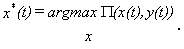
Let the flow of benefits to an agent be given by A(x(t) ,y(t)) where x(t) is a variable controlled by the agent and y(t) is a set of variables determined exogenously and evolve over time. For example, x(t) may be the firm's price and y(t) the firm's exogenous demand function; x(t) may be the firm's employment and y(t) the firm's exogenous technology or x(t) may be the firm's stock of capital and y(t) the firm's exogenous demand or technology functions. Let x*(y(t)) be the level of x which maximizes the flow of benefits given the economic environment, y(t):
The level of x(t) which maximizes the flow of benefits, x*(y(t)), changes continuously as y(t), the exogenous variable, evolves over time. If the level of the control variable, x(t), can be altered at no cost, x(t) would be adjusted continuously such that it is always equal to x*(y(t)). However, if altering the level of x(t) is costly, x(t) would be adjusted only when the deviation of x(t) from x*(t) reaches a predetermined level. Specifically, assume that there are fixed costs of adjustment, (, whenever x(t) is adjusted, independent of the adjustment size. Further assume that the forgone benefits of letting x(t) deviate from x*(t) are linear in the deviation of x(t) from x*(t):

Let the process governing the exogenous variables, y(t), be such that the process governing x*(t) is deterministic with constant trend and seasonal fluctuations. For simplicity, suppose that there are only two seasons: high season where the optimal level increases and low season where the optimal level decreases. Each season lasts exactly one period and is immediately followed by the other season. The optimal level increases during the high season by a trend and a seasonal effect while during the low season the optimal level increases by a trend but decreases by a seasonal effect. More precisely, x*(t) evolves according to the following continuous process:

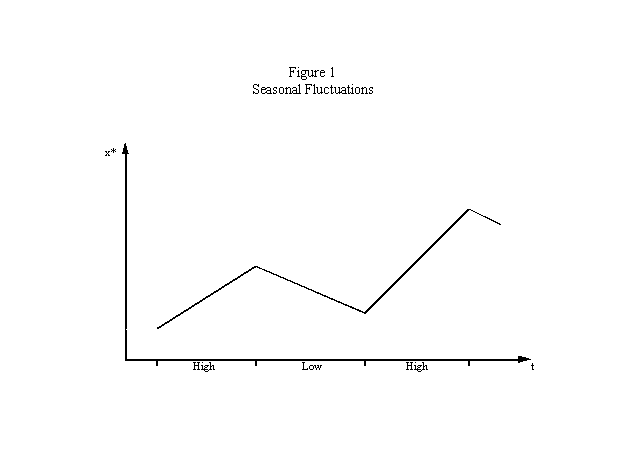
where " is the time trend, s is the seasonal effect, ts is the time elapsed since the beginning of the current season (ts0[0,1]) and Dh is a dummy variable which takes the value of one if it is a high season and zero if it is a low season (see figure 1). At the beginning of the high season x*(t) is s/2 below its trend. During the high season x*(t) increases at a rate of "+s such that in the middle of the season (ts=0.5) it is equal to its trend and at the end of the high season (the beginning of the low season) it is s/2 above its trend. During the low season x*(t) decreases at a rate of s-" such that in the middle of the low season (ts=0.5) it is equal to its trend and at the end of the low season (beginning of the high season) x*(t) is again s/2 below its trend. The agent's problem is to construct a policy which maximizes her benefits given the
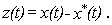
process governing x*(t) (equation 3), the forgone benefits of deviating from x*(t) (equation 2) and the cost of adjustments ((). The optimal policy is set to minimizes the forgone benefits of deviating from x*(t) plus the adjustment costs during a time interval T. Let z(t) be the difference between current level of x(t) and the optimal frictionless level, x*(t):
The optimal policy can be described in terms of the deviation at the beginning (end) of each season and fixed trigger points and adjustment points for each season in terms of z. We can describe the adjustment policy during the high season in terms of two parameters (H, h). Adjustment occurs during the high season only when the variable {z(t)} hits the trigger point h. The variable {z(t)} is allowed to drift down until it reaches h. When {z(t)} reaches h the agent increases x immediately and move {z(t)} instantaneously to point H.
Similarly, we can describe the adjustment policy during the low season in terms of two parameters (l, L). Adjustment occurs during the low season only when the variable {z(t)} hits the trigger point L. Thus {z(t)} is allowed to drift until it reaches L. When {z(t)} reaches L the agent increases x immediately and move {z(t)} instantaneously to point l.
In addition, because the high season follows the low season and vice versa, the optimal policy involves also the deviation at the beginning (end) of each season, i.e., the level of z(t) at the beginning of the high season (end of the low season), E, and the level of z(t) at the beginning of the low season (end of the high season), e,. In other words the optimal policy is to set the trigger and target thresholds in each season such that the variable {z(t)} is equal to e at the beginning of the high season (end of the low season) and is equal to E in the end of the high season.
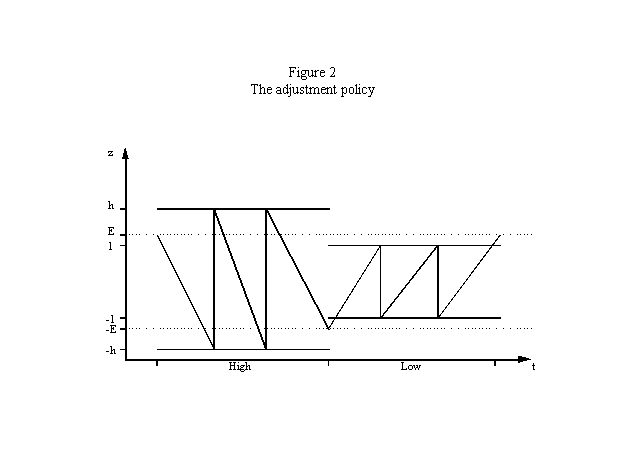
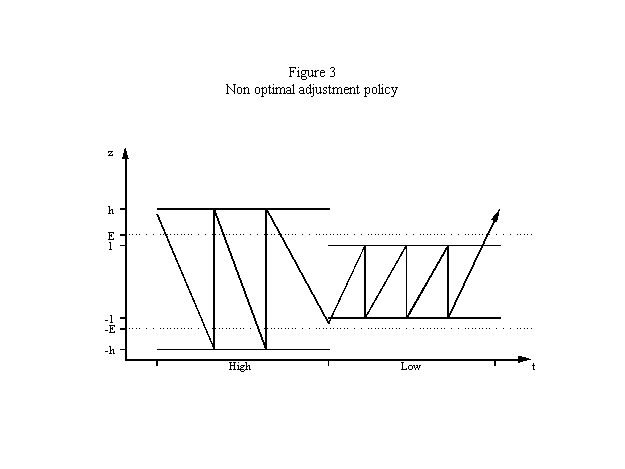
Given that the forgone benefits are symmetric in z(t), the trigger and target thresholds during each season are symmetric: [-h, h] in the high season and [-l, l] in the low season. I.e., during the high season z is adjusted from -h to h and during the low season z is adjusted from l to -l. The symmetry of the cost function implies also that the deviation at the beginning and at the end of a season are symmetric as well. z is equal to E in the beginning of the high season and to -E in the beginning of the low season (see figure 2). To see this, consider the case where the deviation at the beginning of the high season is greater then the deviation at the end of the high season (see figure 3). In this case, the agent can increase the benefits simply by decreasing the deviation at the beginning of the high season and increasing the deviation at the end of the high season by the same amount. Such a shift would not affect the number of adjustments each season, but it would decrease the total deviation during each season and therefore would decrease the foregone benefits.
Next I turn to solve for the optimal thresholds each season and the optimal deviation at the end (beginning) of each season ((-h, h), ( -l, l) and (-E, E) respectively). Ignoring integer constraints, the optimal policy is to set the thresholds and the deviation at the end of each season which minimize the forgone benefits and the adjustment costs during the high and low season. The forgone benefits during the high season are:

The first term is the foregone benefits prior to the first adjustment (The deviation at the beginning of the high season is E and adjustment occurs when z reaches -h). The second term is the forgone benefits after the last adjustment during the high season (z is adjusted to h and then eroded until it reaches -E at the end of the season). The third term is the foregone benefits between the first and last adjustment during the high (this period lasts (1-2(h+E)/(a+s)) and z spends an equal fraction of time, 1/2h, at each point in the interval [-h, h]). Similarly the forgone benefits during the low season are:

The first term is the foregone benefits prior to the first adjustment (The deviation at the beginning of the low season is -E and adjustment occurs when z reaches l). The second term is the forgone benefits after the last adjustment (z is adjusted to -l and then drifts until it reaches E at the end of the season). The third term is the foregone benefits between the first and last adjustment during the low season (this period lasts (1-2(l+E)/(a+s)) and z spends equal fractions of time, 1/2l, at each point in this interval.
The number of adjustments during each season can be derived from the increase (decrease) in the actual level of x during each season. The increase (decrease) in x during the season is equal to the increase in the frictionless optimal level, x*, during the season less the difference in the deviation (z)between the beginning of the season and the end of the season. Therefor, x increases by "+s-2E during the high season and decreases by s-"-2E during the low season. Since the adjustment step is 2h in the high season and 2l in the low season, the number of adjustments during the high season are:

and the number of adjustments during the low season are:

Adding equations 5 to 8 yields the total losses during the high and low season as a function of the high season thresholds, (-h, h), the low season thresholds (-l, l) and the deviation at the end of each season (-E, E):

The optimal thresholds and the deviation at the end of each season are determined by the first order condition of the total costs (equation 9) with respect to the control variables: the high season thresholds, the low season thresholds and the deviation at the end of each season, h, l and E respectively:
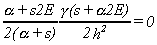
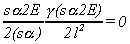
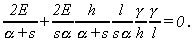
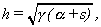
The solution of the three first order conditions above yields the high season thresholds, h, the low season thresholds, l, and the deviation at the end of the high season, E:

and

The high season's thresholds increase with
the trend, the seasonal effect and the adjustment costs. I.e.,
the larger the adjustment costs, the trend and the seasonal effect
the larger the adjustment step and the deviation which trigger
adjustment. The thresholds during the low season increase with
the adjustment costs and the seasonal effect but decrease with
the trend. The thresholds during the low season decrease when
the trend increases because during the low season the trend is
opposite to the seasonal effect. As a result, higher trend decreases
the drift during the low season and hence the optimal thresholds
are smaller. Finally, the deviation at the end of each season
increases with the adjustment costs and the seasonal effect. But
the deviation at the end of each season decreases with the trend.
That is, when the trend is higher, the deviation at the beginning
and the end of each season is smaller. Intuitively, higher trend
decreases the drift during the low season as it is opposite to
the seasonal effect. As a result, the change in the optimal value
during the low season is very small. I.e., when the optimal level
drifts very slowly starting the low season with large deviation
is not optimal as a large fraction of the season is spent far
from the optimal level. In the extreme case where the trend and
the seasonal effect cancel each other during the low season, the
optimal level does not change during the low season. That is,
the deviation at the beginning of the low season stays constant
throughout the entire season. In this case, the best policy is
to start the low season at the optimal level, i.e., E=0.
3. The Seasonality Trend Relationship
The solution above can be used to investigate the effect of the trend on the observed seasonal fluctuations. Higher trend affects the seasonal fluctuations because it decreases the deviations at the end of each season. As a result the change in x during each season is larger as smaller part of the increase (decrease) in the optimal level is "spent" on moving between the deviation in the beginning and the end of the season. This argument is shown formally below.
Theorem:
Seasonal fluctuations, the difference between the actual change in the high season and in the low season, increases with the trend in absolute value.
Proof
The control variable, x, increases during the high season by "+s-2E and decreases during the low season by s-"-2E. Thus, the difference between the change in the high season and the change in the low season is:

The deviation at the end of each season depends negatively on the absolute value of the trend, |a| (see equation 15). Hence, the difference in the change during the high season and the low season, the seasonal fluctuations, increases with the absolute value of the trend.
Q.E.D.
4. Price Seasonality and Inflation
To clarify the results above, consider an example where the endogenous variable, x, is the firm's price, and the exogenous variables, y, are the demand or cost functions the firm faces. Specifically, consider a monopolistic firm facing a linear production function (17) and a constant elasticity demand function (18):


Where Q is the quantity produced or demanded, L is the quantity of the input used in the production of Q and , is the demand elasticity which is assumed to be greater than one. Seasonality is introduced into the model through the demand elasticity, ,, which increases during the high season and decreases during the low season. Given the production and the demand functions above the firm's frictionless optimal price is a constant mark up over marginal costs:

Where W, the unit costs of L, are proportional to the economy wide price level. Define 0 as the natural logarithm of ,/,-1, w as the natural logarithm of W and p* as the natural logarithm of P*. Equation 19 can then be written as:

The optimal price evolves over time according to the inflation rate (through w) and the seasonal change in the demand elasticity, 0. The optimal frictionless price increases during the high season by the inflation rate, B, and the seasonal effect, and decreases during the low season by the seasonal effect net the inflation rate. Thus, the frictionless optimal price, p*, is governed by a process described in equation (3) where the trend is the economy wide inflation rate:

If there are no costs associated with price adjustments, the firm adjusts its price continuously to the optimal price. The firm increases its price by s+B during the high season and decreases its price by s-B during the low season. The difference in the inflation rate between the high season and the low season is 2s independent of the inflation rate.
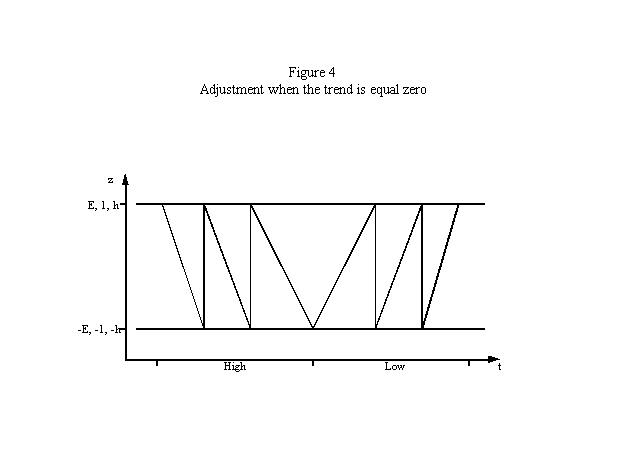
Consider now the case where price adjustment is costly. First, suppose that the rate of inflation, B, is equal to zero. Hence, the low season and the high season are symmetric. The optimal price increases by s during the high season and decreases by s during the low season. As a result, the thresholds and the deviation at the end of each season are the same, l=h=E (see figure 4). The inflation rate is equal to s-2h during the high season and 2h-s during the low season. The difference in the inflation rate between the high and low season is 2s-4E.
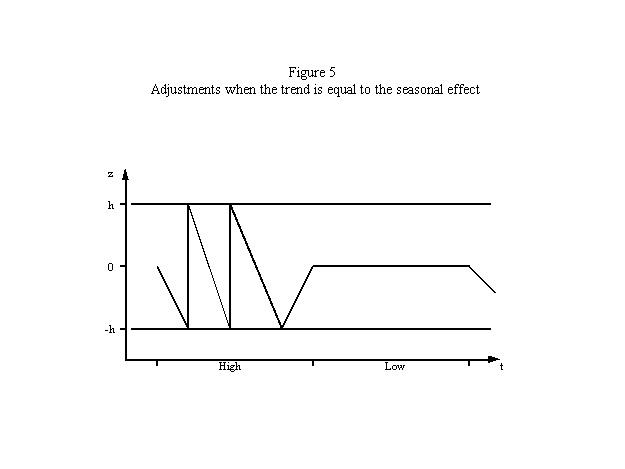
Now, suppose that the rate of inflation is equal to s, the seasonal effect, instead of zero as in the case above. In this case, the optimal price during the low season does not change. The inflation and the decrease in the mark up during the low season cancel each other out. Consequently the price deviation at the beginning of the low season stays constant throughout the season and the optimal deviation at the beginning of each season is zero (E=l=0) (see
figure 5). The observed inflation is s+B (2s), during the high season and zero during the low season. The difference in the inflation rate between the high season and the low season is 2s.
To compare, the seasonal fluctuations are
2s when the inflation rate is equal to s and 2s-4E when the inflation
is zero. The seasonal fluctuations are higher when the inflation
is higher.
5. Description of the Data and Estimation
I test the model's predictions, the effect of the trend on the seasonal fluctuations, by investigating the seasonal fluctuations of several price series. Prices are the natural choice to test the effect of the trend on seasonal fluctuations since the inflation rate is a good proxy of the trend in the process governing the prices (the trend of the frictionless optimal price).
The positive correlation between price dispersion and inflation and between inflation and its variance is well documented (see for example Fischer (1981)). But, there is little evidence on the relationship between seasonal fluctuations and inflation. I use data of several price series from Israel during the period 1983 to 1994 to estimate the relationship between seasonal fluctuations and inflation. This period consists of two "regimes," a regime of high inflation prior to the stabilization program of July 1985 and a regime of "low" inflation following the stabilization program of July. A test of the model is whether the seasonal fluctuations are higher during the high inflation period than during the low inflation period. To test whether the effect of inflation on the seasonal fluctuations depends on the market structure and the adjustment costs I distinguish between two groups of goods. The first group consists of eight series of clothes items where there are significant market powers and adjustment costs. The second group consists of eight series of Fruits and Vegetables where the adjustment costs and market power are very small or nil. The eight series from the Clothing and Apparel category are: Women's Costume, Women's Dresses, Women's Skirts, Dry Cleaning, Laundry, Women's Slippers, Women's Sandals and Children's Shoes. The eight series form the Fruits and Vegetables category are: Carrot, Onion, Pepper, Tomatoes, Cucumber, Lettuce, Cabbage and Eggplant.
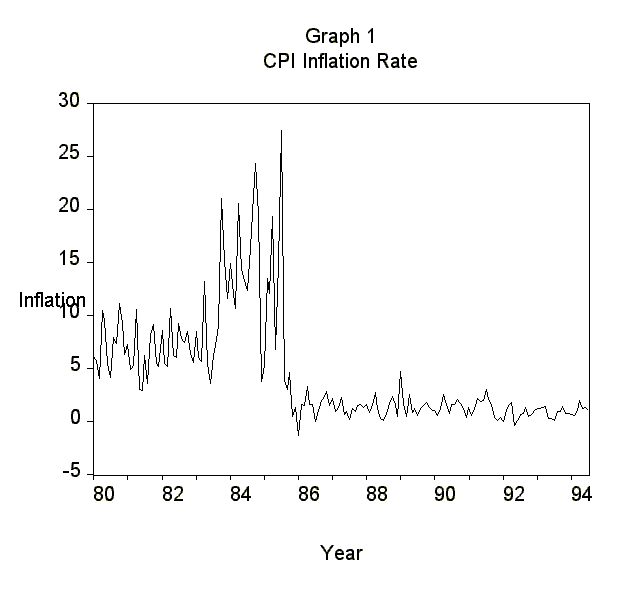
Graph 1 presents the monthly CPI inflation
rates in Israel between 1980 and 1994. Notice the large variation
in the inflation during this period, especially the drop in the
inflation rate following the stabilization program of July 1985.
The monthly inflation rate is between 5 and 10 percent from 1980
to 1983. From 1983 to July 1985 it is between 15 and 20 percent.
Then, following the stabilization in July 1985, the monthly inflation
drops to about 1.5 percent and from then on it declines gradually
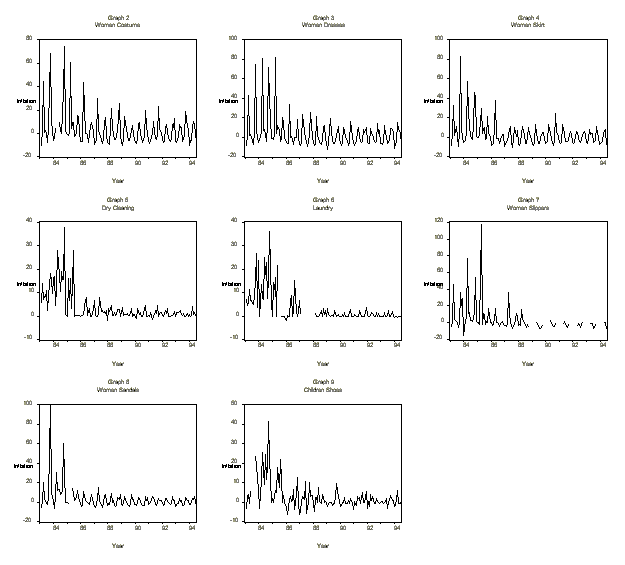
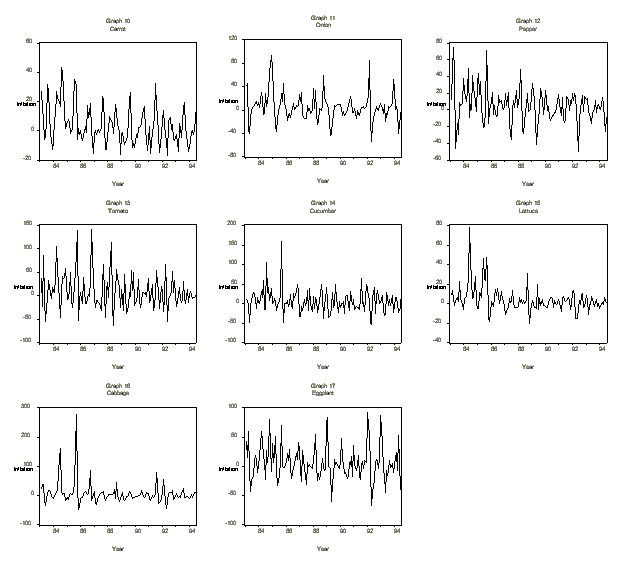
to about 1 percent in 1994. Graphs 2-9 present the monthly inflation
rates of the first group, the cloths series and Graph 10-18 present
the monthly inflation rate of the second group, the Vegetables
series. The difference in the seasonal fluctuations between the
high inflation period, prior to July 1985, and the lower inflation
period, posts July 1985, is very clear. The seasonal fluctuations
are clearly greater during the high inflation period. The graphs
also suggest that the difference in the seasonal fluctuations
between the high inflation period and the low inflation period
is greater in the Clothing series than in the Vegetables series.
Empirical Tests
To test statistically whether the seasonal fluctuations are higher during the high inflation period and in the Cloths' series I estimated the following AR(2) process for each series:
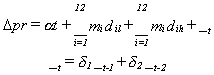
where pr is the real price - the series price index over the CPI price index- ) is a first difference and mil and mih are monthly dummies during the low inflation period and the high inflation period respectively (e.g., m1h takes the value of one if it is January and the inflation is high and zero otherwise).
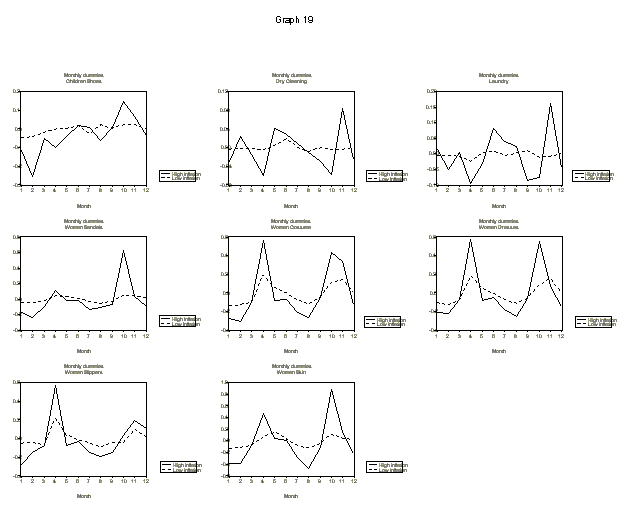
Table 1 presents the results for the cloths series. The seasonal fluctuations which are captured by the monthly dummies are clearly larger during the high inflation period in all the series. The standard deviation of the twelve monthly dummies in each period is presented in the bottom row. The standard deviations of the monthly dummies during the high season are three to eight times the standard deviations of the monthly dummies during the low season. To illustrate the results, the monthly dummies during the high inflation regime and during the low inflation regime are graphed together in Graph 19. The difference between the two periods is apparent. The seasonal fluctuations during the high inflation period much larger than the seasonal fluctuations during the lower inflation period.
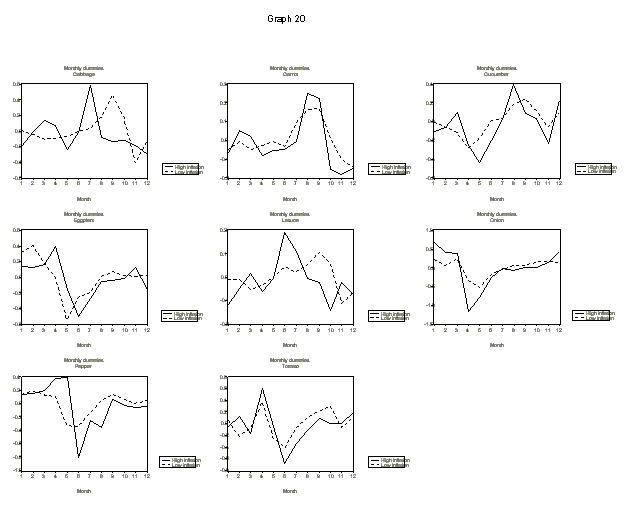
Table 2 presents the results for the Vegetables series. The difference in the seasonal fluctuations between the high inflation period and the lower inflation period is much smaller than in the clothes' series. The standard deviations of the monthly dummies during the high season are only slightly greater then the standard deviations of the monthly dummies during the low season. Again, in order to illustrate the results, I graph the monthly dummies of the two periods together (see graph 20). The difference in the seasonal fluctuations between the two inflation periods is much smaller than the difference in the Cloth's series.
6. Summary and Conclusions
A large literature has studied the adjustment process of the economy using kinked adjustment costs, i.e., fixed costs of adjustment. This paper extends this literature to explain the adjustment process when there are seasonal fluctuations. This paper shows that the seasonal fluctuations increase with the trend, e.g., the seasonality in the unemployment rate is higher during periods of expansions or contractions, price seasonality increases with the inflation rate and so on. The prediction is strongly supported by investigating price seasonality during different periods of inflation.
In addition to explaining some stylized
facts and providing insight into the adjustment process when there
are seasonal fluctuations, this paper has two other contributions.
First, it provides further evidence on the existence of nominal
rigidities and non convex adjustment costs. Second, it suggests
that seasonal fluctuations offer relevant information on the
underlying economic environment. Estimations and Forecasting of
the state of the economy should incorporate seasonal data. First,
because seasonally adjusting the data may be bias when the seasonality
is endogenous as this paper suggests. And second, because seasonal
fluctuations may provide relevant information on the underlying
economic environment. I.e., larger seasonal fluctuations may suggest
a change in the underlying trend.
Table 1: dependent variable: first
difference of real price
Women Costume | Women Dresses | Women Skirt | Dry Cleaning | |||||||||
Monthly dummies | High inf. | Low inf. | High inf. | Low inf. | High inf. | Low inf. | High inf. | Low inf. | ||||
January | -.278 (.076) | -.14 (.036) | -.216 (.052) | -.107 (.025) | -.395 (.091) | -.132 (.043) | -.031 (.016) | -.004 (.009) | ||||
February | -.306 (.076) | -.132 (.036) | -.225 (.043) | -.126 (.025) | -.387 (.074) | -.113 (.043) | .023 (.016) | -.001 (.009) | ||||
March | -.100 (.062) | -.092 (.036) | -.075 (.043) | -.076 (.025) | -.089 (.074) | -.073 (.043) | -.014 (.016) | -.002 (.009) | ||||
April | .557 (.076) | .191 (.036) | .576 (.043) | .183 (.025) | .471 (.074) | .077 (.043) | -.060 (.016) | -.006 (.009) | ||||
May | -.083 (.076) | .058 (.036) | -.086 (.043) | .047 (.025) | .045 (.074) | .150 (.043) | .040 (.016) | .004 (.009) | ||||
June | -.069 (.062) | -.0014 (.036) | -.045 (.043) | -.005 (.025) | .012 (.074) | .029 (.043) | .028 (.016) | .019 (.009) | ||||
July | -.206 (.062) | -.079 (.036) | -.182 (.043) | -.074 (.025) | -.288 (.074) | -.086 (.043) | .008 (.016) | .0005 (.009) | ||||
August | -.261 (.076) | -.119 (.036) | -.250 (.053) | -.115 (.025) | -.476 (.091) | -.122 (.043) | -.010 (.020) | -.008 (.009) | ||||
September | -.051 (.076) | -.044 (.036) | -.062 (.053) | -.054 (.036) | -.113 (.091) | -.045 (.043) | -.030 (.020) | .0007 (.009) | ||||
October | .436 (.076) | .116 (.036) | .553 (.053) | .085 (.025) | .875 (.091) | .112 (.043) | -.057 (.020) | -.004 (.009) | ||||
November | .334 (.076) | .140 (.036) | .068 (.053) | .157 (.025) | .154 (.091) | .042 (.043) | .084 (.020) | -.004 (.009) | ||||
December | -.123 (.076) | .0046 (.036) | -.148 (.053) | .009 (.025) | -.214 (.091) | .021 (.043) | -.025 (.016) | .001 (.009) | ||||
*1 |
.238 (.094) | .151 (.094) | .001 (.094) | .094 (.092) | ||||||||
*2 |
.113 (.094) | .069 (.094) | .056 (.094) | .208 (.092) | ||||||||
R2 Durbin-Watson | 0.75 2.03 | 0.85 2.03 | 0.71 2.03 | 0.34 1.93 | ||||||||
standard deviation of dummies | 0.29 | 0.11 | 0.28 | 0.105 | 0.39 | 0.096 | 0.09 | 0.069 | ||||
Standard errors in parentheses
Table 1: dependent variable: first difference of real price
Laundry
| Women Slippers | Women Sandals | Children Shoes | |||||||||
Monthly dummies | High inf. | Low inf. | High inf. | Low inf. | High inf. | Low inf. | High inf. | Low inf. | ||||
January | .014 (.029) | -.007 (.015) | -.282 (.056) | -.051 (.047) | -.167 (.036) | -.044 (.017) | -.118 (.016) | -.047 (.020) | ||||
February | -.050 (.024) | -.005 (.015) | -.147 (.047) | -.048 (.047) | -.240 (.030) | -.051 (.017) | -.254 (.016) | -.044 (.020) | ||||
March | .003 (.024) | -.010 (.015) | -.078 (.047) | -.067 (.046) | -.091 (.030) | -.026 (.017) | -.053 (.016) | -.019 (.020) | ||||
April | -.097 (.024) | -.025 (.015) | .570 (.047) | 0.216 (.044) | 0.112 (.036) | .043 (.017) | -.102 (.016) | -.002 (.020) | ||||
May | -.031 (.024) | .002 (.015) | -.079 (.047) | .037 (.027) | -.023 (.036) | .032 (.017) | -.043 (.016) | .002 (.020) | ||||
June | .081 (.024) | .007 (.015) | -.034 (.046) | -.016 (.027) | -.014 (.030) | .010 (.017) | .018 (.016) | .017 (.020) | ||||
July | .039 (.029) | -.007 (.015) | -.154 (.046) | -.050 (.027) | -.128 (.030) | -.037 (.017) | .008 (.016) | -.026 (.020) | ||||
August | .022 (.029) | .003 (.016) | -.193 (.056) | -.089 (.027) | -.102 (.036) | -.057 (.017) | -.061 (.020) | .021 (.020) | ||||
September | -.087 (.029) | .009 (.015) | -.150 (.057) | -.048 (.027) | -.071 (.037) | -.025 (.017) | .009 (.020) | .004 (.020) | ||||
October | -.076 (.029) | -.011 (.015) | .031 (.057) | -.046 (.025) | .632 (.037) | .050 (.017) | .150 (.020) | .022 (.020) | ||||
November | .163 (.029) | -.009 (.015) | .189 (.057) | .097 (.044) | .032 (.037) | .036 (.017) | .065 (.020) | .021 (.020) | ||||
December | -.044 (.029) | .001 (.015) | .103 (.057) | .013 (.045) | -.097 (.037) | .018 (.017) | -.035 (.016) | .0001 (.020) | ||||
*1 |
.242 (.101) | .325 (.113) | .139 (.094) | .125 (.093) | ||||||||
*2 |
.037 (.101) | -.148 (.113) | .146 (.094) | .242 (.093) | ||||||||
R2 Durbin-Watson | 0.75 1.97 | 0.85 2.03 | 0.82 2.06 | 0.55 1.99 | ||||||||
standard deviation of dummies | 0.08 | 0.01 | 0.23 | 0.086 | 0.39 | 0.096 | 0.1 | 0.002 | ||||
Standard errors in parentheses
Table 2: dependent variable: first difference of real price
Carrot
| Onion | Pepper | Tomato | |||||||||
Monthly dummies | High inf. | Low inf. | High inf. | Low inf. | High inf. | Low inf. | High inf. | Low inf. | ||||
January | -.063 (.059) | -.049 (.029) | .688 (.252) | .223 (.122) | .140 (.150) | .135 (.072) | -.043 (.262) | .047 (.125) | ||||
February | .053 (.049) | -.007 (.029) | .419 (.211) | .055 (.122) | .149 (.125) | .183 (.072) | .114 (.216) | -.218 (.125) | ||||
March | .023 (.049) | -.050 (.029) | .380 (.211) | .251 (.122) | .191 (.125) | .127 (.072) | -.167 (.216) | -.074 (.125) | ||||
April | -.080 (.049) | -.027 (.029) | -1.169 (.211) | -.333 (.122) | .366 (.125) | .098 (.072) | .598 (.216) | .369 (.125) | ||||
May | -.054 (.049) | -.008 (.029) | -.797 (.210) | -.524 (.122) | .385 (.125) | -.333 (.072) | -.050 (.216) | -.258 (.125) | ||||
June | -.049 (.049) | -.033 (.029) | -.262 (.210) | -.178 (.122) | -.806 (.124) | -.343 (.072) | -.683 (.214) | -.418 (.125) | ||||
July | -.006 (.049) | .096 (.029) | -.026 (.206) | -.043 (.121) | -.249 (.123) | -.148 (.072) | -.340 (.214) | -.083 (.125) | ||||
August | .248 (.059) | .162 (.029) | -.055 (.251) | .052 (.120) | -.356 (.150) | .042 (.072) | -.118 (.262) | .110 (.124) | ||||
September | .224 (.061) | .172 (.029) | .000 (.257) | .057 (.121) | .062 (.152) | .135 (.072) | .086 (.262) | .208 (.124) | ||||
October | -.157 (.061) | .008 (.029) | .003 (.257) | .159 (.122) | -.034 (.152) | .059 (.072) | .007 (.265) | .300 (.125) | ||||
November | -.184 (.061) | -.102 (.029) | .141 (.257) | .159 (.122) | -.056 (.152) | -.001 (.072) | -.002 (.265) | -.066 (.125) | ||||
December | -.151 (.061) | -.146 (.029) | .432 (.257) | .145 (.122) | -.038 (.151) | .043 (.072) | .183 (.262) | .114 (.125) | ||||
*1 |
-.353 (.094) | -.375 (.091) | .217 (.091) | .010 (.092) | ||||||||
*2 |
.128 (.094) | .258 (.091) | .262 (.091) | .238 (.092) | ||||||||
R2 Durbin-Watson | 0.56 1.96 | 0.46 2.01 | 0.56 2.03 | 0.34 2.03 | ||||||||
standard deviation of dummies | 0.14 | 0.01 | 0.53 | 0.24 | 0.33 | 0.18 | 0.31 | 0.23 | ||||
Standard errors in parentheses
Table 2: dependent variable: first
difference of real price
cucumber
| lettuce | Cabbage | Eggplant | |||||||||
Monthly dummies | High inf. | Low inf. | High inf. | Low inf. | High inf. | Low inf. | High inf. | Low inf. | ||||
January | -.106 (.275) | -.007 (.133) | -.114 (.076) | -.010 (.037) | -.197 (.255) | .010 (.124) | .134 (.239) | .317 (.262) | ||||
February | -.057 (.230) | -.060 (.133) | -.049 (.064) | -.012 (.037) | -.000 (.215) | -.049 (.124) | .129 (.199) | .404 (.216) | ||||
March | .101 (.230) | -.115 (.133) | .015 (.064) | -.052 (.037) | .140 (.215) | -.108 (.124) | .163 (.199) | .176 (.216) | ||||
April | -.259 (.230) | -.285 (.133) | -.060 (.064) | -.037 (.037) | .069 (.215) | -.095 (.124) | .395 (.199) | -.003 (.216) | ||||
May | -.441 (.229) | -.173 (.133) | -.006 (.064) | .004 (.037) | -.242 (.214) | -.072 (.124) | -.153 (.198) | -.548 (.216) | ||||
June | -.202 (.225) | .008 (.132) | .193 (.064) | .043 (.037) | -.018 (.211) | -.007 (.123) | -.508 (.197) | -.258 (.214) | ||||
July | .026 (.225) | .030 (.132) | .109 (.062) | .023 (.037) | .585 (.208) | .032 (.123) | -.273 (.195) | -.199 (.214) | ||||
August | .392 (.275) | .185 (.131) | -.006 (.076) | .054 (.037) | -.079 (.254) | .176 (.122) | -.059 (.239) | .007 (.262) | ||||
September | .087 (.275) | .247 (.131) | -.022 (.078) | .106 (.037) | -.139 (.258) | .466 (.123) | -.040 (.241) | .072 (.262) | ||||
October | .034 (.280) | .116 (.133) | -.141 (.078) | .058 (.037) | -.125 (.261) | .167 (.124) | -.010 (.243) | .017 (.265) | ||||
November | -.229 (.280) | -.059 (.133) | -.021 (.078) | -.112 (.037) | -.180 (.261) | -.409 (.124) | .124 (.243) | .013 (.265) | ||||
December | .231 (.276) | .094 (.133) | -.074 (.078) | -.065 (.037) | -.303 (.258) | -.135 (.124) | -.152 (.241) | .024 (.262) | ||||
*1 |
-.111 (.088) | -.357 (.090) | -.313 (.087) | -.256 (.091) | ||||||||
*2 |
.360 (.088) | .317 (.090) | .397 (.087) | .272 (.091) | ||||||||
R2 Durbin-Watson | 0.2 2.09 | 0.29 2.03 | 0.27 1.98 | 0.36 2.09 | ||||||||
standard deviation of dummies | 0.23 | 0.15 | 0.09 | 0.06 | 0.24 | 0.21 | 0.24 | 0.25 | ||||
Standard errors in parentheses
References
Akerlof, George A., and Yellen, Janet L.,
1985, "A Near Rational Model of the Business Cycle, with
wage and Price Inertia," Quarterly Journal of Economics,
Supplement, 823-838.
__________________, 1985, "Can Small
Deviations from Rationality Make Significant Differences to Economic
Equilibria?" American Economic Review 75 (September):
708-721.
Anderson, Patricia M., 1993, "Linear Adjustment Costs and Seasonal Labor Demand: Evidence From Retail Trade Firms," Quarterly Journal of Economics 113 (November): 1015-1042.
Barsky, Robert B. and Jeffrey A. Miron,
1989, "The Seasonal Cycle and the Business Cycle," Journal
of Political Economy 97 (June): 503-535.
Beaulieu, J. Joseph, Jeffrey K. MacKie-Mason,
and Jeffrey A Miron, 1992, " Why Do Countries and Industries
with Large Seasonal Cycles Also have Large Business Cycles?,"
Quarterly Journal of Economics 107 (May): 621-656.
Bentolila, Samuel and Bertola, Giuseppe,
1990, "Firing Costs and Labour Demand: How Bad is Eurosclerosis,"
Review of Economic Studies, 57: 381-402.
Bertola, G., and Caballero Ricardo J., 1990,
"Kinked Adjustment Costs and Aggregate Dynamics," Macroeconomic
Annual: 237-288.
Caballero, Ricardo J., 1992, "A Fallacy
of Composition," American Economic Review 82 (December):
1279-1292.
____________________, 1993, "Microeconomic
Adjustment Hazards and AggregateDynamics," Quarterly Journal
of Economics (May): 359-383.
Caplin, Andrew, and Leahy, John, 1991, "State
Dependence Pricing and Dynamics of Money and Output,"
Quarterly Journal of Economics 426 (August): 683-708.
Caplin, Andrew, and Spulber, Daniel F.,
1987, " Menu Costs and the Neutrality of Money," Quarterly
Journal of Economics 102 (November): 703-725.
Danziger, L., 1987, "Costs of Price
Adjustment and the Welfare Economics of Inflation and Disinflation,"
American Economic Review 95: 547-566.
___________, 1988, "Relative Price
Variability and Inflation: A Disaggregated Analysis," Journal
of Political Economy 95: 547-566.
Fischer, S., 1981, "Relative Shocks,
Relative Price Variability, and Inflation," Brookings
Papers on Economics Activity 2: 171-196.
Mankiw, Gregory N., 1985, " Small Menu
Costs and Large Business Cycles: A Macroeconomic Model of Monopoly,"
Quarterly Journal of Economics 100 (May): 529-539.
Miller, M, H. and Orr, D. 1966 "A
Model of the Demand for Money by Firms". Quarterly Journal
of Economics 80 (August): 413-435.
Parks, R., 1978, "Inflation and Relative
Price Variability," Journal of Political Economy 86:
79-96.
Sargent, Thomas, 1978, "Estimation
of Dynamic Labor Demand Schedules under Rational Expectations,"
Journal of Political Economy 86: 1009-44.
Sheshinski, E., and Weiss, Y., 1977, "Inflation
and Costs of Price Adjustment," Review of Economic Studies,
44: 287-303.
_____________, 1983, "Optimum Price
Policy Under Stochastic Inflation," Review of Economic
Studies, 59: 331-360.
___________, 1981, "On the Relation
Between the Variability of Inflation and the Average Inflation
Rate," Carnegie-Rochester Conference Series on Public Policy,
15:57-86.
Rotemberg, J., 1982, "Monopolistic Price Adjustment and Aggregate Output," Review of Economic Studies, XLIX: 517-531.
Tommasai, A., 1991, "Inflation and
Relative Prices: Evidence from Argentina," Mimeo U.C.L.A,
Department of Economics.
Van Hoomissen, T., 1988, "Price Dispersion
and Inflation: Evidence from Israel," Journal of Political
Economy, 96: 1303-1314.