Organization for Economic Cooperation and Development (1996) Trade, Employment and Labor Standards: A Study of Core Workers’ Rights and International Trade, Paris.
January 25, 1999 Comments Welcome:
Revised SWINNERTON-KENNETH@DOL.GOV
ROGERSC@GUNET.GEORGETOWN.EDU
The Economics of Child Labor: Comment
by
Kenneth A. Swinnerton
U.S. Department of Labor
Bureau of International Labor Affairs
200 Constitution Avenue, N.W.
Room S-5325
Washington, D.C. 20210
and
Carol Ann Rogers
Economics Department
Georgetown University
Washington, D.C. 20057
We thank Gregory Schoepfle, Susan Vroman and two anonymous referees for helpful comments. The views expressed here are our own and do not reflect the views or opinions of the U.S. Department of Labor or the U.S. Government.
In a recent paper, Kaushik Basu and Pham Hoang Van (BV, 1998) develop an important and very interesting model in which a fairly productive economy exhibits multiple equilibria, with children working in at least one. They identify two assumptions as essential to this result. The first - - which they call the "luxury axiom" - - is that a family sends its children to the labor market only if its income from sources other than child labor is very low. The second is embodied in their "substitution axiom" which states that from the point of view of firms, child labor is substitutable for adult labor. In this comment, we show that in addition to these two assumptions about the micro-level behavior of households and firms, there is also an essential macro-level assumption that may be termed the "distribution axiom:" income or wealth from non-labor sources must be sufficiently concentrated in the hands of a few agents. We establish that if non-labor income is distributed with sufficient equality, a market equilibrium with child labor cannot exist in the BV model.
Beyond their contribution as an extension of BV’s theory, our results formalize a proposition implicit in recent policy discussions of child labor. Christiaan Grootaert and Ravi Kanbur (1995) note that as household-level poverty is well-known to be the major cause of child labor, "[g]eneral economic development, equitably distributed, is the best and most sustainable way of reducing child labor." (p. 198, emphasis added) Policy documents from the International Labor Organization (ILO) have long conveyed this view, and now the World Bank appears to as well (Peter Fallon and Zafiris Tzannatos, 1998). There is a growing recognition that while economic development and development policies are necessary to eliminating child labor, they are not always sufficient on their own. Distributional considerations matter. Indeed, in the case in which BV’s model yields multiple equilibria, the economy is developed enough to eliminate child labor. In this comment it becomes clear that if child labor exists in this economy, the causes are purely distributional.
An Extension of the BV Model to Study Distributional Issues
Our starting point is the "Basic Model" of BV’s Section II, in particular, the case in which BV establish the existence of both a "good" - - no children work - - and a "bad" - - all children work - - equilibrium. BV focus exclusively on labor incomes as a determinant of child labor. They justify this focus by assuming that non-labor incomes (returns to capital) are consumed by either (i) a "capitalist" class that owns all of the capital, or (ii) foreign owners of capital. We depart from these assumptions by supposing that some of the working households own capital. We then study how the distribution of returns to capital affects the households’ incentives to have their children work.
Without loss of generality, normalize the measure of firms to 1. Total returns to capital (total "dividends") are
(1)
pi~=~f(A``+``gamma C)``-``w_A``A``-``w_C``C``,
where f(.) is the production function, f’(.) > 0, f’‘(.) < 0, A is the number of adult workers, C is the number of child workers, and ( < 1 is a parameter that captures the notion that one child’s labor is equivalent to that of ( adults. wA and wC are, respectively, the adult and child wages.
Assume there are N households, of two types: those that receive dividends and those that do not. The proportion of dividend-receiving households is 8 0 (0, 1]. Dividends, 2, are equal for all households that receive them, i.e., 2 = B/8N. In other respects the households are identical: as in BV, each household consists of one adult and one child, and the adult member of each household always works, while the child’s labor supply depends on the household’s resources.
The child-labor decision for the (1-8)N households that do not receive dividends is the same as in the BV paper: following from BV’s "luxury axiom," the household sends the child to work if subsistence consumption (s) is not achieved for both members of the household through adult labor alone. Writing e for the amount of labor effort by a child, we have equation (5) of BV:
(2)
e(w_A)`=` scalesym 225\{~stack {0~if~w_A`$`2s # 1~if~w_A`<`2s}~~~(no-dividend~households)
The child-labor decision for the 8N dividend-receiving households needs to be modified to account for the receipt of dividends. Accordingly,
(3)
e(w_A`,`theta)`=` scalesym 225\{~stack {0~if~w_A`+`theta`$`2s # 1~if~w_A`+`theta`<`2s}~~~(dividend~households)
Since N adults work and a unit of child labor is the same as ( units of adult labor, the effective market supply of labor is
(4)
S(w_A,`8)`=` scalesym 338\{~stackalign {N&~if~w_A`$`2s # N+((1-8)N&~if~w_A`0`[2s`-`2, 2s)
# N+(N&~if~w_A`<`2s`-`2}
We note that a priori there are three possible levels of labor supply. One corresponds to BV’s "good" equilibrium: there is no child labor. Another corresponds to BV’s "bad" equilibrium: all N households send their children into the labor market. The third possibility, which is not in BV, is that only the no-dividend households send their children into the market. Children in dividend-receiving households do not work.
We now show that the distribution of dividends to worker households rules out the "bad" equilibrium. If the economy is productive enough to support the good equilibrium, then it generates enough non-labor-related wealth so that households who share in that wealth never have to send their children to work:
Proposition: If a good equilibrium (G) exists, then there is no equilibrium in which dividend-receiving households send their children to work.
Proof: By contradiction. Assume there exists an equilibrium (G) in which no households send their children to work, i.e., that wAG $ 2s. Now suppose there is also another child-labor equilibrium (B) in which all N households send their children to work, i.e., that wAB + 2B < 2s. It can then be shown that wAG < wAB + 2B, which is a contradiction.
To show this, first note that owing to the concavity of the production function f(.),
f'(N) ``<``f(N)/N(5a)
and
f'(N+(N)```<```{f(N+(N)`-`f(N)} over {(N}.(5b)
Since wAG = fN(N) and wAB = fN(N+(N), (5a) and (5b) together imply that
w_A^G``+``gamma w_A^B~<~{f(N+(N)} over N,
or
w_A^G``-``w_A^B~<~{f(N+(N)-w_A^B(1+gamma)N} over N.(6)
Next, recall from BV that if children are employed, then wC = (wA , so that dividends in equilibrium B may be written as:
theta^B~=~{f(N+gamma N)-w_A^B(1+gamma)N} over {lambda N}.(7)
Hence, the right-hand side of inequality (6) equals 82B. Since 8 0 (0,1], (6) implies
w_A^G``-``w_A^B~<~theta^B.(8)
qed.
Corollary 1: If 8 = 1, then only the good equilibrium exists.
Proof: Obvious, now all households receive dividends.
The intuition behind these results is this: in the "good" equilibrium the level of output is high enough to sustain all households and the adult wage is high enough by itself to ensure that each household is sustained without sending its child to work. If children work, then the additional output more than covers the children’s wage bill. Thus, the higher level of output is more than sufficient to cover both the total wage bill from the good equilibrium and the children's wage bill from the equilibrium with child labor. Since there is more than enough output to sustain potentially all households without employing children, the existence of child labor must trace back to the way that output is distributed across households. As the only difference between households in the model is whether or not dividends are distributed to them, it follows that the receipt of dividends is sufficient to ensure that households do not send their children to work. The corollary states that when all households receive dividends, none sends its child to work: child labor cannot exist in this economy if wealth is distributed equally.
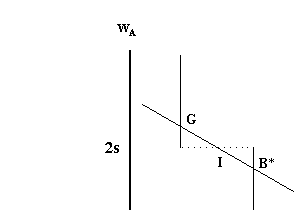
Now look at Figure 1. The figure is drawn to be consistent with the proposition that if the good equilibrium (L = N) exists, then the bad equilibrium (L = N[1+(]) cannot exist: the labor demand curve does not intersect the third segment of labor supply where L = N[1+(]. As the figure is drawn, there are two stable equilibria, G and B*. The length of the horizontal step at wA = 2s between L = N and L = N[1+((1-8)] depends on 8. As 8 increases, this length decreases. In the extreme case where 8 = 1, the step collapses on N. It follows immediately that any 8 such that the vertical portion of the lower step is located to the left of point I rules out the existence of equilibrium B*. This suggests that there is a critical concentration of wealth, 8* , (0, 1), at which an equilibrium with any child labor ceases to exist. In other words, the strictly equal distribution of dividends across all households described in Corollary 1 is not necessary to eliminate child labor. If there are simply "enough" dividend households, withdrawal of their children from the labor market will raise the adult wage by enough to induce the children from non-dividend households to leave the market as well. From Figure 1, it is seen that 8* is defined implicitly by
2s``=``f'`scalesym 110 \(`[1+gamma(1-lambda^*)]N`scalesym 110 \) .
From a policy perspective, these findings suggest that redistributions of wealth could eliminate child labor. From the standpoint of understanding the causes of child labor, it is clear that in some instances the issue is not economy-wide poverty. The economy may be fully capable of generating enough wealth to eliminate child labor, but very concentrated holdings of that wealth may keep it from doing so.
Conclusion
In a World Bank policy paper, Fallon and Tzannatos (1998) note that there is a negative association between income and the level of child labor for low-income countries, but that this association becomes less marked in the more affluent developing countries, i.e. those with per capita GDPs in the range of one to four thousand U.S. dollars. Given the well-known problems with data on child labor both within countries and in a cross-country context, Fallon and Tzannatos most strongly suggest that the weakening of the negative relationship between the incidence of child labor and per capita GDP may be a statistical artifact. Our model suggests another factor that may explain this finding: when child labor is observed in these more affluent countries, inequality in the income distribution may be the reason.
References
Basu, Kaushik (1998) "Child Labor: Cause, Consequence and Cure, with Remarks on International Labor Standards," forthcoming in Journal of Economic Literature.
_______ and Pham Hoang Van (1998) "The Economics of Child Labor," American Economic Review, 88(3), June, pp. 412-427.
Fallon, Peter and Zafiris Tzannatos (1998) Child Labor: Issues and Directions for the World Bank, Washington, D.C.: World Bank.
Grootaert, Christiaan and Ravi Kanbur (1995) "Child Labor: An Economic Perspective," International Labor Review, 134(2), pp. 185-203.
International Labor Organization, http://www.ilo.org/public/english/child/index.htm.
Organization for Economic Cooperation and Development (1996) Trade, Employment and Labor Standards: A Study of Core Workers’ Rights and International Trade, Paris.