 (1)
(1)
Equilibrium Search Models
Audra J. Bowlus
Nicholas M. Kiefer
George R. Neumann*
Date: June 4, 1997
This paper applies an equilibrium search to study the transition
from schooling to work of U.S. high school graduates. We consider
the case where there is heterogeneity in firm productivity and
the number of firm types is discrete. For this case the estimation
problem is non-standard and the likelihood function is non-differentiable.
This paper provides a computational method to obtain the MLE
and, through several Monte Carlo studies, characterizes the behavior
of the estimator. Applying these methods to the transition from
school to work, our results show that nonemployed blacks receive
fewer offers than whites and employed blacks are more likely to
lose their jobs. Importantly, employed blacks and whites receive
job offers at the same rate. However, the difference in job destruction
rates is so great that it accounts for three-quarters of the black-white
wage differential.
Keywords: Labor market transitions; duration models; simulated annealing;discrete non -parametric heterogeneity; black-white earnings differential.
JEL Classification: J64, J3, C41.
Editorial Communications: Prof. George R. Neumann, Dept. of Economics,
Univ. of Iowa, Iowa City, IA, 52242-1000, USA
1. Introduction
The essential idea of equilibrium search models of labor market behavior is that wage policy matters. In contrast, the stylized neoclassical competitive model predicts that firms paying a wage above the competitive equilibrium will disappear; those offering less will attract no workers. The search approach introduces "friction" via information asymmetries. Here, firms that offer high wages are more attractive to workers, obtaining and retaining employees more readily than firms offering lower wages. Other things equal high wage firms generate lower profit per worker but make it up on volume. These simple ideas about wage policy have been stated in informal ways by several scholars. Hicks (1932, [1966]) discusses the 'Gospel of High Wages' whereby unusually successful employers pay high wages to have the "pick of the market" (p.36). Kerr (1954) initiated a long-surviving, although never mainstream, line of research on empirical correlates of wage policy that has since become known as "Dual Labor Market" theory. While these early discussions of wage policy are often colorful, formal content has been given to the ideas only recently in equilibrium search models by Albrecht and Axell (1984), Burdett (1990), Burdett and Mortensen (1995), and Mortensen (1990). In competitive models wage policy doesn't matter because by definition in equilibrium the law of one price holds: all workers of a given type receive the same wage. Even in simple monopsony models of the labor market (Card and Krueger (1995)) wage policy does not matter because the law of one price still holds, albeit at lower than the competitive level. In contrast, search models generate dynamic monopsony power for employers due to the presence of trade frictions such as the length of time it takes to find a new job. A firm's wage policy is important in such models because it directly affects the distribution of income in an economy. Moreover, in such dynamic monopsony models public policy experiments such as introducing or changing a minimum wage can have employment effects that are quite different from those expected in the standard competitive case.
Because equilibrium search models provide a natural interpretation of interesting labor market phenomena, the estimation of such models has attracted considerable attention. Eckstein and Wolpin (1990) estimate a version of Albrecht and Axell's (1984) model; van den Berg and Ridder (1993a,1993b), and Kiefer and Neumann (1993), and Bowlus, Kiefer, and Neumann (1995) estimate a version of Mortensen's (1990) model. Although these models differ in the forces of competition generated by firms, each predicts a disperse price equilibrium to exist. In the Albrecht and Axell model the equilibrium wage distribution is determined by heterogeneity in reservation wages of workers. In Mortensen's approach the equilibrium wage distribution is determined by the technology that matches workers to jobs. This is a pure search equilibrium model, in that heterogeneity in workers or firms is not required for the existence of a dispersed equilibrium. To date, efforts at fitting these models to data have not been completely successful. The tight theoretical structure needed to generate simple estimation strategies results in a poor match between theory and evidence. "Evidence" in this context consists of data on the search time to find employment, the wage accepted, and the duration of the job. While the duration data are in reasonable agreement with the predictions of the theory, the distribution of earnings is not. This is to be expected: when wage policy matters, higher wages bring forth greater labor supply to firms, and since workers prefer higher wages, the distribution function of wages is predicted to have a thick right tail. However, empirical wage distributions typically have thin right tails, looking much like income distributions for which Pareto distributions are frequently used to characterize the upper tail. One explanation for this mismatch between theory and evidence is that unmeasured differences across workers and jobs can not be ignored. Of course, unobserved heterogeneity, like dummy variables in a regression, can explain any divergence between fact and theory. We adopt the approach of introducing heterogeneity in small doses - so that the essential information basis for wage dispersion is not completely absorbed into "heterogeneity."
In this paper we provide methods for estimating equilibrium search models using a non-parametric estimator of heterogeneity. In Section 2 we describe the basic equilibrium search model due to Mortensen (1990) and Burdett and Mortensen (1995) and we develop the likelihood function appropriate to data generated by this model. For the case that we consider, namely a discrete number of firm types having different productivity levels Pj, j=1,..,J, the estimation problem is non-standard, and the likelihood function is not differentiable. We characterize the MLE for this problem and provide a means of computing it. The computational method we employ exploits the special structure of the problem. In the first part of the algorithm we calculate the points of support of the wage distribution in the presence of heterogeneity; in the second part the profile likelihood function, conditioned on the points of support of the wage distribution, is maximized with respect to the remaining parameters in the usual manner. Asymptotic independence of these parameter blocks guarantees that the stepwise maximum is a global maximum.
The third section contains a Monte Carlo study of the properties of the estimators we propose using all the data from the search model - unemployment duration, accepted wages, job spell duration and job transitions. In Sections 4 and 5 we apply this technology to study the transition between school and work for black and white male high school graduates using the National Longitudinal Survey of Youth (NLSY). This application has been of considerable policy interest in recent years, so we use it to examine how well the search framework can explain empirical patterns found in the data. The model provides a satisfactory fit to the nonemployment durations following graduation and the wage offer distribution for the first full-time job for both groups. It has more difficulty matching the job duration data. Longer nonemployment spells and lower wages for blacks are captured in the model through a lower arrival rate of offers while nonemployed and a higher job destruction rate while employed. Three quarters of the black-white wage differential is explained by differences in the search parameters highlighting the important role labor market mechanisms can play in explaining wage differentials. Our conclusions are given in the sixth and final section of the paper.
2. Equilibrium Search Models
To characterize labor market transition data we use the equilibrium search model set out in Mortensen (1990). We summarize the homogeneous version of it briefly here. The primitives of the model are (1) the offer arrival rate for unemployed workers, l0, (2) the arrival rate of offers while employed, l1, (3) the job destruction rate, d, and (4) the productivity level of firms, P. In the model workers, taking the wage offer distribution of the firms as given, solve the standard search utility maximization problem and adopt a reservation wage strategy. Following Mortensen and Neumann (1988) a worker's reservation wage while unemployed is:
(1)
where F(w) is the wage offer distribution, k0=l0/d and k1=l1/d, and b is the value of non-market time. Unemployed workers see jobs arrive at rate l0, and they accept the first job that offers more than their reservation wage. While employed at wage w, a worker's reservation wage is also w. Job offers arrive at rate l1 for employed workers, and jobs are destroyed at rate d. In the homogeneous version firms are identical with productivity level P, face constant returns to scale in production, and maximize profits by choosing the wage to pay. The balancing condition which equates supply and demand is that firms will offer higher wages if and only if they can expect to get an additional number of workers to cover the lower per worker profits. Higher wages attract more workers to a firm and allow firms to retain the workers longer. Mortensen (1990) shows that the unique equilibrium wage offer distribution is:
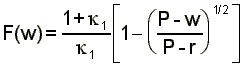 (2)
(2)
with density
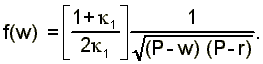 (3)
(3)
The development so far has considered the case where all firms have identical productivity, P. Bowlus, Kiefer and Neumann (1995) and Koning, Ridder and van den Berg (1995) point out that this implies from (3) that the density of wage offers, is increasing over its support. But, as noted above, empirical wage distributions typically have a thin right tail.
The observed empirical distribution of wages can be made consistent with the equilibrium search model if within a market there are differing levels of productivity across firms and if firms with especially high productivity are relatively rare. Heterogeneity in firm productivity can be introduced in two ways. Following Bontemps, Robin and van den Berg (1996) one could assume P is continuously distributed. Alternatively, following Bowlus, Kiefer and Neumann (1995) heterogeneity can be viewed as arising from a finite number of firm types, Q. Either approach can fit the wage distribution, but there are advantages and disadvantages of the approaches in other respects. The disadvantage of assuming a continuum of firm types is that the assumption creates a direct map between the distribution chosen to represent productivity and the resulting wage distribution due to the competition faced on either side by any one firm. A one-to-one mapping exists between productivity and wages. The model is then less clearly a search model - in that there is no longer pure search wage dispersion. Thus, it is difficult to assess the role of information in the operation of labor markets. The advantage of assuming a continuous distribution function is that it makes the estimation problem standard.
The advantages of modeling heterogeneity as discrete are twofold. First, while allowing for some flexibility in the shape of the wage offer distribution, it retains the key model element of search induced wage dispersion. Second, the classification of workers into different levels of productivity generates testable economic implications that will be of use when paired worker-firm data are available. A disadvantage is that discrete heterogeneity results in a likelihood function that is discontinuous in some of the parameters and whose estimation is non-standard. Non-standard estimation issues arise frequently in the application of dynamic programming models and can be handled.
Because we find the advantages of the discrete specification compelling enough to justify a trial application, we pursue the discrete heterogeneity approach in this paper. To this end, assume that there are Q types of firms with productivity P1 < P2 < ... < PQ. The fraction of firms having productivity Pj or less is gj = g(Pj). The equilibrium wage distribution, following Mortensen (1990), is:
 (4)
(4)
with fj defined by
 wLj < w wHj
(5)
wLj < w wHj
(5)
where wLj is the lowest wage that will be offered by a firm of type j and wHj is the highest wage paid by a type-j firm.
Several restrictions are implied by the model. First, wL1 = r, and wHj = wLj+1, j = 1,..,Q-1. Second, F(wHj) = gj, j=1,...,Q. Define Bj = [(1+k1(1-gj))/ (1+k1(1-gj-1))]2 and observe that 0 < Bj < 1 " j. Then, from the condition F(wHj) = gj it follows that
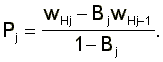 (6)
(6)
Equation (6) implies that if we know k1, r, wHj and gj, j = 1,..,Q, we can estimate the unobserved productivity levels, Pj.
The stochastic processes induced by the model described above
completely characterize labor market histories, whether complete
or incomplete. The data to be explained are the duration of unemployed
search, D1, the wage received on an accepted job, w,
the length of that job, D2, and whether the job ends
because it was lost (C=1) or left (C=0). According to the theory
unemployed search duration is exponential with intensity parameter
l0. The marginal distribution
of accepted wages is f(w) given by  I(wLj
< w wHj) (7)
I(wLj
< w wHj) (7)
where I(x) is the indicator that the event x occurs. The theory also predicts that conditional on the wage rate received, w, the density of job duration, f(D2½w), is exponential with intensity parameter (d + l1(1-F(w)) where F(w) is given in equation (4). Finally the probability that a job ends by being lost rather than left, Pr(C=1½w), is
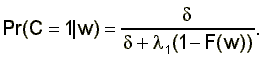 (8)
(8)
The likelihood function for this segment of the labor market history is:
 (9)
(9)
We partition the parameters of this model into three groups as: q = < q1,q2,q3 > where
q1 = < wH1, wH2, .., wHQ-1 >
q2 = < r, wHQ >
q3 = < l0, l1, d >.
Observe that the likelihood function is continuous but not differentiable in wH1,...,wHQ-1, which can be seen from the distribution function of wages shown in equation (5). However, the cut points wHj, j=1,..,Q-1, are points of discontinuity of the density and the results of Chernoff and Rubin (1956) show that maximum likelihood estimates of discontinuity in density converge to their true value at rate N. Therefore asymptotically, to order N1/2, the variability in estimates of wHj is unimportant and can be ignored. We provide empirical evidence on this conclusion in a small sampling experiment below. In our application, we use the bootstrap to provide standard errors for these parameters. The likelihood function (9) with wHj treated as known remains non-standard because the range of the random variable, w, is from r to wHQ and these are parameters of the model. Kiefer and Neumann (1993) propose the estimators
 (10)
(10)
for r and wHQ. The estimators  and
and  are super-efficient but in finite
samples they are not necessarily the MLE's for r and wHQ.
However, asymptotically they are the MLE's and the theory of
local cuts (Christensen and Kiefer (1994)) justifies conditioning
on them. As van den Berg and Ridder (1993a) note, these estimators
are sensitive to measurement error, but at least for the case
of classical measurement error their performance is actually improved
in small samples.
are super-efficient but in finite
samples they are not necessarily the MLE's for r and wHQ.
However, asymptotically they are the MLE's and the theory of
local cuts (Christensen and Kiefer (1994)) justifies conditioning
on them. As van den Berg and Ridder (1993a) note, these estimators
are sensitive to measurement error, but at least for the case
of classical measurement error their performance is actually improved
in small samples.
A characterization of maximum likelihood estimators for wHj j=1,..,Q-1 in wage data is given by the following theorem. The result is that the MLEs for these parameters occur at observed wages.
Theorem 1.
Let {WN} be the set of observed wages from a sample
of size N drawn from the wage distribution described in equation
(7). Denote the parameters corresponding to points of discontinuity
of this distribution as wHj, j = 1 to Q-1. The maximum
likelihood estimator for wHj, denoted  ,
is a (Q-1) element of WN.
,
is a (Q-1) element of WN.
Proof.
It suffices to consider the case of a single cutpoint,  .
Write the likelihood for wage data as
.
Write the likelihood for wage data as
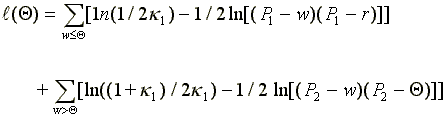
Here P1 and P2 are functions of  and
and  is a single kink point in the distribution.
The argument is as follows: if
is a single kink point in the distribution.
The argument is as follows: if  does
not occur at an observed wage, then the first and second order
conditions for a maximum must be satisfied at
does
not occur at an observed wage, then the first and second order
conditions for a maximum must be satisfied at  .
We show this is not possible. It suffices to do this for the
case where
.
We show this is not possible. It suffices to do this for the
case where  is the only unknown parameter
as we show the second derivative is positive - so in the multiparameter
case a diagonal element of the Hessian would be positive, violating
the second order condition. Differentiating twice and using ¶P1/
is the only unknown parameter
as we show the second derivative is positive - so in the multiparameter
case a diagonal element of the Hessian would be positive, violating
the second order condition. Differentiating twice and using ¶P1/¶ = 1/(1-B1) and ¶P2/
 = -B2/(1-B2) gives
2lqq = 
+ 
+ 
+ 
> 0
Theorem 1 tells us that there is no purpose looking for solutions to normal equations for estimates of the points of discontinuity; the estimates are observed values of wages, which are the points of discontinuity of the likelihood function of the sample. Though our theorem and proof focus on the leading case of wage data (the most relevant, and necessary, source of information on the wage distribution), experience has shown us that the addition of duration data, etc. does not affect the main result. Many variations are possible with different data configurations. For Q known there are N!/(N-Q+1)!(Q-1)! potential estimates of Hj, which can be a large number. Finding the maximum of the likelihood function can be done by a grid search in low dimensions, although for Q > 3 this becomes time intensive for samples of the size typically used in panel data - that is, N » 500-1,000. For example, for Q=3 and N=500 there are N(N-1)/2 =124,750 distinct combinations of wH1 and wH2 possible. The N(N-1)/2 elements are the upper off-diagonal elements in a matrix array of W x W where search is restricted by the order relation wH2 > wH1. This triangular array is replaced in higher dimensions by the suitably restricted sub-matrices with wHj > wHi for j > i £ Q. Not all of these ordered points are admissible. To be admissible we must have Pj > Pi whenever j > I. Mortensen (1990) shows that Pj > Pi Þ wHj > wHi, but the converse is not true as can be seen from manipulation of equation (6). Equation (6) provides the solution to P = A*WH , where P is an Qx1 vector of productivities of the Q firm types, and WH is an (Q+1)x1 vector of wage cut points -WH(1) = r, WH(2) = wH1, etc. When P is not ordered, the estimate of wHj that generated P is not admissible, and the likelihood function need not be evaluated at that point.
The likelihood function shown in (9) can be maximized using an
iterative procedure with two steps in each iteration. In the
first step of the algorithm the function is 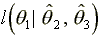 maximized using Simulated Annealing (Szu and Hartley (1987), Otten
and Ginneken, (1989), Kirkpatrick et. al.(1983)) to obtain an
estimate of
maximized using Simulated Annealing (Szu and Hartley (1987), Otten
and Ginneken, (1989), Kirkpatrick et. al.(1983)) to obtain an
estimate of  . In the smooth maximization
step
. In the smooth maximization
step  is used to maximize
 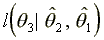 using
a Newton-Raphson procedure. These steps are iterated until convergence
occurs. Since the estimator
using
a Newton-Raphson procedure. These steps are iterated until convergence
occurs. Since the estimator  converges
at rate N (Chernoff and Rubin, 1956) it is asymptotically independent
of
converges
at rate N (Chernoff and Rubin, 1956) it is asymptotically independent
of  . The estimator
  is also superefficient (and a local cut) and asymptotically independent
of
is also superefficient (and a local cut) and asymptotically independent
of  . Thus, iterative separate maximizations
lead to a joint maximum of the likelihood function on convergence.
In the Simulated Annealing step we use a maximum number of iterations
that depends on the number of points of support of the heterogeneity
distribution, Q, with a "wrong" acceptance probability
of .05 for a unit step in the wrong direction. On the smooth
part of the function we maximize
. Thus, iterative separate maximizations
lead to a joint maximum of the likelihood function on convergence.
In the Simulated Annealing step we use a maximum number of iterations
that depends on the number of points of support of the heterogeneity
distribution, Q, with a "wrong" acceptance probability
of .05 for a unit step in the wrong direction. On the smooth
part of the function we maximize 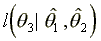 using
Gauss's OPTMUM procedure with a stopping criteria of a change
in function value less than 10-8.
using
Gauss's OPTMUM procedure with a stopping criteria of a change
in function value less than 10-8.
So far we have treated Q, the number of points of support of
the heterogeneity distribution, as known. The choice of Q in
this framework is similar to choosing the points of support in
the Heckman-Singer (1984) estimator of a mixing distribution.
As yet there is no formal test for choosing the correct level
of Q. Certainly one could consider conditional moments tests,
choosing the first Q that produces a set of estimated moments
within a given tolerance range of the sample moments. In our
experience the quasi-likelihood ratio test - -2*Dlogl
< c05 - appears to work
reasonably well as a criterion for choosing Q. We describe our
experience with this rule with a small Monte Carlo study in Section
3.
3. Monte Carlo Results
To examine the behavior of the estimator described in section
2 we conducted a small Monte Carlo analysis. Samples of size
500 were generated according to the true model and 500 replications
were performed. The true model is specified as l0
= 0.03, l1 = 0.01, d
= 0.0035, Q=3, r = 100, wH1 = 179, wH2 =
377, wH3 = 677.35, g1
= .3, g2 = .7. The model
was estimated for Q= 1,...,7, and the number of break points was
selected by comparing minus twice the loglikelihood difference
associated with increasing Q by one (this statistic is denoted
V) with the .05 critical value of 2(1). We denote
the Q chosen by this criterion as Q*. As we noted
above, the sampling distribution of V is unknown. It is clear
that the likelihood function is nondecreasing in Q. Note that
the Neyman-Pearson lemma applies, so V is the right criterion
function to use. What remains unknown is the distribution of
V and therefore the appropriate critical values.
For 500 replications the marginal distribution of the estimated
Q is given in Table 1.
| Table 1 Sample Distribution of True value of Q = 3 | |||||
| = | 1 | 2 | 3 | 4 | 5+ |
| h() = | .000 | .000 | .368 | .398 | .234 |
Using this criterion Table 1 indicates a tendency towards overfitting the points of support for the wage distribution. Note that this is the opposite of the pattern typically found in using the Heckman-Singer estimator. In fact, Heckman and Singer (1984) find that the estimator typically chooses a small number of points of support. As Table 1 shows, in this Monte Carlo experiment we never underfit Q and 63% of the time we choose a value greater than the true value of Q. This bears further investigation and suggests increasing our critical values.
The obvious question is how does the choice of Q affect the estimates
of the parameters of the model, in particular l0,
l1, and d.
Table 2 shows the sampling distribution for these parameters
with Q chosen according to the criterion we have given. Thus
these are marginal quantities (with respect to Q). As the table
shows the mean values of these estimates are dead on. Furthermore
the sampling variation is very small. For example, 95% of the
sampling distribution of l1
lies between .009 and .011, and for d
between .0031 and .0038.
| Table 2 Sample Distribution of l0, l1, and d | |||
| Parameter | Mean | 5th %-tile | 95th %-tile |
| l0 | 0.030 | 0.028 | 0.033 |
| l1 | 0.010 | 0.009 | 0.011 |
| d | 0.0035 | 0.0031 | 0.0038 |
If we use a value of greater than the true value of Q, Qo,
we find that this has a relatively small effect on the parameters.
For example, the root mean square error for l1
increases by 2.4% if we compare the estimates implied by *
with those produced using Qo. However, the root mean
square error for d decreases by 2.2%
using the same comparison, which implies that very little is lost
on average by overfitting Q. In contrast, although we would never
choose to underfit the distribution by following this criterion,
had we chosen equal to 2, for example, the root mean square
errors for l1 and d
double compared to Q*. Thus the "loss" associated with
overfitting Q seems minor.
4. The Transition From School to Work
We apply the estimation procedure described above to a sample of wage and duration data from the NLSY for black and white male high school graduates who did not continue on in formal education. We collected information on: (1) the non-employment spell between graduation and the first full-time job, (2) the wage accepted on the first full-time job, (3) the job spell length, and (4) whether the job was left (a quit) or lost. Two important, practical measurement issues arise in studying the transition between school and work. One involves the timing of when a job is found, and, consequently, measurement of non-employment spells. The second issue is the definition of a job: How should one distinguish full-time employment from casual, stop-gap jobs? Obviously, the definition of a full-time job affects measurement of job search duration, so we begin with our definition of full-time employment.
Nonemployment durations
We define the first full-time job as the first recorded employment opportunity that:
To make sure we have the first full-time job spell after graduation we include only individuals who finished high school after January 1, 1978. If the first full-time job spell happens to surround the education completion date, it is used as the first spell only if the individual holds the job longer than two months after the education completion date. This eliminates summer jobs and temporary jobs held while in school. Nonemployment durations then consist of the number of weeks between the start of the first full-time job and the respondent's high school graduation date. Consequently, the spell of job search may actually contain one or more spells of part-time employment. This focus on full-time employment is standard in the literature.
Even with the restriction of employment to full-time jobs a substantial number of nonemployment spells have weeks of search equal to zero; i.e., the individuals were employed prior to finishing their education. In the data 22% (44/199) of black high school graduates had zero search duration, as did 32% (149/465) of white high school graduates. Eckstein and Wolpin (1995), who also study the school to work transition using NLSY data, measure spell duration in quarters and treat these spells as having a duration of 1 quarter. This procedure artificially produces the appearance of duration dependence even when none is present, and in fact can produce the appearance of negative duration dependence when the data actually are drawn from a distribution characterized by positive duration dependence. This problem is, of course, the classic problem of initial conditions. When an individual starts searching for a job is unobserved; a search duration is partially observed only if a job is not found by the end of formal education, and in this case only the forward recurrence time, TF, is observed. Completed spells of search, TC, are random variables characterized by observed measurements TC = TB + TF, where TB, is a realization of a backward recurrence time. The problem is that TB is unobserved. As is well known ( Billingsley (1961), Cox and Lewis (1966), Heckman and Singer (1986)) the distribution of forward recurrence times is not in general the same as the distribution of completed spells, the only exception is the exponential distribution. There is no simple fix for this data problem. Discarding the first observation as Billingsley suggests is not an option as there are no repeat spells of transiting from school to work. In what follows we maintain the assumption that search durations are exponentially distributed, but recognize that the observed measurements are left-censored. That is, only individuals with a positive forward recurrence time contribute information on nonemployment durations in the likelihood function. Based on the estimates obtained under this specification we test whether the data can reject the exponential specification and, if so, why.
Job Duration
Job durations are recorded as the number of weeks from the starting date of the job to the ending date of the job or survey, whichever comes first. If the latter, then the spell is right-censored. Because we follow individuals through the 1992 wave of the NLSY, the censoring rates are low - less than 10% for both blacks and whites. Individuals are coded as leaving the first job if they leave it for another job without an intervening spell of nonemployment, and as having lost it if they transit into nonemployment. It is possible for a nonemployment/job spell series to be inadmissible. This occurs if either one of the spells has an erroneous start or stop date. These spell series are excluded as well as those with job spells that are not in the private sector and those with missing wages or hours.
Wages
Wage data in the NLSY are categorized according to time rates: hourly, daily, weekly, bi-weekly, monthly, and annually. Each time a respondent is questioned about a job, wage information is collected. For this study the first wage reported for a job is used as the accepted wage offer. All wages are converted into weekly wages and reported in 1990 constant dollars. Some care needs to be taken with the wage information reported by the NLSY. Several cases can be found where a respondent reports a time rate that does not agree with the pay rate. To identify these problem responses we cross-checked all time and pay rate responses against upper and lower bounds collected for males of the same age and education from the Current Population Surveys (CPS) for 1979-1992. Those respondents with wages that do not fall within the acceptable ranges are dropped from the sample. Wages greater than $600 per week are also dropped from the sample.
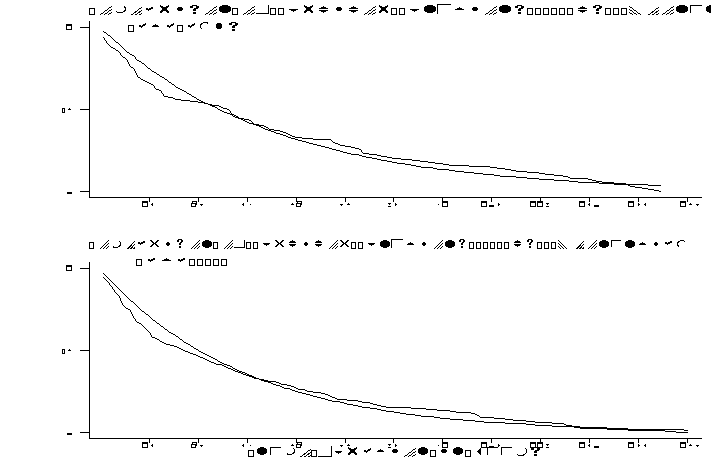 Figure
1
Figure
1
Sample Characteristics: Durations and Accepted Wages. The raw data on durations and accepted wages are informative about the underlying search process. In Figure 1 we show the survivor function for nonemployment durations for black and for white high school graduates. In each case we plot the Kaplan-Meier estimate of the survivor function along with the survivor function for an exponential random variable with the same mean duration. The visual impression one gets from these data is that there is slight drop off in the hazard rate in the second quarter of non-participation - from 13 to 26 weeks - but that overall for both groups the exponential specification does not appear at odds with the data. We will return to this point in section 5 below where we formally test this proposition. In comparing blacks and whites we find a substantial difference in mean nonemployment durations. On average, black high school graduates spend 45 weeks searching for full-time employment after graduation while whites spend 37 weeks. Taken together with the higher tendency of whites to already be employed at the time of graduation (32% versus 22%), black males experience a more difficult time making the transition to work.
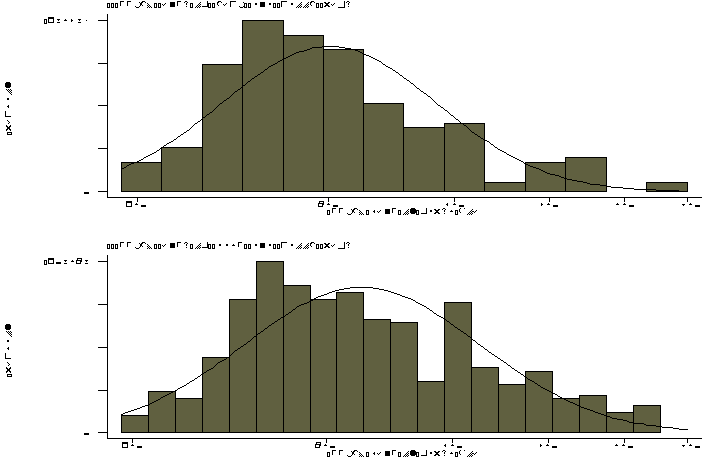
Figure 2 shows the empirical distribution of accepted wages for high school graduates by race. Along with the histogram of wages we have drawn the frequency function for a log normal distribution with the same mean and variance as the underlying data. In both cases the data suggest that the wage distribution is less skewed to the right than a simple log normal. The mean accepted wage for white high school graduates is $291.70 and for black graduates is $255.08. Thus we find a substantial black-white wage differential of 13% even among first jobs. Given the age of the respondents (14 to 21) at the start of the survey in 1979, the majority graduate from high school between 1978 and 1984. This period covers the 1980-1982 recession. Examining wages in the year these first jobs started, we find no significant effect of the recession for either blacks or whites. However, as pointed out by Eckstein and Wolpin (1995), whites who graduate during the recession have significantly lower wages on their first jobs. Further analysis of this effect in our sample reveals this result stems not from a cycle effect but rather from a general decline in wages over the sample period. This decline fits with evidence from Juhn, Murphy and Pierce (1993), although in these data it appears to be too large. Further investigation of this patterns seems warranted but is both beyond the scope of this paper and the NLSY data.
One indicator of specification problems in a stationary search model is the presence of correlation between accepted wages and search duration. For white high school graduates the correlation between accepted wage and measured search duration is -0.072, with a marginal significance level of 20%. Similarly, for black high school graduates the correlation is -0.149, with a marginal significance level of 6%. Thus these data do not suggest evidence of a changing reservation wage or of unmeasured worker heterogeneity, both of which would generate correlation between accepted wages and search duration.
In addition to differences across blacks and whites in nonemployment durations and accepted wages, differences also emerge in job spell durations and transition patterns. The mean job spell duration (including censored spells) for white high school graduates is 114 weeks while it is only 85.4 weeks for black high school graduates. Of those job spells that end within the sample period, 71% end in a transition to nonemployment for black graduates. The comparable figure for white graduates is only 55%. A further implication of search models is that the expected duration of a job spell is positively related to the accepted wage. This pattern is also found in these data - rD2,W = 0.258 (with msl=0.0002) for black high school graduates and rD2,W = 0.107 (with msl= 0.021) for white high school graduates, although the overall levels of correlation (especially for whites) are surprisingly weak. We return to this issue in section 5.
We also examine the employment outcomes of workers who start
jobs before their education is completed. In these data 44 of
199 black high school graduates and 149 of 465 white high school
graduates have such employment. Accepted wages, on average, are
the same whether the job began before schooling ended or not.
For blacks the difference between the group means is $7.15, while
for whites the difference is $5.44. Compared to mean weekly earnings
of $255 for blacks and $291 for whites, these differences are
both statistically and practically small. On average, black high
school graduates worked 23.4 weeks prior to graduating. Similarly,
white high school graduates worked 34.8 weeks before school ended.
This leads to a marginally significant difference in mean job
spell durations. For blacks, those who started employment before
they completed schooling stayed with their first employer 29 weeks
longer (t=1.33), while for whites the difference in job durations
was 20 weeks (t=1.40).
Tables 3 and 4 contain the estimation results for white and black
males, respectively. In both cases a large improvement in the
log likelihood function occurs when heterogeneity is introduced.
As in Bowlus, Kiefer and Neumann (1995), the value of the log
likelihood function stabilizes as Q gets larger. Using our criterion
the optimal choice for Q is 4 for whites, and either 3 or 4 for
blacks. For ease of comparison of wage distributions we choose
a value of Q = 4 in both cases. Examining the behavior of the
parameter estimates over Q we find that they converge as well.
At levels of Q beyond the optimal choice, the differences in
the parameters across Q are insignificant. This is primarily
due to the inclusion of duration and transition data, in addition
to wage data, in the log likelihood function.
| Table 3
Estimates for White Male High School Graduates | ||||
| Q | 0 | 1 | LogL | |
| 1 | 0.026878
(.001542) | 0.004079 (.000301) | 0.005143 (.000302) | -7064.67 |
| 2 | 0.026878 (.001542) |
0.006947 (.000497) | 0.004612 (.000291) | -6932.55 |
| 3 | 0.026878 (.001542) |
0.007877 (.000562) | 0.004445 (.000287) | -6905.17 |
| 4 | 0.026878 (.001542) |
0.008041 (.000574) | 0.004409 (.000287) | -6898.73 |
| 5 | 0.026878 (.001542) |
0.008119 (.000581) | 0.004395 (.000287) | -6897.58 |
| 6 | 0.026878 (.001542) |
0.008321 (.000596) | 0.004364 (.000286) | -6895.67 |
| ||||
| Q | 0 | 1 | LogL | |
| 1 | 0.022258
(.001798) | 0.003207 (.000450) | 0.008448 (.000694) | -3064.56 |
| 2 | 0.022258 (.001798) |
0.006940 (.000923) | 0.007730 (.000674) | -2958.37 |
| 3 | 0.022258 (.001798) |
0.007472 (.000971) | 0.007634 (.000673) | -2939.99 |
| 4 | 0.022258 (.001798) |
0.008001 (.001065) | 0.007551 (.000671) | -2938.17 |
| 5 | 0.022258 (.001798) |
0.008165 (.001078) | 0.007519 (.000670) | -2936.45 |
| 6 | 0.022258 (.001798) |
0.007978 (.001080) | 0.007532 (.000672) | -2935.97 |
Comparing the estimates across the two groups reveals that blacks
face a significantly higher arrival rate of offers while unemployed,
 , and a significantly higher job destruction
rate,
, and a significantly higher job destruction
rate,  . Interestingly
  ,
the arrival rate of job offers while employed, is not different
for young black and white males. These results imply much lower
relative competition levels for blacks than whites. The values
of
,
the arrival rate of job offers while employed, is not different
for young black and white males. These results imply much lower
relative competition levels for blacks than whites. The values
of 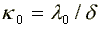 and
and  for white males are 6.10 and 1.82, respectively, while for black
males they are 2.95 and 1.06. Table 5 shows the estimates of
r, wHj, gj and
Pj, j=1,..,Q*, for both groups. It is interesting
to note that black and white men have similar reservation wages
and similar degrees of heterogeneity in productivity . However,
as stated before, blacks earn 87.4% of whites in this sample.
This wage differential arises because job destruction is higher
for blacks and because of differences in productivity. The higher
outflow of blacks means the effective competition for them is
almost half that for whites (compare k1s)
giving firms more monopsony power in the black labor market and
lowering their wages. In addition, a higher job destruction rate
slows the rate at which blacks are able to move up the wage distribution
through job-to-job transitions. The difference in the values
of k1 accounts for approximately
three-quarters of the black-white wage differential. The remainder
stems from differences in the productivity distribution. Even
though average productivity is higher in the black labor market
($520 versus $486), the white distribution produces higher average
wage offers. The higher mean comes primarily from the high value
of P4 for blacks. However, a job offer from this firm
type is highly unlikely, and so mean wage offer differences are
primarily driven by the higher values for whites at low productivity
firms, the lower fraction of P1 firms for whites, and
the higher fraction of P2 firms for whites. Thus,
while
for white males are 6.10 and 1.82, respectively, while for black
males they are 2.95 and 1.06. Table 5 shows the estimates of
r, wHj, gj and
Pj, j=1,..,Q*, for both groups. It is interesting
to note that black and white men have similar reservation wages
and similar degrees of heterogeneity in productivity . However,
as stated before, blacks earn 87.4% of whites in this sample.
This wage differential arises because job destruction is higher
for blacks and because of differences in productivity. The higher
outflow of blacks means the effective competition for them is
almost half that for whites (compare k1s)
giving firms more monopsony power in the black labor market and
lowering their wages. In addition, a higher job destruction rate
slows the rate at which blacks are able to move up the wage distribution
through job-to-job transitions. The difference in the values
of k1 accounts for approximately
three-quarters of the black-white wage differential. The remainder
stems from differences in the productivity distribution. Even
though average productivity is higher in the black labor market
($520 versus $486), the white distribution produces higher average
wage offers. The higher mean comes primarily from the high value
of P4 for blacks. However, a job offer from this firm
type is highly unlikely, and so mean wage offer differences are
primarily driven by the higher values for whites at low productivity
firms, the lower fraction of P1 firms for whites, and
the higher fraction of P2 firms for whites. Thus,
while
| ||
Parameters |
|
|
| P4 | 1164.92 | 2060.84 |
productivity differences are important, the greater presence of the wage differential is explained in this model by differences in labor market competition across the groups.
Asymptotic standard errors for 0, 1, and are shown in parentheses in Tables 3 and 4. Table 6 provides bootstrap standard errors for 0, 1, and using the white high school graduate sample, based on 100 replications for the parameters corresponding to Q*. We note that the standard bootstrap may not provide the correct coverage probabilities in this case because we have estimated the endpoints of the distribution (Bickel and Freedman (1981)). Beran and Ducharme (1991) and Swanepoel (1986) show that this problem can be avoided by undersampling in the bootstrap. That is, instead of drawing N bootstrap observations with replacement from the sample of N observations, one needs to draw M N. Unfortunately, the asymptotic bounds on the sequence needed do not provide any aid in choosing M in application. To provide some feel for how to choose M we ran a small Monte Carlo experiment to bootstrap the distribution of the maximum from a sample of N observations. The distribution was U(0,1). We set N=500, and drew a sample. We bootstrapped from this sample setting M at 100,200,..,500. We examined the sampling distribution of the maximum value, X(N) , and the normed and centered statistic defined by
 [11]
[11]
The sample maximum has density function 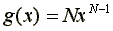 and RM,N is asympotically distributed as extreme value
1 in the case of the unit uniform. Here X*(M)
is the first order-statistic from the resample of M observations
and X(N) is the sample maximum observation.
and RM,N is asympotically distributed as extreme value
1 in the case of the unit uniform. Here X*(M)
is the first order-statistic from the resample of M observations
and X(N) is the sample maximum observation.
In this experiment we find that the 90 and higher percentiles of RM,N line up very well for the sample maximum, even for M/N =1 for sample sizes of 500. For the centered and normed maximum this agreement fades as the ratio of M/N exceeds 70%. In Table 6 we report standard errors corresponding to M=N; i.e., no under-sampling. Results using a 30% undersampling scheme are similar, although the standard errors are a little larger.
In Table 6 we also compare the standard errors from the Hessian for the regular parameters to those from the bootstrap. They line up well, showing that the asymptotic standard errors are a good approximation. As noted, above the bootstrap standard errors are the only ones available for the change-point parameters. Note that, as expected, these parameters are quite precisely estimated.
Diagnostics
With estimates of the model in hand we can ask how well does this simple model fit the data. For non-employment spells the issue is whether the assumption of exponentiality can be rejected. Figure 1 above suggests no great discrepancy, but we proceed to a formal test. Within groups the duration of recorded search is exponential with intensity parameter 0 so a natural test would be White's Information Matrix test, which in this context can be shown (Kennan and Neumann (1988)) to test whether the variance equals the mean squared. There is substantial evidence that the finite sample distribution of the IM test is poorly approximated by its asymptotic distribution for samples of the size used in most economic studies, (i.e., N < 50,000). However, Horowitz (1994) has shown that bootstrap-based critical values eliminate essentially all of the size problem with this test. We bootstrapped the IM test for exponential search spells using 1,000
| Table 6a
Comparison of Hessian and Bootstrap Standard Deviations For White Male NLSY Sample | |||||||
| Parameter
s.d.'s x (10+3) | Hessian
| Bootstrap | Bootstrap CV | ||||
| 0 | 1.542 | 1.844 | 0.068 | ||||
| 1 | .574 | 0.736 | 0.097 | ||||
| .287 | 0.425 | 0.095 | |||||
| Table 6b
Bootstrap Standard Deviations of Cut Points | |||||||
| Parameter | S.D. | Parameter | S.D. | ||||
| r | 3.638 | P1 | 21.767 | ||||
| wH1 | 28.782 | P2 | 57.484 | ||||
| wH2 | 43.857 | P3 | 97.972 | ||||
| wH3 | 50.611 | P4 | 157.307 | ||||
| wH4 | 4.941 | -- | -- | ||||
replications and obtained marginal significance levels of 0.549 for white high school graduates and 0.492 for black high school graduates. Thus, in both cases we cannot reject the hypothesis that waiting times are exponential. This is not surprising. In the data the mean observed duration is 45.6 weeks for blacks and the standard deviation is 43.7 weeks. For whites, comparable figures are a mean of 37.8 weeks and standard deviation of 38.9 weeks. Therefore, a test that looks at whether the variance equals the mean squared will not find evidence against it in these data. For example, the standard chi-squared based 95% confidence interval (which is based on, and sensitive to, a normality assumption) yields confidence intervals of 38.7 to 52.5 weeks for the standard deviation of search spells for blacks, and 33.4 to 41.1 weeks for whites. Of course, this conclusion would be reversed if we treated the zero duration spells as having 1 week duration. Using that convention results in a mean "duration" of 35.7 weeks for blacks with a standard deviation of 42.8 , and for whites a mean of 26 weeks and a standard deviation of 36.4 weeks. Both the bootstrapped White IM test and the classical chi-square test for the standard deviation equal to the mean strongly reject the hypothesis.
These tests look only at the relation of the mean and variance. To pursue these diagnostic issues further we examine the slope of the hazard function. To do so, we fit a Weibull model to the duration data and test whether the estimated shape parameter,, differs significantly from 1. The results are shown in Table 7 for only duration greater than zero (Dur1) and durations defined as Dur2 = Dur1 +I(Dur1==0)*1. For both groups using only durations recorded as positive, the shape parameter is estimated to be .92, which is fairly close to 1. For blacks the asymptotic confidence interval straddles 1.0, while for whites it is, to two decimal points, right on the line.
| Dependent Var/ Group | 95% Upper Limit | ||
| Dur1 | |||
| Black HS Graduates | 1.0441 | ||
| White HS Graduates | .9985 | ||
| Dur2 | |||
| Black HS Graduates | .7459 | ||
| White HS Graduates | .6714 |
When durations for which we do not have a forward recurrence time
(Dur1 ==0) are treated as having 1 week of search, as in Dur2,
it is obvious from the table that the shape parameter reveals
a declining hazard rate; i.e.,  .
.
We conclude from this that the assumption of exponential search times is not rejected by the data once it is realized that the observed times are not completed durations but forward recurrence times from the date of completed education. The claim that "It is a well established empirical regularity that hazard rates are decreasing with the duration of search... " (Eckstein and Wolpin, 1995, p. 263) is not supported by the data and is based only on a coding convention.
Figure 3 shows the empirical distribution function of wages and
the theoretical cumulative distribution function implied by the
parameter estimates for each group. The overall fit of the wage
data is quite good, although for both groups there is a tendency
to over-predict wages in the left tail.
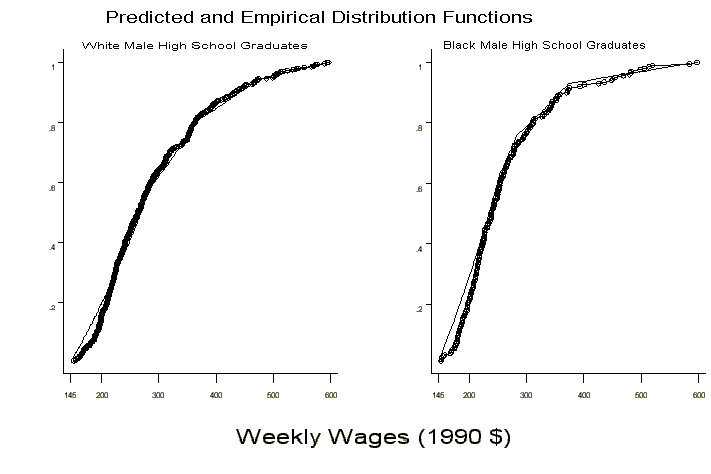
Of course, closeness is measured here in terms of the distribution function. The theoretical probability density function increases monotonically on any sub-interval of w, that is, on any interval where P is constant, and consequently it would not be close to any data that had a declining density. This caveat aside, Figure 3 shows that the wage data can be reconciled using only 4 types of firms.
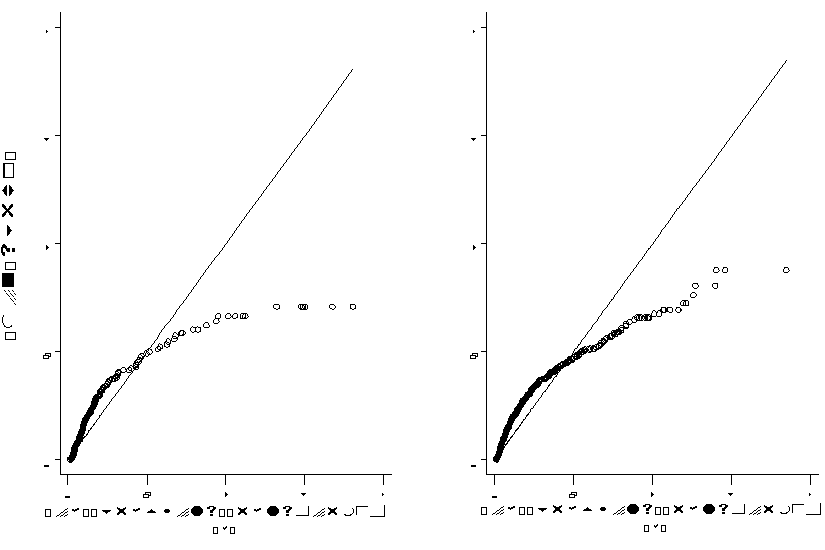
Given the acceptable fit of the model to the wage and nonemployment data, we turn our attention to the job spell data. Job durations, D2, in the model are exponential with parameter d + l1(1-F(w)). They are independent but, because of the dependence on the current wage w, not identically distributed across individuals. Thus, we observe a mixture of exponentials. To test whether or not this distributional assumption holds we note that the following transformation of the data - z=(d + l1(1-F(w)))D2 - is independently and identically distributed as unit exponential if all of the job durations are completed spells. In both high school graduate samples the level of censoring is less than 10%. Therefore, we ignore the complications in testing brought about by the presence of censoring. In Figure 4 we test unit exponentiality of the transformed durations using a graphical test (see Horowitz and Neumann (1989)). If the distributional assumption holds, then the integrated hazard function of the transformed durations should be a straight line with slope 1. Clearly in both cases the test fails. More formal tests, such as estimating a Weibull model, lead to the same conclusion. The graphs indicate that there are too few long spells in the data. To assess the reasons why the job durations reject the exponential specifications, we performed a small Monte Carlo experiment using the estimated values of + l1[1-F(w)] to generate the transformed unit exponential job durations. Table 8 shows data for the high school graduate sample and from simulations of exponential job durations. Mean duration is lower for both blacks and whites and the quartiles indicate that this holds throughout the mid-range of the duration distributions. In other words, the actual distribution is skewed to the left, indicating that there are many more short duration jobs than would be expected. Interestingly, a simple hypothesis such as "short term jobs are dead-end jobs with low wages" is not supported by the data. White high school graduates have a correlation between wages and job duration that, while positive, is only half that predicted by the model, and black high school graduates job duration is more correlated with the wage than would be expected.
| Table 8. Monte Carlo Results of Distribution of Job Spell Durations | ||||
| Whites | Blacks | |||
| Mean | ||||
| 25th %-tile | ||||
| 50th %-tile | ||||
| 75th %-tile | ||||
| Corr(D2,w) | ||||
It is possible that the poor fit of the job duration data is
due to the estimates of d and l1
being unduly influenced by the wage data. To estimate the arrival
rates one needs unemployment durations, job durations and wages.
However, one need not impose the model's implied structural form
of the wage offer distributions, as identification only requires
an estimate of the empirical distribution function of the wage
offer distribution F(w). Re-estimating d
and l1 using the empirical
distribution function of wages yields estimates that are very
close to those of Q=4 for whites (l1
= .007898 and d = .004420) and Q=3
for blacks (l1 = .007588
and d = .007603). Tests of the distributional
assumptions using these parameters do not overturn the results
found above. Thus, high school graduates spend less time in their
first job given their wages, than implied by the search model.
It may be that the job shopping tendencies of young workers lead
to exit patterns inconsistent with the search model's rule of
only voluntarily leaving a job if another with a higher wage is
waiting.
6. Conclusions
We have demonstrated that the equilibrium search model with heterogeneity in firm productivity can be estimated and provides a dramatic improvement in fit with respect to wage data relative to the homogeneous model. The estimation problem is nonregular, but its special features can be exploited to design an efficient estimation procedure. A limited sampling experiment verifies that the estimates are feasible and have reasonable properties. We provide an application using NLSY data on new entrants in the U.S. labor market. Since the model is nonlinear and nonregular we provide bootstrap standard errors of our parameter estimates. Diagnostic tests show the model provides a satisfactory fit to nonemployment duration and wage data, but has trouble fitting job durations. Our results show that nonemployed blacks receive fewer offers than whites and employed blacks are more likely to lose their jobs. Importantly, employed blacks and whites receive job offers at the same rate. However, the difference in job destruction rates is so great that it can account for three-quarters of the black-white wage differential. These findings underscore the importance of labor market institutions - affecting matching and job loss - in explaining racial differences in incomes.
References.
Albrecht, J. W., and B. Axell, [1984] "An Equilibrium Model
of Search Unemployment," Journal of Political Economy,
92:824-40.
Beran, R. and G.R. Ducharme, [1991] "Asymptotic Theory for
Bootstrap Methods in Statistics," Les Publications CRM, Centre
de Recherches Mathematiques, Universite de Montreal.
van den Berg, G. J. and G. Ridder, [1993a] "Estimating Equilibrium
Search Models from Wage Data," in N. C. Westergaard-Nielsen
and P. Jensen, eds., Proceedings of the Third Symposium On
Panel Data and Labour Market Dynamics, New York: North-Holland,
43-55.
_____________, [1993b] "On the Estimation of Equilibrium
Search Models from Panel Data," in J.C. Van Ours, G. A. Pfann,
and G. Ridder, eds., Labor Demand and Equilibrium Wage Formation,
New York: North-Holland, 227-245.
Bickel, Peter J. and David A. Freedman, [1981] "Some Asymptotic
Theory for the Bootstrap, " The Annals of Statistics
9: 1196-1217.
Billingsley, Patrick, [1961], Statistical Inference for Markov
Processes, University of Chicago Press, Chicago.
Bontemps, Christian, Jean-Marc Robin, and Gerard J. van den Berg,
[1996] "Equilibrium Search with a Continuous Distribution
of Productivities: Theory and Estimation," mimeo.
Bowlus, A., N. M. Kiefer, and G. R. Neumann, [1995], "Estimation
of Equilibrium Wage Distributions with Heterogeneity," Journal
of Applied Econometrics, 10: S119-S131.
Burdett, K., [1990], "Search Models: A Survey," University
of Essex Discussion Paper.
Burdett, K., and D. T. Mortensen, [1995], "Wage Differentials,
Employer Size, and Unemployment," International Economic
Review, forthcoming.
Card, David, and Alan B. Krueger, [1995], Myth and Measurement:
The New Economics of the Minimum Wage, Princeton University
Press: Princeton, N.J.
Chernoff, H., and H. Rubin, [1956], "The Estimation of the
Location of a Discontinuity in Density", Proceedings of
the Third Berkeley Symposium on Mathematical Statistics and Probability,
Berkeley: University of California Press, 1, 19-37.
Christensen, B. J. and N. M. Kiefer, [1994], "Local Cuts
and Separate Inference," Scandinavian Journal of Statistics,
20:1-13.
Cox, D. R., and P. A. Lewis, [1966], The Statistical Analysis
of Series of Events, Methuen Co.: London.
Eckstein, Z., and K. I. Wolpin, [1990], "Estimating a Market
Equilibrium Search Model From Panel Data on Individuals,"
Econometrica, 58:783-808.
____________ [1995] "Duration to First Job and the Return
to Schooling: Estimates from a Search-Matching Model," Review
of Economic Studies, 62: 263-286.
Heckman, J. J., and B. Singer, [1984], "Econometric Duration
Analysis," Journal of Econometrics, 32:59-84.
_______, [1986], "Econometric Analysis of Longitudinal Data,"
Chapter 29 in Z. Griliches and M. D Intrilligator, eds., Handbook
of Econometrics, Volume III, North-Holland, Amsterdam, 1689-1763.
Hicks, J. R. [1932], The Theory of Wages, MacMillan, London.
[2nd edition, 1966].
Horowitz, J. L., [1994], "Bootstrap-based Critical Values
for the Information Matrix Test," Journal of Econometrics,
61:395-411.
Horowitz, J. L. and G.R. Neumann, [1989], "Specification
Testing in Censored Regression Models: Parametric and Semiparametric
Methods," Journal of Applied Econometrics, 4: S61-S86.
Juhn, Chinhui, Kevin M. Murphy and Brooks Pierce, [1993], "Wage
Inequality and the Rise in Return to Skill," Journal of
Political Economy 101(3): 410-442.
Kennan, J., and G. R. Neumann, [1988], "Why does the Information
Matrix Test Reject So Often?," Working Paper No. 88-4, Department
of Economics, University of Iowa, Iowa City, IA.
Kerr, C. S., [1954], "The Balkanization of Labor Markets,"
in E. Wright-Bakke et al., eds., Labor Mobility and Economic
Opportunity, MIT Press, Cambridge, MA.
Kiefer, N. M., and G. R. Neumann, [1993] "Wage Dispersion
with Homogeneity: The Empirical Equilibrium Search Model,"
in N. C. Westergaard-Nielsen and P. Jensen, eds., Proceedings
of the Third Symposium On Panel Data and Labour Market Dynamics,
New York: North-Holland, 57-74.
Kirkpatrick, S., C. D. Gelatt, Jr., and M.P. Vecchi, [1983] "Optimization
by Simulated annealing," Science, 220:67180;
Koning, P., G. Ridder, and G. J. van den Berg, [1995], "Structural
and Frictional Unemployment in an Equilibrium Search Model with
Heterogeneous Agents," Journal of Applied Econometrics,
10: S133-151.
Mortensen, D. T., [1990] "Equilibrium Wage Distributions:
A Synthesis," in J. Hartog, G. Ridder, and J. Theeuwes, eds.,
Panel Data and Labor Market Studies, New York: North-Holland,
279-96.
Mortensen, D. T., and G. R. Neumann, [1988], "Estimating
Structural Model of Unemployment and Job Duration in Dynamic Econometric
Modeling," Proceedings of the Third International Symposium
in Economic Theory and Econometrics, Cambridge University
Press.
Neumann, G. R., [1997], "Search Models and Duration Data,"
ch. 3 in H. Pesaran and P. Schmidt, eds., Handbook of Applied
Econometrics: Volume II Microeconometrics, Basil Blackwell,
Oxford.
Otten, R., and L. van Ginneken, [1989], The Annealing Algorithm,
Boston: Kluwer.
Swanepoel, Jan W.H., [1986], "A Note on Proving that the
(Modified) Bootstrap Works," Communications in Statistics:
Theory and Methods 15: 3193-3203.
Szu, H., and R. Hartley, [1987] "Fast Simulated Annealing,"
Physics Letters, A, 12:15762.