The hypothesis of perfect capital mobility appear in numerous macroeconomic models of open economy. Quantitative analysis about speed of convergence, optimization of savings allocation and speculative attacks depended of the existence of capital mobility.
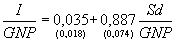
In a polemical article, Feldstein & Horioka (1980) elaborate an econometric model to test the degree of capital mobility. Surprisingly, the econometric results indicate a low degree of capital mobility. This study propose a new method for test capital mobility. The basic idea was that in a country with low degree of capital mobility, like a close economy, all domestic saving will be used to finance domestic investment. Furthermore, in a country with high degree of capital mobility, domestic saving will be used around the world, looking for a better remuneration. In this way, domestic saving will be uncorrelated with domestic investment. A cross-section regression was estimated for 21 OECD countries in the period 1960-74. The results of Feldstein & Horioka (1980) regression was:
 , (1)
, (1)
*standart errors are in parenthesis.
In the Feldstein-Horioka (F-H) sense, a coefficient of the domestic saving rate (Sd/GNP) near zero, will signalize for the absence of correlation between domestic saving rate and investment rate (I/GNP) and then for the existence of capital mobility. Otherwise, a F-H coefficient near one indicate a high relation for domestic saving and investment and then a low degree of capital mobility. The authors interpret the result of equation (1) as an indicator of low degree of capital mobility.
The F-H regression generate an extensive debate in the literature about the correlation between investment and domestic saving rates and the relation with the capital mobility. The high correlation between domestic saving and investment is a stylized fact of international macroeconomic. The question is the relevance of this correlation for capital mobility.
This article propose a general explanation for the Feldstein-Horioka puzzle, in the view that the F-H coefficient do not reflect capital mobility, but a substitutability relation between domestic and external savings. Section II present a literature review of the F-H puzzle, section III propose a general explanation for the puzzle and the comments are made in sector IV.
The idea to establish a correlation between domestic saving and investment as a measure of capital mobility was proposed by Feldstein & Horioka (1980). The conclusion of the authors invalidate the common sense of existence of capital mobility. This result was know in the literature as the Feldstein-Horioka puzzle.
Sachs (1981) propose a modification for the F-H model, introducing external saving (current account deficit) in the place of domestic saving and including another variables like a trend and a product gap. In this new formulation conclude in favor of capital mobility. Since Sachs (1981), many studies was elaborates to clear the puzzle. Statistical questions like co-integration and economic models that incorporate the investment endogeneity or fiscal polices adopted by governments try explanate the puzzle.
A common critique to F-H equation is attribute to the use of correlation between domestic saving and investment as a proxy for capital mobility. Montiel (1994) argues about the vulnerability of this test for indirect correlations between domestic saving and investment that do not reflect capital mobility. In a study for OECD countries, Tesar (1991) conclude that large and small countries show a significant correlation between domestic saving and investment and that this correlation is a phenomenon of short and long run. Furthermore, the author argument that this correlation is an important empirical regularity, but offer little evidence about capital mobility.
The problem of F-H regression with endogenous relation, that appear in time series studies, between domestic saving and investment because both variables are pro-cyclical was stand out for Dooley, Frankel & Mathienson (1987). Romer (1996) reinforce this argument, he elaborate a constructo of a country with individuals that have little rate of discount and then high rates of saving, but in this country the persons do not permit the existence of strong syndicates, generating a positive incentive to the investment. In this way, domestic saving and investment will be correlated for a reason other than capital mobility.
Relating taxes, investment and domestic saving Barro, Mankiw & Sala-i-Martin (1995) elaborate a theoretical model that permit a correlation between domestic saving and investment in a world of perfect capital mobility. This result is a consequence of the equality of net returns after taxes.
Tobin (1983) show that if the government react a commercial deficit, induct for an increase in investment, cutting government expenses or increasing taxes, then domestic saving and investment will be correlated.
A econometric study about the F-H puzzle can be find in Bayoumi (1990). The author use instrumental variables to avoid the endogenous problem and averages rates of domestic saving and investment to eliminate the influence of economic cycle. In cross-section analysis he conclude that the high correlation must be attributed to government policies that react to a deficit in current account. In time series regressions, the correlation would been reflecting the endogenous behavior of investment in stocks.
In a cross-section regression for 17 OECD countries, Murphy (1984) conclude that the correlation is related to the size of the country, large countries show higher correlations than small countries. Baxter & Crucini (1993) related the size of the country, domestic saving, investment and an adjustment cost to avoid great oscillations in the national capital stock.
An sophisticate statistical argument was elaborated by Coakley, Kulasi & Smith (1996). In a study for 23 OECD countries show that investment and domestic saving rates are integrated of order one (I(1)), but the non-ponzi condition implicate that the current account must be integrated of order zero (I(0)). By the way, investment and domestic saving should co-integrate with unit coefficient, irrespectively of the degree of capital mobility.
In this section is proposed a general and simple explanation about the F-H puzzle. Since that any mechanism limit the variance of external saving, the F-H test will indicate a low degree of capital mobility. Formally,
 external saving rate
 domestic saving rate
 investment rate
(3.1) 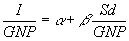 (Feldstein-Horioka equation)
(3.2) 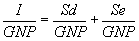 (identity)
Replacing equation (3.1) in identity:
(3.3) 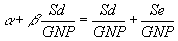
Reordering the terms:
(3.4) 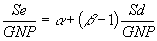 (substitutability equation)
or,
(3.5) 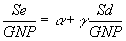 (substitutability equation, where
  ).
).
The algebra in equation (3.5) shows that the constant in the F-H equation, a, is the same that the substitutability equation. Moreover, the coefficient of F-H regression is equal to the coefficient of substitutability equation more one, i.e., b=g+1. In other words, the F-H parameters are know in the substitutability equation and vice-versa.
To illustrate this point will be showed three hypothetical cases where the F-H coefficient do not necessarily relate capital mobility, but just the external saving variance.
The first case (table 1) shows a null correlation between external and domestic saving, consequently the F-H coefficient is unity. Nevertheless, do not be clear suppose inexistence of capital mobility in this example, since the amount of external saving is greater than domestic saving.
Table 1: External Saving High and Constant
|
I/GNP |
Sd/GNP |
Se/GNP |
|
12 |
2 |
10 |
|
11 |
1 |
10 |
|
13 |
3 |
10 |
|
17 |
7 |
10 |
|
16 |
6 |
10 |
In the hypothesis that table 1 reflect a cross-section analysis, the countries would have investment finance mainly for external savings, but would be considerate of low capital mobility. The second case (table 2) show the opposite, that is, domestic savings finance a great part of investment. However, external saving show a high variance.
Table 2: External Saving Low and with High Variance
|
I/GNP |
Sd/GNP |
Se/GNP |
|
20 |
19 |
1 |
|
20 |
19,5 |
0,5 |
|
20 |
18 |
2 |
|
20 |
20 |
0 |
|
20 |
21 |
-1 |
The econometrics results of table 2 are g = -1 and b = 0. The F-H interpretation of case 2 implicate accept a perfect capital mobility in a world that have almost all investment financed by domestic saving. Concluding, the third case (table 3), show that is no reason to expect that the F-H coefficient range between 0 and 1. When the external and domestic saving are positively related, the F-H regression show a coefficient greater than unity.
Table 3: External Saving Positively Related with Domestic Saving
|
I/GNP |
Sd/GNP |
Se/GNP |
|
15 |
5 |
10 |
|
17,25 |
5,25 |
12 |
|
16,1 |
5,1 |
11 |
|
13,75 |
4,75 |
9 |
|
19 |
6 |
13 |
Case 3 could be considerate as typical example of high capital mobility, since the external savings are high and changes in the demand for investment was basically financed for changing in external saving. Nevertheless, in face of the positive relationship between domestic and external saving, the F-H coefficient is 4,08 with a confidence interval with 99% of significance of (2,10; 6,05).
The equivalency can be used to demonstrate the general solution of the Feldstein-Horioka puzzle, because b=g+1, the determinant of the F-H coefficient (b) is the substitutability coefficient (g). The F-H regression does a test of the substitutability between domestic and external savings. In this way, when the correlation between savings go to zero the F-H coefficients goes to unity. Formally:
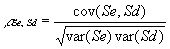
A null correlation between savings generate a F-H unity coefficient, that represent a no capital mobility in the F-H sense.
A curious result of interpret F-H regression in terms of substitutability between savings, occur in the interpretation of the F-H coefficient as a proxy to current account solvency. Coakley, Kulasi & Smith (1996) argue that a no ponzi condition generates a F-H unity coefficient. However, the substitutability equation shows that a F-H unity coefficient is a particular result of null correlation between savings. In this way, a no ponzi condition implicate in a F-H unity coefficient, but the reverse is not true, that is, a F-H unity coefficient do not implicate in the sustainability of current account. As an illustration, suppose a country that maintain constant the external saving. This trajectory, independently of sustainability, will implicate that the F-H equation co-integrated with unity coefficient. The fact of null correlation between savings, generate a F-H unity coefficient independently of the solvency of current account. Coakley, Kulasi & Smith (1996) propose a necessary, but not sufficient condition for current account solvency. Picture 1 can clear the argument.
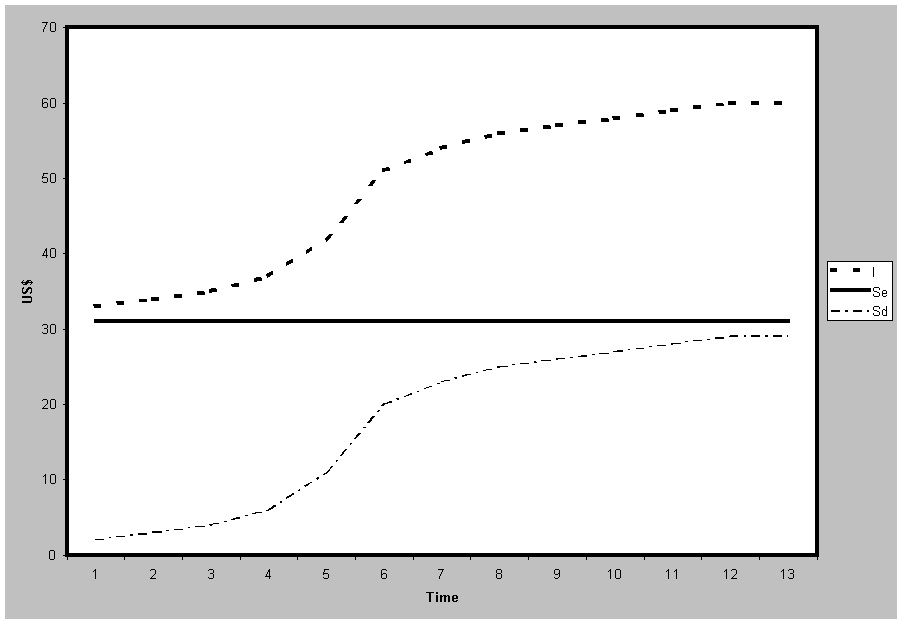 Picture 1: An Illustration Between Investment, Domestic and External Savings
Note that in picture 1, because external saving is constant, will not have relation between external and domestic saving, implicating that F-H coefficient will be unity. However, for the analysis of picture 1 is not clear that current account is solvent.
In this article was proposed an general explanation for the F-H puzzle based in an equation of substitutability between external and domestic savings. In this view, the F-H coefficient do not represent capital mobility, but just a substitutability relation between external and domestic savings. Furthermore, this new interpretation of F-H regression shows the inability of use the F-H unity coefficient to inference about current account solvency.