,
,
Seasonal Fluctuations and International Trade*
MITSUHIRO KANEDA
and
GIL MEHREZ
Department of Economics
Georgetown University
Washington, DC 20057-1036
kanedam@gunet.georgetown.edu
mehrezg@gunet.georgetown.edu
June 25, 1998
ABSTRACT
This paper argues that seasonal fluctuations in international trade are large and have non-trivial effects on a country's resource allocation, production, and welfare. Using U.S. quarterly data, we find fluctuations of as much as 43% and 15% for apparel imports and exports respectively, and 7% and 12% for aggregate imports and exports respectively. In addition, we observe that seasonal fluctuations of aggregate exports have decreased substantially over time. We formulate a general equilibrium model to examine the link between changes in the size of seasonal fluctuations and the levels and variances of employment, output, and consumption. One result is that if price fluctuations increase under free trade, the traded good sector shrinks and the non-traded good sector expands. Increased trade volume can decrease fluctuations in domestic production of either good. This is verified in the data of U.S. apparel trade and production: we find that doubling of trade volume is associated with a 40% decrease in fluctuations in production.
Keywords: Seasonal Fluctuations, International Trade
JEL Classification: F10, F11, F14, E39
1. Introduction
Can seasonal fluctuations in international trade be ignored? This paper puts forward an argument that seasonal fluctuations in international trade are large and have non-trivial effects on a country's resource allocation, production, and welfare. For this purpose, we present empirical observations from U.S. trade data, and a general equilibrium model of an economy exposed to seasonal fluctuations in trade.
Most economic activities are, in fact, affected by seasonal fluctuations. Large seasonal fluctuations are present in every aggregate measure of economic activity such as GNP, employment, prices and international trade. For example, Barsky and Miron (1989) observe in U.S. data (1967-87) that seasonal fluctuations account for about 90% of the fluctuations in the rate of growth of GNP. GNP decreases by 8.1% in the first quarter and increases by 4.9% in the fourth quarter; employment decreases by 2.5% in the first quarter; exports decrease by 2.5% and 7.1% in the first and third quarters respectively and increase by 4.3% and 5.3% in the second and fourth quarters respectively; and imports decrease by 3.7% in the fourth quarter and increase by 4.7% in the second quarter.
Despite the magnitudes of these seasonal fluctuations, little attention has been paid to them in the literature until recently. Moreover, seasonal fluctuations have in most cases been treated as noise orthogonal to economic activity. Recent findings, however, suggest that seasonal fluctuations depend on the state of the economy and are a useful natural experiment to test and estimate various economics models (see Barsky and Miron (1989), Beaulieu, MacKie-Mason, and Miron (1992), and Mehrez (1996, 1998)). Our paper is an attempt to place greater emphasis on the significance of seasonal fluctuations in international trade. We examine data of U.S. aggregate, apparel, and footwear trade, and find some striking empirical regularities. We construct a general equilibrium model of a closed and an open economy, and find that seasonal fluctuations in trade can influence a country's resource allocation, production, and welfare: changes in seasonal fluctuations can have both first and second order (level and variance) effects.
The relevance of seasonal fluctuations in trade can be best illuminated by considering the following scenario under which the same good gets exported in one season and imported in another. A difference in the seasonal fluctuations across countries can give rise to trade across seasons: a country can export a good in one season and import the same good in another. Even if net trade registers as zero, that is, the amount exported in one season equals the amount imported in the other, such trade has welfare implications and affects the levels and variances of factor use and output. The effect of changes in the size of seasonal fluctuations is not clearly understood yet.
Trade of a good across seasons can, of course, be considered as trade of two goods with different timing characteristics. In the Arrow-Debreu world, such trade is identical to trade between any two distinct goods. This may explain the literature's lack of interest in seasonal fluctuations and trade: conventional trade theory results seem applicable to trade across seasons. However, this is no longer true once we consider a richer setting in which a particular good is produced by a single firm in different seasons while distinct goods are produced by different firms, and there exist adjustment costs. Suppose a good is produced by using factors of production that cannot be adjusted across seasons (for example, capital stock) and factors that can be adjusted (for example, labor). Then, production in different seasons is linked together by the level of the capital stock: a firm which faces seasonal fluctuations in prices has to take account of both seasons to decide on its optimal capital stock (common across seasons) and labor uses in different seasons. Since seasonal fluctuations in the world market and trade across seasons affect this production decision by the firm, they have effect on the levels and fluctuations of factor use and output in a way different from a simpler model in which capital can always be adjusted. In contrast, in the standard model with two distinct goods, production of one good is independent (at the firm level) of production of the other good. Thus with adjustment costs, trade across seasons introduce effects on means and variances of factor use, output, and consumption that have not been captured by the standard model of trade between distinct goods.
We begin by presenting some stylized facts observed in U.S. trade data. We find that there are fluctuations as much as 7% and 12% for aggregate imports and exports respectively, 43% and 15% for apparel imports and exports respectively, and 35% for footwear imports. In addition, it is found that seasonal fluctuations of aggregate exports have decreased substantially over time.
To investigate the effect of trade across seasons, we construct a model of an economy with two inputs, two goods, two seasons (comprising a period), and seasonal fluctuations in demand. By comparing autarky and free trade, we examine the effect of a country exposing itself to world market fluctuations (which may be smaller or larger than the domestic seasonal fluctuations). The free trade fluctuations are captured by fluctuations in the seasonal prices. We also examine the effect of changes in the magnitude of the fluctuations of free trade prices on the economy. By using numerical simulations, we observe the effects on the levels and variances of employment, output, consumption, trade, and welfare.
Some of the notable comparative static results are the following. (1) If the seasonal price fluctuations increase when a country moves from autarky to free trade, then the mean labor use and the mean output of the traded good industry decrease, while those of the non-traded good industry increase. That is, labor and output shift from the traded sector to the non-traded sector. (2) If the seasonal price fluctuations decrease by moving from autarky to free trade, then the opposite holds. (3) For a freely trading economy, the effect of an increase in the seasonal price fluctuations is as follows. The mean labor use and the mean output of the traded good industry decrease, while those of the non-traded good industry increase. Welfare may increase or decrease.
Although the literature of international trade under uncertainty also examines the effects of fluctuations on a trading country, our analysis differs in formulation and in the question addressed. While models in this literature have both factors perfectly mobile across seasons and both goods tradable, in our model, one factor is fixed across seasons and one good is non-traded. Furthermore, our fluctuations are deterministic: there is no uncertainty in our model. Our interest is in how second order changes (i.e. changes in seasonal fluctuations) affect the first order statistics (levels) and second order statistics (variances) of the economy, and welfare. In contrast, the literature's focus is in the examination of the robustness of the results associated with the Heckscher-Ohlin model.
One of the model's implications is that through international trade across seasons, an increase in the volume of trade can be accompanied by a decrease in the seasonal fluctuations of domestic production. Data of U.S. apparel production (January 1947 to March 1998) and trade demonstrate this. We find a strong negative correlation between the magnitude of seasonal fluctuations of apparel production and the volume of trade.
This paper is organized as follows. Section 2 presents some stylized facts on the magnitudes and patterns of seasonal fluctuations in U.S. imports and exports. In Section 3 we develop the model and present some comparative static results. Section 4 examines the relationship between the volume of trade and seasonal fluctuations in production for the U.S. apparel industry. Section 5 concludes.
2. Stylized Facts
In this section we demonstrate the magnitude and importance of seasonal fluctuations in international trade using U.S. quarterly data of aggregate imports and exports as well as imports and exports of apparel and footwear. The goal of this section is to motivate the theoretical analysis by showing that trade across seasons has significant implications and is not merely a theoretical curiosity.
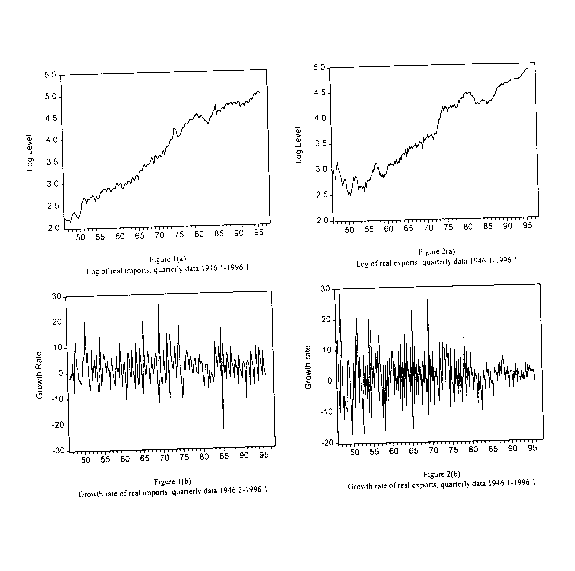
Figures 1(a) and 1(b) plot the log level and the growth rate respectively of quarterly aggregate U.S. imports in constant dollars between 1946 and 1996. The seasonal fluctuations in aggregate imports can definitely be observed and appear to be large and constant over time. We estimate the seasonal factors using the dummy regression model. That is, we regress the growth rate of imports less its mean growth rate between 1946 and 1996 on four quarterly dummies,
(1) ,
where Xt is the quarterly growth rate of imports less the mean growth rate during the sample period, and Qs, s=1, .., 4, are quarterly dummies. The results are presented in Table 1. The entries in the table are the OLS estimates of the coefficients on the seasonal dummies. These coefficients show that aggregate imports increase by 4.9% (above the mean growth) in the second quarter and decrease by about 2.4% and 2.3% in the fourth and first quarters respectively.
Aggregate exports exhibit large seasonal fluctuations as well, but the timings of the high and low seasons are different. Figures 2(a) and 2(b) plot the log level and the growth rate respectively of quarterly aggregate U.S. exports in constant dollars between 1946 and 1996. The estimated seasonal pattern of exports is presented in Table 1. The coefficients on the dummies show that exports increase by 4.7% and 4.1% in the second and fourth quarters respectively, and decrease by 7.1% and 1.6% in the third and first quarters respectively. We further find that, remarkably, seasonal fluctuations of exports have decreased after 1980. This, to our knowledge, has not been pointed out before. Regressing the growth rate of exports on quarterly dummies for the period prior to 1980 and for the period after 1980 separately suggests that the seasonal fluctuations after 1980 are about one half of the seasonal fluctuations prior to 1980 (see Table 1).
To conclude, aggregate imports fluctuate by as much as 7% (between the first and fourth quarters) and aggregate exports fluctuate by as much as 12% (between the second and third quarters). Comparing fluctuations of imports and exports, they have the same signs in the first and second quarters but have opposite signs in the fourth quarter. Imports increase in the second quarter and decrease in the first and fourth quarters, while exports increase in the second and fourth quarters and decrease in the third quarter. There is also very strong evidence that the seasonal fluctuations of exports have declined substantially over time.
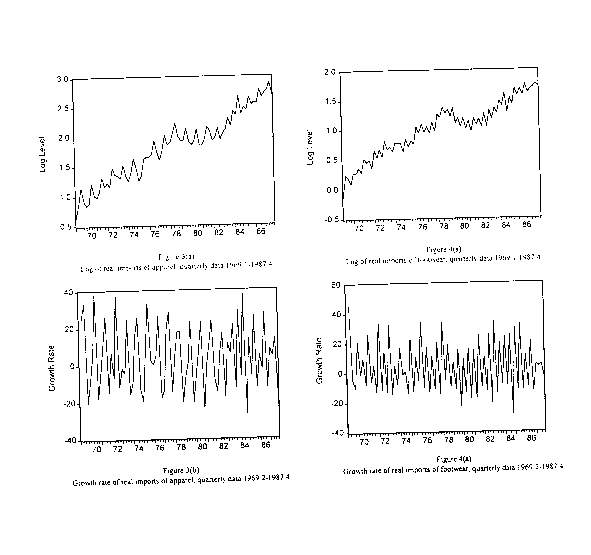
Aggregate imports and exports, however, do not fully reflect the importance of trade across seasons since industries with asynchronous seasonal fluctuations offsetting one another, as well as industries without seasonal fluctuations are included. Thus, we next examine industries for which large seasonal fluctuations are expected a priori: apparel, and footwear. We collected quarterly data from 1969 to 1987 for imports and from 1971 to 1987 for exports. Figures 3(a) and 4(a) present the natural logarithm of quarterly real imports of apparel and of footwear in constant dollars between 1969 and 1987, and Figures 3(b) and 4(b) present the growth rates of these series. Two clear observations can be made from the figures. First, there is a large increase in imports over time. Imports of apparel and of footwear increased to 7.7 and 6.4 times respectively between 1969 and 1987. In comparison, during the same period, U.S. production of apparel increased by only 25%. Second, seasonal fluctuations are large. The estimated seasonal patterns in these series (the OLS estimates of the coefficients on the seasonal dummies) are presented in Table 1. The coefficient estimates show that imports of apparel increase by 22.7% in the third quarter and decrease by 20.0% and 4.6% in the fourth and first quarters respectively. Imports of footwear increase by 17.5% and 11.1% in the first and third quarters respectively, and decrease by 17.1% and 10.6% in the fourth and second quarters respectively.
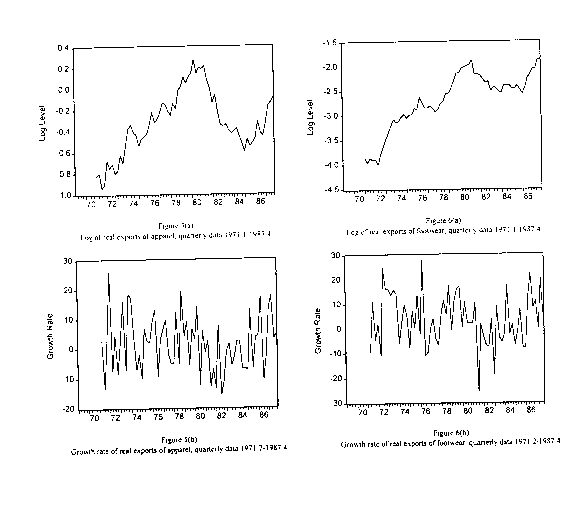
Exports of apparel and of footwear exhibit large seasonal fluctuations as well, but the seasonal fluctuations are smaller and have different patterns. Figures 5(a) and 6(a) present the natural logarithm of quarterly exports of apparel and of footwear in constant dollars between 1971 and 1987, and Figures 5(b) and 6(b) present the growth rates of these series. Between 1971 and 1987, exports of apparel and of footwear doubled and increased to 7.5 times respectively. The estimated seasonal patterns in these series are presented in Table 1. The coefficient estimates show that exports of apparel increase by 6.9% in the second quarter and decrease by 8.1% in the third quarter. Exports of footwear decrease by 4.8% in the first quarter.
To conclude, there are seasonal fluctuations by as much as 43% for apparel imports (between the third and fourth quarters),15% for apparel exports (between the second and third quarters), and 35% for footwear imports (between the first and fourth quarters). Seasonal fluctuations of imports and exports have different patterns. The share of import of apparel in domestic consumption has increased from 5% of total apparel consumption ($1.3 billion) in 1970 to 26% ($22 billion) in 1988 (Murray (1995)). This implies that between 1970 and 1988 trade across seasons in apparel had increased by more than 5 times.
Having established the quantitative significance of seasonal fluctuations in international trade, we next examine the qualitative effects.
3. The Model
We next formulate a model to examine how seasonal fluctuations and international trade across seasons are linked to production, consumption, and welfare. In particular, our interest will be in how changes in seasonal fluctuations (a second order change) may affect the means and variances of employment and output (first and second order statistics). We employ a perfectly competitive general equilibrium model with two final goods, two factors of production, and two seasons. The two goods are both final goods: good x is tradable while good y is non-tradable. The two factors of production are capital (K) and labor (L), and the two seasons called high and low are labeled by s = h, l respectively. The two seasons comprise a period. Demand for each good fluctuates between seasons: demand for good x (good y) is high (low) in season h and demand for good x (good y) is low (high) in season l. Goods are not storable, and there is no uncertainty in the model.
Firms produce in each season, using capital and labor, by a constant returns to scale technology. Capital input for each firm is fixed during a period: firms cannot adjust the quantity of its capital input across seasons. Labor input, on the other hand, can be varied across seasons. Capital thus represents factors of production that can only be adjusted each period and not across seasons, such as factories or large machineries. Labor represents factors that are adjustable in each season, such as man-hours and leased equipment. We further assume for simplicity that the production functions are the same across sectors. Specifically, using the Cobb-Douglas form, the production functions of the tradable and non-tradable goods in each season are:
(1)  , and
, and
(2)  ,
,
where 0<
b<1 and s = h, l.The total capital supply and labor supply are fixed. Capital supply is denoted by K, and labor supply is normalized to 1. The factor market clearing conditions are:
(3) 
(4) 
(5) 
Equations (1) through (5) define the economy's convex production feasibility set in 4 dimensions: Qxh, Qyh, Qxl, and Qyl.
The utility of a representative consumer defined over the two goods in the two seasons is:
(6)  ,
,
where  is consumption of good i in season s. The seasonal fluctuation in consumer preference is captured by
 <a<1. We are therefore modeling domestic seasonal fluctuations to originate from the demand side, with a relatively high preference for good x (low preference for good y) in season h, and a relatively low preference for good x (high preference for good y) in season l.
3.1 Autarky Solution
We first look at the autarky solution, which will be used later as a benchmark to investigate the effects of international trade. The solution satisfies the following first order conditions along with the constraints (1) though (5) and convexity of the production set:
(7) 
(8) 
(9)  ,
,
where  (j=1,2,3,4) is the partial derivative of u with respect to the jth argument,
  and
and  are partial derivatives of
  with respect to the first and second arguments,
  and
and  are partial derivatives of
  with respect to the first and second arguments, and s=h,l. As usual, the first order conditions are the equalities across the two sectors of the shadow values of the marginal products of each of the factors. Since capital can only be adjusted each period (consisting of the two seasons), each side of equation (7) is the welfare effect of a marginal unit of capital via period output. Each side of equations (8) and (9) is the welfare effect of a marginal unit of labor via seasonal output.
We define p as the relative price of the high-season good x in terms of the low-season good x. In the autarky solution, this relative price is equal to the marginal utility of the high-season good x relative to the marginal utility of the low-season good x:
 .
.
Due to the assumed symmetries in the model (in production and in preference), capital is split equally between sectors x and y ( ), and there is symmetry in labor allocation (
 and
and  ).
).
3.2 Free Trade Solution
The world market is also subject to seasonal fluctuations, which may be larger or smaller than the domestic fluctuations. The world fluctuations may be synchronous or asynchronous to domestic. We are interested in how a country is affected if a it exposes itself to the world market (i.e. increases its volume of trade), and also, how the freely trading country is affected if fluctuations in the world market changes.
Our model will take the form of a small open country which takes the world relative price of the high-season good x in terms of the low-season good x, p ( ), as given. The value of p represents the world seasonal fluctuation, and without loss of generality, we assume that the world price of good x in season h is greater relative to that in season l, i.e. p≥1. If p>pa (if p<pa), the country exports (imports) good x in season h and imports (exports) it in season l. We assume that trade balances each period (consisting of the two seasons). The results we obtain are also valid for a large country if p is interpreted as the equilibrium relative price of the large country freely trading with the rest of the world.
The free trade solution is obtained by maximizing (6) subject to the production possibilities (1) to (5), domestic market clearing of the non-traded good Qys=Dys for s=h,l, and period trade balance
(10)  ,
,
where  .
.
The solution satisfies the following first order conditions:
(11) 
(12) 
(13)
(14) .
Equation (11) is the equality of the world relative price to the ratio of marginal utilities for the traded good across seasons. Interpretations of equations (12) to (14) are the same as those of (7) to (9). We will be able to make two sets of observations: a comparison of autarky and free trade, and the effect of increased or decreased fluctuations on the freely trading country.
3.3 Effect of Trade
Since the model could not be solved analytically for general parametric values, we solved the model numerically for several plausible parameter values (within  ≤
≤
 and
and  ≤b≤
≤b≤ ) and obtained the following results which are consistent across the values we examined.
We find that capital allocation across the two sectors, Kx and Ky, is unaffected by free trade. This results from the effect on the shadow values of the marginal products of capital in each season, and that capital cannot be adjusted across seasons i.e. the same Kx is used to produce in both the high and low seasons. For example, an increase in p, the relative price of high-season good x in terms of low-season good x, increases the shadow value of marginal product of capital to produce good x in season h, but this is entirely offset by the decrease in the shadow value of marginal product of capital to produce good x in season l. Thus capital demand by sector X does not change. The relative shadow price of high-season good y in terms of low-season good y also changes, but this too does not affect the demand for capital by sector Y.
With respect to use of labor, the seasonally adjustable factor, Lxh increases and Lxl decreases if the world fluctuation is greater than the domestic fluctuation (p>pa). Lyh decreases and Lyl increases if the world fluctuation is greater than the domestic fluctuation. The opposites happen if the world fluctuation is smaller than the domestic fluctuation (p<pa).
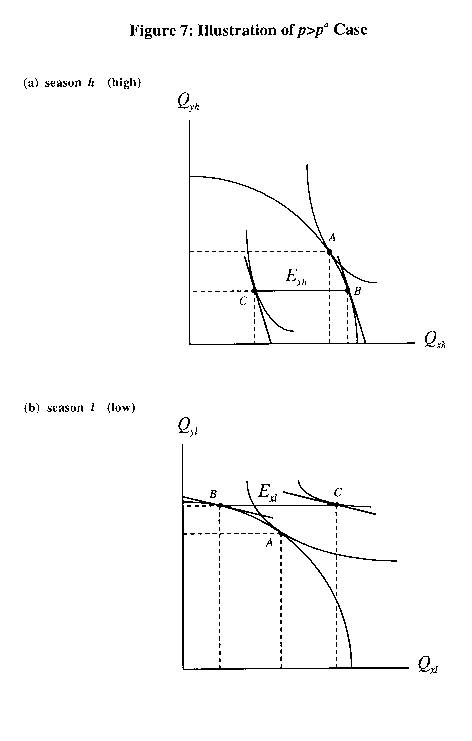
The situation for p>pa is illustrated in Figure 7: panel (a) for the high season and (b) for the low season. Given that capital allocation cannot be adjusted across seasons, the production possibilities frontiers are the same across seasons. In autarky, optimization results in production and consumption at point A in each of the panels. Under free trade, production is at point B and consumption is at point C. Exh is the export in the high season, and Exl is the import in the low season. The marginal rate of substitution at point C is equal to the marginal rate of transformation at point B in each panel, and Exh and Exl satisfy the trade balance condition (10).
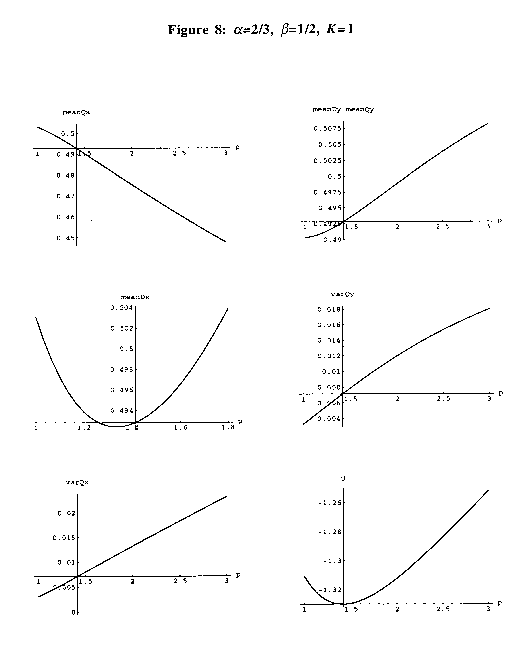
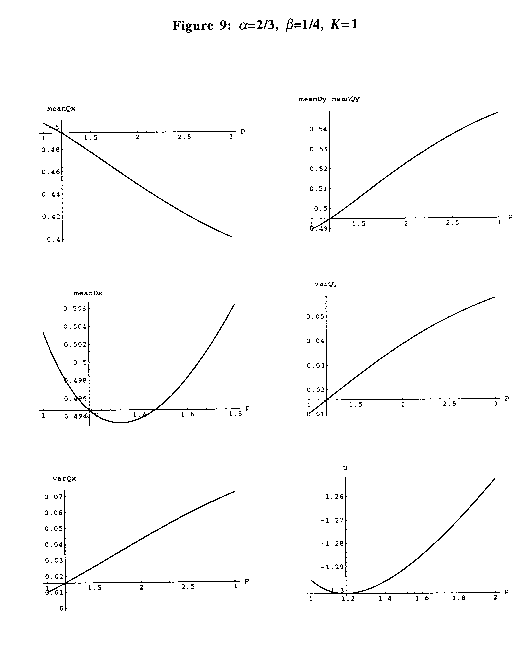
Some of the results are presented on Figures 8 and 9, which plot the values of means and variances of some of the variables as functions of p. For each graph, the origin corresponds to the autarky point. The only qualitative difference between the two figures is with the mean of Dx. Having examined the results for the different parameter values, we find the following effects on the means and variances across seasons for each of the goods to be robust among our parameter values.
Proposition 1.1. Consider an autarkic economy exposing itself to world seasonal fluctuations by starting to trade freely. If the fluctuations under free trade are larger than the fluctuations under autarky (i.e. if p>pa):
(a) the mean labor use and the mean production of the traded good decrease;
(b) the mean labor use and the mean production of the non-traded good increase;
(c) the mean consumption of the traded good can increase or decrease;
(d) the mean consumption of the non-traded good increases;
(e) the variances of labor use and production of both goods increase; and
(f) welfare increases.
This represents the situation in which a small country starts to trade freely and exposes itself to world fluctuations which are larger than domestic. Alternatively, it is the situation in which a large country starts to trade freely and the resultant world price fluctuations are larger than under autarky.
The intuition for these results is as follows. When a country faces a larger seasonal fluctuation through an increase in the relative price of high-season good x with respect to low-season good x, two factors come into play in affecting production. First, the convexity of production possibilities set implies that larger fluctuations decrease the means of production of both goods.
The second factor is substitution in consumption. Given the diminishing marginal utility in each of the four arguments, Dxh, Dyh, Dxh, Dxl, "smoothing in consumption" takes place across these arguments for welfare maximization. In season h, there is an increase in the relative price of good x, and as a result, production of good x increases, production (and consumption) of good y decreases, and good x is exported. In season l, there is a decrease in the relative price of good x, and as a result, production of good x decreases, production (and consumption) of good y increases, and good x is imported. Note that since p>1, for every unit of good x exported in season h, more than one unit of good x is imported in season l. This means that the change in season h (increase in the production of good x and decrease in the production of good y) is smaller than the change in season l (decrease in the production of good x and increase in the production of good y). Therefore, the substitution effect is to decrease the mean production of good x and increase the mean production of good y. Summarizing, for good x, both the convexity and the substitution effects are to decrease its mean production. For good y, the convexity effect is to decrease its mean production (and consumption) and the substitution effect is to increase its mean production (and consumption). For our functional specification and parameter values, for good y, the former effect is dominated by the latter. This is a striking finding. If a country, by freely trading, exposes itself to a larger seasonal fluctuation of the price of the traded good, its traded good sector shrinks unambiguously, and in our specification its non-traded good sector expands.
The mean consumption of good x, the traded good, can increase or decrease because the above negative production effect coexists with the usual substitution and income effects of the tradable good consumption. The variances increase as expected, and welfare increases because of increased consumption possibilities from allowing international trade.
The effects on a country which faces smaller seasonal fluctuations (p<pa) are presented as the following.
Proposition 1.2. Consider an autarkic economy exposing itself to world seasonal fluctuations by starting to trade freely. If the fluctuations under free trade are smaller than the fluctuations under autarky (i.e. if p<pa):
(a) the mean labor use and the mean production of the traded good increase;
(b) the mean labor use and the mean production of the non-traded good decrease;
(c) the mean consumption of the traded good can increase or decrease;
(d) the mean consumption of the non-traded good decreases;
(e) the variances of labor use and production of both goods decrease; and
(f) welfare increases.
This presents the situation in which a small country starts to trade freely and exposes itself to world fluctuations which are smaller than domestic. Alternatively, it is the situation in which a large country starts to trade freely and the resultant world price fluctuations are smaller than under autarky.
The above results can be explained by the same intuitions as those for Proposition 1.1. The convexity and substitution effects are the just the opposites of those for Proposition 1.1, explaining (a) to (d). There is a decrease in seasonal fluctuations, thus decreases in the variances. The effect on welfare is also an increase due to increased consumption possibilities due to free trade.
One plausible scenario, when looking at data, is an increase in the volume of trade of a large country whose fluctuations are asynchronous to the rest of the world, and the resultant price fluctuations are smaller. Proposition 1.2 predicts the outcome on the means and variances for such a case in which the change from autarky to free trade can represent the effect of an increase in trade volume. The traded good sector expands while the non-traded sector shrinks. Fluctuations in domestic production become smaller, and welfare increases.
3.4 Effect of Changing World Seasonal Fluctuations
Next we consider the comparative static of changing p for a freely trading country. We define an increase in the world seasonal fluctuations by an increase in p. As above, capital allocation is unaffected.
Proposition 2. Consider a freely trading economy. If the price fluctuation of the traded good (p) increases:
(a) the mean labor use and the mean production of the traded good decrease;
(b) the mean labor use and the mean production of the non-traded good increase;
(c) the mean consumption of the traded good can increase or decrease;
(d) the mean consumption of the non-traded good increases;
(e) the variances of labor use and productions of both goods increase; and
(f) welfare increases if p>pa, and decreases if p<pa.
The intuition for (a) to (e) is the same as those for Proposition 1.1. An increase in the world seasonal fluctuation shrinks the traded good sector and expands the non-traded good sector.
Welfare has a U-shaped graph with respect to p, with the minimum at autarky p. Welfare is decreasing (increasing) with respect to p for values of p lower (higher) than the autarky p. The effect on welfare can be explained entirely by terms of trade changes. When the world seasonal fluctuation is smaller than the domestic fluctuation, the country is importing in season h and exporting in season l. An increase in p( ) is a terms of trade deterioration. On the other hand, when the world fluctuation is greater, the country is exporting in season h and importing in season l. An increase in p is a terms of trade improvement.
4. Volume of Trade and Fluctuations in Domestic Production
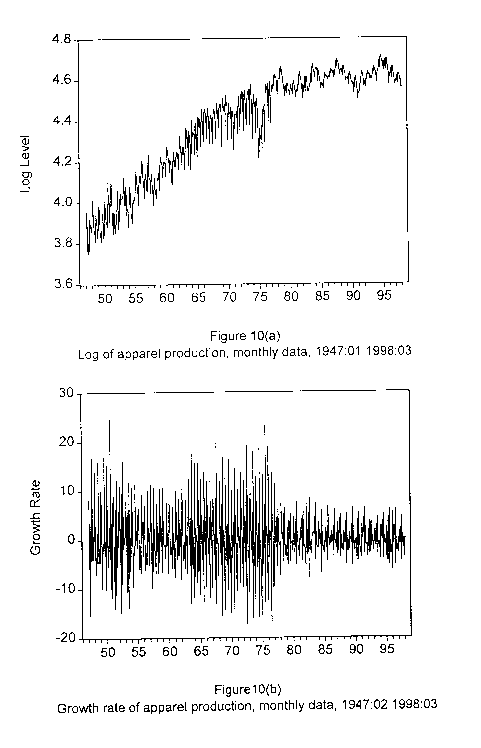
One of the model's results is that through international trade across seasons, an increase in the volume of trade can be accompanied by a decrease in the seasonal fluctuations of domestic production. We use monthly data of U.S. apparel production from 1947:01 to 1998:03 to investigate whether the increase in international trade was accompanied by a decrease in seasonal fluctuations of production. Figures 10(a) and 10(b) present the monthly log level and the monthly growth rate of apparel production from 1947 to 1998. The decrease in the seasonal fluctuations in the second half of the 1970's is clearly identifiable.
To test whether the seasonal fluctuations of apparel production are indeed negatively correlated with the increase in apparel trade volume, we regressed the monthly growth rate of production less its mean growth rate on monthly dummies and an interaction term, the monthly dummies multiplied by the ratio of trade volume to production. Specifically, we estimate the following equation:
(16)  ,
,
where Xt is the monthly growth rate of apparel production less its mean growth rate, Ms, s=1, .., 12, are monthly dummies, TRADE is defined as apparel imports plus exports divided by the industrial production (IP) index for apparel, and TREND is an annual time trend.
The results are presented in Table 2. The first column presents the result of regressing the monthly growth rate of production just on the monthly dummies. The coefficients show that production increases in January, February, June and August by 3.5%, 6.1%, 2.9%, and 10.7% respectively, and decreases in April, July, November and December by 3.8%, 7.9%, 3.6%, and 5.1% respectively. The second column presents the result when trade interaction term is included. The trade coefficient is negative and significant. This implies that a larger volume of trade is associated with smaller seasonal fluctuations in production. For example, between 1980 and 1990 the share of trade doubled from 1 to 2. Given the coefficient of -0.37, such an increase implies that the seasonal fluctuations of production have decreased by 37%. One possible explanation of the negative correlation between trade volume and fluctuations in production is that both have changed over time independent of each other. Column 3 presents the result when we add a time trend to the regression. The coefficient on trade is still negative and significant while the coefficient of the trend is insignificant. This suggests that the results are not driven by a common trend.
4.1 Competing Explanations
It is important to note that we demonstrated only a negative correlation between the volume of international trade and the size of seasonal fluctuations in production, and not causality. The negative correlation can be explained by several other models where the decrease in the seasonal fluctuations of production is independent of international trade. For example, it is possible that the decrease in the seasonal fluctuations of production is a result of a shift in technology. That is, technology has become less flexible, and as a result, fluctuations in production are smaller. Another explanation is that there was a change in tastes over time: the fluctuations in demand have decreased independent of international trade. A change in technology and tastes, however, could have also been a result of international trade. In other words, an increase in international trade may have allowed firms to shift to a more rigid technology (or a shift of the economy to more rigid and capital intensive industries) since fluctuations in demand can be met with fluctuations in imports. Likewise, international trade may have affected the seasonal fluctuations in tastes as consumers are exposed to larger varieties of commodities. These competing explanations, therefore, are consistent with our model, and further research should expand the model to investigate the exact channels by which international trade affects seasonal fluctuations in production.
5. Conclusions
This paper claims that seasonal fluctuations in international trade and trade across seasons are important elements which cannot be ignored in terms of magnitude (shown by our empirical investigations) and implications (shown by our model and empirical evidences). Using U.S. data for aggregate trade and for apparel and footwear, we demonstrate the existence of large seasonal fluctuations. The model shows the links between second order changes (size of seasonal fluctuations) and the first and second order statistics of the economy (levels and variances of employment, production, and consumption), and find some surprising relationships. Most notably, we find in our simulations that an increase in seasonal fluctuations will expand the non-traded good sector and shrinks the traded good sector. We find in U.S. apparel trade data that there is a negative correlation between the volume of trade and the size of seasonal fluctuations in production, which is consistent to our model. This is only a first paper on this topic, and further research should investigate the various implications of international trade across seasons.
References
Anderson, Patricia M., 1993, "Linear Adjustment Costs and Seasonal Labor Demand: Evidence From Retail Trade Firms," Quarterly Journal of Economics 113: 1015-1042.
Barsky, Robert B., and Jeffrey A. Miron, 1989, "The Seasonal Cycle and the Business Cycle," Journal of Political Economy 97: 503-535.
Beaulieu, J. Joseph, and Jeffrey A. Miron, 1992, "A Cross Country Comparison of Seasonal Cycle and Business Cycle," Economic Journal 102: 772-788.
Beaulieu, J. Joseph, Jeffrey K. MacKie-Mason, and Jeffrey A. Miron, 1992, "Why Do Countries and Industries with Large Seasonal Cycles Also have Large Business Cycles?" Quarterly Journal of Economics 107: 621-656.
Bursk, J. Parker, 1931, Seasonal Variation in Employment in Manufacturing Industries (University of Pennsylvania Press, Philadelphia).
Canova, Fabio and Eric Ghysels, 1994, "Changes in Seasonal Patterns: Are They Cyclical?" Journal of Economics Dynamics and Control 18:1143-71.
Chatterjee, Satyajit, and B. Ravikumar, 1992, "A Neoclassical Model of Seasonal Fluctuations," Journal of Monetary Economics 29:59-86.
Franses, Philip H., 1996, Periodicity and Stochastic Trends In Economics Time Series (Oxford University Press, Oxford).
Helpman, Elhanan and Assaf Razin, 1978, A Theory of International Trade Under Uncertainty (Academic Press, New York).
Hufbauer, Gary C., Diane T. Berliner, and Kimberly A. Elliott, 1986, Trade Protection in the United States: 31 Case Studies (Institute for International Economics, Washington, DC).
Hylleberg, Svend, 1986, Seasonality in Regression (Academic Press, New York).
Kuznets, Simon, 1933, Seasonal Variation in Industry and Trade (National Bureau of Economic Research, New York).
Markusen, James R., James R. Melvin, William H. Kaempfer, and Keith E. Maskus, 1995, International Trade: Theory and Evidence (MacGraw-Hill, New York).
Mehrez, Gil, 1996, State Dependent Adjustment in an Economy with Seasonal Fluctuations, Georgetown University Working Paper Series #96-09.
Mehrez, Gil, 1998, Nominal Rigidities and Seasonal Fluctuations, Georgetown University Working Paper Series #98-07.
Miron A. Jeffrey, 1996, The Economics of Seasonal Cycles, Cambridge: MIT Press.