 be trading block i's endowment of good j. For simplicity, there
is one unit of each good in the world. If
be trading block i's endowment of good j. For simplicity, there
is one unit of each good in the world. If  = .6 it means trading block i is endowed with 60% of the world's
endowment of good j.
= .6 it means trading block i is endowed with 60% of the world's
endowment of good j.
Abstract: There has been growing debate about whether bilateral trade agreements are damaging multilateral efforts to eliminate barriers to international trade. This paper develops a model in which trading blocks always charge optimal tariffs and make trade agreements based on strategic considerations. We ask a very simple question. Does the fact that trading blocks can form bilateral trade agreements make Free trade less likely to occur? The answer is that it depends on the size distribution of the trading blocks. If there is one large trading block along with some smaller ones then bilateral trade agreements allow the smaller trading blocks to coalesce and block the monopoly power of large trading blocks. In this case, bilateral trade agreements facilitate the attainment of free trade. Not allowing customs unions leads to more not less protection. If trading blocks are of roughly equivalent size then bilateral trade agreements allow groups of trading blocks to more effectively monopolize world trade in which case they may make free trade less likely. These results suggest that a policy which inhibits the formation of trading blocks may be harmful. We also compute the welfare effects of trade agreements to get some idea of how empirically important these issues are.
I. Introduction
In recent years, the world trading system has witnessed an unprecedented transformation: from the multilateralism of the WTO (formerly GATT) towards regional trading agreements. The number of existing free trade agreements has nearly doubled in the last four years. This development has led to renewed interest in one of the oldest questions in the customs unions literature: are the new spate of regional trading arrangements, such as NAFTA, a help or a hindrance in the goal of attaining free international trade? In the current literature there is a vigorous debate taking place about this basic issue. While some researchers claim that these agreements can be instrumental in attaining global free trade, others fiercely oppose regional agreements, since they see them as a potential threat to the multilateral trading system.
In this paper, we examine this issue using a simple general equilibrium model in which trading blocks behave optimally. In particular, we address the following questions: are regional trade agreements stepping stones to global free trade? Or, should they be seen as a threat to the multilateral trading system, and, therefore, be banned? To understand the implications of various policies, we compare equilibrium outcomes when bilateral agreements are allowed and when they are not allowed. The most surprising result of this investigation is that not allowing bilateral agreements can result in more protection and lower world welfare. Whether the ban on bilateral agreements helps or not depends on the size distribution of trading blocks.
There has been a growing body of literature which examines several effects of increasing regionalism on free trade: Krugman (1991), using a monopolistically competitive model, shows that regional trade agreements can potentially increase external tariffs due to the non-cooperative behavior of large trading blocks. An important outcome of his analysis is that if there are only three trading blocks, the world welfare is at its minimum. However, subsequent studies show that his results are sensitive to some of his assumptions. Bhagwati and Panagariya (1996) conclude that preferential trade agreements are mostly welfare reducing since the partner countries might end up with severe welfare losses due to substantial amount of trade diversion. Krueger (1996), employing Vinerian arguments, finds that Free Trade Areas constitute a potential threat to the world trading system because these types of agreements are, in general, trade diverting and they lead to formation of new interest groups who oppose the multilateral tariff reductions.
Interestingly, some researchers paint a completely different picture about the implications of bilateral trade agreements: Nordstrom (1995) finds that regional trade agreements might provide trading blocks with stronger incentives to pursue multilateral trade liberalization since establishing these types of agreements allows small countries to more effectively deal with large trading blocks. Perroni and Whalley (1996) indicate that recent regional trade agreements generally take the form of Free Trade Associations in which member countries can choose their external tariff rates freely. In contrast to Krugman's findings, this new form of regionalism does not increase the monopoly power of newly established trading blocks and does not necessarily imply higher external trade barriers between the emerging trading blocks. They conclude that increasing regionalism is not a threat to the multilateral trading system.
Our approach to the questions posed above differs in some key ways from others in this literature: First, we analyze the strategic interactions between trading blocks in a general equilibrium model which was developed in Riezman (1985) and Kennan and Riezman (1990). Second, we investigate the implications of policy proposals to ban bilateral trade agreements in an environment where trading blocks optimally respond to externally imposed policies by evaluating costs and benefits of a menu of free trade agreements. Third, we analyze Free Trade Associations (FTAs) and Customs Unions (CUs) and document various implications of these different types of agreements. Fourth, we calculate welfare gains associated with these agreements for each trading block and the world.
Interestingly, the strategic aspects of these questions tend to be downplayed in much of the previous literature. Requiring optimal behavior has many advantages. First, and most important, is that requiring that trading blocks set tariffs optimally allows us to rationalize initial tariffs within the context of the model. We specify why tariffs are initially being charged and the properties of the initial equilibrium. This is important because an understanding of why tariffs exist in the first place helps to properly evaluate the welfare consequences of changing them via a change in trading agreements. In our model, tariffs exist for terms of trade reasons although the model could be easily adapted to deal with other motivations.
Second, optimality implies that trading blocks are individually rational. In this context, it means that trading blocks optimize at all stages both in terms of who they cooperate with and what tariffs they charge given the constraints imposed by their cooperative agreements. We model the decision to cooperate and under what terms cooperation will take place.
The issue of whether bilateral agreements are a help or a hindrance to the attainment of free trade then becomes a question of analyzing the effect of banning bilateral agreements. One can think of two different proposals that have been discussed. The first would ban all bilateral trade agreements. A weaker version would ban customs unions but allow Free Trade Associations. We calibrate our model to simulate two different world economies. Then we conduct policy experiments on both economies. In the first economy, when bilateral agreements are allowed free trade is the unique equilibrium. Banning bilateral agreements results in the non-cooperative tariff equilibrium being the outcome. Thus, in this case bilateral agreements play an essential role in the attainment of free trade. However, in the second economy, the reverse is true. A customs union is the equilibrium when bilateral agreements are allowed, but free trade is chosen when they are banned. In this case, bilateral agreements do obstruct free trade.
The intuition for these results is clear. Bilateral agreements
allow trading blocks to merge and essentially get larger for the
purposes of trade policy. In the first economy two smaller trading
blocks use the threat of a customs union to block the third larger
trading block from using tariffs. In equilibrium, this threat
is not carried out and free trade is the result. In the second
economy, what happens is that the initial endowment structure
is such that in equilibrium two trading blocks get together and
exploit the third, hence blocking free trade. Hence, allowing
trading blocks does have the potential to block free trade, but
it also has the potential to allow smaller blocks to successfully
oppose larger ones and in some cases can actually facilitate the
attainment of free trade. This suggests that any proposed policy
to ban or limit bilateral agreements should be structured to take
account of these potential effects.
II. The Model
We first construct a model sufficiently general to incorporate an arbitrary number of trading blocks. Each trading block optimally determines its external tariff rates. There are N trading blocks in our model. Within the trading blocks, member countries freely trade with each other.
Trading blocks set tariffs optimally and consider all possible trade agreements when they decide what to do. They can choose not to be part of any trade agreement and charge the optimal tariff or they could decide to join a coalition with other trading blocks. They could be part of an FTA, a CU or an N trading block coalition-free trade. In the FTA member trading blocks agree to free trade between themselves but are allowed to set their external tariffs independently. A customs union is an FTA with the additional provision that the external tariff is set jointly by the members. A CU (or FTA) of all trading blocks is, of course, Free trade.
Trading blocks play a two-stage game. In the second stage, tariffs
are chosen, given the coalition structure. Trading blocks or
coalitions of trading blocks choose tariffs optimally yielding
a Nash equilibrium in tariffs. In the first stage, trading blocks
use information from the second stage to choose which coalition,
if any, to join. In order to determine the outcome of the first
stage we employ the core solution concept. The core is a natural
concept to use because it selects allocations that cannot be blocked
by any potential group of trading blocks. As we shall see the
potential to threaten to form coalitions will have important effects.
II.1. The Environment
Think of a world of N trading blocks. Each trading block is endowed
with a fixed amount of each final commodity. Let
be trading block i's endowment of good j. For simplicity, there
is one unit of each good in the world. If
= .6 it means trading block i is endowed with 60% of the world's
endowment of good j.
In each trading block, the agents derive utility by consuming M different goods. Assume that each trading block consists of individuals with identical Cobb-Douglas preferences. Then the utility function of a representative agent is the same as the aggregate and is given by
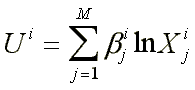
where Ui is the utility of trading block i,
 is the weight trading block i puts on
commodity j, and
is the weight trading block i puts on
commodity j, and  is the aggregate consumption
of good j in trading block i.
is the aggregate consumption
of good j in trading block i.
The volume of trade  , is defined to be
 =
=  -
-  .
Positive values of
.
Positive values of  indicate imports,
negative values exports. Trading blocks charge optimal tariffs
on imports. Denote the ad valorem tariff charged by trading block
i on imports of good j by
indicate imports,
negative values exports. Trading blocks charge optimal tariffs
on imports. Denote the ad valorem tariff charged by trading block
i on imports of good j by  . Then if the
world price for good j is Pj, then the domestic
price of good j in trading block i is
. Then if the
world price for good j is Pj, then the domestic
price of good j in trading block i is  = (1+
= (1+ ) Pj .
Given that each trading block consists of identical individuals aggregate demand is obtained from maximizing utility subject to the budget constraint
(2) 
where  is income in trading block i and
consists of income from the endowment plus tariff revenue.
is income in trading block i and
consists of income from the endowment plus tariff revenue.
II.2. The Equilibrium
The trading blocks solve their optimization problems by maximizing (1) subject to (2). At the equilibrium, the aggregate expenditure in each trading block must equal the value of the endowment vector. In other words, the resource constraint of each trading block i is given by
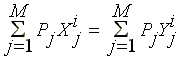
In addition to this constraint, the world demand for each good, which is normalized to one, should be equal to world supply:
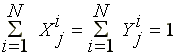
These two conditions imply that world expenditure on each good
will equal the world price for that good.
II.3. The Numerical Solution Method
. Because we cannot solve the model analytically we use a recursive
numerical solution method to find an approximate solution for
equilibrium allocations, prices and tariffs. In order to utilize
the solution algorithm, we specify the number of trading blocks,
the number of goods and endowment of each trading block. We assume
that M=N=3 and  =1/3 for all i,j=1,2,3.
Assuming N=3 has a natural interpretation since many authors
have discussed the possibility that the world is rapidly moving
towards three trading blocks (see for example, Frankel, Stein
and Wei (1996).) The assumptions on preferences are not as limiting
as they seem. Any variation in cross trading block preferences
or preferences across commodities could be replicated by a suitable
adjustment of endowments. Thus, we focus on variation in the
endowment matrix, but the results can apply to more general situations.
=1/3 for all i,j=1,2,3.
Assuming N=3 has a natural interpretation since many authors
have discussed the possibility that the world is rapidly moving
towards three trading blocks (see for example, Frankel, Stein
and Wei (1996).) The assumptions on preferences are not as limiting
as they seem. Any variation in cross trading block preferences
or preferences across commodities could be replicated by a suitable
adjustment of endowments. Thus, we focus on variation in the
endowment matrix, but the results can apply to more general situations.
The intuition of our solution method is simple: for a given endowment matrix, we can compute the equilibrium with optimal tariffs. Thus, when a trading block considers changing its tariff it has to make this calculation for any proposed tariff change. Once a trading block changes its tariff we have to re-compute optimal tariffs for the other two trading blocks. This continues until no trading block wants to alter its tariff rate. (for details see Kennan and Riezman (1990).)
Trade pattern assumptions should introduce as little asymmetry as possible. A customs union means that member countries treat member and non-member countries differently. Hence, if you are trying to explain why customs unions exist the initial situation should be symmetric. Each region is endowed with some of each good. We structure our simulations in such a way that in all the possible equilibria each trading block exports one good (trading block i exports good i) and import the other two goods. Transfer payments between trading blocks are not allowed. Kowalczyk and Sjostrom (1994) analyze a model of customs unions in which side payments are allowed, but their framework requires that there are no spillovers to non-members when a customs union forms. They find that the use of inter-block transfers can facilitate the attainment of free trade.
Operationally, FTAs and CUs put constraints on the feasible tariff matrix. For an FTA, tariffs between the member blocks are set to zero, and external tariffs are set independently. This means to compute the equilibrium, the appropriate tariffs are constrained to be zero and optimal tariffs are computed as before. Alternatively, one might consider a more general case in which we let coalitions have tariffs between the member blocks. We require that free trade be practiced within the coalition because article XXIV of the GATT requires this. It is also worth mentioning that trade agreements in practice, such as the EU or NAFTA abide by article XXIV. Computing customs unions equilibria is a bit more complicated. One can think of a CU as an FTA with the added feature that the external tariff is set jointly. In general, (except when the endowment pattern is symmetric) there will be a conflict of interest between the member trading blocks as to what the external tariff should be.
How potential customs union members resolve this conflict is a serious problem deserving of careful analysis. In fact, there is at least one paper which addresses this issue directly (see Gatsios and Karp (1991).) In their model, members sometimes have congruent interests and sometimes opposing interests. Here member's interests are always opposed in the sense that if their endowment structure is not symmetric they want different external tariffs. There is no simple or obvious solution to this problem. We assume that trading blocks compromise on the external tariff by splitting the utility difference. Operationally, we calculate the equilibrium by computing two equilibria for each potential customs union. In one equilibrium one trading block picks the external tariff for the customs union. In the other equilibrium the other trading block chooses the external tariff. We then average the utilities for each trading block between the two equilibria. We assume then that the customs union selects an external tariff that gives each trading block this average utility.
III. Coalition Choice
In this section we model the choice of coalition partners. Trading blocks use the results from the previous section to decide which coalition, if any, to join. How trading blocks make this decision is modeled by the choice of a cooperative solution concept. The particular solution concept we use is the core. This was first used in Riezman (1985) to analyze the formation of customs unions and seems to be a natural one to use for this problem. One difference from Riezman (1985) is that we broaden the scope to include FTAs as well CUs.
With three trading blocks there are eight possible configurations
for world trading arrangements. There could be no customs union
agreement with each trading block charging optimal tariffs. Call
this coalition structure 1 denoted by {{1}, {2}, {3}}. This is
the non-cooperative Nash equilibrium. There are, in addition,
three possible customs unions, and potentially three free trade
associations. Finally, we could have the grand coalition form,
coalition structure 8, and get free trade. These coalition structures
are summarized in Table 1:
[insert Table 1 here]
The notation is meant to suggest that in Free Trade Associations, members have free trade amongst themselves, but select tariffs to the outside trading block independently. For example, in NAFTA, the US and Mexico have free trade, but are free to set tariffs to third parties independently. In the case of a customs union, the external tariff is jointly determined. As pointed out in previous work, (Kennan and Riezman (1990)) when two trading blocks import the same good they internalize the tariff externality that exists. As Perroni and Whalley (1996) show solving this tariff externality has significant welfare effects.
To define the core we need some preliminary definitions. Let Aj be the allocation of consumption goods when coalition structure j is chosen. For example, A4 is the matrix of consumption good allocations that prevails when there is an FTA between trading blocks 1 and 2. Each trading block's utility can be expressed as a function of an allocation. Ui(Aj) is the utility of trading block i when allocation Aj is realized. U3(A4), for example, is the utility trading block 3 receives when 1 and 2 form an FTA.
The first issue to clarify is how trading blocks evaluate membership in a particular coalition. When a trading block evaluates membership in a two or three trading block coalition, it is straightforward. In these cases there is only one allocation which could occur so trading blocks simply compute their utility under the relevant allocation. For example, Trading block 1 will get a utility of U1(A6) if it joins in a customs union with trading block 3, i.e. U1({1,3}) = U1(A6). Or trading block 2 gets U2(A8) if free trade occurs, U2({1,2,3}) = U2(A8).
How a trading block evaluates not being in a coalition is problematic. A trading block knows that if they do not join a coalition any of three allocations could occur; the other two blocks could form an FTA, a CU or Nash equilibrium (allocation 1) could occur. In trying to predict what will happen if it does not join a coalition the trading block assumes that the other countries will choose the best alternative for them. In cases where the best alternative is not unique trading blocks adopt a pessimistic view and assume they will receive the lowest payoff of the remaining possible allocations. For each model economy and each policy experiment we check to see that the assumptions made by individual coalitions are consistent with the equilibrium outcomes. This way of handling this problem makes sense because chances are the other two trading blocks will make a coalition choice that is best for them. This usually means that the excluded trading block suffers lower utility. We now turn to defining the core.
To define the core we need to first define blocking.
Definition: A coalition S blocks allocation j if for all trading blocks i in S
Ui(S) Ui(Aj),
with strict inequality for at least one member of S.
We can now define the core.
Definition: An allocation Aj is in the core if it is unblocked by any feasible coalition.
Allocations in the core are stable in the sense that no trading block does better in a feasible coalition. It implies that trading blocks can communicate with each other about possible trading arrangements, but all decisions to join coalitions are voluntary. In addition, no trading block can prevent other trading blocks from forming coalitions.
The core has a natural interpretation in this setting. Allocations
in the core will be the ones observed. In the case of multiple
core allocations the theory offers no guidance as to which ones
might actually be observed. Likewise, if the core is empty the
model makes no prediction as to what might happen. In the next
section of the paper we use the core equilibrium concept to investigate
policies that limit coalitional choices.
IV. Do Bilateral Agreements Make Free Trade Less Likely?
To answer this question we perform two simple policy experiments.
One policy experiment bans all types of bilateral agreements.
In the model of the world economy presented here it simply means
that free trade or Nash equilibrium are the only possible allocations.
All customs unions and free trade associations are banned. The
outcome under this regime can then be compared to the outcome
when article XXIV-type (customs unions and free trade associations)
are allowed. We consider a second, less drastic policy which
forbids customs unions, but allows free trade associations. The
rationale for this policy is that it keeps the tariff reduction
aspects of bilateral agreements, while not allowing the tariff
coordination aspect.
IV.1. Economy 1
We simulate two different world economies which differ by their
endowment pattern. In the first economy (see Table 2) there is
one large trading block (43% of the world's endowment evaluated
at free trade prices) and two smaller ones (each has about 28%
of the total world endowment.) First, consider what happens
if there are no restrictions on bilateral agreements. The CU
{2,3} blocks NE and FTA {2,3}. FTA {1,2} and FTA {1,3} block
each other because the non-member can always join with one of
the members and make all members of the new coalition at least
as well off and one member strictly better off. For the same
reasons CU {1,2} and CU {1,3} block each other. The customs union
between 2 and 3 is blocked by CU {1,2}. A single trading block
coalition of trading block 1 does not block FT because U1
({1}) = 112.626, trading block 1 can only guarantee itself a utility
level of 112.626 by charging tariffs and refusing to join any
trade agreements. Clearly single trading block coalitions with
2 or 3 do not block free trade. Thus free trade is unblocked
and the only allocation in the core.
[insert Table 2 here]
What happens in this economy is that trading block 1 can win
a tariff war, its utility is higher at Nash equilibrium than at
free trade. However, the threat of blocks 2 and 3 to form a
customs union is sufficient to keep trading block 1 from charging
tariffs in equilibrium and the result is free trade. We next
evaluate what happens if trade agreements are restricted.
IV.1a. All bilateral agreements banned
Suppose all CUs and all FTAs are banned. The NE and FT are the
only possible equilibria. In this case U1({1}) =
117.360. Thus, if trading block 1 charges tariffs it guarantees
itself a utility level of 117.360 which is higher than its free
trade level. Thus, NE will block FT and will be the only core
allocation. In this economy banning bilateral trading agreements
results in higher tariffs and lower welfare for the two small
trading blocks but the large block benefits. In this economy
trade agreements allow smaller trading blocks to effectively oppose
large ones by threatening to form a customs union. This threat
essentially prevents the large trading block from charging tariffs
and refusing to cooperate with other trading blocks. The result
is that free trade is the unique equilibrium. The result is subtle
in the sense that for this economy bilateral agreements are not
observed, yet they play an instrumental role. The option they
provide to smaller trading blocks leads to a more equitable and
efficient outcome.
IV.1b. Customs unions banned
We next consider a more moderate policy which allows FTAs but bans CUs. In this economy U1({1}) = 117.707 so coalition {1} blocks FT and FTA {1,2}. FTA {2,3} blocks NE since 2 and 3 do better in the FTA. U2{2}= U3{3}=67.115 so FTA {2,3} is unblocked and the unique equilibrium. Again, banning trade agreements leads to more not less protection. Again, the large trading block (1) benefits from this restriction, while the two smaller ones suffer. This more moderate policy is better for all trading blocks than the complete ban. However, this policy still results in efficiency losses when compared to the situation in which all bilateral agreements are permitted.
In economy 1, the possibility that trading blocks can form customs
unions and free trade associations results in free trade being
the only allocation in the core. When CUs and FTAs are not allowed
then Nash equilibrium is the only core allocation. If only CUs
are banned then 2 and 3 will form an FTA. In both cases, restricting
bilateral agreements benefits the large trading block at the
expense of the two smaller ones. The intuition for these results
is that customs unions, and to a lesser extent free trade areas,
allow smaller trading blocks to essentially become bigger for
the purposes of making trade policy. This allows them to compete
more effectively against big trading blocks. This more equal
footing can result in free trade being chosen in equilibrium.
Thus, the lesson learned from economy 1 is that bilateral agreements
can facilitate the attainment of free trade. Banning such agreements
could have the opposite effect that those pushing such policies
desire.
IV.2. Economy 2
In the second economy, the size distribution of trading blocks is more even. There is one small trading block with 30% of the world's endowment and two larger blocks with 35% each.
[insert Table 3 here]
When bilateral agreements are permitted trading blocks 2 and 3
will form a customs union. The CU {2,3} blocks FT, NE, FTA {2,3},
FTA {1,2} and CU {1,2} because in all cases trading blocks 2 and
3 do better in a customs union with each other than in any of
the other equilibria. None of the other allocations can block
CU {2,3}. Thus, CU {2,3} is the unique core allocation.
IV.2a. All bilateral agreements banned
When all bilateral agreements are banned free trade is the unique
equilibrium. In this case FT and NE are the only possible
equilibria. FT blocks NE since every trading block is strictly
better off at free trade. Obviously, NE does not block FT thus
FT is the unique core allocation. This result is the opposite
of economy 1. Here, allowing bilateral trade agreements prevents
free trade from occurring. In other words, customs unions are
not a stepping stone to free trade. Intuitively, what happens
is that in economy 2 the trading blocks are of similar size.
When the two biggest form a customs union they can win a tariff
war with the third trading block. It turns out that the small
trading block cannot do well enough in a customs union with one
of the large trading blocks to block the customs union between
the two larger trading blocks. In this case, bilateral agreements
are bad in that they allow the two larger trading blocks to become
big enough that they can use their size to exploit the smaller
trading block.
IV.2b. Customs unions banned
When only FTAs are allowed, free trade blocks all other
allocations and is the unique equilibrium. So, in this case allowing
FTAs has no effect on the outcome and is harmless. So, for economy
2 allowing CUs can lead to inefficiency. FTAs are benign however.
IV.3. Policy Implications
The results of this section suggest caution when considering banning bilateral trade agreements. Economy 1 illustrates the point that customs unions can allow smaller trading blocks to more effectively compete with large ones. What is interesting is that this more effective competition results in free trade. Banning customs unions in this case would have the opposite effect that proponents of such a policy intend.
One might ask is the world more like economy 1 or economy 2?
While we acknowledge that there are more than three trading blocks
in the world today many have suggested that the world is headed
in that direction (see Frankel, Stein, and Wei (1996).) Suppose
the world does evolve in that direction. Can we say anything
about which economy is the most plausible representation of that
world. In Table 4, we present the results of some preliminary
calculations that suggest that economy 1 may, in fact, be close
to what we would have.
[insert Table 4 here]
We divide the world into three regions and use 1992 data to compute
the aggregates for these three regions. We then normalize these
endowments so that the endowment of each commodity adds to one.
Following this procedure we can make the endowment matrix look
exactly like the endowment matrix of economy 1. This is a very
crude calculation, but the point is that the endowment structure
of economy 1 is not implausible should the world evolve into three
trading blocks. This reinforces our cautionary statements above.
Banning bilateral trade agreements could backfire leading to
more not less protection.
V. Welfare Implications of Trade Agreements
We use utility comparisons to determine equilibrium in previous sections. In some cases the differences in utility are quite small. Also, the utility function is an ordinal index. This raises questions about the empirical importance of our earlier results. In this section, we calculate the welfare costs associated with free trade agreements to get a feel for how large these costs are. In other words, we would like to answer the following question: how much would trading blocks lose if they established various forms of bilateral free trade agreements instead of a world of free trade? Generally, we find that the welfare losses associated with the absence of free trade are quite large.
The measure of the welfare cost we use is the fraction by which the consumption allocations should be decreased in the free trade equilibrium to keep the representative agent with the same utility as the one in an equilibrium with tariffs. We use the measure of compensating variation in consumption to evaluate the welfare costs associated bilateral agreements. The welfare cost is calculated as
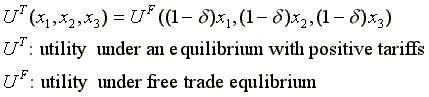
Tables 5 and 6 present the welfare costs associated with economies
1 and 2. Since the measure of welfare cost is in terms of consumption,
it provides an estimate of the percentage reduction in aggregate
consumption as a result of establishing trade blocks instead of
having a world of free trade. To illustrate, consider the welfare
costs associated with the Nash equilibrium in Table 5. The first
trading block has 0.99 percent consumption gain when its consumption
is compared with the one in free trade equilibrium. However, the
second and third trading blocks face a severe decline in their
consumption. Each of these trading blocks consumes approximately
6.5 percent less in a world of three trading blocks charging optimal
tariffs than a world of free trade.
[Tables 5 and 6 here]
Table 5 indicates that the welfare losses associated with banning bilateral agreements are quite large. Recall that banning such agreements in the case of economy 1 means that we have Nash equilibrium rather than free trade. In this case, trading block 1 gains a small amount, slightly less than 1 percent of consumption, while the other smaller trading blocks experience a loss of more than 6 percent. The losses are quite large as compared to the gains as the world welfare loss of more than 3 percent indicates. Some of the other results are interesting. Notice that in terms of world welfare losses, CU{2,3} has a higher aggregate welfare loss than NE. This suggests that the resulting tariff war between trading block 1 and the CU{2,3} causes more distortion than the tariff war when each trading block makes policy independently.
Also interesting is that the welfare losses for trade agreements between the large block and one of the small blocks ({1,2} or {1,3}) are small relative to the effect of the two smaller blocks joining forces. The intuition here is that when the two small blocks get together the resulting tariff war is between two roughly comparable size blocks. This leads to much higher tariffs and welfare losses than when a large and small block get together to oppose a small block.
The welfare losses for economy 2 (in Table 6) tend to be smaller.
Again, keeping with the previous intuition since all blocks in
this economy are close to the same size, any trade agreement results
in a tariff war between two blocks of quite different size. This
leads to smaller tariffs and lower welfare losses.
VI. Concluding Comments
We have shown that banning bilateral trade agreements can lead to more, not less protection. In the case where this is true the potential welfare losses are quite large. We also showed that bilateral agreements can lead to more protection. This occurs when trading blocks are initially approximately the same size. However, the welfare losses associated with these trade agreements tend to be small. The policy implication is that banning trade agreements is a very risky policy. Even if at the initial conditions banning agreements proved to be useful, there is no guarantee that the world will not evolve into a situation in which such bans are harmful.
Which situation actually prevails today is an empirical question. Preliminary calculations suggest that economy 1 (where banning agreements is harmful) is a plausible possibility.
The welfare calculations we performed suggest some interesting possibilities. What happens in our model economies is that when trade agreements lead to trading blocks of equal size they tend to be welfare enhancing. If they lead to blocks of unequal size then the opposite occurs. More careful work needs to be done to determine the robustness of these results.References:
Arndt, S., 1969, Customs unions and the theory of tariffs, American
Economic Review 59, 108-118.
Bhagwati J., 1995, U.S. trade policy: The infatuation with free
trade areas, in J. Bhagwati and A. O. Krueger (eds.), The dangerous
drift to preferential trade agreements, The AEI Press, Washington
D.C., 1-18.
Bhagwati, J. and A. Panagariya, 1996, Preferential trading areas
and multilateralism: strangers, friends or foes?, in Free Trade
Areas or Free Trade? The Economics of Preferential Trading Agreements
in J. Bhagwati and A. Panagariya (eds.), AEI press, forthcoming.
Bond, E. and C. Syropoulos, 1996, The size of trading blocs: Market
power and world welfare effects, Journal of International Economics,
40, 1/2, 411-437.
Cole, H.L. and M. Obstfeld, 1991, Commodity Trade and International
Risk Sharing: How much do Financial Markets Matter?, Journal of
Monetary Economics 28,3-24.
Deardorff, A. V., and R. M. Stern, 1994, Multilateral trade negotiations
and preferential trading arrangements, in A. V. Deardorff and
R. M. Stern (eds.), Analytical and Negotiating Issues in the Global
Trading System, University of Michigan Press, 27-94.
Frankel, J. A., E. Stein, and S. J. Wei, 1996, Regional trading
agreements: natural or super-natural?, American Economic Review
86, 52-56.
Gatsios, K., and L. Karp, 1991, Delegation games in customs unions,
Review of Economic Studies 58, 391-397.
Haveman, J., 1993, Some welfare effects of dynamic customs union
formation, mimeo, Purdue University.
Kennan, J., and R. Riezman, 1990, Optimal tariff equilibria with
customs unions, Canadian Journal of Economics 90, 70-83.
Kowalczyk, C. and T. Sjostrom, 1994, Bringing GATT into the core,
Economica, 61, 301-317.
Kowalczyk, C, 1990, Welfare and customs unions, NBER WP #3476.
Krueger, A. O., 1995, Free trade agreements versus customs unions,
NBER WP#5084
Krugman, P. , 1991, Is bilateralism bad?, in E. Helpman and A.
Razin, eds., International Trade and Trade Policy, Cambridge,
MIT Press
Lipsey, R. G., 1970, The theory of customs unions: A general equilibrium
analysis, Weidenfeld and Nicholson, London.
Lucas, R.E., 1987, Models of Business Cycles, Oxford, Blackwell
Markusen, J. R., and R. M. Wigle, 1989, Nash equilibrium tariffs
for the United States and Canada: The roles of country size, scale
economies, and capital mobility, Journal of Political Economy
97, 368-386.
Nordstrom, H., 1995, Customs unions, regional trading blocks and
welfare, in R. Baldwin, P. Haaparanta, and J. Kiander (eds.),
Expanding membership of the European Union, Cambridge University
Press, 54-78.
Perroni, C. and J. Whalley, 1994, The new regionalism: trade liberalization
or insurance?, NBER WP#4626
Perroni, C. and J. Whalley, 1996, How severe is global retaliation
risk under increasing regionalism?, American Economic Review 86,
57-61.
Richardson, M., 1993, Endogenous protection and trade diversion,
Journal of International Economics 34, 309-324.
Riezman, R., 1985, Customs unions and the core, Journal of International
Economics 19, 355-365.
Sampson, G. P., 1996, Compatibility of regional and multilateral
trading arrangements: reforming the WTO process, American Economic
Review 86, 88-82.
Summers, L., 1991, Regionalism and the world trading system, in
Federal Reserve Bank of Kansas City, Policy implications of trade
and currency zones., 295-301.
Summers, R., and A. Heston, 1991, The Penn World Table (Mark 5):
An Expanded Set of International Comparisons, 1950-1988, Quarterly
Journal of Economics 106, 327-368.
Viner, J., 1950, The customs union issue, Carnegie Endowment for
International Peace.
| |
|
|
| {1} {2} {3} Nash Equilibrium | |
| {1} {{2},{3}} FTA between 2 and 3 | |
| {2} {{1},{3}} FTA between 1 and 3 | |
| {3} {{1},{2}} FTA between 1 and 2 | |
| {1} {2,3} CU between 2 and 3 | |
| {2} {1,3} CU between 1 and 3 | |
| {3} {1,2,} CU between 1 and 2 | |
| {1,2,3} Free Trade | |
| |||||||||||||
| |||||||||||||
| C.3 | |||||||||||||
| 1 | 116.375 | 0 | 0 | 0 | 0.333 | 0.433 | 0.433 | 0.433 | 0.367 | -0.183 | -0.183 | ||
| 2 | 73.887 | 0 | 0 | 0 | 0.333 | 0.283 | 0.283 | 0.283 | -0.183 | 0.217 | -0.033 | ||
| 3 | 73.887 | 0 | 0 | 0 | 0.333 | 0.283 | 0.283 | 0.283 | -0.183 | -0.033 | 0.217 | ||
| 1 | 117.360 | 0 | 1.236 | 1.236 | 0.397 | 0.623 | 0.367 | 0.367 | 0.177 | -0.117 | -0.117 | ||
| 2 | 67.115 | 0.445 | 0 | 0.313 | 0.301 | 0.189 | 0.359 | 0.274 | -0.089 | 0.141 | -0.024 | ||
| 3 | 67.115 | 0.445 | 0.313 | 0 | 0.301 | 0.189 | 0.274 | 0.359 | -0.089 | -0.024 | 0.141 | ||
| 1 | 117.707 | 0 | 1.249 | 1.249 | 0.400 | 0.622 | 0.369 | 0.369 | 0.178 | -0.119 | -0.119 | ||
| FTA{2,3} {{2,3} | 2 | 67.582 | 0.249 | 0 | 0 | 0.300 | 0.189 | 0.315 | 0.315 | -0.089 | 0.185 | -0.065 | |
| 3 | 67.582 | 0.249 | 0 | 0 | 0.300 | 0.189 | 0.315 | 0.315 | -0.089 | -0.065 | 0.185 | ||
| 1 | 115.205 | 0 | 0 | 0.336 | 0.331 | 0.475 | 0.457 | 0.362 | 0.325 | -0.207 | -0.112 | ||
| 2 | 74.905 | 0 | 0 | 0.061 | 0.344 | 0.294 | 0.283 | 0.282 | -0.194 | 0.217 | -0.032 | ||
| 3 | 71.833 | 0.516 | 0.300 | 0 | 0.325 | 0.231 | 0.260 | 0.357 | -0.131 | -0.010 | 0.144 | ||
| 1 | 112.626 | 0 | 1.047 | 1.047 | 0.351 | 0.638 | 0.338 | 0.338 | 0.162 | -0.088 | -0.088 | ||
| 2 | 69.335 | 0.692 | 0 | 0 | 0.324 | 0.181 | 0.331 | 0.331 | -0.081 | 0.169 | -0.081 | ||
| 3 | 69.335 | 0.692 | 0 | 0 | 0.324 | 0.181 | 0.331 | 0.331 | -0.081 | -0.081 | 0.169 | ||
| 1 | 116.367 | 0 | 0 | 0.180 | 0.335 | 0.455 | 0.446 | 0.401 | 0.345 | -0.196 | -0.151 | ||
| 2 | 74.279 | 0 | 0 | 0.180 | 0.342 | 0.299 | 0.293 | 0.263 | -0.199 | 0.207 | -0.013 | ||
| 3 | 72.190 | 0.310 | 0.212 | 0 | 0.323 | 0.247 | 0.261 | 0.336 | -0.147 | -0.011 | 0.164 | ||
1 The utility function used is 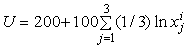
2 CU{2,1} corresponds to a customs union agreement between trading blocks 2 and 1. Trading block 2 chooses the external tariff rate of the union. 3 Trading block number. 4 International trade=endowment-consumption. | |||||||||||||
| |||||||||||||
| |||||||||||||
| C.3 | |||||||||||||
| 1 | 79.603 | 0 | 0 | 0 | 0.333 | 0.300 | 0.300 | 0.300 | 0.200 | -0.100 | -0.100 | ||
| 2 | 95.018 | 0 | 0 | 0 | 0.333 | 0.350 | 0.350 | 0.350 | -0.100 | 0.250 | -0.150 | ||
| 3 | 95.018 | 0 | 0 | 0 | 0.333 | 0.350 | 0.350 | 0.350 | -0.100 | -0.150 | 0.250 | ||
| 1 | 73.499 | 0 | 0.360 | 0.360 | 0.323 | 0.372 | 0.261 | 0.261 | 0.128 | -0.061 | -0.061 | ||
| 2 | 93.404 | 0.501 | 0 | 0.554 | 0.339 | 0.314 | 0.450 | 0.289 | -0.064 | 0.150 | -0.089 | ||
| 3 | 93.404 | 0.501 | 0.554 | 0 | 0.339 | 0.314 | 0.289 | 0.450 | -0.064 | -0.089 | 0.150 | ||
| 1 | 78.365 | 0 | 0.379 | 0.379 | 0.333 | 0.368 | 0.266 | 0.266 | 0.132 | -0.066 | -0.066 | ||
| FTA{2,3} {{2,3} | 2 | 94.791 | 0.164 | 0 | 0 | 0.334 | 0.316 | 0.367 | 0.367 | -0.066 | 0.233 | -0.306 | |
| 3 | 94.791 | 0.164 | 0 | 0 | 0.334 | 0.316 | 0.367 | 0.367 | -0.066 | -0.167 | 0.233 | ||
| 1 | 79.106 | 0 | 0 | 0.148 | 0.330 | 0.315 | 0.320 | 0.263 | 0.185 | -0.120 | -0.063 | ||
| 2 | 93.563 | 0 | 0 | 0.235 | 0.325 | 0.374 | 0.379 | 0.290 | -0.124 | 0.221 | -0.090 | ||
| 3 | 94.128 | 0.305 | 0.582 | 0 | 0.345 | 0.311 | 0.300 | 0.447 | -0.061 | -0.100 | 0.153 | ||
| 1 | 74.538 | 0 | 0.287 | 0.287 | 0.286 | 0.392 | 0.243 | 0.243 | 0.108 | -0.043 | -0.043 | ||
| 2 | 95.532 | 0.554 | 0 | 0 | 0.357 | 0.304 | 0.378 | 0.378 | -0.054 | 0.222 | -0.178 | ||
| 3 | 95.532 | 0.554 | 0 | 0 | 0.357 | 0.304 | 0.378 | 0.378 | -0.054 | -0.178 | 0.222 | ||
| 1 | 80.838 | 0 | 0 | 0.320 | 0.353 | 0.314 | 0.330 | 0.270 | 0.186 | -0.130 | -0.070 | ||
| 2 | 94.898 | 0 | 0 | 0.320 | 0.336 | 0.362 | 0.380 | 0.311 | -0.112 | 0.220 | -0.111 | ||
| 3 | 92.165 | 0.142 | 0.340 | 0 | 0.311 | 0.324 | 0.290 | 0.419 | -0.074 | -0.090 | 0.181 | ||
1 The utility function used is 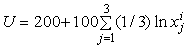
2 CU{2,1} corresponds to a customs union agreement between trading blocks 2 and 1. Trading block 2 chooses the external tariff rate of the union. 3 Trading block number. 4 International trade=endowment-consumption. | |||||||||||||
| ||
| Trading Block | Members | Size |
| 1 (Americas) | Canada, Mexico and the U.S. | 5.45E+9 |
| 2 (Europe) | France, Germany, Italy, Spain and England | 3.56E+9 |
| 3 (Asia) | China, Japan, and the South Korea | 3.56E+9 |
| 1 The data is taken from the Penn World Table 5.6 (1995), data set described in Summers and Heston (1991). | ||
| |||||
| |||||