
 ; j = 1,
2. (1)
; j = 1,
2. (1)
How would the tariff rate in a political economy respond to
changes in exogenous environment? To answer this question a bargain-theoretic
approach is adopted and a tariff-endogenous general equilibrium
model of a small open political economy is derived. A comparative
static analysis of the model shows that the bargained tariff rate
changes to compensate, at least in part, for the relative loss
of the loser arising from changes in the exogenous environment
- be it the domestic factor endowment or the international terms
of trade.
Key Words: endogenous-tariff, comparative statics, Nash-bargaining
games, CGE models and political economy.
JEL Classification: C68, C78, and F13.
Correspondence: Hom M. Pant
Centre for Regional Economic Analysis, University of Tasmania
GPO Box 252-90, Hobart, Tasmania - 7001, Australia,
Tel: 61 - (03) 6226 7696 Fax: 61 - (03) 6223 8053
e-mail: hom.pant@crea.utas.edu.au
1 October 1996
Hom Moorti Pant*
Centre for Regional Economic Analysis,
University of Tasmania, GPO Box 252C, Hobart, Tasmania - 7001, Australia.
Introduction
Imagine a small open political economy where tastes, technologies and the factor endowment are given and where the government trades tariff protection for political support and citizens trade political support for higher real income. How would the tariff rate in such a political economy respond to changes in the factor endowment or the international terms of trade? Is there any factor endowment configuration that makes the import competing sector ready to accept lower protection? Does the tariff rate rise as the price of importable falls in the world market? The answers to these questions are important in determining the general position of a country's trade negotiator towards trade liberalization. They will also help us understand whether a given country would be prepared to offer unilateral trade liberalization even without any change in the world market conditions. This paper answers these questions in the framework of a fully consistent and operational general equilibrium model of a political economy.
Tariff determination is viewed as a bargaining problem between the gainers and the losers from a tariff change and employs the generalized Nash solution to solve the bargaining problem. By doing so, we avoid the risk of analyzing the behaviour of a sub-optimal tariff rate determined at an equilibrium of a non-cooperative game. We also avoid the well-known logical problems associated with assuming that each agent is individually rational and at the same time assuming that the government (a collection of individuals) is a social welfare maximizer.
This approach allows us to combine the condition characterizing a Nash bargaining solution in the political sphere with the conditions of equilibrium in a Ricardo-Viner type model of the economic sphere to derive a set of necessary conditions of general equilibrium in a tariff-endogenous model of a political economy. The vector of endogenous variables, including the tariff rate, that emerges at the solution of this model simultaneously satisfies all conditions of equilibrium in both the spheres and therefore yields the general equilibrium of the political economy. A study of the comparative static behaviour of the tariff rate around this equilibrium point suggests that the tariff rate changes to compensate, at least partly, for the relative loss of the loser (compared to that of the other player) arising from changes in the exogenous environment. In particular, it is found that if the endowment of the factor used intensively or specific to the import competing sector increases, ceteris paribus, the equilibrium tariff rate falls. This result is not only consistent with the prediction of models with a support maximizing government, but also is consistent with the prediction of models with governments that maximize a conservative social welfare function (Corden, 1974). A straightforward corollary of this result is that if capital accumulation (or sector-specific technical progress for that matter) takes place in the import competing sector at a faster rate, then the country may opt for a unilateral trade liberalization.
The questions addressed by this study have also been examined by Magee, Brock and Young (1989). Our study, however, differs from theirs in two respects. First, we employ a Ricardo-Viner model to describe the economic sphere rather than the Heckscher-Ohlin model and second, we view the political process of tariff determination as a cooperative rather than a non-cooperative game. Such a shift in the modelling strategy is warranted because tariffs often do change within a single term of a government and the incumbent government has the power and motivation to enforce any cooperative agreements reached by the groups affected by such changes.
The rest of the paper is divided into four sections. Section two derives a rent transformation frontier on the basis of a two-good three-factor Ricardo-Viner model of the economic sphere. In section three we define a bargaining problem in the political sphere using the rent transformation frontier and derive the condition for a Nash solution to the bargaining problem which, in turn, characterizes the equilibrium in the political sphere. In section four, we first identify the disagreement payoffs with players' minimum expectation and then using the linearized conditions for equilibrium in both the spheres we derive and explain the comparative static properties of the tariff rate. Finally, the paper is summarized in section five.
In this section we describe a simplified model of the economic sphere of a small open political economy. This model (of the economic sphere) is similar to any conventional Walrasian type general equilibrium model in that government policies are treated as exogenously given.
We consider an economic sphere with two industries producing two tradeable goods using mobile and homogenous labour, and sector-specific capital stocks. Their production technologies are characterized by constant returns to scale CES functions. Good 1 is import competing and good 2 is exportable under free trade. In this economy, imported goods are considered as perfect substitutes to home goods. A single tariff rate, which subsumes all trade taxes and restrictions, imposed on the import of good 1, is the only wedge between domestic and world prices. The government transfers the tariff revenue to the household.
The endowment of factors and world prices are exogenous and in this model of the economic sphere the tariff rate (government policies) is also considered as an exogenous variable. The domestic relative price of commodities is unaffected by domestic (demand and supply) conditions of the economic sphere. Therefore, the supply side decisions are unaffected by the demand side decisions. To simplify further, we also assume that a representative consumer receives all national income (value added and tariff revenue) and spends it on the consumption of the two commodities to maximize a Cobb-Douglas utility function. Finally, we also assume that in this economy the net inflow of capital is zero, which forces the trade account, in equilibrium, to balance at foreign prices.
(a) The Goods Market:
The supply functions of domestic production sectors:
; j = 1,
2. (1)
Consumer demand functions:
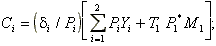 i = 1, 2. (2)
Equilibrium in the market of good 1.
 . (3)
. (3)
(b) The Foreign Exchange Market:
Trade balance constraint:
 (4)
(4)
(c) The Labour Market:
Sectoral labour demand:
 (5)
(5)
Labour market equilibrium:
 (6)
(6)
Domestic price determination:
 (7a)
(7a)
 . (7b)
Virtual rental rates:
 (8)
(8)
Total number of equations = 13. Total number of variables = 20 of which 7 are exogenous.
Under the above assumptions, we derived a set of conditions for
the optimal behaviour of price-taking producers and consumers
in the economic sphere. These conditions were then solved to derive
demand, supply and rental functions at given commodity prices,
wage rate and factor endowment. These functions together with
instantaneous market clearing conditions define a Walrasian system,
which is listed in Table 1, of 13 equations in 20 variables. The
variables used in Table 1 are defined as follows: Yi,
Ci, Mi, Pi, and  are respectively sectoral output, domestic demand, net import,
domestic and world price of commodity i (i= 1,2); Lj,
Kj and Rj represent employment of
labour; stock of sector-specific capital and rental rates of capital
in industry j (j=1,2) respectively; L is the total stock of labour
in the economy, W is the wage rate; T1 is the
tariff rate on good 1 and
are respectively sectoral output, domestic demand, net import,
domestic and world price of commodity i (i= 1,2); Lj,
Kj and Rj represent employment of
labour; stock of sector-specific capital and rental rates of capital
in industry j (j=1,2) respectively; L is the total stock of labour
in the economy, W is the wage rate; T1 is the
tariff rate on good 1 and  is the exchange
rate.
is the exchange
rate.
This model contains eight parameters, of which 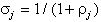 represents the elasticity of factor substitution,
  and
and  are share parameters of the CES
production function in sector j that sum to unity and
are share parameters of the CES
production function in sector j that sum to unity and  is the share of commodity j in the budget of the representative
consumer.
is the share of commodity j in the budget of the representative
consumer.
The system of equations given in Table 1 can be read as follows: Equations (5) and (6) describe a simple labour market. Equation (5) gives the demand for labour resulting from the cost minimizing behaviour of the production sectors at given commodity prices and the factor endowment; and equation (6) requires that the labour market clear for a given supply of labour. The wage rate adjusts to clear the labour market, and sectoral employment of labour is then determined by (5). Equation (1) then yields sectoral output supply at these prices, and equation (2) yields domestic consumption of the two commodities that maximize a household utility function. Equations (3) and (4) yield quantities of net imports of the two commodities, which are two of the three market-clearing conditions - two for commodities and one for foreign exchange. Invoking Walras law, the market clearing condition for commodity 2 has been omitted. Equation (8) yields the rental rates at which existing stocks of sector-specific capital are optimal to produce output levels determined by equation (1).
Besides taking the endowment variables, world prices and the
tariff rate as given, this system is closed by using the homogeneity
property of the demand and supply functions (1), (2), and (5),
and choosing commodity 2 as the numeraire (and setting its price
equal to unity in all markets). Thus the seven exogenous variables
of the model are: sector-specific capital stocks, Kj,
economy wide stock of labour, L, world prices,  ,
domestic price of the numeraire commodity P2,
and the tariff rate T. This closure sets number of endogenous
variables to 13 which is just equal the number of the equations
describing the economic sphere as listed in Table 1. As a result
of price normalization, the exchange rate remains fixed at unity
by (7b) and in what follows we have omitted the exchange rate
variable and equation (7b) from the discussion. It must be noted
that the normalization has no consequence in determining the "real"
quantities of the model as far as the behavioural equations satisfy
the homogeneity condition.
,
domestic price of the numeraire commodity P2,
and the tariff rate T. This closure sets number of endogenous
variables to 13 which is just equal the number of the equations
describing the economic sphere as listed in Table 1. As a result
of price normalization, the exchange rate remains fixed at unity
by (7b) and in what follows we have omitted the exchange rate
variable and equation (7b) from the discussion. It must be noted
that the normalization has no consequence in determining the "real"
quantities of the model as far as the behavioural equations satisfy
the homogeneity condition.
The rent transformation function
Definition 1 (RTF) The locus of the combinations of equilibrium rental incomes (or rates) in units of own output corresponding to each tariff rate (or domestic relative price), while all other exogenous variables are held fixed, is defined as the Rent Transformation Frontier (RTF). A function that describes the locus is the Rent Transformation Function.
By eliminating the wage rate variable from the two sectoral-rental functions given by equation (8) the rent transformation function can be expressed as
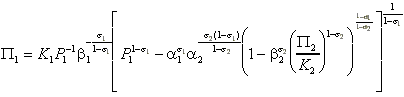 (9)
(9)
where, for each i= 1, 2  (10)
(10)
is the normalized (in units of own output) profit or rental income
to the owner of the specific factor employed in sector i.
This idea of rent transformation frontier is a general equilibrium
analogue of the Gardnerís idea of the surplus transformation
frontier (Gardner, 1983; 1987).
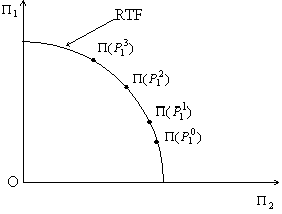
Figure 1: Price movements along the RTF
The graph of equation (9) can be plotted with the help of equations
(5)-(8) and (10). For each tariff rate a unique set of domestic
prices is determined by equation (7) and the wage rate can then
be determined by equations (5) and (6). Using these prices and
the wage rate a unique combination of real rental incomes can
be determined by equations (8) and (10). Thus, we can always find
a unique combination of real rental income,  ,
for each tariff rate at the equilibrium of the economic sphere.
,
for each tariff rate at the equilibrium of the economic sphere.
It has been shown in the appendix that  ,
and that a sufficient condition for
,
and that a sufficient condition for  is
is  for each i = 1, 2. In this
study we consider only those production functions satisfying the
restriction
for each i = 1, 2. In this
study we consider only those production functions satisfying the
restriction  . So, the rent transformation
frontier certainly slopes downward to the right and is concave
to the origin in the rental-plane as illustrated in Figure 1.
. So, the rent transformation
frontier certainly slopes downward to the right and is concave
to the origin in the rental-plane as illustrated in Figure 1.
The rent transformation frontier (or function) is a useful device to see how a change in domestic relative price effects a transfer of rents, in equilibrium, between the owners of capital in the two sectors. It shows a well known result that as the relative price of the import-competing good increases, the real rental income in sector 1 (the import-competing sector) increases and the real rental income in sector 2 falls (see, for example, Jones, 1971; Mussa, 1974, Neary, 1978).
It is easy to see that any change in the tariff rate or in the international relative price causes a movement along the rent transformation frontier CD and a change in the endowment of factors in the economy brings about a shift in the RTF. An increase in the stock of sector-specific capital shifts the point D rightward or the point C upward, as the case may be, of the RTF. An increase in the stock of the mobile factor shifts the whole frontier outside, the extent of tilt depending on the relative labour intensities of the two sectors.
This study assumes that any tariff change proposal causes the political sphere to divide itself into four segments. The first segment consists of people who expect to receive higher real income and the second segment consists of people who expect to lose out from the proposed change. The third group consists of people who are unsure of its effects and the fourth group is the government who is responsible for implementing the change and wants to make something "good" out of it. Leaving the government aside, the remaining three groups are identified by their factor ownership in the following way.
The owners of the specific-factors are assumed to maximize their real rental income net of any lobbying (policy-seeking) costs. As the rent transformation frontier shows, the owners of the sector-specific factors have divergent interests with respect to changes in the tariff rate. One of them expects to gain and the other expects to lose from a change in the tariff rate. They will lobby the government accordingly.
We further assume that the owners of the mobile factor are large in number, have sufficiently high organisational and informational cost, suffer from free rider problem, and therefore, are rationally ignorant of the possible impacts of a small change in the government's policies. This situation deters them from behaving strategically by themselves vis a vis the government and other factor owners. Their individual political behaviour, however, is influenced by the lobbying activities (political education) of other strategic agents, namely owners of the sector specific-factors.
Following previous studies (for example, Peltzman, 1976; Hillman, 1982; Cassing and Hillman, 1986; Magee, Brock and Young, 1989; Long and Vousden, 1991), we assume that the government is a political support maximizer. The government and owners of specific-factors are assumed to be organised and fully informed of the political responses of the non-strategic agents to the lobbying efforts and the responses of the economic sphere to policy changes.
Under the above assumptions, the variation in the political support to the government depends on the lobbying behaviour of the specific factor owners. Rental incomes of the specific-factor owners depend on the government's choice of the tariff rate. Thus, we have a gaming situation among the owners of the two specific-factors, and the government. What a player obtains at the end depends not only on his actions but also on the actions of the rest of the players. The government will choose the tariff rate that would maximize its political support while each of the owners of sector specific-factors would choose their lobbying efforts (political activities) to maximize their net real rental incomes. It is further assumed that the political process allows the players to communicate their threats, bluffs, proposals and counter-proposals, and finally, enter into a binding agreement if it is individually rational to do so.
It follows from the above assumptions that if the owners of specific-factors
agree on a particular tariff rate, then the best policy for the
government is to implement it. This will guarantee the maximum
support to the government and the two specific-factor owners will
receive the resulting real rental-income as their payoffs. If
there is disagreement we assume, however, that the government
behaves as a Stackelberg leader vis-a-vis the other two players.
The government announces a lobbying sensitive policy (tariff)
function to extract maximum political support for it. The other
two players behave as Nash players against each other taking the
government's policy function as given. The tariff rate that emerges
at the Nash equilibrium of the noncooperative game will be implemented.
The owners of the specific-factors will receive the resulting
rents less the lobbying expenditures as their payoffs.

Figure 2: A Bargaining problem in the tariff game
To illustrate the point, let us consider Figure 2, where the
curve CD represents the rent transformation frontier (RTF). Suppose
that the parties could not agree on any tariff rate, and chose
to play a noncooperative game. Suppose further that a unique noncooperative
Nash equilibrium is obtained at E with lobbying expenditures  and
and  units of respective outputs which
yields a domestic price ratio of P1. Then the sectoral
payoffs, which are rental incomes net of lobbying expenditures,
are
units of respective outputs which
yields a domestic price ratio of P1. Then the sectoral
payoffs, which are rental incomes net of lobbying expenditures,
are  and
and  for
player 1 and player 2 respectively.
for
player 1 and player 2 respectively.
However, had the two players been able to negotiate and agree on the same price P1, and had agreed on not to participate in competitive lobbying, both would have received payoffs represented by the corresponding point R at the frontier. This point represents a combination of higher payoffs than that corresponds to the point E.
Thus, given that some interior point such as E would be the outcome of disagreement, the shaded area EFG represents the set of feasible payoffs in cooperation. The arc FG represents the set of feasible and Pareto efficient payoffs to the two players. The set of feasible outcomes in cooperation that dominate noncooperative outcome(s) is non empty, so long as each noncooperative equilibrium implies positive lobbying by at least one player. Therefore, there is always an incentive to the players to be involved in a bargaining process and search for a mutually acceptable tariff rate.
There are three reasons to believe that all agreements reached in a tariff game will be enforceable. First, playing a noncooperative Nash equilibrium strategy is always a credible threat that can be issued by any player against the other player. This credibility works as a deterrent against possible deviant behaviour of either player. Second, as Subik (1982) argued, constitutional arrangements and the presence of government as the enforcing agency makes players almost incapable of deviating from any agreement. Moreover, if the government is a support maximizer, as we have assumed, then it will also have an incentive to implement such cooperative agreements. Third, the tariff game can be viewed as a periodic game. It is played repeatedly. Cooperative outcomes of repeated games are, in general, self-enforcing (Fudenberg and Maskin, 1986; Friedman, 1986). That is, cooperation can yield better outcomes and cooperative strategies in the Tariff game are enforceable. Thus, a bargain-theoretic approach appears to be a natural way to study the tariff (policy) formation process in the political sphere of a political economy.
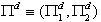
Definition 2 (Bargaining Set). For given disagreement
payoffs 
 , let
, let

 ,
,
then  is a collection of all feasible
payoff combinations that are individually rational to both players.
is a collection of all feasible
payoff combinations that are individually rational to both players.
 is defined as the bargaining set over
which the players in the tariff game may bargain. It is not difficult
to see that the bargaining set
is defined as the bargaining set over
which the players in the tariff game may bargain. It is not difficult
to see that the bargaining set  is compact
and convex. The pair
is compact
and convex. The pair  defines a bargaining
problem in a tariff-setting game. Under these conditions, whether
the disagreement payoffs are assumed to be predetermined or not
(variable), the bargaining problem
defines a bargaining
problem in a tariff-setting game. Under these conditions, whether
the disagreement payoffs are assumed to be predetermined or not
(variable), the bargaining problem  admits
a unique Nash solution (Nash, 1950, 1953 and Harsanyi, 1963).
admits
a unique Nash solution (Nash, 1950, 1953 and Harsanyi, 1963).
Nash's original solution to a bargaining problem, however, was based on the contention that all significant differences between the players are captured by the differences in the bargaining set and the disagreement payoffs. Subsequent authors have shown several sources of asymmetry on the bargaining powers of the players that are not accounted for by the bargaining set and the disagreement point - the constituents of a mathematical description of a bargaining problem. For example, Kalai (1977) has shown that if an n-person symmetric bargaining game is played by two coalitions of size p and q with p+q=n such that within each coalition players have identical utility functions, then a non-symmetric Nash solution may arise even if the n-person game yields a symmetric Nash solution. In this case the source of apparent ëbargaining powerí of the coalition is its membership. This was not envisaged by Nash. Similarly, the other sources of asymmetry are: players having different degrees of risk aversion (Roth, 1979), difference in the time preference rate (Rubinstein, 1982), different probability attached to the risk of breakdown of the negotiation (Binmore, Rubinstein, and Wolinsky, 1986), bargaining skill (Ohyama, 1989) and players possessing imperfect knowledge about each other (Harsanyi and Selton, 1972). In particular, these studies contend that players may well be endowed with uneven bargaining powers or weights and so the original Nash solution is not general.
A generalized Nash solution to a bargaining problem was
obtained by Roth (1979), who allowed players to differ in their
relative bargaining power for whatever the reasons. In solving
the bargaining problem in the tariff game we follow Roth (1979)
and define the bargaining problem by  where
where  is the vector of normalized bargaining
powers. As Roth (1979) showed the generalized Nash solution to
the bargaining problem
is the vector of normalized bargaining
powers. As Roth (1979) showed the generalized Nash solution to
the bargaining problem  is the solution
to the following maximization problem:
is the solution
to the following maximization problem:
 (11)
(11)
subject to  . (12)
Since the bargaining set  is compact
and convex, and the maximand (the generalized Nash product) is
concave over the bargaining set
is compact
and convex, and the maximand (the generalized Nash product) is
concave over the bargaining set  , the
necessary condition also becomes the sufficient condition for
a unique generalized Nash solution to the bargaining problem.
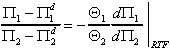
This condition can be written as
, the
necessary condition also becomes the sufficient condition for
a unique generalized Nash solution to the bargaining problem.
This condition can be written as
 . (13)
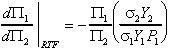
It can be deduced from the system of equations given in Table-1 (see Appendix 1) that
 , (14a)
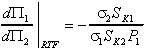
which can also be expressed as
 (14b)
(14b)
where  is the distributive share of capital
in the output of sector i. substituting the expression
for the slope of the RTF from equation (14a) into the equilibrium
condition (13) we get
is the distributive share of capital
in the output of sector i. substituting the expression
for the slope of the RTF from equation (14a) into the equilibrium
condition (13) we get
 (15)
(15)
Alternately, equation (15) may also be written as
 . (16)
The condition (16) can be explained as follows. Since  is a strictly increasing function of
  and
and  is a strictly decreasing function
of
is a strictly decreasing function
of  , the left-hand side of equation (16)
is a strictly increasing function of
, the left-hand side of equation (16)
is a strictly increasing function of  for given a value of
  . We know that
  is nonincreasing and
  is nondecreasing
(constant in the Cobb-Douglas case) in
is nondecreasing
(constant in the Cobb-Douglas case) in  ;
for a given distribution of bargaining power, the right-hand side
of equation (16) is a strictly decreasing function of
;
for a given distribution of bargaining power, the right-hand side
of equation (16) is a strictly decreasing function of  .
Thus, a unique domestic relative price satisfies the necessary
and sufficient condition for the solution to the bargaining problem.
The existence problem is solved, however, by the compact and convex
nature of the bargaining set and concavity of the maximand - generalized
Nash product.
.
Thus, a unique domestic relative price satisfies the necessary
and sufficient condition for the solution to the bargaining problem.
The existence problem is solved, however, by the compact and convex
nature of the bargaining set and concavity of the maximand - generalized
Nash product.
At the solution of any Nash bargaining problem, as first shown by Aumann and Kurz (1977) and subsequently refined by Roth (1979) and Svejnar (1986) that, players' fear of ruin relative to their bargaining power are equalized. A player's fear of ruin is the inverse of the maximum probability of disagreement (ruin) per unit of additional gain which the player is prepared to tolerate, for a very small potential gain (Aumann and Kurz, 1977 and Svejnar, 1986). We will see shortly that the equilibrium condition (13) shows that this equality holds in the tariff game as well. This condition not only identifies the Nash solution to a bargaining problem but also provides an intuitive explanation of why such a solution is obtained. This condition forcefully puts forward Zuthenís (1930) explanation that during a bargaining process the player who fears most concedes. In the following discussion this condition will be used extensively.
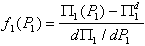
In the case of a tariff game, where the players may be viewed
as bargaining over the magnitude of the relative price of commodity
1, it can be easily seen that player 1's fear of ruin,  ,
is given by
,
is given by
 , (17a)
and player 2's fear of ruin,  , is given
by
, is given
by
 . (17b)
Intuitively, the fear of ruin is measured by the loss per unit of potential gain. The numerators in (17a) and (17b) measure the current gains over the conflict payoffs while the denominators measure potential gains from favourable unit changes in the relative price of good 1.
It follows from condition (13) and equation (17) that at the
point of Nash solution to the bargaining problem,  ,
that is, players' fears of ruin relative to their bargaining powers
are equalized.
,
that is, players' fears of ruin relative to their bargaining powers
are equalized.
Any shock that disturbs this equality places the system out of
equilibrium and makes either one of the players more fearful of
ruin. One who fears the most concedes during the following bargaining
process and the political process will again be in equilibrium.
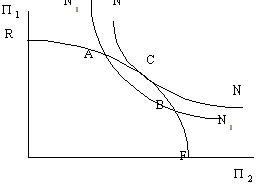
Figure 3: Stability of the Nash Solution
This process is illustrated with the help of Figure 3. In this
figure a level curve, labelled NN, of the generalized Nash product
is tangent to the curve RF, representing the boundary of the bargaining
set  , at point C. Let P1 be
the domestic price ratio and
, at point C. Let P1 be
the domestic price ratio and  be the payoff
combination at the point C. We know that at point C the generalized
fear-of-ruins are equalized across the players. Suppose that,
for some reason, the equilibrium is disturbed and the political
economy is at the point B. Given the values of the exogenous variables,
the relative price should rise and the economy should move to
point C if the Nash solution at point C is a stable one.
be the payoff
combination at the point C. We know that at point C the generalized
fear-of-ruins are equalized across the players. Suppose that,
for some reason, the equilibrium is disturbed and the political
economy is at the point B. Given the values of the exogenous variables,
the relative price should rise and the economy should move to
point C if the Nash solution at point C is a stable one.
At point B the generalized Nash product is not maximized. Obviously,
B is not an equilibrium point. The two players will start bargaining
over the domestic relative price (tariff rate). Player 1 would
like the price to rise and player 2 would not like the
price to rise. Since the absolute slope of the RTF is greater
than that of the Nash product curve, it can be easily inferred
from equations (13) and (17) that  holds
at B. This means that player 2 will concede during the bargaining
process and the domestic relative price will rise. The process
will continue until the point C is reached. Here both players
are equally fearful, relative to their bargaining power, of each
other quitting the negotiation. Similarly, it can be seen that
if the economy moves to a point like A, then player 1's fear of
ruin will exceed player 2's fear of ruin. Player 1 will concede
and the price will fall.
holds
at B. This means that player 2 will concede during the bargaining
process and the domestic relative price will rise. The process
will continue until the point C is reached. Here both players
are equally fearful, relative to their bargaining power, of each
other quitting the negotiation. Similarly, it can be seen that
if the economy moves to a point like A, then player 1's fear of
ruin will exceed player 2's fear of ruin. Player 1 will concede
and the price will fall.
Thus, equation (15) describes an equilibrating mechanism in the political sphere and the RTF provides the interface between the economic and the political spheres. Therefore, equation (15) together with the conditions of general equilibrium of the economic sphere yields the conditions of general equilibrium of the political economy. The system of equations (1) - (8), (10) and (15) describe a general equilibrium of the political economy. It contains 3 more equations and three more variables than the system listed in Table 1. These additional variables are: the tariff rate and real-rental incomes of the two owners of sector-specefic capital stocks. For given values of exogenous variables and model parameters, the system, in principle, can now be solved for the 16 endogenous variables. The solution vector of endogenous variables describes the general equilibrium of the political economy. The tariff rate that emerges at this equilibrium is defined as the bargained tariff rate.
This system demands, naturally, more information than by a conventional
policy-exogenous CGE model. The extra information required are
on the distribution of the playersí bargaining powers and
on disagreement payoffs,  . This paper
assumes that the distribution of bargaining power between the
players is exogenously given and is unaffected by small changes
in exogenous variables.
. This paper
assumes that the distribution of bargaining power between the
players is exogenously given and is unaffected by small changes
in exogenous variables.
In this section we first provide an operational definition of disagreement payoffs and then use it to derive comparative static response of the tariff rate by solving the linearized model of the political economy around an "observed" equilibrium point. In so doing, we use lower case to denote the percentage change of the variables written in uppercase so far except the tariff rate, for which a lower case would mean change in percentage points and the uppercase would continue to represent the tariff rate.
Disagreement payoff is the payoff that a player will receive if they fail to reach an agreement. In most situations it simply reflects players' perception of what the disagreement payoffs would be rather than the realization of it since they may not end up in a conflict at all. A natural candidate for this is the payoffs at a noncooperative Nash equilibrium in the tariff game. There are two problems, however, that render it less attractive. First, the possibility of multiple Nash equilibria in a general setting of the game can not be dismissed a priori, and there seems no clear way of identifying which one of them will be attained if there is a disagreement. Second, even if there are reasons to believe that a unique Nash equilibrium will be attained, the government's pricing function has to be specified before any Nash equilibrium can be computed. This would further require a knowledge of the government's political support function, which is not an easy task either.
In general, the operational definition of the disagreement payoffs
in the theory of bargaining has remained unclear. It has, therefore,
been suggested as a matter of modelling judgement (Binmore, Rubinstein,
and Wolinsky, 1986). A reasonable candidate for this is the point
of minimum expectation, as suggested by Roth (1977). As Thomson
(1981) has shown, this point possesses some desirable properties
of a reference point to the players. Roth's idea of minimum expectation
can be adapted for our purpose as follows:
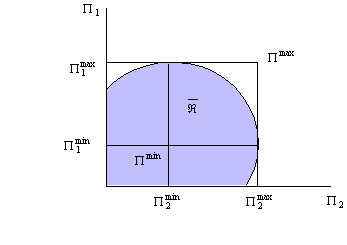
Figure 4: The point of minimum expectation
Definition 3 (minimum expectation) Let  be the set of all feasible payoff combinations. For each player
i, let
be the set of all feasible payoff combinations. For each player
i, let
 and
and 
Then the payoff combination  is a combination
of the minimum expectations of the players and the payoff combination
is a combination
of the minimum expectations of the players and the payoff combination
 , which is also called the ideal point,
is a combination of the aspiration levels of the players (see
figure 4).
, which is also called the ideal point,
is a combination of the aspiration levels of the players (see
figure 4).
One attractive feature of the point of minimum expectation is
that it represents the payoff to each player when the bargaining
opponent has been able to obtain the best possible outcome for
herself, say by forming a coalition with the government or by
pre-emptive lobbying. The payoff combination  therefore represents the worst outcome for each player. No rational
player will choose a strategy that yields his opponent a payoff
less than that corresponding to
therefore represents the worst outcome for each player. No rational
player will choose a strategy that yields his opponent a payoff
less than that corresponding to  because
such strategy would bring no benefit, possibly would lead to a
reduction, in his own payoff. In other words, for each player,
the payoff combination
because
such strategy would bring no benefit, possibly would lead to a
reduction, in his own payoff. In other words, for each player,
the payoff combination  corresponds to
the opponent's dictatorial solution.
corresponds to
the opponent's dictatorial solution.
Roth (1977) has shown that the Nash solution to the class of
bargaining problems in which the disagreement payoff is given
by  satisfies all the axioms as satisfied
by the original Nash solution. The only difference between the
two is that Nash's solution is independent of irrelevant alternatives
(axiom of independence) other than the disagreement point, whereas
the new solution will be independent of irrelevant alternatives
other than the point of minimum expectation.
satisfies all the axioms as satisfied
by the original Nash solution. The only difference between the
two is that Nash's solution is independent of irrelevant alternatives
(axiom of independence) other than the disagreement point, whereas
the new solution will be independent of irrelevant alternatives
other than the point of minimum expectation.
To define the minimum expectation of players in the Tariff game we allow for the possibilities that any one of the players may form a "coalition" with the government. The government then choses a policy that best suits the winning player and balances its budget, if necessary, by taxing the losing player and other nonstrategic agents in the political economy. Given these possibilities, the worst outcome to the losing player would be that he has to surrender all of his rental income to finance the government's budget deficit. This, in turn, implies that the payoff at the minimum expectation of each player is zero.
Though it is very restrictive, the identification of  with
with  is interesting for three reasons.
First, it greatly simplifies the model so that analytical results
are possible. It can be used to illustrate the mechanism of endogenous
determination of the tariff rate. Second, it corresponds to a
potentially dictatorial type of government. The results,
therefore, will show the behaviour of bargained tariff rates under
a particular political environment where the government can be
captured by one of the bargaining party if no agreement is reached
during the bargaining process. Third, more interestingly,
is interesting for three reasons.
First, it greatly simplifies the model so that analytical results
are possible. It can be used to illustrate the mechanism of endogenous
determination of the tariff rate. Second, it corresponds to a
potentially dictatorial type of government. The results,
therefore, will show the behaviour of bargained tariff rates under
a particular political environment where the government can be
captured by one of the bargaining party if no agreement is reached
during the bargaining process. Third, more interestingly,  corresponds to Brock, Magee, and Young's economic black hole
and could be considered as the worst possible noncooperative Nash
equilibrium outcome in the tariff game.
corresponds to Brock, Magee, and Young's economic black hole
and could be considered as the worst possible noncooperative Nash
equilibrium outcome in the tariff game.
Substituting  into equation (15) and
solving for
into equation (15) and
solving for  we obtain
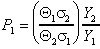 . (18)
Linearizing equation (18) around the ëobservedí general equilibrium point we obtain
 (19)
(19)
At unchanged bargaining powers, whatever they may be, equation (19) reduces to
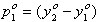 . (20)
Equation (20) shows that if some exogenous shock led the outputs of the two sectors to grow at different rates, then the relative price of the commodity growing at a faster rate will fall. To get a more precise meaning out of equation (20), we linearize the rest of the equations listed in Table 1 and obtain the linearized version of the policy endogenous general equilibrium model (PEGEM) that is listed in Table 2. We have omitted four equations - namely, equations (10), (2), (3), and (4) - which are of no consequence to the following analysis. Note that the equations (21) - (25) are the linearized versions of the equations (1), (5), (6), (7) and (8) respectively. As a notational convention, superscript ìoî indicates that the shares or the variable has been defined around the observed (base year) equilibrium point.
The system of equations listed in Table 2 contains 9 equations
in 9 endogenous variables, including the tariff rate. The system
can be solved and the elasticity formulae can be obtained for
each of the endogenous variables with respect to each of the exogenous
variables.
The Economic Sphere:
Output supply functions:
 (21)
(21)
Labour demand functions:
 (22)
(22)
The labour market equilibrium condition:
 (23)
(23)
Price equations:
 (24a)
(24a)
and,  . (24b)
Sectoral rental rates:
 . (25)
The Political Sphere:
Condition for Nash bargaining equilibrium:
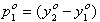 . (20')
First we solve equations (22) and (23) for changes in the wage rate, and then we use it in equation (21) to solve for the response of sectoral outputs to changes in factor endowment variables and the domestic relative price. These results are then used in (20') to obtain

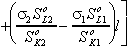 ; (26)
where  .
.
Recalling that the wedge between the domestic relative price and the world relative price is the tariff rate (see equation (24a) in Table 2) it further follows from equation (26) that

 . (27)
Some interesting results follow from equation (27). Before we
discuss those results, recall the definitions of some of the variables
and parameters involved in these results. First, 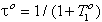 ,
where T1 is the tariff rate and
,
where T1 is the tariff rate and  is the change in the percentage point (not the percentage change
in the tariff rate) of the tariff rate. If we exclude the possibility
of subsidizing imports or taxing exports at rates greater than
100% as practically implausible, then
is the change in the percentage point (not the percentage change
in the tariff rate) of the tariff rate. If we exclude the possibility
of subsidizing imports or taxing exports at rates greater than
100% as practically implausible, then  is always positive. Furthermore, the share parameters
  and
and  are always positive. The elasticities
of factor substitution
are always positive. The elasticities
of factor substitution  and
and  are also positive.
By setting any three of the four exogenous variables -  and
and  , equal to zero in turn we can obtain
the direction of comparative static responses of the tariff rate
as follows:
, equal to zero in turn we can obtain
the direction of comparative static responses of the tariff rate
as follows:
 (28)
(28)
 (29)
(29)
 (30)
(30)
and
 . (31)
These results can be summarized as follows. For small changes, other things remaining the same:
Result 1 Any change in the relative price of the import competing good in the world market is exactly compensated by domestic tariff changes leaving the domestic relative price unchanged;
Result 2 If a sector experiences an exogenous increase in the stock of its specific factor, then the rate of protection awarded to this (growing) sector will decline and the rate of protection awarded to the other sector will rise;
Result 3 An exogenous increase in the supply of the mobile factor (labour) in the economy may lead to a fall or a rise in the rate of protection awarded to a sector depending on the relative ease of factor substitution and factor intensity between the two sectors.
Result 1 states that the domestic economy will be fully insulated against terms of trade shocks by compensatory tariff adjustments. No reallocation of resources will take place. Why do we get this result?
To illustrate, suppose that  represent
the distribution of rents at free trade, and
represent
the distribution of rents at free trade, and  represent the payoffs at the initial Nash bargaining equilibrium.
So at
represent the payoffs at the initial Nash bargaining equilibrium.
So at  players' generalized fears of ruin
are equal. Suppose further that, other things the same, the price
of the home exportable good rises in the world market. Let the
new world relative price of the import competing good be
players' generalized fears of ruin
are equal. Suppose further that, other things the same, the price
of the home exportable good rises in the world market. Let the
new world relative price of the import competing good be  such that
  .
.
At an unchanged tariff rate the relative price of the import
competing good in the domestic market will fall at the same proportional
rate as it did in the world market. Let the new domestic relative
price be  . A conventional policy-exogenous
general equilibrium model would, in this case, predict that the
rental income of the import competing sector will fall and that
of the exporting sector will rise. Thus, the players will slide
from the point
. A conventional policy-exogenous
general equilibrium model would, in this case, predict that the
rental income of the import competing sector will fall and that
of the exporting sector will rise. Thus, the players will slide
from the point  to the point
  along the RTF (see Figure 5). As a result, relative to the reference
point (origin), the gain of player 1 declines and that of player
2 increases.
along the RTF (see Figure 5). As a result, relative to the reference
point (origin), the gain of player 1 declines and that of player
2 increases.
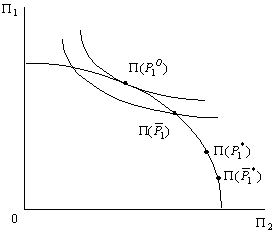
Figure 5: Terms of trade gain and the tariff rate
Since each player's fear of ruin (disagreement) depends directly
on the size of the gain relative to his minimum expectation, it
follows that at  player 2 will be more
fearful of player 1 declaring disagreement than player 1 fears
of player 2 declaring disagreement. This inequality causes disequilibrium
in the political market. To restore equality in players' generalized
fear of ruin player 2's payoff has to be reduced and/or that of
player 1 has to be raised by tariff changes. Therefore, in the
new sequence of bargaining process, prompted by the world price
change, player 2 will ultimately concede, and the tariff rate
will rise in the new equilibrium. The new tariff rate will be
such that the induced domestic relative price remains unaffected.
This is so because the RTF and the level curves of the generalized
Nash product are unaffected by changes in the international terms
of trade, and therefore, the equilibrium point will also remain
unaffected.
player 2 will be more
fearful of player 1 declaring disagreement than player 1 fears
of player 2 declaring disagreement. This inequality causes disequilibrium
in the political market. To restore equality in players' generalized
fear of ruin player 2's payoff has to be reduced and/or that of
player 1 has to be raised by tariff changes. Therefore, in the
new sequence of bargaining process, prompted by the world price
change, player 2 will ultimately concede, and the tariff rate
will rise in the new equilibrium. The new tariff rate will be
such that the induced domestic relative price remains unaffected.
This is so because the RTF and the level curves of the generalized
Nash product are unaffected by changes in the international terms
of trade, and therefore, the equilibrium point will also remain
unaffected.
Result 2 The following explanation can be given to the result that an exogenous increase in the stock of the specific factor in the import competing sector would lead to a fall in the tariff rate and/or a rise in the export subsidy. The remaining part of Result 2 (ie., the effect of an increase in the stock of the specific factor in the exporting sector) and Result 3, (ie., the effect of an increased supply of the mobile factor) can be explained in a similar way.
To simplify the diagrammatic exposition, we have assumed in Figure
6 that production functions are Cobb-Douglas in both sectors.
Suppose that E0 is the initial equilibrium of the tariff
game. Suppose further that the capital stock in sector 1 increases
exogenously and the RTF shifts upwards to C'D. A policy-exogenous
general equilibrium model would predict that, at an unchanged
tariff rate and hence at an unchanged domestic relative price,
the output and rental income of sector 1 will increase and the
output and rental income of sector 2 will fall. Employment in
sector 2 falls as the wage rate is pushed up by increased activity
in sector 1. Let E1 describe the combination of the
rental incomes (in economic equilibrium) of the two sectors at
unchanged commodity prices.
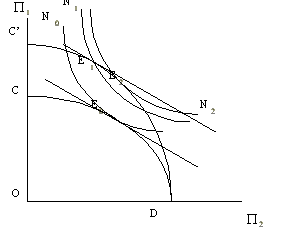
Figure 6: Capital accumulation in the import competing sector and the tariff rate
The slopes of the frontiers at E0 and at E1 should be equal because it follows from equation (14b) that with Cobb-Douglas production functions the slope of the RTF depends only on the relative price. The absolute slope of the Nash product curve at E1, however, will exceed the slope of the Nash product curve at E0 (by homotheticity, see the curve labelled N1). Therefore, the curve N1 will not be tangent to the frontier C'D at E1. The difference in the absolute values of the slopes indicates that at E1 player 1's fear of ruin will exceed player 2's fear of ruin. Therefore, in the new bargaining process, induced by the shock, player 1 will concede and the tariff rate will fall, leading to a fall in the relative price of commodity 1 in the domestic market. The new bargained equilibrium will be attained at E2 on C'D where both players are equally fearful of ruin. Employment, output and real-rental income of the exporting sector may very well increase, as shown in the Figure by point E2, as a result of capital accumulation in the import-competing sector.
This paper attempted to study the endogenous response of the tariff rate to changes in exogenous variables such as world price and domestic factor endowment. In so doing it employed a bargain-theoretic framework to derive an operational general equilibrium model of a political economy. A comparative static exercise did reveal that the tariff rate will change to fully offset the effects of terms of trade changes on domestic prices, and will fall if domestic factor endowment change leads to an increase in the relative rental income of the protected sector. The key to this result is held by changes in the relative fear of ruin. Whether be it in the world price or the domestic factor endowment, if a given exogenous change causes the rental income of the protected sector to rise relative to that of the unprotected sector, then the protected sector becomes more fearful of ruin (breakdown of agreement) and is prepared to forego some rental income rather than risk the whole gain over his minimum expectation. As a result the tariff rate will fall.
Though consistent with general intuition and some of previous studies in terms of the direction and magnitude, the insulating response of the tariff rate with respect to terms of trade changes is very strong. It should be noted, however, that the magnitudes of these results are subject to the choice of origin as the point of minimum expectation of the barganing parties. This choice made the maximand (the Nash product) to depend only on the level of current rental incomes which can easily be seen as a parallel expression to a Stigler-Peltzman type political support function and hence, the insular result. As indicated by Hillman (1982) result or Long and Vousden (1991) result, the endogenous response of the tariff rate to a terms of trade shock can be weakened by a suitable choice of the reference point. What would be the appropriate point of reference in this kind of game is a topic for future research.
The most important finding of this study is that the endognous response of the tariff rate to domestic factor endowment change is predictable. The tariff rate falls if any change in factor endowment causes the protected sector to gain relatively more than the unprotected sector at the going tariff rate. The implication of this result is that a country would be prepared for unilateral or multi-lateral tariff reduction if its import-competing sector has experienced a substantial accumulation of capital stock or has experienced a substantial growth in factor productivity or has experienced a growth in labour force if its import-competing sector is more labour-intensive. An attempt to liberalize trade without any such changes in the economic environment can be expected to meet strong opposition in the political sphere. Another obvious implication of this study is that long-term forecasts based on models that treat policy variables as exogenously given have to be treated with caution.
Appendix 1: Derivation of the First and Second Order Derivatives of the RTF
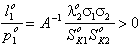
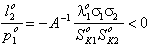
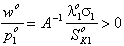
Setting  and solving equations (21) to
(25) listed in Table 2, which describe changes in the economic
sphere of the political economy, we obtain the following elasticity
formulae:
and solving equations (21) to
(25) listed in Table 2, which describe changes in the economic
sphere of the political economy, we obtain the following elasticity
formulae:
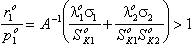 , (A1)
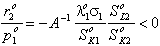 , (A2)
 , (A3)
 , (A4)
 , (A5)
 (A6)
(A6)
 (A7)
(A7)
and 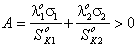 . (A8)
Where, all the lower case roman letters are percentage changes
of the corresponding variables written in upper case.  represents percentage change in the distributive share of labour,
 , in industry j around the observed
equilibrium whereas
, in industry j around the observed
equilibrium whereas  represents the share
(not its percentage change) of industry j in total employment
of labour and
represents the share
(not its percentage change) of industry j in total employment
of labour and  represents elasticity of
factor substitution in sector j.
represents elasticity of
factor substitution in sector j.
We will use these elasticity results to derive the slope and curvature properties of the RTF.
A change in the rental income can arise only if the domestic relative price changes, since other exogenous variables are held fixed. We, therefore, have
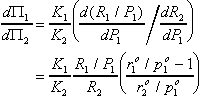 (A9)
(A9)
Using (A1) and (A2) in (A9) we obtain
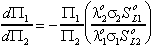 < 0 (A10)
Which can also be written as
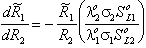 . (A11)
where,  .
.
Differentiating both sides of (A11) with respect to R2 yields, on further simplification,
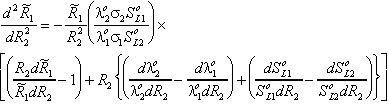 (A12)
(A12)
Using equation (A11), equation (A12) can be re-written as
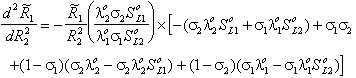 (A13)
(A13)
Upon a further simplification of equation (A13), using the adding up properties of the distributive and employment shares, we get
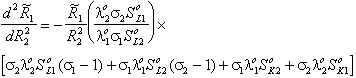 (A14)
(A14)
Thus, it is clear from the right hand side of equation (A14) that
 for each i is sufficient for
  .
In other words, this means a sufficient condition for
.
In other words, this means a sufficient condition for  is
is  for each i.
References
Aumann, Robert J. and M. Kurz, 1977, Power and Taxes, Econometrica 45, 1137-1161.
Baldwin, Richard, 1987, Politically Realistic Objective Functions and Trade Policy, Economics Letters 24, 282-290.
Binmore, K., 1987, Perfect Equilibria in Bargaining Models, in: K. Binmore and P. Dasgupta, eds., The Economics of Bargaining, (Basil Blackwell) 77-105.
Binmore, Ken, Ariel Rubinstein and Asher Wolinsky, 1986, The Nash Bargaining Solution in Economic Modelling, Rand Journal of Economics 17, 176-188.
Carlson, Hans, 1991, A Bargaining Model Where Parties Make Errors, Econometrica 59, 1487-1496.
Chun, Youngsub, 1988, Nash Solutions and Timing of Bargaining, Economics Letters 28, 27-31.
Chun, Youngsub and William Thomson, 1990, Nash Solution and Uncertain Disagreement Points, Games and Economic Behaviour 2, 213-223.
Coggins, Jay Steven, 1989, On the Existence and Optimality of Equilibria in Lobbying Economies, Unpublished PhD Thesis, University of Minnesota.
Coggins, Jay S., Theodore Graham-Tomasi and Terry Roe, 1991, Existence of Equilibrium in a Lobbying Economy, International Economic Review 32, 533-550.
Corden, W. M., 1974, Trade Policy and Economic Welfare, (Oxford University Press, Oxford).
Feenstra, Robert and Jagdish Bhagwati, 1982, Tariff-seeking and the Efficient Tariff, in: J. Bhagwati, ed., Import Competition and Response, (University of Chicago Press, Chicago) 245-58.
Findlay, R. and S Wellisz 1982, Endogenous Tariffs, The Political Economy of Trade Restrictions and Welfare, in: J. N. Bhagwati, ed., Import Competition and Response, (University of Chicago Press, Chicago) 223-34.
Findlay, Ronald and Stanislaw Wellisz, 1983, Some Aspects of the Political Economy of Trade Restrictions, Kyklos 36, 469-81.
Findlay, Ronald and Stanislaw Wellisz, 1984, Toward a Model of Endogenous Rent-Seeking, in: D. C. Colander, ed., Neoclassical Political Economy: The Analysis of Rent-Seeking and DUP Activities, (Ballinger Publishing Company, Cambridge) 89-100.
Friedman, James W., 1986, Game Theory with Applications to Economics, (Oxford University Press, Oxford).
Fudenberg, Drew and Eric Maskin, 1986, The Folk Theorem in a Repeated Games with Discounting and Incomplete Information, Econometrica 54, 533-555.
Gardner, B. L., 1983, Efficient Redistributions through Commodity Markets, American Journal of Agricultural Economics 65, 225-34.
Gardner, B. L., 1987, The Economics of Agricultural Policies, (Macmillan, New York).
Grossman, Gene M. and Elhanan Helpman, 1994, Protection for Sale, The American Economic Review 84, 833-850.
Hall, H. Keith and Douglas Nelson, 1992, Institutional Structure in the Political Economy of Protection: Legislated V. Administered Protection, Economics and Politics 4, 61-77.
Harsanyi, John C., 1963, A Simplified bargaining Model for the n-Person Cooperative Game, International Economic Review 4, 195-220.
Harsanyi, J. C. and R. Selton, 1972, A Generalized Nash Solution for Two-Person Bargaining Games with Incomplete Information, Management Science 18, 80-106.
Hillman, A. L., 1982, Declining Industries and Political-Support Protectionist Motives, American Economic Review 72, 1180-7.
Jones, R. W., 1971, A Three Factor Model in Theory, Trade, and History, in: J. N. Bhagwati and et al., eds., Trade, Balance of Payments and Growth: Papers in International Economics in Honour of Charles P. Kindleberger, (North-Holland, Amsterdam) 3-21.
Kalai, E., 1977, Nonsymmetric Nash Solutions and Replications of 2-Person Bargaining, International Journal of Game Theory 6, 129-133.
Long, Ngo Van and Neil Vousden, 1991, Protectionist Responses and Declining Industries, Journal of International Economics 30, 87-103.
Magee, Stephen P., William A. Brock and Leslie Young, 1989, Black Hole Tariffs and Endogenous Policy Theory, (Cambridge University Press, Cambridge).
Mussa, Michael, 1974, Tariffs and the Distribution of Income: The Importance of Factor Specificity, Substitutability, and Intensity in the Short and Long Run, Journal of Political Economy 82, 1191-1203.
Nash, John, 1950, The Bargaining Problem, Econometrica 18, 155-162.
Nash, John, 1953, Two-Person Cooperative Games, Econometrica 21, 128-140.
Neary, J. P., 1978, Short-Run Capital Specificity and the Pure Theory of International Trade, Economic Journal 88, 488-510.
Ng, Yew-Kwang, 1981, Bentham or Nash? On the Acceptable form of Social Welfare Function, Economic Record 57, 238-50.
Ohyama, Michiro, 1989, Bargaining with Differential Skills, KEIO Economic Studies 26, 1-4.
Pant, H. M., 1992, Tariff Determination in General equilibrium: A Bargain-theoretic Approach to Policy Modelling, Unpublished PhD Thesis, The Australian National University.
Peltzman, Sam, 1976, Toward a More General Theory of Regulation, Journal of Law and Economics 19, 211-40.
Roth, Alvin E., 1977, Independence of Irrelevant Alternatives, and Solutions to Nash's Bargaining Problem, Journal of Economic Theory 16, 247-251.
Roth, Alvin E., 1979, Axiomatic Models of Bargaining, (Springer-Verlag, Berlin).
Sen, Amartya, 1979, Personal Utilities and Public Judgements: Or What's Wrong with Welfare Economics, The Economic Journal 89, 537-58.
Stigler, George J., 1971, The Theory of Economic Regulation, Bell Journal of Economics and Management Science 2, 3-21.
Subik, Martin, 1982, Game Theory in Social Sciences, Concepts and Solutions, (The MIT Press, Cambridge).
Svejnar, Jan, 1986, Bargaining Power, Fear of Disagreement, and Wage Settlements: Theory and Evidence from U. S. Industry, Econometrica 54, 1055-1078.
Thomson, William, 1981, A Class of Solutions to Bargaining Problems, Journal of Economic Theory 25, 431-441.
van Damme, Eric, 1986, The Nash Bargaining Solution is Optimal, Journal of Economic Theory 38, 78-100.
Wellisz, Stanislaw and John Wilson, 1986, Lobbying and Tariff Formation: A Deadweight Loss Consideration, Journal of International Economics 20, 367-75.
Yaari, Menhaem E., 1981, Rawls, Edgeworth, Shapley, Nash: Theories of Redistributive Justice Re-examined, Journal of Economic Theory 24, 1-39.
Zuthen, Frederik, 1930, Problem of Monopoly and Economic Welfare, (G. Routledge, London).