 and
andOtto-von-Guericke Universität Magdeburg
Fakultät für Wirtschaftswissenchaft
Restructuring of Ukrainian Enterprises after Privatization:
Does Ownership Structure Matter?*
Discussion Paper
March 24th, 1999
|
Irina Akimova Kharkov State Polytechnic University Danilevskogo Str.17, Ap.59, Kharkov, Ukraine maria@flat.kharkov.ua |
Gerhard Schwödiauer, Otto-von-Guericke University of Magdeburg Univirsitätsplatz 2, Magdeburg 39104, Germany schwoediauer@ww.uni-magdeburg.de
|
|
|
Abstract*
For a set of data from a survey of middle-sized and large industrial enterprise in Ukraine after privatization regression equations are estimated that explain the response of restructuring and performance indicators to ownership structures, competitive pressures, and hardening budget constraints. While ownership matters less for restructuring activity than competition and budget constraints, in particular concentrated outside ownership does have a significant positive impact on the firms’ performance.
JEL Classification numbers : D21,L33,P00
___________________________________________________________
* This reseach was financially supported by INTAS grant N 952-280 and by a Research Fellowship provided
by Konferenz der Deutschen Akademien der Wissenschaften (sponsored by Volkswagen Stiftung)I. Introduction
Restructuring of large and middle-sized industrial firms after their privatization has become an important topic of economic research as documented by a growing number of theoretical and empirical studies (see e.g. Boycko et al, 1995; Shleifer and Vishny ,1994 , 1996; Earle and Estrin 1996, 1997,1998; Barberis et al 1996; Frydman et al, 1997; Claessens, Djankov and Pohl 1997; Djankov and Pohl 1997, 1998).
However, the recent empirical literature on enterprise restructuring in transition economies has been focused mainly on the role of privatization and hardening of budget constraints, pointing at liberalization and stabilization as important pre-requisites of restructuring. Most studies on East European firms showed that privatization positively influenced the restructuring process, though studies on Russian firms were less convincing in this respect (Earle et al 1996; Jones, 1997, 1998). In theoretical contributions consequences of ownership changes were analyzed differentiating typically between private ownership, inside ownership, outside ownership, and concentrated ownership. When the process of privatization is not completed there is a large group of enterprises in which the state holds a controlling stake while the rest of shares is distributed among private owners. The latter may have the blocking power rights that affect the restructuring process in the enterprise. The behavior of the firms with the state as majority owner and private parties that have a blocking power right, however, did not receive much attention in transition research.
Relatively little attention has also been paid to the effects of competition on enterprise restructuring. While there are theoretical models suggesting that competition could be a leading force of performance improvement (e.g.Blanchard et al 1990; Stiglitz 1994; Dyker and Barrow 1995), empirical tests of this hypothesis in a transitional context have been extremely limited (Earle and Woergotter 1993; Earle and Estrin 1998). Monopolization is viewed as a counterpart of competition, and its negative effect on restructuring is generally accepted. However, the changes in the monopolistic power of large enterprises at an early stage of transition under increasing international competitive pressure and their effect on enterprise restructuring have not been thoroughly investigated .
Finally, most of the studies on enterprise restructuring focused on those East European economies which, compared to Ukraine and other CIS countries, proceeded rather fast with their economic reforms. In a slowly transforming economy, however, the relative importance of the main forces driving enterprise restructuring can be different, their effects can be less pronounced and deserve special treatment. In this respect, the measurement of restructuring plays an important role. Changes in performance outcomes may be hardly visible yet as the post-privatization period available for observation is rather short. In this case, it is necessary to look at the variety of restructuring activities undertaken by the enterprises. Together with the analysis of performance indicators, this could help to create a more objective picture of the restructuring process in an economy which is still in the early stages of transition.
In this paper, the authors attempt to shed some light on the relationship between the level of enterprise restructuring on the one hand, and ownership changes, hard budget constraints, and increasing competition on the other hand, in a slowly developing economy like Ukraine. For this purpose we designed and conducted a survey of 173 middle-sized and large industrial firms in spring 1998 asking questions on restructuring steps, managers’ attitudes towards different aspects of restructuring, enterprise performance, competitive environment, budget constraints, and ownership structure.
The main goal has been to estimate quantitatively the joint impact of ownership, competition and hardening of budget constraints both on performance indicators and on an index of strategic restructuring activities. In particular, the authors want to test the hypothesis that the changes in ownership structure ensuing from privatization matter for enterprise restructuring (even if competition and budget constraint variables are simultaneously introduced) but will affect performance and activity measures differently in an early stage of transition.
The paper is structured as follows. Section II briefly describes the design and implementation of Ukrainian privatization. Section III discusses the link between restructuring and its driving forces ( namely ownership changes, hardening of budget constraint, increasing competition and marketization of the economy), and develops the hypotheses to be tested. Section IV describes the data used in the analysis. Section V presents the estimated equations and the description of the variables employed in the analysis. Section VI discusses the results, and section VII offers some conclusions.
II. Ukrainian privatization
The privatization process in Ukraine was initiated in 1992 by establishing a privatization program that aimed at a wide and fair distribution of state assets to the private sector as a means towards a more effective corporate governance. In 1992 there existed around 18,000 medium and large state owned enterprises and 45,000 state owned small enterprises in Ukraine. The small scale privatization was planned to be completed by the end of 1997 together with the privatization of 8,000 medium and large enterprises. The latter were prepared for privatization through corporatization. They were valued and converted into joint stock companies, and the State Property Fund held the shares of the enterprises under privatization.
In Ukraine, privatization was mainly implemented on the basis of a voucher scheme. Each citizen of Ukraine had the right to receive one voucher. The sale of shares in the enterprises was effected not only by vouchers, but also by payment in cash. Preferential treatment was given to workers and managers of the enterprises and also to main suppliers (mainly in the agro-industrial sector). Workers’ collectives acquired shares in their enterprises at a nominal price using their privatization certificates and by additional payments at a discount. Managers were provided with a packet of shares of their enterprises (up to 5%) either for free or at a discount. Shares not sold to the employees could be bought by Ukrainian citizens at the voucher auctions.
Foreign participation in the privatization process was limited as foreigners could not participate directly in the mass privatization and were allowed to purchase shares of enterprises only following their privatization. Foreign investors could participate in tenders. However, in practice the State Property Fund reserved only about 10% of shares for investment tender by outsiders..
Privatization in Ukraine has proceeded unevenly with relatively positive results in small-scale privatization and at a slower pace for large-scale privatization. According to the State Property Fund , about 53,705 enterprises were privatized by July 1998 (including over 7800 medium-sized and large companies ). Small-scale privatization was almost completed in 1997. Among the privatized medium-sized and large companies, 43% of enterprises were privatized completely (i.e. 100% of shares transferred to private owners) and for another 38% of companies more than 70% of their equity was transferred to private hands (Ukrainian Economic Trends, N1, 1998). Almost two-thirds of the privatized companies were transferred to private owners using non-competitive methods (buy-out and lease with buy-out). The most popular methods of privatization in industry were sales of shares in open-joint stock companies (73%) and buy-outs or lease with buy-outs (12%). In 1998, privatized companies produced over 65% of industrial output. In 1997-98 the pace of privatization slowed down due to opposition in Ukrainian parliament.
The development of the enterprise sector presently is constrained by the limited ability to attract much outside capital, weakness of financial discipline and failure in the enforcement of bankruptcy laws. The continuing deep economic crisis resulted in the decreasing profitability of the enterprises and limited ability to finance restructuring . In 1998 about 50% of Ukrainian enterprises reported to make losses. Lack of clarity and stability of the legal environment and government policy negatively influenced the flow of foreign direct investment the cumulative stock of which amounted to about US $ 2.5 billion in 1998. Ukraine’s banking sector still is at an early stage of development, it is small and undercapitalized. Credit to the private sector is scarce and loans are mainly short term. Though during the last 4 years state subsidies were considerably reduced, soft budget constraints remained. According to the EBRD estimations, by mid-1998 inter-enterprise arrears amounted to over 80% of GDP , wage arrears were 5% of GDP (excluding budgetary wage arrears), and barter trade accounted for 42% of industrial sales (EBRD Report 1998, p.196).
Unfavorable tax regulations and weakness in the enforcement of business contracts is reflected in an increase of the shadow economy estimated to range between 40% and 50% of GDP. A high degree of skepticism towards the market and uncertainty about government policy are combined with extensive corruption. In an EBRD survey of 1997, Ukraine together with four other CIS countries received the highest score for corruption among public officials. The low and uneven pace of reforms provided the basis for the EBRD categorization of Ukraine into the group of countries in a less advanced stage of transition. This means that Ukraine has not demonstrated a track record of steadfast progress in reform and „reached the level of institutional development of the degree or integration into world markets that would ensure the resilience of market reforms" (EBRD Transition Report 1997, p.22).
III. Conceptual framework
Enterprise restructuring during transition from centrally planned to market economies is defined by Pohl, Anderson Claessens and Djankov (1997) as a complex process to maintain profitability in the face of a changing economic environment, technological progress and competition from other firms. Djankov (1998) characterizes restructuring as the adjustment process that enables enterprises to reach commercial viability as proxied by a positive net cash flow. The restructuring process starts with a change of the goal of the firm (from rent-seeking to value maximization ) and the overall strategic orientation of the firm’s management (from the fulfilling of central plan requirements to customer orientation) and proceeds through the implementation of changes in basic structures of the enterprise which can be identified, following van Capelle-Konijenberg (1995), as governance structure, cost structure, organizational structure, asset structure and capital structure. Restructuring measures along cost; organization, asset and capital dimensions are, in general, interdependent. Therefore, it is better to use the classification that distinguishes between reactive (passive or defensive) and active (strategic or deep) restructuring (e.g. Carlin, van Reenen, Wolfe, 1995; Carlin and Aghion, 1996; Djankov and Pohl, 1998) .
Reactive restructuring is forced upon enterprises in transitional economies as a consequence of the decline in the demand for their products, market liberalization and the imposition of a harder budget constraint. In this respect, it is rather an adjustment activity than restructuring. Reactive restructuring includes labor shedding, cutting of real wage, reduction in social and unused production assets, closing unprofitable product lines, and some training of the old management team. It can be expected from firms, regardless of their ownership structure (Carlin and Aghion, 1996), even if their goals and their management’s basic strategic orientation has not undergone a significant change. Active or deep restructuring measures aim at a long-run improvement of the viability and performance of the firm in a competitive environment. They are the consequence of a radical change in goal and strategic outlook of the firms towards value maximization and , respectively, market orientation, and are typically accompanied by investment in new, up-to-date equipment, development of new products and new markets, increasing attention to product quality, structural changes in labor force, improvement of the organizational structure, and management turnover.
Strategic restructuring of the enterprise should eventually result in its successful adjustment to a new market environment and in improved performance. While in the long-run this relationship is not in doubt, in the short-run it is not so obvious, in particular for a slow transition economy like Ukraine. Strategic restructuring of firms will in due course show up in improvement of performance indicators if it is not confined to exceptional cases but proceeds on a broad front thus bringing about systemic changes favorable to the working of market forces. Restructuring on such a systemic level has proceeded at a fast pace in the Central European reform economies. Accordingly, while in the early 90s empirical studies emphasized the analysis of restructuring measures, since the mid-90s the research focus shifted to the analysis of various performance indicators as proxies for restructuring. This may, however, be misleading in the context of the slowly reforming CIS- economies in which a considerable number of enterprises particularly in the domestic sector still rely, albeit formally privatized, on the old „web of mutual support" (e.g. Linz and Krueger, 1998) in order to survive without restructuring. In the Ukrainian case, which the authors are studying in this paper, effective large-scale privatization did not start before 1994. So there are, in fact, not more than 3-4 years of observations of restructuring efforts and results. After such short a time span performance variables may not yet vary significantly between firms which undertook steps towards strategic restructuring and market orientation, and enterprises which just muddled through by means of vast barter operations. It is argued therefore that, given the slow transformation of the Ukrainian economy and the rather early stage of restructuring our sample enterprises are in, using both performance indicators and indicators for restructuring activities makes sense.
The aim of the present research is to obtain empirical evidence on the driving forces (and obstacles to) enterprise restructuring under the conditions of a typical slow-transition economy like the Ukrainian one. Given the concept of active restructuring as a bundle of entrepreneurial policy consequences drawn from a fundamental redirection of the firm’s goal structure, the basic hypothesis to test and, if possible, corroborate is the proposition that changes in ownership rights in the formerly state-owned enterprises provide effective incentives to forward-looking restructuring. Ownership rights in an enterprise are a complex of control and cash-flow rights that ideally should be united in the hands of a wealth-maximizing decision maker. From this point of view, the ownership structure of state enterprises immediately before and after the dissolution of the Soviet Union was even farther away from an efficient arrangement that during the high times of central planning (Boycko et al 1995). Mass privatization as such does not result in an improved alignment of control rights (vested in management and local politician and bureaucrats) and cash-flow rights which, after privatization, are widely dispersed among inside and outside owners. In the literature, privatization is seen as the most important element in the process of de-politicization of the economy (Boycko et al 1995), sometimes also as a key to industrial restructuring in general (Pohl, Anderson, Claessens and Djankov 1997), and to reactive restructuring in particular (e.g. Carlin and Aghion 1996). Economic theory suggests that more is to be hoped for active restructuring from concentrated private ownership which will reduce the extent of the agency problems generated by diffused owners (though it will not solve the problem of the diverse and competing de facto control rights of local politicians and bureaucrats that are the source of corruption and pose a serious obstacle to strategic restructuring even in the case of an efficient ownership structure of the enterprise as such!). The views to be found in the literature range from the observation that even concentrated inside ownership may stimulate restructuring and enhance performance if it couples control and cash-flow rights tightly enough (Jones 1998) to the proposition that concentrated outside ownership is more conducive to strategic restructuring then concentrated inside ownership, especially if the dominant outside owners are domestic financial organizations or foreign owners (see Aghion and Blanchard 1998; Djankov 1998). However, it has also been pointed out that concentrated foreign ownership is neither necessary nor sufficient for successful restructuring (Bonin 1998).
On the other hand, as far as the early stages of transition and in particular slowly reforming economies are concerned, various empirical inquiries have cast doubt on a strong and positive relationship between changes in ownership structure and restructuring or performance. E.g., Mertlick (1996) argued that there was no significant difference in terms of restructuring between privatized and non-privatized firms in the Czech Republic. For Hungary early surveys indicate that most Hungarian enterprises undertook some restructuring independent of ownership (Szanya 1993). Recent studies of Russian firms seldom have found strong evidence that privatization affected economic outcomes (e.g., Earle et al 1997; Jones 1997), though Jones (1998) by going beyond measuring privatization just by a dummy variable and including ownership-transition variables and variables capturing variation in the level of control arrived at a more differentiated picture. For the Ukraine, small quarterly surveys of enterprise behavior conducted by the Ukrainian Ministry of Statistics in 1996-1997 did not show significant differences in performance between privatized and non-privatized firms. In any case, since (because of considerable time lags between strategic restructuring activities and measurable performance outcomes) the short record available for privatized firms in Ukraine makes a significant positive correlation between restructuring indicators and performance indicators unlikely, it is expected that variables representing ownership structure (if they have an impact at all) will affect restructuring and performance indicators differently.
It has rightly been pointed out (e.g. by Frydman and Rapaczynski 1997Z) that ownership changes, from state ownership to privatization and more concentrated forms of non-state ownership, can have a favorable impact on restructuring measures and performance only if they are accompanied by market liberalization, macro-stabilization and the development of commercial institutions (corporate law and enforceable bankruptcy rules), i.e. by the creation of a framework of rules imposing hard budget constraints, improving the mechanism of efficient corporate governance, and enhancing competition. It is generally agreed that competition is the main force that pushes efficiency and innovation. Some authors (e.g. Vickers and Yarrow 1988; Stiglitz 1994) have attributed to competition even the primary role relative to that of privatization as stimulator of enterprise restructuring and performance in transition economies. The policy implication would be that demonopolizing the highly concentrated and vertically integrated market structures and increasing competitive pressure on privatized and still state-owned (possibly corporatized) enterprises alike by opening up domestic markets to foreign producers and emerging private domestic firms ought to be at the top of the agenda for economic reforms. Empirical evidence on the role of competitive forces in slowly reforming transition economies, however, is so far rather limited. Earle and Estrin (1996, 1998) examined competition effects on enterprise performance of Russian firms and found only weak evidence for competition having begun to play a significant role. Frydman et al (1993, 1998) using evidence from a cross-national survey conducted in Eastern Europe have concluded that as long as the firms’ environment is characterized by a high degree of uncertainty , competition cannot substitute for ownership.
As far as this study is concerned, it should be taken into account that the Ukrainian economy has inherited a highly monopolized production structure the breaking-up of which has hardly started. Many of the enterprises prepared for privatization or already privatized still hold a monopoly position among domestic producers for one or several core products. Their wide spectrum of product lines includes many other goods that are nowadays subject to competition from other domestic or foreign producers (not only from the West, but also from Eastern Europe and the CIS). Since structural changes in the economy and the demise of CMEA have frequently caused a decline in the demand for the former core products, formerly secondary products gain in importance for the firms’ viability and expose the old monopolists to a more competitive environment. Maintaining the inherited monopoly in some core markets for a while, however, may allow the enterprise to accumulate rents for self-financing investment in new activities and may also improve its chances to obtain outside finance while an immediate strong competitive pressure in the face of high adjustment costs may have an adverse effect on the performance and restructuring capabilities of the enterprise (e.g. Nelson and Winter 1982; Earle and Estrin 1998; Ickes, Ryterman and Tenev 1995). This specification of competition variables will aim at capturing these ambivalent effects of competition in the early stages of transformation.
Competition will remain, of course, without any effect on enterprise behavior as long as the enterprises’ budget constraints are not considerably hardened. This means, first of all, a significant reduction or complete withdrawal of direct government budget subsidies and of indirect government support via soft bank loans and the placing of state orders. Another source of soft finance is provided by the accumulation of inter-enterprise, wage and tax arrears. Though a certain amount of inter-enterprise arrears may be considered a substitute for trade credit, there is empirical evidence for East European and CIS countries that wage and tax arrears tend to be concentrated in the weakest enterprises and help them to survive (Schaffer 1995; Alfandari and Shaffer 1996; Claessens and Peters 1997; Dobrinsky 1997). An extensive reliance on barter arrangements, not untypical for many enterprises in the slow-transition economies is another technique of escaping the implication of hard budget constraints and the necessities of a profound market orientation. Its negative effects on deep restructuring are probably even more dramatic than the aforementioned sources of soft finance. Since for the sample of enterprises used in the analysis the reliable data on payment arrears is lacking, the extent of barter trade and state orders as well as the receipt of direct government subsidies are taken as indicators of budget softness. The hardening of budget constraints that usually accompanies privatization is certainly the main force behind reactive restructuring. Our hypothesis is that hardening of an enterprise’s budget constraints in conjunction with increased competition and a change in ownership structure will have a positive impact on strategic restructuring too. As Earle and Estrin (1998) have pointed out all three factors are shaping the behavior of firms during and after privatization, though empirical studies trying to quantify the simultaneous impact of changes in ownership structure, competition and hardening of budget constraints are rare .The authors follow in this paper the approach of Earle and Estrin (1998) who study the impact of these factors on the performance of Russian enterprises. For the reason already discussed, however, the authors test in addition for a significant dependence of some indicators of strategic restructuring activity on these three groups of these explanatory variables.
IV. The data
The analysis is based on the data from a survey of 174 Ukrainian industrial firms with more than 1000 employees that was conducted by us with the support of the Ukrainian Ministry of Statistics in May-July 1998. The sample was drawn from a complete list of Ukrainian industrial enterprises in 1990 . Since the goal was to study the behavior of large industrial enterprises after privatization, the sample included only enterprises with a number of employees greater than 1000(and no de novo private firms). The population list was stratified by region and industry, and then an initial sample of 500 firms was randomly drawn.
The questionnaire was designed using information from 69 in-depth interviews conducted with top-managers of Ukrainian industrial enterprises in 1997. It consisted of closed questions concerning the respective enterprise’s restructuring activities after privatization (or during the last two years in case the firm was not privatized), its performance and its managers’ attitudes towards restructuring. The questionnaire was mailed to the top managers of the companies with the support of the Ukrainian Ministry of Statistics in June 1998. One month later 174 replies were received, representing a response rate of 34.6 %. The characteristics of the final sample are presented in Table 1.
Take in Table 1 here
The survey exhibits some bias towards the machine building sector, while consumer goods are underrepresented. Although the sample is not perfectly representative, it covers a range of industries broad enough to allow meaningful conclusions about corporate behavior of large industrial enterprises in Ukraine.
In addition to the mailing survey, again with the help of Ukrainian statistical authorities, some economic and financial data were extracted from company records for the five year period prior to the date of the survey. These data were used for the construction of performance indicators.
V. Methodology
The influence of ownership structures, competition and hardened budget constraints on the performance and restructuring activities of enterprises is described in abstract terms by functional relationships
(1) and
(2) 
where i indexes firms, is an indicator of enterprise performance ,
  is an indicator of overall restructuring activity,
  specifies ownership,
  is a vector of competition variables ,
  indicates hardness of budget constraints, and
  is a vector of other covariates of the respective dependent variable.
Privatization and ownership structure
The effect of ownership structure is captured by a set of alternative ownership dummies (OWN). Four basic ownership specifications are used: private ownership (PRIV), outside private ownership (PRIVOUT), concentrated inside ownership (CONCINS), and concentrated (private) outside ownership (CONCOUT). PRIV is equal to 1 if private parties hold more than 50% of the company’s equity capital, it is equal to 0 in case of a non-corporatized state enterprise, a corporatized state enterprise in which the state owns 100% of shares, and a (partly) privatized firm in which the state holds at least 50%. PRIVOUT is a dummy variable which equals 1 if the shares owned by outside private parties (including Ukrainian financial and non-financial organizations, foreign financial and non-financial organizations, and Ukrainian individuals) is larger than 50%. CONCINS is defined as being equal to 1 if the total amount of shares held by insiders (managers and non-managerial employees of the firm) exceeds 50% since we assume that under these circumstances insider interests will be organized and effectively controlled by the firm’s managers. We consider outside ownership to be concentrated if a small group of stakeholders (3-4) own more than 50% of shares. Such concentrated owners do not include Ukrainian individual outsiders who typically are small dispersed owners, each possessing just a few shares, that would lack the ability to organize their joint interests. In this sample, there was no information about the existence of an individual outsider with a significant stock of shares. Thus, CONCOUT is a dummy variable defined as equal to 1 if the total amount of shares held by outsiders, i.e. Ukrainian financial and non-financial organizations and foreign financial and non-financial organizations and individuals, is larger than 50%.
In order to capture the influence private share holders with blocking power may exert on the performance and restructuring activity of a partially privatized firm in which the state is still a majority holder, four additional ownership specifications are constructed: BLOCPINS, BLOCPOUT, BLOCPMIX, and BLOCPOW. Private parties with a blocking power could be represented by a small group of insiders, outsiders or a mixture of both outsiders and insiders. Insider interests are easily organized by top-management to represent joint interest , so if the total amount of shares owned by managers and non-managerial employees exceeds 25% of equity capital (in a firm with the state as majority holder) insiders are considered to wield blocking power and the dummy variable BLOCPINS is defined as equal to 1. Outside parties with blocking power may include Ukrainian or foreign financial and non-financial organizations. Assuming that dispersed individual outsider shareholders find it difficult to form an alliance with other private parties to block strategic decisions made by the state, and given that in our sample there are no significant individual outsiders, we define the variable of outside blocking power (BLOCPOUT) to be equal to 1, if the share owned by Ukrainian and foreign financial and non-financial organizations is larger than 25%. Mixed blocking power reflects the case when insiders are able to enter into an alliance with an outsider (or outsiders) to oppose the strategic decisions made by a majority holder. For example, insiders may support outsiders if the latter can provide access to additional sources of investment. The corresponding dummy variable BLOCPMIX takes on the value of 1, if any combination of insiders and (corporate) outsiders holds more than 25% of shares. Finally, the authors use a dummy variable BLOCPOW that reflects the presence of any kind of private party with blocking power in a firm with the state as a majority holder. BLOCPOW is equal to 1 if any one of the three other blocking power variables (BLOCPINS, BLOCKOUT, or BLOCPMIX) is equal to 1. Finally, the dummy CORPOR (equal to 1 if a non-private enterprise is corporatized) is used for estimating the possible effect of corporatization on performance and restructuring activities of state-owned firms.
Hard budget constraints
For gauging the hardness of a firm’s budget constraint three indicators are employed: state subsidization, share of state orders in total sales, and share of barter operations in total sales. State subsidization (SUBSIDY) is a dummy variable that is equal to 1 if the firm has reported the receiving of state subsidies after its privatization (or during the last three years in case of state enterprises), and 0 otherwise. The share of state order in total sales in 1997 (STORDER) reflects indirect subsidization of Ukrainian enterprises. STORDER is an interval variable measured on 11-point scale (1-no state order , 2- share of state order was less than 10% of total sales, 11- share of state order was more than 90% of total sales). The share of barter in total sales (BARTER) is measured similarly to the share of state orders in total sales. The basic hypothesis is that, as with STORDER, a high BARTER-score means that the enterprise is able to maintain its operations by relying on its old „web of mutual support" which would not exclude some measures of defensive restructuring and might in the short run even be compatible with a positive performance record, but will generally be a disincentive to strategic, market-oriented restructuring activities.
Competition
The usual approach to measuring the degree of product market competition employs indicators of domestic market concentration. For example, Earl and Estrin (1997, 1998) use 4-firms sales concentration ratios for 2- and 4-digit industries in Russia. For Ukraine, however, such data were not available, so that the authors had to resort to constructing a set of subjective indicators of perceived product-market competition, based on responses to survey questions. Managers were asked to report whether they were aware of significant competitors for their major products. They were also asked to evaluate the level of competitive pressure they faced in 1997 in their main markets from other Ukrainian producers , as well as from CIS, Eastern Europe, Western Europe, and the rest of the world. In addition, managers were asked to report on the changes they experienced in the level of competitive pressure in their main markets during the last three years with respect to groups of competitors mentioned above. Subjective measures of product market competition may, of course, be biased as they reflect managers’ beliefs rather than the objective market situation. Nevertheless, these indicators are worth investigating .
The authors define COMPUKR as the level of competitive pressure exerted by Ukrainian competitors on the surveyed firms. Similarly, COMPCIS, COMPEEUR, COMPWEUR, COMPOTH measure the level of competitive pressure produced by CIS, East European, West European competitors and those from the other parts of the world, respectively. These variables are measured on a 5-point Likert scale (5- very high, 1-no competitive pressure). CHANGEUKR is defined as the change in the level of competitive pressure produced by Ukrainian competitors during the last three years before the survey has been carried out. CHANGECIS, CHANGEEEUR, CHANGEWEUR, CHANGEOTH measure analogous changes in the level of competitive pressure due to CIS, East European, West European competitors and those from the other parts of the world. These variables also are measured on a 5-point Likert scale (5-increased significantly, 3-no change, 1-decreased significantly).
To simplify the analysis, additional dummy variables have been created for the level of competitive pressure and its changes with respect to domestic and foreign (non-CIS) competitors. DOMCOMP is defined as a high level of competitive pressure exerted by domestic (Ukrainian) competitors on the surveyed firm. DOMCOMP is equal to 1 if COMPUKR>3 (i.e., high or very high). We define FORCOMP as a high level of competitive pressure produced by foreign (non-CIS) competitors. It is equal to 1 if at least one of the variables indicating the level of competitive pressure from foreign producers (COMPEEUR, COMPWEUR, COMPOTH) takes on a value higher than 3. Similarly, the authors created two dummy variables for an increased level of competitive pressure. INCDOMCOMP reflects an increased level of competitive pressure produced by domestic competitors. It is equal to 1 if CHANGEUKR>3 (increased or significantly increased). INCFORCOMP reflects an increased level of competitive pressure from foreign (non-CIS ) competitors. It is equal to 1 if at least one of the variables indicating changes in the level of competitive pressure from foreign competitors (CHANGEEEUR, CHANGEWEUR, CHANGEOTH) takes on a value higher than 3. Another competition indicator reflects a monopolistic position of the firm in the Ukrainian market for at least one of its core product. MONPROD is equal to one if the firm reports that it is a monopolistic producer of at least one of its core products in Ukraine. Finally, a dummy variable COMPTHREAT is created to indicate the existence of some major competitor threatening the firm’s position in the market. COMPTHREAT is equal to 1 if the company reports the existence of a competitor that threatens its market position.
Control variables
In order to control for the pre-privatization differences in performance, the authors employ the approach developed by Frydman et al (1997) and use the respective measures of performance during the initial year after privatization as independent variables (INIPERF). In some regressions , a variable (INIPOS) of subjective evaluation of the firm’s pre-privatization overall position (or its position three years before the date of survey, in case of state firms) reported by managers is used. INIPOS is an interval variable measured on a 5-point Likert scale (5-much better than the average in a particular branch, 3-average, 1-much less than the average). Industry (IND) and region (REG) dummies are used in order to control for the differences related to product market structure, growth rates of particular industries, peculiarities of regional policies.
Mean statistics for all variables employed in the analysis are presented in Table 3.
Performance indicators
The authors experiment with several quantitative measures of performance: labor productivity (defined as sales per employee), revenue per employee (revenue being a broader concept than sales), sales, cost per unit of sales, employment, and profitability (defined as profit per unit of sales). All the nominal data are measured at current prices but were converted into US dollars by using average exchange rates for the Ukrainian currency over the years 1993-1997. To smooth out the year-to-year variation in performance indicators we calculate average annualized growth rates AGRPERF (=AGRPROD, AGRREV, etc. , see Table 3). For privatized firms, the respective performance indicator was annualized between the year of privatization and the sampling year 1997. The „year of privatization" is in this context understood as the year when the enterprise was officially privatized, i.e. the year during which shares were issued. As Frydman et al (1997) have suggested, starting with the year when the new owners assumed de facto control of a firm would be preferable; from our survey; however, the information is not available. Since the year of privatization differs among firms; AGRPERF was tentatively constructed for various periods (1994-1997, 1995-1997, 1996-1997). Since regression results did not differ very much in this respect, we report only results on AGRPERF for 1995-1997 ( the majority of privatization took place at the end of 1994 and during 1995).
For estimation purposes the authors take a linearization of function (1) and run OLS-regressions of performance equations of the type
(1´) 
where following Frydman et al (1997) the term

is interpreted as an overall transition effect (including industry and region effects), while the terms

 +
+ ,
, 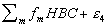
stand for ownership, competition, and hard budget constraints effects, respectively, on the respective performance indicator. For OWN=PRIV the whole sample is used. For OWN= PRIVOUT, CONCINS, CONCOUT the regressions are restricted to the sub-sample of privatized enterprises, while for OWN=BLOCPOW, BLOCPINS, BLOCPOUT, BLOCPMIX, and CORPOR the sub-sample of state-controlled enterprises is used .
Restructuring indicators
Earle and Estrin (1997) have argued that the multidimensionality of restructuring suggests that it may be desirable to construct an index of overall restructuring including a number of different components. Taking up this idea the authors use twelve qualitative restructuring indicators that can plausibly be assumed to signal moves towards market orientation and deep restructuring (though most of them represent „soft" rather than „hard" restructuring measures):
(1) change of top managers (president or vice-presidents of the firm);
structural changes in employment , namely
(2) increase in the share of qualified employees in total employment, and
(3) increase in the share of sales/marketing personnel in total employment;
(4) buying of modern equipment/technology;
(5) introduction of new products;
(6) increase in quality control ;
(7) international quality certification of the products;
(8) development of strategic marketing plans;
(9) regular advertising ;
(10) development of new distribution channels;
(11) participation in international fairs;
(12) changes in the organizational structure of the firm.
The managers of surveyed enterprises were asked if they employed any of the listed restructuring measures after the firm’s privatization (or during last three years in case of a state enterprise). Their answers were converted into a set of dummy variables defined as equal to 1 if the measure had been adopted. The frequencies for these restructuring measures are reported in Table 2. Instead of estimating a polytomous choice model (Drymes, 1978), for the sake of simplicity we computed an index  of firm’s overall restructuring activity as the (unweighted) sum of all twelve restructuring dummies
  ,
,  , the mean value of which in the whole sample is 4.66 (std.deviation=2.28) suggesting rather low level of restructuring activity in Ukrainian firms. On this basis, a logit model
(2´) 
is estimated (by a ML-techniques) where  , and p is the probability of the event 5
£
£
12, i.e. for a firm’s restructuring index being above the total sample’s average. Again, the constant together with the terms controlling for initial position (or, in some regressions, initial performance), industry and region effects are interpreted to represent an overall transition effect, while dOWN, ,
, and p is the probability of the event 5
£
£
12, i.e. for a firm’s restructuring index being above the total sample’s average. Again, the constant together with the terms controlling for initial position (or, in some regressions, initial performance), industry and region effects are interpreted to represent an overall transition effect, while dOWN, ,  stand for ownership-structure, competition, and hard-budget-constraints effects on the firm’s propensity to undertake above-average restructuring activities. Depending on which variable is substituted for OWN , the sample is appropriately restricted.
VI. Results
Selected regression results are presented in tables 4-6(for restructuring) and in tables 7-12 (for performance). The general strategy was to examine a large number of alternative specifications of competition, hard-budget-constraints and control variables in order to ascertain the robustness of the estimated relationships. In a first step the authors would estimate basic models with various specifications of ownership variables, dummy variables for competitive pressure, monopolistic position and the presence of a competitor’s threat, using as controls broad industry and region categories and initial performance (or position) variables. In further steps, the authors introduce the geographically more disaggregated interval measures for competitive pressure and examine the sensitivity with respect to the definition of control variables.
Restructuring, privatization, competition and hard budget constraints
Do privatization and ownership structure influence the inclination of enterprises to engage in restructuring? Apparently, as can be seen from tables 4-6, the empirical evidence for such an impact is not strong.
Take Tables 4,5,6 here
For the whole sample, the privatization dummy, in all specifications of competition and control variables, is positive but not significant. However, this need not to be interpreted as meaning that it does not matter for restructuring activities whether an enterprise is (more than 50%) privatized or still state-controlled. In all these equations, the subsidization dummy is highly significantly negative. It can be shown that for the sample subsidization and state ownership is strongly positively correlated (in fact, only one out of the 56 privatized firms still received some subsidy). So obviously, the hard-budget-constraints variable SUBSIDY has captured the privatization effect supporting the argument that privatization in the early phases of transition is more or less tantamount to a hardening of budget constraints which in turn provides incentives to restructuring.
The next question is, of course, if for privatized firms it matters whether outside ownership dominates (dispersed or concentrated) or the ownership structure is of the concentrated-insider type. Though the respective dummies are not statistically significant they do have the „theoretically correct" signs: Concentrated insider ownership has the tendency of influencing overall restructuring activity positively (since it presents a closer alignment of control and cash-flow rights) while outside and concentrated outsider ownership, which given the poorly developed institutions of corporate governance can be expected to create severe agency problem, tend to have a negative impact on restructuring. For state enterprises (table 6), the blocking power variables have generally positive coefficients (while the influence of corporatization seems rather to be negative) though none of the coefficients is statistically significant. Also for the sub-sample of state-controlled enterprises the access to government subsidies significantly reduces the propensity to restructure.
As far as restructuring indicators are concerned, the heatedly debated question about what would be more important, privatization and ownership or competition, has in this case to be answered in favor of the competition effects: For the whole sample and the sub-sample of privatized firms (perceived) foreign competition consistently and significantly affects restructuring activities positively. In the more disaggregated specification it turns out that it is the Eastern-Europe and rest-of-the-world variables (for privatized firms) that are significant. Also for the restructuring propensity of state enterprises competition matters, in this case predominantly competition in the domestic market. It is interesting that generally, and for privatized firms in particular, possessing a monopolistic position for some core product in the Ukrainian market seems to influence overall restructuring activity in a significantly positive way. This is not at all at odds with the positive effects of perceived competitive pressure in foreign markets. Very likely, traditional monopolists in the domestic market find it easier to raise outside finance from strategic investors interested in a particular industry or from financial intermediaries (because of their higher survival credibility) , and to finance investment in new technology from their own monopoly rents (in fact, in our sample a significantly higher proportion of monopolistic producers than of non-monopolists reported some investment activity after privatization).
The fact that the constant is generally negative (and for the whole-sample estimation also significant) and that initial position effects as well as industry and region specifics do not seem to matter very much suggests a strong negative aggregate transition effect on restructuring due to the slow pace of market-oriented reforms on the national level and a high degree of economic and political instability.
Performance, privatization, competition and hardening budget constraints
Among the performance indicators only two, viz. the growth in labor productivity and the growth in sales, yielded statistically significant (and rather similar) regression equations results for which are reported in tables 7-12. They are remarkably different from those for restructuring activity.
Take Tables 7,8,9,10,11,12 here
As for restructuring activity, the privatization variable does not really matter; though its coefficient is even negative it is not significant, and neither are the hard-budget-constraints variables. A significantly positive influence on performance for the sample as a whole and for the sub-sample of state enterprises can be attributed to a monopolistic position in the domestic market while a perceived threat to the firm’s market position from a competitor has a significantly negative impact on performance for all the enterprises and privatized firms in particular (but not for the sub-sample of state-controlled enterprises!). This suggests that state enterprises are still shielded from the winds of competition by various forms of government support.
However, for privatized firms their ownership structure is of significant explanatory value for their performance. It is outside ownership and, in particular, concentrated outside ownership which have a significantly positive effect on the performance indicator (while for the PRIVOUT-specifications the relationship as a whole is not significant, the adjusted  is significant for the CONCOUT-specifications). Also for state-controlled firms the ownership structure matters. In this case it is the blocking power of outsiders that exerts a significantly positive influence on performance.
The transition affect is not significant in the performance equations, only the region effect is significant but of a low order of magnitude.
VII. Conclusions
The basic conclusion that can be drawn from the analysis is that the joint impact of privatization and ownership structures, competition, and hardening of budget constraints on overall restructuring activity is rather different from that on performance.
As far as the propensity of large industrial firms to engage themselves in some restructuring activity at the early stage of Ukrainian transition is concerned, research results suggest that driving forces behind it are the hardening of budget constraints (represented mainly by the cut in government subsidies) and increased foreign competition (for still state-controlled enterprises also domestic competition matters). Ownership variable did not prove significant. For performance, on the contrary, ownership turns out to be of significant importance. Again, it is not privatization as such that matters. But as soon as enterprises are privatized their performance is significantly improved by outside and, in particular, concentrated outside ownership (while concentrated inside ownership has a negative, though insignificant, effect). In the case of enterprises in which the state still holds a majority stake, it is outsiders’ blocking power that improves performance significantly. It is an open question why outside owners should be able to improve an enterprise’s performance but would not have a positive influence on restructuring activity. Maybe it is an indication for the „short-termism" in the outside owners’ attitude (who are mainly interested in a quick improvement in the firm’s cash flow). Competition matters for performance too. Contrary to the case of restructuring it is, however, rather domestic than foreign competition that has a positive impact.
Rather interesting is the role a monopolistic position in some core domestic market plays. The propensity to restructure is positively influenced by such a monopolistic position in the case of privatized firms, while for performance it seems to be mainly for state-controlled enterprises that a monopolistic position has a significantly positive impact. A perceived threat to a firm’s market position, however, seems to have a negative impact on the performance of, in particular, private firms.
The results also suggest that the general climate for restructuring during the first years after large-scale privatization has not been favorable. The constant in the logistic regressions is consistently negative (and significant for the whole sample), moreover this overall transition effect is of a size such that even under the most favorable circumstances with respect to ownership, competition and hard budget constraints variables a probability of above-average restructuring activity is obtained that at best is equal to the complementary probability.
Whether a further movement towards more concentrated forms of outside ownership will eventually have a positive impact also on strategic restructuring is too early to tell. Although this snapshot did not show a significant (or even any positive) influence of outside private ownership and its positive impact on performance might be pessimistically interpreted as a sign of short-termimist behavior on the part of outside owners, it may as well be that the favorable influence of concentrated outside ownership on performance will in due course lead to a positive selection effect and an increased flow of new capital into the restructuring activities of the successful firms.
REFERENCES
Table 1. Sample characteristics.
|
Number of the firms (%) |
|
|
Branch Energy and fuel Machine building Chemicals Metallurgy Production of consumer goods Communications and electronics Other industrial production Size (number of employees) 1000-3000 >3000 Privatization Privatized firms (private share >0), including private share<50% private share >50% Non-privatized firms, including corporatized state firms non-corporatized state firms, including: will be privatized within next two years will not be privatized within next two years Type of enterprise State enterprise Open joint-stock company Closed joint-stock company Partnership |
29 (16.8%) 77 (44.5%) 18 (10.4%) 15 (8.7%) 12 (6.9%) 13 (7.5%) 9 (5.2%)
100 (57.3%) 73 (42.2%)
94 (54.3%) 38 (21.4%) 56 (32.9%) 79 (45.7%) 18 (9.3%) 63 (36.5%) 34 (19.7%)
29 (16.8%)
61 (36.5%) 95 (54.9%) 13 (7.5%) 2 (1.2%) |
Table 2. Indicators of strategic restructuring
|
Frequencies |
|
|
Change of top-manager Increase in share of qualified workers in total employment Increase in share of sales and marketing departments personnel in total employment Buy new equipment/technology Introduction of new products Increase in quality control International certification of products Development of a strategic marketing plan Regular advertising Development of new distribution channels Participation in international fairs Change of organizational structure
|
72 (41.6%) 76 (43.9%) 77 (44.5%)
65 (37.6%) 123 (71.1%) 116 (67.1%) 35 (20.2%) 70 (40.5%) 44 (25.4%) 105 (60.7%) 62 (35.8%) 3 (1.7%) |
Table 3. Descriptive statistics for variables used in the analysis
|
Variable name |
Description |
Mean |
Std.deviation |
N |
|
Dependent variable AGRPROD
AGRREV AGRSALES AGRCOST AGREMP R Ownership PRIVATE PRIVOUT CONCINS CONCOUT BLOCPINS
BLOCOUT
BLOCMIX
CORPOR Competition DOMCOMP
FORCOPMP
INCDOMCOMP
INCFORCOMP
COMPUKR
COMPCIS |
Average growth rate of labor productivity (sales per employee) after privatization Average growth rate of real revenue per employee after privatization Average growth rate of real sales after privatization Average growth rate of costs per unit of sales after privatization Average growth rate of employment after privatization Index of overall restructuring activity
Dummy for private firms Dummy for outside privatization Dummy for inside concentrated ownership Dummy for outside concentrated ownership Dummy for insiders blocking power in a firm with the state as majority shareholder Dummy for outsiders blocking power in a firm with the state as majority shareholder Dummy for mixed (insiders + outsiders) blocking power in a firm with the state as majority shareholder Dummy for corporatized state enterprises
Dummy for the high level of competitive pressure from domestic producers in 1997 Dummy for the high level of competitive pressure from foreign producers in 1997 Dummy for the increased level of competitive pressure from domestic producers since 1995 Dummy for the increased level of competitive pressure from foreign producers since 1995 Interval variable for the level of competitive pressure from Ukrainian producers Interval variable for the level of competitive pressure from CIS producers |
1.16
0.92 1.00 -0.18 -0.06 4.66
0.32 0.13 0.10 0.10 0.05
0.03
0.04
0.15
0.57
0.77
0.62
0.66
2.77
3.21
|
6.23
7.61 5.99 2.47 0.12 2.28
0.47 0.33 0.31 0.30 0.22
0.18
0.20
0.36
0.50
0.42
0.49
0.47
1.28
1.41
|
173
173 173 173 170 169
173 173 173 173 118
118
118
118
173
173
173
173
173
173
|
Table 3. Descriptive statistics for variables used in the analysis
|
Variable name |
Description |
Mean |
Std.deviation |
N |
|
Competition COMPEEUR
COMPWEUR
CPOMTOTH
CHANGEUKR
CHANGCIS
CHANGEEEUR
CHANGEWEUR
CHANGEOTH
MONPROD
COMPTHREAT
Hard budget constraints SUBSIDY STORDER BARTER Control variables INIPOS INIPROD INIREV INISALES INICOST |
Interval variable for the level of competitive pressure from East European producers Interval variable for the level of competitive pressure from West European producers Interval variable for the level of competitive pressure from the producers from the other countries Interval variable for the change in the level of competitive pressure from Ukrainian producers Interval variable for the change in the level of competitive pressure from CIS producers Interval variable for the change in the level of competitive pressure from East European producers Interval variable for the change in the level of competitive pressure from West European producers Interval variable for the change in the level of competitive pressure from the producers from other countries Dummy for monopolistic position in producing at least one core product in Ukraine Dummy for having the competitor that threatens market position of the firm
Dummy for receiving state subsidies Interval variable for the share of state order in total sales Interval variable for the share of barter in total sales
Interval variable for initial position of the firm (subjective) Initial level of labor productivity Initial level of revenues Initial level of sales Initial level of costs per unit of sales Initial level of employment |
2.79
2.24
3.16
3.48
3.65
3.64
3.41
3.81
0.64
0.65
0.14 0.92 5.52
3.01 6.73 1.93 27685.48 0.74 4253.71 |
1.72
1.73
1.91
0.79
0.89
0.94
1.02
1.13
0.48
0.48
0.35 2.31 2.98
0.82 11.80 3.00 50632.2 0.43 3602.05 |
173
173
173
165
158
149
140
149
173
173
173 173 173
173 173 173 173 173 173 |
Table 4. Logistic regressions :restructuring activity equations
Dependent variable: index of overall restructuring activity R
|
Independents |
Coeff.(S.E.) 4.1 |
Coeff. (S.E.) 4.2 |
Coeff. (S.E.) 4.3 |
Coeff. (S.E.) 4.4 |
Coeff. (S.E.) 4.5 |
Coeff. (S.E.) 4.6 |
Coeff. (S.E.) 4.7 |
Coeff. (S.E.) 4.8 |
|
Ownership PRIV PRIVOUT CONCINS CONCOUT
Competition DOMCOMP FORCOMP INCDOMCOMP INCFORCOMP MONPROD
Hardening budget constraints SUBSIDY STORDER BARTER
Control variables INIPOS IND REG
Constant Chi -sq. N |
0.09 (0.38) - - -
0.14 (0.36) 0.94**(0.48) - - 0.52 (0.37)
-1.53**(0.70) -0.05 (0.08) -0.02 (0.08)
0.20 (0.36) Y Y
-1.86* (1.03) 24.32** 173 |
0.09 (0.39) - - -
- - 0.23 (0.37) 0.89**(0.43) 0.44 (0.37)
-1.54**(0.70) -0.06 (0.08) -0.02 (0.06)
0.20 (0.22) Y Y
-1.77*(1.02) 25.1** 173
|
- -1.04 (0.78) - -
-0.30 (0.80) 2.38**(1.33) - - 1.40**(0.70)
-4.40 (36.8) -0.28 (0.37) -0.10 (0.14)
0.62 (0.46) Y Y
-4.2 (2.66) 17.1* 56 |
- -1.24 (0.76) - -
- - -0.38 (0.87) 1.68** (0.95) 1.20* (0.68)
-4.20 (36.6) -0.31 (0.37) -0.14 (0.14)
0.46 (0.64) Y Y
-3.08 (2.19) 16.9* 56 |
- - 0.10 (0.72) -
-0.25 (0.79) 2.25** (1.29) - - 1.20*(0.67)
--3.44 (36.8) -0.34 (0.38) -0.08 (0.14)
0.51 (0.44) Y Y
-4.42 (2.63) 16.8* 56 |
- - 0.16 (0.72) -
- - -0.37 (0.86) 1.37 (0.92) 1.02*(0.56)
-3.0 (36.6) -0.38 (0.37) -0.12 (0.13)
0.49 (0.43) Y Y
-3.19 (2.15) 17.2* 56 |
- - - -0.73 (0.76)
-0.32 (0.80) 2.22*(1.21) - - 1.34* (0.72)
-3.90 (36.8) -0.30 (0.37) -0.10 (0.14)
0.55 (0.46) Y Y
-4.07 (2.66) 18.2* 56 |
- - - -0.92 (0.98)
- - -033 (0.87) 1.48*(0.82) 1.18* (0.69)
-3.9 (36.6) -0.31 (0.38) -0.14 (0.14)
0.56 (0.44) Y Y
-3.02 (2.16) 18.2* 56 |
* p<0.01, ** p<0.05, significant coefficients bold-faced
Table 5
.Logistic regressions: alternative specifications for competition and control variables.Dependent variable: index for overall restructuring activity R
|
Coeff.(S.E.) 5.1 |
Coeff.(S.E.) 5.2 |
Coeff.(S.E.) 5.3 |
Coeff.(S.E.) 5.4 |
Coeff.(S.E.) 5.5 |
Coeff.(S.E.) 5.6 |
Coeff.(S.E.) 5.7 |
Coeff.(S.E.) 5.8 |
|
|
Ownership PRIV PRIVOUT CONCINS CONCOUT Competition DOMCOMP FORCOMP COMPUKR COMPCIS COMPEEUR COMPWEUR COMPOTH MONPROD
Hard budget constraints SUBSIDY STORDER BARTER
Control variables INIPOS INIPROD INIEMP IND REG Constant Chi- sq N |
0.04 (0.12) - - -
- - 0.23 (0.16) -0.06 (0.15) 0.23* (0.11) 0.04 (0.12) 0.14 (0.12) 0.75* (0.40)
-1.53**(0.71) -0.04 (0.08) -0.04 (0.06)
0.25 (0.24) - - Y Y -2.60**(1.2) 30.1** 173
|
- -1.38 (0.83) - - - - - 0.16 (0.36) -0.30 (0.46) 0.10 (0.31) -0.31 (0.29) 0.70** (0.29) 1.86** (0.85)
-3.7(36.71) -0.34 (0.39) -0.14 (0.15)
1.13* (0.58) - - Y Y -5.3(3.38) 18.2* 56 |
- - 0.42 (0.80) -
- - 0.18 (0.35) -0.35 (0.44) 0.16 (0.29) -0.30 (0.27) 0.61** (0.27) 1.63** (0.79)
-2.4 (36.7) -0.42 (0.39) -0.10 (0.14)
0.85* (0.50) - - Y Y -5.08(3.20) 17.9* 56 |
- - - -0.92 (0.80)
- - 0.14 (0.35) -0.31 (0.44) 0.14(0.30) -0.31 (0.27) 0.63** (0.27) 1.75**(0.38)
-3.15 (35.7) -0.37 (0.39) -0.14 (0.15)
0.96* (0.54) - - Y Y -4.85 (3.20) 16.9* 56 |
0.39 (0.40) - - -
0.06 (0.39) 0.83* (0.52) - - - - - 0.30 (0.40)
-1.70**(0.78) -0.04 (0.08) 0.01 (0.06)
- 0.02 (0.02) 0.0004**(0.0001) detailed detailed -2.74**(0.92) 42.7** 164 |
- -1.49 (0.89) - -
-0.80 (0.87) 2.30 (1.56) - - - - - 1.67** (0.83)
-3.01 (36.8) -0.36 (0.39) -0.16 (0.18)
- 0.0001 (0.0001) 0.000008(0.0008) detailed detailed -3.04 (2.72) 16.8* 56 |
- - 0.28 (0.74) -
-0.69 (0.77) 1.75 (1.41) - - - - - 1.27**(0.75)
--1.94 (36.7) -0.42 (0.37) -0.11 (0.15)
- 0.0004 (0.0003) 0.000007(0.00007) detailed detailed -3.18 (2.51) 16.9* 56 |
- - - -1.52 (0.95)
-0.89 (0.81) 2.18 (1.58) - - - - - 1.74** (0.85)
-2.03 (36.7) -0.40 (0.39) -0.19 (0.16)
- 0.0004 (0.0003) 0.00008(0.00008) detailed detailed -3.56 (2.80) 17.1* 56 |
*p<0.01, ** p<0.05, significant coefficients bold-faced
Table 6.
Logistic regressions :restructuring activity equations, state majority ownership specifications . Dependent variable: index of overall restructuring activity R
|
Independents
|
Coeff.(S.E.) 6.1 |
Coeff.(S.E.) 6.2 |
Coeff.(S.E.) 6.3 |
Coeff.(S.E.) 6.4 |
Coeff.(S.E.) 6.5 |
|
Ownership BLOCPOW BLOCPINS BLOCPOUT BLOCPMIX CORPOR
Competition COMPUKR COMPCIS COMPEEUR COMPWEUR COMPOTH MONPROD
Hard budget constraints SUBSIDY STORDER BARTER Control variables INIPROD IND REG
Constant Chi-sq
|
0.16 (1.06) - - - -
0.39**(0.20) -0.18 (0.19) 0.19 (0.16) 0.29* (0.17) -0.02 (0.15) 0.66 (0.54)
-1.54**(0.75) -0.04 (0.09) -0.03 (0.07)
-0.008 (0.05) Y Y
-1.52 (1.45) 24.1** |
- 1.51 (1.17) - - -
0.41** (0.20) -0.21 (0.20) 0.19 (0.16) 0.29* (0.17) -0.02 (0.15) 0.74 (0.54)
-1.50** (0.75) -0.04 (0.10) -0.03 (0.07)
-0.07 (0.90) Y Y
-1.84 (1.47) 25.9**
|
- - 1.57 (1.46) - -
0.39** (0.20) -0.21 (0.20) 0.20 (0.16) 0.29* (0.17) -0.02 (0.15) 0.70 (0.53)
-1.57**(0.75) -0.04 (0.09) -0.02 (0.07)
0.03 (0.3) Y Y
-1.64 (1.44) 25.3**
|
- - - 0.16 (1.06) -
0.39**(0.20) -0.18 (0.19) 0.19 (0.16) 0.27 (0.17) -0.02 (0.15) 0.66 (0.54)
-1.54**(0.75) -0.04 (0.09) -0.02 (0.07)
-0.008 (0.03) Y Y
-1.60 (1.45) 24.1** |
- - - - -1.03 (0.67)
0.41**(0.21) -0.14 (0.199 0.21 (0.16) 0.25 (0.17) -0.03 (0.15) 0.85 (0.55)
-1.39*(0.77) -0.04 (0.09) -0.02 (0.07)
-0.04 (0.3)
-1.60 (1.45) 26.5** |
*p<0.01, ** p<0.05, significant coefficients bold-faced
Table 7
. Liner regressions : performance equations.Dependent variable: average growth of labor productivity ( sales per employee) after privatization
|
Independents |
Coeff.(S.E.) 7.1 |
Coeff.(S.E.) 7.2 |
Coeff.(S.E.) 7.3 |
Coeff.(S.E.) 7.4 |
Coeff.(S.E.) 7.5 |
Coeff.(S.E.) 7.6 |
Coeff.(S.E.) 7.7 |
Coeff.(S.E.) 7.8 |
|
Ownership PRIV PRIVOUT CONCINS CONCOUT Competition DOMCOMP FORCOMP INCDOMCOMP INCFORCOMP MONPROD
Hardening budget constraints SUBSIDY STORDER BARTER Control variables INIPROD IND REG
Constant Adj R sq
F N |
-0.49 (0.71) - - -
0.45 (0.67) 0.37 (0.84) - - 1.24**(0.68)
-1.26 (1.03) 0.02 (0.14) 0.05 (0.10)
-0.02 (0.02) Y Y*
0.17 (1.13) 0.061
2.27** 164 |
- 2.74** (0.90)- -
1.75* (1.09) 0.44 (1.50) - - 0.51 (0.92)
-0.59 (4.8) 0.05 (0.36) 0.30 (0.19)
-0.02 (0.04) Y Y*
-3.2 (2.6) 0.10
1.58 56 |
- - - 1.32 (1.06)-
1.38 (1.09) 0.31 (1.62) - - 0.68 (0.98)
-2.30 (5.1) 0.10 (0.39) 0.21 (0.20)
-0.02 (0.05) Y Y*
-0.35 (2.62) -0.02
0.80 56 |
- - - 3.15** (1.03)
1.83* (1.01) 0.90 (1.49) - - 0.34 (0.90)
-1.15 (1.47) 0.08 (0.30) 0.35 (0.19)
-0.03 (0.04) Y Y*
-3.52( 2.62) 0.14
1.83* 56 |
-0.44 (0.71) - - -
- - -0.07 (0.68) 0.35 (0.77) 1.13*(0.68)
-1.09 (1.02) 0.01 (0.14) 0.06 (0.10)
-0.02 (0.02) Y Y*
0.43 (1.2) 0.058
2.01** 164 |
- 2.50** (1.02)- -
- - 0.56 (1.08) -0.25 (1.19) 0.21 (0.93)
-1.63 (4.80) -0.11 (0.35) 0.25 (0.19)
-0.03 (0.05) Y Y*
-1.4 (2.20) 0.04
1.23 56 |
- - -1.33 (1.08) -
- - 0.52 (1.14) 0.28 (1.2) 0.39 (0.98)
-0.88 (4.9) -0.12 (0.30) 0.19 (0.20)
-0.02 (0.05) Y Y*
0.29 (2.3) -0.05
0.72 56 |
- - - 2.75** (1.02)
- - 0.37 (1.07) 0.004 (1.14) 0.02 (0.90)
1.30 (4.01) -0.14 (0.35) 0.29 (0.19)
-0.03 (0.02) Y Y*
0.26 (1.13) 0.068
1.37 56 |
*p<0.01, ** p<0.05, significant coefficients bold-faced
Table 8.Linear regression :performance equations, specifications with disaggregated measures of competition
Dependent variable: average growth labor productivity after privatization
|
Coeff.(S.E.) 8.1 |
Coeff.(S.E.) 8.2 |
Coeff.(S.E.) 8.3 |
Coeff.(S.E.) 8.4 |
Coeff.(S.E.) 8.5 |
Coeff.(S.E.) 8.6 |
Coeff.(S.E.) 8.7 |
Coeff.(S.E.) 8.8 |
Coeff.(S.E.) 8.9 |
|
|
Ownership PRIV PRIVOUT CONCINS CONCOUT BLOCPOW BLOCPINS BLOCPOUT BLOCPMIX CORPOR Competition COMPUKR COMPCIS COMPEEUR COMPWEUR COMPOTH MONPROD Hard budget constraints SUBSIDY STORDER BARTER Control variables INIPROD IND REG
Constant Adj R sq F N |
-0.34 (0.69) - - - - - - - -
0.60**(0.26) -0.74**(0.26) 0.25 (0.22) -0.29 (0.23) 0.17 (0.20) 1.77** (0.68)
-0.91 (1.01) 0.002 (0.13) 0.02 (0.10)
-0.04**(0.02) Y Y*
0.80 (1.45) 0.113 2.48** 173 |
- 2.56** (1.04) - - - - - - -
0.38 (0.46) 0.36 (0.53) 0.21 (0.39) -0.16 (0.35) 0.03 (0.34) 0.50 (1.02)
-1.1 (5.46) 0.09 (0.13) 0.28 (0.20)
-0.04 (0.05) Y Y*
-4.55 (3.26) 0.012 1.04 56 |
- - -1.25 (1.12) - - - - - -
0.26 (0.49) 0.30 (0.57) 0.14 (0.41) -0.13 (0.35) 0.06 (0.35) 0.65 (1.08)
-2.73 (5.7) 0.11 (0.43) 0.20 (0.21)
-0.04 (0.05) Y Y*
-1.54 (3.3) -0.11 0.58 56
|
- - - 2.95**(1.06) - - - - -
0.41 (0.46) 0.30(0.57) 0.21 (0.38) -0.12 (0.35) 0.05 (0.35) 0.37 (1.01)
-1.28 (5.37) 0.004 (0.13) 0.03 (0.01)
-0.04 (0.05) Y Y*
-4.38 (3.18) 0.039 1.15 56 |
- - - - 1.27 (1.24) - - - -
0.91 **(0.33) -1.14**(0.33) 0.14 (0.17) -0.29 (0.31) 0.004 (0.25) 2.54**(0.94)
-0.84 (1.15) 0.004 (0.16) -0.07 (0.13)
-0.04 (0.03) Y Y*
1.84 (1.75) 0.174 2.78** 118 |
- - - - - 0.77 (1.96) - - -
0.90** (0.33) -1.15**(0.34) 0.16 (0.27) -0.31 (0.31) 0.01 (0.26) 2.48**(0.95)
-0.87 (1.16) 0.004 (0.16) -0.06 (0.13)
-0.04 (0.03) Y Y*
1.79 (1.73) 0.166 2.73** 118 |
- - - - - - 4.05*(2.40) - -
0.89**(0.33) -1.04**(0.33) 0.14 (0.27) -0.36 (0.31) 0.02 (0.26) 2.25**(0.94)
-0.84 (1.15) 0.013 (0.15) -0.10 (0.13)
-0.04 (0.03) Y Y*
1.79 (1.76) 0.187 3.02** 118 |
- - - - - - - -0.57 (1.97) -
0.89**(0.33) -1.13**(0.33) 0.17 (0.27) -0.32 (0.27) 0.01 (0.26) 2.42**(0.94)
-0.90 (1.15) 0.002 (0.16) -0.06 (0.13)
-0.04 (0.03) Y Y*
1.90 (1.76) 0.166 2.73** 118 |
- - - - - - - - 1.68 (1.14)
0.89** (0.33) -1.21** (0.33) 0.13 (0.27) -0.28 (0.31) 0.02 (0.25) 2.19**(0.94)
-1.29 (1.17) 0.02 (0.16) -0.11 (0.13)
-0.04 (0.03) Y Y*
2.19 (1.75) 0.183 3.00** 118 |
*p<0.01, ** p<0.05, significant coefficients bold-faced
Table 9. Linear regressions : performance equations, specifications with alternative competition measure COMPTHREAT
Dependent variable: average growth of labor productivity after privatization
|
Coeff.(S.E.) 9.1 |
Coeff.(S.E.) 9.2 |
Coeff.(S.E.) 9.3 |
Coeff.(S.E.) 9.4 |
Coeff.(S.E.) 9.5 |
Coeff.(S.E.) 9.6 |
Coeff.(S.E.) 9.7 |
Coeff.(S.E.) 9.8 |
Coeff.(S.E.) 9.9 |
|
|
Ownership PRIV PRIVOUT CONCINS CONCOUT BLOCPOW BLOCPINS BLOCPOUT BLOCPMIX CORPOR
Competition MONPROD COMPTHREAT
Hard budget constraints SUBSIDY STORDER BARTER
Control variables INIPROD IND REG
Constant Adj R sq F N |
-0.32 (0.79) - - - - - - - -
1.29**(0.67) -1.24**(0.67)
-1.18 (1.01) -0.02 (0.14) 0.05 (0.10)
-0.03 (0.02) Y Y*
1.39 (1.22) 0.083 2.64** 164 |
- 2.81** (0.97)- - - - - - -
0.14 (0.85) -2.68**(0.95)
4.85 (4.7) -0.15 (0.32) 0.06 (0.10)
-0.07 (0.045) Y Y*
0.81 (1.80) 0.21 2.61** 56 |
- - -1.04 (1.10) - - - - - -
0.43 (0.97) -2.20**(1.03)
1.99 (4.6) -0.23 (0.34) 0.13 (0.15)
-0.08 (0.02) Y Y*
2.7 (2.02) 0.06 1.36 56 |
- - - 3.16** (0.93)- - - - -
-0.06 (0.80) -2.75**(0.93)
-0.90 (1.0) -0.03 (0.14) 0.06 (0.10)
-0.08 (0.06) Y Y*
1.19 (1.80) 0.24 2.82** 56 |
- - - - 1.21 (1.30) - - - -
1.86*(0.95) -1.05 (0.87)
-1.08 (1.20) -0.05 (0.17) 0.001 (0.13)
-0.02 (0.03) Y Y*
1.19 (1.55) 0.067 1.90** 113 |
- - - - - -0.18 (2.04) - - -
1.73*(0.96) -0.99 (0.88)
-1.15 (1.20) -0.04 (0.17) 0.005 (0.13)
-0.02 (0.03) Y Y*
1.25 (1.56) 0.059 1.79* 113
|
- - - - - - 4.75* (2.10)- -
1.53*(0.83) -0.99 (0.86)
-1.10 (1.18) -0.02 (0.17) -0.03 (0.13)
-0.02 (0.03) Y Y*
1.35 (1.53) 0.090 2.23** 113 |
- - - - - - - 0.24 (2.0) -
1.76*(0.95) -1.0 (0.87)
-1.14 (1.20) -0.04 (0.17) 0.006 (0.13)
-0.02 80.03) Y Y*
1.24 (1.52) 0.059 1.79* 113 |
- - - - - - - - 1.17 (1.16)
1.59* (0.85) -1.04 (0.87)
-1.41 (1.23) -0.03 (0.17) -0.02 (0.14)
-0.02 (0.03) Y Y*
1.30 (1.55) 0.068 1.91** 113 |
*p<0.01, ** p<0.05, significant coefficients bold-faced
Table 10. Linear regressions : performance equations, private ownership specifications.
Dependent variable: average growth of sales volume after privatization
|
Coeff.(S.E.) 10.1 |
Coeff.(S.E.) 10.2 |
Coeff.(S.E.) 10.3 |
Coeff.(S.E.) 10.4 |
Coeff.(S.E.) 10.5 |
Coeff.(S.E.) 10.6 |
Coeff.(S.E.) 10.7 |
Coeff.(S.E.) 10.8 |
|
|
Ownership PRIV PRIVOUT CONCINS CONCOUT Competition DOMCOMP FORCOMP INCDOMCOMP INCFORCOMP MONPROD
Hardening budget constraints SUBSIDY STORDER BARTER Control variables INISALES
IND REG
Constant Adj R sq
F N |
-0.38 (0.14) - - -
0.45 (0.61) 0.39 (0.75) - - 1.10*(0.62)
-1.27 (0.92) 0.02 (0.12) 0.03 (0.09)
-0.00005 (0.00005) Y Y*
0.01 (1.19) 0.057
2.05** 164
|
- 2.75**(0.98) - -
1.79* (1.00) 0.63 (1.45) - - 0.54 (00.81)
-0.86 (4.7) 0.12 (0.35) 0.31 (0.18)
-0.00005 (0.0001) Y Y*
-3.66 2.60) 0.09
1.56 56 |
- - -1.20 (1.09) -
1.41 (1.00) 0.49 (1.6) - - 0.81 (0.91)
-2.4 (5.1) 0.12 (0.35) 0.21 (0.20)
-0.00006 (0.0001) Y Y*
-0.93 (2.6) -0.03
0.8 56 |
- - - 3.14** (1.0)
1.84*(1.01) 1.01 (1.4) - - 0.43 (0.91)
-1.3 (4.7) 0.09 (0.32) 0.30 (0.19)
-0.00005 (0.0001) Y Y*
-3.8 (2.5) 0.13
1.79* 56 |
-0.32 (0.63) - - -
- - 0.04 (0.61) 0.37 (0.69) 0.99*(0.61)
-1.38 (0.92) 0.02 (0.12) 0.02 (0.09)
-0.00005 (0.00005) Y Y*
0.28 (1.15) 0.057
1.98* 164 |
- 2.47** (1.01)- -
- - 0.61 (1.08) -0.08 (1.13) 0.27 (0.94)
1.46 (4.8) -0.09 (0.35) 0.25 (0.19)
-0.00005 (0.0001) Y Y*
-1.93 (2.17) 0.038
1.20 56
|
- - -1.28 (1.09) -
- - 0.60 (1.13) 0.47 (1.20) 0.48 (0.98)
1.03 (4.9) -0.12 (0.12) 0.25 (0.19)
-0.00005 (0.0001) Y Y*
-1.93 (2.17) -0.06
0.69 56 |
- - - 2.75** (1.02)
- - 0.44 (1.07) 0.17 (1.11) 0.11 (0.94)
1.25 (4.7) -0.12 (0.30) 0.27 (0.19)
0.00005 (0.00005) Y Y*
-1.74 (2.12) 0.060
1.32 56
|
*p<0.01, ** p<0.05, significant coefficients bold-faced
Table 11. Linear regressions : performance equations, specifications for disaggregated competition variables
Dependent variable: average growth of sales volume after privatization
|
Coeff.(S.E) 11.1 |
Coeff.(S.E) 11.2 |
Coeff.(S.E) 11.3 |
Coeff.(S.E) 11.4 |
Coeff.(S.E) 11.5 |
Coeff.(S.E) 11.6 |
Coeff.(S.E) 11.7 |
Coeff.(S.E) 11.8 |
Coeff.(S.E) 11.9 |
|
|
Ownership PRIV PRIVOUT CONCINS CONSOUT BLOCPOW BLOCPINS BLOCPOUT BLOCPMIX CORPOR Competition COMPUKR COMPCIS COMPEEUR COMPWEUR COMPOTH MONPROD Hard budget constraints SUBSIDY STORDER BARTER Control variables INISALES
IND REG
Constant Adj R sq F N |
-0.32 (0.62) - - - - - - - -
0.58**(0.23) -0.52**(0.23) 0.20 (0.19) -0.15 (0.20) 0.17 (0.18) 1.61**(0.61)
-0.80 (0.91) -0.01 (0.12) -0.01 (0.09)
-0.00008 (0.0008) Y Y*
0.60 (1.30) 0.116 2.53** 164 |
- 2.64** (1.03)- - - - - - -
0.38 (0.48) 0.39 (0.53) 0.20 (0.39) -0.16 (0.35) 0.04 (0.33) 0.54 (1.05)
-1.3 (5.4) 0.10 (0.40) 0.28 (0.20)
-0.00003 (0.0001) Y Y*
-4.91 (3.14) 0.01 1.04 56 |
- - -1.17 (1.10) - - - - - -
0.26 (0.55) 0.36 (0.57) 0.14 (0.41) -0.13 (0.39) 0.07 (0.36) 0.74 (1.11)
-3.0 (5.75) 0.15 (0.43) 0.20 (0.21)
-0.000085 (0.0001) Y Y*
-2.16 (3.25) -0.12 0.56 56 |
- - - 2.93 **(1.06) - - - - -
0.44 (0.47) 0.26 (0.53) 0.22 (0.38) -0.12 (0.38) 0.15 (0.33) 0.50 (1.03)
-1.39 (5.1) 0.04 (0.40) 0.31 (0.20)
-0.00005 (0.0001) Y Y*
-4.79 (3.07) 0.03 1.14 56 |
- - - - 0.73 (1.07) - - - -
0.81**(0.28) -0.96**(0.27) 0.11 (0.24) -0.15 (0.26) 0.02 (0.22) 2.06**(0.81)
-1.02 (0.99) 0.008 (0.14) -0.10 (0.11)
-0.00008 (0.00005) Y Y*
1.37 (1.07) 0.171 2.77** 113 |
- - - - - 0.40 (1.69) - - -
0.80**(0.29) -0.97**(0.28) 0.12 (0.23) -0.26 (0.26) 0.02 (0.22) 2.02**(0.81)
-1.04 (1.01) 0.005 (0.14) -0.10 (0.11)
-0.00008 (0.00005) Y Y*
1.39 (1.51) 0.167 2.73** 113 |
- - - - - - 2.74 (2.16) - -
0.81**(0.28) -0.90**(0.27) 0.10 (0.29) -0.30 (0.26) 0.04 (0.22) 1.89**(0.80)
-1.06 (0.99) 0.009 (0.14) -0.10 (0.11)
-0.00008 (0.0006) Y Y*
1.34 (1.50) 0.180 2.89** 113 |
- - - - - - - -0.24 (1.70) -
0.80**(0.28) -0.95**(0.27) 0.12 (0.23) -0.27 (0.27) 0.03 (0.22) 1.98**(0.81)
-1.06 (0.99) 0.009 (0.14) -0.10 (0.11)
-0.00008 (0.00006) Y Y*
1.40 (1.51) 0.167 2.73** 113 |
- - - - - - - - 1.65* (0.98)
0.80**(0.28) -1.04**(0.17) 0.08 (0.23) -0.24 (0.26) 0.004 (0.12) 1.78**(0.80)
-1.43 (1-01) 0.03 80.13) -0.15 (0.11)
-0.00008 (0.00006) Y Y*
1.71 (1.50) 0.190 3.02** 113 |
*p<0.01, ** p<0.05, significant coefficients bold-faced
Table 12 . Linear regressions: performance equations: specifications for competition variable COMPTHREAT
Dependent variable: average growth of sales volume after privatization
|
Independents |
Coeff.(S.E.) 12.1 |
Coeff.(S.E.) 12.2 |
Coeff.(S.E.) 12.3 |
Coeff.(S.E.) 12.4 |
Coeff.(S.E.) 12.5 |
Coeff.(S.E.) 12.6 |
Coeff.(S.E.) 12.7 |
Coeff.(S.E.) 12.8 |
Coeff.(S.E.) 12.9 |
|
Ownership PRIV PRIVOUT CONCINS CONCOUT BLOCPOW BLOCPINS BLOCPOUT BLOCPMIX CORPOR
Competition MONPROD COMPTHREAT
Hard budget constraints SUBSIDY STORDER BARTER
Control variables INISALES
IND REG
Constant Adj R sq F N |
-0.22 (0.62) - - - - - - - -
1.14*(0.60) -1.09*(0.59)
-1.20 (0.92) -0.01 (0.11) 0.01 (0.09)
-0.00006 (0.00005) Y Y*
1.13 (1.09) 0.081 2.59** 164 |
- 2.81** (0.93) - - - - - - -
0.27 (0.86) -2.47**(0.94)
4.69 (4.44) -0.33 (0.32) 0.15 (0.18)
-0.00006 (0.00006) Y Y*
0.90(1.08) 0.182 2.30** 56 |
- - -0.93 (1.02) - - - - - -
0.61 (0.93) -1.97*(1.02)
1.85 (4.75) -0.20 (0.35) 0.12 (0.19)
-0.0001 (0.0001) Y Y*
1.18 (1.08) 0.03 1.17 56 |
- - - 3.12** (0.94) - - - - -
0.12 (0.85) -2.52**(0.92)
4.67 (4.35) -0.38 (0.32) 0.21 (0.17)
-0.0001 (0.0001) Y Y*
1.0 (1.78) 0.215 2.55** 56 |
- - - - 0.68 (1.13) - - - -
1.50*(0.82) -0.82 (0.75)
-1.12 (1.05) -0.03 (0.14) -0.03 (0.11)
-0.00006 (0.0005) Y Y*
0.98 (1.34) 0.062 1.83* 113 |
- - - - - -0.36 (1.77) - - -
1.41*(0.83) -0.77 (0.76)
-1.24 (1.04) -0.01 (0.15) -0.03 (0.11)
-0.00006 (0.00005) Y Y*
1.62 (1.35) 0.60 1.79* 113 |
- - - - - - 3.19 (2.24) - -
1.31*(0.80) -0.78 (0.71)
-1.24 (1.04) -0.02 (0.14) -0.03 (0.11)
-0.00006 (0.00005) Y Y*
1.09 (1.31) 0.077 2.05** 113 |
- - - - - - - 0.05 (1.79) -
1.44* (0.82) -0.79 (0.75)
-1.26 (1.05) -0.02 (0.15) -0.03 (0.11)
-0.00006 (0.00005) Y Y*
1.01 (1.35) 0.059 1.79* 113 |
- - - - - - - - 1.14 (1.02)
1.30 (0.81) -0.84 (0.75)
-1.52 (1.07) -0.01 (0.14) -0.06 (0.12)
-0.00006 (0.00005) Y Y*
1.08 (1.34) 0.070 1.94* 113
|
*p<0.01, ** p<0.05, significant coefficients bold-faced