 ,
,* The author is grateful to Moore McDowell for helpful comments on an earlier draft.
"[T]he search for the 'relevant market' must be undertaken and pursued with relentless clarity.
It is, in essence, an economic task, put to the uses of the law. Unless this task is well done,
the results will be distorted in terms of the conclusion as to whether the law has been violated
and what the decree should contain."
Justice Fortas, U.S. v. Grinnell dissent(1)
1. Introduction
Along with widespread acknowledgement of the importance of relevant market definitions to the outcome of most antitrust cases, there is extensive commentary on the inconsistency with which the concept has been applied by the courts.(2) Consistency, of course, requires a coherent underlying framework. Based on the above statement of Justice Fortas and the central importance of competition policy in a free-enterprise system, it might be expected that economists would have contributed significantly to developing the requisite framework. That this has not historically been the case has been pointed out by Stigler:
"My lament is that this battle on market definitions...has received virtually no attention from
us economists. Except for a casual flirtation with cross-elasticity of demand and supply, the
determination of markets has remained an undeveloped area of economic research at either
the theoretical or empirical level."(3)
Since Professor Stigler said this, several studies on market definition have appeared,(4) many of them prompted by the issuance of new U.S. Department of Justice (DOJ) Merger Guidelines in 1982 (revised in 1984, and, again, in 1992 when they were issued jointly with the Federal Trade Commission, FTC).(5) It is argued below that some features in the Guidelines (GL) approach to market definition are valuable. Nevertheless, taken as a whole, it does not provide a method, which, however relentlessly pursued, can be trusted to reveal markets clearly relevant to statutory purposes.
Major shortcomings of the GL approach are examined in Part 2. These include failure to focus on competition, the need for knowledge of cost data, and discontinuities. The purpose of this paper is to show how these defects could be avoided by using alternative analytic frameworks.
Two possible alternative approaches are suggested in Part 3. Both of them are based solely on demand and avoid discontinuities and the property of the GL method that substitutes are treated on an all-or-nothing basis, i.e., either a substitute is treated as totally on a par with items already included or else it is excluded entirely from the market as defined. The proposed alternative approaches differ in their prescriptions for partial inclusion of substitute capacity. The focus of the first approach is to focus on the question of by how many units capacity of the substitute would have to change to have the same effect as a unit change in capacity of the original item. The suggested proxy measure for this purpose can be symbolized as
,say, where P and Q stand for price and quantity, and o and s denote original and substitute, respectively. This method is called the equivalent-effect approach.(6)
It turns out that the proposed method can also be interpreted in terms of equivalent effect on residual demand that would be faced by a collusive group dominating supply of the original item. It is shown that, under standard conditions, Ros measures the shift in residual demand per unit change in quantity of a substitute holding constant all prices except that of the substitute. This shift is easily compared to the effect of an increase in fringe supply of the original item. The focus on residual demand, shows that the proposed method can be given a broader interpretation in terms of determinants of market power than would be suggested by Ros which (like GL) focuses narrowly on price effects.(7)
The paper presents a second approach which offers a simple operational method of giving practical content to the "reasonable interchangeability" concept which is a prominent feature of U.S. Supreme Court decisions. It proposes the inclusion of a substitute based on identification of an effective locus of competition with the original item. In its geographic dimension, it is designed to embody another Supreme Court concept, namely "alternatives to which customers could reasonably turn for supplies".
Unlike the GL method which might include only the next-best-substitute, the proposed methods would include (subject to de minimis thresholds) all direct substitutes for an original item.
Finally, some modified versions of the GL approach are considered. Part 4 discusses the strengths and weaknesses of the alternative approaches as tools of antitrust policy.
2. Problems in the Guidelines Market-Definition Methodology
2.1 Overview
It is ironic that the Court's leading attempt to enunciate principles of market definition produced an outer boundary consisting of flexible wrapping materials.(8) A cynic might be forgiven for describing subsequent delineation efforts as exercises in creative use of pliable enveloping media. Reduction of ensuing unpredictability, was a major purpose in issuing new DOJ merger guidelines in 1982. These guidelines, as revised, seek to provide a road map indicating how the DOJ or FTC would proceed in individual cases.
The GL method of defining the product dimension of the market is to start with a product "narrowly defined" of one of the merging firms and gauge the profitability of (at least) a "small but significant and nontransitory price increase" (SSNIP) (normally 5% lasting for the foreseeable future) by a hypothetical monopolist of the product in question. If at least a SSNIP would not be maximally profitable because of diversion of demand to other products, the next-best substitute (NBS) for the original product is then included. At this point, the (maximal) profitability of price increases in both included products is assessed. If the maximally profitable joint price increase involves at least a SSNIP for the first product, then these two products form a relevant group. Otherwise the process is continued by inclusion at each stage of the NBS, until a group of products is first formed such that, at least, a SSNIP for a product of one of the merging firms would be maximally profitable for a hypothetical monopolist of the group.(9) The GL approach to the geographic dimension of a market is very similar. It is based on identifying the smallest set of locations of production (starting with that of a merging firm) such that a hypothetical profit-maximizing monopolist would impose at least a SSNIP f.o.b. at one of the locations of a merging firm.
Apart from the inherent arbitrariness of choosing the appropriate level for an SSNIP, the GL procedure involves difficulties that would be present even if all SSNIP's were standardized at 5% (for one year). For example, if a 5% increase in PA, the price of the initial product, would be profitable, but a 3% increase would be maximally profitable, the 1992 GL require that the market be expanded to include the NBS, B say, which is to be measured with reference to the 5% rather than the 3% increase in PA.(10) Similarly, if increases in PA and PB of 5% each would be profitable, but a joint increase of PA = 4% PB = 25% would be maximally so, the product group would need to be further expanded as long as no merging firm produced B (irrespective of the size of B capacity).(11) This is a departure from earlier versions of the guidelines which would have regarded A and B as relevant, and which spoke of profitability rather than maximal profitability. Needless to say, gauging the latter requires even more knowledge of cost functions for all the firms involved in the GL-defined market - information of a sort not routinely available to firms seeking guidance from the GL. On the positive side, the GL do present a tightly focussed market definition technique. However, it is not obvious that an exclusive focus on (maximal) profitability of price increases will lead to markets most relevant to the statutory purpose of assessing whether the effect of a merger "may be substantially to lessen competition...".(12)
Some of the changes in the 1992 GL serve to illustrate that its approach is hypothetical not just in positing a profit-maximizing monopolist, but also in specifying what stays fixed in judging the profitability of SSNIP's. For example, the 1992 GL state explicitly that the terms of sale of alternative products are to be held constant (13) (and that unlimited supplies are to be assumed available on those terms). Instead of such a ceteris paribus assumption, earlier versions of the GL seemed to imply a mutatis mutandis approach in which sympathetic changes in other prices were allowed. While the latter approach implies extra informational burdens, it at least holds out the possibility of assessing whether a hypothetical monopolist could actually impose at least a SSNIP. This would seem to be the logic of the statement:
"...the Agency seeks to define a market in which firms could effectively exercise market
power if they were able to coordinate their actions"(14)
Without grounding in what would happen, the GL market definition technique can be seen as just one of many possible cet. par techniques with different foci which have just as much claim to serve as a basis for assessing significant lessening of competition, while not sharing the GL need for knowledge of cost functions. Two such approaches are presented in Part 3.
Even apart from focal difficulties, the DOJ approach has several problems. These are discussed in the next two sections.
2.2 Problems with Next-Best-Substitute Rule
It is easy to construct examples in which the NBS rule leads to bizarre results. A direct concern with competition would require that great attention be paid to the different uses which different customers might have for a product. The GL indirect approach, centered on profitability tests, can lead to severe difficulties in situations where customers regard products as substitutable in some uses but not in others. For example, suppose that an increase in PA of 4% would be maximally profitable, and that the next best substitute is B which is an alternative to A in use number 1. Suppose further, that a joint increase in PA of 5% and PB of 25% would be profit-maximizing largely because B has other uses in which it has no substitute. The GL method then calls for adding B to A as a relevant product group. Furthermore, all of B capacity would normally be included even if less than one percent of B sales were for the use in which A would be substitutable. This, of course, would usually lead to very small shares being attributed to merging A suppliers that have very large shares of A capacity.(15) Moreover, there may be another substitute for A, C, say, which is only slightly less good than B, and which is also such that a 5% increase in PA and a 25% increase in PC would be maximally profitable. (Again, the profitability might come mostly on sales of C for uses in which it had no substitutes.) Now, if C capacity were only one tenth of B capacity, the merger might trigger a challenge were it judged in a market consisting of A and C. The difficulty with the GL procedure in this instance lies not only in the discontinuity element, whereby a small change in assumptions might lead to B + A rather than C + A as the relevant market -- with a consequent tenfold expansion in market size. There is also the theoretical difficulty that the aggregate increase in profitability might be greater if C suppliers were induced into a price increase than if B suppliers were.(16) Alternatively, it might be easier to persuade C suppliers to collude. If the main concern is with collusion, one needs to ask which cross-product collusion would be more probable. In this example, neither seems particularly likely; however, the A and C combination seems less implausible - involving as it does the tail wagging a much smaller dog. The GL procedure would, nevertheless, call for utilizing the A and B combination. This would be the case despite the language stating that the agency would use the "smallest" product group in which a hypothetical monopolist could profitably raise price. It seems clear that the "smallest" principle in question refers to a refusal to enlarge a group that had been arrived at solely by the use of the next-best-substitute concept (used seriatim if necessary).(17)
The seriatim use of the next-best-substitute approach itself leads to some awkward consequences. Consider the following sequence: (1) The maximally profitable increase in PA is 3%; (2) B is the NBS and the maximally profitable joint increase is PA = 4% PB = 6%; (3) C is the NBS because of diversion of sales of B to C for uses in which A is not substitutable. (4) Finally, suppose that a joint increase in prices of PA = 5% PB = 20% PC = 20% would be maximally profitable. On these assumptions, the GL would define the relevant group as A + B + C. This result seems particularly incongruous in the case where the vast majority of B sales are for uses in which A is not substitutable, while C is not substitutable for A in any use, and sales of C dwarf those of B and A.
As this example shows, the agency approach can bring into the market relevant to a merger of A suppliers things that are not at all "interchangeable" with A. It can also omit entirely things that are perfectly interchangeable in some uses of A so long as they are not the next-best-substitute. This feature tends to reduce the GL-defined market size, compared to one based on traditional "reasonable interchangeability," while the possibility of inclusion of items such as C above would have the opposite effect. Accordingly, it is impossible to say in general which approach might lead to larger markets.
What can be seen clearly from the above examples is that the GL procedure is far from being simply an algorithm that gives operational content to the reasonable interchangeability concept; it is capable of producing quite contrary results. The resulting distortions can be amplified by inherent discontinuities, as is explained next.(18)
2.3 Discontinuities
The first relevant notion of continuity (of a market definition procedure) is that two different groups using it, but starting with only slightly different answers to initial questions (e.g., cross-elasticity estimates), should not end up with greatly divergent results. This sort of continuity is required to avoid excessive unpredictability and to guarantee some degree of consistency in application.
The examples discussed above demonstrate the weakness of the GL method in this respect. At each step, decisions on which products to include turn on whether certain price increases would be maximally profitable. Not alone is such profitability usually very difficult to determine accurately, but small differences in the estimated answer can trigger enormous differences in the resultant markets.(19)
A separate source of discontinuity in the GL procedure is the next-best-substitute (NBS) rule. It is obvious that, in some cases, there will be close decisions as to which product is the NBS. Here again, two groups, making only slightly different assumptions might take different products as the NBS. As the examples in 2.2 suggest, the consequence (particularly in situations where products have multiple distinct uses) might be vastly discrepant market definitions.(20)
The above-mentioned discontinuities of the GL approach are exacerbated by its norm of inclusion (exclusion) of products on an all-or-nothing basis. For example, if A is the initial product, B its next-best-substitute and A plus B constitute a GL product market, all of B capacity or sales is normally to be included irrespective of how interchangeable A and B are. Such a course becomes problematic in case B has ten uses, in none of which A is substitutable, and which together account for a hundred times the sales of B in the uses for which it is substitutable for A. The GL apparently call for treating the B capacity in this case exactly as if there were no uses of B other than those in which A could be substituted.(21) Such an evaluation of competitive forces, would be the equivalent in military terms of assuming that all enemy divisions were concentrated on a single front in a situation where war was simultaneously being waged on ten others.(22)
2.4 Defects in Geographic Definition
The Guidelines procedure for defining geographic market dimensions serves to amplify all the difficulties noted above.(23) Rather than cataloging the resultant anomalies, one example will be given to indicate their nature.
Suppose that the merging firms are located in Chicago and (like all such firms) are supplying widgets only to Chicago, and that no price increase in widgets of (PWC) 5% by Chicago producers would be maximally profitable - not because of alternative sources of widget supply, but due to switches to substitute products. Suppose further that gadgets produced in Chicago are the NBS for widgets for the Chicago customers, and that no joint increase in widget and gadget prices of involving PWC 5% by Chicago producers would be maximally profitable -- this time mostly because of imports of gadgets to Chicago form a new source, Atlanta, say. Although switches to imports by gadget purchasers may have very little to do with common uses of widgets and gadgets, at this point the GL would call for including in the market the Atlanta producers of gadgets. The GL scheme would now require examination of the maximal profitability of joint increases in gadget prices at Chicago and Atlanta and in widget prices at Chicago only. If no such increases involving PWC 5% were estimated to be maximally profitable, and Atlanta customers switches to widgets (produced at Atlanta) from gadgets were sufficient to render these widgets the NBS, the Atlanta widget suppliers would be added in, even though there might be no reasonable prospect of widget supplies being diverted from Chicago to Atlanta (or vice versa). The last step in the example also further illustrates a major problem with the NBS concept. It might well be that the last joint price increase postulated would have implied different patterns of sales losses for the three groups; Chicago widget suppliers might lose most to gidget substitutes; Chicago gadget suppliers might find quadgets the biggest source of diversion; while Atlanta gadget suppliers might be most affected by switches to widgets. Nevertheless, the GL procedure calls for choice of a single NBS. If the data were to dictate choice of quadgets, and these were supplied only from Pittsburgh on an f.o.b. basis to customers nationwide, the next stage would appear to involve examination of nationwide effects of quadget price increases -- although quadgets might not be a substitute in any use for the initial product (widgets), and sales of the latter might be on a localized basis.
The eclectic nature of the GL approach can also be seen by visualizing merging sellers at some central location of a homogeneous product on a line. As seen from the above example, the procedure can go off in one direction until a maximally profitable SSNIP is found. In the process, competitors in the other direction might be ignored.(24) Similarly, by allowing substitutes of substitutes, items may be included that no customers of the merging firms would even consider substituting for these firms' products. It is argued in the next part that a more satisfactory approach than the GL one is to regard the initial product and location as central and to expand markets in all directions in product and geographic space in which (significant) direct substitutes exist, but to stop short of including any indirect ones.
Of course, the GL focus on profitability could be preserved but the procedure amended to add in the next best direct substitute of the original product at each stage.(25) Only when all (significant) direct substitutes had been included would any indirect NBS be considered.
3. Alternative Approaches
3.1 Equivalent-Effect Method
The first alternative approach starts with a product and a geographic location and appraises
substitute products (and locations) through asking by how many units capacity of the substitute
would have to change to have the same effect as changing one unit of capacity of the original item.(26)
Equivalent effect on price is the focus at first. Using quantity as a proxy for capacity, an initial
product/location combination is identified, with associated quantity and price being designated Q1,
P1, respectively. There are n direct substitute
items(27) (which may be the same physical product at different locations) whose quantities and prices are labelled Qi, Pi, i = 2, 3,...n. For each such substitute, define a "price-equivalence ratio," Ri1, by

Prices other than P1 and Pi are held fixed in the partial differentiation so that the implied framework is a system of quasi inverse-demand functions:

where P is the vector of prices other than P1 or Pi. In the notation of (2),

If quantity units are chosen so that initial prices are all equal to one, then, under standard assumptions (see below) R i1 < 1, and the method proposed is to take the fraction of item i capacity represented by Ri1 as being relevant to a merger involving item 1.(28) Another way of interpreting the price-equivalence ratio (PER) is through

In (3), P is held fixed, while Q1 responds to changes in Qi so that
P1 = G1 (Q1, Qi,P) stays fixed at its initial value of unity. Viewed from the perspective of (3), R21 measures the change in Q1 required to neutralize the effect of a change in Qi on P1, and Ri1 < 1 means that the change in Q1 is less than the change in Qi involved. Remembering that quantity units are chosen so that all prices are initially equal to one, this is seen to be analogous to the property of direct demand functions for substitutes that own-price effects dominate cross effects. In fact, (see (4) below), Ri1 can be expressed completely in terms of the direct-demand system derivatives that would (theoretically) need to be known to implement the DOJ approach.
Still another equivalent-effect interpretation of Ri1 is available. It is based on considering the effect of a change in capacity (proxied by quantity) of item i on the (cet. par.) residual demand that would be faced by a collusive group of producers of item 1. The effect of a higher quantity Qi is estimated by

In (4) all prices except Pi are held fixed, and quantity units are again chosen so that initial prices are
all unity. The rationale behind (4) is that 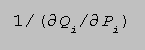 is a measure of how much Pi must
change in response to a change in Qi in a cet. par. price framework. This effect leads to a shift in the
demand for item 1 that corresponds to
is a measure of how much Pi must
change in response to a change in Qi in a cet. par. price framework. This effect leads to a shift in the
demand for item 1 that corresponds to  per unit change in Pi (measured at initial P1, P).
With fringe supply unchanged, this shift in total demand for item 1 would also be the shift in residual
demand facing a dominant collusive group. Thus D i1 provides a means of judging the comparative
effect of a change in Qi vs that of fringe supply of item 1 (namely unity) on the residual demand of
a collusive group of item 1 producers. It is easy to show, by differentiation of (2), that Di1 = Ri1, so
that the latter also can be given an interpretation in terms of residual demand.(29) In actual
applications, the "point" derivatives in (1) and (4) would usually need to be approximated by the sort
of "arc" concept that is used in the next proposed method.
per unit change in Pi (measured at initial P1, P).
With fringe supply unchanged, this shift in total demand for item 1 would also be the shift in residual
demand facing a dominant collusive group. Thus D i1 provides a means of judging the comparative
effect of a change in Qi vs that of fringe supply of item 1 (namely unity) on the residual demand of
a collusive group of item 1 producers. It is easy to show, by differentiation of (2), that Di1 = Ri1, so
that the latter also can be given an interpretation in terms of residual demand.(29) In actual
applications, the "point" derivatives in (1) and (4) would usually need to be approximated by the sort
of "arc" concept that is used in the next proposed method.
3.3 Mutual Overlap Method
In this approach, the key idea is to identify an overlapping zone of effective competition
between item 1 (some initial item) and a direct substitute, item i. The proposed method is analogous
to that of the GL in being based on small but significant non-transitory price changes (normally 5%
for the foreseeable future). However, price decreases from initial levels are employed in the present
method. Specifically, consider a small but significant and non-transitory decrease (SSNDP) in price
of item 1,  say, and let
  measure the corresponding change in quantity demanded for
a direct substitute item i (cet. par.)(30) Similarly, consider
measure the corresponding change in quantity demanded for
a direct substitute item i (cet. par.)(30) Similarly, consider  an SSNDP for item i and let
  measure the induced change in quantity demanded of item 1. Define an index of mutual overlap
(IMO)
measure the induced change in quantity demanded of item 1. Define an index of mutual overlap
(IMO)
by
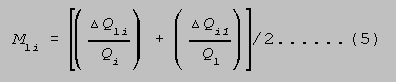
where Q1 and Qi are initial quantities of items 1 and i, respectively. As before, units are to be chosen to make all initial prices equal to one. Obviously, if items 1 and i are such close substitutes in all uses that each would lose all sales to the other in response to an SSNDP, then M1i = 1, and the capacity of item i would be treated as on a par with that of item 1. Otherwise, only the fraction M1i would be included. The intuitive appeal of M1i is clearer when both of the ratios in (5) are equal, say to . What if M1i is equal still but instead the first ratio equal .1 and the second .0, while the volume of item i sales is vastly larger than that of item 1.? Although it seems reasonable in those circumstances to include half of item i capacity in evaluating a merger involving item 1, inclusion of half of item 1 capacity in considering an item i merger may look excessive. However, since by assumption item i capacity is vastly larger than that of item 1, inclusion of even helf of the latter will make only a tiny difference to HHI's etc.
A market can be seen as a framework in which all of the forces of rivalry play out. Exclusive focus on prices (or even cet. par. residual demand) may be too narrow. A zone of competitive overlap identified by sales losses in response to SSNDPS would be more likely to indicate the extent that sellers feel their fortunes are intertwined, and rivalry of all sorts (including advertising, etc.) thereby affected.
4. Comparative Evaluation of Methods
4.1 General Considerations
Formidable obstacles stand in the way of scientific evaluation of market definition techniques for merger analysis. First, the effect of market definition will depend on the later steps in the analysis. Even if, as in this paper, it is assumed that the later steps would be as specified in the GL, precise effects of changes in market definition technique on decisions as to whether to challenge a merger are difficult to establish. Furthermore, even if they could be established precisely, the societal impacts would vary with the appropriate oligopolistic model and would depend on what goal of antitrust policy was being examined. In these circumstances, evaluation may have to rely on crude proxy measures and content itself with indicative rather than conclusive evidence.
4.2 Theoretical Results Relating to the PER
The equivalent-effect method can be related to the standard expression for price-cost margins in an oligopolistic industry, namely

where PCM is the cross-firm average price-cost margin weighted by sales, H is the HHI, the cet. par. own-price elasticity, and a constant conjectural variation (cv.) relating total to firm output changes. In the case n = 2, Equation (6) generalizes (see Appendix B) to the framework given by (2), as

where PCM1 is the sales-weighted average price-cost margin for sellers of item 1, H and
are as defined above (for item 1), e1 is the inverse-demand elasticity 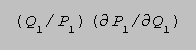 corresponding to (2), and
 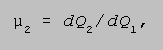 is the change in output of item 2 conjectured by firms
selling item 1, per unit change in Q1.(31)
is the change in output of item 2 conjectured by firms
selling item 1, per unit change in Q1.(31)
Although (7), like (6), is an endogenous relationship and, as such, does not lend itself easily
to comparative-static analysis, this has not prevented (6) being used to bolster the case for regarding
higher values of H as likely to be associated with higher PCM values. Equation (7) can be used in
the same spirit and, with appropriate caveats, extended to relate R 21, to PCM1. The key here is to
note that it is natural to assume that  (in the absence of coordinated action or cross-ownership of items 1 and 2). Thus, for example, a contraction in Q1 would be expected to lead to
an expansion of Q2. This is certainly implicit in the standard model behind (6) in which P2 is
assumed fixed as Q1 varies. With a given negative value of 2, it is evident that the larger is R21 the
smaller will be PCM1 (assuming other terms in (7 ) are unchanged). It can also be argued that 2
itself could be expected to be absolutely smaller when there are fewer competitors selling item 2.
This is certainly an implication of simple linear Cournot and Stackelberg models of competition in
item 2 when one examines the shifts in equilibrium output associated with demand shifts (see
Appendix B).(32) The implication of low absolute 2 when concentration levels in item 2 are high is
that, for given R21 (and H1 1 e1), (7) indicates a higher PCM1. Consistent with this, for a given R21
and H1, a higher H2 (HHI in item 2) would imply a higher adjusted HHI for the proposed method,
which is given by
(in the absence of coordinated action or cross-ownership of items 1 and 2). Thus, for example, a contraction in Q1 would be expected to lead to
an expansion of Q2. This is certainly implicit in the standard model behind (6) in which P2 is
assumed fixed as Q1 varies. With a given negative value of 2, it is evident that the larger is R21 the
smaller will be PCM1 (assuming other terms in (7 ) are unchanged). It can also be argued that 2
itself could be expected to be absolutely smaller when there are fewer competitors selling item 2.
This is certainly an implication of simple linear Cournot and Stackelberg models of competition in
item 2 when one examines the shifts in equilibrium output associated with demand shifts (see
Appendix B).(32) The implication of low absolute 2 when concentration levels in item 2 are high is
that, for given R21 (and H1 1 e1), (7) indicates a higher PCM1. Consistent with this, for a given R21
and H1, a higher H2 (HHI in item 2) would imply a higher adjusted HHI for the proposed method,
which is given by

where 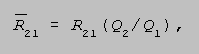 (see Appendix C).
4.3 Illustration of IMO Approach
Both of the proposed methods would include fractions of each (significant) substitute's capacity.To see what this implies in practice, it is helpful to give an example involving the IMO.
Consider a proposed merger between two Atlanta widget manufacturers. Assume that all widgets are physically identical but are sold either f.o.b. Atlanta or f.o.b. Indianapolis.(33) Assume further, that there are absolutely no alternative products which customers could substitute for widgets. The mutual overlap approach would start with analysis of the impact of a price decrease f.o.b. Indianapolis on the group of all U.S. customers. In this simple case there is no doubt, because of homogeneity, that the initial product should be taken as widgets, and that all sellers at Indianapolis can be assumed in general to offer widgets at the same f.o.b. price, pi say.(34) Consider the response of a customer located at X to a test level (5%), decrease in pi sustained for one year, assuming other things constant (including the Atlanta f.o.b. price, pa say). In theory, the only customers that would switch from Atlanta to Indianapolis as a result would be those for which
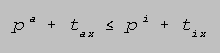
but at the same time

where tax is the per-widget cost of transportation from Atlanta to X, and tix is the analogous cost from Indianapolis.(35) In the special case where transportation cost is exactly proportional to distance (measured in a plane), the selling areas of Atlanta and Indianapolis producers would be separated by a hyperbolic curve as in Figure 1.(36)
Customers at locations nearer to Atlanta than the hyperbola will purchase from there; those on the other side will buy from Indianapolis. When the f.o.b. price at Indianapolis is reduced by 5%, the corresponding hyperbola is shifted nearer to Atlanta as shown in Figure 2. Customers located between the hyperbolae are those that switch to Indianapolis in response to the price decrease.
In the figure, i represents Indianapolis, a Atlanta. The hyperbolic curve Ho represents the locations to which transport cost differences between i and a exactly equal the f.o.b. price differential. Taking pi > pa and choosing units so that per unit transport cost is equal to one, point Z is at a distance
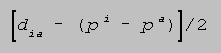
from i, where dia is the distance between i and a. If pi = pa, Ho would be a straight line, at right angles to ia and Z would be equidistant from i and a. It is assumed that, initially at least, the price differential is less than the transport cost between i and a (otherwise one producer group could make no sales).
In the figure, Ho is as in Figure 1; H1 is the corresponding curve when Indianapolis price if lowered. The zone of resultant customer switching from Atlanta to Indianapolis is indicated by the hatched area between Ho and H1. One of the ingredients in (5) is the proportion this switching represents of initial Atlanta sales.(37) If the initial price differential and transport costs between i and a are both small, the postulated 5% drop in pi might move H1 to the other side of a, indicating, in fact, that no sales would be made by Atlanta producers. If a similar loss of all sales would be experienced by Indianapolis producers in response to a 5% reduction in pa, the corresponding Mia in (5) would be unity, and i and a capacity would be treated as on a par. (Otherwise i capacity would be discounted in treating a merger of Atlanta producers.)
In this example, the sole factor which differentiates Indianapolis from Atlanta widgets is transport costs. It nevertheless illustrates the important general principle that, for some customers, two items may be excellent substitutes, while for others they may be very poor. Rather than treat them as totally equivalent or totally dissimilar -- as the GL all-or-nothing approach does -- the proposed alternative seeks to identify a relevant overlapping zone where competition among them is strongest.
Another way to visualize the greater intensity of competition (among Indianapolis and Atlanta producers) between Ho and H1 (in Figure 2) than exists at a or i is to imagine the competitive strategy that might be adopted by a monopolist producer at Indianapolis that was considering differentiating its product in an attempt to switch custom away from Atlanta. Given a uniform density of customer distribution, any such competitive effort would obviously be more likely to succeed in the zone between Ho and H1 than at Indianapolis itself. It follows that such competitive efforts are more likely to occur near the boundary zone and that only the portion of Indianapolis capacity corresponding to sales near that zone can be taken as fully competitive with Atlanta capacity.
A similar point can be made by positing several production locations (in addition to Indianapolis) which compete with Atlanta. For example, if Baltimore and Dallas were also centers of widget production, the customer area in which Atlanta was the low-cost source would, under the conditions of Figure 1, be bounded by three hyperbolic curves -- one for each competitive location. The alternative method's inclusion of only part of Indianapolis capacity as being relevant to analysis of effects of Atlanta mergers can also be rationalized by saying that it reflects the fact that Indianapolis capacity is simultaneously involved in competitive struggles on two other fronts (with Baltimore and Dallas), so that it would be unrealistic (as GL might effectively do under the all-or-nothing rule) to assume that it is fully concentrated on competition with Atlanta. This point would be most obvious if DOJ or FTC were faced at the same time with analysis of three separate widget firm mergers -- one in each of the cities that compete with Indianapolis.
4.5 Possible Problems with Proposed Methods
Although both proposed methods (implicitly) allow for the "distraction" factor just discussed, they are open to the objection that they do not guarantee that the markets they generate are subject to the exercise of market power, as the latter is defined in the GL approach. What they do is simply to assemble all the (significant) direct substitutes for an initial item, with the fraction of each substitute's capacity to be included being determined by the specified concept of the degree of similarity of the items. Consider what would happen if the GL procedures, other than market definition, were to be applied to the markets generated by the proposed procedures. Would the proposed methods fail to challenge a merger that presented a serious risk of diminution of competition? This would seem to be possible only if the expansion of the market via inclusion of significant direct substitutes is judged to misrepresent real competitive constraints. However, it is difficult to imagine cases in which, e.g., the GL method would confine the market to the initial item (because of profitability of an SSNIP 5%) and yet either of the proposed alternative methods would bring in sufficient fractions of substitute capacity to expand the market substantially.
What of the opposite error, namely challenge to a merger that poses no real threat to competition? This could happen if the market defined by an initial item and appropriate fractions of direct substitutes gave a distorted picture, e.g., of relevant levels of or changes in HHI's. It is conceivable that the item plus direct substitutes as a group are so constrained by indirect substitutes that the merger would be harmless. One way to mitigate this objection is to include in the definition of the initial item all things that are so close substitutes that each would lose (nearly) all sales to the other in response to SSNDP'S. When that is done, some indirect substitutes would then be regarded as direct. With that amendment, it is possible to meet the objection head-on by simply refusing to challenge any merger where a monopoly producer of all items in the market as defined could not profitably impose an SSNIP.(38) This seems preferable to the GL alternative which might expand the market using a chain of indirect substitutes and itself is not guaranteed to avoid a challenge to the merger.
On a final topic, it may be objected to the IMO method that the SSNDP concept it uses is arbitrary. This is true, but exactly the same objection is valid for the GL SSNIP. The PER approach avoids this problem in theory. However, it is open to the objection that the "point" concepts involved (even though approximated by corresponding "arc" concepts) have only a local validity.
It may seem that the PER approach requires more precise knowledge of direct-demand derivatives than do the GL. However, both for determining maximal profitability and the NBS, the GL also need at least approximations to the sort of derivatives in Eq. (4) above.
5. Conclusion
Given lack of agreement on goals of the antitrust laws(39) and the plethora of models of
oligopolistic behavior, it would be surprising if any market definition technique for merger analysis
were to be regarded universally as best. All that can be realistically expected is a method that, based
on most models, would normally advance the most important goals. Two such methods have been
presented. Unlike the GL procedure, the methods suggested avoid discontinuities and the need for
cost data, and are more reflective than the GL of direct competition, whose lessening is the concern
of 7. Adoption of either alternative method would not require any changes in the other steps of the
GL merger evaluation process.
A.1 Determination of the Product Dimension
In determining the product dimension, the first step is to consider an item supplied by a
merging firm.(40) The next step is to select a relevant customer group -- one whose members could
all acquire the item on essentially equivalent terms (a concept more fully explained in the discussion
of geographic boundaries in A.2 below). The third step consists of deciding on a list of items that
are so highly interchangeable (by the customer group) with the initial item that they could all be
regarded jointly as the initial product. The determination of adequate inter changeability for this
purpose is accomplished as follows; first, a "significant non-transitory" decrease (say 5% for one
year) in the price of the item to the customer group is postulated cet, par. (i.e., holding constant all
other terms, all other prices, and all quantities of products in which the item might be an input);(41)
next a list is assembled of all items for which demand by the customer group would be replaced
entirely through switching to the original item subject to the price decrease; finally, an item from this
list is included in the initial "product" if an equal non-transitory percent decrease in its price cet. par.
would cause all demand by the customer group for the original item to switch entirely to that item
as a substitute.
These steps are designed to produce as an initial "product" a group of items that have virtually the same uses (as far as the relevant customer group is concerned) and are
regarded as extremely good substitutes in all of these uses. Prices of such items are likely to move
very closely together.(42)
A.2 Geographic Aspects
The essence of the proposed method will be illustrated by considering in turn the cases of
delivered pricing and f.o.b. origin pricing. "Delivered pricing," as used here, connotes any
arrangements other than f.o.b. origin pricing. In addition to situations where suppliers offer the same
delivered price to all customers whereever located in the continental U.S. (CONUS) -- an
arrangement called uniform delivered pricing here -- there are cases in which producers offer the
product for sale at locations other than their origin, and generally at different prices. These are,
effectively, delivered prices for customers able to use the product at a delivery point, such as
Chicago, say; however, for other customers, the effects might be more similar to an "f.o.b. Chicago"
arrangement.
A.2 (i): Delivered Pricing
A customer group with respect to a product of a merging firm is defined as those that could
usefully acquire the product of the merging firm on the same terms.(43) "Usefully" here is intended
to convey the idea that the terms in question would not be dominated by other more favorable terms.
For example, it is not of much use for a factory manager in Chicago to be able to purchase a gidget
in New Orleans for $2.00 when one of like quality can be purchased in Chicago for $1.50. Indeed,
if transportation costs for a widget were $1.00 between the cities, the New Orleans option would not
be of any use to the manager in question even if price there were $1.50 and that in Chicago $2.00.
If the product is sold on a delivered basis at different prices in different places, the groups of
customers that might usefully take delivery in each such place would be treated separately.
A.2 (ii): F.o.b. Origin Pricing
In case the merging firm offers its product f.o.b. origin on the same terms, to all comers, each location from which it is sold would be treated separately -- as in the GL approach. The customer group would be taken as all U.S. purchasers. The key insight in understanding the approach is that, to a customer located in Detroit, a widget in Chicago is not the same as a widget in Pittsburgh, although one might be a very good substitue for the other, depending on transporation costs and conditions.(44)
As stated above, in practice, the determination of product and geographic dimensions of the
market needs to be done simultaneously. In the proposed method, the controlling principle is first
to identify the relevant customer group, and to select an "original" item produced by a merging firm
and an associated location. The effective initial item is then constructed by grouping all
product/location combination for which the Index of Mutual Overlap (as defined by Equation (5)
above) with the original item has a value of unity for the customer group in question. In deciding
which direct substitutes to include, it would be reasonable to ignore those whose effects are
negligble. For practical convenience, consideration could be limited to substitutes for which the
IMO (or PER) exceeded some arbitrary lower limit, 0.1 say.
B.1 Generalization of Eq (7).
Consider an inverse-demand system for n items:
 (B1)
(B1)
Assuming that the ith firm that produces item 1 has constant marginal cost C1i, then the first-order condition for a profit maximum is:
 (B2)
(B2)
The can be written:

(B3)
Where dQ1 / dq1i = 1, say is a standard conjectural variation (cv), while
dQj / dQ1 = j, say, is a cv representing conjectural changes in output of the jth item in response to a change in Q1. Multiplication of (B3) by q1i (P1 /Q1) and summation over i leads to
 (B4)
(B4)
B.2 Comparative Statics in Simple Cases
This section briefly summarizes some comparative static results in Cournot and Stackelberg
models which have relevance to possible correlation between j (as defined in B.1 above) and n,
the number of sellers of item j.
It is assumed throughout that the cet. par. inverse demand for item j is given by
Pj = aj - bjQj. To study the effects of changes of Q1 on equilibrium Qj in these models it is necessary
to look first at the expected effects of changing Q1 on aj (or bj) and then at the effects of changing
aj (or bj) on equilibrium Qj. It is expected that a decrease in Q1 would have a positive impact on aj
and (normally) a negative effect on bj. If all firms have the same linear marginal cost c + dq, then
the Cournot equilibrium output for n firms is given by  ,
,
and it is easy to verify that  both increase with n (if c, d > o).
Similarly, although the the equilibrium output in an n-firm Stackelberg model with the same
parameters is given by a messy expression, it is easy to show that
both increase with n (if c, d > o).
Similarly, although the the equilibrium output in an n-firm Stackelberg model with the same
parameters is given by a messy expression, it is easy to show that 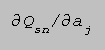 increases with n. The
effect on
increases with n. The
effect on 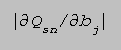 of increasing n is only easy to establish if d = o, in which case it increases
with n.
of increasing n is only easy to establish if d = o, in which case it increases
with n.
As noted in the text, the results of this section add plausibility to the hypothesis that the
conjectural variation 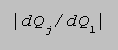 is an increasing function of n.
C.1 Computation
The discussion is based on the PER method, but would apply to the MOI approach if Rj1 were replaced throughout by M1j . It is assumed, for simplicity of exposition, that there is no cross-product overlap of firm ownership. Assuming that quantities are used as proxies for capacities, the adjusted HHI to apply to analysis of a merger involving a firm selling item 1 is given by (45)
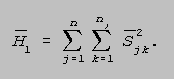 (C.1)
(C.1)
where,
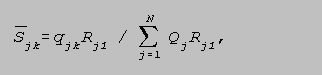 (C.2)
(C.2)
qjk being the output of the kth firm selling item j, while 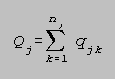 (nj being the number of firms
selling item j).
(nj being the number of firms
selling item j).
C.2 Properties
To understand the adjusted HHI, it is useful to study its relationship to the underlying HHI's. It is easy to show that, for n = 2,
 (C.3)
(C.3)
where  are the usual HHI's in items 1 and 2, respectively.
The following properties follow directly from Eq. (C.3)
a. If 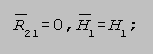
b. If 
c. If 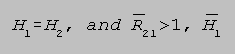 is increasing in
  .
.
If 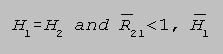 is decreasing in
which together imply that 
gives the smallest value of 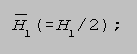
d. As 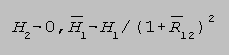 which decreases in
e. 
f. Since 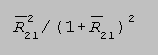 increases with
  so does the relative weight of
H2 compared to H1.
so does the relative weight of
H2 compared to H1.
Bork, R. (1978) The Antitrust Paradox.
Dorward, M. (1982) "Recent Developments in the Theory of Spatial Competition and their Implications for Industrial Economics" J. Indust. Econ. 31, 133.
Greenhut, M, Greenhut, J. and Li, T. (1980) "Spatial Pricing Patterns in the United States" Quart. J. Econ. 94, 329.
Harris, R. and Jorde, T. (1984) "Antitrust Market Definition: An Integrated Approach", Calif. L. Rev. 72, 1.
McElroy, F. (1977) "Scale, Substitution, and Utilization Effects of Investment Tax Incentives"
Atlantic Econ. J. 5, 24.
McElroy, F. (1985) "Price and Welfare Effects of Dominant Firm Mergers" Journal of Economics
45, 115.
Murata (1977) Mathematics for Stability and Optimization of Economic Systems.
Okuguchi, K. (1978) "Equilibrium Prices in the Bertrand and Cournot Oligopolies" Journal of Economic Theory, 42, 128.
Ordover, J. and Willig, R. (1993) "Economics and the 1992 Merger Guidelines: A Brief Survey"
Review of Industrial Organization 8, 139.
Phlips, L. and Thisse, J (1982) "Spatial Competition and the Theory of Differentiated Markets:
An Introduction" J. Indust. Econ. 31, 12.
Pitofsky, R. (1990) "New Definitions of Relevant Market and the Assault on Antitrust" Columbia Law Review 90, 1806.
Posner, R, (1976) Antitrust Law, 125-133.
Stigler, G. (1982) "The Economists and the Problem of Monopoly" 72 Am. Econ. Rev. (Pap. & Proc), 72, 1.
Simons, J. and Williams, M. (1993) "The Renaissance of Market Definition" Antitrust Bull (Winter), 799.
Vives, X (1985) "On the Efficiency of Bertrand and Cournot Equilibrium with Product Differentiation" Journal of Economic Theory 36, 166.
Werden, G. (1983) "Market Delineation and the Justice Departments Merger Guidelines" Duke Law Journal 514.
1. 384 U.S. 563 (1966).
2. See Harris and Jorde, Posner.
3. Stigler (1982).
4. See, e.g., Werden. For more recent examples, see Ordover and Willig; Pitofsky; Simons and Williams.
5. U.S. Dept. of Justice Merger Guidelines, 47 Fed. Reg. 28, 493 (1982), U.S. Dept. of Justice Merger Guidelines, 49 Fed. Reg. 26, 823 (1984), U.S. Dept. of Justice and Federal Trade Commission, Horizontal Merger Guidelines reprinted in Review of Industrial Organization (1993) 8, 231-256, hereinafter cited as Guidelines (GL).
6. Although presented in terms of inverse demand, Ros can be expressed simply in terms of direct demand derivatives. See part 3, below. It should be noted that the GL approach also requires knowledge of these derivatives.
7. Although, the two interpretations are similar in providing metrics for translating the capacity of a substitute into an equivalent-effect capacity of the original item, for other than limitingly small changes they would lead to divergent results.
8. U.S. v. E.I. duPont de Nemours Co., 351 U.S. 377 (1956), where "reasonable interchangeability" is introduced.
9. The NBS "...refers to the alternative which, if available in unlimited quantities at constant prices, would account for the greatest value of diversion of demand..." in response to a SSNIP (GL n.9).
10. See Ordover and Willig. The GL are ambiguous about which price increases should be used to measure the NBS. It seems clear that SSNIP's should be used for products of a merging firm but it seems possible that profit-maximizing increases are used for other products.
11. On the other hand, it may be that a joint increase of PA = 6%, PB = 4% would be optimal, in which case A and B would be a relevant group. See Ordover and Willig.
12. 7 Clayton Act, USC 18
13. See GL n.10. The GL also seem to rule out scale effects of input price increases: "...buyers likely would respond...only by shifting to other products..." GL 1.11
14. GL 1.0. After the market is defined, the GL allow for analysis of competitive effects and entry including possible changes in terms of sale of other products: See GL n.10.
15. It should however be noted that adding B to A will not always render the merger less likely to challenge under the GL. Thus, even though the merging A producers share of the larger total would always be lower (assuming they do not produce B also) non-merging A firms may have sufficiently high shares of B supply to increase HHI sufficiently to trigger a challenge.
16. It is assumed here that the merging A firms supply neither B nor C. Differences in initial price-cost margins as between B and C supply could produce the profitability differential hypothesized.
17. See GL 1.11
18. It is apparent from that above examples that the GL procedure - by focusing only on next-best-substitutes, yet allowing substitutes of substitutes -- can violate through being both too narrow and too broad, the Brown Shoe principle that: "the boundaries of the relevant market must be drawn with sufficient breadth to include the competing products of each of the merging firms and to recognize competition where in fact competition exists." (Brown Shoe Co. v. U.S. 370 U.S. 294 (1962))
19. Similarly large swings could result from small delays in evaluating the merger: small price (or wage) changes, or introduction of new products which were only slightly substitutable, could tip the balance on profitability and lead to a greatly changed market.
20. The agencies do consider (See GL 1.522) in an unspecified manner the difference between the last product included and the best excluded substitute, which might in some instances mitigate the effects of discontinuity of definition.
21. However, "In measuring a firm's market share, the Agency will not include its sales or capacity to the extent that the firm's capacity is committed or so profitably employed outside the relevant market that it would not be available to respond to an increase in price in the market." (GL1.41)
22. The alternative market definition methods proposed in Part 3 automatically allow for this "distraction" effect. It can be modelled formally by assuming p is the probability of an "emergency" on any individual front in a given time period. Even if simultaneous emergencies on different fronts are independent, it is easy to show that the probability of more than one simultaneous emergency increases with the number of fronts.
23. In addition, language describing delineation of spatial boundaries is couched in terms of f.o.b. origin pricing -- although the majority of pricing in the U.S. has probably not been of this type. See Greenhut et. al., Phlips and Thisse. Dorward explains how, even in an oligopolistic setting, the force of competition may cause the abandonment of any attempt at f.o.b. pricing.
24. It is not claimed that these outcomes are certain to happen under the GL procedure, only that they are realistic possibilities.
25. That this is not required by existing practice can be confirmed by reading Ordover and Willig at p. 140.
26. The problems of determining an initial product and location in practice are discussed in Appendix A. Practical difficulties of implementation are compared to those of the DOJ method in Part 4 below.
27. As judged by customers of the original item. Details of determining which items are direct substitutes are discussed in Appendix A.
28. Appendix C discusses the role Ri1 plays in computing individual firms' shares in an HHI that reflects all (significant) direct substitutes for item 1.
29. The equality of Ri1 and Di1 is one basis for assuming Ri1 < 1, since under normal conditions Di1 < 1. See e.g., Okuguchi, Vives. A direct proof can be based on Murata p. 127.
30. As in GL, the prices and other terms of sale of all other related items and the quantities of products in which any of the items are inputs are held constant.
31. Generalizations of (7) to n > 2 are discussed in Appendix B.
32. It is assumed that there is no explicit cross-product collusion.
33. It is assumed that there are no other production locations.
34. Capacity constraints could, of course, allow firms to charge different prices under certain conditions; this complication is ignored here since the customer group is supposed to be on the same footing as to terms (see Appendix A). Discrimination in price would require the recognition of more customer groups.
35. "Transportation" may include ancillary services or insurance, etc.
36. The reason for this is that, if the transport cost per unit distance is c, then customers at X would purchase from Atlanta if pa + c.d.ax < pi + c.d ix where dax'dix are planar distances from X to Atlanta and Indianapolis. Customers would be indifferent between the two locations where

or

Now, a hyerbola is the locus of a point that moves so that the difference between its distances
to two fixed points is constant; the last equation states exactly such a condition.
37. The other is the same thing with the roles of Atlanta and Indianapolis reversed. The switching of sales involved could be illustrated by hyperbolic figures similar to Figs. 1, 2.
38. Of course, it is possible that it is because of a dominant firm that the market price is already so close to a monopoly price that no SSNIP would be profitable. If that is the case, it would be appropriate to allow mergers not involving the dominant firm. As shown by McElroy (1985), dominant-firm acquisitions of fringe firms are likely to be welfare-reducing under standard conditions and probably should be disallowed even when the further lessening of competition involved is small.
39. See e.g., Bork, Pitofsky.
40. What constitutes "an item" will be discussed below; it might be noted that the GL speak of commencing the analysis with a product "narrowly defined" -- without further explanation.
41. The "product" in which an item is an input is to be understood as a broad enough concept to embrace minor design changes such as might be caused by switching to inputs of slightly different shape or size than the item in question. One reason for assuming quantities of such products fixed is that reduction of demand due to complete abandonment of satisfaction of a use, (consequent on a product price increase) while it certainly affects measurement of the degree of market power, does not help in identifying substitutes for the product in question. In other words, scale effects of the input price changes are ruled out; only substitution effects are measured. See, e.g., McElroy (1977).
42. From this perspective, it should not make much difference whether the starting "item" is joined at the outset of the analysis to other items that are certain to end up in the initial product grouping.
43. It is assumed for simplicity, that the same customer group is defined for each item in the initial product grouping.
44. If "Chicago" producers are somewhat widely scattered around the Chicago area, "selling f.o.b. Chicago" may need to be more precisely defined. Should this be the case, the procedure discussed above in A.1 for defining what items comprise the initial "product" would be followed. Under f.o.b. origin pricing, spatially separate suppliers of a physically homogenous product are analogous to firms offering items that are differentiated varieties of some product group. The method in A.1 essentially lumps together those that would lose all sales to each other consequent on a small relative price increase.
45. It should be noted that R11 = 1.