
First Draft: September 29, 1995
Last Revised: October 29, 1996
1:59 pm
This essay explores why firms would want to practice
vaporware -- the issuance of intentionally false product
announcements. In my model, a firm is able to release an upgraded
version of its original product. However, consumers do not know
the date at which the upgrade will first become available. A
firm that is successful practicing vaporware steals market share
from its competitor and earns greater profits than if consumers
had perfect information. A firm that would release an upgrade
at a relatively early date will issue only true announcements
about the product's release. Firms that release upgrades at later
dates will practice vaporware only if consumers believe they will
make truthful announcements. Successful vaporware is equivalent
to a firm cashing in on its reputation for making truthful product
preannouncements.
I would like to thank Eric Rasmusen, Anjan Thakor,
Tom Lyon and Wayne Winston for their helpful comments and suggestions.
This paper also benefited from the Business Economics seminar
at the Indiana University School of Business. This paper is from
my doctoral dissertation, "Essays in Credible Commitment
Mechanisms". All errors are my own. The views expressed
in this paper are those of the author and do not necessarily represent
the views or policies of the Federal Trade Commission or any individual
Commissioner.
The author prepared this paper for a symposium on
The Economics of Antitrust Enforcement for the 71st Annual WEA
International Conference, July 1, 1996, for a session jointly
sponsored by WEA International and Antitrust Bulletin.
This file was converted to WordPerfect 6.1 from its original AmiPro 2.0 format. Paragraph and character styles do not convert accurately between the two programs. Therefore, some letters that are Greek text in the original file may appear as English text in the WordPerfect file. Similarly, while all variables in the original file were italicized, some are italicized in the new file while others are not. I have attempted to correct for these discrepancies wherever I could find them. However, to the extent that I may not have found all of them, the following notes apply.
There is no difference intended between italicized variables and un-italicized variables (i.e. c is equivalent to c).
The Greek letters ", $ and 0 sometimes appear as a, b and h, respectively.
Subscripts and superscripts may appear as normal text (i.e. PtA appears as PtA or PtA).
I apologize for any inconvenience or confusion these inconsistencies
may cause.
vaporware: promised software that misses its announced
release date, usually by a considerable length of time -- Microsoft
Press Computer Dictionary, 1991.
I. Introduction
Recently, in United States of America v. Microsoft Corp., the practice of "vaporware" has been thrust into the public eye. Parties opposed to the consent decree asked the District Court to compel the Justice Department into investigating allegations that Microsoft makes false and misleading "preannouncements" of its products in an attempt to gain market power. Certainly computer software manufacturers make announcements that are ex post false. One need only look at the various trade publications to find examples of computer software for which introduction has been delayed past its initially anticipated date.
While "vaporware" is a relatively new term, product preannouncements have been part of antitrust case history for some time. One of the central accusations in United States v. IBM was that IBM gained market power by announcing its new computer systems while they were still early in development. The contention is that preannouncements make consumers want either to delay their purchase of a rival's good or to join the customer base of the "offending" firm. However, for a preannouncement to violate antitrust laws, these announcements must be "knowingly false and contribute to the acquisition, maintenance, or exercise of market power." Therefore, a theory is needed to show when and how firms can benefit from making spurious announcements. This essay will show that, when consumers have incomplete information about the date at which a firm will be able to release a product upgrade, some firms will make false announcements about the upgrade's arrival unless consumers are unlikely to believe such announcements.
The presence of false or misleading announcements is not new to the economics literature. Crawford and Sobel (1982) develop a model in which a Sender transmits imprecise (but not false) messages to a Receiver in a Nash bargaining game. Stein (1989) shows that this "cheap talk" mechanism explains policy announcements made by monetary authorities. Farrell and Saloner (1986), hereafter F&S, develop a model that explains preannouncements in the presence of network externalities. F&S consider a game of symmetric information in which a firm may preannounce a forthcoming product. Products in this market exhibit network externalities where the new product's network is incompatible with the old. By preannouncing the product, the firm is able to induce some consumers to delay purchasing the original good.
Preannouncements in F&S are not, however, vaporware, in the least favorable sense of the word -- intentionally false. Consumers believe all announcements are true, and they are correct. For a firm to practice vaporware, it must be willing to issue an announcement that consumers know is not true. Consumers can only be susceptible to such an announcement if they have incomplete information about when the firm is capable of delivering an upgrade to the market. Landis and Rolfe (1985) postulate that when a firm repeatedly makes mistaken forecasts of product availability, intelligent consumers will discount these forecasts. They speculate that consumers can be fooled by a false announcement but once -- that a firm continually making announcements that are later proven false will lose all credibility with consumers.
In the model below, the upgrading firm competes in a Bertrand duopoly game with a rival that does not upgrade. The firms' original goods are identical except each firm's good exhibits network externalities. That is, the more consumers who buy one particular firm's original good, the greater the utility each consumer receives from buying that firm's good. The two rival's networks are mutually exclusive.
Prior to the game, nature chooses the upgrading firm from one of three possible types. One type upgrades at date t=3, another upgrades at date t=4, and the last releases its upgrade at date t=5. When consumers know which type of upgrader is present in the market, the model arrives at the F&S result -- consumers join the upgrading firm's network in anticipation of the upgrade. This "bandwagon" effect means the upgrading firm gets a market share in excess of the standard Bertrand solution before its upgrade has been introduced. Therefore, if consumers do not know which type of upgrader they face, a firm that can upgrade at only a relatively late date has an incentive to falsely announce an earlier upgrade date and get consumers to join its network sooner than otherwise. New consumers will purchase the original good from the firm with the bigger network, and a firm successfully practicing vaporware will earn greater profits.
However, the profits of a firm that makes false announcements depend upon consumers' beliefs about the firm's type. When consumers realize a previous announcement was false, they update their prior beliefs about the upgrader's type according to Bayes' Rule. The less likely consumers are to believe an announcement, the less profitable it is for the firm to make that announcement. Therefore, whether or not a firm practices vaporware, and how successful it is when it does, depends upon consumers ex ante beliefs about the upgrader's type and upon their revised beliefs after they see a false announcement.
This paper is organized as follows. Section II describes the
model. Section III presents the results of the full-information
model. In section IV, the results of the game with incomplete
information are presented. Section V concludes the essay.
II. The Model
Consider an industry in which two firms produce a good with two periods of durability. Each firm's good exhibits network externalities: as more consumers own a firm's product, each consumer receives more utility from that product at the margin. Each firm's network is exclusive -- consumers of firm A's good do not receive network utility when another consumer purchases firm B's good. In the absence of network externalities, these goods would be perfect substitutes. The firms compete in prices, so the game they play is a simple derivative of Bertrand price competition.
Let firm A be able to offer an upgrade of its original durable good at some date T>1. The upgrade is a strict improvement over the original good. A's upgrade also exhibits network externalities. The upgrade's network is exclusive of the network for firm B's original good. The upgrade is also backwards compatible with firm A's original good -- consumers who own the upgrade receive network utility from both purchases of the upgrade and previous purchases of A's original good. Consumers who own only A's original good at the time of the upgrade do not receive network utility when other consumers purchase the upgrade. Firm B is never able to
release an upgrade. Each firm sets prices in each period to maximize the present value of its profit stream, given its rival's price. The marginal cost of production for all goods is c>0.
At the beginning of each period, a cohort of consumers of mass equal to one enters the market. These consumers are infinitely wealthy; they can pay any price charged for either A or B's goods. Consumers live for two periods. The present value to each consumer in cohort t of owning firm i's original good is:
where $0[0,1] is the discount factor, v is the base utility of the original good, and 0it > 0 is the per-period network utility accrued at date t from belonging to firm i's network. E signifies taking an expectation. 0it-1 > 0 indicates that some (or all or none of the) consumers born in the previous period, in Cohort t-1, have joined firm i's network. These consumers are the installed base for Network i at date t. Upon joining firm i's network, new consumers receive network utility conferred upon them by the installed base.
In equation (1), consumers receive the present value of two periods worth of base utility, (1+$)v. They receive network utility from the installed base, 0it-1 > 0. They further receive the present value of two periods worth of network utility from their own generation's purchases of firm i's good. Finally, they receive the present value of the expected increase in network utility from the succeeding generation's purchases at date t+1.
The present value to each consumer in cohort t from owning firm A's upgrade is:

when the consumer has not previously purchased an original good (i.e. is in the first period of life), and

when the consumer has already purchased an original good (is in the last period of life). The variable a represents the improvement of the upgrade over the original good. Consumers demand at most one unit of the original good and one unit of the upgrade. Consumers never make a purchase in the second period of their lives unless that is when the upgrade is introduced. Consumers will purchase from firm A if the present value of the expected utility net of prices is greater for firm A's good than it is for firm B's good. They will purchase from firm B if the opposite is true. If the expected net utility from each firms' goods are equal, consumers will be indifferent between buying A's good and B's good. In such a case, half of all consumers will buy from A and half will buy from B. Otherwise, the winner takes all. This means that, even though firm A's upgrade is strictly better than firm B's original good, consumers will still buy from B if A sets its price too high.
The game lasts an infinite number of periods. Both full information
and incomplete information regimes will be considered. When consumers
have incomplete information about when firm A will release its
upgrade, A is allowed to announce when its upgrade will be available.
An announcement may be made at the beginning of the game and
at the beginning of each period for which an upgrade might have
been expected, but was not made available. Table 1 shows the
order of play.
III. Full-information Equilibria
When consumers know for certain when an upgrade will be introduced by firm A, it should be expected that firm A will dominate the market beginning, at least, with the period immediately prior to the upgrade. From equation (1) we know that whether or not a consumer will buy A's original good today depends upon the expected increase in A's network size tomorrow. If consumers know that the upgrade will be available tomorrow, and the upgrade is strictly preferred to B's original at the same prices, then consumers should expect that A will "monopolize" the market after the upgrade. This, in turn, may lead consumers to believe that A will dominate the market prior to releasing the upgrade.
There are many possible subgame-perfect equilibria when consumers
are fully informed. In the equilibrium considered here, the upgrading
firm receives rents in the period immediately prior to its upgrade's
release. This is essential for vaporware to be practiced when
information is incomplete. If no benefits are received by the
firm prior to when consumers expect an upgrade to be released,
then there is no reason for a firm to lie about the release date.
Full-information Equilibrium: At date t=1, let consumers have
the following expectations about firm A's network size: E0At<T-1
= 1/2, E0At>T-1=1.
When consumers know the date, T, at which firm A will release
its upgrade, the following path of prices and outputs will be
a subgame-perfect equilibrium: PAt<T-1=c,
qAt<T-1=1/2, PBt<T-1=c,
qBt<T-1=1/2, PAT-1=1+$+c,
qAT-1=1, PBT-1=c,
qBT-1=0, PAt>T-1=(1+$)("v+2),
qAt>T-1=1, PBt>T-1=c,
qBt>T-1=0.
The proof that this equilibrium is subgame-perfect is in the appendix.
This equilibrium is analogous to the findings of F&S. If the upgrade were a "surprise" and the firm made no announcements, truthful or otherwise, the solution to this game in every period before the upgrade would be the Bertrand solution. In every period after the upgrade, the upgrading firm would monopolize the market. Consumers possessing perfect information about the upgrade's release date is equivalent to the firm making a truthful preannouncement as in F&S. In this model, as in theirs, consumers will join the upgrader's network en masse prior to the upgrade's release.
The profits to firm A in the equilibrium when the upgrade is available at date T are

if expectations are E0AT-1 =1. If expectations are E0AT-1 =1/2, then A's profits are:

Finally, if expectations are E0AT-1 =0, firm A's profits at any date t<T-1 will be:

The Full-information Equilibrium is not the only possible subgame-perfect equilibrium for the full-information game. In fact, there is an infinite number of equilibria because there is an infinite number of combinations of consumers' expectations across time. This is just one set of expectations, for which, when information is incomplete, firm A may practice vaporware, as will be shown later.
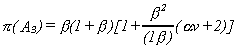
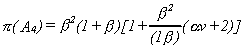
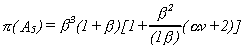
The set of expectations in the Full-information Equilibrium is a good candidate for vaporware when information is incomplete. Under these expectations, consumers reward the upgrading firm by purchasing its original good at a price above cost in the period prior to the upgrade's release. When information is incomplete, if a firm can fool consumers into believing that the upgrade will arrive sooner than it truly will, then the firm will earn economic profits during a period in which, if consumers were informed, its profits would be zero. Let AT represent a firm that releases its upgrade at date T. Then the following equations are the present-value of profits at date t = 1 in the subgame-perfect equilibrium for A3, A4, and A5:
IV. An Incomplete Information Equilibrium
In the incomplete information game, consumers do not know when firm A will release its upgrade. This is equivalent to saying that there are many possible types of firm A and each type upgrades at a different date. Consumers do not know which type of firm A they are facing. For simplicity, assume that there are only three possible types of firm A: one that upgrades at date 3 (A3), one that upgrades at date 4 (A4), and one that upgrades at date 5 (A5). Consumers know that there is a positive probability that the firm A they encounter is one of these three types. Let consumers believe that type A3 occurs at date t with probability xt, A4 occurs with probability yt, and A5 occurs with probability zt=1-xt-yt.
In order to convey its true type, firm A will issue an announcement at date t=1, and at any date at which an upgrade was expected by consumers but was not delivered. Firm A may issue a true announcement or a false announcement. "Vaporware" is a false announcement. Consumers may punish firm A for making a false announcement by changing their beliefs about firm A's true type. For example, at date t=1, consumers receive an announcement that an upgrade will arrive at date t=4. Upon seeing this announcement, consumers will revise their prior expectations about firm A's true type. If consumers' prior beliefs are x0=1/2, y0=1/3, and z0=1/6, an announcement of t1=4 may induce consumers to update their beliefs to x1=0, y1=2/3, and z1=1/3.
Consumers' beliefs about firm A's type serve as the firm's reputation. The more consumers revise their beliefs towards type A5 and away from type A3, the worse firm A's reputation. The firm cashes in on its reputation by making false upgrade announcements, as consumers revise their beliefs away from the firm's favor. The question to be answered is, will a firm practice vaporware when doing so will tarnish its reputation?
Equations (7) - (9) give the profits each type of firm A would earn under full information. These are also the profits these types of firm A would earn by making only truthful announcements. A3 has no incentive to make a false announcement; consumers know that there can never be an upgrade at date t=2 and it will never pay for the firm to announce a later upgrade date than is true (the price at the date prior to the upgrade will be lower after such a lie). Therefore, only types A4 and A5 are candidates for practicing vaporware. To successfully practice vaporware, firm A must make a false announcement of an upgrade that results in increased profits for firm A and consequently, reduced market share (and/or profits) for its rival, firm B.
There are four possible equilibria for the incomplete information
game specified here. These equilibria differ in the manner in
which consumers update their beliefs after seeing an announcement.
In the equilibria below, the set of beliefs {x0,
y0, z0} are consumers' a priori beliefs.
The set {x1, y1, z1}
specifies consumers' beliefs after they have seen the announcement
t1. Likewise, the set {x3, y3,
z3} specifies consumers' beliefs after
they have realized t1 is false at date t=3 and
have seen the new announcement t3.
Equilibrium 1: Let consumers have the following prior beliefs:
x0 >1/2 and y0 >1/3. Then at date
1, types A3, A4 and A5 will announce
t1=3. At date 3, types A4 will announce
t3=4 and A5 will announce t3=5.
The proof that this is a perfect Bayesian equilibrium is in the appendix.
When x0>1/2, consumers believe that a firm that announces t1=3 is of type A3 with high probability. Therefore, it is easy for the firm to fool consumers into thinking it is not types A4 or A5. That consumers believe the firm is type A3 with probability x0 is equivalent to 100x0% of consumers believing the firm is A3 with probability one and 100(1-x0)% of consumers believing the firm is one of the other types with probability one. Therefore, 100x0% of consumers will be willing to purchase firm A's original good at some price greater than marginal cost at date t=2. Recall that when consumers have full information, they are willing to pay a price above cost in the period prior to when they expect the upgrade to be released. Therefore, both types A4 and A5 will prefer to falsely announce an upgrade for date 3.
If at date 3 no upgrade is released, consumers realize that they have been fooled by the firm and revise their beliefs about the firm's type. If y0 >1/3, consumers believe that the firm is type A4 with a high probability. Therefore, 100y0% of consumers believe that the upgrade will be released at date 4 and are willing to pay a price above cost for the original good at date 3.
When consumers believe a false announcement of t1=3 came from either A4 or A5, type A5 will prefer to make a new true announcement of t3=5. At first, this may seem strange. After all, since y is relatively large, consumers are relatively susceptible to a false announcement. However, compare the price paths for A5 from each different set of announcements.
When y=1 in Table 2, the prices and quantities in each period are the same. However, when y is just slightly smaller than one and A5 announces t3=4, there is just enough uncertainty in consumers minds that the price and quantity are both lower than if the firm announces t3=5. A5 is better off revealing its true type in period 3 because the gain in network size from the first false announcement is sufficient to induce all consumers to purchase its good in period 3. The uncertainty generated by a second false announcement is undesirable.
In Equilibrium 1 consumers are trusting. In the following three
propositions, consumers are much more cynical; the firm's reputation
either starts out small, or suffers from a false announcement.
Equilibrium 2: Let consumers have the following beliefs:
x0 >1/2 and y0 <1/3. Then
at date 1, types A3 and A5 will announce
t1=3, and type A4 will announce t1=4.
At date 3, type A5 will announce t3=5.
The proof that this is a perfect bayesian equilibrium is in the appendix.
In Equilibrium 2, consumers initially believe that the firm is type A3 with a relatively high probability when they see an announcement of t1=3. However, upon realizing a false announcement at date 3, they revise their beliefs such that they believe the firm's true type is A5 with a relatively high probability. Therefore, A4 will not make a false announcement at date 1 because the punishment is too severe; there are very few consumers who will be willing to pay a price greater than marginal cost at date 3 for A4's original good. A4 then prefers to reveal its type at date 1 and announce an upgrade forthcoming at date 4.
Type A5 however, will prefer to mimic type A3
and initially announce an upgrade for date 3. A5 can
sell original units to 100x0% of cohort 2 consumers
at date 2 for a price greater than marginal cost. At date 3,
A's type is perfectly revealed because only type A5
will make a false announcement. However, because more than half
of all cohort 2 consumers purchased A5's original good,
A5's network is relatively large. Therefore, cohort
3 consumers will value A's original good more highly than B's
original good. So practicing vaporware pays handsomely for A5
under these beliefs. It has stolen enough market share by making
false announcements to guarantee that it profits even after its
true type is revealed at date 3.
Equilibrium 3: Let consumers have the following beliefs:
x0 <1/2 and y0 >1/3. Then
at date 1, type A3 will announce t1=3, and
types A4 and A5 will announce t1=4.
The proof that this is a perfect Bayesian equilibrium is in the appendix.
Because x0 is relatively small, type A4
prefers to reveal its true type and announce an upgrade for date
4. Type A5 would like to make two false announcements,
t1=3 and t3=4. However, because
type A4 would initially announce t1=4,
A5's type is revealed at date 3 when announcing t1=3.
Therefore, A5 will prefer to announce t1=4
and mimic type A4.
Equilibrium 4: Let consumers have the following beliefs:
x0 <1/2 and y0 <1/3.
Then at date 1, type A3 will announce t1=3,
type A4 will announce t1=4, and A5
will announce t1=5.
The proof that this is a perfect Bayesian equilibrium is in the appendix.
Here consumers believe that the firm is type A3 with a relatively small probability at date 1 and is type A4 with a relatively small probability at date 3. In other words, consumers are skeptical and firm A has a poor reputation. In this case, neither type A4 or A5 benefit from making a false upgrade announcement; consumers do not believe what they are told. Therefore, each firm will reveal its true type at date 1 and make only true announcements about the upgrade's release date.
From these four equilibria come the following propositions.
Proposition 1: Type A4 will only make a false announcement if consumers' prior beliefs about the firm's type are x0 > 1/2 and y0 > 1/3 (the firm has a good reputation for making truthful announcements). Otherwise, the firm will make only true announcements.
Proof:
When x0 > 1/2 and y0 > 1/3, as in Equilibrium 1, consumers believe that the probability of the firm's type being A3 is relatively high. When they see an announcement of t1=3 consumers do not revise their beliefs and type A4 can earn greater profits by falsely announcing t1=3. At date 3, when consumers realize that t1=3 was indeed false, they revise their beliefs such that x3=0. Since the prior probability that the true type is A4 is y0 > 1/3, the posterior probability for this type is y3 > 1/2, by Bayesian updating. At no time is A4's "reputation" tarnished with consumers -- at first its reputation is excellent, x0 > 1/2, and its revised reputation is good as well, y3 > 1/2. As can be seen from Equilibria 2, 3 and 4, if the firm's reputation is any less, either x0 < 1/2, y0 < 1/3 or both, then type A4 will only want to make truthful announcements. QED.
For large x0 and y0, consumers
place a high probability on announcement of t1=3
being made by type A3. Therefore, the benefits from
falsely announcing t1=3 are large for type A4.
Large x0 and y0 are equivalent
to firm A having a good reputation. Conversely, small x0
and/or y0 are equivalent to firm A having a
poorer reputation.
Proposition 2: Type A5 will only make a true announcement
if consumers' prior beliefs about the firm's type are x0
< 1/2 and y0 < 1/3 (the firm has
a poor reputation). Otherwise, the firm will make false announcements.
Proof:
When x0 < 1/2 and y0 < 1/3, as in Equilibrium 4, consumers believe that the probability of the firm's type being A5 is relatively high. If they see an announcement of t1=3 consumers do not revise their beliefs and type A5 cannot earn greater profits by falsely announcing t1=3. Similarly, if they ever witness an announcement of t=4 at any date, consumers will revise their beliefs about the firm's type such that x3=0. Since the prior probability that the true type is A4 is y0 < 1/3, the posterior probability for this type is y3 < 1/2, by Bayesian updating. This means that the posterior beliefs that the true type is A5 are z3>1/2. Under these beliefs the firm has a very poor reputation. Consumers believe that the firm is highly likely to be type A5 regardless of the announcement they receive. There is no benefit to A5 from making a false announcement when the firm's reputation is so poor. As can be seen from Equilibria 1, 2 and 3, if the firm's reputation is any better, either x0 > 1/2, y0 > 1/3 or both, then type A5 will prefer to make a false announcement. QED.
As in Proposition 1, for small x0 and y0
consumers place high probability on any announcement being made
by type A5. Therefore, the benefits from any false
announcement are small. However, if either x0
or y0 are relatively large, then there is not
enough of a deterrence to keep type A5 from making
a false announcement.
Proposition 3: Firm B's sales will decline if either A5
makes a false announcement or if A4 makes a false announcement
and x0 and y0 are large enough.
Proof:
Under perfect information, firm B's sales are one-half unit in each period until the date before the upgrade is expected. From date T-1 onward, firm B's sales will be zero. Therefore, if firm A's true type is A5, firm B would receive 1/2 unit of sales in each of the first three periods when A5 makes a true announcement or if consumers have full information. When consumers have incomplete information and x1 is relatively large, firm B will make sales of q1B=1/2 and q2B=1-x (see Equilibria 1 and 2) when A5 announces falsely. For any x1>1/2, firm B's sales will be less than full information. If x1 is relatively small but y3 is relatively large, as in Equilibrium 3, firm B's sales will be q1B=q2B=1/2 and q3B=1-y. Therefore, for any y1>1/2, firm B's sales will be less than full information. Then when A5 makes a false announcement, firm B's sales will decline.
In Equilibrium 1, A4 makes a false announcement. Firm B's sales will be q1B=1/2, q2B=1-x and q3B=1-y. If x+y>3/2, then firm B's aggregate sales will be less than the full information aggregate sales of 1 unit. QED.
In each period, firm B can sell at most one unit of its original good to the newly arrived cohort of consumers. Early in the game the two firms sell the "same" product and the upgrade is far enough away so that it does not influence the purchasing decisions of the current cohort of consumers. In these early periods, firms A and B will have equal market share (as predicted by Bertrand's paradox) provided that the is no exogenous impetus for consumers to all join one network as opposed to the other. When type A5 finds it profitable to make a false upgrade announcement, it will capture market share from its rival, B, in one of these "early" periods.
This is of particular interest when describing the antitrust implications of vaporware. First, for an announcement to be illegal according to antitrust laws, it must be intentionally false or misleading. Second, the announcement must enable the firm to acquire market power. Both of these conditions have been shown to occur in the theory.
Type A4 is never the only type that would be willing
to make a false announcement. Type A5 will always
find it profitable to make false announcements when A4
finds it profitable to do so. Therefore, the effect upon firm
B from type A4 making a false announcement in the first
period depends upon consumers beliefs about the announcement they
see in the third period. In period three, once consumers realize
that a false announcement was made in the first period, they revise
their beliefs about the firm's type. If they see a new announcement
of t3=4, consumers must remain skeptical about
the firm's type. Although Equilibrium 1 says that type A5
will announce t3=5, consumers' beliefs must
be consistent with the equilibrium. Therefore y3<1,
and (1-y)% of consumers will not buy from firm A at any
price greater than marginal cost when they receive the signal
t3=4. Depending upon the size of y3,
firm B's aggregate sales then may increase or decrease when type
A4 makes a false announcement. Therefore, it is possible
for the practice of vaporware to actually benefit the firm's rivals.
V. Conclusion
The better a firm's reputation, the more likely are consumers to believe a false announcement. Therefore, vaporware can only be effective in a market in which the offending firm makes announcements that consumers tend to believe: where the firm has a good reputation. When consumers do tend to believe a firm's announcements, a firm may issue false announcements that reduce its rival's market share. This brings to light two possible future considerations for models of vaporware. One extension of the model would be to allow firms to make multiple upgrades of its original good. In such a model, reputation effects would be even more apparent. Firms could build a reputation by releasing upgrades at the announced dates and eventually cash in on that reputation.
The second possible extension is to introduce uncertainty into the firm's upgrading date. For example, firm A4 may have an upgrade ready for release at date 4 with a 90% probability. However, there would be a 10% probability that this firm could not produce the upgrade until date 5. With such uncertainty, we might expect to see some firms making truthful announcements for a larger set of consumers' beliefs. Other types of firms, like A5, might be more inclined to practice vaporware when upgrade dates are uncertain because consumers might be more forgiving of a delayed upgrade. However, in any instance, vaporware can only be effective in a market where consumers do not punish false announcements.
This type of model also has applications to any situation in which a firm or an agent must make an offer or announcement to which it cannot commit, but receives some benefits prior to the realization that the offer was untrue. For example, a graduate student on the job market promising his dissertation will be complete by a particular date. Or, a manager promising a stock split or dividend in the coming quarter. All of these games have the same quality: false announcements are not realized until some time has passed and some benefit has been conferred. In each of these games, we should expect that the more skeptical the players receiving the announcements are, the less likely a false announcement will be made.
As for implications to antitrust law, this model would seem to
suggest that policy makers should punish firms that make false
announcements. However, because this model does not include the
possibility that firms may make honest errors in their announcements,
current policy with regard to product preannouncements should
not be changed. Currently, product preannouncements that prove
to be false must be shown to be made with the knowledge that they
would be false. While this essay suggests that firms sometimes
have an incentive to make intentionally false announcements, it
may be extremely difficult to prove in court such announcements
were made intentionally.
VI. Appendix
Lemma 1: Let T be the date at which A releases an upgrade. Consider any date t >T. Let the state be 0At-1 = 1, 0Bt-1 = 0. Let expectations be E0At = 1. Then the subgame-perfect equilibrium prices and quantities are: PtA=(1+$)("v+2)+c, qtA = 1, PtB = c, qtB = 0.
Proof:
Assume for simplicity that E0i t+1= E0it. A consumer in cohort t > T will prefer to buy A's upgrade over B's original good if

Otherwise, the consumer would prefer to buy from firm B. Consumers will be indifferent between these two choices when

If A sets its price low enough, PtA < (1+$)("v+2)+PtB, A will capture the entire market. Firm B will not make any sales any non-negative price. Even if B is willing to give its original good away, A can still set a positive price such that all consumers are willing to purchase its upgrade. Therefore, A will set PtA=(1+$)("v+2)+c, and make sales of qtA = 1, for per-period profits of (1+$)("v+2). Firm B will set PtB = c, and make no sales, earning zero profits per period. Given firm B's Bertrand-style pricing strategy, PtB < -(1+$)("v+2) +PtA, A can do no better under any other strategy. Any higher price and B will get all sales. Any lower price and A's profits will be lower. Likewise, given A's Bertrand-style pricing strategy, B cannot make any sales at any positive price. Therefore, this set of prices is a subgame-perfect equilibrium. QED
The present value of all profits for t>T for firm A is:

The present value of all profits for t>T for
firm B is zero.
Lemma 2: Consider date T. Let the state be 0AT-1 = y, 0BT-1 = (1-y) where y0(0,1). Let expectations be E0AT =1. Then the subgame-perfect equilibrium prices and quantities are: PTA = (1+$)"v+2(y+$)+c, qTA = 1, PTB = c, qTB = 0.
Proof:
There are y consumers who belong to firm A's network and are willing to pay at most PAT="v+1 for the upgrade. There are (1-y) consumers who belong to firm B's network and are willing to pay at most PAT=av+2y for firm A's upgrade. Consumers in cohort T will buy the upgrade from firm A if PAT < (1+$)"v+2(y+$)+PBT. It is easy to see that as $ goes to one, (1+$)"v+2(y+$)+PBT-c is greater than both 2("v+1-c) and (2-y)("v+2y-c), for y < 1/2, and (2-y)("v+1-c) and 2("v+2y-c) for y > 1/2. Therefore, A's best response to any price offered by B at date T is PAT < (1+$)"v+2(y+$)+PBT. Similarly, B's best response to any price offered by A is PBT < -(1+$)"v-2(y+$)+PAT. Therefore, even if B offered a price of zero all consumers would buy from A at a price greater than marginal cost. So B is indifferent between offering any price other than marginal cost. If A offers any price greater than PAT = (1+$)"v+2(y+$)+c, no consumer will buy. At any lower price, A's profits will fall. Therefore A will not offer any other price. The equilibrium is subgame perfect. QED.
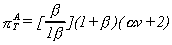
The present value of profits to firm A when y = 1 as given by Lemma 2 is:
The present value of profits to firm A when y = 0 as given by Lemma 2 is:

The present value of profits to firm A when y = 1/2 as given by Lemma 2 is:

Lemma 3.1: Consider date T-1. Let the state be 0AT-2 = y, 0BT-2 = (1-y) where y0(0,1). Let expectations be E0AT-1 =1 and E0AT =1. Then the subgame-perfect equilibrium prices and quantities are: PT-1A = 2y+$+c, qT-1A = 1, PT-1B = c, qT-1B = 0.
Proof:
Regardless of the firm from which cohort T-1 consumers choose to buy at date T-1, these consumers will not want to buy the upgrade at date T. Given their expectations about the increase in firm A's network size, consumers will buy firm A's original good instead of firm B's if y+(1+$)-PAT-1 > 1-y -PBT-1. Then A's best response to any price offered by B is PAT-1 <2y+$+PBT-1. Firm B's best response to any price offered by A is PBT-1 <-2y-$+PAT-1 . As long as marginal costs are not too large, firm A can always offer a positive price at which all consumers will prefer to buy A's original good. Then firm B cannot do better than to offer a price of marginal cost and sell zero units of the good, given firm A's strategy. B's sales will not increase from zero at any other price. Therefore, B is indifferent between a price of c and any other price. Given B's strategy, firm A will offer the price PAT-1 =2y+$+ c and sell one unit of its original good. Any higher price, and all consumers will switch to firm B's good. Any lower price and A's revenues will fall. These prices are then part of a subgame perfect equilibrium. QED.
Firm A's profits when y =1 from the equilibrium in Lemma 3.1 are:
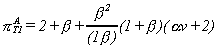
Firm A's profits when y = 1/2 in the equilibrium in Lemma 3.1 are:
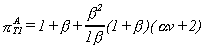
In Lemma 3.3, consumers in cohort T-1 know that they will not purchase the upgrade at the price A will set at date T. Therefore, these consumers do not need to make an additional, inter-temporal purchase decision; they are only concerned with the net utilities they will receive from buying the original good from either A or B. When these consumers expect A's network size to grow by 1 in the current period, they are willing to pay a premium for A's original good and will not buy firm B's good at any positive price.
Firm A's profits when y = 0 in the equilibrium in Lemma 3.1 are:
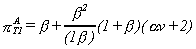
Lemma 3.2: Consider date T-1. Let the state be 0AT-2 = y, 0BT-2 = (1-y) where y0(0,1). Let expectations be E0AT-1 =0 and E0AT =1. Then the subgame-perfect equilibrium prices and quantities are: PT-1A = c, qT-1A = 0, PT-1B = 2(1-y)+$+c, qT-1B = 1.
Proof:
Regardless of the firm from which cohort T-1 consumers
choose to buy at date T-1, these consumers will not want
to buy the upgrade at date T. Given their expectations
about the increase in firm A's network size, consumers will buy
firm A's original good instead of firm B's if y-PAT-1
> 1-y +(1+$)-PBT-1.
Then A's best response to any price offered by B is PAT-1
<-2(1-y)-$+PBT-1.
Firm B's best response to any price offered by A is PBT-1<2(1-y)+$+PAT-1.
As long as marginal costs are not too large, firm B can always
offer a positive price at which all consumers will prefer to buy
B's original good. Thus firm A cannot do better than to offer
a price of marginal cost and sell zero units of the good, given
firm B's strategy. A's sales will not increase from zero at any
other price. Therefore, A is indifferent between a price of c
and any other price. Given A's strategy, firm B will offer the
price PBT-1 =2(1-y)+$+
c and sell one unit of its original good. Any higher price,
and all consumers will switch to firm A's good. Any lower price
and B's revenues will fall. These prices are then part of a subgame
perfect equilibrium. QED.
Firm A's profits for y = 1, y=1/2 or y=0 from the equilibrium in Lemma 3.2 are:

Firm B's profits are equal to $
when y=1. Firm B's profits will be equal to 1+$
when y=1/2 or y=0.
Lemma 3.3: Consider date T-1. Let the state be 0AT-2 = 0BT-2 = 1/2. Let expectations be E0AT-1 =1/2, E0AT = 1. Then the subgame-perfect equilibrium prices and quantities are: PT-1A = c, qT-1A = 1/2, PT-1B = c, qT-1B = 1/2.
Proof:
Under these expectations, the price at date T will be PTA=(1+$)("v+1)+c, so cohort T-1 consumers will not buy the upgrade at date T. Therefore, cohort T-1 consumers do not expect to receive any additional network utility at date T; from the perspective of a cohort T-1 consumer, 0TA=0 even though all cohort T consumers will buy A's upgrade. Consequently, consumers in cohort T-1 will prefer to buy the original good from A than B if

Equation (A11) can be rewritten, as PT-1A<PT-1B. The profit stream firm A will accrue from dates T onward, in equilibrium, are given in equation (A6). Given consumers expectations about the future, this profit stream will not change for any price that adheres to A's equilibrium strategy. Therefore, A's best-response function depends upon only the current period. So, when A offers PT-1A<PT-1B, all consumers will buy from A, so this is A's best-response function. Similarly, firm B's best-response function is PT-1B<PT-1A.
Given firm B's strategy, firm A will not offer any PT-1A > c. It would lose all consumers to firm B. A will not offer any price lower than PT-1A = c, else its profits would be less since sales would not increase. Given A's strategy, firm B can do no better than to offer PT-1B = c. It would lose all customers to A from any higher price, and could not increase its sales at a lower price. Therefore, this is a subgame-perfect equilibrium. QED.
Firm A's profits in the equilibrium in Lemma 3.3 are:

Lemma 4: Consider date t<T-1. Let the state be 0At<T-1 = 0Bt<T-1 = 1/2. Let expectations be E0At+1 =1/2. Then the subgame -perfect equilibrium prices and quantities are: Pt<T-1A = c, qt<T!1A = 1/2, Pt<T-1B = c, qt<T-1B = 1/2.
Proof:
The consumers in cohorts that enter the market prior to date T-1 will never live long enough to see the upgrade. If expectations do not change prior to date T-1, then as long as firm A's price conforms to its equilibrium strategy, its profits from date T-1 onward are unaffected by the current period. Consumers prefer to buy firm A's original good to firm B's good if

This simplifies to PtA<PtB. This expression is A's best-response to any price offer by B that is greater than or equal to marginal cost. Similarly, B's best-response function is PtB<PtA. Therefore, the best price each firm can offer at any date t < T-1, given its rival's strategy, is price equals marginal cost. At such a price, the two firms will sell 1/2 units each.
Given B's strategy, A cannot offer any price greater than marginal
cost without losing all sales. A is then indifferent between
pricing at cost and any higher price. Any price less than marginal
cost and A will lose money. Similarly, given A's strategy, B
cannot offer any other price such that its profits would be greater.
Therefore, these prices are part of a subgame-perfect equilibrium.
QED.
Lemma 5: Let the date be T-2. Let the state be 0AT-3 = x,0BT-3 = 1-x, where x0(0,1). Let expectations be E0AT-2 =1 and E0BT-2 =1. Then the subgame-perfect equilibrium prices and quantities are: PTA =2x+$+c, qTA = 1, PTB = c, qTB = 0.
Proof:
Given their expectations about the increase in firm A's network
size, consumers in cohort T-2 will buy firm A's original
good instead of firm B's if x+(1+$)-PAT-2
> 1-x -PBT-2.
Thus A's best response to any price offered by B is PAT-2
<2x+$+PBT-2.
Firm B's best response to any price offered by A is PBT-2
<-2x-$+PAT-2
. As long as marginal costs are not too large, firm A can always
offer a positive price at which all consumers will prefer to buy
A's original good. Then firm B cannot do better than to offer
a price of marginal cost and sell zero units of the good, given
firm A's strategy. B's sales will not increase from zero at any
other price. Therefore, B is indifferent between a price of c
and any other price. Given B's strategy, firm A will offer the
price PAT-2 =2x+$+
c and sell one unit of its original good. Any higher price,
and all consumers will switch to firm B's good. Any lower price
and A's revenues will fall. These prices are then part of a subgame
perfect equilibrium. QED.
Full-information Equilibrium: At date t=1, let consumers have the following expectations about firm A's network size: E0At<T-1 = 1/2, E0At>T-1=1. When consumers know the date, T, at which firm A will release its upgrade, the following path of prices and outputs will be a subgame-perfect equilibrium: PAt<T-1=c, qAt<T-1=1/2, PBt<T-1=c, qBt<T-1=1/2, PAT-1=1+$+c, qAT-1=1, PBT-1=c, qBT-1=0, PAt>T-1=(1+$)("v+2), qAt>T-1=1, PBt>T-1=c, qBt>T-1=0.
Proof:
At the beginning of the game, expectations are that the marginal increase in firm A's network size will equal the marginal increase in firm B's network size, so E0At<T-1 = E0Bt<T-1 =1/2. Assuming that no upgrade is available until at least the third period, T > 3, then the equilibrium prices and quantities for all dates t < T-1 are given by Lemma 4. Each firm sets its price to marginal cost and sells 1/2 a unit of its original good.
At date T-1, the date immediately prior to the upgrade, one half of consumers in cohort T!2 own A's original good and the other half own B's original good. Since the upgrade is due at the start of the next period, let consumers expect the marginal increase in A's network size to be equal to one, E0AT-1 = 1. From Lemma 3.3, firm A will charge a price of PAT-1=1+$+c and sell qAT-1=1 unit of output. Firm B will set a price equal to marginal cost and sell nothing.
At date T, the date of the upgrade, all consumers in cohort T-1 belong to firm A's network. Since A's upgrade is an improvement over firm B's good, let consumers expect the marginal increase in A's network size to be equal to one, E0AT = 1. Then from Lemma 2.1, firm A will charge a price of PAT=(1+$)("v+2)+c and sell qAT-1=1 unit of output. Firm B will set a price equal to marginal cost and sell nothing. From Lemma 1, these will also be the prices and quantities for every period t>T.
Since the equilibria specified in lemmas 1, 2.1, 3.3, and 4 are
subgame-perfect equilibria, then (by backwards induction), the
equilibrium specified in this proposition must also be a subgame-perfect
equilibrium. QED.
Lemma 6.1: Let the state be 0At-1 = 0Bt-1 = 1/2. 100y% of all consumers believe that the upgrade will arrive in the next period, where y0(1/2, 1). 100(1-y)% of all consumers believe that the upgrade will not arrive for at least two periods. Let expectations be E0At =y and E0Bt =1-y. Then the subgame-perfect equilibrium prices and quantities are: PTA = (2y-1)(1+$)+c, qTA = y, PTB = c, qTB = 1-y.
Proof:
Those consumers who believe the date is truly T-2 will
be unwilling to pay any price greater than marginal cost for the
original good. Given their expectations about the increase in
firm A's network size, the consumers who believe the date is T-1
will buy firm A's original good if (1+$)y
- PAT > (1+$)(1-y)
- PBT. Then PAT<
(1+$)(2y-1)+PBT
is firm A's best-response function. Firm B's best-response function
is PBT< -(1+$)(2y-1)+PAT.
As long as marginal costs are not too large, firm A can always
offer a positive price at which all consumers will prefer to buy
A's original good. Firm B cannot do better than to offer a price
of marginal cost and sell zero units of the good, given firm A's
strategy. B's sales will not increase from zero at any other
price. Therefore, B is indifferent between a price of c
and any other price. Given B's strategy, firm A will offer the
price PAT-2 =(1+$)(2y-1)+
c and sell one unit of its original good. Any higher price,
and all consumers will switch to firm B's good. Any lower price
and A's revenues will fall. These prices are then part of a subgame
perfect equilibrium. QED.
Lemma 6.2: Let the state be 0At-1 = 0Bt-1 = 1/2. 100y% of all consumers believe that the upgrade will arrive in the next period, where y0(0,1/2). 100(1-y)% of all consumers believe that the upgrade will not arrive for at least two periods. Let expectations be E0At =0 and E0Bt =1. Then the subgame-perfect equilibrium prices and quantities are: PTA =c, qTA = 0, PTB = 1+$+c, qTB = 1.
Proof:
Given their expectations about the increase in firm A's network size, consumers will buy firm A's original good instead of firm B's if PAT-1 < -(1+$)+PBT-1. This is also A's best response to any price offered by B. Firm B's best response to any price offered by A is PBT-1 <(1+$)+PAT-1 . As long as marginal costs are not too large, firm B can always offer a positive price at which all consumers will prefer to buy B's original good. Thus firm A cannot do better than to offer a price of marginal cost and sell zero units of the good, given firm B's strategy. A's sales will not increase from zero at any other price. Therefore, A is indifferent between a price of c and any other price. Given A's strategy, firm B will offer the price PBT-1 =1+$+ c and sell one unit of its original good. Any higher price, and all consumers will switch to firm A's good. Any lower price and B's revenues will fall. These prices are then part of a subgame perfect equilibrium. QED.
Lemma 6.3: Let the state be 0At-1 = x, 0Bt-1 = 1-x, where x0(0,1). 100y% of all consumers believe that the upgrade will arrive in the next period, where y is "large". 100(1-y)% of all consumers believe that the upgrade will not arrive for at least two periods. Let expectations be E0At =y and E0Bt =1-y. Then the subgame-perfect equilibrium prices and quantities are: PTA =(2x-1)+( 1+$)(2y-1)+c, qTA = y, PTB = c, qTB = 1-y.
Proof:
Those consumers who believe the date is T-2 or earlier are unwilling to pay any price greater than marginal cost for the original good. Those consumers who believe the date is T-1, will buy firm A's original good if x+(1+$)y-PAt > 1-x+(1+$)(1-y)-PBt. A's best response to any price offered by B is PAt < (2x-1)+(1+$)(2y-1)+PBt. Firm B's best response to any price offered by A is PBT-1 <-(2x-1)-(1+$)(2y-1)+PAT-1 . As long as marginal costs are not too large, firm A can always offer a positive price at which all y consumers who believe the date it T-1 will prefer to buy A's original good. Then firm B cannot do better than to offer a price of marginal cost and sell 1-y units of the good, given firm A's strategy. B's sales will not increase at any lower price; only consumers who believe the date is T-2 will want to buy from B. At any higher price, no consumers will buy from B. Therefore, B is, at best, indifferent between a price of c and any other price. Given B's strategy, firm A will offer the price PAT-1 =(2x-1)+(1+$)(2y-1)+ c and sell y units of its original good. Any higher price, and all consumers will switch to firm B's good. Any lower price and A's revenues will fall. These prices are then part of a subgame perfect equilibrium. QED.
Lemma 6.4: Let the state be 0At-1 = x, 0Bt-1 = 1-x, where x0(0,1). 100y% of all consumers believe that the upgrade will arrive in the next period, where y is "small". 100(1-y)% of all consumers believe that the upgrade will not arrive for at least two periods. Let expectations be E0At =0 and E0Bt =1. Then the subgame-perfect equilibrium prices and quantities are: PTA =c, qTA = 0, PTB = ( 1+$)-(2x-1)+c, qTB = 1.
Proof:
Those consumers who believe the date is T-2 or earlier
are unwilling to pay any price greater than marginal cost for
the original good. Those consumers who believe the date is T-1,
given their expectations, will buy firm A's original good if x-PAt
> (1-x)+(1+$)-PBt.
A's best response to any price offered by B is PAt
< (2x-1)-(1+$)+PBt.
Firm B's best response to any price offered by A is PBT-1
<-(2x-1)+(1+$)+PAT-1
. As long as marginal costs are not too large, and b is large
enough, firm B can always offer a positive price at which all
consumers will prefer to buy B's original good. Then firm A cannot
do better than to offer a price of marginal cost and zero units
of the good, given firm B's strategy. A's sales will not increase
at any other price. Therefore, A is indifferent between a price
of c and any other price. Given A's strategy, firm B will
offer the price PAT-1
=(1+$)-(2x-1)+ c
and sell 1 unit of its original good. Any higher price, and all
consumers will switch to firm A's good. Any lower price and B's
revenues will fall. These prices are then part of a subgame perfect
equilibrium. QED.
Lemma 6.5: Let the state be 0At-1 = 0, 0Bt-1 = 1. 100y% of all consumers believe that the upgrade will arrive in the next period, where y is "large". 100(1-y)% of all consumers believe that the upgrade will not arrive for at least two periods. Let expectations be E0At =y and E0Bt =1-y. Then the subgame-perfect equilibrium prices and quantities are: PTA =( 1+$)(2y-1)-1+c, qTA = y, PTB = c, qTB = 1-y.
Proof:
Those consumers who believe the date is T-2 or earlier
are unwilling to pay any price greater than marginal cost for
the original good. Those consumers who believe the date is T-1,
given their expectations, will buy firm A's original good if (1+$)y-PAt
> 1+(1+$)(1-y)-PBt.
A's best response to any price offered by B is PAt
< (1+$)(2y-1)-1+PBt.
Firm B's best response to any price offered by A is PBT-1
<-(1+$)(2y-1)+1+PAT-1
. As long as marginal costs are not too large, firm A can always
offer a positive price at which all y consumers who believe
the date it T-1 will prefer to buy A's original good.
Then firm B cannot do better than to offer a price of marginal
cost and sell 1-y units of the good, given firm A's strategy.
B's sales will not increase at any lower price; only consumers
who believe the date is T-2 will want to buy from B. At
any higher price, no consumers will buy from B. Therefore, B
is, at best, indifferent between a price of c and any other
price. Given B's strategy, firm A will offer the price PAT-1
=(1+$)(2y-1)-1+ c
and sell y units of its original good. Any higher price,
and all consumers will switch to firm B's good. Any lower price
and A's revenues will fall. These prices are then part of a subgame
perfect equilibrium. QED.
Lemma 6.6: Let the state be 0At-1 = 0, 0Bt-1 = 1. 100y% of all consumers believe that the upgrade will arrive in the next period, where y is "small". 100(1-y)% of all consumers believe that the upgrade will not arrive for at least two periods. Let expectations be E0At =0 and E0Bt =1. Then the subgame-perfect equilibrium prices and quantities are: PTA =c, qTA = 0, PTB = 1+$+c, qTB = 1.
Proof:
Those consumers who believe the date is T-2 or earlier
are unwilling to pay any price greater than marginal cost for
the original good. Those consumers who believe the date is T-1,
given their expectations, will buy firm A's original good if PAt
< -(1+$)+PBt.
This is also A's best response to any price offered by B.
Firm B's best response to any price offered by A is PBT-1
<(1+$)+PAT-1
. As long as marginal costs are not too large, and $
is large enough, firm B can always offer a positive price at which
all consumers will prefer to buy B's original good. Then firm
A cannot do better than to offer a price of marginal cost and
zero units of the good, given firm B's strategy. A's sales will
not increase at any other price. Therefore, A is indifferent
between a price of c and any other price. Given A's strategy,
firm B will offer the price PAT-1
=1+$+c and sell 1
unit of its original good. Any higher price, and all consumers
will switch to firm A's good. Any lower price and B's revenues
will fall. These prices are then part of a subgame perfect equilibrium.
QED.
Equilibrium 1: Let consumers have the following prior beliefs: x0 >1/2 and y0 >1/3. Then at date 1, types A3, A4 and A5 will announce t1=3. At date 3, types A4 will announce t3=4 and A5 will announce t3=5.
Proof:
First consider date t=4. If no upgrade has been released by this date, consumers know that firm A's true type must be A5. If A5 announced its true type at the start of the game, t1=5, or, if it announced t1=3 and t3=5, then its profits at date 4 will be
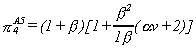
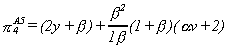
(see Lemma 3.1). If the firm made a previous false announcement of t1=4 or t3=4, then at date 3, 100y% of all consumers believed the firm was truly type A4 and purchased A5's original good. The remaining 100(1-y)% of consumers believed the firm was truly A5 and purchased firm B's original good. From Lemma 3.1 then, we know that A5's profits at date 4 will be
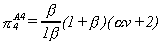
Type A4, if it made a truthful announcement at the start and consumers all believe such an announcement when it is made will receive profits of
beginning at date 4. If 100(1-y)% of consumers did not believe an announcement of t1=4 or t3=4 when it was made, then these consumers would have bought firm B's original good at date 3. Then from Lemma 2, A4's profits will be

Type A3's profits at date 4 are given by equation (A16). We know from the lemmas that these profits are each part of a subgame-perfect equilibrium. Since consumers have full information at date t=4, these subgame perfect equilibria are also sequential equilibria.
At date t=3, if there is an upgrade available, then consumers know that the firm's type is A3. If there is no upgrade and either an announcement t1=3 or an announcement of t1=4 was previously made, then 100y% of consumers believe that the firm is type A4 and 100(1-y)% of consumers believe the firm is type A5.
Suppose that the announcement at date 1 was t1=4. The consumers who believe the firm's true type is A5 will not be willing to pay any price greater than marginal cost at date 3. The consumers who believe the firm's true type is A4 are willing to pay a price greater than cost, depending upon their expectations for the increase in network size. Since y>1/2, then from Lemmas 6.1 and 2, profits will be at date 3

for type A4, and from Lemmas 6.1 and 3.1 profits will be

for type A5.
Suppose the announcement at date 1 was t1=3 and consumers believe that either A4 or A5 could have made such an announcement. Then type A5 has the choice between making a new announcement of t3=4 or t3=5. At date 2, 100x% of all consumers believed the firm was type A3 and bought the original good from A. The remaining 100(1-x)% of all cohort 2 consumers believed the firm was either type A4 or A5 and purchased from firm B.
If A5 announces t3=5, its profits will be, from Lemmas 5 and 3.1,

If A5 announces t3=4, its profits will be, from Lemmas 6.3 and 3.1,

Equation (A21) is greater than (A20). Therefore, when consumers believe a false announcement of t1=3 came from either A4 or A5, type A5 will prefer to make a new true announcement of t3=5. At first, this may seem strange. After all, since y is relatively large, consumers are relatively susceptible to a false announcement. However, compare the price paths for A5 from each different set of announcements.
Notice in Table 2 that when y=1, the prices and quantities in each period are the same. However, when y is just slightly smaller than one and A5 announces t3=4, there is just enough uncertainty in consumers minds that the price and quantity are both lower than if the firm announces t3=5. A5 is better off revealing its true type in period 3 because the gain in network size from the first false announcement is sufficient to induce all consumers to purchase its good in period 3. The uncertainty generated by a second false announcement is undesirable.
A4 announcing t3=4 and A5 announcing t3=5 is a subgame-perfect equilibrium. Given the other players' strategies, neither type can do better than to announce their true types when consumers believe an announcement of t1=3 could have come from either. There are no out-of-equilibrium announcements in then this equilibrium. Therefore, this is a Perfect Bayesian Equilibrium as well.
At date t=2, no announcements will be made. Now consider date 1. A5 can do no worse than to announce its true type at date 1 and earn its full-information profits (see equation (11)). Type A4's expected profits from announcing t1=3 are


where the equilibrium prices and quantities are P1A=c, q1A=1/2, P2A=(2x-1)(1+$)+c, q2A=x, P3A=2x-1+(1+$)(2y-1)+c, q3A=y, P4A=(1+$)"v+2(y+$)+c, q4A=1, PA t>5 =(1+$)("v+2)+c, qt>5A=1.
It is easy to see that the profits in equation (A22) are greater than type A4's full-information profits from equation (8). Therefore, type A4 will announce t1=3 when x1 and y3 are both relatively large.
Type A5's expected profits from announcing t1=4 are

where P1A=c, q1A=1/2, P2A=c, q2A=1/2, P3A=(2y-1)(1+$)+c, q3A=y, P4A=2y+$+c, q4A=1, Pt>5A=(1+$)("v+2)+c, qt>5A=1. Type A5's expected profits from announcing t1=3 and t3=4, where P1A=c, q1A=1/2, P2A=(2x-1)(1+$)+c, q2A=x, P3A=2x-1+(1+$)(2y-1)+c, q3A=y, P4A=2y+$+c, q4A=1, Pt>5A=(1+$)("v+2)+c, qt>5A=1 are:

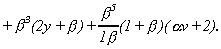
Finally, A5's expected profits from announcing t1=3 and t3=5 are

where P1A=c, q1A=1/2, P2A=(2x-1)(1+$)+c, q2A=x, P3A=2x+$+c, q3A=1, P4A=2+$+c, q4A=1, Pt>5A=(1+$)("v+2)+c, qt>5A=1.
It is easy to see that A5's profits from announcing t1=3 and t3=4 are greater than the profits from announcing t1=4. Also, for all y "large enough", profits from announcing t1=3 and t3=5 are greater than from announcing t1=3 and t3=4.
In a subgame-perfect equilibrium, all three types of firm will
announce t1=3 in the first period. In period
three, type A4 will announce t3=4
and A5 will announce t3=5. Let consumers
believe that an out-of-equilibrium move is made by type A5
with probability one. Then all types of the firm will prefer
to not deviate from the equilibrium -- profits would be considerably
less otherwise. Therefore, this equilibrium is also a perfect
bayesian equilibrium.
Equilibrium 2: Let consumers have the following beliefs: x0 >1/2 and y0 <1/3. Then at date 1, types A3 and A5 will announce t1=3, and type A4 will announce t1=4. At date 3, type A5 will announce t3=5.
Proof:
First consider date t=3. Suppose that no upgrade has been released and the true firm type is A5. Further suppose that A5 made an announcement of t1=3 in the first period, and 100x% of all cohort 2 consumers purchased A5's original good in period 2, believing that the upgrade would arrive at date 3. If consumers believe with probability y that the firm's type is A4, then type A5 will receive the following profits from announcing t3=4:
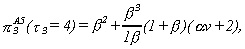
where the path of prices and quantities is, P3A=c, q3A=0, P4A=$+c, q4A=1, Pt>5A=(1+$)("v+2)+c, qt>5A=1. If type A5 announces t3=5, its profits will be:

where the path of prices and quantities is, P3A=2x+$+c, q3A=1, P4A=2+$+c, q4A=1, Pt>5A=(1+$)("v+2)+c, qt>5A=1. It is easy to see that A5 will prefer to announce t3=5 when consumers believe with (small) probability y that the firm's type is A4, it was previously announced that t1=3, and 100x% of consumers bought the original good from firm A in the second period.
If, in this state of the game, type A4's only recourse is to announce t3=4. Its profits will be:

P3A=c, q3A=0, P4A=(1+$)"v+2$+c, q4A=1, Pt>5A=(1+$)("v+2)+c, qt>5A=1. Given the other players strategies, neither will want to offer any other price or make any other announcement. Therefore, this is a subgame perfect equilibrium for this state. Furthermore, there is no out-of-equilibrium announcement, so this equilibrium must also be a perfect bayesian equilibrium for this state.
Suppose in the first period type A4 would have announced t1=4. Then at date 3, if a previous announcement of t1=3 was made and no upgrade is now available, consumers will know with certainty that the firm's true type is A5. Therefore, A5 has no other choice of action but to announce t3=5. Its profits will be identical to equation (A27). We know from the associated lemmas that the corresponding price path is a subgame perfect equilibrium for this state. Furthermore, since consumers have complete information, this is a perfect bayesian equilibrium as well.
No announcements occur in the second period, so now consider date t=1. Type A4's profits from announcing t1=4 (when A5 announces t1=3) are its full-information profits from equation (8),

By announcing t1=3, A4 would earn profits of

from a price path of P1A=c, q1A=1/2, P2A=(2x-1)(1+$)+c, q2A=x, P3A=c, q3A=0, P4A=(1+$)"v+2$+c, q4A=1, Pt>5A=(1+$)("v+2)+c, qt>5A=1. If the discount factor b is large enough, then A4 will prefer to reveal its true type in the first period to announcing t1=3.
If type A5 announces t1=5, its profits will equal its full information profits in equation (9),

If it announces t1=4 when A4 also announces t1=4 its profits will be:

where the price path is P1A=P2A=c, q1A=q2A=1/2, P3A=c, q3A=0, P4A=$+c, q4A=1, Pt>5A=(1+$)("v+2)+c, qt>5A=1. It is easy to see that equation (A31) is greater than equation (A32). Therefore, A5 will never announce t1=4.
It has already been shown that A5 will not announce
t3=4 in period 3 when it announces t1=3.
A5's profits from announcing t1=3
and t3=5, when A4 announces t1=4,
are:
where the path of prices is P1A=c, q1A=1/2, P2A=(1+$)(2x-1)+c, q2A=x, P3 A=2x+$+c, q3A =1, P4A=2+$+c, q4A=1, Pt>5A=(1+$)("v+2)+c, qt>5A=1. It is easy to see that (A33) is greater than (A31). Therefore, A5 will prefer to announce t1=3 in the first period and t3=5 in the third period.
Given the other players' strategies, no type of firm will make
any other announcement or offer any other price. Therefore, this
equilibrium is a subgame perfect equilibrium for this game. Further,
if consumers believe that an out-of-equilibrium move is made by
the type A5 with probability one, no type of firm will
wish to make any out-of-equilibrium announcement or any price
offer. Therefore, this equilibrium is also a perfect bayesian
equilibrium. QED.
Equilibrium 3: Let consumers have the following beliefs: x0 <1/2 and y0 >1/3. Then at date 1, type A3 will announce t1=3, and types A4 and A5 will announce t1=4.
Proof:
At date t=4, consumers are perfectly informed -- either an upgrade occurs and the firm's true type is A4 or there is no upgrade and the firm's true type is A5. Now consider date t=1. If A4 and A5 both announce t1=4, then A4's profits will be:

where the path of prices is P1A=c, q1A=1/2, P2A=c, q2A=1/2, P3A=(2y-1)(1+$)+c, q3A=y, P4A=(1+$)"v+2(y+$)+c, q4A=1, Pt>5A=(1+$)("v+2)+c, qt>5A=1. If A4 announces t1=3 when A5 announces t1=4, then A4's profits will be:

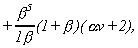
where the path of prices is P1A=c, q1A=1/2, P2A=c, q2A=0, P3A=(2y-1)(1+$)-1+c, q3A=y, P4A=(1+$)"v+2(y+$)+c, q4A=1, Pt>5A=(1+$)("v+2)+c, qt>5A=1. It is easy to see that A4's profits are less when it announces t1=3, t3=4 instead of t1=4. The price it can charge in period 3 is strictly less when the announcement is t1=3, t3=4 instead of t1=4, while all other prices are the same.
If A4 and A5 both announce t1=4, then A5's profits will be:

where P1A=c, q1A=1/2, P2A=c, q2A=1/2, P3A=(2y-1)(1+$)+c, q3A=y, P4A=2y+$+c, q4A=1, Pt>5A=(1+$)("v+2)+c, qt>5A=1. When A4 would announce t1=4, A5 would be unable to announce t1=3, t3=4; consumers know that if they see t1=3 in the first period and no upgrade is on the market in the third period, the firm's type cannot be A4, but must be A5. If A5 announces t1=3, t3=5 when A4 would announce t1=4, its profits will be:

where P1A=c, q1A=1/2, P2A=c, q2A=0, P3A=c, q3A=0, P4A=$+c, q4A=1, Pt>5A=(1+$)(av+2)+c, qt>5A=1. For relatively small x (x<1/2), A5 prefers to announce t1=4.
Therefore, given the other players strategies, no player wants to make any other announcement or offer any other price. Further, if consumers believe that an out-of-equilibrium move is made by type A5 with probability one, then no type of firm will deviate from the equilibrium. Therefore, this equilibrium is also a perfect bayesian equilibrium for this game. QED
.
Equilibrium 4: Let consumers have the following beliefs: x0 <1/3 and y0 <1/3. Then at date 1, type A3 will announce t1=3, type A4 will announce t1=4, and A5 will announce t1=5.
Proof:
In this equilibrium, each of the firms will earn its full-information profits, as specified in equations (7) - (9).



If type A4 were to announce instead that it would release its upgrade at t1=3, its profits would be:

where the path of prices and outputs is P1A=c, q1A=1/2, P2A=c, q2A=0, P3A=c, q3A=0, P4A=(1+$)"v+$+c, q4A=1, Pt>5A=(1+$)("v+2)+c, qt>5A=1. It is easy to see that the profits in equation (A41) are less than A4's full-information profits in (A39). Therefore, when type A3 would announce t1=3 and type A5 would announce t1=5, type A4 prefers to announce t1=4 to t1=3 and t3=4.
If, given the other types' announcements, A5 were to announce t1=3 and t3=5 (it could not announce t1=3 and t3=4 when A4 announces t1=4), its profits would be:

where the path of prices and outputs is P1A=c, q1A=1/2, P2A=c, q2A=0, P3A=c, q3A=0, P4A=$+c, q4A=1, Pt>5A=(1+$)("v+2)+c, qt>5A=1. If A5 were to announce t1=4, given the other types announcements, its profits would be the same as in equation (A42):
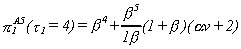
where the path of prices and outputs is P1A=c, q1A=1/2, P2A=c, q2A=1/2, P3A=c, q3A=0, P4A=$+c, q4A=1, Pt>5A=(1+$)("v+2)+c, qt>5A=1. It is easy to see that type A5 prefers to make only a true announcement in this situation.
Given the other players' strategies, no type of firm wants to
make a different announcement or offer a different price path.
Therefore, this equilibrium is a subgame-perfect equilibrium
for this game. Let consumers believe that an out-of-equilibrium
move is made by the type A5 with probability one.
Then this equilibrium will also be a perfect bayesian equilibrium.
Types A3 and A4 would be strictly worse
off by offering some out-of-equilibrium price when consumers have
such beliefs. QED
VII. References
Choi, Jay Pil. "Network Externality, Compatibility Choice, and Planned Obsolescence," Journal of Industrial Economics, 1994, v42 (2), 167-182.
Crawford, Vincent P. and Joel Sobel. "Strategic Information Transmission," Econometrica, 1982, v50 (6), 1431-1452.
Farrell, Joseph and Garth Saloner. "Installed Base and Compatibility: Innovation, Product Preannouncements and Predation," American Economic Review, 1986, v76 (5), 940-955.
Fisher, Franklin M., John J. McGowan and Joen E. Greenwood. Folded, Spindled, and Mutilated: Economics Analysis and U.S. v. IBM, Cambridge, MA: MIT Press, 1983.
Kreps, David M. and Robert Wilson. "Sequential Equilibria," Econometrica, 1982, v50 (4), 863- 894.
Landis, Robin and Ronald Rolfe. "Market Conduct Under Section 2 -- When is it Anticompetitive?," in F. M. Fisher, ed., Antitrust and Regulation; Essays in Memory of John J. McGowan, Cambridge, MA: MIT Press, 1985, 131-152.
Stein, Jeremy. "Cheap Talk and the Fed: A Theory of Imprecise Policy Announcements," American Economic Review, 1989 v79 (1), 32-42.
United States of America v. Microsoft Corp., 1995.
Table 3.1
Sequence of Events
Date | Event |
0 | A Nature chooses T, the date at which firm A can introduce its upgrade. |
t < T | A Start of period t < T. A Consumers belonging to Cohort t are born. A Consumers belonging to Cohort t-1 turn middle-age. A Firm A announces a date at which its upgrade will be available. A Firms A and B simultaneously offer prices for their original goods. A Consumers in Cohort t-1 transmit the history of the game to Cohort t consumers. A Consumers revise their beliefs about when the upgrade will actually be released and set expectations about the marginal increase in each firm's network size from sales this period. A Consumers in Cohort t buy from either firm A or firm B. A End of period t < T. |
T | A Start of period T. A Consumers belonging to Cohort T are born. A Consumers belonging to Cohort T-1 turn middle-age. A Firm A releases its upgrade. A Firms A and B simultaneously offer prices for their goods. A Consumers in Cohort T-1 transmit the history of the game to Cohort T consumers. A Consumers set expectations about the marginal increase in each firm's network size from sales this period. A Consumers in Cohort T buy from either firm A or firm B. A Consumers in Cohort T-1 choose whether or not to buy firm A's upgrade. A End of period T. |
t > T | A Start of period T. A Consumers belonging to Cohort T are born. A Consumers belonging to Cohort T-1 turn middle-age. A Firms A and B simultaneously offer prices for their goods. A Consumers in Cohort T-1 transmit the history of the game to Cohort T consumers. A Consumers set expectations about the marginal increase in each firm's network size from sales this period. A Consumers in Cohort T buy from either firm A or firm B. A End of period T. |
Table 2
date | A5's price (t3=4) | output | A5's price (t3=5) | output |
1 | c | 1/2 | c | 1/2 |
2 | (2x-1)(1+$)+c | x | (2x-1)(1+$)+c | x |
3 | (2x-1)+(1+$)(2y-1)+c | y | 2x+$+c | 1 |
4 | 2y+$+c | 1 | 2+$+c | 1 |
5 | (1+$)("v+2)+c |
1 | (1+$)("v+2)+c |
1 |
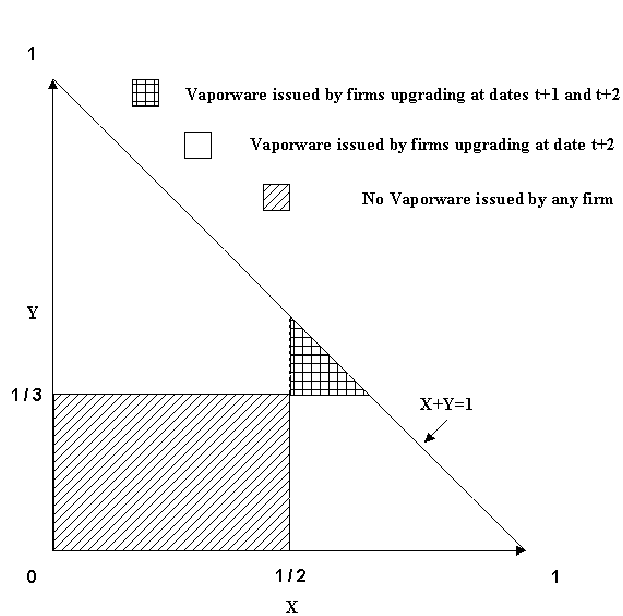
Figure 1
Announcements in relation to beliefs X and Y.