First Draft: December, 1996
This Draft: May 8, 1997
Comments Welcome
Country Funds and Asymmetric Information+
Jeffrey A. Frankel
and
Sergio L. Schmukler
Department of Economics
University of California at Berkeley
Abstract
Closed-end country funds trade in New York at their price. Their Net Asset Value (NAV) represent the value of the underlying assets, usually traded in each particular country. If the holders of the underlying assets have more information the about local assets than the country fund holders, changes in NAVs will tend to explain future changes in prices but not vice versa. This paper shows that most NAVs appear exogenous; while most prices reject exogeneity. Past changes in NAVs and discounts predict current prices more frequently than prices and discounts predict NAVs. The price (NAV) adjustment coefficients are low and negatively correlated with the local (foreign) market variability--but not with the fund price (NAV) variability. These findings are consistent with the existence of asymmetric information in international capital markets. The appendix introduces a model of asymmetric information, that rationalizes our empirical findings. Different perceived risk makes foreign investors willing to less pay for local assets than domestic investors. Therefore, country fund prices (driven mainly by small U.S. investors) tend to be lower than NAVs (driven mainly by domestic and large foreign investors). Two other propositions are derived. First, since NAVs and prices are linked by a long-run relationship, unusually large past discounts explain current NAVs and prices. Second, the presence of "noise traders" delays the adjustment toward the long-run equilibrium.
JEL Classification Numbers: F30, G11, G14, G15
Keywords: asymmetric information; country funds; closed-end funds; cost of information;
noise traders; cointegration; error-correction model; exogeneity.
I. Introduction
In the past, investors wishing to diversify their portfolios through global investment needed to buy stocks or bonds in the market of each particular country. This implied a certain degree of sophistication and capital. For instance, transaction costs to trade in foreign markets vary but they are generally higher than the cost of buying in domestic markets, even for countries without any restrictions on capital movements.
The new trends in international capital markets, namely securitization and globalization, have made foreign investment more accessible to all investors. Along with these changes, new financial instruments have become available. As a consequence, less sophisticated investors with little capital have begun to find international diversification easier to achieve. First foreign bonds, and later equities of foreign companies started trading in international stock exchange markets. In the United States, American investors can now acquire shares of many major foreign companies through American Depository Receipts (ADRs), available in New York. However, this kind of investment still requires some knowledge of the country, of the industry, and of the company itself.
This paper focuses on another new vehicle for global investment. Investors attracted to certain countries, but with no specific knowledge of particular industries or firms, can acquire shares of closed-end country and regional funds. Most of these funds were established in the late 1980s and during the 1990s, although others have a longer history. They primarily invest in equities from a specific country. Regional funds invest in groups of countries within a given region. Some open-end country and regional funds also exist. Holding open-end funds is analogous to holding the underlying assets, because their shares can be redeemed. Both open-end country funds and their respective underlying equities are valued almost identically, provided that arbitrage is feasible. However, this is not the case for closed-end country funds.
The shares of closed-end country funds cannot be redeemed, so perfect arbitrage becomes practically impossible. The fund manager decides the portfolio of the fund, and investors only become aware of the assets they hold at certain points in time--when the fund manager reports the fund composition. Country fund holders trade most of their shares in Wall Street at the country fund price. The net asset value (NAV) is also computed. The NAV is the dollar value of the underlying assets, which are individually traded in each domestic market. The discount, equal to the percentage difference between the NAV and the price, reflects how the holders of the individual shares value their assets relative to the country fund holders.
In a perfectly efficient and internationally integrated market, discounts would be equal to zero --since NAVs and country fund prices are two market values of the same assets. However, closed-end country fund discounts are in fact large and variable. For instance, it is not uncommon to find average discounts of around 15 percent for country funds like the German ones, the French funds, the United Kingdom Fund, the First Australian Fund, and the Mexico Fund. Contrary to other cases, several of these funds are relatively big and liquid. Moreover, most of the stock markets of their respective countries are also liquid, and do not have restrictions on capital movements. Therefore, one would expect NAVs to be close to fund prices. However, average discounts persist. In addition, they exhibit large fluctuations. For example, discounts reached peaks of 30 percent in 50 percent of the funds.
The literature has proposed two main explanations for this phenomenon. On the one hand, discounts have been attributed to the presence of transaction costs and illiquid markets, that makes perfect arbitrage infeasible. Therefore, since markets are partially segmented, the NAV and the fund price reflect the specific characteristics of each respective market. On the other hand, the literature has also claimed that country funds are held by a different clientele, which includes "noise traders." These irrational investors trade based on sentiments, and tend to misperceive the fundamental values of the assets. Since sentiments shift randomly over time and since only rational traders buy the underlying assets, there is an extra risk in holding country funds. Given that pure arbitrage is impossible to achieve, the riskier asset (the country fund) is valued below the underlying assets, and discounts are the norm.
In this paper, though we allow for imperfect arbitrage and noise traders in the markets, we present a novel explanation to the existence of average discounts in country funds. The main hypothesis of this paper is that asymmetric information implies that country funds trade at positive discounts. Rational country fund holders internalize the fact that they know little about each remote country or region. As a consequence, they are willing to pay less than relatively well-informed local investors for the same assets.
Asymmetric information also explains the dynamics between NAVs and fund prices. Then, the paper computes exogeneity tests for 61 country funds from Europe, Latin America, and the Pacific Rim. We test whether the NAV, the price, or both adjust to the long-run and to the short-run relationships between NAVs and prices. In other words, we investigate which variable appears to be "strongly exogenous" (or predicted only by its own past): the NAV or the price. The results are obtained by estimating error-correction models for each fund by full-information maximum likelihood (following Johansen, 1988, and Johansen and Juselius, 1990).
The paper also tests whether there is a statistically significant relationship between the NAV-price adjustment coefficients and the variability of NAVs and fund prices. The asymmetric information model predicts that with more noise in the "external market" the adjustment coefficients become smaller. In other words, the less noise NAVs contain, the faster prices react to changes in NAVs--if NAVs are closer to fundamentals. On the other hand, the "noise traders model" predicts that with more noise in the New York market the adjustment of prices to NAVs become slower--since noise traders in New York disconnect prices from NAVs (namely, from fundamentals). By estimating these relationships, we are able to see which model is supported by the data.
In the appendix, we present a model of asymmetric information. The model captures some of the empirical regularities found in country funds. We assume that investors are risk averse, and that more information reduces the subjective variance of returns. The model also relies on two factors. On the one hand, domestic and large international investors--who are usually well informed--are the ones that mainly determine the NAVs. On the other hand, small American investors who are relatively uninformed drive the fund prices. As a consequence, country fund prices are below NAVs in equilibrium. Two other propositions are derived from the theoretical assumptions. They show how past discounts affect current prices and NAVs.
The remainder of the paper is organized as follows. Section II summarizes the existing literature on country fund discounts. Sections III tests the asymmetric information hypothesis. The theoretical model is introduced in the appendix section.
II. The Rationale Behind Country Fund Discounts in the Literature
Country funds are known to trade at high and variable average discounts. In other words, the prices at which country funds trade are in general lower than their Net Asset Values. Part A of Table 1 shows summary results from a sample of 61 country funds based in New York. The table demonstrates that, when statistically different from zero, discounts tend to have a positive mean. Discounts are significantly positive for around 82 percent, 42 percent, and 53 percent of the European, Latin American, and the Pacific Rim funds respectively. On the other hand, discounts are significantly negative for only 12 percent, 25 percent, and 28 percent of the funds.
It should be noted that most of the country funds started trading in the early 1990s. During the early 1990s, the international community was optimistic about emerging markets in Asia and Latin America. Favored by low U.S. interest rates, foreign capital flew toward these markets. Part of these flows were channeled through country funds. For instance, Claessens and Rhee [1994] show that new country funds account for 25 percent of the equity flows to developing countries over the 1989-1993 period. The sentiment changed when the U.S. interest rates increased during 1994, and in the aftermath of the Mexican crisis of 1994. Therefore, the fact that a higher proportion of European funds trade at positive discounts (when compared with funds from the other regions) is not surprising. Optimistic U.S. investors probably pushed up the price of the country funds from emerging economies--relative to the value of their underlying assets--and discounts shrank over that period.
T1
Positive discounts can be observed in Figure 1, which takes two representative funds from each region. The plots show that the funds started trading at premia. Funds like the Italy Fund, the Chile Fund, the Malaysia Fund, and the Swiss Fund (although to a lesser degree) demonstrate this point. Fund managers planned the initial public offerings (IPO) around a time of optimistic sentiments with respect to the specific country. It should be remarked that when periods of high premia, around the IPOs, are not included in the sample the results of Table 1 change. Average discounts rise, and close-to-zero discounts become statistically significant and positive. Figure 1 also shows that in the case of the Korea Fund, premia persisted over time, however it vanished in the last years. For some time, this fund was considered as one of the only channels to invest in Korean equities, therefore the demand for its shares was high. When other instruments like new Korean funds became available, the Korean Fund premia declined.
Appendix Tables A1.2 display detailed summary statistics of percentage discounts for the sample of 61 country funds. The statistics include funds that invest in particular countries as well as regional funds, which invest in several countries within one region. The table tabulates their average, standard deviation, minimum, and maximum. Table 1 and appendix tables show that discounts are quite variable. Funds achieved premia as high as 94 percent for the Korea Fund and 89 percent for the Spain Fund. They also hit discounts of 83 percent for the Brazil Fund and 53 percent for the Malaysia Fund.
F1
F2
When all the observations are taken jointly, Part B of Table 1 and Figure 2 show that discounts are positive for Europe and Latin America but not for Asia. The histogram for Europe is somewhat skewed to the right, showing that discounts tend to be positive except for some observations that display large premia. The histogram for Asia is similar but it is more centered in zero. Long left tails are consistent with large premia around the IPO and with optimistic sentiments, in particular around the Berlin Wall fall in 1989 and in the period of capital inflows to emerging Asian economies. The histogram for Latin America presents both long left and right tails, implying optimistic and pessimistic sentiments with respect to these countries.
As noted in the introduction, these large and variable discounts have been rationalized in the literature in two different ways. The first one claims that transaction costs and market segmentation impose obstacles to arbitrage. Therefore, NAVs and prices can differ from each other. In light of these barriers, Frankel and Schmukler [1996] summarize a set of possible "arbitrage strategies" intended to take advantage of the NAV-price difference. We conclude that, despite large discounts, there is no pure arbitrage strategy that can be easily followed. Closed-end funds do not admit share redemptions. Therefore, investors cannot treat the country fund shares as identical to the basket of underlying assets.
In an frictionless world, a rational arbitrageur could buy the country fund and sell short its underlying assets whenever the fund trades at discount. However, besides the fact that closed-end fund shares cannot be redeemed, different types of transaction costs impose additional obstacles to arbitrage. Management fees should be paid when buying both the country funds and the underlying assets. These fees are higher than the ones to buy domestic closed-end funds. Other institutional factors generate barriers to arbitrage. The underlying assets are traded in the local currency, while the country fund shares are sold in the currency of the market where they trade (U.S. dollars in this case). Since buying in one market and selling in the other one cannot be done simultaneously, arbitrage involves exchange rate risks. Markets trade at different times and barriers to capital movement exist--making simultaneous transactions sometimes impossible. In addition, the composition of the country fund portfolio is known only at certain points in time, so any arbitrageur must be aware of any changes in the portfolio composition when selling short. The transaction costs we allude to in this paper have already been theoretically and empirically studied in Stulz [1981], Diwan, Errunza, and Senbet [1993], Errunza and Losq [1985], Bonser-Neal, Brauer, Neal, and Wheatley [1990], and Rogers [1994].
Another group of papers explain the existence of positive discounts due to the participation of noise traders in international capital markets. This literature claims that a different clientele, composed by both rational and irrational agents, holds country funds. On the other hand, only rational investors hold the underlying assets. Therefore, holding the country fund is riskier than holding the assets, because future changes in noise traders misperceptions cannot be fully predicted. Since investors are risk averse, the price of the country fund is lower than the NAV. Among the papers that relate this theory to domestic closed-end fund are Lee, Shleifer, and Thaler [1990, 1991], Chen, Kan, and Miller [1993], and Chopra, Lee, Shleifer, and Thaler [1993]. Other papers like Hardouvelis, La Porta, and Wizman [1994], and Klibanoff, Lamont, and Wizman [1996] look at the presence of noise traders among country funds holders.
The present paper introduces asymmetric information into the discussion about country fund discounts. Asymmetric information has been widely treated in the finance and related literature. Some examples include Akerlof [1970], Grossman and Stiglitz [1980], French and Poterba [1991], Lang, Litzenberger, and Madrigal [1992], and Gehrig [1993]. Asymmetric information can show up in different ways. First, domestic investors may have access to locally available information, that foreign investors do not receive. Perhaps foreign investors can obtain the same information, but must bear an extra cost to get it. Second, domestic investors may have the same information, but interpret it in a different way. Third, there may be leaks in information, and domestic investors are able to obtain it first. Fourth, asymmetric information could also be introduced from a different angle. Domestic and foreign investors may have the same information set. However, country fund holders might lack information on how the fund is managed
Even though there is an information disadvantage, foreign investment may still look attractive as a consequence of expected high returns and diversification benefits (especially from emerging markets). Small uninformed investors may be more attracted to buy country funds than the underlying assets, since transaction costs are far lower. Also, they know that country fund managers are generally more informed about the country, and can allocate the portfolio of assets more wisely. As a consequence, small investors will prefer country funds to directly purchase local securities.
This paper claims that foreign investors realize that they are less informed than local investors when buying foreign equities. They know that they will do worse on average when holding foreign assets with respect to local resident. As a consequence, other things equal, foreign investors are willing to pay less for the same assets, and average positive discounts are observed. The effects of introducing asymmetric information are formally presented in the Appendix.
The idea of asymmetric information differs from the noise traders model, in which country fund holders randomly overestimate or underestimate future returns on foreign investment. In this paper, foreign investors are rational agents who try to assess the best forecast of future returns. However, since they are far away from the market in which they invest, they face higher uncertainty. In other words, due to asymmetric information, foreign investors have a "higher subjective variance" than local investors--even though their average forecast is unbiased. They perceive investment in a foreign country as been riskier than domestic investors do.
As an instance of asymmetric information, Frankel and Schmukler [1996] show that NAVs fell before fund prices, around two weeks prior to the Mexican devaluation of December 1994. We interpret this fact as evidence of asymmetric information, since Mexican investors (the main holders of the underlying assets) reacted to the crisis of 1994 before foreign investors (the main holder of the country funds). Mexican investors probably knew more and foresaw the crisis, while small American investors reacted with a lag.
This paper concentrates only on country funds, where the information asymmetry may be more obvious--given that the underlying assets are located in distant countries. Nevertheless, the same idea can be applied to domestic closed-end country funds, in which most of the previous literature has focused on. Small investors are the ones that usually buy domestic closed-end funds, since--compared with large investors--they have less information about particular firms and industries. Therefore, asymmetric information might also explain discounts in domestic funds.
It would be interesting to compare the size of country fund discounts versus the ones of domestic funds. If the asymmetry in information is more present in international capital markets than in domestic markets, one would expect to find deeper discounts in country funds than in domestic closed-end funds. However, most of the country funds have been affected by idiosyncratic country factors that would bias any valid comparison. Perhaps, once country funds acquire a longer history, a comparison of the discounts would be more appropriate.
III. Empirical Testing
Asymmetric information yields three testable empirical implications. First, discounts tend to be positive on average. Second, past large discounts, NAVs, and prices help to predict current country fund NAVs and prices. Third, the adjustment coefficients are negatively correlated with the presence of noise in the other markets. We already showed in Table 1 that discounts are in general greater than zero for most of the funds. In this section, we empirically analyze the last two implications of our hypothesis.
III.1 Testing for Exogeneity in NAVs and Prices
In this subsection, we perform exogeneity tests to determine which variable tends to be exogenous: the NAV or the fund price. In other words, we study which variable is the one that adjusts to the long-run NAV-price relationship, and whether lagged short-run changes in NAVs and prices are significant in explaining current changes in both variables. We expect that the variable that comprises more information about the fundamental values of the assets is the one that tends to be exogenous with respect to the other variable. If NAVs are closer to changes in fundamentals, they will tend to react first. Thus future price changes will be predicted by present NAV changes. If prices are the ones closer to fundamentals, the opposite relationship will hold. In summary, we investigate whether NAVs tend to predict prices more often than prices tend to predict NAVs.
When testing for exogeneity we use the same framework for all the funds. We tried different specifications, allowing for several lag structures and restrictions on the variables. Based on economic grounds and on preliminary results, we choose to work with the error-correction model (ECM) to analyze all the funds. We gained confidence on the results after doing sensitivity analysis (which is partially described in the paper).
We tried different lag specifications, working with 2, 4, 8, 24, and 52 lags. We also used the Akaike information criterion to determine the number of lags. We only report the case of 4 lags as a representative result in order to make comparisons across funds by using the same model. For most of the funds further lags are statistically insignificant. Furthermore, the results appear robust to various lag structures. In addition, the estimates do not tend to change across specifications when restrictions on the long-run relationships are imposed.
Exogeneity of NAVs and prices needs to be analyzed in the context of non-stationarity. Appendix Tables A2 display augmented Dickey-Fuller [1979] and Phillips-Perron [1988] tests for NAVs and prices. They conclude that most country fund NAVs and prices are I(1), integrated of order 1. Except for some European and Asian funds, we are not able to reject non-stationarity. Moreover, although not reported, we computed unit root tests for the variables in first differences; non-stationarity is widely rejected.
Even though NAVs and prices seem to be non-stationary, we expect that the variables do not diverge without bound from each other. Country fund NAVs and prices are ultimately two different values of the same assets, so they tend to move together in the long run. In econometric terms, we expect to find cointegration between the variables. Specifically, NAVs and prices may be linked by a stationary (linear) long-run relationship of the following form
Pt = p +l Nt+e t,
where the mean-zero error term e t is stationary, e t~ I(0).
Johansen [1988], and Johansen and Juselius [1990] tests are tabulated in Tables A3. The results vary for each region, but we find a number of cases in which the presence of one cointegrating vector cannot be rejected. For 8 out of 17 funds we cannot reject cointegration among European funds. For 4 out of 12 funds there is evidence of cointegration in Latin American funds. In the case of Asia, cointegration is not rejected for 17 out of 32 funds. Tables A3 also display unit root tests for country fund discounts. Namely, we test for stationarity once the cointegrating vectors are constrained to be (1, -1). For most of the cases, the tests reject non-stationarity in discounts. The Phillips-Perron tests reject--at a 10 percent significance level--the presence of unit roots in 16 out of 17 European funds, in 12 out of 12 Latin American funds, and in 24 out of 32 Pacific Rim funds.
The fact that there is cointegration is in itself interesting since it confirms the a-priori economic intuition mentioned above--that there is a long-run equilibrium relationship linking country fund NAVs and prices. Notwithstanding, we can obtain more information from the cointegration tests. Appendix Tables A4 display the fitted lambda calculated by the "Johansen" full-information maximum likelihood (FIML) methodology. Standard errors obtained from FIML, and the hypotheses that the l s are 0 and 1 are also displayed on the tables. At a 10 percent significance level we find that 75 percent of the European funds, 91 percent of the Latin American funds, and 85 percent of the Pacific Rim funds, reject the null hypotheses that the fitted l s are 0.
At the same time, the tables show that 65 percent of the European fund, 66 percent of the Latin American funds, and 47 percent of the Pacific Basin funds cannot reject that the fitted l s are 1. That means that shocks to NAVs are entirely transmitted to prices in the long run. This finding also confirms our economic intuition, which says that changes in the value of the underlying assets will eventually be reflected entirely in the corresponding country fund prices. Some of the fitted l s are different from 1, like for example the one for the France Growth Fund--what contradicts the economic intuition. However, their standard errors appear very large.
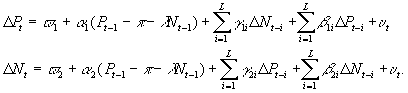
Given that the variables are non-stationary, usual Granger-causality tests of the variables in levels--which are exogeneity tests in the vector-autoregression (VAR) framework--do not yield statistics that are Normally distributed. On the other hand, VAR processes in first differences omit important information contained in the long-run relationship, and consequently may have specification biases. Nevertheless, both the short-run and the long-run dynamics are embedded in the ECM representation. The first differences of NAVs and prices are related to the one-period lagged cointegrating vector, and with lagged first differences of both variables,
(1)
As part of the sensitivity analysis, we estimate the above model using different techniques and specifications. First, we restrict the cointegrating vector to be (1, -1), and estimate the ECM by including lagged discounts as regressors. Second, we estimate the entire model (1) by FIML. In this way, we can simultaneously obtain estimates for p and l , along with estimates for the other parameters of the model.
Representative results from the FIML procedure are displayed in Table 2. Large funds from each of the three regions are chosen. We select funds with a long history, which are not affected by particular optimism around the IPO. Table 2 contains information detailed in Tables A4 and A5, where the results for all the country funds are reported. Fitted l s with their standard errors are displayed in the first two columns of Table 2.
The rest of Table 2 tabulates exogeneity tests, calculated from FIML estimations of each country fund. Weak exogeneity tests--with respect to the parameters p and l --are computed by looking at the adjustment toward the long-run relationship. Given that there is cointegration, either the NAVs, the fund price, or both respond to deviations in the long-run relationship. A significant fitted a 1 (a 2) means that the price (NAV) adjusts to changes in the cointegration relationship. If one of the variables is "weakly exogenous"--if it does not adjust to the long-run equilibrium--only one equation of model (1) is sufficient for efficient inference about the parameters p and l . Nevertheless, in the present case we are particularly interested in another issue: we want to determine which variable is the one that responds to changes in the long-run equilibrium.
T2
The point estimates of a are also displayed, since besides their statistical significance their size is also interesting. Significant a 1s are greater than significant a 2s. Significant a 1s range from values as low 2 percent for the Korea Fund, and as high as 28 percent for the Templeton Vietnam Fund. Significant a 2s range from values as low 3 percent for the India Growth Fund, and as high as 13 percent for the Jardine Fleming India Fund. These coefficients imply half lives for prices that go from less than 2 weeks to 18 weeks, and half lives for NAVs that go from more than 3 weeks to 18 weeks. The average significant a 1 (a 2) is -0.11 (0.075). They suggest that the adjustments are relatively slow, but higher in absolute value for prices than for NAVs. One could argue that these results support the asymmetric information hypothesis. Prices react more to changes in past discounts because deviations from the long-run equilibrium convey more information for prices than for NAVs.
Table 2 also reports tests regarding the short-run adjustment. These tests look at whether the set of fitted g 1 and g 2 are jointly zero. A vector g 1’ (g 2’) different from zero means that current fund prices (NAVs) adjust to past changes in NAVs (prices). Finally, Table 2 displays statistics that test which variable is "strongly exogenous:" the NAV, the price, or both. The strong exogeneity test looks at whether a 1 and g 1’ (or a 2 and g 2’) are jointly zero. As in the case of weak exogeneity, strong exogeneity should be considered in the context of the parameters of interest. Nevertheless, in this paper we are particularly focused in another aspect. We call "strong exogeneity" or "Granger-noncausality" the cases when the fund NAV or price is explained only by its own past--but not by the long-run equilibrium or by the recent history of the other variable.
All the results are detailed in Tables A5, A6, and A7. Tables A5 assume that cointegration exists in all the funds, even when the tests failed to detect it. Tables A6 do not include the long-run relationship for the cases we failed to find evidence of cointegration. Tables A7 assumes that all the funds are not cointegrated. We display results from different specifications to illustrate how results vary across models. We are also reluctant to work with only one model because some of the standard errors are relatively large. We summarize all these results in Table 3, given that the reader might be interested in a general conclusion rather than in particular country funds.
Table 3 tabulates the percentage of funds for which NAVs and fund prices adjust to short-run and long-run changes. In addition, Table 3 displays the median Wald statistic for each test across every group of funds. The table shows that NAVs tend to be the exogenous variables. In other words, past changes in NAVs help to explain present changes in prices but not otherwise. Moreover, deviations from the long-run equilibrium seem to be more informative for prices than they are for NAVs. The results hold for the case when cointegration is assumed, but even more strongly for the one when cointegration is not assumed. Overall, NAVs tend to be strongly exogenous. Table 3 shows that in 70 and 73 percent of the times NAVs are strongly exogenous, depending on whether cointegration is assumed or not. Meanwhile, prices are only strongly exogenous in 30 and 33 percent of the times respectively. When cointegration is ruled out, the results show that for 61 (33) percent of the cases NAVs (prices) are exogenous.
In general terms, these results are consistent with the fact that NAVs are closer to information about local market fundamentals, and consequently react first. Nevertheless, we recognize that in principle these results are also consistent with previous papers--which assumed that noise traders hold country funds but not the underlying assets. If country fund holders repeatedly underpredict or overpredict changes in fund prices, they are the ones that will adjust to changes in NAVs (which are closer to fundamentals). We explore further implications of both theories in the next subsection.
A further look at Table 3 suggests interesting conclusions. First, all the exogeneity tests for every region yield the same results: NAVs tend to be the exogenous variable, while fund prices are the ones that adjust to past changes in NAVs. This evidence seems to support the hypothesis of asymmetric information in all regions. Second, this relationship holds more strongly for Europe than for Latin America or the Pacific Rim. This fact is not surprising. We have already indicated that discounts are positive for a smaller proportion of Latin American and Pacific Rim funds relative to European funds. Appendix Table A1.1 shows that most funds started trading in the early 1990s. As mentioned before, these funds cover a period of high capital flows to emerging countries in Asia and Latin America. A significant part of these flows was due to investors that bought foreign equities in the form of ADRs and country funds. Therefore, optimistic foreign investors may have generated a boom in country fund prices, that later on pushed local stock market prices up.
Third, if fund prices reflect foreign investors’ reactions toward each country, Table 3 might also suggests that foreign investors have treated the Latin America and the Pacific Rim differently. They react in more cases to short-run changes in Latin American NAVs, while they do so in a higher proportion to long-run changes in Pacific Rim country funds. Part A of Table 3 shows that 50 percent of the Pacific Rim fund prices respond to long-run movements in the NAV-price long-run equilibrium, but 41 percent of the prices adjust to the short-run dynamics. On the other hand, 25 percent of the Latin American fund prices react to deviations from the long-run relationship, but instead 67 percent of the prices revert to short-run changes in NAVs.
T3
The results might imply that investment in Latin America had a shorter horizon than investment in the Pacific Rim. This point has already been suggested among others by Calvo, Leiderman, and Reinhart [1994], who show that inflows to Asia had a higher proportion of foreign direct investment than flows to Latin America. Therefore, concerns of sudden reversals of the inflows were more predominant among people that invested in Latin American than among the ones that invested in Asia.
III.2 Why Are Adjustments Slow?
If only asymmetric information exists fund prices would mimic NAVs as soon as NAVs become available every week. However, the ECMs show that prices follow NAVs, but at a slower pace than the one implied by asymmetric information. Four reasons may explain this sluggishness.
First, the presence of noise traders may delay the adjustment since foreign investors face a signal-extraction problem. Changes in NAVs can be caused by noise traders’ misperceptions (who participate in the local market) or by changes in the country’s fundamentals. Second, prices may be slow to react due to market illiquidity. If country fund markets are shallow, investors may be willing to trade their assets but few transactions take place. Therefore, prices will follow NAVs as long as transactions occur.
Third, if there are noise traders only in the country fund market as the noise traders literature suggests, they will not react to changes in NAVs. Their estimates of the asset values differ from the fundamental values, reflected by the NAVs. So the link between NAVs and prices is distorted by noise traders’ misperceptions. Fourth, it could be the case that domestic and foreign investors have different preferences or are part of different clienteles. So NAVs and fund prices move according to each market preferences, although they may eventually move together in the long run. Therefore, a weak connection is found between NAVs and prices in the short run. This idea of "different opinions" was discussed in Harris and Raviv [1993].
This section tests whether there is statistical evidence consistent with the competing explanations of sluggish responses. We relate the adjustment coefficients to measures of noise trading and market liquidity. As a proxy for noise trading we take the standard deviation of first-differenced log NAVs and prices, given that the variables in levels are non-stationary. Assuming a constant variability in the fundamental factors that explain NAVs and prices, more noise in the markets leads to increasing variability in NAVs and prices. As a proxy for market liquidity we take each fund’s total assets. A more appropriate measure would be the turnover ratio, displayed in Table A1.1. Unfortunately, several missing data do permit us to compute valid tests.
The first part of Table 4 shows regressions of the fitted price adjustment coefficients (negative fitted a 1s) on three explanatory variables: the standard deviation of first-differenced NAVs and prices, and the value of the country funds’ assets. The first three regressions show that more noise in the local market implies lower adjustment coefficients for country fund prices. They also show that the value of the total assets is not statistically significant in explaining price adjustments. Lastly, they show that noise in the country fund market is not statistically related to the adjustment coefficient.
The fourth and fifth regressions concentrate on the NAV adjustment coefficients. They suggest that the standard deviation of first-differenced log prices is slightly correlated with the fitted a 2s. However, the standard deviation of fist-differenced NAVs is not statistically related to the NAV adjustment to the long-run equilibrium. Figure 3 gives another perspective of these relationships by displaying plots of the adjustment coefficients on our measure of noise trading. Although not reported, similar results are obtained when we correct for heteroskedasticity. The correction takes into account different standard errors of the adjustment coefficients, calculated in the first-step regressions.
In summary, results from Table 4 suggest that the speeds of adjustment are negatively related to the variability of the "external market." The adjustment of country fund prices is negatively related to the variability of the NAVs, while the adjustment of NAVs is negatively related to the variability of the fund prices. This suggests the typical signal-extraction problem of markets with imperfect information. The statistical relationship holds more strongly for the price adjustment case. Finally, the noise trader models would predict that more noise in the foreign market is related to slower price adjustments. The higher the misperception, the less related NAVs and prices are. Our results do not support this hypothesis, but they favor the asymmetric information model.
F3
T4
VI. Summary and Conclusions
This paper has addressed several issues concerning country funds. The main finding of the paper is that country funds support the hypothesis of asymmetric information. We estimated error-correction models for each country fund, since the variables appeared to be non-stationary, and due to the existence of cointegration between NAVs and prices. The exogeneity tests concluded that NAVs tend to be the exogenous variable. In other words, past NAVs and discounts predict current changes in country fund prices more often than past fund prices and discounts predict current changes in NAVs. This relationship held in general for the three regions studied, namely Europe, Latin America, and the Pacific Rim.
The results appeared robust to various specifications. When cointegration was (not) assumed, we rejected the null hypothesis of strongly exogenous prices in 70 (73) percent of the funds, but we only rejected the null hypothesis of strongly exogenous NAVs in 30 (33) percent of the funds. On the other hand, by ruling out cointegration, we found that prices adjust in 61 percent of the cases to short-run changes in NAV. However, NAVs adjust in 33 percent of the cases to short-run changes in prices. In light of the theoretical model, we found this evidence consistent with asymmetric information. NAVs seem to be closer to local information; they are the ones that react first to local news. Later on, the foreign markets receive the information, so prices react after NAVs have reacted.
Our empirical analysis also found sluggish adjustments to the long-run relationships between NAVs and prices. In other words, NAVs and prices react to large discounts slower than what asymmetric information predicts. Thus, we explored the statistical relationship between the speeds of adjustment and other variables. We worked with each market’s variability as a measure of noise in the markets. The tests showed that there is a statistically significant negative relationship between the price adjustment coefficients and the standard deviation of first-differenced log NAVs. We found a similar relationship between the NAV adjustment coefficients and the standard deviation of first-differenced log prices. However, we failed to find a significant relationship between the adjustment coefficients and the variability of the markets where the shares trade.
The model introduced in the Appendix explains why one might expect average positive discounts to be the norm. Assuming asymmetric information, the theoretical model derives three propositions. In the first proposition, the model shows that discounts are on average positive. Foreign investors, less informed than domestic residents, are willing to pay less for the same assets, driving prices below NAVs.
As one extension to the theoretical model, the second proposition shows that past fluctuations in discounts help to predict current changes in prices and NAVs. Furthermore, if holders of the underlying assets have better information, deviations from the NAV-price relationship will be more informative for the country fund holders than for the owners of the underlying assets. Hence, asymmetric information suggests that past changes in NAVs and discounts tend to predict current changes in prices more often than vice versa. NAVs turn out to be "exogenous" with respect to country fund prices.
The mere presence of asymmetric information implies that prices (NAVs) adjust to changes in NAVs (prices) at most with a lag of one week. The reason for this timing is that NAVs are only reported once a week, while prices are available whenever the New York markets are open. The third proposition extends the results by introducing noise traders, thus NAVs and prices are not fully revealing. As a consequence, investors face a signal-extraction problem. They need to guess what part of the changes in NAVs (prices) is due to changes in fundamentals, and which part is due to change in noise traders’ misperceptions. In summary, the last theoretical proposition demonstrates that the short-run adjustment of prices and NAVs to the long-run equilibrium is only partial. In other words, the model shows that prices and NAVs are sticky to changes in the NAV-price equilibrium relationship.
The asymmetric information approach presents two main advantages over the "noise traders model." First, it enables us to derive average positive discounts excluding noise traders or irrational agents from the model. In addition, it allows us to include noise traders in the market of country funds as well as in the market of underlying assets. Therefore, we could see how noise in both markets affect the adjustment toward the long-run equilibrium. Finally, we are able to empirically test the asymmetric information hypothesis against the noise traders model.
This paper could be extended in several ways. For example, the asymmetric information hypothesis model can be related to other results found in previous research. Asymmetric information may arise as an alternative model to rationalize the home-country bias puzzle--which previous models have failed to solve. As another extension, this model might explain why investors may decide to remain uninformed. When the share they invest in local assets is small it might be too costly to pay for local advice. Therefore, they will overreact to big headlines (which appear to convey important information), but not to small news. This feature would be consistent with Klibanoff, Lamont, and Wizman’s [1996] empirical finding. Finally, asymmetric information is also consistent with herding behavior, as noted in Calvo [1995].
Appendix - A Model of Asymmetric Information
This appendix introduces a model that addresses the primary ideas of this paper. The model also captures some of the main stylized facts about country funds. The type of approach presented here can be found in De Long, Shleifer, Summers, and Waldman [1990], Lang, Litzenberger, and Madrigal [1992], Gehrig [1993], Hardouvelis, La Porta, and Wizman [1994], and Klibanoff, Lamont, and Wizman [1996].
In period 1, they choose their portfolio to maximize their future expected utility. They consume all their wealth in period 2 and leave no bequests to future generations. Two assets are available in the economy: a safe asset and a risky one. The safe asset, which we think of as U.S. government bonds, has a perfectly elastic supply and pays a return r. Its price is normalized to 1. The risky asset is a basket of securities from the domestic country. The risky asset can be held directly or via holding the respective country fund.
Pt is the foreign market price of the country funds. Nt is the NAV, the domestic value of the portfolio of underlying assets (denominated in the foreign currency). For simplicity we assume that domestic investors only hold the underlying assets while foreign investors only hold country funds. The domestic investor’s demand function is f nt while the foreign investor’s demand is f *ft.
Both domestic and foreign investors have constant absolute risk aversion utility functions. g represents their degree of absolute risk aversion. Investors maximize their expected utility in period 1, choosing their demand for risk-free and risky securities. Their wealth in the period they consume are

Wt (W*t) stands for the initial wealth (in foreign currency) of the representative domestic (foreign) investor. The dividend paid by the risky asset is equal to yt+1. The returns of the risky assets are
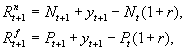
such that

e t+1 stands for unexpected shocks to the returns of the risky asset.
We assume that

Domestic and foreign investors have access to different information sets. Domestic investors observe It, while foreign investors look at a more limited information set I*t, such that I*t Ì It. In each period, the prior distributions of NAVs and prices are equal for both groups of investors. Nevertheless, the posterior distributions--conditioned on both information sets--are distinct across groups. The only difference between investors is reflected in the following expression:
(2) 
At time t, foreign investors cannot observe Nt, since the NAV is published once a week ex post. In addition, foreign investors do not know the composition of the fund. Taking into account these factors, equation (2) asserts that--given the locally available information at time t--foreign investors perceive a higher variance. q >0 represents the difference in the one-step-ahead expected variances. It captures the fact that foreign investment is perceived as a more risky activity than domestic investment. In other terms, expression (2) says that the conditional variance is smaller than the unconditional variance for domestic investors, but not for foreign investors. We assume that the information asymmetry does not affect expected wealth: both sets of investors make the same average forecasts.
Returns are assumed to be normally distributed. Then investors maximize the following conditional expected utility functions

A) Asymmetric Information and Positive Discounts
Proposition 1:
Discounts are strictly positive if the difference in information is greater than zero. In other terms, if q >0, Nt -Pt >0.
Proof of Proposition 1
Substituting the expressions for wealth into the conditional expected utility functions we get

Expected values and variances are taken at time t.
The maximization process yields the following demand functions for the underlying assets and for the country fund
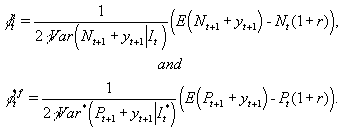
The equilibrium conditions for the risky assets are,

We assume that Sn and Sf (the supplies of underlying assets and country funds) are fixed and equal to S. We also assume that there exists a continuum [0,1] of domestic and foreign investors.
To solve for NAVs and country fund prices, we impose that the unconditional distributions of Nt+1 and Pt+1 are identical to the distributions of Nt and Pt. We also know that

and
 .
.
Then, using the demand functions and the equilibrium conditions, we obtain the following steady-state closed-form expressions
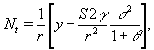
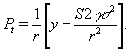
Finally, we can derive the following expression for the country fund discount
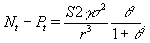
This result shows that under no information asymmetry (q =0), both assets are valued equally, Nt-Pt=0. Namely, the NAV-price difference depends on the fact that domestic investors have more information than foreign investors. If q >0, Nt-Pt>0. In addition, discounts depend positively on the other parameters of the model, like the risk aversion coefficient and the unconditional variance of the fundamentals. QED
B) Lagged Discounts, Present Prices, and Present NAVs
Proposition 2:
Past values of NAVs (prices) explain present fund prices (NAVs) when NAVs (prices) react first to fundamentals.
Proof of Proposition 2
We now assume that both domestic and foreign investors can buy the country fund and the underlying assets. However, investors pay an extra cost to buy in the "external market." Domestic (foreign) investors pay a fixed amount "k" per share to buy the country fund (underlying assets). These costs are based on the fact that pure arbitrage is not feasible--as summarized in Frankel and Schmukler (1996). Investors maximize the following expected utility functions. Since both assets are perfectly correlated, there are no gains from diversification and investors demand only one of the assets. Other things equal, domestic (foreign) investors demand underlying assets (country fund shares). The "excess demand functions" are:


The above expressions show that arbitrage will take place if discounts are relatively large. Large deviations of prices from NAVs will not persist over time. Therefore, unusually large past discounts are informative about how NAVs and prices will behave. We assume that the long-run relationship between prices and NAVs of the following form
Pt = p + Nt.
Changes in this relationship induce adjustments toward the long-run level. As an empirical fact, we know that the current NAV is unknown when the country fund price is set (due to the frequency that NAVs become publicly available). However, the past value is public knowledge. Investors realize that large previous discounts will make future prices and/or NAVs change. If NAVs change first, according to news received, prices adjust in the following periods. If instead changes in prices reflect new long-run conditions, NAVs will adjust later on.
We illustrate the case of prices following changes in discounts due to past changes in NAVs. However, the symmetrical case--when NAVs follow prices--can be demonstrated. The new expected utility function account for future changes in prices,

Then, the new demand function for country funds is

Substituting into the market equilibrium conditions,

we can obtain the new country fund price,
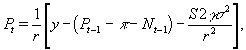
which shows that the past price and NAV affect today’s price. The long-run adjustment is taken into account and incorporated into the present fund price. QED
If country funds prices and NAVs were available at every moment in time, knowing that local residents have more information, foreign investors would constantly follow the domestic agents. However, NAVs are published ex-post on a weekly basis, so they are usually not available when country funds are traded.
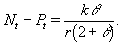
A similar result to proposition 1 can be derived under the new framework. We now assume that shocks to dividends are imperfectly correlated across markets. Therefore, diversification is beneficial; domestic and foreign investors participate in both markets. However domestic investors would tend to buy the underlying assets, while foreign investors would tend to buy the country fund. Asymmetric information would imply positive discounts whenever k>0 and q >0.
Investors maximize,
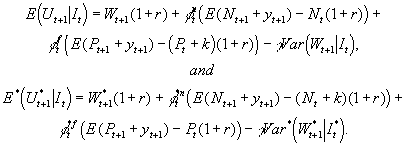
The new steady-state closed-form expressions for the NAV and price are
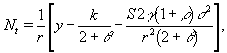
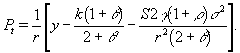
where 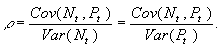
The new expression for the country fund discount is:
C) Noise-Traders and the Speed of Adjustment
The basic model predicts that both NAVs and prices fully react to past changes in abnormally large discounts with at most a one-week lag. However, the empirical results showed that the adjustment coefficients are low. It takes more than one week to return to the long-run equilibrium. We extend the basic model by introducing noise traders into the picture. This extension makes the adjustment coefficients smaller.
Proposition 3:
The presence of noise traders imply that NAVs and prices can vary due to new information received or to deviations in noise traders’ misperceptions. Therefore, the adjustments to past changes in NAVs and prices become slower because of a signal-extraction problem.
Proof of Proposition 3
The representative domestic and foreign noise trader misperceives the value of the assets by a random variable h t and h *t respectively, such that

For simplicity, we assume that the underlying assets are only held by domestic investors, while country fund shares are only held by foreign investors. There is a fraction n and n * of noise traders in both markets. The domestic and foreign representative noise traders maximize:

Then, the closed-form steady-state NAV and price are:


As in proposition 3, we only illustrate the case in which prices adjust to past NAVs, given that relevant information is only known locally. The symmetrical situation--the case in which NAVs follow changes in prices--could be described in a similar manner. The above expressions assumed that E(e t+1)=0. However, NAVs are affected by unforeseen shocks to the local assets and by changes in the noise traders misperceptions. Foreign investors only observe changes in NAVs ex-post. They do not know whether the change came from locally available news or from shifts in noise traders’ misperceptions. The only information they have is that any change in NAV took the following form:
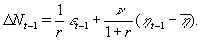
Foreign investors know that only changes in fundamentals will be transmitted to prices in the future. Therefore, any change in past NAVs is a noisy signal of the change in fundamentals. Foreign investors face a signal-extraction problem. The distribution of shocks to news and to misperceptions are public knowledge. Both shocks are independent and normally distributed, therefore
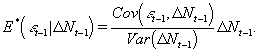
Then,
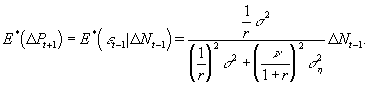
Foreign investors take into account the future expected change in prices, so the maximization process yields that
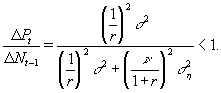
The higher the noise in the local market, the slower the one-period adjustment of prices with respect to NAVs, given that the number of noise traders (n ) is positive. In other words, the lower the relative variability of noise with respect to the total variability of NAVs and the fewer the noise traders, the more revealing past NAVs are. QED
References
Akerlof, George, "The Market for Lemons: Quality Uncertainty and the Market Mechanism," Quarterly Journal of Economics, 1970, 89:488-500.
Bonser-Neal, Catherine, Gregory Brauer, Robert Neal, and Simon Wheatley, "International Investment Restrictions and Closed-End Country Fund Prices," Journal of Finance, 1990, Vol. XLV, no. 2, June.
Calvo, Guillermo, "Varieties of Capital Market Crises," unpublished manuscript, Center for International Economics, University of Maryland at College Park, 1995.
Calvo, Guillermo, Leonardo Leiderman, and Carmen Reinhart, "The Capital Inflows Problem: Concepts and Issues," Contemporary Economic Policy, 1994, Vol. XII, July.
Chen, Nai-Fu, Raymond Kan, and Merton H. Miller, "Are the Discounts on Closed-End Funds a Sentiment Index?," Journal of Finance, 1993, Vol. XLVIII, 2:795-800.
Chopra, Navin, Charles M.C. Lee, Andrei Shleifer, and Richard H. Thaler, "Yes, Discounts on Closed-End Funds Are a Sentiment Index," Journal of Finance, 1993, Vol. XLVIII, 2:801-808.
Claessens, Stijn, and Moon-Whoan Rhee, "The Effect of Barriers to Equity Investment in Developing Countries," in J. Frankel, ed., The Internationalization of Equity Markets, the University of Chicago Press, Chicago, 1994.
De Long, J. Bradford, Andrei Shleifer, Lawrence H. Summers, and Robert Waldmann, "Noise Trader Risk in Financial Markets," Journal of Political Economy, 1990, Vol. 98, 4:703-738.
Diamond, Douglas, W., and Robert E. Verrechia, "Information Aggregation in a Noisy Rational Expectations Economy," Journal of Financial Economics, 1982, 9:221-235.
Dickey, David A. and Wayne A. Fuller, "Distribution of the Estimators for Autoregressive Time Series with a Unit Root," Journal of the American Statistical Association, 1979, 74:427-431.
Diwan, Ishac, Vihang Errunza, and Lemma Senbet, "Country Funds For Emerging Economies," in Stijn Claenssens and Sudarshan Gooptu (eds.) Portfolio Investment in Developing Countries, Washington: The World Bank, 1993.
Errunza, Vihang R., and Etienne Losq, "International Asset Pricing under Mild Segmentation: Theory and Tests," Journal of Finance, 1985, 40:105-124.
Frankel, Jeffrey A., and Sergio L. Schmukler, "Country Fund Discounts and the Mexican Crisis of December 1994: Did Local Residents Turn Pessimistic Before International Investors?," Open Economies Review, 1996, Vol. 7, Fall.
French, Kenneth, and James Poterba, "Investor Diversification and International Equity Markets," American Economic Review. Papers and Proceedings, 1991, 81:222-26.
Gehrig, Thomas, "An Information Based Explanation of the Domestic Bias in International Equity Investment," Scandinavian Journal of Economics, 1993, 9: 97-109.
Grossman, Sanford J., and Joseph E. Stiglitz, "On the Impossibility of Informationally Efficient Market," American Economic Review, 1980, 70:393-408.
Hardouvelis, Gikas A., Rafael La Porta, and Thierry A. Wizman, "What Moves the Discount on Country Equity Funds?," in J. Frankel, ed., The Internationalization of Equity Markets, the University of Chicago Press, Chicago, 1994.
Harris, Milton, and Artur Raviv, "Difference of Opinion Make a Horse Race," The Review of Financial Studies, 1993, Vol. 6, 3:473-506.
Johansen, Soren, "Statistical Analysis of Cointegration Vectors," Journal of Economic Dynamics and Control, 1988, 12: 255-259.
Johansen, Soren, and Katerina Juselius, "Maximum Likelihood Estimation and Inference on Cointegration - With Applications to the Demand for Money," Oxford Bulletin of Economics and Statistics, 1990, 52:169-210.
Klibanoff, Peter, Owen Lamont, and Thierry A. Wizman, "Investor Reaction to Salient News in Closed-End Funds," National Bureau of Economic Research Working Paper No. 5588, May 1996.
Lang, Larry H. P., Robert H. Litzenberger, and Vicente Madrigal, "Testing Financial Market Equilibrium under Asymmetric Information," Journal of Political Economy, 1992, Vol. 100, 21:317-348.
Lee, Charles M.C., Andrei Shleifer, and Richard Thaler, "Anomalies. Closed-End Mutual Funds," Journal of economic Perspectives, 1990, Vol. 4, 4:153-164.
Lee, Charles M.C., Andrei Shleifer, and Richard Thaler, "Investor Sentiment and the Closed-end Fund Puzzle," Journal of Finance, 1991, Vol. 46, 1:75-109.
Lewis, Karen K., "Puzzles in International Financial Markets," in Handbook of International Economics, Vol. III, edited by G. Grossman and K. Rogoff, 1995.
Phillips, Peter C. B., and Pierre Perron, 1988, "Testing for a Unit Root in Time Series Regression," Biometrica, pp. 335-346.
Rogers, John, H., 1994, "Entry Barriers and Price Movements between Major and Emerging Stock Markets," Journal of Macroeconomics, Spring, Vol. 16, 2: 221-241.
Stultz, René M., "On the Effects of Barriers to International Investment," Journal of Finance, 1981, Vol. XXXVI, 4:923-934.
Tesar, Linda L. and Ingrid M. Werner, "Internal Equity Transactions and U.S. Portfolio Choice," in J. Frankel, ed., The Internationalization of Equity Markets, the University of Chicago Press, Chicago, 1994.
Endnotes
|
TABLE 2 |
||||||||||||||||||||||
|
FULL-INFORMATION MAXIMUM LIKELIHOOD ESTIMATION RESULTS |
||||||||||||||||||||||
|
THE CASE OF 6 REPRESENTATIVE FUNDS (2 FOR EACH REGION)+ |
||||||||||||||||||||||
|
EXOGENEITY TESTS (WALD STATISTICS) AND NORMALIZED COINTEGRATING VECTORS |
||||||||||||||||||||||
|
4 LAGS - SAMPLE 1/4/85-3/8/96 |
||||||||||||||||||||||
|
FITTED |
FITTED |
LONG-RUN ADJUSTMENT (Weak Exogeneity) |
SHORT-RUN ADJUSMENT |
GRANGER-NONCAUSALITY (Strong Exogeneity) |
||||||||||||||||||
|
LAMBDA |
STAND. |
Chi-Squared (1) |
Chi-Squared (2) |
|
Chi-Squared(3) |
|||||||||||||||||
|
EUROPEAN FUNDS: |
ID |
No. OBS. |
ERROR |
H0:alpha1=0 |
alpha1 |
H0: alpha2=0 |
alpha2 |
H0:gamma1'=0 |
H0: gamma2'=0 |
H0:alpha1 & gamma1'=0 |
H0: alpha2 & gamma2'=0 |
|||||||||||
|
ITALY FUND |
ITA |
499 |
0.87 |
0.165 |
6.32 |
** |
-0.050 |
2.56 |
|
0.021 |
11.10 |
** |
1.60 |
|
19.08 |
*** |
5.46 |
|
||||
|
SWISS HELVETIA FUND |
SWZ |
443 |
0.97 |
0.082 |
5.49 |
** |
-0.076 |
1.07 |
|
0.019 |
31.81 |
*** |
1.41 |
|
48.11 |
*** |
2.87 |
|
||||
|
LATIN AMERICAN FUNDS: |
||||||||||||||||||||||
|
CHILE FUND |
CH |
332 |
0.93 |
0.082 |
9.35 |
*** |
-0.083 |
2.46 |
|
-0.027 |
22.78 |
*** |
5.20 |
|
37.94 |
*** |
6.75 |
|
||||
|
MEXICO FUND |
MXF |
555 |
1.18 |
0.046 |
1.12 |
|
-0.027 |
7.38 |
*** |
0.051 |
18.74 |
*** |
8.03 |
* |
25.41 |
*** |
26.89 |
*** |
||||
|
PACIFIC RIM FUNDS: |
||||||||||||||||||||||
|
KOREA FUND |
KF |
584 |
0.69 |
0.306 |
4.37 |
** |
-0.023 |
0.16 |
|
-0.002 |
19.13 |
*** |
8.74 |
* |
24.17 |
*** |
8.74 |
|
||||
|
MALAYSIA FUND |
MF |
453 |
1.09 |
0.116 |
13.04 |
*** |
-0.085 |
0.19 |
|
-0.007 |
6.73 |
|
40.34 |
*** |
26.42 |
*** |
41.24 |
*** |
||||
|
+ All the results are tabulated in Tables A4 and A5. |
||||||||||||||||||||||
|
*, (**), [***] Implies significance at 10%, (5%), [1%]. |
||||||||||||||||||||||