Is the Malaysian Foreign Exchange Market Efficient?
Dr. Omar Marashdeh
Senior Lecturer
Graduate School of Business
The University of Sydney
Locked Bag 20
Newtown, NSW 2042, Australia
E-mail: omarm@gsb.usyd.edu.au
Paper prepared for presentation at The Tenth Annual
Australasian Finance & Banking Conference, 4-5 December 1997,
Sydney, Australia,, and the Second Asian Academy of Management
Conference, 12-13 December 1997, Langkawi, Kedah, Malaysia..
Abstract
This paper examines the Malaysian foreign exchange market
efficiency for the USD, Singapore dollar, pound, and yen over
the 1980:1-1994:12 period by utilizing Johansen-Juselius (JJ)
Maximum Likelihood procedure. The bivariate cointegration
results show the absence of cointegration among the bilateral
exchange rates. This is further confirmed by the multivariate
cointegration results which indicate the absence of a
cointegration relationship among the four exchange rates.
Thus, the foreign exchange markets for the four currencies are
weakly efficient. However, these results were susceptible to
the sample period under consideration. The subperiod analysis
shows that a cointegrating relationship existed among the four
currencies during 1980:1-1985:10 period. However, this
relationship disappeared during the 1985:10-1994:12 period.
Moreover, the results of the analysis remained the same after
extending the sample to 1996:1. This implies that the
Malaysian Foreign exchange market is weakly efficient.
1. Introduction
The efficiency of the foreign exchange markets has been
examined by, among others, MacDonald and Taylor (1989), Levich
(1989), Baillie and Bollerslev (1989), Coleman (1990),
Copeland (1991), Tronzano (1992), Alexander and Johnson
(1992), Masih and Masih (1994), Karfakis and Parikh (1994),
and Baharumshah and Habibullah (1995). All of these studies
with the exception of Baharumshah and Habibullah (who examined
the Malaysian case) (1995) have examined the efficiency of
foreign exchange markets in developed countries. Most of these
studies, however, have used Engle and Granger two steps
cointegration analysis in their approach to examining market
efficiency with the exception of Baillie and Bollerslev (1989)
and Karfakis and Parikh (1994) who use Johansen-Juselius (JJ)
maximum likelihood procedure. In general, the Engle and
Granger bivariate cointegration analysis leads to acceptance
of the efficiency of the foreign exchange market, whereas the
Johansen and Juselius multivaraite cointegration analysis,
which accounts for interdependence among the exchange rates,
leads to a rejection of the efficiency of the foreign exchange
markets.
Baillie and Bollerslev (1989) test the efficiency of the U.S.
daily spot and forward foreign exchange markets for seven
currencies, namely, the pound, yen, mark, Canadian dollar,
Italian lira, French franc, and the Swiss franc. They find
that at least one common unit root is present in the seven
daily spot and forward exchange rates. They conclude that the
foreign exchange market is inefficient and the exchange rates
are tied together by one long-run relationship.
Karfakis and Parikh (1994) examine the market efficiency of
five major exchange rates of the Australian dollar by using
Johansen and Juselius (1991) multivariate cointegration
technique. They conclude that cointegrated relationships exist
in the foreign exchange market when interdependence among
exchange rates is accounted for.
Baharumshah and Habibullah (1995) examine the efficiency of
the Malaysian foreign exchange market for six currencies,
namely, the Malaysian ringgit (RM), Pound sterling, Deutsche
mark, Japanese yen, Singapore dollar, and Swiss franc over the
1973:1-1992:8 period. In their study, the exchange rates were
expressed as foreign currency per unit of US dollar. The
closing prices at the end of the month/quarter were used. By
using Engle and Granger bivariate cointegration technique,
they find that the Malaysian spot exchange market is weakly
efficient in the long-run. However, their results were
sensitive to the sample period.
The purpose of this study is to test the efficiency of the
Malaysian foreign exchange market for four major currencies,
namely, the US dollar, the Japanese yen, the Singaporean
dollar (SGD), and the British pound over the 1980:1-1994:12
period. The data are the average monthly Malaysian ringgit per
unit of foreign currency. The data are obtained from Bank
Division, Bank Negara Malaysia (BNM).
This study differs from Baharumshah and Habihullah (1995) in
two aspects: 1) they use Engle and Granger bivariate
cointegration analysis, whereas this study uses Johansen-Juselius multivariate cointegration analysis; and 2) their
sample runs from 1973:1-1992:8, whereas this study uses more
recent data from 1980:1 to 1994:12 and a hold out sample until
1996:1.
2. The Malaysian Foreign Exchange Market
Prior to 1972, the ringgit was linked to the sterling. The
Malaysian ringgit severed its ties with the sterling on June
24, 1972 due to economic problems. The link to the U.S. dollar
was established on June 24, 1972. On June 21, 1973, the
ringgit was allowed to float. Since September 27, 1975, the
ringgit has been determined by a weighted average of the major
trading partners' currencies. However, neither the weight nor
the currencies involved are known as the central bank does not
divulge such information. The four countries in this study
(Japan, UK, USA, and Singapore) accounted for 62% of total
trade with Malaysia over the 1991-1993 period (Marashdeh
(1995)).
The foreign exchange market has expanded since 1975. The
monthly turn-over has increased from RM2 billion in 1975 to
RM8.7 billion in 1985, RM37 billion in 1993, and 47.3 billion
in 1994 (BNM, 1994a,b). In 1994, the U.S. dollar accounted for
62.8% of total transactions followed by the Deutsche mark
(19%) and the Japanese yen (14.3%) (BNM, 1994b). The central
bank intervened in the foreign exchange market to smooth the
day to day fluctuations in the value of the ringgit (BNM,
1994). Such intervention was made heavily in the foreign
exchange market in 1989, 1992 and 1994 to reduce the short-term/speculative flows to the Malaysian market which took
advantage of the interest rate differentials between Malaysia
and their home countries. The intervention took the form of
restriction on swaps, limits on ringgit borrowing of
commercial banks from offshore companies, limits on non-trade
related external liabilities of banking institutions,
revision of eligible liabilities base for computation of
statutory reserve requirement and liquidity, prohibition of
sale of short-term monetary instruments to non-residents, and
placement of foreign vestro accounts with the central bank
(BNM, 1994a,b).
The major players in the Malaysian foreign exchange market are
all commercial banks, finance companies, and money-changers.
3. Methodology
The time series properties of the data are tested for
stationarity by augmented Dickey-Fuller (ADF) test (due to
Dickey and Fuller (1981)) and Phillips-Perron (PP) test (due
to Phillips (1987), Phillips and Perron (1988) and Perron
(1988)). The Dickey-Fuller test is based on the following
equation for the jth exchange rate
Yj,t = +Yj,t-1 +Yj,t-i +et (i=1,2,...,k) (1)
And the Phillips-Perron test is based on the following
equation for the jth exchange rate
Yj,t = +(1-)Yj,t-1 + Yj,t-i +vt (i=1,2,...,k) (2)
Where j= USD, SGD, Pound, Yen. Y is the exchange rate, e and v
are residual vectors.
A rejection of the unit root hypothesis implies that the
exchange rate is stationary, i.e., integrated of order zero,
I(0). Sufficient number of lags are included based on the
highest significant autocorrelation function (ACF) and the
partial autocorrelation function (PACF) to ensure that the
residuals are not serially correlated.
The unit root tests are also performed on the first difference
of the exchange rates to test for higher order unit roots. A
rejection of the unit root hypothesis for the first difference
means that the exchange rate is integrated of order one, i.e.,
I(1), and the first difference is integrated of order zero,
I(0). That is, differencing the exchange rates once leads to
stationarity.
The above equations are, also, augmented with a time trend to
allow for the possible presence of deterministic time trend.
To examine whether a structural break in the series leads to
the rejection of stationarity of the data in level form,
Perron (1989) test for unit roots with structural change is
applied. The test takes the form:
yt = +t +DU +d(DTB) +yt-1 + ciyt-i (i= 1,2,...k) (3)
where t is a time trend; DTB=1 for 1985:11 and zero otherwise;
DU is a dummy variable which takes a value of 1 for t >
1985:10 and zero otherwise; measures the exogenous change in
the rate of growth of the series; and d measures the exogenous
change in the level of the series (see Perron 1989 for a
discussion of the properties of the test).
Perron (1989) shows that under the unit root hypothesis: =0,
=0, =0, d=0, and =1, whereas under the alternative
hypothesis of stationary fluctuations around a deterministic
breaking trend function: 0, 0, 0, d=0, and <1. The
optimal number of lags (k) is chosen based on the highest
significant lag from the ACF or PACF functions.
The efficiency hypothesis test proceeds with Johansen and
Juselius (1990 and 1992) Maximum Likelihood procedure which
tests for the dependance of the exchange rates on each other.
The procedure is based on the interim multiplier form of the
vector autoregressive (VAR) representation of the system
(equation (4)).
Yt = iYt-i + qYt-q + t+Vt (i=1,...,q-1) (4)
where Yt is nx1 vector of exchange rates (Yen, SGD, USD, and
Pound), q is a square nxn matrix of ranks r n, is nx1
vector of constants and Vt is nx1 vector of residuals.
The testing procedure involves the null hypothesis H0: q=',
i.e., there are at most r cointegrated vectors 1, 2,.., r
which provide r stationary linear combinations 'Yt-q. The test
proceeds by regressing the n-element vectors Yt and Yt-q on
Yt-i, i=1,2,...,q-1, and monthly dummies, and obtaining the
associated n-element residual vectors R0(t) and Rq(t). The test
for the number of cointegrating vectors is obtained by solving
the eigenvalue problem
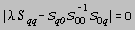 (5)
(5)
by the Choleski decomposition of Sqq. Where  ,
,
i,j=0,q and T denotes the number of observations.
The Trace test, for the number of cointegrating vectors is
less than or equal to r, q=', is
-2ln(Q:H2H1)=- T Ln(1- i) (i=r+1 to n) (6)
where i corresponds to the n-r smallest eigenvalues of
Sq0S-100S0q with respect to Sqq. The maximal eigenvalue statistic
for testing the null hypothesis that the number of
cointegrating vectors is r (H2(r)) against the alternative r+1
(H2(r+1)) is given by
-2Ln(Q:rr+1) = - TLn(1- r+1) (7)
The likelihood ratio test statistic of zero loading factors
H4: =A in H2 is given by
-2ln(Q:H4H2) = T Ln{(1- 4,i)/(1- i)} (i=1 to n) (8)
This is a test of weak exogeneity on the parameters of the
matrix (Johansen and Juselius (1992)). That is, the loading
factor j (j=USD, SGD, Yen, Pound) entering the jth equation
serves as a test of weak exogeneity of Yj with respect to the
cointegration vector.
The strong form of market efficiency says that in an efficient
market the price of an asset should reflect all available
information (Fama (1970 and 1991)). A weaker form of this
hypothesis says that in an efficient market, the price should
reflect all available information up to the point where the
marginal cost of obtaining that information is equal to the
marginal cost (Fama (1991)). On the other hand, the weak form
of the market efficiency says that in an efficient market, the
price of an asset should reflect all information which are
contained in the past prices of the asset. The cointegration
hypothesis says that if two exchange rates are cointegrated
then one could be used to predict the other, i.e., evidence
against market efficiency. Therefore, a rejection of the
cointegration hypothesis leads to a rejection of the market
efficiency hypothesis in favor of the error correction
mechanism (ECM). Under ECM, past equilibrium errors could be
used to predict current rates. Thus, a rejection of foreign
exchange efficiency means that traders can use simple rules to
out-perform the market.
4. Sensitivity Analysis
Earlier studies have shown that the results of Johansen-Juselius procedure is sensitive to model specifications and
sample periods. With regard to model specifications, test is
conducted for both bivariate and multivariate specifications
for the exchange rates. With regard to sample size, the
sample is further subdivided into two samples: 1980:1-1985:10
(prior to the intervention of the G-5 in the foreign exchange
market) and 1985:10-1994:12 (post intervention). For stability
of the results, both bivariate and multivariate specifications
as well as the subsample results are expected to remain the
same. Cheung and Lai (1993) state that the JJ method tends to
over-estimate the number of cointegrating vectors when there
are small samples with too many variables or lags. As such,
this paper places more emphasis on higher confidence levels,
say, 99% instead of the 95%, when using the trace and the
maximal-eigenvalue test statistics.
To identify any period of temporal instability in the model,
iterative tests for the number of cointegrating relationship,
r, are conducted. The test proceeds from an initial estimate
of the subsample 1980:1-1985:10 and successively proceeds by
iterating r until the end of the period. The test was further
extended beyond the sample period to 1996:1 to examine the
stability of the results after 1994:12.
5. Empirical Results
Table 1 shows the augmented Dickey-Fuller and Phillips-Perron
tests for unit roots in the four exchange rates. The table
shows that all exchange rates in their level form are I(1)
while in first difference are I(0), i.e., the exchange rates
become stationary after differencing once.
Insert table 1 here
These results are further confirmed by the Perron test for
structural break after the agreement of the Finance Ministers
of the G-5 to intervene in the foreign exchange market to
adjust the US dollar exchange rate. The test shows that all
series displays a unit root in their level form.
Insert table 2 here
Table 3 shows the Johansen-Juselius maximum likelihood
bivariate test for the efficiency of the exchange market. The
test covers 1980:1-1994:12; 1980:1-1985:10; and 1985:10-1994:12 periods for the six bilateral combinations of the
exchange rates. The lag length was determined based on
minimization of Akaike final prediction error (FPE) and serial
correlations. For the 1980:1-1994:12 period, the table shows
that the hypothesis of at least 2 stochastic trends in all
bilateral exchange rates could not be rejected. That is, the
bilateral exchange markets are weakly efficient. For the
1980:1-1985:10 period, however, the table shows that the
foreign exchange market is weakly efficient except for the
SGD-Yen and SGD-USD markets. For the 1985:10-1994:12 period,
the foreign exchange market is weakly efficient as the
cointegration hypothesis was accepted for all bilateral
combinations of the exchange rates.
Insert table 3 here
The lag length in the multivariate cointegrating system is
determined by minimization of the FPE and tests for normality
and serial correlation in the residuals for each equation. The
optimal number of lags to remove serial correlations form the
systems is achieved at 6 lags, but no lag length is able to
ensure that all residuals pass normality test. At lags less
than 6, the system suffers from serial autocorrelations. The
results for the model with 7 or 5 lags are similar to the
models with 6 lags. Therefore, the results reported in this
paper are for the models with 6 lags.
Table 4 shows the residual misspecification tests for the VAR
models for the whole sample and the two subsamples. For the
whole sample, the table shows that the Yen, SGD, and USD
equations suffer from excess skewness while the Yen, SGD, USD,
and Pound equations suffer from excess kurtosis. Jarque-Bera
test shows that the residual vectors for the four equations
deviate significantly from normality. For the 1980:1-1985:10
period, the table shows that the residual vectors do not
deviate from normality. However, for 1985:10-1994:12 period,
the residual vectors exhibit significant skewness, kurtosis,
and deviate significantly from normality. Johansen-Juselius
(1992) indicate that deviation from normality may not bias the
results as long as the errors admit a central limit theorem.
Insert table 4 here
Table 5 shows the results of applying Johansen-Juselius
maximum likelihood cointegration test for the VAR models for
the three periods: 1980:1-1994:12; 1980:1-1985:10; and
1985:10-1994:12. For the whole period, the maximal eigenvalue
and trace tests show that the hypothesis of at least 4
stochastic trends in the four equations system which
determines the spot rates could not be rejected, i.e., the
foreign exchange market is weakly efficient. However, this
conclusion is susceptible to the sample period. For the
1980:1-1985:10 period, the maximal eigenvalue and trace tests
confirm the presence of three stochastic trends in the four
equation model, or one long-run relationship among the four
exchange rates. That is, a common I(0) disequilibrium error
among the four currencies partly determines the monthly
changes in the exchange rates for the 1980:1-1985:10 period.
This relationship may provide evidence against foreign
exchange market efficiency during the 1980:1-1985:10. This
finding collaborates the findings of Baillie and Bollerslev
(1989) and Kurfakis and Parikh (1994).
However, this long-run relationship becomes less significant
for the 1985:10-1994:12 period as the maximal eigenvalue test
is statistically significant at the 10% only. These results
show that the exchange market tends to be more efficient, the
longer the time period under considerations as evident by the
1980:1-1994:12 and 1985:10-1994:12 periods against the 1980:1-1985:10 period. These findings confirm the findings of earlier
studies (for example see Sephton and Larsen (1991)) that the
JJ method is sensitive to model specifications and time
period.
Insert table 5
To examine whether the cointegration relationship 'Yt-q does
not enter all equations of the VAR system for the 1980:1-1985:10 period, the likelihood ratio test (equation 8) is
applied. The results of the likelihood ratio tests on the
loading factors indicate that the null hypothesis of zero
loading is rejected for all currencies (see table 6). This
implies that the four currencies adjust to clear the non-equilibrium in the foreign exchange market.
Insert table 6 here
The results of the iterative Johansen-Juselius test for the
temporal stability of the results are presented in table 7.
The table shows that instability of the results took place
only in October 1985. Thereafter, the results remained stable.
However, these results are dependent on the starting date of
the estimation period as evident by the results for the
subsamples reported in table 5. After extending the sample
period to 1996:1 and conducting the JJ test, the results
remained the same as those for the 1980:1-1994:12 sample.
Thus, the long-run stability of the estimated results, based
on 1980:1 starting date, are robust.
Insert Table 7 here
6. Conclusion
The purpose of this paper is to study the efficiency of the
Malaysian Foreign exchange market for four currencies, namely,
USD, SGD, Yen, and Pound over the 1980:1-1994:12 period.
Johansen-Juselius maximum likelihood cointegration technique
is employed in the analysis. The bivariate tests show that the
foreign exchange market is weakly efficient. However, when the
exchange rates interdependence is taken into account, the
foreign exchange market is weakly efficient for the whole
period. However, for the subperiod 1980:1-1985:10 the evidence
indicates that at least one unit root exists among the four
exchange rates, i.e., a long run relationship exists among the
four exchange rates. The disequilibrium error from this
relationship could be used to predict next period's exchange
rate. This disequilibrium error provides evidence against weak
form efficiency of the exchange rate. As for the subperiod
1985:10-1994:12, the foreign exchange market is weakly
efficient. The bivariate JJ test for the subperiods confirms
the findings for the multivariate JJ test.
JJ iterative tests indicate the presence of one cointegrating
vector prior to 1985:10 and the absence of this cointegrating
vector thereafter. Moreover, after extending the sample to
1996:1, the results remained the same as those for the 1980:1-1994:12 period. That is, in the long-run, the Malaysian
foreign exchange market is weakly efficient. Inefficiencies in
the foreign exchange market may take place in the short-run
due to government interventions, thin trading and market
imperfections. In the long-run, however, these inefficiencies
are more likely to disappear. As such, the cointegration
results across model specifications and time appear to be
robust.
Caution should be exercised when using these results due to
the limited scope of the technique employed and its
sensitivity to starting date, sample size and number of lags
employed. In case where evidence was suggestive of market
inefficiency, it is possible that transaction costs could
eliminate this inefficiency in the market.
7. References
Alexander, C.O. and A. Johnson, (1992), Are foreign exchange
markets really efficient?, Economics Letters 40, 449-453.
Baharumshah A.Z. and M.S. Habibullah, (1995), The efficiency
of the spot foreign exchange market: evidence from the
Malaysian currency market, paper presented at the Third
Malaysian Econometric Conference, June 14-15, Kuala Lumpur,
Malaysia.
Baillie Richard T. and Tim Bollerslev, (1989), Common
stochastic trends in a system of exchange rates, The Journal
of Finance XLIV, 167-181.
Bank Negara Malaysia (1994a), Money and Banking in Malaysia:
35th Anniversary Edition 1959-1994, Kuala Lumpur, Malaysia.
--------- (1994b), Annual Report 1994, Kuala Lumpur, Malaysia.
Cheung, Y.W. and Lai, K.S (1993), Finite-sample sizes of
Johansen's likelihood ratio test for cointegration, Oxford
Bulletin of Economics and Statistics, 55 (3), 313-328.
Coleman, M, (1990), Cointegration-based test of daily foreign
exchange market efficiency, Economic Letters 32, 53-59.
Copeland, L, (1991), Cointegration test of daily foreign
exchange data, Oxford Bulletin of Economics and Statistics 53,
185-198.
Dickey, D.A. and Fuller, W.A, (1981), Likelihood ratio
statistics for autoregressive time series with a unit root,
Econometrica 49, 1057-72.
Engle, R. F. and Granger, C. W. J, (1987), Cointegration and
the error correction: representation, estimation and testing,
Econometrica 55, 251-76.
Fama, E.F, (1970), Efficient capital markets: review of theory
and empirical work, Journal of Finance 25, 383-417.
---------, (1991), Efficient capital markets II, The Journal
of Finance, XLVI, 1575-1617.
Johansen S. and K. Juselius, (1990), Maximum likelihood
estimation and inference on cointegration-with application to
Demand For Money, Oxford Bulletin of Economics and Statistics
52, 169-210.
------------(1992), Testing structural hypothesis in a
multivariate cointegration analysis of the PPP and the UP for
the UK, Journal of Econometrics, 53, 211-244.
Karfakis, Costas I. and Ashok Parikh (1994), Exchange rate
convergence and market efficiency, Applied Financial
Economics 4, 93-98.
Levich, R.M, (1989), Is the foreign exchange market efficient?
Oxford Review of Economic Policy 5, 40-60.
MacDonald, R. and M.P. Taylor (1989), Foreign exchange market
efficiency and cointegration: some evidence from recent float,
Economics Letters 29, 63-68.
Marashdeh, O., (1995), The effect of the foreign exchange rate
on the demand for financial assets in Malaysia, in M.
Sulaiman, A.G. Shafie, and J.H. Ali (eds): Proceedings of the
First Annual Asian Academy of Management Conference,
Universiti Sains Malaysia, Penang, Malaysia, pp. 156-166.
Masih A. M.M. and Masih R, (1994), On the robustness of
cointegration tests of the market efficiency hypothesis:
evidence from six European foreign exchange markets, Economia
Internazionale XLVII, 160-180.
Perron P. (1988), Trends and random walks in macroeconomic
time series, Journal of Economic Dynamics and Control, 12,
297-332.
-------- (1989), The great crash, the oil price shock, and the
unit root hypothesis, Econometrica, 57, 1361-1401.
Phillips P. (1987), Time series regression with a unit root,
Econometrica, 55, 277-301.
Phillips P. and Perron P. (1988), Testing for a unit roots
time series regression, Biometrika, 75, 335-346.
Phillips, P (1991), Unidentified components in reduced rank
regression estimation of ECM's, Yale University, Mimo.
Sephton P.S. and Larsen H.K. (1991), Tests of exchange market
efficiency: fragile evidence from cointegration tests, Journal
of International Money and Finance, 10, 561-570.
Tronzano, M, (1992), efficiency in German and Japanese foreign
exchange markets: evidence from cointegration techniques,
Review of World Economics 128, 1-20.
Table 1
Tests of the Unit Roots hypothesis for the Exchange Rates (1980:1-1994:12)
Currency No Trend Trend
ADF(u) Z() Z(t) Z(1) ADF() Z(*) Z(t*) Z(2) Z(3) Lag
Level Form
Yen -0.56 -0.21 -0.15 2.42 -3.19+ -8.67 -2.15 3.21 2.49 11
SGD 0.78 0.64 0.65 5.68+ -1.44 -6.49 -1.83 5.05+ 2.38 7
Pound -2.12 -5.52 -1.77 1.68 -2.29 -5.63 -1.81 1.25 1.76 8
USD -2.04 -4.65 -1.92 2.26 -1.01 -8.45 -1.90 1.82 2.36 11
First Difference
Yen -3.03+ -131.6* -10.1* 50.96* -3.06+ -130.4* -10.05* 33.71* 50.55* 13
SGD -3.49* -104.13* -10.01* 49.87* -3.75* -101.46* -10.06* 33.44* 50.16* 11
Pound -4.49* -100.72* -8.88* 39.33* -4.10* -100.45* -8.86* 26.07* 39.09* 7
USD -3.62* -100.78* -10.71* 56.97* -3.76* -97.45* -10.83* 38.62* 57.93* 13
* Significant at the 1% level. + Significant at the 5% level.
The order of lags is set as the highest significant lag order from either the ACF or PACF of
the first difference series.
ADF(u) and ADF() are the augmented Dickey-Fuller test for =0 in the no trend and trend cases,
respectively.
Z() and Z(*) are Phillips' (1987) tests for =1 in the no trend and trend cases, respectively.
Z(t) and Z(t*) are the Phillips-Perron's (1988) tests for =1 in the no trend and trend cases,
respectively.
Z(1) is the Phillips-Perron test for =0 and =1 in the no trend case.
Z(2) is the Phillips-Perron test for *=*=0 and *=1 in the trend case.
Z(3) is the Phillips-Perron test for =0 and *=1 in the trend case.
Table 2
Perron Tests for Structural Change in October, 1985
y= +t+DU+dDTB+yt-1+ ciyt-i (i= 1,2,...k)
Currency t t t d td t lag lambda R
Yen 0.051 3.20 0.036 2.60 0.0004 2.22 0.039 0.89 0.931 -3.18 10 0.38 0.995
Pound 0.159 2.53 0.085 2.27 -0.0004 -1.4 -0.101 -0.92 0.957 -2.85 8 0.38 0.971
USD 0.158 1.86 0.017 1.47 -0.0001 -0.4 0.035 1.1 0.936 -1.71 11 0.38 0.965
SGD 0.023 1.16 0.004 0.71 0.0001 0.81 -0.020 -1.3 0.978 -1.03 7 0.38 0.996
The test is for =0, =0, =0, d=0, and =1.
The level of significance for =1 and lambda= 0.4 is -4.34 at the 1% level and -3.72 at the 5%
level (Perron 1989, Table IV.B, p. 1376).
Lambda is time of break relative to sample size.
Table 3
Bivariate Johansen Tests between alternative Currencies
Relationship |
Lag |
H0: r=0 |
H0: r=1 |
| Trace |
Maximal
Eigenvalue |
Maximal
Eigenvalue &
Trace |
| 1980:1-1994:12 Period |
| Pound-USD |
11 |
18.539 |
14.104 |
4.436 |
| Pound-SGD |
8 |
7.491 |
7.081 |
0.410 |
| SGD-Yen |
11 |
8.644 |
8.557 |
0.086 |
| SGD-USD |
11 |
13.647 |
13.641 |
0.006 |
| USD-Yen |
11 |
7.304 |
6.278 |
1.026 |
| Yen-Pound |
11 |
12.245 |
11.065 |
1.181 |
| 1980:1-1985:10 Period |
| Pound-USD |
11 |
13.3 |
10.861 |
2.439 |
| Pound-SGD |
8 |
6.3 |
4.766 |
1.534 |
| SGD-Yen |
11 |
17.639 |
16.929** |
0.71 |
| SGD-USD |
11 |
19.907 |
18.884* |
1.023 |
| USD-Yen |
11 |
19.597 |
14.684 |
4.911 |
| Yen-Pound |
11 |
7.221 |
5.428 |
1.794 |
| 1985:10-1994:12 Period |
| Pound-USD |
11 |
11.440 |
9.354 |
0.209 |
| Pound-SGD |
8 |
3.855 |
3.853 |
0.002 |
| SGD-Yen |
11 |
6.249 |
5.315 |
0.934 |
| SGD-USD |
11 |
11.394 |
11.391 |
0.003 |
| USD-Yen |
11 |
3.549 |
3.431 |
0.071 |
| Yen-Pound |
11 |
2.421 |
2.222 |
0.199 |
* and ** Significant at the 1% and 2.5% levels, respectively.
Table 4
Residual Misspecification Tests in the VAR Model
| Equation |
FPE |
Q(20) |
SK |
KR |
JB(2) |
Sigma |
| 1980:1-1994:12 Period |
| Yen |
0.0023 |
29.84 |
0.664* |
1.639* |
30.20* |
0.044 |
| SGD |
0.0003 |
20.15 |
0.293* |
4.628* |
146.78* |
0.015 |
| USD |
0.0134 |
19.11 |
-0.565* |
3.179* |
76.72* |
0.107 |
| Pound |
0.0011 |
29.63 |
0.229 |
4.279* |
124.73* |
0.031 |
| 1980:1-1985:10 Period |
| Yen |
0.0006 |
12.28 |
0.472 |
-0.156 |
2.421 |
0.021 |
| SGD |
0.0001 |
15.28 |
0.213 |
-0.276 |
0.783 |
0.007 |
| USD |
0.0101 |
21.93 |
0.441 |
0.978 |
3.784 |
0.082 |
| Pound |
0.0015 |
15.41 |
-0.026 |
0.919 |
1.532 |
0.031 |
| 1985:10-1994:12 Period |
| Yen |
0.01254 |
4.29 |
9.01* |
104.0* |
**** |
0.1029 |
| SGD |
0.01025 |
1.57 |
11.39* |
143.7* |
**** |
0.0930 |
| USD |
0.10381 |
2.74 |
10.17* |
124.6* |
**** |
0.2961 |
| Pound |
0.04673 |
1.45 |
11.54* |
146.2* |
**** |
0.1987 |
Sigma refers to the standard error of the equation.
Q(20) refer to Ljung-Box Q statistic for serial correlation
for the first 20 autocorrelations.
JB= Jarque-Bera test for normality of residuals.
FPE refers to Akaike information criterion.
SK refers to skewness.
KR refers to kurtosis.
* Statistically significant at the 5% or better.
**** Statistically significant at the 1%.
Table 5
Johansen-Juselius maximum likelihood cointegration tests
| r |
n-r |
Trace |
Maximal
eigenvalue |
Eigenvalue |
| 1980:1-1994:12 Period |
| 0 |
4 |
37.724 |
17.639 |
0.0964 |
| 1 |
3 |
20.085 |
13.34 |
0.0738 |
| 2 |
2 |
6.745 |
6.015 |
0.03398 |
| 3 |
1 |
0.729 |
0.729 |
0.00418 |
| 1980:1-1985:10 Period |
| 0 |
4 |
68.496* |
41.283* |
0.47537 |
| 1 |
3 |
27.213 |
16.758 |
0.23037 |
| 2 |
2 |
10.455 |
9.592 |
0.13919 |
| 3 |
1 |
0.863 |
0.863 |
0.01340 |
| 1985:10-1994:12 Period |
| 0 |
4 |
44.693 |
26.819 |
0.14284 |
| 1 |
3 |
17.874 |
11.549 |
0.06422 |
| 2 |
2 |
6.325 |
6.260 |
0.03534 |
| 3 |
1 |
0.065 |
0.065 |
0.00037 |
* significant at the 1% levels.
r and n-r denote the number of eigenvectors and common
trends, respectively.
Table 6
Testing for zero loading factors
-Restriction Eigenvalues -2lnQ(H4\H2)
1980:1-1985:10 Period
H2: q=' (0.47537 0.23037 0.13919 0.134)
H4: J=0 (0.26158 0.11826 0.03648 0.000) (1)=23.24*
H4: S=0 (0.20359 0.05317 0.00679 0.000) (1)=28.38*
H4: Uk=0 (0.35410 0.15710 0.00077 0.000) (1)=14.14*
H4: US=0 (0.16944 0.04998 0.00874 0.000) (1)=31.24*
* indicates significant at the 5%.
Table 7
Iterated Johansen-Juselius Test for the Four Exchange Rates
System
| Sample |
H0: r=0 (n=4) |
H0: r=1 (n=3) |
| Maximal
eigenvalue |
Trace |
Maximal
eigenvalue |
trace |
| 1980:1-1985:10 |
41.283* |
68.496* |
16.758 |
27.213 |
| 1980:1-1986:10 |
17.737 |
38.109 |
13.351 |
20.372 |
| 1980:1-1987:10 |
22.108 |
41.76 |
11.501 |
19.742 |
| 1980:1-1988:10 |
19.977 |
35.992 |
8.391 |
16.015 |
| 1980:1-1989:10 |
21.71 |
38.45 |
9.72 |
16.741 |
| 1980:1-1990:10 |
20.611 |
40.745 |
12.627 |
20.134 |
| 1980:1-1991:10 |
20.144 |
38.17 |
11.738 |
18.027 |
| 1980:1-1992:10 |
15.502 |
30.982 |
10.869 |
15.481 |
| 1980:1-1993:10 |
20.139 |
40.227 |
13.418 |
20.088 |
| 1980:1-1994:12 |
17.639 |
37.724 |
13.34 |
20.085 |
| 1980:1-1996:1 |
15.636 |
35.772 |
13.351 |
20.136 |
* Significant at the 1% level. The significance levels for
r=0 and r=1 at the 1% are 32.616 and 26.154 for maximal
eigenvalue, respectively. The significance levels for r=0 and
r=1 at the 1% for the trace are 55.551 and 37.291,
respectively.