 2
2
Prepared for presentation at the Southern Finance Association
Annual Meeting, 19-22 November 1997, Baltimore, Maryland, USA.
ABSTRACT
The purpose of this paper is to estimate the demand for money
in Malaysia over the 1980:1-1994:10 period using cointegration
and error correction methodology. The analysis shows that money
balance, income, exchange rate, price and interest rate are cointegrated.
Thus, the long-run demand for money balances for
M1 is specified and estimated by using Johansen and Juselius Maximum
likelihood cointegration method. The calculated errors from the
long run money demand for M1 are then used in the error correction
model of M1 demand. Hendry and Ericsson's general to specific
procedure is used to reach the final form of the short-run dynamic
demand for money. The explanatory variables that influence the
money demand (M1) in the short run are income, expected inflation
rate, 6-months mode deposit rate, expected rate of change of exchange
rate, seasonal dummies, and the error correction from the long-run
demand for money. Chow test shows that the estimated demand function
remains stable over the 1980:1-1994:10 period. The findings, also,
indicate the presence of currency substitution in Malaysia.
1. INTRODUCTION
The link between the demand for money and the expected depreciation
of the exchange rate has been documented by earlier studies (see
for example, Mandell (1963), Arango and Nadiri (1981), Bahmani-Oskooee
and Malixi (1991), and Marashdeh (1990, 1994 and 1995)). The currency
substitution literature provides evidence of how the exchange
rate influences the demand for money. Currency substitution postulates
that when the exchange rate depreciates, foreigners reduce their
holdings of domestic money balances and domestic residents increase
their holdings of foreign money balances. This in turn leads to
an increase in the monetary base in the home country and domestic
interest rates to decrease resulting in higher demand for money.
The impact of real effective exchange rate on the demand for money
in Malaysia is examined by Marashdeh (1995). Marashdeh (1995)
specifies the demand for money as a function of real income, own
rate of return, interest rate on alternative assets, real effective
exchange rate, and lagged money balances. He reports that the
demand for narrow money is influenced by income, 3-months t-bills,
and lagged money balances; whereas M2 is influenced by real income,
own rate of return (6-month mode deposit rate), 3-month t-bill
rate and lagged money balances. He finds that real effective exchange
rate has a negative impact in the short-run, whereas it has no
impact in the long-run. However, his study does not check for
the degree of cointegration among the variables, i.e., the presence
of spurious correlation problem among the variables.
Earlier studies of the Malaysian money demand did not examine
the impact of the exchange rate on the money demand (see for example,
Semadram (1981), Habibullah and Ghaffar (1987), and Habibulah
(1989)). Semadram (1981) concludes that the demand for money
is influenced by real income and interest rate; whereas Hibibulah
and Ghaffar (1989) conclude that money demand is determined by
real income, interest rate and inflation rate. Hibibulah (1989)
shows that the demand for M3 is influenced by real income, interest
rate, inflation rate, rate of return on money and previous holdings
of money. However, these studies also suffer from the spurious
correlation problem. One way to deal with this problem is the
error correction approach to dynamic modelling.
Cointegration and error correction mechanisms have been used by,
among others, Arize (1994), Hendry and Ericsson (1991), and Mehra
(1991 and 1993) to study the demand for money. Mehra (1991 and
1993) uses cointegration and error correction to examine the stability
of the U.S. demand for M2. Arize (1994) uses cointegration and
error correction to show the stability of the U.S demand for M2
over the 1953:1-1991:4 period. Hendry and Ericsson (1991) apply
the general to specific error correction procedure to examine
the U.K demand for money.
However, none of the earlier studies on the Malaysian Money demand
examines for the stationarity of the data. As such, the purpose
of this study is to use cointegration and error correction techniques
to model the Malaysian demand for money over the 1980:1-1994:10
period and to examine the impact of the exchange rate on the Malaysian
money demand.
The period under-study witnessed the economy going through the
recessions years of 1985-1986 and the subsequent recovery of the
Malaysian economy thereafter. For the boom years of 1987 to 1994
the economy achieved an average annual growth rate of around 8%.
This period, also, witnessed the deregulation of interest rates
on loans and deposits as well as the introduction of several measures
to deregulate the financial market and make it more competitive.
The deregulation of interest rates started in October 1978 by
allowing banks to determine their deposit rates. This deregulation
was suspended from October 1985 to January 1987 due to tight liquidity
in the market and ensuing recession. During this period, commercial
banks were asked to peg their deposit rates of up to one year
maturity to the deposit rates of the two leading domestic banks.
The deregulation was resumed in February 1987. The deregulation
of the interest rates created more competitive environment in
the banking industry.
The period under-study witnessed the introduction of several new
financial products and technological changes. Automated Teller
Machines (ATMs) were introduced in the mid 1980s. Electronic banking
and telebanking were introduced in the early 1990s. Newly introduced
financial products include deposit cum investment facility, cash
management accounts (savings cum current account facility), multi-tiered
accelerated interest rate savings deposits, Repurchase agreements
(Repos), Negotiable Certificate of Deposits (NCDs), and Credit
Cards. The introduction of new financial instruments and technological
changes led to changes in the demand for money, away from currency
and demand deposits towards quasi-money during this period.
2. MODEL SPECIFICATIONS
In general, a demand for money is assumed to depend on a scale
variable, the rate of return on money, and the opportunity cost
of holding money. To account for the openness of the economy,
expected depreciation of the nominal effective exchange rate is
usually added to the model. Since banks and financial institutions
are not allowed to offer interest on current accounts, the appropriate
rate of return on M1 is the expected inflation rate. Therefore,
a long-run demand for money could be specified as follows:
LnM1t = a0 + a1LnYt +a2LnPt -a3ARt ± a4 LnEt + et 1
where
M1 is desired money balances (defined as currency in circulation plus demand deposits).
Y is nominal income proxied by the Industrial production index (1988=100).
P is the consumer price index (1988=100) (the rate of return on money).
AR is opportunity cost of holding money (6-months mode average deposit rate (%)).
E is a trade weight nominal exchange rate (Malaysian ringgit per unit of foreign currency) for U.S.A., UK, Japan, and Singapore. The weight is taken from Marashdeh (1995).
e is an error term.
Equation 1 poses several technical problems: first, are the data
stationary in their level form? Non-stationarity of data leads
to biased t-statistics and invalidates the results of the regression.
As such, testing for the stationarity of the data is a prerequisite
for further analysis. This is done by applying Phillips-Perron
unit root tests. Second, the above equation ignores the dynamic
nature of money demand. Therefore, to account for the dynamics
of the model, an error correction model could be specified in
first difference as follows:
2
Where RESt-i is the lagged value of the long-run error term (equation
1) and is the error correction coefficient. e is an error term.
The time series properties of the data are tested for stationarity by Phillips-Perron (due to Phillips (1987), Perron (1988) and Phillips-Perron (1988)) tests for unit root. The tests are based on the following equation for the ith time series

 3
3
Where X= LnM1, AR, LnY, LnP, LnE, and u is a residual.
A rejection of the unit root hypothesis, i.e., A=1, means that
the time series is stationary, i.e., integrated of order zero,
I(0). Sufficient number of lags are included based on the highest
significant ACF and PACF to ensure that the residuals are not
serially correlated. Equation 3 was, also, augmented with a time
trend to allow for the possible presence of deterministic time
trend. The equation was augmented with seasonal dummies to account
for the seasonality of the data. The unit root test was, also,
performed on the first difference of each time series to test
for higher order unit roots. A rejection of the unit root hypothesis
for the first difference means that the time series is integrated
of order one, I(1), and the first difference is integrated of
order zero, I(0). That is, differencing each series one time leads
to stationarity.
Equation 1 was estimated by Johansen and Juselius (1990) Maximum Likelihood procedures. The procedure is based on the interim multiplier form of the vector autoregressive (VAR) representation of the system (equation (4)).
 4
4
where X(t) is nx1 vector of variables,  q
is a square nxn matrix of ranks r n, µ is nx1 vector of
constants and V(t) is nx1 vector of residuals.
q
is a square nxn matrix of ranks r n, µ is nx1 vector of
constants and V(t) is nx1 vector of residuals.
The testing procedure involves the null hypothesis H0:
 q=, i.e., there are at most r cointegrated
vectors 1, 2,.., r which provide r stationary linear combinations
'X(t-q). The test proceeds by regressing the n-element vectors
X(t) and X(t-q) on X(t-i), i=1,2,...,q-1, monthly dummies and
a constant, and obtaining the associated n-element residual vectors
R0(t) and Rq(t). The test for the number
of cointegrating vectors is obtained by solving the eigenvalue
problem
q=, i.e., there are at most r cointegrated
vectors 1, 2,.., r which provide r stationary linear combinations
'X(t-q). The test proceeds by regressing the n-element vectors
X(t) and X(t-q) on X(t-i), i=1,2,...,q-1, monthly dummies and
a constant, and obtaining the associated n-element residual vectors
R0(t) and Rq(t). The test for the number
of cointegrating vectors is obtained by solving the eigenvalue
problem
 5
5
by the Choleski decomposition of Sqq. Where 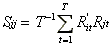 ,
,
i,j=0,q and T denotes the number of observations.
The likelihood ratio test (trace), for the number of cointegrating
vectors is less than or equal to r, H0:  q=
, is
q=
, is
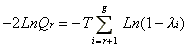 6
6
where i corresponds to the n-r smallest eigenvalues of  with respect to Sqq. The maximal eigenvalue statistic
for testing the null hypothesis that the number of cointegrating
vectors is r against the alternative r+1 is given by:
with respect to Sqq. The maximal eigenvalue statistic
for testing the null hypothesis that the number of cointegrating
vectors is r against the alternative r+1 is given by:
-2Ln(Q) = - TLn(1- r+1)
7
3. EMPIRICAL RESULTS
The first difference of LnP and LnE were obtained as follows:
a constant, and current and two lags of nominal money balances,
3-months t-bill rate, 6-months mode deposit rate, nominal income,
and nominal exchange rate are used as instruments for expected
inflation rate and expected depreciation of the exchange rate.
The new variables were tested for unit roots and used in the subsequent
analysis.
Table 1 shows the Phillips-Perron tests for unit roots for the
level and first difference for log narrow money demand (lnM1),
log income (LnY), 6-month mode fixed deposit rate (AR), log
price (lnP), and nominal effective exchange rate (LnE). The table
shows that, for the level of the variables, lnM1, LnY, AR, lnP,
and LnE are cointegrated of order one, i.e, I(1), For the first
difference, money demand, nominal income, expected inflation
rate, expected change in the exchange rate, and 6-months mode
deposit rate are stationary. Therefore, LnM1, LnY, LnP, LnE, and
AR in their level form are not stationary but in their first difference
are stationary. Thus, cointegration between money demand, income,
exchange rate, price, and interest rate on 6-month mode deposit
rate is tested. Therefore, the final form of the error-correction
model to be estimated is:
 8
8
Table 2 shows the residual misspecification test for the VAR model
for money demand, income, expected change in the exchange rate,
inflation rate, and interest rate. The lag length in the multivariate
cointegrating system is determined by minimization of Akiake Information
Criteria (log AIC), Schwarz Criteria (Log SC) and removal of serial
correlations from the residuals. The optimal lag length to remove
serial correlations is achieved at 6 lags. At lower lags the system
suffers from serial correlation. Therefore, the results reported
in this paper are those for the model with 6 lags. The residual
misspecification tests for the residuals for the VAR model show
that the M1 equation does not suffer from skewness and excess
kurtosis, whereas the other equations suffer from excess kurtosis
and lack of normality. The deviation from normality for the LnY,
inflation, AR, and expected change in the exchange rate equations
might be due to the exclusion of variables which determine income,
inflation, expected change in the exchange rate, and interest
rate equations other than those included in the system.
The Johansen-Juselius (1990) maximum likelihood test for the cointegration
of M1, LnY, LnE, LnP and AR (table 3) indicates that there is,
at most, one unique cointegrating vector. Normalizing on this
vector for M1 yields:
LnM1 = 0.909LnY + 0.029R - 6.182LnE - 2.465LnP
The long-run relationship between income and money demand is positive as expected. The long-run relationship between the expected change in the exchange rate is negative, indicating the presence of currency substitution in Malaysia. The long-run relationship between money balances and inflation is negative, whereas the long-run relationship between money demand and interest rate is positive. This positive relationship could be explained by the presence of current cum interest bearing account facilities. These facilities offer the convenience of a current account with all the advantages of interest bearing account. As such, depositors might consider the rate of interest on interest bearing accounts as a rate of return on money.
The dynamic model for money demand is estimated by Hendry and
Ericsson's (1991) general to specific procedure. The model uses
lagged residual from the Johansen-Juselius cointegrating vector
(tables 3). First, current and six lags of each explanatory variable,
and the error correction term obtained from the Johansen and Juselius
procedure are included. Second, insignificant variables are gradually
eliminated. The validity of the restrictions is tested by using
Schwarz Criterion; for reasons of space, the unrestricted form
of the equation is not reported. Several diagnostic tests have
been performed including Jarque-Bera test for normality, Box-Pierce-Ljung
statistic for autocorrelation, the ARCH test for heteroskedasticity,
the RESET test for functional misspecification, and the Chow test
for structural stability.
The final form of the estimated dynamic model and the results
of the diagnostic tests are presented in table 4. The model was
augmented with a dummy variable to measure the impact of the deregulation
suspension in October, 1985 to January, 1987. The dummy variable
takes the value of one for October, 19985 to January 1987, and
zero otherwise. The empirical findings presented in table 4 show
that the overall fit of the estimated model is good as indicated
by adjusted R-squared, SEE, the RESET test for functional misspecification,
the ARCH test for conditional heteroskedasticity, the Box-Pierce-Ljung
test for autocorrelation, and the Chow test for stability of the
regressions after the deregulation of base lending rates in February
2, 1991. The hypotheses that the residual is not serially correlated
cannot be rejected, and there is no significant autoregressive
conditional heteroskedasticity or parameter instability. However,
the normality assumption is rejected.
The results presented at table 4 show that income (current, and lags 1 to 6), 6-months mode deposit rate (lags 1,3, 4 and 6), expected inflation rate (current, and lags 1 and 3), expected change in the exchange rate (lags 1, 2, 4, and 6), the first lag of the error correction term and seasonal dummies are important factors in determining narrow money demand. That is, in the short-run, money demand depends on a weighted moving average of past and present income, opportunity cost of holdings money, expected inflation rate, and expected depreciation rate. The error correction from the Johansen-Juselius vector enters negatively at lag 1 with an overall impact of 0.3% adjustment every month, or 3.6% a year.
The short-run impact of income on the demand for money is alternating
between positive and negative. The coefficient of Yt is positive
which implies that as income increases suddenly, money demand
will not decrease rapidly as in the case of a steady rise in income.
The new financial instruments which allow placement of money in
interest bearing accounts, and, at the same time, allow the use
of current account facilities explains the oscillating sign for
income. The oscillating signs in the short-run may represent this
effect: as income increases and bills are needed to be paid, a
transfer from savings deposit to current accounts and currency
is initiated, i.e., creating the positive relationship. However,
when no bills are needed to be paid, money are then transferred
back to savings accounts, i.e., creating the negative relationship.
The overall impact of a rise in income is to increase money demand
marginally by 0.1%.
The short-run impact of the expected inflation rate is mixed and
ranges from negative to positive. Short-run coefficients on expected
inflation might be explained as follows: when expected inflation
increases, the immediate reaction would be to decrease the holding
of money . However, if the increase in inflation persists, agents
would start to increase their holdings of money balances to meet
the rise in prices. In the short-run, the overall impact of a
rise in inflation rate is to increase the holdings of money balances
by 10.8%.
Some of the short-run effects of the interest rate have the opposite sign to the long-run effect. The immediate impact of a rise in interest rates is to reduce the holdings of money balances. The intermediate effect is mixed and alternates between negative and positive, i.e., a decrease in the holdings of money balances in the third month, an increase in the fourth month, and so on. In the short-run, the overall impact of a rise in interest rate is to increase the holdings of money balances by 0.93% every six months compared to 2.9% in the long-run.
The long-run relationship between money demand and the expected
depreciation of the exchange rate is negative. As the currency
depreciates rapidly, the demand for money declines. This suggests
the presence of currency substitution in Malaysia. The initial
effect of a rise in the expected depreciation rate is to decrease
the holdings of money balances. However, the intermediate effect
is to increase the demand for money balances. In this case, the
impact effect has a lower coefficient than both the intermediate
effect and the long-run effect. For the short-run, the impact
of a rise in expected depreciation rate of the exchange rate is
to increase money balances by 1.44% compared to a reduction of
62% in the long-run. The long-run coefficient on expected depreciation
is larger than the long-run coefficient of the interest rate on
6-month deposit rate. This suggests that foreign currency is a
closer substitute for domestic money.
4. CONCLUSION
This study uses cointegration and error correction to estimate
the Malaysian money demand (M1) over the 1980:1-1994:10 period.
The study utilizes Johansen and Juselius maximum likelihood cointegration
procedure to estimate the long-run money demand. The error correction
from the long-run money demand is then used in a dynamic model
to estimate the short-run money demand. The overall explanatory
power of the model is good.
In general, the findings of this study indicate that the error
correction mechanism is a good representation of money demand
in Malaysia over the 1980:1-1994:10 period. The speed of adjustment
or error correction under the Johansen and Juselius error correction
mechanism is a round 0.3% a month. Chow test for structural stability
of the estimated money demand indicates stability of the money
demand over the period of the study. The factors that determine
the Malaysian demand for money in the short-run are income, expected
inflation rate, the rate of return on 6-months mode deposit rate,
expected depreciation of the exchange rate, seasonal dummies,
and the error correction from the long-run demand for money..
The study finds evidence to support the presence of currency substitution
in Malaysia. The presence of currency substitution has several
policy implications: the monetary authority should take into account
the impact of the exchange rate on the Malaysian economy in its
formulation of domestic monetary policy; the presence of foreign
currency accounts in Malaysia may give the Central Bank more control
over the conduct of domestic policy as the Central Bank will be
able to monitor the conversion of domestic money into foreign
money; and to have better control over these balances, the Central
Bank may need to impose required reserves.
5. REFERENCES
Arango, S. and M. Nadiri (1981) The demand for money in open economy.
Journal of Monetary Economics, 22, No. 7, January, pp.
69-83.
Arize, A.C. (1994) Has M2 Demand in the USA Become Unstable? Evidence
from an Error-Correction Model. Applied Economics, 26,
pp.957-967.
Bahmani-Oskooee, M. and M. Malixi (1991) Exchange rate sensitivity
of demand for money in developing countries. Applied Economics,
23, pp. 1377-1384.
Bank Negara Malaysia, Quarterly Bulletin, various issues, Kuala
Lumpur, Malaysia.
---------- (1994a) Money and Banking in Malaysia: 35th Anniversary
Edition 1959-1994, Kuala Lumpur, Malaysia.
--------- (1994b) Annual Report 1994, Kuala Lumpur, Malaysia.
Johansen S. and K. Juselius (1990) Maximum Likelihood Estimation
and Inference on Cointegration-with Application to Demand For
Money. Oxford Bulletin of Economics and Statistics,
52, pp. 169-210.
Habibullah M. and R. Ghaffar (1987) Real Versus Nominal Adjustment
Mechanism in the Malaysian Money Demand Function. Pertanika,
10:3, pp. 357-364.
Habibullah M. (1989) Short-term Interest Rate and Own Rate of
Money in Malaysian Money Demand Function. Journal Ekonomi Malaysia,
19, pp. 3-15.
Hendry, David, F. and Nil R. Ericsson (1991) An Econometric Analysis
of U.K. Money Demand in Monetary Trends in the United States and
the United Kingdom by Milton
Friedman and Anna J. Schwartz. American Economic Review, 81, pp.8-38.
Mandell A. (1963) Capital Mobility and stabilization policy under
fixed and flexible exchange rate. Canadian Journal of Economics
and Political Science, 29, pp. 475-85.
Marashdeh O. (1990) The demand for money in Jordan: An open
economy framework. Unpublished Doctoral Dissertation, West
Virginia University.
------ (1994) The sensitivity of the Jordanian money demand to
real effective exchange rates. The Middle East Business and
Economics Review, January, Vol. 6, No. 1, pp. 11-18.
-------- (1995) The Effect of the Exchange Rate on the Demand
for Financial Assets in Malaysia. First Annual Asian Academy
of Management Conference Proceedings, 7-8 December, Penang,
Malaysia, pp. 156-166.
Mehra, Y.P. (1993) The Stability of M2 Demand Function: Evidence
from an Error-Correction Model. Journal of Money, Credit, and
Banking, 25, pp. 455-460.
------- (1991) An Error-Correction Model of US M2 Demand.
Federal Reserve Bank of Richmond Economic Review, 77, pp.
3- 12.
Perron P. (1988) Trends and random walks in macroeconomic time
series. Journal of Economic Dynamics and Control, 12, 297-332.
Phillips P. (1987) Time series regression with a unit root.
Econometrica, 55, 277-301.
Phillips P. and Perron P. (1988) Testing for a unit roots time
series regression. Biometrika, 75, 335-346.
Semudram, M (1981) The Demand for Money in Malaysia Economy: Empirical
Estimation and Analysis of Stability. Malaysian Economic Review,
26:2, pp. 53-63.
Yusuf M. (1987) The Demand for Money and Inflation Expectations
in Malaysia. Asian Economic Review, 24:3.
Table 1
Phillips-Perron Tests for Stationarity of the variables (1980:1-1994:10)
Variable Z(t ) Z(t*) Lag
Level Form
LnM1 -2.53 13
AR -3.23 4
LnY -1.68 13
LnE 0.78 1
LnP -2.11 13
First Difference
LnM1 -161.1* 12
AR -166.2* 1
LnY -182.9* 12
LnE -178.8* 1
LnP -148.5 * 12
* Significant at the 1% level.
The order of lags is set as the highest significant lag order from either the ACF or PACF of the first difference series and minimization of the Akaike Information Criterion.
Z(t ) and Z(t*) the Phillips-Perron tests for =1 in the no trend
and trend cases, respectively.
Table 2
Residuals Misspecification tests for the VAR model
| Equation | LnM1 | LnY | AR | LnE | Inflation |
| Sigma | 0.0329 | 0.1674 | 0.387 | 0.014 | 0.054 |
| Log AIC | -436.7 | -396.8 | 392.64 | -773.8 | -977.96 |
| Log SC | -292.98 | -253.1 | 536.34 | -630.1 | -834.3 |
| Skewness | 0.3199 | -0.1524 | 0.3342 | 0.1256 | 0.2324 |
| Kurtosis | 0.7018 | 2.215 | 3.774 | 6.7011 | 1.9183 |
| JB(2) | 4.58 | 25.41* | 74.66* | 228.55* | 19.8* |
| Chi Square(36) | 25.6 | 38.5 | 30.5 | 16.4 | 39.5 |
* significant at the 1% level.
JB is Jarque-Bera test for normality of residuals
Chi-square (36) is autocorrelation test for the first 36 autocorrelations equal to zero.
Table 3
Johansen and Juselius Cointegration Test for the 4 VAR Model
| r | Trace | Maximal Eigenvalue | Eigenvalue |
| 4 | 4.24 | 4.24 | 0.1882 |
| 3 | 10.77 | 6.53 | 0.1435 |
| 2 | 23.91 | 13.14 | 0.0748 |
| 1 | 50.08 | 26.18 | 0.0379 |
| 0 | 85.31* | 35.23* | 0.0248 |
* significant at the 5% level.
r denotes the number of eigenvectors.
Table 4
The dynamic demand for narrow money ( LnM1) (1980:12-1994:10)
| Variable | lag | Coefficient | T-stat | Variable | Coefficient | T-stat |
| income | 0 | 0.5303 | 9.8 | February | -0.0432 | -4.65 |
| 1 | -0.3642 | -6.4 | March | -0.0545 | -5.88 | |
| 2 | 0.1413 | 2.4 | April | -0.0303 | -3.15 | |
| 3 | -0.1961 | -3.99 | May | -0.0459 | -4.94 | |
| 4 | 0.0533 | 3.9 | June | -0.0262 | -2.87 | |
| 5 | -0.1281 | -3.02 | July | -0.0430 | -4.83 | |
| 6 | 0.0402 | 3.3 | August | -0.0402 | -4.77 | |
| interest rate | 1 | -0.0099 | -1.67 | September | -0.0278 | -3.47 |
| 3 | -0.0097 | -1.97 | October | -0.0399 | -4.82 | |
| 4 | 0.0230 | 3.3 | November | -0.0232 | -3.1 | |
| 5 | -0.0102 | -2.26 | December | -0.0134 | --1.51 | |
| 6 | 0.0161 | 2.48 | Constant | 0.0088 | 0.79 | |
| inflation | 0 | -2.9654 | -9.39 | Dummy | -0.0066 | -1.66 |
| 1 | 2.3622 | 6.81 | ||||
| 2 | -1.2047 | -3.28 | ||||
| 3 | 1.1712 | 3.87 | ||||
| 5 | 0.7443 | 3.14 | ||||
| Exchange rate | 1 | -0.5647 | -2.7 | |||
| 2 | 0.8914 | 5.76 | ||||
| 4 | 0.7347 | 3.2 | ||||
| 6 | 0.3744 | 2.13 | ||||
| RES | -0.0032 | -3.1 | ||||
| Rho | -0.3939 | -4.9 |
Summary Statistics
R-Square = 0.78 R-Square Adjusted = 0.72
SEE-SIGMA = 0.0177 SSR= 0.0409
Model Selection Tests
Akaike (1973) Information Criterion- Log AIC = -463.97
Schwarz(1978) Criterion-log SC = -354.84
Skewness= 0.399 Excess Kurtosis=1.12 Jarque-Bera Normality Test: 2(2)= 10.38
Heteroskedasticity Test: ARCH Test: 2(12)= 16.2
Ramsey RESET Specification Tests:
RESET(1,131)= 1.226 RESET(2,130)= 0.641 RESET(3,129)=0.558
Autocorrelation Tests:
Box-Pierce-Ljung 2(36)= 26.72 Durbin-watson= 1.95
joint significance of variables
seasonal dummies: F(11,131) = 6.4 income: F(7,131) = 16.7
interest rate: F(5,131) = 3.1 inflation: F(5,131) = 19.3
exchange rate: F4,131)= 11.9 regression: F(35131)= 17.6
Chow Test: F(34,100)= 15.3 Z( 6) = -156.36
Z(n) is Phillips-Perron unit root test with and n lags.
RES is the error correction term from the Johansen and Juselius cointegration procedure.
Rho is the first order correlation coefficient.