Real Exchange Rate Misalignments and Growth
Ofair Razin
Georgetown University
Susan M. Collins*
Georgetown University and
The Brookings Institution
June 1997
____________________
* The research presented in this paper is work that Ofair Razin completed for his doctoral
dissertation. It was a pleasure to advise him in his doctoral work and to prepare this paper for
publication, in his memory. This paper is forthcoming in Assaf Razin and Efraim Sadka (eds.)
International Economic Integration: Public Economics Perspectives, Cambridge University Press.
I. Introduction
Real exchange rate (RER) misalignment refers to a situation in which a country's actual
RER deviates from some notion of an implicit "ideal" RER. An exchange rate is labeled
"undervalued" when it is more depreciated than this ideal, and "overvalued" when it is more
appreciated than this ideal. Such misalignments are widely believed to influence economic
behavior. In particular, Overvaluation is expected to hinder economic growth while undervaluation
is sometimes thought to provide an environment conducive to growth. But unless the "ideal" is
explicitly specified, the concepts of RER misalignment remain subjective. The objectives of this
paper are first to develop and construct explicit measures of RER misalignment, and second to
explore systematically the relationships between misalignment and economic growth.
Conceptually, a RER is misaligned when it deviates from the underlying RER that would
have prevailed in the absence of price rigidities, frictions and other short run factors. A more
structured definition of misalignment uses the notion of an "equilibrium RER". This typically
refers to the theoretical RER that would have prevailed if the economy were simultaneously in
internal and external balance. Internal balance refers to the economy operating at full employment
and at full capacity output. External balance refers to a sustainable current account position given a
country's desired capital position, as a net lender or borrower. A RER misalignment can then be
defined as the deviation of the actual RER from this "equilibrium RER".
A number of empirical papers attempt to measure RER misalignments by operationalizing
the theoretical concept of an "equilibrium RER" .(1) (See Razin 1996a for additional discussion of
this literature.) This empirical work includes very different types of analysis for developed and for
developing countries. That for developed countries typically takes advantage of both extensive
available data and the findings from large multi-country macro models (like the IMF's Multimod).
These models can simulate "equilibrium RERs" which are consistent with constructed proxies of
external and internal balances. Both types of information can then be used to provide benchmark
RERs for policy makers. Williamson (1995) provides one example of this work.
Such extensive information is not available for the developing countries (LDCs). Data is
much less detailed and incomplete, and there are no comparable dynamic simulation models.
Existing empirical work here is done mostly at a cross country level, using pooled data and
estimating cross country regressions. Further, the analysis is typically done for relatively small
samples of countries. For example, Edwards (1995) develops a model for a small economy. He
shows how both nominal and real factors play a role in determining the RER(2) in the short run, while
only real factors influence the (steady state) "equilibrium exchange rate". Edwards estimates a
version of his model using pooled data on a panel of 12 developing countries. His results provide
support for the model -- RER movements do respond to both nominal and real disturbances, and
inconsistent macroeconomic policies tend to generate a RER overvaluation.
A key objective of this paper, therefore, is to develop and empirically implement a
methodology for constructing RER misalignment indicators for a very large sample of both
industrial and developing economies. The work focuses on the misalignment that arises as a result
of short run price rigidity. An open economy macro model developed by Frenkel and Razin (1995)
provides a unified framework for analysis. As shown below, an estimable equation is derived from
the model's structural solution for the RER. The resulting estimates are then used to construct RER
misalignment measures, for 93 countries, over 16 to 18 year periods since 1975. These
misalignment indicators are then used as explanatory variables in growth regressions.
There are at least two possible channels through which RER misalignments might influence
growth. First, they could influence domestic and foreign investment, thereby influencing the
capital accumulation process. Capital accumulation is a well established "engine of growth".
Second, a RER that is out of line could effect the tradables sector, and the competitiveness of this
sector vis a vis the rest of the world. This sector's performance is also generally though to be an
important component of the economy's overall growth.
Misalignment volatility could also have an impact on growth. Theoretical and empirical
work shows that a volatile economic environment (for example volatility of the terms of trade,
exchange rates, money supply, productivity) has a harmful effect on economic performance.(3)
Misalignment volatility is possibly another such factor.
The paper is organized as follows. Section II focuses on RER misalignments. It begins by
outlining the theoretical framework that is the basis for the work. It then uses the framework to
construct indicators of RER misalignment for. Section III uses the now standard methodology of
growth regressions to explore the effects of RER misalignment on growth. An innovation of this
analysis is to consider potentially non-linear relationships between key variables. The final section
contains concluding remarks.
II. Real Exchange Rate Misalignment
The empirical analysis implements the stochastic version of the Mundell-Fleming open
economy model developed by Frenkel and Razin (1995). The model consists of a set of simple
equations which represent linear approximations to underlying behavioral equations. This model is
particularly appropriate for usage in constructing indicators of RER misalignment because its
solution distinguishes between an RER that is affected by short run rigidities and an RER that would
obtain in the absence of such rigidities. As noted above, this is precisely what is meant by
"misalignment" in this paper. The model also explicitly distinguishes between perfect capital
mobility and full capital controls. This provides a structure for exploring differences between
industrial and developing counties, which typically differ in the extent of capital restrictions. The
discussion below highlights key features of the model, and then focuses on the implied solutions for
the RER that are used in the estimations. Readers are referred to Razin (1996a) and Frenkel and
Razin (1995) for a detailed presentation of the model, and a derivation of the solution.
Theoretical framework
The model is based on the standard IS-LM model of a small open economy that produces a
single traded good. Aggregate demand depends on the real exchange rate, and on real interest rates.
Equilibrium is determined simultaneously in the goods and money markets. This basic framework is
extended in two ways. First, output supply, money supply and domestic demand are assumed to be
stochastic processes, through the introduction of independent and identically distributed (iid)
shocks.
Second, price rigidities are introduced by specifying the price level as an average of the free
market -- flex -- price and a one-period contract price set in period t-1 based on expectations about
the market clearing price in period t. Thus, the model has both the standard flex-price solution,
which assumes prices are fully flexible, and a full-fledged solution, which incorporates the price
rigidities.
Just as for a standard IS-LM set-up, this model can be solved under different assumptions
about the extent of international capital mobility. Of particular interest in the current context, the
determinants of the real exchange rate are somewhat different in the perfect capital mobility case
than they are in the full capital controls case.
The empirical analysis in this paper is based on the solutions for the equilibrium real
exchange rate (RER) that come from the model outlined above. All variables (except interest rates)
are in logarithms. Define the RER as follows: qt = st + pt - pt *, where s is the foreign currency
price of domestic currency, and p and p* are domestic and foreign price levels respectively. Note
that exchange rates have been defined so that a rise implies an appreciation.
It can be shown that the full-fledged solution for the RER is the flex-price solution, g( ), plus
a linear combination of stochastic shocks, f( ):
(1) capital mobility: qt = g1( yts, dt , i* ) + f1 (mt , yt )
(2) capital controls: qt = g2( yts, dtX ) + f2 (mt , yt , dtA )
where 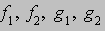 are all linear functions; ys is output supply; i* is the world interest rate; d is
the exogenous component of aggregate demand and y ,m are stochastic shocks to output and money
supply. In the capital controls case, aggregate demand has been decomposed into domestic
absorption and the trade balance. Thus, dX is the exogenous component of demand for net exports,
while dA is the stochastic shock to domestic absorption.
are all linear functions; ys is output supply; i* is the world interest rate; d is
the exogenous component of aggregate demand and y ,m are stochastic shocks to output and money
supply. In the capital controls case, aggregate demand has been decomposed into domestic
absorption and the trade balance. Thus, dX is the exogenous component of demand for net exports,
while dA is the stochastic shock to domestic absorption.
Equation (1) shows the determinants of the RER under perfect capital mobility. The flex-price solution, g1, depends on the fundamental determinants of domestic supply and aggregate
demand, as well as on world interest rates. In the absence of price rigidities, the RER will
appreciate in response to higher output or world interest rates, but depreciate in response to higher
aggregate demand. The function f( ) shows how the RER will deviate from its flex-price level given
price rigidities -- money supply shocks will cause short term real appreciations while output supply
shocks will cause short-run real depreciations.
Under full capital controls, the RER must adjust so as to maintain external balance. Thus,
in the solution for the RER given in (2), conditions in world capital markets no longer determine the
flex-price solution. Instead of total aggregate demand, it is now the exogenous component of
demand for net exports that matters. As before, increased long-run output supply is associated with
an RER appreciation. Due to short-run price rigidities, the RER will deviate from this flex-price
solution because of money and output shocks, as in the capital mobility case. In addition, positive
shocks to domestic absorption will cause a temporary RER appreciation.
The model thus provides a clear distinction between a "flex-price" RER and the model's
"full fledged" solution RER. The "flex-price" RER is determined by fundamental (or long-run)
variables related to domestic supply, demand, and the external economy. In the empirical analysis,
deviations of the actual RER from (an estimated) flex-price level will be taken as indicators of
exchange rate misalignment. As shown above, these deviations arise from short-term rigidities, and
are associated with various types of shocks.
The model also distinguishes between high and low capital mobility. Two key differences
that arise in the solution for the RER are considered in the empirical analysis. First, factors related
to external balance are important determinants of the flex-price RER under capital controls, but not
under full capital mobility. Second, domestic absorption shocks cause deviations from the flex-price
RER under capital controls, but not under full capital mobility.
An attractive feature of this model is its relative simplicity. The RER solutions are well
defined, yet general enough to provide a useful framework for empirical implementation. One
drawback is that the model is not a fully dynamic framework, and can not capture dynamic forward
looking behavior. (See Elbadawi (1995) for an argument for such models in this context.)
Empirical Implementation
The solutions for the "full-fledged" RER are the basis for the construction of indicators of
RER misalignment. A country's actual RER each year is assumed to be a linear function of two sets
of determinants. In equation (3), W denotes long-run (or fundamental) variables that would
determine its RER in the absence of any rigidities. Z denotes key shocks. The error term is
included to capture additional shocks omitted from Z. It would also reflect unobserved
fundamentals.
(3) qit = Wit + Zit + it ; i = 1, ..., M ; t = 1, ..., T
As before,  is the (log of the ) RER of country i at time t.
  is a vector of variables for
country i at time t that capture longer-run factors, and are thus relevant for the "flex-price" RER;
and
is a vector of variables for
country i at time t that capture longer-run factors, and are thus relevant for the "flex-price" RER;
and  is a vector of variables for country i at time t that proxy short-run shocks.
  is an iid error
term for country i at time t.
is an iid error
term for country i at time t.
This equation was estimated separately for developed and developing countries. In both
cases, the empirical analysis tested whether fixed country effects was the appropriate specification.
Two additional econometric issues are raised, but not pursued, here. One is the potential non-stationarity of the RER. See Razin (1996a) for further discussion. The other is the potential
endogeneity of variables chosen as long-term factors.
Misalignment indicators are then constructed for each country at each time period, where
misalignment is defined as:
(4) misit = (qit - Wit) = (Zit + it)
Thus a "misalignment" is the deviation of the actual RER from a linear combination of variables
that proxy the "flex-price" RER, due to the short run shock proxies and the error term of the
regression.
The analysis is undertaken for a total of 93 countries over the period 1975 to 1992.
However, smaller time periods were used for some countries. The sample was divided into two sub
panels -- one with 20 developed countries, and a total of 322 observations; the other with 73
"developing" countries, and a total of 1190 observations. (Appendix A gives a list of countries.)
The real exchange rate
Implementation requires a measure of the real exchange rate for a very large panel of
developed and less-developed (LDC) countries. Previous analyses of this type have either focused
on developed economies, or used smaller groups of LDCs. In particular, previous work (Razin,
1996a) used data on real effective exchange rates from Morgan Guaranty for 19 developed and 23
developing countries.(4)
The procedure followed here is to use data on the price of consumption goods (and
services) from the PENN World Tables. These series are attractive for use in this context because
they are available for such a large cross section of countries and years, and because they were
constructed to be internationally comparable.(5) Higher consumption goods prices can be interpreted
as reflecting more appreciated exchange rates. The data for each country were then indexed
(1987=100).(6)
Table 1 reports means and standard deviations of the log RER (LRER) for developed and
developing countries. The figures illustrate the well known fact that there is considerably more
exchange rate volatility among developing than industrial countries. Note that the similarity of the
means for the two country groups reflects the indexation procedure.
Long- versus short-term factors -- the W and Z matrices
The next step is to specify right-hand side variables. As discussed above, variables included
in the W matrix should reflect underlying fundamentals, or the longer-run, while those included in
the Z matrix should proxy short run shocks. The model also suggested somewhat different
variables were relevant depending on the degree of capital mobility -- both sets will be considered in
the analysis. All data discussed here are from the World Bank's World Tables.
For the W matrix the theoretical model points to variables related to output supply, the
exogenous components of demand in general and the trade balance more specifically, and world
interest rates. Accordingly, five variables are chosen as candidates for W. Both to incorporate a
longer run perspective and reduce potential endogeneity problems, each of these variables was
specified as a five-year moving average. Table 1 reports means and standard deviations for
developing and industrial country groups.
GYL5 is growth in output per worker. This variable is used as an indicator of trends in
labor productivity -- a fundamental determinant of domestic output supply. As shown productivity
growth was somewhat slower on average among developing countries, but exhibited considerably
greater variability.
MG5 is annual money growth in excess of output growth. This variable is taken as an
indicator of the overall stance of monetary policy. Thus, it is interpreted as an underlying
determinant of domestic demand. Not surprisingly, this indicator implies that LDCs maintained
considerably looser monetary policy on average, than industrial countries.
In addition, three variables are included as potential indicators of external conditions.
TOT5 is the (log of the) terms of trade. KY5 is annual long-term capital inflows as a share of GDP.
Finally, RBY5 is the annual resource balance (exports minus imports of goods and non-factor
services) also as a share of GDP. Table 1 shows that LDCs as a group enjoyed much larger long-term capital inflows, but ran much larger external deficits. If, as postulated, industrial economies
exhibit greater capital mobility than LDCs, then these variables related to external balance should
be important in the estimated equation for LDCs.
The Z matrix should include variables that proxy short run shocks to output, absorption and
money supply. Thus, the three indicators considered are SHOCKY, SHOCKA and SHOCKM,
which are respectively, yearly deviations of (the logs of) GDP, absorption, and money supply from
fitted ARMA(1,1) processes. Again, the model implies that we should expect to see differences
between high capital mobility developed countries and lower capital mobility LDCs. Domestic
absorption shocks should matter more for the LDCs, while output and money supply shocks should
be relevant for both groups. Means and standard deviations for these variables are given in Table 2.
A key difference between LDCs and industrial economies is in the average size of monetary shocks.
There is also much more variability for all three variables in the LDC sample.
RER Regression Results
The results from the panel regressions of LRER on the long-term factors and shocks are
reported in Table 3. Note that the specifications for each country group were chosen on the basis of
the significance of estimated coefficients and robustness to outliers. Future work could explore
alternative explanatory variables and specifications. The results are quite interesting, and are
broadly consistent with the model developed above. In particular, there are significant differences
between the estimated coefficients for developed countries versus LDCs, and many of these can be
interpreted in terms of more extensive capital controls among LDCs. However, there are also some
surprises.
Using a Hausman-Wu test, the fixed effects specification could be rejected for developed
but not for developing countries. Overall, the fit is considerably better for LDCs than for developed
countries. This likely reflects both the usage of fixed effects, and the fact that the right hand side
variables exhibit significantly more variation for the LDC sample.
Consider first the role of long-term factors in determining RER movements. As expected,
variables directly related to external balance are much more important for LDCs than for developed
countries. Indeed, both long-term trends in net trade relative to GDP (RBY5) and long-term capital
inflows relative to GDP (KY5) are strongly significant in the LDC equation, but insignificant for
developed countries. Greater net trade surpluses in LDCs are associated with more depreciated
RERs while greater long-term capital inflows are associated with more appreciated RERs. The
terms of trade enters significantly in both regressions -- TOT improvements are associated with
more appreciated RERs. However, the TOT has both greater statistical significance, and a larger
coefficient estimate for LDCs.
The results for other long-term variables are somewhat surprising. GDP per worker, a proxy
for productivity growth, does not enter significantly in either regression. The growth of money
relative to GDP enters only for LDCs, and has an unexpected sign. Especially given the surprising
results for money shocks, it would be interesting to explore other proxies for the long and short-term
monetary variables.
Consider next the role of shocks. As discussed above, the model implies absorption shocks
should be more important in developing countries, to the extent that they are characterized by less
capital mobility. Table 3 shows that although positive absorption shocks are associated with RER
appreciation in both groups, the coefficient is larger and more significant for LDCs. The model also
implies that output and money shocks should be relevant for both country groups. As shown in
Table 3, output shocks appear to matter only for LDCs (positive shocks are associated with RER
depreciations). Money shocks enter only in the developed country equation -- as expected, a
positive money shock is associated with RER depreciation.
Misalignment Indicators
The next step is to construct misalignment indicators for each country in each time period.
Recall that "misalignment" as defined in (4) is the deviation of the actual RER from a linear
combination of variables that proxy the "flex-price" RER, due to the short run shock proxies and the
error term of the regression. A positive value signifies an overvaluation of the actual RER relative
to the "flex price" RER, and a negative value signifies an undervaluation. Thus, annual
misalignment indicators were constructed using the coefficient estimates reported in Table 3. (See
Razin (1996a) for an extensive discussion of the behavior of similarly constructed misalignment
indicators in a number of individual countries.)
The growth analysis in the next section requires country characteristics, including RER
misalignment over longer time periods. Thus, the annual data were then divided into two sub-periods: 1975-77 to 1983 (period 1) and 1984 to 1990-92 (period 2). The early period includes the
years leading up to the international debt crisis, while the latter period encompasses the aftermath,
and early recovery. For each country and sub-period, averages and standard deviations of the
yearly values were constructed. This gives a total of 170 observations, each characterized by a
country and a period. Both variables were multiplied by 100 to convert them to percentages.
Table 4 provides some statistics on RER misalignments in each time period, where LDCs
have been divided into six regional groupings. According to the indicator developed and
constructed here, RERs were overvalued in most of the LDC regions during the earlier period, with
the misalignments most pronounced in Sub-Saharan Africa, South Asia and especially Europe and
Central Asia. In contrast, RERs were relatively undervalued in all regions on average in the later
period. Of course, such broad regional and time averages can mask significant differences among
individual countries and over time.
III. Growth Analysis
This section explores the link between real exchange rate misalignment and economic
growth using regression analysis.(7) Many previous growth studies have included real exchange rate
indicators as explanatory variables, typically finding RER instability to be associated with
significantly slower growth. (For example, see Gavin, Hausmann and Leiderman (1995)). This
work uses RER proxies directly, without attempting to construct measures of misalignment.
Arguably, it is misalignment, not the level or variability of the RER per se, that should be associated
with slower growth.
The approach followed here is to add misalignment measures to the right-hand side
variables that are now standard in this literature. Indeed, choice of explanatory variables is heavily
influenced by the classic analysis in Barro and Lee (1994). As in their work, right hand side
variables include indicators for initial conditions, the external environment, and macroeconomic
policy. In this context, the actual RER (level, change or standard deviation) has frequently been
included as an indicator of macroeconomic policy. The finding that RER volatility (measured by
the standard deviation) is negatively associated with growth has been interpreted as evidence that
"unsustainable" macroeconomic policies cause exchange rate misalignments and hinder growth.
But this may be a poor proxy for RER misalignment. Further, any misalignments should reflect not
only policy variables, such as monetary and fiscal policies, but also the effects of various shocks.
Thus, the present analysis includes as a right-hand side variable the measure of RER misalignment
constructed above.
A difference between the present analysis and work by Barro and Lee and others is the
relatively short time period considered. The intent in analysis presented here is to select a time
period that is short enough for the misalignment indicator to be meaningful, but long enough that
growth is not primarily determined by cyclical factors.
Summary statistics for the variables used in the growth regressions are reported in Table 5.
In the table, observations are averaged over both time periods, but disaggregated by region. The
dependent variable is gypc -- average annual growth in GDP per capita. The four indicators of
initial conditions are all for 1970. These are gdp, life, prim and sec, defined respectively as per
capita GDP in U.S. dollars, life expectancy at birth and primary and secondary school enrollments
(as percentages of total relevant age group). Initial income is included to capture "catch-up" while
the other variables are taken as measures of initial health and education. (8) Change in the terms of
trade, gtot, and standard deviation in the terms of trade, sdtot, are included to capture cross country
differences in the relevant external environment. Finally, government consumption as a percentage
of GDP, govcon, is included as an indicator of fiscal policy.(9) As with misalignment, these variables
are measured as percents. All data are from the World Bank, World Tables. Variables were
constructed for each country for the same sub-periods as the misalignment measures. Data were
available for 152 of the 170 observations.
Growth Regressions
Table 6 presents the basic results. All observations are pooled, and regional dummies are
included. Consider first regression 1. All the variables, except possibly the initial conditions for
schooling, have the expected signs. The variable "govcon" has a significant negative coefficient,
which accords with the arguments given by Barro and Lee. The initial conditions -- life expectancy
and income level -- are significantly associated with growth as expected. Although schooling has a
somewhat surprising negative coefficient, the estimate for primary schooling is only marginally
significant, while that for secondary schooling is insignificant.(10) The coefficients on the regional
dummies for East Asia and the developed countries are positive (although not significant), those on
the dummies for Sub Saharan Africa and Latin America are negative and marginally significant.
Somewhat surprisingly, the external conditions do not enter significantly.
Regression 1 also finds that average misalignments (and the standard deviation of
misalignment) are negatively associated with growth. However, the result is only weakly
significant. The remainder of the paper explores the possibility that this weak finding is due to non-linearities in the relationship.
Over- versus under-valuation
Misalignments may have a very different effect on growth depending on whether they
reflect over- or under-valuations of the RER. To test this hypothesis, the misalignment variable was
split into two pieces. Those observations in which misalignment is positive are labeled
"overvaluation" while those in which it is negative are labeled "undervaluation".
As shown in regression 2 (Table 6) overvaluation does has a negative and statistically
significant effect on economic growth. The effect is also economically significant -- the estimated
coefficient implies that a 10% overvaluation of a country's RER is associated with a decline in real
per capita output growth of 0.6 percentage points. Interestingly, the estimation does not find a
significant relationship between RER undervaluation and growth. These findings motivated a closer
look at a various groupings of the data.
Additional non-linearities
The final part of the analysis looks for additional non-linearities in the relationships between
growth and both misalignment and the volatility of misalignment. This work should be viewed as
exploratory. The approach taken is to further sub-divide the groups of 90 over-valued RERs
(misalignment >0) and 62 under-valued RERs (misalignment <0) into low, medium, high and very
high categories. In each case, low refers to a relatively small misalignment (near zero), while very
high refers to the observations with the greatest percentage misalignments. Similarly, the
observations for the standard deviation of RER misalignment were divided into four groups, with
low referring to those with the most stable misalignment indicator, and very high referring to those
with the greatest volatility in RER misalignment.
In creating these sub-divisions, the intent is to identify both a meaningful differentiation
among groups with respect to the variable in question, while ensuring that sub-groups are of similar
size. For the four undervalued RER groups and the four standard deviation groups, this was
accomplished by division into quartiles. For the four overvalued RER groups, the observations
were first divided according to the overall average and then each of the resulting groups was split in
half. In the resulting groups, the undervaluations ranged from 1.2% in the "low" group to 10% in
the "very high" group. Those with high undervaluation are primarily from the later time period, but
include all regions. Overvaluations ranged from 0.9% in the "low" group to 11.7% in the "very
high" group. Observations with high overvaluation are predominantly in the earlier time period, and
are concentrated in Sub-Saharan Africa and Latin America. Standard deviations range from an
average of 2.2% in the "low" group to 13.9% in the "very high" group. Observations with very
high standard deviations of misalignment are concentrated in Africa and Latin America. However,
they come from both time periods, and include observations with undervaluation and overvaluation.
Estimations are reported in Table 7. The first column shows the results when all twelve
misalignment indicators are included. It is perhaps not surprising that most do not enter
significantly. However, the results do show that the previously reported finding that overvaluations
slow growth is due to the observations with very high overvaluations. Smaller amounts of
overvaluation do not appear to have a significantly deleterious effect. The second column of the
table reports the results when a sub-set of these misalignment indicators are included. This sub-set
came from a step-wise elimination of variables, based on the size of their t-statistics. These results
should be viewed as preliminary. None-the-less, they are quite provocative. In addition to the
strong, negative effect of very high over-valuation, the results suggest that high (but not "very high")
undervaluations may help to promote growth. However, this analysis has failed to find a
significant relationship between the volatility of misalignment and economic growth.
IV. Concluding Remarks
This paper empirically explores the relationship between RER misalignment and economic
growth for a large sample of developed and developing countries. It seeks to make two
contributions to the existing literature. First, it develops and implements an indicator of RER
misalignments. This indicator is based on a well-structured but simple extension of an IS-LM
model of an open economy. The framework introduces short-run price rigidities and shows that the
solution for the RER can be decomposed into a RER that would obtain if prices were fully flexible,
and a deviation from this level that arises because of various short run shocks. This framework is
then used as the basis for a RER regression. Interestingly, the estimation results are consistent with
key model predictions about the differences between RER determination in industrial countries,
with relatively high capital mobility, versus developing economies, with relatively extensive capital
restrictions. The estimation results are then used to construct indicators of misalignment.
The second half of the paper uses growth regression analysis to study the determinants of
economic growth. In addition to the now standard explanatory variables -- initial conditions,
external environment and fiscal policy stance -- the level and standard deviation of RER
misalignment is included on the right hand side. These variables are conceptually preferable to
simply including the change or standard deviation in the RER, as various other studies have done.
While recognizing the problems arising from potential endogeneity of the policy and RER
indicators, the results are provocative. The analysis finds there are important non-linearities in the
relationship between misalignment and growth. In particular, it is only very high over-valuations
that appear to be associated with slower economic growth. Furthermore, moderate to high (but not
very high) undervaluations appear to be associated with more rapid economic growth.
References
Barro, Robert (1991) "Economic Growth in a Cross Section of Countries", Quarterly Journal of
Economics 106, p. 407-443.
, and Jong Wa Lee (1994) "Sources of Economic Growth", Carnegie-Rochester
Conference Series on Public Policy 40, p. 1-46.
Bayoumi, Tamim, Peter Clark, Steven Symanski, and Mark Taylor (1994) "The robustness of
equilibrium exchange rate calculations to alternative assumptions and methodologies" in John
Williamson (ed) Estimating equilibrium exchange rates, Washington DC:Institute for International
Economics.
Borensztein, Eduardo (1995) "Long run exchange rate developments in Korea", IMF, unpublished.
Bosworth, Barry, Susan Collins, and Chen (1996) "Accounting for Differences in Economic
Growth", in Akira Kohsaka and Koichi Ohno (eds.) Structural Adjustment and Economic Reform:
East Asia, Latin America and Central and Eastern Europe Tokyo: Institute of Developing
Economies.
Campa, Manuel (1993) "Entry by Foreign Firms in the U.S. Under Exchange Rate Uncertainty", The
Review of Economics and Statistics 75, p. 614-622.
Collins, Susan M. And Barry Bosworth (1996) "Economic Growth in East Asia: Accumulation
versus Assimilation" Brookings Papers on Economic Activity Vol. 2 pp. 135-203.
Cottani, Joaquin, Domingo Cavallo, and Shahbaz Khan (1990). "RER behavior and economic
performance in LDCs", Economic Development and Cultural Change 39, P. 61-76.
Dixit, Avinash and Robert Pindyck , 1994, Investment Under Uncertainty, Princeton University
Press.
Edwards, Sebastian (1989) "Real exchange rates in developing countries: concepts and
measurement", NBER WP 1950.
(1995) "Real and monetary determinants of real exchange rate behavior: theory and
evidence from developing countries" in Williamson (ed) Estimating equilibrium exchange rates,
1995, Washington: Institute for International Economics.
Elbadawi (1995) "Estimating long run equilibrium exchange rates" in Williamson (ed) Estimating
equilibrium exchange rates, 1995, Washington:Institute for International Economics.
Frenkel, Jacob and Assaf Razin Fiscal policies and the world economy 1995, third edition,
unpublished.
Gavin, Michael, Ricardo Hausmann and Leo Leiderman (1995) "The macroeconomics of Capital
flows to latin America: Recent experience and policy issues" OCE Working Paper, Inter-American
Development Bank.
Ghura, Dhaneshwar and Thomas Grennes (1993) "The RER and macroeconomic performance in
Sub Saharan Africa" Journal of Development Economics 42, P. 155-174.
Leahy and Whited (1995) "The Effect of Uncertainty on Investment: Some Stylized Facts", NBER
WP no. 4986.
Razin, Ofair (1996a) "Real Exchange Rate Misalignments", Ph.D. Dissertation: chapter 1,
Georgetown University, Department of Economics.
_________ (1996b) "Real Exchange Rate Misalignments and Growth" Ph.D. Dissertation: chapter
2, Georgetown Univeristy, Department of Economics.
Williamson, John (1995) "Estimates of FEERs" in Williamson (ed) Estimating Equilibrium
Exchange Rates, Washington DC: Institute for International Economics.
Table 1.
Variables for the X matrix -- Long-Run Factors
|
variable |
Definition |
developing countries
|
developed countries |
|
|
|
average
|
st. dev. |
average |
st. dev. |
| 1. |
LRER |
log of the yearly constructed real
exchange rate |
2.0669 |
0.1591 |
2.0030 |
0.0327 |
| 2. |
TOT5 |
5 year MA of the log of the
yearly terms of trade |
2.0602 |
0.0851 |
1.9909 |
0.0516 |
| 3. |
RBY5 |
5 year MA of the ratio of the
resource balance to GDP |
-0.0720 |
0.1056 |
0.0031 |
0.0324 |
| 4. |
MG5 |
5 year MA of the money supply
growth minus GDP growth |
0.0079 |
0.0288 |
0.0019 |
0.0113 |
| 5. |
KY5 |
5 year MA of the ratio of net long
term capital inflows to GDP |
0.0424 |
0.0384 |
0.0019 |
0.0327 |
| 6. |
GYL5 |
5 year growth of GDP per worker |
0.0147 |
0.0642 |
0.0282 |
0.0242 |
Note: See text for data sources and variable definitions. MA -- moving average.
Table 2.
Variables for the Z matrix -- Shocks
|
variable |
Definition |
Developing |
developed |
|
|
|
average
|
st. dev. |
average |
st. dev. |
| 1. |
SHOCKY |
yearly log of GDP minus the 5 year
MA of the series |
0.0280 |
0.0329 |
0.0231 |
0.0140 |
| 2. |
SHOCKA |
yearly log of absorption minus the 5
year MA of the series |
0.0264 |
0.0438 |
0.0262 |
0.0264 |
| 3. |
SHOCKM |
yearly log of the money supply minus
the 5 year MA of the series |
0.2122 |
0.2438 |
0.1024 |
0.0631 |
Notes: See text for data sources and variable definitions. MA -- moving average.
Table 3.
RER Regressions
(For Construction of Misalignment Indicators)
| Variable |
Developing countries
|
Developed countries
|
| Constant |
Fixed effect
|
1.76484
(21.4) |
| RBY5 |
-0.18774
(-3.72) |
|
| TOT5 |
0.389938
(9.30) |
0.121548
(2.92) |
| KY5 |
0.835939
(7.47) |
|
| MG5 |
0.48991
(4.94) |
|
| GYL |
|
-0.10682
(-1.28) |
| SHOCKY |
-0.71121
(-4.34) |
|
| SHOCKA |
0.473968
(4.29) |
0.249905
(2.57) |
| SHOCKM |
|
-0.07161 |
| Adj. R2 |
0.664 |
0.378 |
1. Dependent variable is LRER
In parentheses are t-statistics, critical values are 1.28 (10%),
1.96 (2.5%), 2.57 (0.5%)
Table 4.
Summary statistics for the constructed misalignments
Type |
Region |
Period |
No.
of
obs. |
Average |
Standard
deviation |
|
|
|
|
|
|
| Developing
countries |
Sub Saharan
Africa |
1 |
27 |
2.698 |
7.854 |
|
|
2 |
27 |
-5.121 |
7.572 |
|
|
|
|
|
|
|
|
|
|
|
|
|
East Asia
and Pacific |
1 |
7 |
1.816 |
6.698 |
|
|
2 |
9 |
-4.328 |
5.425 |
|
|
|
|
|
|
|
|
|
|
|
|
|
Latin
America and
Caribbean |
1 |
20 |
1.479 |
6.238 |
|
|
2 |
17 |
-1.872 |
6.620 |
|
|
|
|
|
|
|
|
|
|
|
|
|
Middle East
and North
Africa |
1 |
4 |
-0.4007 |
4.972 |
|
|
2 |
9 |
-1.726 |
4.649 |
|
|
|
|
|
|
|
|
|
|
|
|
|
South Asia |
1 |
3 |
2.501 |
1.464 |
|
|
2 |
4 |
-6.026 |
1.394 |
|
|
|
|
|
|
|
|
|
|
|
|
|
Europe and
Central Asia |
1 |
3 |
4.706 |
2.169 |
|
|
2 |
3 |
-4.7065 |
2.1691 |
|
|
|
|
|
|
|
|
|
|
|
|
| Developed
countries |
|
1 |
20 |
-1.441 |
4.909 |
|
|
2 |
17 |
-0.948 |
2.454 |
Table 5
Summary Statistics for Variables used in Growth Regressions
| variable |
Sub
Saharan
Africa |
East
Asia and
Pacific |
Latin
America
and the
Caribbean |
Middle
East and
North
Africa |
South
Asia |
Europe and
Central
Asia |
developed
countries |
|
average
(st. dev.) |
ave.
(st.dev)
|
average
(st. dev.) |
average
(st. dev.) |
average
(st. dev.) |
average
(st. dev.) |
average
(st. dev.) |
| 1. gypc (%) |
-0.1907
(0.9908) |
1.720
(1.293) |
0.0583
(0.8967) |
0.3839
(1.752) |
1.207
(0.2402) |
0.8334
(0.4845) |
0.8381
(0.3919) |
| 2. gtot (%) |
-0.8075
(1.563) |
-0.7786
(1.337) |
-0.8718
(1.575) |
-0.9821
(1.2457) |
-0.7855
(0.7672) |
-0.1171
(1.557) |
-0.0571
(0.8476) |
| 5. sdtot |
17.65
(14.60) |
13.47
(8.656) |
19.73
(12.31) |
18.06
(12.13) |
10.09
(5.124) |
8.625
(5.522) |
6.201
(3.792) |
| 6.govcon(% |
15.02
(5.358) |
13.35
(5.582) |
11.84
(4.330) |
19.26
(6.749) |
11.22
(1.148) |
12.51
(5.095) |
18.38
(4.077) |
| 7. life
(years) |
43.90
(6.003) |
56.81
(6.87) |
59.98
(6.36) |
58.30
(8.27) |
48.37
(2.30) |
65.97
(6.60) |
72.17
(1.32) |
| 8. prim (%) |
56.86
(27.92) |
87.14
(18.19) |
97.34
(15.41) |
80.80
(16.84) |
56.00
(16.53) |
104.4
(5.31) |
101.4
(10.24) |
| 9. sec |
8.40
(6.19) |
28.28
(14.62) |
28.93
(13.52) |
35.18
(19.17) |
16.72
(8.98) |
50.85
(16.49) |
75.73
(10.36) |
| 10. gdp |
1180
(868.4) |
1605
(638.4) |
2987
(1838) |
3330
(2858) |
990.2
(203.1) |
3200
(835.7) |
8889
(2328) |
|
|
|
|
|
|
|
|
| no. of obs. |
43 |
14 |
33 |
13 |
5 |
7 |
37 |
Sources: World Bank, World Tables.
Notes: see text for full variable definitions.
Table 6.
Growth Regressions -- Basic Results
| Variable |
definition
|
Regression 1 |
regression 2 |
| Govcon |
percent of govt. consumption in
GDP |
-0.0424
(-2.66) |
-0.0443
(-2.80) |
| Gtot |
growth of the TOT (%) |
0.0470
(1.10) |
0.0599
(1.40) |
| Sdtot |
standard deviation of the TOT |
-0.0067
(-0.97) |
-0.0051
(-0.75) |
| Life |
life expectancy at birth in 1970
(years) |
0.0493
(3.28) |
0.0458
(3.05) |
| Prim |
primary school enrollment rate in
1970 (%) |
-0.0072
(-1.49) |
-0.0059
(-1.23) |
| Sec |
secondary school enrollment rate in
1970 (%) |
-0.0028
(-0.35) |
-0.0025
(-0.32) |
| Gdp |
GDP per capita in 1970 ($) |
-0.0001
(-3.35) |
-0.0001
(-3.57) |
| Dummies |
|
|
|
| SSA |
Sub Saharan Africa |
-0.7690
(-1.34) |
-0.5436
(-0.94) |
| EAP |
East Asia and Pacific |
0.6901
(1.07) |
0.9363
(1.44) |
| LAC |
Latin America and Caribbean |
-0.7800
(-1.20) |
-0.5162
(-0.78) |
| MENA |
Middle East and North Africa |
-0.1651
(-0.24) |
-0.0727
(-0.10) |
| SA |
South Asia |
0.1516
(0.22) |
0.3650
(0.53) |
| ECA |
Europe and Central Asia |
-0.1471
(-0.20) |
0.1695
(0.23) |
| DED |
developed countries |
0.4437
(0.64) |
0.7331
(1.05) |
| Mis |
average misalignment (%) |
-0.0213
(-1.73) |
|
| 1. 90 obs. with an
undervaluation |
absolute value of average
misalignment |
|
-0.0143
(-0.65) |
| 2. 62 obs. with an
overvaluation |
average misalignment |
|
-0.0647
(-2.56) |
| Sdmis |
standard deviation of the yearly
misalignments |
-0.0309
(-1.34) |
-0.0206
(-0.87) |
|
|
|
|
| no. of obs.. |
|
152 |
152 |
| adj. R2 |
|
0.403 |
0.415 |
1. Dependent variable is gypc
2. In parentheses are t-statistics, critical values are 1.28 (10%), 1.96 (2.5%), 2.57 (0.5%)
Table 7.
Growth Regressions -- Additional Results
| Variable |
regression 3
|
regression 4 |
| Govcon |
-0.0490
(-3.27) |
-0.0458
(-3.21) |
| Gtot |
0.0459
(1.08) |
0.0547
(1.34) |
| Prim |
0.0057
(-1.16) |
-0.0059
(-1.31) |
| Life |
0.0467
(3.83) |
0.0415
(4.51) |
| Gdp |
-0.0001
(-3.68) |
-0.0001
(-4.00) |
| Dummies |
|
|
| SSA |
-0.5724
(-2.49) |
-0.6426
(-3.26) |
| EAP |
0.7356
(2.49) |
0.8297
(2.98) |
| LAC |
-0.6635
(-2.67) |
-0.6401
(-2.67) |
| DED |
0.6548
(1.82) |
0.7749
(2.35) |
| mis, undervalued |
|
|
| 1. low |
0.0804
(0.34) |
|
| 2 medium |
-0.0921
(-0.82) |
|
| 3. high |
0.0586
(0.94) |
0.0940
(2.31) |
| 4. very high |
-0.0266
(-0.97) |
|
| mis, overvalued |
|
|
| 1. low |
-0.3080
(-1.11) |
|
| 2. medium |
-0.1027
(-1.12) |
|
| 3. high |
-0.0059
(-0.10) |
|
| 4. very high |
-0.0773
(-2.54) |
-0.0625
(-2.67) |
Table 7. (cont.)
| Sdmis |
|
|
| 1. low |
-0.1197
(-0.72) |
-0.0633
(-0.84) |
| 2. medium |
-0.0103
(-0.09) |
|
| 3. high |
-0.0199
(-0.03) |
|
| 4. very high |
-0.0221
(-0.59) |
-0.0190
(-1.23) |
| 5. extreme |
|
|
| no. of obs. |
152 |
152 |
| adj. R2 |
0.440 |
0.452 |
1. Dependent variable is gypc
2. In parentheses are t-statistics, critical values are 1.28 (10%), 1.96 (2.5%), 2.57 (0.5%)
Appendix A - Country list
- Countries in the growth analysis
1. Sub Saharan Africa 3. East Asia and Pacific
Benin China
Burkina Faso Indonesis
Cameroon Korea
Central African Federation Malaisya
Chad Papua New Guinea
Cote d'Ivoire Philippines
Gabon Singapore
Gambia Thailand
Kenya
Madagascar 4. Latin America and the Caribbean
Mali Bolivia
Mauritania Brazil
Mauritus Chile
Nigeria Costa Rica
Rwanda Dominican Republic
Senegal Ecuador
Sierra Leone El Salvadore
South Africa Guatamala
Sudan Guyana
Togo Honduras
Zaire Jamaica
Zambia Mexico
Zimbabwe Nicaragua
Paraguay
2. Middle east and North Africa Peru
Algeria Trinidad and Tobago
Cyprus Uruguay
Egypt Venezuela
Iran
Israel 5. South Asia
Kuwait Bangladesh
Marocco India
Syria Pakistan
Tunisia
(*) Poland is not part of the dummy for ECA
Appendix A: (cont.)
6. Europe and Central Asia - Additional countries
Greece (not in the growth analysis)
Poland (*) Argentina
Portugal Colombia
Turkey Congo
Ghana
7. Developed Countries Malawi
Australia Myanmar
Austria Somalia
Belgium Sri Lanka
Canada
Denmark
England
Finland
France
Germany
Iceland
Ireland
Italy
Japan
Netherland
New Zealand
Norway
Spain
Sweden
United States
1. This literature includes Williamson (1995), Bayoumi, Clark, Symansky, and Taylor (1994),
Borenzstein (1995), Edwards (1989, 1995), Elbadawi (1995), Cottani, Cavallo, and Kahn (1990) and
Ghura and Grennes (1993).
2.
2 Edwards defines the RER is as the relative prices of tradables and nontradables,
3. For example, see Campa (1993), Dixit and Pindyck (1994), Gavin, Hausmann and Leiderman
(1995) and Leahy and Whited (1995).
4. Previous work explored links between the misalignment indicators constructed from Morgan
Guaranty REERs and economic growth. Overall, the results were similar to those reported here.
However, in some instances, the relatively small sample size made it difficult to draw conclusive results.
5. See Summers and Heston (1991) for further discussion of these data, and Bosworth, Collins and
Chen (1996) for additional discussion of this series as a measure of RERs. Note that this measure of
domestic relative to foreign prices is consistent with the form of the RER assumed in the model.
Edwards (1995) follows an alternative approach, specifying the RER as the domestic price of tradeable
relative to non-tradeable goods.
6. Indexing does remove much of the cross-country variation. However, the within-country
variation in the data proved insignificant in the regression analysis when non-indexed series were used.
Indexing the RERs lessens the influence of the between country average (although it is still relatively
strong), and gives substantially more sensible estimates for constructing misalignments. There is a
second justification for the indexation. It is well known that the consumption price series from the
PENN World Tables is systematically related to country income level. (See Bosworth, Collins and Chen
1996 for further discussion.) Various procedures have been used to adjust for this bias. The usage of
indices (1987=100) here are one means of adjustment.
7. For further discussion of the large and growing literature using growth regressions, see Barro
and Lee (1994), Collins and Bosworth (1996), and Levine and Renelt (1992). Note that one drawback to
the growth regression approach is the difficulty in addressing difficulties related to the potential
endogeneity of explanatory variables other than initial conditions.
8. Barro (1991) and Barro and Lee (1994) show the importance of conditional convergence of
growth rates of countries with different initial incomes - initial income is negatively associated with
growth when accounting for other initial conditions (such as initial human capital). The data are 1970
values of GDP (in constant 1985 dollars), life expectancy when born (years), primary and secondary
school enrollment rates (ratios of actual number of students to the number of children in the relevant age
group).
9. Barro and Lee (1994) stress that government size is potentially associated negatively with
growth.
10. See Collins and Bosworth (1996) for additional discussion of the links between education and
growth, and for references.