file: WP6.1: aerc_con.ppr
Abstract
Introduction 1
I. The Importance of Internal and External Shocks 4
A. External Shocks: Uncertain Terms of Trade 4
B. External Shocks: Uncertain Access to and Cost of Foreign Capital 5 C. Internal Shocks: Uncertain Agricultural Output and Domestic Policy
Shocks 10
D. Life is Uncertain! So What? 11
II. The Impact of Uncertainty on Production Commodity Trade 11
III. Trade in Goods and Risk-Free Bonds 20
IV. The Effects of Equity Flows on the Pattern of Trade 26
V. Researchable Issues 31
Appendix 34
In most African economies, both agricultural production and the
terms-of-trade are highly uncertain. This paper re-examines the
implications of such uncertainty for the optimal mix of production
and trade under alternative assumptions about international capital
flows. The ultimate objective is to explore the possible effects
of increased financial integration on real economic activity in
developing countries.
In the presence of uncertainty and limited international capital flows, diversifying production -- and exports -- rather than specializing according to comparative advantage may be desirable depending on a country's degree of risk aversion. Once international borrowing and lending becomes available, however, it may provide a more efficient mechanism for coping smoothing consumption in the face of income fluctuations than does diversifying production and exports. The ability to trade equity securities (which represent claims on uncertain future production) in world capital markets permits additional risk sharing possibilities. In some circumstances where equities trade is well-developed, production diversification completely unnecessary. That is, production and price uncertainty can be efficiently hedged through portfolio diversification instead of production diversification.
Cuddington/Liang/Lu
Uncertainty looms large on the economic landscape of countries in Sub-Saharan Africa. This paper re-examines the implications of high levels of economic uncertainty -- due to the prevalence of large internal and external shocks -- for the optimal mix of production, trade and capital flows. The paper's ultimate objective is to explore the possible effects of increased integration of domestic and global financial markets on real economic activity in developing countries. Based on a review of relevant theoretical literature, it is argued that increased opportunities for international risk sharing and intertemporal trade could have important effects on real productive activities (and hence on domestic income distribution, etc.). At present, we know of no work that attempts to assess the empirical importance of increased financial integration for LDCs' domestic production, export, and import decisions. It would be worthwhile in future research to carry out empirical and simulation analyses to see how far-reaching these effects might be in practice.
Solid microfoundations for the modelling of trade and financial flows are a prerequisite for welfare analysis and any subsequent claims regarding the merits of possible policy interventions. Thus, the paper proceeds by reviewing and synthesizing various analytical models of production, trade and capital flows in uncertain environments. The predictions of these models regarding patterns of trade and capital flows are highlighted. In the process, we shed light on the validity of, and qualifications to, the "neoclassical presumption" that countries do indeed gain from free trade in goods and free international capital flows and that trade patterns should reflect the dictates of comparative advantage. As is well-known, the usual gains from trade can be broken down into three types: (1) the gains from trading goods for goods, reflecting comparative advantage, (2) the gains from trading goods for financial assets, reflecting the potential gains from intertemporal trade, and (3) the gains from trading financial assets for other financial assets, in order to exploit opportunities for international risk sharing and diversification. In the absence of market failures of some sort, the "neoclassical presumption" is that, at least for small countries whose actions do not affect world prices, there are indeed potential gains from freer trade in goods and financial assets. This provides the logical starting point for economic welfare and policy analysis. The nature of the market outcome is first analyzed. Next we ask: (1) "Is there a problem?" and (2) "What, if any, policy intervention would improve the situation?"
Section I begins by arguing that, in the African context, economic shocks are large. While real shocks impacting production and trade have historically been of primary concern, financial shocks are likely to become increasingly important as African economies are integrated into the world economy. Recent policy discussions over surging private capital inflows reflect concerns over the increased risks associated with greater access to the international capital markets.
Section II reviews the literature on trade in goods under uncertainty. Initially, it is assumed that there is trade in goods, but no trade in financial assets. We ask: are there gains from trade in spite of the prospect of large terms of trade shocks and highly uncertain domestic production levels? Will trade patterns be determined by specialization according to comparative advantage? The merits of limiting specialization and instead promoting "export diversification" or "import substitution" are considered in this "trade under uncertainty" framework.
Section III asks how gains from trade and equilibrium trade patterns will be affected if international borrowing and lending are permitted. The standard intertemporal trade model is extended, as in Chang (1991), to incorporate uncertain domestic production and the terms of trade shocks. Section IV reviews the Helpman and Razin (1978a,b,c) analysis of trade under uncertainty when international trade in firms' equity claims is permitted. They show that the patterns of production and trade that emerge in uncertain environments when financial flows are not prohibited are significantly altered once trade in equity securities is allowed. This suggests that liberalization of capital account transactions and the resulting global financial integration could have important impacts on the pattern of production and trade in African economies.
Section V concludes by stressing the need to articulate reasons
for market failure in the context of the models presented in earlier
Sections, if one hopes to give policy advice that is well-grounded
in modern welfare economics. It highlights that the bulk of the
literature reviewed in this paper focuses on explaining
the consequences for trade and capital flows of economic uncertainty.
In most of these models, the described outcomes are Pareto efficient.
Thus, one must convincingly argue that, in reality, there are
market failures that open up the possibility of government interventions
to raise societal welfare. (This, of course, requires that the
relevant "government failures" be smaller relative to
the "market failures" they are designed to address!)
The Section concludes by suggesting some fruitful avenues for
future research.
I. The Importance of Internal and External Shocks
A. External Shocks: Uncertain Terms of Trade
Uncertain export earnings from primary commodities are an important consideration for many developing countries, especially those in Sub-Saharan Africa. In the early post-war period, Prebisch(1950) and Singer(1950) warned of the likelihood of a long-term secular deterioration in the terms of trade for LDCs that depended on primary commodity exports. This led to the widespread adoption of import substitution and export diversification strategies of economic development. Since Prebisch and Singer's work circulated in the late 1940s, there has been considerable debate regarding the empirical magnitude of this secular deterioration. (See, e.g. Cuddington and Urzúa (1989), Ardeni and Wright (1992), Powell (1991), Reinhart and Wickham (1994), and Cuddington and Feyzioglu (1995) for recent work in this area, plus references to earlier literature). Debate over the advisability of alternative trade-oriented development strategies has also been intense in recent years. (See World Bank (1987, 1993) for a detailed analysis of outward-oriented versus inward-oriented trade policies.)
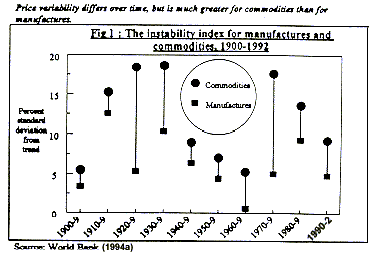
Perhaps more problematic have been the wide fluctuations
in world commodity prices around their long-term trend. Historically,
as Figure 1 shows, the prices of non-oil primary commodities have
been considerably more volatile than the prices of manufactured
products. The resulting volatility in export earnings has had
important economic consequences, and has lead to repeated calls
for commodity price stabilization funds and other vehicles for
coping with commodity price risk. (See World Bank (1994a) for
a discussion. Also Newbery and Stiglitz (1981).)
B. External Shocks: Uncertain Access to and Cost of Foreign Capital
Following the massive sovereign borrowing in the 1970s and the debt crisis of the early 1980s, it became clear that uncertainty regarding the interest rates on variable rate loans, not to mention the possibility of future credit rationing by commercial lenders, posed potentially large risks for developing countries. New external funds from non-official sources essentially dried up in the 1980s for most LDCs.
After a decade of financial retrenchment by international lenders
and economic adjustment in debt-ridden LDCs, private capital flows
again began to surge in the early 1990s. Initially, the bulk
of these flows went to south-east Asian and Latin American economies,
as Table 1 shows. In 1993, however, there was a sharp increase
of capital inflows into Sub-Saharan Africa as well.
Table 1 Annual Long-term Private capital Net Flows (by region)
1990 1991 1992 1993 19901993
SSA US$mill. 920 1548 676 2144 1322
%Exports 1.7 3.0 1.3 4.4 2.6
%GNP 0.6 1.0 0.4 1.3 0.8
EAP US$mill. 20520 2556 42538 62782 37849
%Exports 8.2 8.9 12.9 17.2 12.3
%GNP 2.3 2.6 3.9 5.4 3.7
LAC US$mill. 10651 22755 27894 57708 29752
%Exports 6 12.7 14.6 28.7 15.9
%GNP 1.0 2.1 2.3 4.0 2.5
MENA US$mill. 167 130 1609 1618 816
%Exports 0.2 0.2 1.9 2.2 1
%GNP 0.1 0.0 0.6 0.7 0.3
SA US$mill. 2606 2978 1786 5643 3253
%Exports 6.5 7.0 4.1 11.1 7.4
%GNP 0.7 0.9 0.5 1.7 1.0
ECA US$mill. 9649 4599 24330 27759 16584
%Exports 4.3 1.9 11.6 13.3 7.5
%GNP 0.7 0.4 2.3 3.0 1.4
source: Eduardo Fernandez-Arias and Peter J. Montiel, The Surge in Capital Inflows to Developing Countries: Prospects and Policy Response,
World Bank Working Paper, 1995, table 2, p. 10.
The regions indicated in the leftmost column are
the World Bank groupings: Sub-Saharan Africa (SSA), East Asia
and the Pacific (EAP), Latin America and the Caribbean (LAC),
Middle East and North Africa (MENA), South Asia (SA), and Europe
and Central Asia (ECA).
As capital flows surged, so did the questions about their desirability. Recent policy documents from institutions such as the IMF and World Bank have stressed that renewed capital flows to LDCs may be a mixed blessing. See, e.g., Schadler et al (1993). These concerns may seem curious in light of the "neoclassical presumption" that there are potential welfare gains to both source and recipient countries when capital flows from capital-abundant industrial countries to capital-scarce LDCs. In fact, the discussion is strangely reminiscent of the Dutch Disease literature, which focused on the welfare effects of major resource discoveries or surges in the world prices of commodity exports.
Regarding the "Dutch Disease," the Economist magazine's quipped: "To refer to a vast, valuable energy source as the source of a 'disease' sounds rather ungrateful." The point they were making is: surely there is a presumption that a resource discovery or a surge in a country's terms of trade is welfare improving. The same might be said in the case of renewed capital inflows to previously capital-starved LDCs. Indeed, multilateral agencies spent much of the 1980s trying to figure out how to increase private capital flows to LDCs in the wake of the debt crisis, albeit in some "more appropriate" form than the commercial lending of the 1970s.
Policy concern over renewed capital inflows focuses on several related issues. The first is the sometimes sharp appreciation of the real exchange rate that has accompanied higher levels of capital inflow. Second, if the central bank intervenes to fix the exchange rate (or at least reduce its rate of appreciation), the capital inflows will be at least partly reflected in increases in the domestic money supply, with the possibility of inflationary consequences. Third, there is a question as to the advisability of sterilization in this context. Much of the policy discussion regarding the aforementioned effects has revolved around the issue of how "sustainable" these private capital inflows are expected to be.
It is important to emphasize that real exchange rate appreciation in response to capital inflows is an essential component of the international adjustment process. Ceteris paribus, an increased capital inflow must be mirrored by an offsetting current account "deterioration." The real exchange rate appreciation is the equilibrating relative price adjustment that effects this current account adjustment. For the same reason, a real depreciation will occur later when capital inflows subsequently moderate, which of course they must do eventually if foreign investors are to achieve positive rates of return on their investments.
The preoccupation with sustainability of renewed capital inflows per se is perhaps misguided. As Corden(1991) remarked, "The growth of a child is unsustainable. Nonetheless, it is highly desirable!" Improved access to international capital markets, whether temporary or permanent, is potentially welfare improving. It must be uncertainty about fluctuations in world interest rates, herd-mentality regarding country risks, and uncertain continued access to foreign sources of capital that are the true issues./ This parallels the post-war discussion on the potentially destabilizing effects of unpredictable short-term "hot money" capital flows.
In addition, there may be the fear, with historical justification in light of the debt crisis of the 1980s, that current capital inflows are "excess" in magnitude or that they exceed the economy's "absorptive capacity" for foreign capital. See Corden (1991) for a discussion of why policymakers might indeed be concerned about the overall level of the current account or its obverse, the capital account.
Pull versus Push?
In light of the above policy concerns, it is important to identify the relative importance of various causes of renewed capital flows. First, it provides food for thought when attempting to model capital flows, so as to study their welfare impact and the desirability of possible policy interventions. Second, it may provide some indication about the volatility of such inflows.
The identification of the external and internal causes of capital inflows to emerging economies has been discussed carefully in the existing literature. See Calvo, Leiderman, and Reinhart (1993), Schadler et al (1993), and Fernandez-Arias and Montiel (1995) for detailed analyses. The following factors has been highlighted:
Causes of Renewed Capital Flows to LDCs
A. Push (Supply-side factors)
1. Heightened interest in gains from international portfolio diversification by money managers in industrial countries.
2. Falling interest rates and a economic downturn experienced by the industrial countries, especially the U.S., during the late 1980s.
3. Changes in regional trade arrangements. For instance, Mexico and other Latin American countries benefitted from the initiation of negotiations for the NAFTA in 1990.
4. Financial liberalization in industrial countries, which made their capital markets more open to the private borrowers in developing-countries.
5. Bandwagon effects in international capital markets.
B. Pull (Demand factors):
1. The removal of capital controls and liberalization of restrictions on foreign direct investment in LDCs.
2. Improved macroeconomic conditions in LDCs, reflected in reduced fiscal deficits, increased growth rates, and reduced inflation.
3. Improved creditworthiness due to increased export volumes,
greater export diversification, and debt restructuring or reduction.
There is a consensus in the existing literature that "push" factors have played an important role in causing the surge of capital inflows. The importance of "pull" factors, however, has been more difficult to isolate, except perhaps in some of the South-east Asian nations. In part, this inconclusiveness is due to the difficulty measuring changes in the domestic economic and policy environments in capital-recipient countries.
C. Internal Shocks: Uncertain Agricultural Output and Domestic Policy Shocks
Besides the above-mentioned external shocks due to changing world economic conditions, the African economies often experience large internal shocks due to agricultural output fluctuations, with uncertain weather conditions a key consideration here. Domestic "shocks" from questionable economic policies have also been identified as a major source of poor growth performance and, presumably, high income variability over time. The World Bank (1994b), for example, argues that the role of external shocks in explaining African economies poor macroeconomic performance has been overstated. Domestic policy errors, the report claims, have been at least as important. One might argue, however, that the link between external shocks and subsequent domestic policies is underemphasized in the World Bank report. In many instances, poor domestic policies were triggered by ill-fated attempts to manage booms and busts in agricultural production and exportation, or shocks to these countries' terms of trade and access to world capital markets. (See Cuddington (1989) and Little et al. (1993).)
In short, the significant uncertainty associated with both trade
and financial transactions has been hard to ignore in recent decades.
In the African context, these uncertainties have been readily
apparent on the trade side. With increasing financial integration,
there is the prospect of financial market uncertainties becoming
much more important. Hence, it is certainly timely for the AERC
to initiate a thorough assessment of costs and benefits of increased
international capital mobility, including possible justifications
for policy intervention.
D. Life is Uncertain! So What?
The prevalence and severity of various internal and external shocks
has lead some students of the Sub-Saharan economies to conclude
that this region's problems are in many senses "unique."
In particular, one often hears the argument that there is no
presumption that the usual economic prescriptions should apply
in addressing Africa's economic problems. With this motivation
in mind, this paper investigates what theory does and does not
tell us about the gains from trade and the pattern of trade in
both goods and assets in highly uncertain environments.
II. The Impact of Uncertainty on Production Commodity Trade
This Section argues that the trade strategies of LDCs can not be understood in the context of traditional neoclassical trade theory unless one acknowledges the considerable uncertainty that LDCs' primary commodity production and world trade entail.
Classical trade theory describes how the allocation of national resources according to comparative advantage will maximize potential welfare. Exploiting comparative advantage implies specialization in production and trade. In many developing economies, particularly commodity exporters facing volatile terms of trade, a key component of trade policy involves "export diversification." On the face of it, pursuing export diversification sounds like forsaking one's comparative advantage! This apparent inconsistency between comparative advantage and export diversification can be resolved by considering models of trade under uncertainty. (Other considerations such as scale economies or dynamic considerations in the presence of incomplete markets may also provide justification, perhaps second-best, for trade interventions.)
Formal models of trade under uncertainty first emerged in the 1970s. [See Anderson, Anderson and Riley (1976), Batra (1975), Diamond (1967), Kemp and Liviatan (1973), Ruffin (1974a, b), and Turnovsky (1974)]. The main conclusion of this work was that many of the basic theorems of international trade theory -- the law of comparative advantage, the Heckscher-Ohlin theorem, and others -- are no longer valid in the presence of uncertainty. For example, comparative advantage ceases to be the sole determinant of production and trade patterns if countries are risk adverse.
To illustrate some of the main points, consider a simple Ricardian trade model for a small open economy with two goods:
where Li is the labor input in sector i (i=1,2). qi(s) is a random variable whose value depends on the state of the economy s=1,2,,...,S; there are a discrete number of states.
Assuming full employment:
the stochastic production functions in (1) imply a stochastic production possibility frontier:
The country is "small" in the sense that it takes the (stochastic) relative price of good 1 in terms of good 2 in world markets, denoted as P(s), as given. P(s) may be state dependent. It is assumed that labor allocation decisions are made by households before the resolution of production and price uncertainty. Using (1) and (2), the resulting national income equals:
There is a question of how to define comparative advantage in an uncertain environment. We follow Turnovsky in defining it with reference to the sign of the expected value of pq1(s)-q2(s). If this expectation is greater than zero, the country is said to have comparative advantage in the production of good 1, i.e., on average the country gets a higher payoff in good 1 production. In what follows, E[pq1(s)-q2(s)] is assumed to be positive, so that the country has comparative advantage in good-1 production.
It is assumed that labor is allocated by representative agents whose objective is to maximize expected utility: Consumption and trade decisions, in contrast to labor allocation decisions, are made after the actual values of state s and associated production and price shocks, qi(s) and P(s), are realized. For simplicity, we consider a single risk-averse consumer. His/her budget constraint equals:
once the realizations of world price and domestic productivity shocks, and hence Y, are known. Let V(P,Y) denote the indirect utility function that is generated by substituting the optimal solutions for (C1,C2), denoted by asterisks (*), into the utility function:
The consumer's objective is to choose labor allocation (L1, L2), subject to the full-employment constraint in (2) and non-negativity constraints on sectoral employment, to maximize expected utility:
After substituting for Y(s) using the second-expression for income in (4), which incorporates the full-employment condition (2), the derivative of W with respect to L1 can be written:
indicating that a small increase in L1 affects expected utility via its impacts on the distribution of income and the marginal utility of income. Specifically, expected utility equals the probability-weighted average (across all states of the world s=1,2,...,S) of the product of marginal utility of income multiplied by the marginal income gain of employing one additional labor unit in the production of good 1 rather than good 2.
Given the constraint that L1 must be non-negative and no greater than the total labor supply L, the sign of (8) can be used to determine the optimal labor allocation. (This is formalized by examining the Kuhn-Tucker conditions for the expected utility maximization problem in the Appendix.) Note that the partial derivative in (9) can be less than, equal to, or greater than zero. If it is greater than zero, the optimum will be a corner solution where L1 = L; i.e. complete specialization in good 1 occurs.. If it is less than zero, on the other hand, L1 = 0, implying specialization in good 2. When (9) equals zero, an interior solution with incomplete specialization is optimal.
It is informative to consider a few special cases.
Case I. The certainty case where pq1 > q2
Consider the case where prices and production are nonstochastic: p(s) = p, q1(s) = q1, and q2(s)= q2 . This is, of course, the case presented in traditional trade theory where p>q2/q1 indicates that the country has comparative advantage in good 1. The solution (in the problem above) for L1 equals L, which verifies the classical proposition relating to complete specialization. The corresponding welfare analysis establishes that free trade along the lines suggested by comparative advantage is superior to autarky.
Case 2: q1(s) has stochastic distribution with finite mean (m) and variance (ó2),
while q2 and p are fixed.
In this case, the country faces production uncertainty in the sector where specialization would have occurred in the absence of uncertainty. By assumption, there are no shocks to the terms-of-trade. If the country is risk averse (rather than risk loving or risk neutral), there are circumstances where the county will decide not to specialize in good 1 production. Using quadratic utility function, which has the property of increasing absolute risk aversion, Turnovsky (1974. p.210) shows that as ó2, the variance in the production coefficient of industry 1, increases from zero to infinity, the country passes from complete specialization in good 1, through incomplete specialization in the two commodities, towards complete specialization in good 2. As long as ó2 is finite, however, specialization in good 2 will not occur. From this result, it is clear that after some point as the production mix changes the direction of trade will also change. The country may cease exporting the good in which it has comparative advantage if the uncertainty associated with its production becomes large enough.
Case 3: The terms of trade (p) is stochastic, but there is no production uncertainty.
Here, in contrast to the previous case, all uncertainty comes from external shocks. This case is more complicated and the resulting pattern of specialization is indeterminate, because price uncertainty leads to both substitution and income effects. That is, P(s) enters the expected utility maximization problem (described above) directly as well as indirectly through Y(s). Cases can be constructed to show that, given sufficiently large world price variability, a risk-adverse country may be induced to switch specialization to the production of good 2. (See Turnovsky (1974, p.213, Proposition 7'.)
A more striking implication of this case is that free trade may not be the optimal policy for a small country [Turnovsky 1974; Batra and Russell 1974]. In fact, Turnovsky (1974, p.215, Proposition 9) claims:
The expected gains from trade for a risk averse country, which
under certainty would wish to trade, may, under uncertainty become
negative, causing it to cease trading.
The intuition is that if external price variability is the only source of uncertainty and it, therefore, occurs only when the country is engaged in foreign trade, then with strong risk adversion in preferences, the country's expected utility might be lower under free trade than under autarky.
See Pomery (1984) for a detailed discussion of how free trade and autarky can be Pareto ranked in general when there is world price uncertainty and incomplete (state-contingent) markets. He notes (p.450) that:
Newbery and Stiglitz (1981) give an example, where with incomplete
markets, free trade may be Pareto-dominated by autarky, an idea
which has been adopted by Eaton and Grossman (1981) to give a
second-best argument for tariffs as a form of insurance when internal
markets are incomplete.
Thus, in some circumstances, there may be a role for government intervention to reduce trade and, hence, the level of terms-of-trade uncertainty facing consumers. The relevance of this result may be limited however. In a general-equilibrium framework, prices are endogenously determined. Thus, one must examine the underlying sources of the price uncertainty, such as uncertainty in domestic or foreign preferences and/or in production.
To summarize this section, when there is uncertainty in the terms of trade and/or in the production, a country's production pattern needs not be determined by comparative advantage defined, as mentioned above, in terms of expected marginal value products in each sector. In some (but certainly not all) circumstances, diversifying production may be optimal in the face of uncertainty, even though complete specialization in production would have occurred in the absence of uncertainty. Risk averse countries may opt for a diversified production mix even though it entails lower expected income if they achieve lower variability of income in the process. Theories based on this "portfolio diversification" approach to production help to explain why countries may produce a broader variety of goods ("import substitution") or have a broader mix of exports ("export diversification") than standard comparative advantage theory would predict.
Such diversification would occur in a market setting. Can government
policies improve upon the production and export decisions of private
agents via active trade of industrial policy in the present framework?
In some cases, apparently it can. In the absence of complete
markets, free trade need not be Pareto optimal, even for a small
country. (Pomery 1984).
Table 2
Annual average net private capital flows
to developing countries
(billions of dollars)
Flows | 1977-82 | 1983-90 | 1991-3 | 1993 | 1994 |
FDI | 8.5 | 16.0 | 50.2 | 66.6 |
77.9 |
Portfolio equity flows |
0.0 | 1.3 | 22.9 | 46.9 | 39.5 |
Debt | 42.9 |
17.7 | 35.2 | 45.7 | 55.5 |
Bonds | 2.6 | 2.6 | 22.5 | 42.1 | - |
Loans | 40.3 | 15.1 | 12.7 |
3.6 | - |
Total | 51.4 |
34.9 | 108.3 | 159.1 | 172.9 |
Memorandum items (re: Total) |
|||||
Percent of GNP | 2.4 | 1.0 | 2.4 | 3.5 | 3.6 |
Percent of exports | 8.6 | 4.7 | 10.6 | 15.1 | 14.9 |
---------------------------------------------------------------------------------------------------------------
- Not available
Source: World Bank (1995, p. 12)
===========================================
III. Trade in Goods and Risk-Free Bonds
The conclusions of last section crucially depend on the implicit assumption that there are no international risk sharing mechanisms. As Helpman and Razin (1978a, p.247) point out, the economies in these models are "closed" in a very important respect: there is no international trade in financial assets (equities or debt). "This restriction ties each country's production decisions to its consumption decisions, while a central feature of the standard theory of international trade under certainty is that, given commodity prices, a country's production decision are independent of its consumption decisions."
In terms of empirical realism, the assumption of little or no financial asset trade is becoming increasingly restrictive. During the 1970s up through the debt crisis years of the 1980s, there were large international capital movements, primarily in the form of debt flows. In the African context, most of these flows were from official institutions -- national and multilateral -- to public-sector borrowers. As Table 2 shows, only in the early 1990s did non-debt forms of finance from private sources take off. In Africa, such flows are still small, although they should grow with increasing financial integration.
It is noteworthy that while the sovereign debt literature has provided some possible theoretical explanations for the historical predominance of debt over equity financing, little has been said about the implications of different types of capital flows for production and trade diversification.
An interesting paper by Chang (1991) extends the portfolio approach to production diversification, discussed in the previous section, by introducing (risk-free) international debt finance. By assumption, there are no equity markets. In this context, he shows that "intertemporal substitution [via international borrowing and lending] can take the place of production diversification" (p.267) for countries facing production and terms-of-trade uncertainty. Thus, the incentives to diversify production, rather than specializing according to comparative advantage, are reduced although not generally eliminated.
The simplest intertemporal setup where there are only two periods, denoted by superscripts 1 and 2, respectively, can be used to illustrate Chang's point. The country chooses current and future labor allocation and aggregate consumption to maximize the time-separable intertemporal utility function:
U(C) is a assumed to be an instantaneous logarithmic utility function, a special case in the constant relative risk aversion (CRRA) class. The country can borrow and lend in international capital market at constant risk free interest rate r. Thus the budget constraint is:
Its net foreign assets (or indebtedness, if negative) at the beginning of period 2 is:
To simplify the algebra, assume the only source of uncertainty is in the production of good 1 with production of good 2 involving no uncertainty. So q1(s) is state-dependent and, by assumption, q1(s) > q2 = 1. q(s) takes the value a+g with probability one half and the value a-g with probability one half (a>1, g>0). For notational simplicity, the subscript on q(s) and the relative price (p=1) can be suppressed, so that everything is expressed in real terms. Thus q1(s) measures the relative real return to one unit of labor input in terms of good 2. One unit of labor input can either generate one unit of sure return if allocated to good-2 production, or q1(s) units if allocated to good-1 production. Without loss of generality, the interest rate and subjective rate of time preference are taken to be zero. The labor endowment (L) is constant over time.
Defining the share of labor allocated in the risky production of good 1 in period t as pt , equation (9) can be rewritten:
The country chooses (p11, p12), and (C1, C2) to maximize expected utility.
As usual, this dynamic programming problem is solved by considering the last period first.
In the second period, the country allocates labor to maximize expected utility EU(C2), given the debt inherited from the first period (D):
The solution equals:
The no-default condition on external debt guarantees that D ³ -L in (14).
The optimal period-1 variables C1, D, p1 can then be determined, conditional on the optimal labor allocation in (14) being chosen in period 2 . If the country's initial foreign asset/liability position is zero, optimal period-1 labor allocation equals:
Comparison of (14) and (15) shows that the optimal share of labor devoted to the sector where the country has comparative advantage will be higher when the country has a longer horizon and borrowing and lending possibilities: i.e. p1* ³ p2*. Note that borrowing and lending are unavailable in the last period in the present two period setup. This is also true in each and every period in situations where trade in bonds is not permitted.
In the present model, it can also be shown that the country's expected utility is unambiguously higher with the possibility of borrowing and lending than with autarky in asset trade. There are two sources of utility gains: first, by allowing intertemporal substitution and, second, by permitting increased specialization according to comparative advantage. The stronger the comparative advantage, the greater the gain in utility. "Of course, the country's utility would be still higher under complete [asset] markets, in which the country could receive with certainty the mean of its income, allowing complete specialization according to comparative advantage" (Chang, 1991, p.269).
In sum, this example shows that, at least in some circumstances, a country with the ability to substitute intertemporally via international borrowing and lending will concentrate more resources in the sector where it has comparative advantage. That is, it chooses a higher level of p* than a country that is unable to transfer consumption across periods. The latter country will opt for greater production diversification (i.e. have a relatively low level of p*). Through intertemporal substitution and a re-allocation of factors of production in future periods, the increase in risk due to increased specialization can be partially offset for countries with access to international capital markets. Lengthening the time horizon, so a country can smooth its consumption over longer period of time, will also cause it to opt for greater specialization in production (i.e., p* will be higher). See the Appendix in Chang (1991) for details.
Not surprisingly, the possibility of credit rationing by lenders following a large negative shock to domestic production will reduce the usefulness of international borrowing for smoothing consumption. Hence, borrowing limits (current or prospective) will strength the incentives for a country to diversify production (and exports) relative to the case of unrestricted borrowing and lending. To avoid drastic cutbacks in consumption in bad times, the country will choose to specialize less; its expected utility will be lower than it would be in the absence of a borrowing limit.
Capital Account Liberalization in the Presence of Trade Restrictions
Edwards and van Wijnbergen (1986, 142-3) show that allowing capital inflows in the presence of import tariffs need not be welfare improving, even for a small country that faces a fixed terms-of-trade. Their model has no uncertainty, but presumably their results would carry over to such an environment.
They consider an economy with convex production technology (not the linear technology of the Ricardian model) producing two goods. The import competing good is assumed to be capital intensive and is protected by tariffs. Consumer preferences are summarized by an expenditure function E(p,U) while the production side of the economy is captured by a revenue function R(p,K,L). The budget constraint for this economy is expressed in tariff-distorted domestic prices and includes the tariff revenue, which the government redistributes to the population:
where t is the tariff rate.
It is assumed that liberalization of the capital account results in an increased inflow of capital equipment (rather than consumption goods). If this capital is paid a return equal to the world interest rate, Edwards and van Wijnbergen reproduce the well-known Brecher-Diaz-Alejandro result that domestic welfare necessarily declines if the import-competing sector is capital intensive. That is:
The intuition is as follows. The tariff causes a socially excessive level of importables production for the small open economy. Allowing additional capital to flow into the economy results in an expansion of the capital-intensive sector and a contraction in the labor-intensive sector. (This is the Rybczynski theorem from standard trade theory.) But expanding this sector, which is already too large, worsens the so-called "pre-existing distortion" caused by the tariff. This drives down welfare. Thus, a capital inflow leads to immiserizing growth for the small, tariff-protected economy when the import-competing sector is capital intensive.
This example emphasizes that the sorts of results derived by Svensson
(1988), for example, regarding the gains from financial asset
trade depend on: (1) the absence of large-country terms-of-trade
effects and (2) the absence of any marginal divergences in the
goods markets prior to financial liberalization. Presumably,
with pre-existing distortions in some financial markets, the
opening of additional financial markets need not be welfare improving
for similar reasons.
IV. The Effects of Equity Flows on the Pattern of Trade
Section II considered the effects of uncertainty regarding the level of domestic production or the terms-of-trade on optimal production and trade patterns in the absence of trade in financial assets. The possibility of borrowing and lending in world capital markets was introduced in Section III. It was demonstrated that the domestic production mix shifts towards that implied by comparative advantage once international borrowing and lending is permitted (in the particular model considered, at least.) Trade in risk-free bonds opens up intertemporal consumption smoothing opportunities, mitigating somewhat the need to stabilize income via production diversification (and potentially export diversification, as well).
Suppose international trade in equities is introduced. How does this affect production and trade? Helpman and Razin (1978a) answer this question by introducing trade in "real equities" into an otherwise standard (Ricardian or Heckscher-Ohlin) trade model. Real equities represent claims on a prespecified fraction of a firm's stochastic output. The net market value of these real equities equals the expected (discounted) value of the firm's future output, net of factor payments to labor and capital. The firm chooses factor inputs at the beginning of the period (before uncertainty is resolved) so as to maximize the current market value of the firm.
In the Helpman-Razin analysis, each firm in industry j faces multiplicative technological uncertainty in production:
One can think of the firm as producing and selling Zj real equities, where Zj = fi(Li, Ki). A unit of real equity provides the owner with qi(s) units of good j if state s obtains, where s=1,2,...,S. As mentioned, each firm chooses inputs to maximize its market value; these factor costs are borne by the firm's inital shareholders. Consumers use their proceeds from selling labor and capital services to purchase shares in firms' future outputs. After the resolution of technological and price uncertainty, consumers purchase goods at the prevailing prices with their (now known) income.
The basic point of Helpman and Razin can be illustrated diagrammatically.
We continue to focus on the simple Ricardian model, although
their analysis is general enough to encompass the Heckscher-Ohlin
as well as the Ricardian model. Both qi(s)
(j=1,2) are random variables. TT in Figure 2 represents the
production transformation curve between real equity 1 and real
equity 2. It shows how alternative labor allocations give rise
to different relative supplies of real equities -- claims on future
outputs of firms in each industry. In the Ricardian model, the
slope of TT is the labor input ratio between two industries.
(In the Heckscher-Ohlin model the production possibilities frontier
has the usual concave form.) There is an asset indifference
map (derived from the indirect utility function discussed above),
which depends on subjective expectations regarding price, technological
uncertainty, and the consumer/investor's degree of risk aversion.
The autarkic level of expected utility is shown by the asset
indifference curve WW in Fig.2. In the no-capital flows equilibrium,
the domestic supply and demand for real equities are equalized
(Ep = Ec) by market-clearing price adjustments.
Autarkic equilibrium asset prices depend on preferences and beliefs
about qi(s), and expected
world commodity prices, as well as the output-labor ratios, which
determine the slope of the equities production frontier. In the
diagram, the autarkic asset price ratio can be represented by
the price line that is tangent to both TT and WW
(not drawn). The Figure shows that when international trade in real equity is not admitted, the country maximizes expected utility by avoiding complete specialization in production in order to get the "insurance" benefits associated with a broader mix of equities (representing a sectoral mix of claims on future production).
Helpman and Razin assume the distribution of qi(s) is the same across countries. When trade in real equity is allowed, the exogenous world relative equity price becomes relevant. It is drawn as the slope of PP in Fig.3. (The Figure assumes that the world equity (relative) price happens to be less than the autarky price ratio.) Given world equity prices, the optimal domestic "production" and sale of real equities in each industry, determined by choosing the allocation of domestic labor, shifts to Ep in Fig. 3. Ec represents domestic consumers' chosen equity portfolio, given prevailing world equity prices. The economy imports z2 units of real equity 2, and exports Z1-z1 units of real equity 1.
The important point is that the economy ends up specializing completely in good 1 production, just as it would have in the absence of uncertainty. Thus, permitting trade in real equities has a significant impact on production and trade patterns. Even though Helpman and Razin's model does not contain complete markets in the sense of state-contingent claims, the type of international stock market they introduce makes production diversification completely unnecessary; production and price uncertainty can now be efficiently be hedged through portfolio diversification instead of production diversification.
Combining the analyses of the last three Sections, we conclude
that even if there are strong incentives to diversify production
and exports in the absence of international capital mobility,
these incentives are weakened when debt flows are permitted and
eliminated completely
once complete equity markets become available. Clearly, the
nature of financial asset trade can potentially have profound
effects on an economy's productive structure.
V. Researchable Issues
The "trade under uncertainty" models reviewed here demonstrate how free-market decisions by maximizing agents are altered by the presence of uncertainty. In these models, however, there is no obvious need for policy intervention. For example, the production diversification that occurs in the Turnovsky model is the socially optimal amount. Without introducing some market failure there is no role for government intervention to further increase or reduce the amount of production or export diversification that would otherwise occur.
An example of a model that does have a marginal distortion is Edwards and van Wijnbergen (1986), discussed in Section III. Here, the presence of a tariff implies that the economy is in a second-best situation before and after capital inflows are permitted. They show how liberalizing the capital account in the presence of trade taxes may result in either a rise or fall in welfare depending on the capital intensity of the import-competing sector.
It may be possible to extent recent work on trade adjustment assistance and trade liberalization in the presence of adjustment costs to deal with capital account liberalization issues. See Leamer (1980), Calvo (1988), Mussa (1986), Dixit and Rob (1994), Feenstra and Lewis (1994).) In Calvo's (1988, p.461) paper:
The social costs of temporary liberalization policy in the context
of an economy with infinitely lived individuals and no intertemporal
consumption substitution are studied. Importable goods, however,
can be stored, and storability is the central source of distortions.
Possible welfare costs of the induced inventory accumulation
are shown to be significant. It is also argued that temporariness
is formally equivalent to "lack of credibility." Because
international capital mobility is the vehicle that magnifies these
distortions, the results suggest that an optimal trade liberalization
without full credibility could call for controls on international
capital mobility.
The research summarized in this paper argues that, from a theoretical standpoint, increased opportunities for international risk sharing and intertemporal trade should be expected to have important effects on real productive activities. At present, however, we know of no work that attempts to assess the empirical importance of increased financial integration for the composition of LDCs' production, exports, and imports. It seems, therefore, that it would be worthwhile to carry out empirical or, perhaps, simulation analyses to see how far-reaching these effects might be in practice. Has the changing pattern and composition of capital flows had an empirically discernable impact on the pattern of trade -- with a move toward greater specialization -- as the theory in Sections II-IV would predict?
Regarding the composition of capital inflows, it is generally agreed by economists and policy makers that direct foreign investment (FDI) is superior to debt finance. It is surprising, therefore, that there is little analytical works on why this should be the case. The models presented by Chang (1991) and Helpman and Razin (1978a,b,c) provide a framework that might be extended to address this issue. In the Helpman-Razin model as it stands, it appears that allowing for risk-free debt finance, once equity trading exists, has no incremental effect. In fact, Grossman and Razin (1984, p. 297, proposition 4) show in a more general framework, which extends the Helpman-Razin model to allow for international movement in physical capital, that risk-free debt finance is irrelevant:
When all agents have identical, homothetic, asset utility functions,
the equilibrium allocation of resources with free [physical] capital
movements and free trade in equities and an "inside"
bond is identical to the equilibrium allocation when the bond
market does not exist.
Given the recent concern over the composition of capital flows, debt versus equity, it would be desirable to modify the Helpman-Razin framework so that debt and equity flows had different effects. Ideally, one would like to be able to use this framework to explain why debt flows prevailed in the 1970s while in the 1980s and 1990s equity flows have become relatively more important. Perhaps this will require the introduction of "agency issues" parallelling the discussion of capital structure issues in the corporate finance literature.
One possible approach to getting both debt and equity into these models with uncertainty is to extend the models to include a public sector that borrows by issuing bonds, while the private sector is equity financed. Distinguishing between private-sector and public-sector borrowing and lending has proved important, for example, in explanations of capital flight (see Khan and Ul Haque (1985), Eaton (1987)).
In recent years, formal models of sovereign debt based on options
pricing theory have emerged. These models introduce risky investment
explicitly and view sovereign debt as a contingent claim on the
profits generated by capital investment. (See, e.g., Gennotte,
Kharas, and Sadeq (1987) , Claessens and van Wijnbergen (1993).)
To our knowledge, no one has yet introduced the possibility of
tradeable equity claims into this type of model. Yet clearly,
any analysis of the relative merits of debt versus equity flows
to LDCs must explicitly acknowledge that, in practice, the debt
claims are risky not risk-free; i.e. it can not be satisfactorily
modelled as risk-free "inside" bonds.
References
Anderson, J.E. ad J.G. Riley (1976). "International Trade
with Fluctuating Prices," International Economic Review
17, 7697.
Anderson, J.E. (1981). "The HeckscherOhlin ad TravisVanek
Theorems under Uncertainty," Journal of International
Economics 11, 239247.
Ardeni, P.G. and B. Wright. (1992). "The Prebisch-Singer
Hypothesis: A Reappraisal Independent of Stationarity Hypotheses,"
Economic Journal 102 (July), 803-812.
Batra, R.N. (1975). "Production Uncertainty and the Heckscher-Ohlin
Theorem," Review of Economic Studies 69, 259-268.
Batra, R.N. and W. R. Russell (1974). "Gains Free Trade under
Uncertainty," American Economic Review 64, 10401048.
Calvo, G.A. (1988). "Costly Trade Liberalizations: Durable
Goods and Capital Mobility," IMF Staff Papers 35,
3, 461-474.
Calvo, G.A., L. Leiderman, and C.M. Reinhart (1993). "Capital
Inflows and Real Exchange Rate Appreciation in Latin America,"
IMF Staff Papers 40, 1, 108-151.
Chang, K. (1991). "Export Diversification and International
Debt Under Terms-of-Trade Uncertainty," Journal of Development
Economics 36, 259-279.
Claessens, S., M.P. Dooley, and A. Warner (1993). "Portfolio
Capital Flows: Hot or Cool?" in S. Claessens and S. Gooptu
(eds.) Portfolio Investment in Developing Countries. World
Bank Discussion Paper No.228.
Claessens, S. and S. van Wijnbergen (1993). Secondary Market Prices
and Mexico's Brady Deal," Quarterly Journal of Economics
(November), 965-982.
Corden, W.M. (1991). "Does the Current Account Matter? The
Old View and the New," in J.A. Frenkel and M. Goldstein (eds.)
International Financial Policy: Essays in Honor of Jacques
J. Polak. Washington, D.S.: International Monetary Fund.
Cuddington, J.T. (1989). "Commodity Export Booms in Developing
Countries," World Bank Research Observer 4, 143-165.
Cuddington, J.T. and Urzúa C. M. (1989). "Trends and
Cycles in the Net Terms Trade: A New Approach," Economic
Journal 99 (June), 426-42.
Cuddington, J.T. and T. Feyzioglu. (1995). "Long-Run Trends
in Primary Commodity Prices: Examining Our Differences using the
ARFIMA Model," Georgetown University working paper.
Diamond, P.A. (1967). "The Role of Stock Market in a General
Equilibrium Model with Technological Uncertainty," American
Economic Review 57, 759-796.
Dixit, A. and V. Norman (1980). Theory of International Trade.
Cambridge University Press.
Dixit, A. and R. Rob (1994). "Risk-Sharing Adjustment and
Trade," Journal of International Economics 36, 3/4,
263-287.
Eaton, J. (1987). "Public Debt Guarantees and Private Capital
Flight," World Bank Economic Review 1 (May), 377-395.
Eaton, J. and G.M.Grossman (1981). "Tariffs as Insurance:
Optimal Commercial Policy When Domestic Markets are Incomplete,"
NBER working paper 797.
Edwards, S. and S. Van Wijnbergen (1986). "The Welfare Effects
of Trade and Capital Market Liberalization," International
Economic Review 27, 1, 141-148.
Feenstra, R.C. and T.R. Lewis (1994). "Trade Adjustment Assistance
and Pareto Gains from Trade," Journal of International
Economics 36, 3/4, 201-222.
Fernandez-Arias, E. and P.J. Montiel (1995). "The Surge in
Capital Inflows to Developing Countries: Prospects and Policy
Response," World Bank Working Paper.
Gennotte, G., H.J. Kharas, and S. Sadeq (1987). "A Valuation
Model for Developing-Country Debt with Endogenous Rescheduling,"
World Bank Economic Review 1, 2, 237-271.
Grossman, Gene M. and Assaf Razin (1984). "International
Capital Movements under Uncertainty," Journal of Political
Economy 92, 2 (April), 286-306.
Helpman, E. and A. Razin (1978a). "Uncertainty and International
Trade in the Presence of Stock Markets," Review of Economic
Studies 45, 239250.
------ (1978b). "Welfare Aspects of International Trade in
Goods and Securities," Quarterly Journal of Economics
92, 489508.
------ (1978c). A Theory of International Trade under Uncertainty.
New York: Academic Press.
Kemp, M.C. and Liviatan, Nissan (1973). "Production and Trade
Patterns under Uncertainty," Economic Record 49, 215227.
Khan, M. and N. Ul Haque (1985). "Foreign Borrowing and Capital
Flight: A Formal Analysis," IMF Staff Papers 34 (June),
606-628.
Leamer, E.E. (1980). "Welfare Computations and the Optimal
Staging of Tariff Reductions in Models with Adjustment Costs,"
Journal of International Economics 10, 1, 21-36.
Little, I.M.D., R.N. Cooper, W.M. Corden, and S. Rajapatirana
(1993). Booms, Crisis, and Adjustment: The Macroeconomic Experience
of Developing Countries. New York: Oxford University Press
for the World Bank.
Mussa, M. (1986). "The Adjustment Process and the Timing
of Trade Liberalization," in A.M. Choksi and D. Papageorgiou
(eds.) Economic Liberalization in Developing Countries.
Oxford: Basil Blackwell Ltd.
Newbery, D.M.G. and J.E.Stiglitz (1981). The Theory of Commodity
Price Stabilization: A Study in the Economics of Risk. Oxford:
Oxford University Press.
Pomery, J. (1984). "Uncertainty in Trade Models," in
R.W. Jones and P.B. Kenen (eds.) Handbook in International
Economics, vol. I. Amsterdam: North-Holland.
Powell, A. (1991). "Commodity and Developing Country Terms
of Trade: What Does the Long Run Show?" Economic Journal
101 (November), 1485-1496.
Prebisch, R. (1950). The Economic Development of Latin America
and its Principal Problems. United Nations, Lake Success.
Reinhart, C.M. and P. Wickham. (1994). "Commodity Prices:
Cyclical Weakness or Secular Decline?" IMF Staff Papers
41, 2 (June), 175-213.
Ruffin, R.J. (1974a). "International Trade under Uncertainty,"
Journal of International Economics 4, 243-259.
-------(1974b). "Comparative Advantage under Uncertainty,"
Journal of International Economics 4, 261273.
Schadler, Susan, Maria Carkovic, Adam Bennett, and Robert Kahn
(1993). Recent Experiences with Surges in Capital Inflows.
Occasional Paper No. 108. Washington, D.C.: International Monetary
Fund.
Singer, H. (1950). "The Distributions of Gains Between Investing
and Borrowing Countries," American Economic Review: Papers
and Proceedings May, 473-85.
Stockman, Alan C. and A. Hernandez D. 1988. "Exchange Controls,
Capital Controls, and International Financial Markets," American
Economic Review 78,3 (June), 362-374.
Svensson, L.E.O. (1988). "Trade in Risky Assets," The
American Economic Review 78, 3, 375-394.
Turnovsky, S. J. (1974). "Technological and Price Uncertainty
in a Ricardian Model of International Trade," Review Economic
Studies 41, 20117.
van Wijnbergen, S. (1984). "The 'Dutch Disease:' A Disease
After All?" Economic Journal 94, pp.41-55.
World Bank (1987). World Development Report 1987. New
York: Oxford University Press.
World Bank (1993). The East Asian Miracle: Economic Growth
and Public Policy. Oxford: Oxford University Press.
World Bank (1994a). Global Economic Prospects and the Developing
Countries. Washington, D.C.
World Bank (1994b). Adjustment in Africa: Reforms, Results,
and the Road Ahead . Oxford: Oxford University Press.
World Bank (1995). Global Economic Prospects and the Developing
Countries. Washington, D.C.
This Appendix proves that statement in Section II regarding the
pattern of production in the face of uncertainty.
Proposition: Consider the expression in (8), reproduced here, for a risk averse country:
If q > 0 for all L1 Î
[0,L], then the optimum labor allocation is: L1*
= L; i.e. the country specializes in the production of good 1.
If q = 0 for some 0 < L1
£ L, then L1*
is determined at an interior value; i.e. specialization in production
does not occur.
If q < 0 for all L1 Î
[0,L], then L1* = 0. The country specializes
in the production of good 2.
proof:
The optimization problem is:
Before checking the Kuhn-Tucker conditions, we first show that
they are necessary and sufficient in describing the maximum utility
solution in this case.
It can be shown the objective function W is concave in L1. Risk aversion implies:
The second derivative of W with respective to L1 is:
According to Kuhn-Tucker Sufficiency theorem, a concave objective
function plus linear constraints imply that the Kuhn-Tucker conditions
are necessary and sufficient for a maximum.
Let us denote the Lagrangian as:
The Kuhn-Tucker conditions are:
If q > 0, for all L1
Î [0,L], i.e. E(¶V/¶y)(pa1-a2)
> 0, then (6) implies that l >
0. Equation (4) then implies that L1 = L. It is
clear that L1 = L satisfies Kuhn-Tucker conditions,
and since Kuhn-Tucker conditions are sufficient and necessary
in this case, L1* = L is the optimal solution.
If q = 0 at 0 < L1 £
L, then it must be the case, from (6) and (7), that l
= 0. In this case (9) puts no restriction on the value that
L1 could take. In particular, L1*
= L1 satisfies Kuhn-Tucker conditions.
Analogously, If q < 0 for all L1
Î [0,L], it can be verified that
l = 0, L1 = 0 satisfy Kuhn-Tucker
conditions. Therefore, L1* = 0.
Q.E.D.