 . Where u is the time allocated to work, N is the size of the household, h is the human capital level, w is the wage, r is the marginal productivity of capital and K is the capital level.
Learning-by-Doing and Schooling
Roberto Ellery*
Instituto de Pesquisa em Economia Aplicada
SBS Ed. BNDES Sala 715
Brasília – DF 70076-900
E-mail: ellery@ipea.gov.br
March 19, 1999
JEL Classification: I28, 011 and O15
Keywords: Learning-by-doing, education, human capital and growth.
Abstract
The paper aims to analyze the optimal level of schooling in the presence of learning-by-doing. To achieve this objective the paper introduces the learning-by-doing hypothesis on the Lucas model of economic growth induced by human capital accumulation. With the new setup, it is possible to show that the optimal time at school’s will decrease while the human capital’ growth rate remains the same. Moreover, the paper provides a theoretical foundation to the claims that government should concentrate education’s subsides at the basic school rather than at college education.
Learning-by-Doing and Schooling
Roberto de Goes Ellery Junior
1. Introduction
Human capital accumulation has been widely used as a growth’s engine in the moderns' models of economic growth. Two properties of human capital support this choice. Human capital is not subject to decreasing returns and human capital is a source of externalities. Moreover, empirical tests usually find a positive correlation between human capital and growth.
While the point of human capital being an engine for growth is a commonplace, the same is not true if one wants to define the mechanics of human capital accumulation. There are two ways to model out human capital accumulation. The first uses time in school as the measure for education, in this sense the more time in school the more is the human capital.
A second option is that workers accumulate knowledge through a learning-by-doing process. This approach assumes that individuals learn while they are working. This was a formulation suggested by Arrow (1962) and widely used by growth and learning authors.
The paper aims to unify these two approaches in a single model following Lucas (1988). So one can see how the introduction of learning-by-doing will change the growth rate and the time allocated to schools. In addition, one can suggest some policy rule related to education’s subsidies and the optimal time at schools.
The second section make some points about capital accumulation and shows the baselines of the Lucas model. The third section introduces learning-by-doing in the model of the previous section. The fourth will deal with the time allocated to schools. The fifth will present some conclusions and suggestions for further research.
2. Human Capital Accumulation and the Lucas Model
A key failure of the neoclassical model of growth (Solow, 1957 and Cass, 1965) is that it does not provide an engine to explain endogenous growth. This model had to use an exogenous technological progress to explain persistent growth. That failure made Arrow presents a model where knowledge is the growth engine. However, rather than provide a sector where individuals choose theirs level of human capital, the model suggests that knowledge is a byproduct of capital accumulation. This paper led to a large number of models exploring the learning-by-doing hypothesis.
With the rebirth of the growth literature following Romer (1986), a new generation of models came to explain growth. Those models used the presence of externalities as the growth engine. This approach was possible by the exploration of the fact that externalities could lead to a situation where the economy presents constant or crescent returns, even with decreasing returns at the firm level. That possibility allows the co-existence of growth and competitive equilibrium.
Lucas uses the externalities' idea to provide a model where human capital is the growth engine. Following Uzawa’s two sectors' model (1961), the author assumes that there is a sector to the production of physical capital, or capital, and a sector for the production of human capital. The model suggests that the human capital sector is the source of externalities to the economy. Moreover, there are no decreasing returns in this sector.
The households should choose the share of time allocated for schools and the consumption. The only way to accumulate human capital is going to school. The income of each household is . Where u is the time allocated to work, N is the size of the household, h is the human capital level, w is the wage, r is the marginal productivity of capital and K is the capital level.
The accumulation of human capital follows the rule  . Households choose the optimal level of education. If u is too high then the level of human capital will be too low, and, if u is too low, then there will be too few efforts directed for production. Both effects cause an income’s decrease.
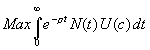
The representative household solves the following problem:
 (1)
(1)
 (2)
(2)
Where r is the discount rate, N the size of the household, which grows at a rate l, c o consumption,  average level of human capital. The production function is:

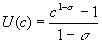
The term  represents the externalities of the human capital over the production sector. The utility function is:
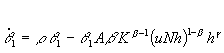
Those are the first order’ conditions to the central planner:
 (3)
(3)
 (4)
(4)
 (5)
(5)
 (6)
(6)
In the case of competitive equilibrium, equation (6) takes the form:
 (7)
(7)
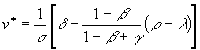
From the first order' conditions one can show that the rate of growth for the human capital, in the central planner equilibrium is:
 (8)
(8)
In the competitive equilibrium the human capital’ rate of growth follows from (7) accordingly:
 (9)
(9)
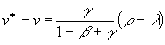
Assuming logarithmic utility (s = 1) one can show that the difference between the central planner and the competitive growth rates is:
 (10)
(10)
Observe that v is lesser than  , which means that the competitive equilibrium is inefficient. This result follows from the fact that the households cannot take into account all the effects of the human capital accumulation. In particular it takes
  as a constant term.
If the externalities are absent, i.e. g equals zero, the competitive equilibrium becomes efficient. The same is true when  .
.
3. Introducing learning-by-doing
This section presents the previous model modified to allow for learning-by-doing. The new rule for human capital accumulation is:
 (11)
(11)
The term  represents the learning-by-doing process. Now one can accumulate human capital when at work. The parameter f and d represent how efficient is the learning process at work and schools respectively.
The new rule for human capital accumulation reduces the pressure to go to school, since that, now it is possible to learn without schools. To guarantee that schools still have a rule one must assume that d is bigger than f, that is, learning at schools is more efficient than at work.
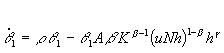
The first orders' conditions for the central planner are:
 (12)
(12)
 (13)
(13)
 (14)
(14)
 (15)
(15)
For the competitive equilibrium, (15) assumes the following form:
 (16)
(16)
Following Lucas, the equation above will provide the growth rate for the capital, k, and for the human capital, v.
From (12) and (14), follow that:
 (17)
(17)
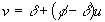
While equation (11) takes the form:
 (18)
(18)
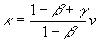
To write down the growth rate of the human capital as function of the parameters, one should write k as a function of v, using (17):
 (19)
(19)
Equation (19) shows that k follows v, so that from now on the discussion should concentrate on v.
For now the analysis will care only for the central planner equilibrium. From equations (13) and (15), follow that:
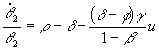 (20)
(20)
Finally, from (18), (19), and (20) the value for v is:
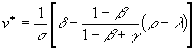 (21)
(21)
For the competitive equilibrium, equation (19) becomes:
 (22)
(22)
The expression for v assumes the form:
(23)
Equations (21) and (23) show that the introduction of learning-by-doing does not lead to a change at the growth rate of the human capital. The result comes from the fact that the central planner and the households care for the level of human capital, not for the way it is accumulated. If it is true, one can show that both will reduce the time allocated to school in order to keep the growth rate of human capital, this is the task of the next section.
4. Learning-by-doing and school’s time
To account for the alterations in u caused by the learning-by-doing one should depart from equations (2) and (11). The first shows that the time allocated to school in the Lucas model is:
 (24)
(24)
Therefore, people will go to school as long as  , a condition that follows from (8).
With the introduction of learning-by-doing u comes from (11), therefore the new expression for u is:
 (25)
(25)
The new condition for a positive u is that d must be bigger than f. If this condition is not observed then there is no incentive to allocate time for schools. It is true because while learning at the workplace the individual is also accumulating capital. On the other hand, at schools individuals will accumulate only human capital. If the human capital accumulation is faster at the work place there is no good in going to school.
Note that, as previously expected, with the learning-by-doing hypothesis there will be a decrease at the time that both, individuals and central planner, will allocate to school. Since there are no changes in v the level of capital, output and consumption should be higher with learning-by-doing.
Differentiating u with respect to f, one can show that:
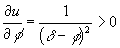 (26)
(26)
Equation (26) shows that the time allocated to school decreases as the learning process becomes more efficient at the workplace. This result suggests that as the capacity of learn while working increases the government should shrink the incentives to a long period at schools. At this situation, incentives to basic education should be larger than incentives to college education.
Finally, one can show how much the introduction of learning-by-doing can account for the inefficacy of the competitive equilibrium. From (10), (24) and (26) it is possible to conclude that:
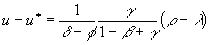 (27)
(27)
Equation (27) shows that the presence of learning-by-doing leads to an increase in the difference between the time households allocate to schools and the optimal time. The result suggests that on presence of learning-by-doing the government should give a stronger incentive to the individuals stay at school.
An immediate use for equations (26) and (27) is that rather than provides an expensive system of free college education the government should increase the incentives for grade schools and high school. Once the individual has acquired his basic education, they would learn through learning-by-doing.
5. Conclusion
The paper shows that in the presence of a learning-by-doing effect the optimal time allocated to school tends to decrease. It can be a sign that the Lucas model suggests to much time at schools. In terms of public policy, the model suggests that the government should consider its educational police taking in account the effects of learning-by-doing.
If the presence of learning-by-doing is too strong it may be the case where spending money to guarantee a public system of free college education, at expenses of basic education, is equivocated. However, as the competitive equilibrium stills inefficient, even in presence of learning-by-doing there is a place for public incentive for education.
A possible modification for the model presented is to introduce the fact that learning through schools uses more physical capital than learning at the workplace. The first needs the construction of school and the hiring of staff employees, while the second comes as a consequence of the work process. So that while there is a crowding out effect for building schools the same is not true for learning-by-doing. Taking in account this effect should turn the optimal time at school even smaller.
Finally one can estimate the parameters' d and f in order to test for a presence of learning-by-doing. The problem with this estimation relies on how to measure human capital, since the usual proxy of years at school no longer is a valid choice.
6. References
Arrow, Kenneth; "The economics implications of learning by doing"; Review of Economics Studies, 1962.
Barro, Robert & Sala-i-Martin, Xavier; "Economic Growth"; McGraw-Hill Advanced Series in Economics, 1995.
Cass, David; "Optimum growth in an aggregative model of capital accumulation"; Review of Economics Studies, 1965.
Jovanovic, Boyan; "Learning and growth"; NBER, 1995.
Koopmans, Tjalling; "On the concept of optimal economic growth"; The Econometric Approach to Development Planning, ed. North Holland, 1965.
Lucas, Robert; "On the mechanics of economic development"; Journal of Monetary Economics, 1988.
Lucas, Robert; "Why doesn’t capital flow from rich to poor countries?" American Economic Review, 1990.
Parente, Stephen; "Technology adoption, learning-by-doing and economic growth"; Journal of Economic Theory, 1994.
Romer, Paul; "Increasing returns and long-run growth"; Journal of Political Economy, 1986.
Solow, Robert; "A contribution to the theory of economic growth"; Quarterly Journal of Economics, 1956.
Uzawa, Hirofumi; "On a two-sector model of economic growth II"; Review of Economics Studies, 1963.
Uzawa, Hirofumi; "On a two-sector model of economic growth"; Review of Economics Studies, 1961.