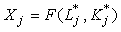
 ; j = 1, … , n,
First, a small open economy is analyzed to show that even a
complete and competitive market may fail to produce Pareto-efficient
outcomes under conditions of changing technology. It is mainly
because price-taking agents can make the prices they face by changing
their technology or technique of production. It is then shown
that this result holds equally true for the regional sub-economies
of this economy. A legal provision of R&D tax/subsidy based
on payroll changes is shown to be a second best policy that corrects
the market failure with a small dead-weight loss. This policy
does not require actual tax collection or subsidy payment and
may be used by regional governments to correct technological market
failure at regional levels. The provision improves the functioning
of the market by eliminating the mismatch between the type of
production sector and the type of technological/technical change
they introduce.
Key words: technical change, pecuniary externality, and market failure.
JEL Classification: D51, D60, D62.
I. INTRODUCTION
Technical progress allows a price taking sector, no matter how small, to circumvent the restriction posed by its smallness in making effective factor (input) prices it faces even if it is incapable of affecting market clearing prices, which everyone faces. With the decision to change technology falling entirely within the domain of each single sector, whether the market outcome will still be efficient is an important question with far reaching implications. This issue is directly relevant to persons and institutions interested on regional problems and policies, particularly in regions where unemployment due to technological "redundancy" is quite high. We would like to know, for example, whether the so-called technological unemployment is an efficient outcome or is the result of the market failure.
If the technical change takes place in many sectors (or in an industry, say because of nation or industry-wide policy reform) simultaneously then it will affect market-clearing prices producing a series of pecuniary externalities across other sectors of the economy. Since Scitovsky (1954) these externalities have clearly been distinguished from the real or technological externalities and considered welfare benign. It is because the external benefits are believed to exactly offset the external costs of pecuniary changes (Shubik, 1971; Anderson, 1974; and Ng, 1983). The pecuniary change is the mechanism through which the market is supposed to yield the most efficient outcome.
It has also been shown, nevertheless, that the pecuniary externality may cause the market to fail if there are imperfections in the market, such as incomplete insurance market (Loong and Zeckhauser, 1982), or the presence of monopolistic elements (Ng, 1983) or agents holding inconsistent price information on potential product innovations (Makowsky and Ostroy, 1995). Even when markets are complete and perfect, the pecuniary externality provides an incentive to the agents to behave strategically, such as collude or merge or extract some tribute, so that some of the external benefits of pecuniary changes can be internalized (Subik, 1971 and Anderson, 1974). As long as people respond to economic incentives, pecuniary externalities may also form the basis for various lobbying activities and institutional change, therefore pecuniary effects of technical change can not be dismissed a priori.
To my knowledge, the efficiency of market outcomes under changing technology has not been examined by previous authors. Is the outcome of a competitive and complete market socially efficient when a sector changes its production technology? In other words, would a profit-maximizing sector guided by exogenously given market prices be able to appropriate only its social contribution of technical progress? If not, what can we do to correct it? What determines whether there is any pecuniary trickle-down effect of a sector-specific technical change? What is the pattern of this effect? Who benefits and who loses at the new equilibrium? This is a list of interesting but yet unanswered questions.
This paper mainly focuses on labour-saving technical change and answers the above questions with a simple specific-factor model of a small open economy, which produces traded goods only and where no new product is being introduced. The purpose of modelling this type of a small open economy is to fix commodity prices and rule out coordination failure, so that the conditions for market efficiency as stated in Makowsky and Ostroy (1995) are satisfied.
In our model, each sector employs a specific-factor, called capital, and a composite of all mobile factors, called labour. The production function of each sector is defined on efficiency units of the two factors, while the sector, however, buys these factors in physical units from fully competitive factor markets. Sectors convert physical units of the factors into their efficiency unit by a given rule and the efficiency units are then fed into a well-defined neo-classical production function to obtain output. A technological change has been defined as a shift in the production function, which implies a change in the productivity of the efficiency units of the factors. A technical change has been defined as a change in the rule of converting physical units into efficiency units of the factors. If a sector requires less physical units of labour, say persons, to extract the same amount of efficiency units of labour then, other things remaining the same, the sector is said to have acquired a labour-saving technical progress. In this situation, the cost per unit of efficiency unit of labour falls even if the market clearing wage rate is unaffected by the technical change. Sectors will make adjustments. The national output and the profit level of the sectors will change. Following Makowsky and Ostroy (1995) we examine whether or not the sectors following the price signal will be able to fully appropriate the social contribution of their technical change. A failure to do so implies a divergence between social and private benefits, which in turn can cause a market failure.
It is shown that whether the sector introducing a labour-saving technical progress will be able to appropriate its social contribution fully, less than fully or more than fully depends on whether local wage elasticity of its labour demand is equal to, greater than or less than unity. A sector introducing a labour-saving technological progress, however, would never be able to appropriate its social contribution fully. Therefore, even a complete and competitive market will fail to deliver an efficient outcome if production sectors have their local wage elasticity of labour demand not equal to unity and the technical and technological progresses are not cost less. Furthermore, a sector will reduce (increase) labour employment if the wage elasticity of its labour demand is less (greater) than unity. This adjustment in employment is privately desirable, but it is socially undesirable. A tax/subsidy scheme to rule out the possibility of this kind of technological market failure has been provided.
Sectors that have locally inelastic (elastic) labour demand have an incentive to 'over-introduce' (under-introduce) labour-saving technology. In the absence of corrective intervention, similar action can be expected on the part of many sectors, which can culminate in sufficient level of unemployment (excess demand) to make the market adjust the market-clearing wage rate. As the wage rate falls (rises), all sectors benefit (lose) and the labour loses (benefits). Trickling-down of pecuniary effects of sector-specific technical progress starts here. Moreover, a fall in the wage rate does not eliminate the incentives to introduce further technical changes. There is also an incentive to sectors with elastic labour demand to subsidize the introduction of labour-saving technology in sectors with inelastic labour demand. Thus, an economy may plunge into the cycle of high-tech, lower wage and higher unemployment forever.
Rest of the paper contains five sections. The market equilibrium under changing technique of production is described in section II. The problem of appropriation in this environment and the possibility of market failure are discussed in section III. The relevance of this result to regional economies is shown in section IV. How an R&D tax/subsidy scheme can correct this problem is shown in section V and the paper is finally concluded in section VI.
II. Market Equilibrium under Changing Technique of Production
In this section, we describe a simplest general equilibrium model of an n-sector, small and open economy producing n-different tradable commodities. Each sector, representing the behaviour of a tiny sector, is assumed to be a price taker in all markets and strives to maximize profit subject to its production function, defined indirectly (see below) over labour and capital. The production decision is decentralized. There is one national consumer, who finally receives all income and consumes goods at constant prices to maximize utility. No new commodity is being introduced and therefore, there is no coordination problem as shown by Makowsky and Ostroy(1995). Under these conditions we can ignore the demand side since the income generating supply side is completely unaffected by it, and the social welfare depends on total income. It is also assumed throughout this paper that labour is nationally mobile and capital is specific to each sector.
The production Function of a Sector
Each sector produces a single commodity by employing labour and capital of given efficiency and the relation is defined by a concave production function:
(1) ; j = 1, … , n,
where  and
and  are
labour and capital measured in their efficiency units and
are
labour and capital measured in their efficiency units and  is the unit of output produced in industry j. The function
  is assumed to describe the hard core technological
relationship between factors, measured in efficiency units, and
output in sector j. Any change in
is assumed to describe the hard core technological
relationship between factors, measured in efficiency units, and
output in sector j. Any change in  reflects the real technological breakthrough attained in
sector j.
reflects the real technological breakthrough attained in
sector j.
The efficiency units of factors and their prices are determined by:
(2)  , and
, and 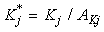
(3)  , and
, and  ,
,
where,  and
and  are
physical units of labour and capital employed in sector
j whose prices are W, the wage rate, and
are
physical units of labour and capital employed in sector
j whose prices are W, the wage rate, and  ,
the rental rate respectively. The coefficients
,
the rental rate respectively. The coefficients  and
and  provide the current mapping between
the efficiency units and the observable physical units of the
factors and represent the current technique of production
and management. Suppose both
provide the current mapping between
the efficiency units and the observable physical units of the
factors and represent the current technique of production
and management. Suppose both  and
and  are unity, then it means the efficiency units,
  and
and  , of the factors are equal to their
physical units, L and K, respectively. A fall in
the value of
, of the factors are equal to their
physical units, L and K, respectively. A fall in
the value of  indicates that to obtain
a given level of efficiency units of labour we now need fewer
persons than before. In other words, this means that more efficiency
units of labour now become available from a given stock of physical
units of labour. Technical progress that occurred in sector j
is said to be factor neutral if changes in
indicates that to obtain
a given level of efficiency units of labour we now need fewer
persons than before. In other words, this means that more efficiency
units of labour now become available from a given stock of physical
units of labour. Technical progress that occurred in sector j
is said to be factor neutral if changes in  and
and  are equiproportional, otherwise it
is biased.
are equiproportional, otherwise it
is biased.
Given a market-clearing wage rate, W, j-specific efficiency
wage rate,  , is determined by (3).
Given the product price, Pj for each commodity
j, a sector j solves the following maximization problem:
, is determined by (3).
Given the product price, Pj for each commodity
j, a sector j solves the following maximization problem:
(4) 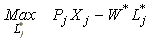
s. t. 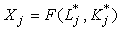
by choosing efficiency units of labour,  .
.
A solution to this problem satisfies the condition that
(5) 
which can be expresses as
(6) 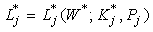 .
.
The condition (5) states the obvious: to maximize profit, employment of efficiency units should be chosen so that the value of its marginal product is equal to the efficiency wage rate. Once the optimal demand for efficiency-unit of labour is determined, the demand for its physical unit can easily be determined by (3) and (4). This process is illustrated in Figure 1.
The first quadrant in Figure 1 shows the marginal product curve
of efficiency units of labour. The efficiency wage rate is converted
into physical wage rate in the second quadrant and the efficiency
units of labour are translated into physical units in the fourth
quadrant. The marginal product curve of, which is also the demand
curve for, the physical units of labour is finally derived in
the third quadrant by noting that each sector is a profit maximizer.
Profit maximization requires that the efficiency units to be so
chosen that the value of its marginal product equals the efficiency
wage rate (the exogenously given output prices are all normalized
to unity).
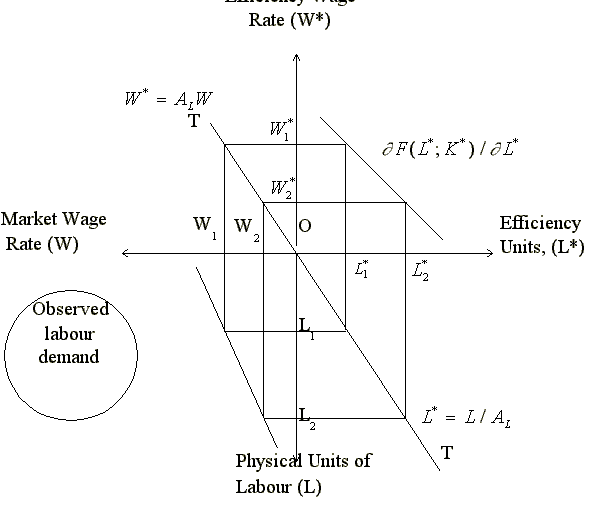
Figure 1: Optimal demand for physical and efficiency units
of labour
To make the point clear, suppose that one person yields two efficiency
units of labour per period, that is AL =
0.5. If W1 is the market wage rate then
the efficiency wage rate,  , is equal to
0.5W1. The first quadrant of the figure shows
that at this wage rate
, is equal to
0.5W1. The first quadrant of the figure shows
that at this wage rate  of efficiency
units of labour maximizes the sector's profit. The fourth quadrant
converts this information into physical units of labour as
of efficiency
units of labour maximizes the sector's profit. The fourth quadrant
converts this information into physical units of labour as  .
We now have a point to trace the demand curve for physical unit
of labour in the third quadrant. Other points can be obtained
by similar arguments.
.
We now have a point to trace the demand curve for physical unit
of labour in the third quadrant. Other points can be obtained
by similar arguments.
Technical Change and Technological Change
The slope of the line TOT that goes from the fourth to the second
quadrant through the origin represents the technical coefficient
AL. A fall in the value of AL
makes the line flatter (pulling towards the x-axis) and an increase
in the value of AL makes the line steeper. A
flatter line would mean that a person now yields more efficiency
units of labour than before, whereas a steeper line would mean
that the same person is now less efficient than before. Thus by
rotating the line TOT around the origin, we can represent a particular
type of labour productivity change, which we define as technical
change. A pure technical change would leave the production
function F unaffected, and the marginal product of efficiency
units unchanged. Such a change, for example, can be brought about
by improved management practices, provision of recreational and
training facilities, etc., but without changing the relationship
between efficiency units and output. It only changes the relationship
between the physical unit of a factor and its efficiency. Thus
a technical change, when unit price is given by the market, alters
the price of an efficiency unit proportionately. If the (productivity)
efficiency of a physical unit of labour increases by 10%, then,
at a constant wage rate, the price of an efficiency unit of labour
falls by 10% as well. The effect of a technical change on the
demand for physical units of labour is shown in Figure 2.
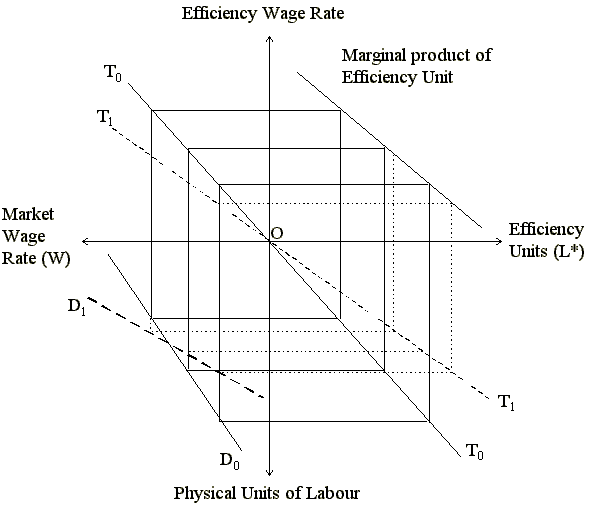
Figure 2: Technical change and demand for physical units
Figure 2 is similar to Figure 1, except that the line T0OT0 representing the technique of production has rotated to a broken line. Labour has become more productive in producing efficiency units, which is represented by the slope of the new line T1OT1. Therefore, the demand curve for physical units of labour has rotated from D0 to D1 (see, the third quadrant). At a given market wage rate, efficiency wage rate has now fallen; demand for efficiency units has risen; and finally, the demand for physical units has, perhaps, changed. Above the point of intersection of the two demand curves D0 and D1 the demand for person has increased, but below the point of intersection it has fallen. The extent of this shift in demand depends on the tilt of the new demand curve D1, which can be explained as follows. As a physical unit means more efficiency units now, say four units as against two. At the unchanged production technology F, the marginal product of the first physical unit is the total of the marginal products of all the first four efficiency units it produces. Therefore, the marginal product of first physical unit has gone up. Similarly, the second physical unit now commands less productive next four efficiency units. Its marginal product, which is the sum of the marginal products of these four efficiency units, can not rise by as much as that of the first did. As we move on, the marginal products of physical units of labour start to fall rapidly, which is described by the tilt of the curve D1.
The point of intersection between the two demand curves D0 and D1 is determined by the wage elasticity of the demand for efficiency units. If the wage elasticity of demand for efficiency unit is unity, then a change in the technique will not affect the demand for physical units at the going market-wage rate. It is because, as productivity of the physical unit goes up, say by 10%, the unit cost of efficiency unit falls by 10% as well. This will increase demand for efficiency units by 10%, so the demand for physical unit remains unchanged.
This point has been illustrated in Figure 3. At the going wage rate W, the demand for physical units has remained the same with the technique T1OT1 as with T0OT0. In general, if the wage elasticity of the demand for efficiency units is globally unity, then no change in technique will bring a shift in the demand curve for physical units in the labour market. Alternatively, if the wage elasticity of demand for efficiency unit is greater than unity over the relevant range, then the new demand curve for physical units will be flatter than the old one as physical units become more productive. Thus, the elasticity of demand for efficiency units plays a critical role in shaping the demand curve for physical units of labour.
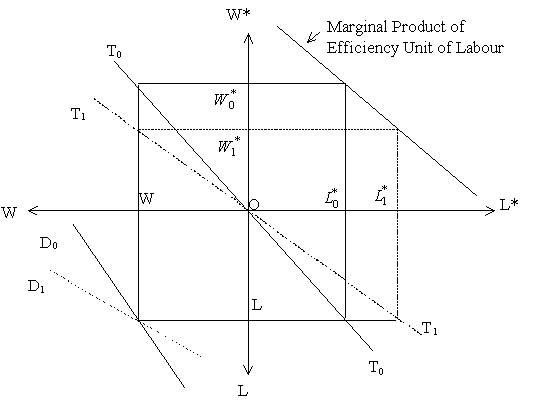
Figure 3: Wage elasticity of demand for efficiency unit and
demand for person
Now, we consider a change in the production technology, that is a shift on the production function F, of an arbitrary sector. The effect of a labour productivity-enhancing shift in the production function and its impact on the demand for persons is illustrated in Figure 4.
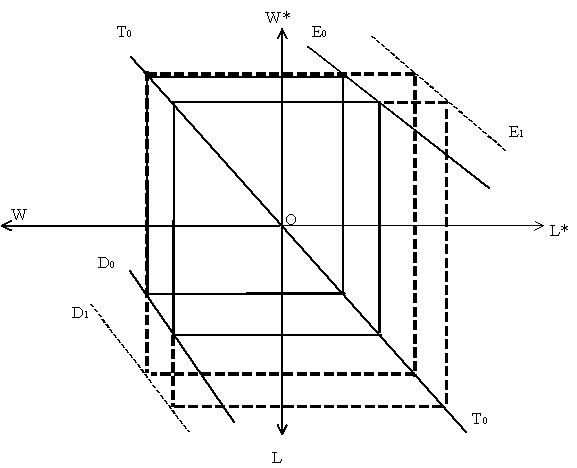
Figure 4: Change in technology and demand for persons
Figure 4 shows a rightward shift on the demand for efficiency
units of labour, from E0 to E1, which was
brought about by an improvement in the productivity of efficiency
units of labour. This increase in productivity, in turn, was the
consequence of a technological progress in the sector. Given T0OT0,
the technique of extracting efficiency units from physical
units of labour, the effect of this technological change on demand
for person are traced by broken lines from first quadrant to the
third quadrant. The demand curve shifts out from D0
to D1.
(a) (b) (c)
Figure 5: Technical and technological change, wage elasticity
and the shifts on labour demand curve
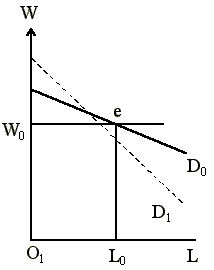
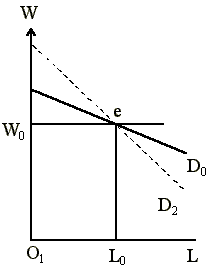
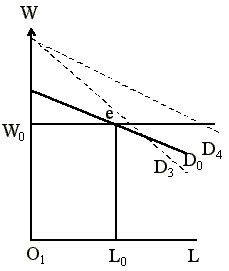
Figure 5 summarizes the types of shifts on the demand-for-labour curve discussed so far, which were brought about by technical and technological changes in a given sector.
D0 is the initial demand curve for physical units of labour. The market wage rate is given at W0 and the sector is currently employing L0 persons. If a technical change takes place in the sector, then depending upon the local wage elasticity of demand for the efficiency units, the shift on the demand curve for persons may take any of the situation shown in panel (a), (b) or (c). If the elasticity is less than unity, then the shift will be as shown in panel (a); the new demand curve will be like D1, intersecting D0 to the left of current equilibrium point e. If the elasticity is unity, then the new demand curve will be like D2 as shown in panel (b), indicating no change in the demand for persons at the going wage rate. If the elasticity is greater than unity, then the new demand curve will be like D3 as shown in panel (c), which indicates an increase in demand for physical unit at the going wage rate. Similarly, the new demand curve would be like D4, definitely to the right of the point e throughout if it is caused by a labour-saving technological progress. As far as the effect on demand for persons is concerned, D3 and D4 are similar. Therefore, in what follows we will consider three types of possible shifts of the demand curve for physical units of labour that is brought about by productivity changes under three different ranges of the wage elasticity: less than unity, unity and greater than unity.
Equilibrium in the labour market: the last component of general equilibrium
For the general equilibrium of the small open economy, we now need to specify the resource constraint of the economy. For that matter, we now require that the demand for physical units of labour by all sectors add just up to the total supply of labour. That is, we require
(7)  .
.
To illustrate the equilibrium and the comparative static graphically, let us aggregate the labour demand of all but one arbitrary sector into one and call it as sector 2, and the arbitrarily chosen sector as sector 1. Given that the economy has got a fixed supply of labour and the flexible wage clears the labour market we can describe the essence of the general equilibrium of this economy as in Figure 6.
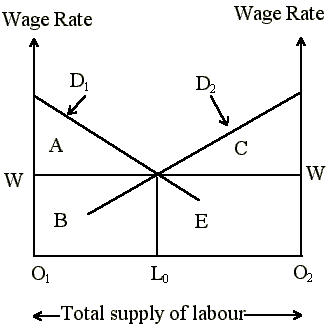
Figure 6: Equilibrium in the labour market
The small open economy described here has commodity prices determined exogenousely by the world market; we shall hold them fixed throughout the analysis. Note that we have chosen the units so that the commodity prices are all unity. This normalization lets us do our sums freely without altering the quality of our results. The market-clearing wage rate is W, sector 1 employs O1L0 units of labour, and all other sectors together employ the rest, O2L0 units, of labour. Marginal products of labour are equalized across the sectors; this allocation of labour is efficient. Labour gets the area (B+E), and sector-specific factors receive area A and C respectively. Total income of the society is given by the area A+B+C+E. Now, we have got our tools ready for the comparative statics and the analysis of the appropriation problem. The main results are summarized in a series of propositions.
III Technical Change and the Appropriation Problem
Proposition 1: If a sector has wage elasticity of demand for efficiency units equal to unity locally, then this sector will just appropriate its social contribution of labour-saving technical change. There will be no appropriation problem and the market will remain efficient.
Proof: Assume that the conditions of the proposition hold
- that is, the sector 1 has unitary elastic demand for efficiency
units of labour at the going wage rate - and it introduces a labour-saving
technical change. Then, as discussed in previous section, its
demand for persons curve would shift to  from D1, as shown by the dotted line in Figure
7. The shift will be such that
from D1, as shown by the dotted line in Figure
7. The shift will be such that  will intersect
the existing demand curve, D1, at point e
so that there will be no change in the demand for physical units
of labour at the going wage rate. The labour market equilibrium
will be undisturbed, the equilibrium wage rate will remain at
W0, and the allocation of labour would be given by
L0.
will intersect
the existing demand curve, D1, at point e
so that there will be no change in the demand for physical units
of labour at the going wage rate. The labour market equilibrium
will be undisturbed, the equilibrium wage rate will remain at
W0, and the allocation of labour would be given by
L0.
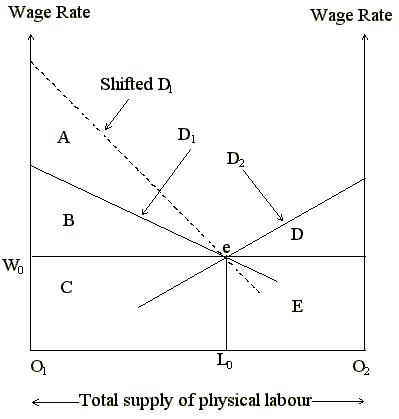
Figure 7: Technical change and appropriation in sectors
with unitary elastic labour demand
The income of the society would be given by the area (A+B+C+D+E), which currently is the area (B+C+D+E). Hence the social contribution of the proposed technical change is given by the area A. Since sector 1 is currently appropriating the area B and would be appropriating the area (A+B) after the change, the private return of the proposed change is, therefore, given by the area A. Sector 1 will fully appropriate the social contribution of its technical change. Given that the social and private costs of introducing the technical change do not diverge, the proposed change is privately profitable if, and only if it is socially profitable. Hence, the market remains efficient.
Proposition 2: If a sector's local wage elasticity of demand for efficiency units is less than unity, then this sector will appropriate more than its social contribution of labour-saving technical change. There will be an appropriation problem and the market will fail in delivering an efficient outcome. Such sectors will over-introduce labour-saving technical change than socially desirable.
Proof: Assume that the condition of Proposition 2 holds,
that is the local wage elasticity of sector 1's demand for efficiency
units is less than unity. Then as a result of labour-saving technical
change, its demand curve for physical units would shift to  from
from  as shown in Figure 8.
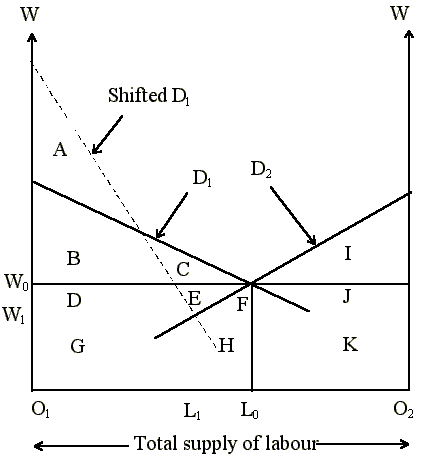
Figure 8: Appropriation problem with less elastic labour demand
Since sector 1's demand for physical units of labour will fall at the going wage rate, the equilibrium wage rate would fall to W1 and the allocation of labour across sectors would be given by L1. Now let us examine the private and social contribution of this change.
Aggregate social output before the technical change in sector 1 is:
Y0 = [(B+C)+(D+E+F+G+H)] + [I+(J+K)].
Aggregate social output after technical change in sector 1 would be:
Y1 = [(A+B+D) + G] + [(F+J+I)+(H+K)]
Therefore the social contribution of the technical change would be:
DY=Y1 - Y0 = [A-C-E].
Similarly, the profit of sector 1 before the technical change is given by
P0 = B+C,
and the profit of sector 1 after the change would be:
P1 = A+B+D.
Therefore, private benefit of the technical change = DP = A+D-C
Excess appropriation by sector 1, which is the excess of private benefit of technical change to sector 1 over its social contribution, is given by:
DP - DY = (A+D-C)-(A-C-E) = (D+E) > 0.
Thus, sector 1 will be able to appropriate the area (D+E) in addition to its social contribution of the labour-saving technical change. Therefore, all labour-saving technical change that cost less than their private benefits will be privately profitable and will be introduced even if they cost more than their social benefits; there will be an over-introduction of labour-saving technical change. Hence, in this case, the market fails.
Proposition 3: If a sector's local wage elasticity of demand for efficiency units of labour is greater than unity, then this sector will appropriate less than its social contribution of labour-saving technical progress. There will be an appropriation problem and the market again fails in delivering an efficient outcome. Such sectors will under-introduce labour-saving technical change than it is socially desirable.
Proof: This proposition covers the case left out by Propositions
1 and 2. The proof follows similar line of arguments. Assume that
the sector 1 has (at least, locally) elastic demand for efficiency
units of labour at the going wage rate. As discussed in the previous
section, sector 1's demand for physical units of labour increases
at the going wage rate as a result of the introduction of a labour-saving
technical change. The consequent increase in the demand for physical
units of labour is represented by the broken line,  ,
in Figure 9,
,
in Figure 9,
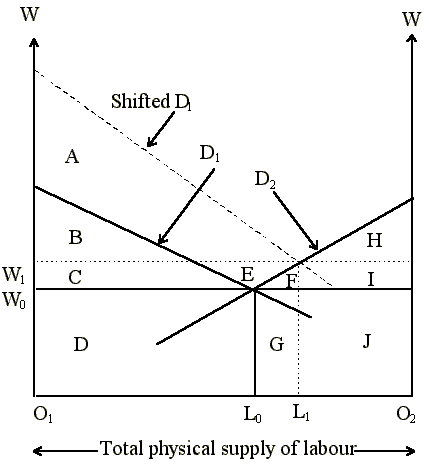
Figure 9: Appropriation problem in sectors with elastic demand for labour
The wage rate rises to W1 to clear the labour market, and sector 1 employs more person and other sectors reduce their employment in the new equilibrium after the technical change. It is useful to recall that this shift in the labour demand curve of sector 1 is similar to the situation in which the sector had a labour-saving technological progress. Therefore, the result that follows represents both cases.
Now, let us examine the social contribution and private benefit of the change.
The national output before the technical change in sector 1 is given by:
Y0 = [(B+C)+D]+[(F+I+H) + (G+J)],
and the national output after the technical change in sector 1 would be:
Y1 = [(A+B)+(C+D+E+F+G)] + [H+(J+J)].
Therefore, the social contribution of technical change is given by
DY=Y1 - Y0 = A+E.
The profit of sector 1 before the technical change is given by
P0 = B+C,
while the profit of sector 1 after change is given by
P1 = A+B.
Therefore, private benefit to sector 1 of the labour-saving technical change is given by
DP = A-C.
Clearly, the excess appropriation by sector 1 in this case is negative, for
DP - DY = (A-C)-(A+E) = - (C+E) < 0.
Thus, sector 1 fails to fully appropriate its social contribution of labour-saving technical change. Consequently, some projects that are socially desirable but are privately costly will not be undertaken. The market fails.
Corollary 1: Whether or not a labour-saving technical change in a sector will produce pecuniary externality or trickle-down effects to other sectors depends on whether or not the local elasticity of labour demand of the sector is unity.
Proof: This corollary follows immediately from Propositions 1,2 and 3.
Corollary 2: There is an incentive to sectors with elastic labour demand to subsidize the introduction of labour-saving technical change in sectors with very low elasticity of labour demand. Such subsidization may actually take place if the size of the sector introducing the change is sufficiently large, even if all sectors behave competitively.
Proof: It was shown in the proof of Proposition 2 that
the market wage rate falls as a result of the introduction of
labour-saving technical progress in sectors with inelastic labour
demand. Because of this fall, all other sectors benefit, they
increase their profit by the area (F+J) in Figure 8. It was shown
in Proposition 3 that sectors with high wage elasticity of labour
demand fail to fully appropriate their contribution to the national
output and so under-invest in labour-saving technical change of
their own. Suppose sector 2 in Figure 8 has elastic demand for
labour. If sector 2 subsidizes sector 1 up to the amount  less than the area (F+J) to introduce a labour-saving technical
change in sector 1 of the order represented in Figure 8 it will
increase its profit by
less than the area (F+J) to introduce a labour-saving technical
change in sector 1 of the order represented in Figure 8 it will
increase its profit by  . If the change
was not previously privately profitable to sector 1, it may now
become profitable after the cross-subsidization from other sectors,
which will further exacerbate the inefficiency of the market outcome.
Therefore, the sectors with elastic demand have an incentive to
subsidize sectors with inelastic demand for labour. There are
two reasons not to expect such cross-subsidization to take place.
First, technical change in a particular sector may have insignificant
effect in the market wage rate and second, the benefit of lower
wage would be shared by sufficiently large number of sectors suffering
from the free rider problem. The presence of various producers'
organization, however, can serve to mitigate the importance of
these two reasons and indirect cross-subsidization (such as research
funding) may actually take place.
. If the change
was not previously privately profitable to sector 1, it may now
become profitable after the cross-subsidization from other sectors,
which will further exacerbate the inefficiency of the market outcome.
Therefore, the sectors with elastic demand have an incentive to
subsidize sectors with inelastic demand for labour. There are
two reasons not to expect such cross-subsidization to take place.
First, technical change in a particular sector may have insignificant
effect in the market wage rate and second, the benefit of lower
wage would be shared by sufficiently large number of sectors suffering
from the free rider problem. The presence of various producers'
organization, however, can serve to mitigate the importance of
these two reasons and indirect cross-subsidization (such as research
funding) may actually take place.
IV Implication to Regional Economies
Since a region can be considered as a small open sub-economy of the national economy, it can be viewed as a price taker in both goods and factor markets. In a model of a regional economy, a natural assumption would be to take commodity prices and the wage rate as given. It is possible to get the impression from Propositions 1-3 (Figures 7-9) that if a labour-saving technical progress does not alter the market clearing wage rate then there will be no appropriation problem. Therefore, regional markets, taken in isolation, will remain efficient. Hence, one may conclude that as far as regional economies are concerned the technological market failure of the above type is not relevant at all. This is, however, not true. We will shortly see that regional markets also fail to produce efficient outcomes when a labour-saving technical change takes place in production sectors, however small, with local wage elasticity of labour demand that is different from unity. This is because the appropriation problem is not caused by the change in the market wage rate resulting from the labour-saving technical change but from change in the demand for labour that follows the technical change.
Corollary 3: Let there be an unlimited supply of labour at some exogenously fixed wage rate. A production sector, no matter however small, will fail to appropriate just the social contribution of its labour-saving technical change and the market fails if the local wage elasticity of its demand for the efficiency units of labour is different from unity.
Proof: Let us consider the introduction of a labour saving
technical progress in a small regional sector as represented in
either of the two panels in Figure 10. The sector will be represented
by panel (a) if its wage elasticity is less than unity and by
panel (b) if its wage elasticity is greater than unity. Let the
wage rate be fixed at W0 and L0 represent
its initial level of employment. Its initial contribution to social
output is given by the area B+C+D+E+F in panel (a) and by the
area B+D in panel (b). The specific factor has received the area
B+C, and the area D+E is the wage bill in panel (a) and the specific-factor
has received the area B and the area D is the wage bill in panel
(b). With the introduction of a labour-saving technical change,
the demand curve for physical units of labour shifts to from
from  in both cases.
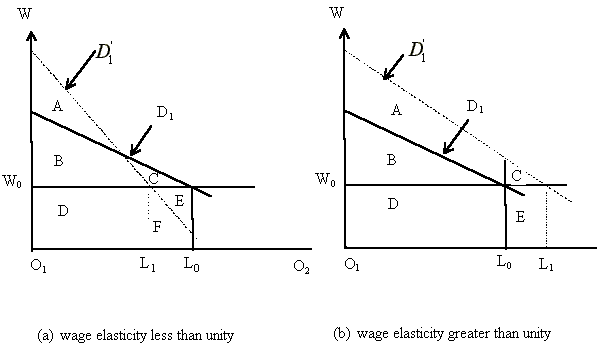
Figure 10: Appropriation problem in a small regional-production-sector
The sector would find it profitable to adjust, reduce in case (a) and increase in case (b), the employment level to the point L1 from L0. Since the output of the other sectors would remain unchanged, the change in national output because of the introduction of the labour-saving technical change in sector 1 is the same as the change in its own output. Therefore, the increase in social output is given by the area (A-C-E-F) in case (a) and the area (A+C+E) in case (b). The change in the sector's profit is given by the area (A-C) in case (a) and by the area (A+C) in case (b). The area (A-C) exceeds the area (A-C-E-F) by the area (E+F) and the area (A+C) falls short of the area (A+C+E) by the area E. There is an over-appropriation in case (a) and an under-appropriation in case (b). Thus, even if the wage rate is unaffected by the sector-specific technical change, the regional market fails in delivering an efficient outcome if the wage elasticity of demand for labour in the regional production sector introducing the technical change is different from unity. More importantly, the discrepancy between private gain and social contribution of a given technical change is greater when the wage rate is exogenously fixed than when it is flexible.
The above result clearly implies that a labour-saving technical progress alone, if it occurs in sectors with low wage elasticity of labour demand, can cause regional unemployment even if the economy was previously at full employment. Overtime it may build up sufficient pressure in the national labour market for the market-clearing wage rate to fall. In a world of ever changing technique of production, maintenance of full employment through the market forces only, therefore, seems next to impossible. Therefore, we now ask is there a way to correct the operation of the market mechanism?
V Legislation of R&D Subsidy and Correction of the Market Failure
In this section, we will see how a carefully designed intervention improves the efficient functioning of the market and the economy (regional as well as national) can be saved from falling into the high-tech, low wage and high unemployment trap.
Proposition 6: For sectors j= 1, 2, …, n, let  ,
where
,
where  and
and  are
respectively the payroll of the sector j before and after the
labour-saving technical change is introduced in some arbitrary
sector 1. Let
are
respectively the payroll of the sector j before and after the
labour-saving technical change is introduced in some arbitrary
sector 1. Let 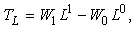 where
where  and
and  are the market clearing wage rates
before and after the change and
are the market clearing wage rates
before and after the change and  and
and  are respectively the economy-wide employment level before and
after the change. Then the legislation of the tax
are respectively the economy-wide employment level before and
after the change. Then the legislation of the tax  to the n production sectors and the labour, irrespective of whoever
introduces the labour-saving technical change, improves market
efficiency. It corrects the market failure with a small second
order dead weight loss. Moreover, unless the economy has unemployment
this R&D tax/subsidy need not require actual collection of
the tax or payment of the subsidy.
to the n production sectors and the labour, irrespective of whoever
introduces the labour-saving technical change, improves market
efficiency. It corrects the market failure with a small second
order dead weight loss. Moreover, unless the economy has unemployment
this R&D tax/subsidy need not require actual collection of
the tax or payment of the subsidy.
Proof: We will first show that the R&D tax/subsidy improves market efficiency, when a single sector in a regional economy introduces a labour-saving technique.
As we already know from Figure 10 that that at the free market solution a sector would over-appropriate by the area (E+F) in case (a) and under-appropriate by the area E in case (b). The employment in the sector falls in case (a) and rises in case (b). The wage bill declines in (a) and rises in (b). As a result, the sector would be liable to an R&D tax equal to the area (E+F) in case (a), and a subsidy equal to the area E in case of (b). The workers are entitled to a subsidy equal to the area (E+F) in a case of (a) and a tax equal to the area E in case of (b). There is no funding problem in the scheme, since the tax exactly offsets the over or under appropriated amount. It corrects the malincentive provided by the market, therefore, only socially desirable technical change will take place.
Now we have to show that the sector actually chooses to employ L0 amount of labour in both cases with the better technique of production in place.
In case of (b) the choice is clear; it will not be able to increase employment beyond L0, because the extra labour has to work for free. Therefore, the sector will continue to employ L0 collect the area A as its increased profit which is also equal to its marginal social contribution. So, let us focus on case (a). In this case, the sector has the following choices: employ L1 and pay the R&D tax, employ L0 and do not pay the tax, or choose in between the two.
If the sector chooses to employ L1 units of labour, its payoff from the technical change and the R&D tax would be the area (A-C-E-F). If it chooses to continue to employ L0 persons even after the technical change, then its payoff from the change would be the area (A-C-E). It will be able to recoup the area F from the increased production. Clearly to employ L0 dominates the strategy to employ L1. Not only that, to employ L0 dominates the strategy to employ at any convex combination of the two. Hence the sector will employ L0 and pay no R&D tax. Thus with this tax/subsidy scheme, no sector will change its employment level, and all socially profitable technical changes will be implemented.
Now we will consider this scheme in general equilibrium. Assume that sufficiently many sectors introduce labour-saving technical change and the labour market feels the difference. The market-clearing wage rate adjusts to clear the labour market. Will the proposed scheme be still useful in improving market efficiency?
First, let us consider the case of falling demand for labour, that sectors with very small wage elasticity of labour demand introduce the change. We analyse the working of the scheme with Figure 11, which is basically Figure 8 with the area H in Figure 8 divided into two areas, I and H, in Figure 11.
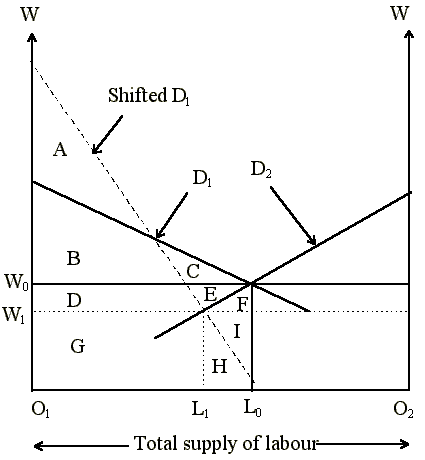
Figure 11: Technical change in many sectors with inelastic labour demand, labour market equilibrium and the R&D subsidy
We know that the free market solution in this case is that the sector over-appropriates by the area (D+E), the employment in sector 1 falls to L1, and the wage rate falls to W1. Since the payroll declines after the change, the sector is liable to an R&D tax, which is equal to the area (D+E+F+I+H). Hence, if the sector chooses to stay with the market solution its net profit will increase by the area [A - (C+E+F+I+H)] over its initial value of (B+C). If, however, the sector chooses to employ the L0 units, then it does not have to pay the tax since the wage rate and hence its wage bill will not fall. Its profit will increase by [A - (C+E+F+I)]. Thus, by choosing to employ the original number of workers rather than L1 the sector can increase its profit by the area H, (i.e. recover part of its R&D tax liability). Hence, the sector will choose to employ L0.
As the pecuniary externality is controlled at its source, the external effect of technical change has been internalized. There will be no effect on other sectors whatsoever of the technical change since the wage rate remains unchanged. The sector introducing the change appropriates just its contribution to the society, and the income of the rest of the society is unchanged. This is not the first best solution, however. There is some inefficiency left out here. It is the area (F+I), which represents the loss in social output of labour from being employed in "less productive" employment. The cost of being so will not be borne by the workers, though.
Finally, we consider the case in which sectors with high wage elasticity of labour demand introduce the labour-saving technical change. To analyse the effectiveness of the R&D tax/subsidy scheme we reconsider Figure 9, which is slightly modified and reproduced as Figure 12.
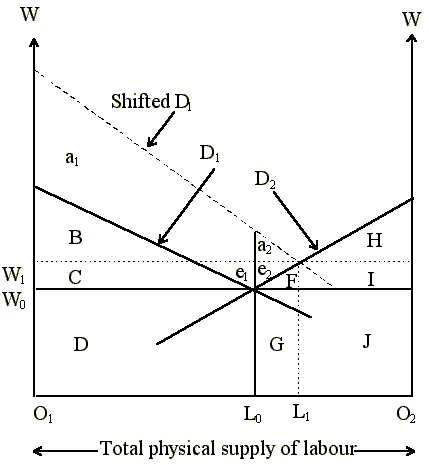
Figure 12: Technical change in sectors with high wage elasticity of labour demand, labour market equilibrium and the R&D tax/subsidy scheme.
We know that in this case the market solution implies an under appropriation of the social contribution made by the sector (Proposition 3). We want to see whether the R&D tax/subsidy scheme can correct this problem or not.
Note that the technical/technological progress introduced in sector 1 causes the market wage rate to rise; the payroll of the sector 2 will also rise at unchanged employment. Since the R&D tax/subsidy scheme provides subsidy to the production sectors to cover any rise in their wage bill at the market wage rate, sector 2 will not reduce its employment irrespective of the market wage rate. Since extra income earned via higher wage rate will be taxed away, there is no incentive to the workers to move sectors even if sector 1 wants to bid them away by offering them a higher wage rate. Hence the employment in sector 1 will remain at L0, and the market wage rate will remain at W0. Sector 1 will increase its profit by the area (a1+e1), which is just equal to its marginal social contribution via the technical change.
Marginal product of labour in sector 1 will remain higher than that in other sectors, causing the dead weight loss equal to the area (a2+e2) - the two little triangles! Hence, the guided market allocation will remain second best.
V Conclusion
The market in general fails to provide right incentives, when sectors do change their technique or technology of production. The first theorem of welfare economics, which states that all Walrasian equilibria are Pareto efficient, needs another revision. The first revision was proposed by Makowsky and Ostroy (1995). They have shown that markets can not provide correct incentives as far as sectors are engaged in product innovation. They suggested that private price information regarding new products held by different agents should be consistent in order that the Walrasian equilibrium with this possibility to be Pareto efficient. Here we have seen that if sectors change production technique or technology, the Walrasian equilibrium may not necessarily be efficient. In order that the first theorem of welfare economics remains valid, the sectors should not be allowed to change their production technology. They, however, may change their technique of production provided the wage elasticity of labour demand always remains equal to unity, which is rather stringent.
In this paper, we have seen that sectors with "inelastic" demand for labour tend to over-do and sectors with "elastic" demand for labour tend to under-do labour-saving technical progress compared to what would be the social optimum. It happens so because of the appropriation problem - that these sectors fail to appropriate their social contribution of the technical change correctly and therefore, they receive incorrect signal from the market.
To avoid this deficiency of the market mechanism, we proposed a R&D tax/subsidy scheme. This scheme funds all increases in the payrolls of the production sectors arising out of labour-saving technical progress and taxes away any saving made in their payrolls, irrespective of whether the sector is responsible for the change or not. This scheme also does not let wage earners suffer or benefit from the pure technical change. The most interesting aspect of this scheme is that it restores the market efficiency and only needs to be legislated, neither there is any need for actual tax collection nor a need of the subsidy being paid out.
In the absence of such corrective policy, there is always a danger to the economy of falling out of full employment, and plunge continually into the cycle of high-tech, higher unemployment, and lower wages.
References
Anderson, F.J. (1974), "Pecuniary Externalities and Referent Groups in the Operation of the Price System", Southern Economic Journal, 40: 442-46.
Foster, Edward (1983), "Rents and Pecuniary Externalities in Cost-Benefit Analysis: Reply", The American Economic Review, 73: 1171-2.
Loong, Lee Hsien and Richard Zeckhauser (1982), "Pecuniary Externalities Do Matter When Contingent Claims Markets Are Incomplete", Quarterly Journal of Economics, 97: 171-79.
Makowsky, Louis and Joseph M. Ostroy (1995), "Appropriation and Efficiency: A Revision of the First Theorem of Welfare Economics", The American Economic Review 85: 808-27.
Ng, Yew Kwang (1983), "Rents and Pecuniary Externalities in Cost-Benefit Analysis: Comment", The American Economic Review, 73: 1163-70.
Scitovsky, Tibor (1954), "Two Concepts of External Economies", Journal of Political Economy, 62: 143-51.
Scotchmer, Suzanne (1986), "Local Public Goods in an Equilibrium: How Pecuniary Externality Matter", Regional Science and Urban Economics, 16: 463-81.
Shubik, Martin (1971), "Pecuniary Externalities", The American Economic Review, 61: 713-18.
Wildasin, David E. (1988), "Indirect Distributional Effects in Benefit-Cost Analysis of Small Projects", Economic Journal, 98: 801-907.