Intellectual Property Intensity (IPI) measures the weight of IP in the firm's total market value. IPI has a positive (convex) functional relationship with Price to Book (P/B) ratio, and thus may provide additional economic insight to the empirical value-growth effect. Growth firms have higher IPI while value firms are characterized by lower IPI. The large (small) weight of IP in growth (value) firms can explain their higher (lower) profitability. This is due to: (i) the monopolistic power that results from IP and (ii) the higher risk associated with IP. Thus, the lower (higher) returns that characterize growth (value) stocks should be attributed to market inefficiency and mispricing and not to lower (higher) risk. The positive bias in growth stock prices is explained by the inability of investors to fully account for the risk associated with IP.
Using a sample of biotechnology companies I compare
the forecasting ability of IPI versus P/B. I find that IPI has
a superior forecasting ability over P/B.
1. Introduction
Recent work and debate in the financial literature
is focused on the value-growth effect and its sources. The value-growth
effect, a widely observed empirical phenomena, states that the
so-called growth (value) firms, distinguished by their high (low)
Price to Book (P/B) ratio, tend to have higher (lower) future
profitability, but their stocks tend to generate lower (higher)
returns. The profitability superiority of growth firms versus
value firms is reported by Fama & French (FF, 1995), Fairfield
(1994), Bernard (1994) and Frankel & Lee (FL, 1997). The positive
return differential between value and growth stocks is reported
by FF (1992, 1996, 1997), Lakonishok, Shleifer & Vishney (LSV,
1994), Davis (1994), Chan, Hamao & Lakonishok (1992), Capaul,
Rowley & Sharpe (1993) and FL (1997).
The evidence of the value-growth effect is conclusive,
but there is an extensive debate about the economic explanation
of this phenomena. One explanation is that the higher returns
that characterize value stocks reflect higher risk associated
with these companies. The main advocates of this view are FF (1992,
1993, 1996, 1997) and Daniel & Titman (1995). A second view,
supported by LSV (1994) and FL (1997), is that the value-growth
effect represents market inefficiency and specifically over optimistic
(pessimistic) mispricing of growth (value) stocks.
The economic foundation of both theories is not straightforward
since P/B, which is the metric used to distinguish between value
and growth firms, does not represent any clear economic characteristic
of the firm. FL (1997) use accounting based valuation model to
represent a more interpretable formulation of P/B. Following their
notation V/B, which is the theoretical value for P/B is:
(1) (V/B)t = 1 + Bt-1
. (1+re)-i
Et [(ROEt+i-re).Bt+i-1]
Where:
B - Book value.
ROE - Return on book equity.
re - Cost of equity capital.
E - Expectations operator
This representation lends economic sense to the (theoretical)
P/B ratio. P/B is a function of the discounted expected (infinite)
sum of abnormal earnings, weighted by their respective book values.
Growth firms are expected to have ROE higher than their cost of
equity capital, while value firms are expected to have ROE close
to their cost of equity capital.
The FL representation associates the value-growth
effect with future profitability. Investors can successfully identify
which firms will have high (low) profits and are ready to pay
higher (lower) prices for these firm's stocks. Explanation of
the return aspect of the value-growth effect is less straightforward.
FL suggest that the return effect is caused by mispricing and
support this view by presenting empirical findings showing that
the P/B ratio is positively correlated with higher than average
forecasts for ROE: "Specifically, we find that the consensus
I/B/E/S forecasts is too high (too low) for low (high) B/P firm,..."
(FL, 1997 p. 24). According to this explanation investors
can predict correctly whether a firm will have higher (lower)
than normal future profits, but are over optimistic (pessimistic)
about the size of such profits and thus positively (negatively)
misprice the firm's stocks.
Although the FL representation is economically plausible
the mispricing issue is still puzzling. Examination of the empirical
results of FL shows that the cross-sectional average ROE in their
sample ranges between 8% to 18%, and the intertemporal average
(over 18 years covered by their data set) is 13%. These figures
coincide with the commonly used cost of equity capital in the
U.S.A. which is in the range of 10% to 15%, as shown by Palepu,
Bernard & Healy (PBH, 1996). Moreover, PBH show that ROE,
in U.S. industrial firms, tends to revert to 13% in a period of
3 to 5 years. However, if we look at the P/B series in the FL
study we see that the cross-sectional average P/B ranges between
1.38 and 2.96 and the intertemporal average is 2.18. Thus, there
is a discrepancy between the observed average long-run ROE and
P/B. Since the average long-run ROE is very close to the cost
of equity capital, we should expect that the average long-run
P/B will be close to 1, otherwise we must conclude that investor's
expectations are irrational. Instead we find an average premium,
amounting to 118%, of market value over book value. It is peculiar
why, over long period of time, investors are consistently wrong
in their expectations. FL account the discrepancy between the
observed ROE and P/B to conservative accounting policies, however
the extent of the difference seems too high to be explained in
such manner.
In a previous article (Malki, 1997) I have suggested
a measure for the Intellectual Property Intensity (IPI) of a firm,
and have shown some desirable properties of this measure. This
article examines the theoretical and empirical functional relationship
between IPI and P/B. The identification of positive functional
relationship between IPI and P/B suggests that the value-growth
effect can be understood within the framework of IP analysis.
Furthermore, the forecasting ability of IPI relative to P/B is
examined and is found to be superior.
Section 2 describes the data set used for the empirical
analysis; section 3 explains the concept of IPI and shows its
functional relationship with P/B; section 4 analyzes the value-growth
effect in IP framework; section 5 compares the forecasting ability
of IPI relative to P/B; and section 6 concludes the article.
2. The Data
For the empirical analysis I have used financial
and market data for 47 biotechnology public companies which comprise
the Genetic Engineering News Index (GEN-DEX). As I have previously
shown the biotechnology sector has different IPI distribution
than the U.S. industrial norm (Malki, 1997). Moreover, being a
sector that derives most of its value from IP we might expect
that IPI will be more uniform across biotechnology companies.
Data were available to the years 1991-1996 through
the Wall Street Research Net (WSRN). Some companies were not publicly
traded in 1991-1992, and I have also excluded anomalies such as
negative book values and extremely high P/B values. The last column
of Table 1 lists the number of observations available for each
year. definitions of the variables in the data set are available
via WSRN and may be found at http://www.wsrn.com.
3. The concept of IPI.
A similar concept to IPI is described by Smith &
Parr (SP, 1993); the following analysis is taken from Malki (1997).
The IPI concept is based on the observation that a firm's value
is the sum of its tangible and intangible asset values. Tangible
assets include current assets (such as cash, securities, inventories
and receivables) and fixed assets (such as buildings, machinery
and vehicles). Intangible assets include on-the-job training,
know-how, brands, trademarks, copyrights and patents. Although
financial statements can reflect only the tangible portion of
the firm's value, markets evaluate firms according to the full
scope of their assets worth. Thus, we can estimate the value of
intangible assets by combining market data with fundamentals.
A significant insight, initially presented by Modigliani
& Miller (MM, 1958), is that the value of a firm is the sum
of its equity market value and its debt market value. Debt market
value is usually assumed to equal the respective book value, and
thus we can calculate the firm's market value as the sum of its
market capitalization and the book value of its current liabilities
and long term debt. The difference between the firm's market value
and its assets book value is a fair estimate of its intangible
assets worth.
The ratio of intangible assets worth to the total
firm's market value is the Intellectual Property Intensity (IPI).
IPI has some desirable properties making it a good mean for comparison
between different companies. Since the tangible assets value is
always positive, IPI must be, by definition, less than one. Intangible
assets value can be negative, usually when the market is extremely
pessimistic about the firm's prospects, however, when this anomaly
is discarded IPI will vary between 0 and 1. Firms with IPI close
to zero derive most of their value from their tangible assets,
while values close to one characterize firms that use intellectual
property as their main source of value creation.
The mathematical representation of IPI is fairly
straightforward:
By definition:
(2) ABV = CA + NFA = B + D
Where:
ABV - Assets book value
CA - Current assets
NFA - Net fixed assets
B - Equity book value
D - Debt book value
The definition of the firm's value proposed by MM
is:
(3) AMV = EMV + DMV
Where:
AMV- Assets market value which, according to MM, is equal to the discounted sum of future net operating income (income before interest payments minus tax).
EMV - Equity market value.
DMV - Debt market value.
Assuming that debt's market value (which is usually
not observable) can be fairly estimated by debt book value we
get:
(4) AMV = D + EMV
Equation (4) defines AMV as a combination of balance
sheet figures and market data.
Intellectual Property Intensity (IPI) is defined
as:
(5) IPI = (AMV - ABV)/AMV
Combining (2), (4) and (5) leads to another representation:
(6) IPI = (EMV - B)/(EMV + D)
Dividing the numerator and the denominator by B represents
IPI as a function of P/B:
(7) IPI = (P/B -1)/(P/B + D/B)
Where:
D/B is the financial leverage.
Inverting (7) leads to the representation of P/B
in terms of IPI:
(8) P/B = (1 + IPI.(D/B))/(1 - IPI)
4. IPI and the value-growth effect.
Equation (8) defines the functional relationship
between IPI and P/B. When IPI equals zero P/B equals one, suggesting
that firms with no IP have market value that is equal to their
book value. When IPI is close to one, meaning that the firm derives
most of its value from IP, P/B will tend to be very high. This
observation can explain the fact that the average long-run P/B
is higher than one. Since most firms use IP in their business
activities, at least to some extent, we should expect that the
average P/B will be higher than one.
Further insight can be gained from the partial derivatives
of P/B in respect to IPI.
The first derivative is:
(9) d1(P/B)/d(IPI) = (D/B + 1)/(1 -
IPI)2
which is always positive (excluding negative book
values as anomalies).
The second derivative is:
(10) d2(P/B)/d(IPI) = 2/(1 - IPI)3
and is also positive since IPI is by definition smaller
than 1.
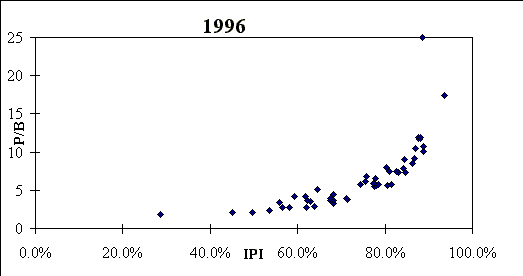
The signs of the partial derivatives suggest a positive
convex functional relationship between P/B and IPI. Diagrams 1-a
to 1-c present P/B versus IPI in our sample of biotechnology companies
for the years 1994-1996. The positive convex functional relationship
is very apparent.
The functional relationship between P/B and IPI sheds
new light on the value-growth effect. Growth (value) firms are
characterized by high (low) IPI, but unlike P/B, IPI lends itself
to economic interpretation. The two aspects of the value-growth
effect can be explained in the framework of IP characteristics.
High future profitability is a result of higher use of IP. SP
(1993) examine a large sample of firms from various industries
and show that high IPI (defined there slightly different) is positively
correlated with net income and gross profit margins. Moreover,
there is a plausible theoretical explanation to such abnormal
profits. IP is expected to generate higher profits due to two
main reasons:
The above analysis suggests that the low (high) returns
on growth (value) stocks cannot be explained by lower (higher)
risk, since growth (value) firms, with higher (lower) IPI,
are exposed to higher (lower) risk. IP-based analysis leads
to the conclusion that the value-growth effect must be attributed
to market inefficiency and mispricing.
Such market inefficiency and mispricing can also
be explained in the framework of IP analysis. When investors shape
their expectations about the firm's value they basically sum the
values of the various components of the firm's assets base. Since
prices of IP are usually not observable, due to the lack of marketability,
we should expect higher pricing errors in relation to stocks of
high IPI firms. This, however, does not explain why the mispricing
of high IPI firms is positively biased (e.g. high IPI firm's stocks
tend to have too high prices and thus generate lower than average
returns). The reason for such positive mispricing bias can be
attributed to the unpredicted obsolescence risk associated with
IP. Conventional capital budgeting theory suggests that, facing
uncertainty, investors can make rational decisions about their
investment if they know (or can fairly estimate) the probabilities
of the different outcomes. I suggest that the probabilities of
unpredicted obsolescence cannot be estimated by investors. Estimating
probabilities is possible when events are reoccurring and thus
frequencies of past events can be used to estimate the probabilities
of future events. While the probability of R&D failure or
failure of advertising campaign may be predicted from past experience,
shifts in technology or shifts in public attitude cannot be predicted.
Who could predict that PCs will become so effective and cheap
driving other types of mini-computers out of the market, or that
the internet will explode with free information threatening the
solvency of on-line information companies, or that ecological
awareness will force car makers to focus on low-emission cars.
At the time when these events occurred there was no relevant past
experience and thus the probability for there occurrence was not
predictable. Thus, due to the unique characteristics of IP, it
is possible for investors to systematically underestimate the
risk associate with investing in IP, and thus create overoptimistic
expectations regarding high IPI firms and overvalue their stocks.
5. The forecasting performance of IPI versus P/B.
Certain properties of IPI makes it a useful metric
for determining stock values. Unlike the V metric, proposed by
FL, IPI is objective since it is made of financial and market
data, without subjective estimates such as the cost of equity
capital and the expected future earnings. Compared with P/B, which
is also an objective metric, IPI has superior forecasting performance.
Table 1 presents descriptive statistics of P/B and
IPI in the sample of biotechnology companies. The average biotechnology
company in the sample had P/B in the range of 4 to 7, and IPI
in the range of 56% to 74%. Excluding the year 1994, which was
unfavorable for the biotechnology sector, the average P/B ranges
between 4.5 to 7, and the average IPI ranges between 65% to 74%.
IPI is more concentrated around its mean than P/B as demonstrated
by the coefficient of variation (the standard deviation divided
by the mean) which is substantially smaller for IPI than for P/B.
This suggests that the cross-sectional average IPI may be an efficient
forecasting estimator.
An important feature of value metrics is their ability
to forecast future stock prices. I have compared the ex-post forecasting
ability of P/B versus IPI. For each metric I have constructed
one-period-ahead forecasts using: (i) the average value of the
metric, for each company in the sample, over the period prior
to the forecast year (time-series model); (ii) the cross-sectional
average of the metric one year prior to the forecast year (cross-section
model). Using the time-series model I have computed forecasts
for 1996, 1995 and 1994, by averaging the values of each company's
metric for 1991-1995, 1991-1994, and 1991-1993 respectively. Using
the cross-section model I have computed forecasts for 1992-1996
using the metric cross-sectional averages for 1991-1995 respectively.
The forecasts are calculated ex-post using the fundamental values
(e.g. the equity and debt book values) of the forecast period.
Forecasts are generated using the following equations:
__
(11) EMVt+1 = Bt+1.(P/B)
__ __
(12) EMVt+1 = (Bt+1 + IPI.Dt+1)/(1
- IPI)
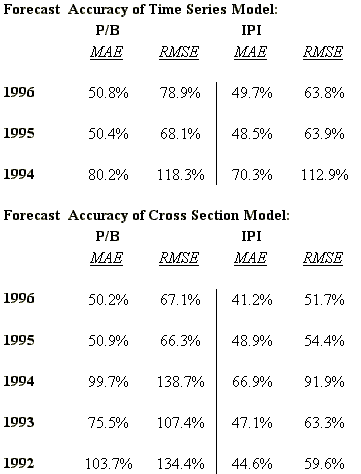
The forecasting errors for each model and each metric
were computed using RMSE (root mean square error) and MAE (mean
absolute error), and the results are shown in Table 2.
In general forecasts generated by IPI are superior
to those generated by P/B, in both models, for all forecast periods.
In the time-series model the reduction in the forecast error,
due to the use of IPI instead of P/B, is significant by the RMSE
criterion, but marginal by the MAE criterion (RMSE penalizes for
large forecast errors while MAE does not). In the cross-section
model the reduction in the forecast error, due to the use of IPI
instead of P/B, is much more substantial and significant by both
RMSE and MAE. The superiority of forecasts based on IPI, relative
to those based on P/B, is conclusive in this sample.
6. Conclusions
Intellectual Property Intensity (IPI) is positively
related to P/B. This functional relationship between the two metrics
enables me to suggest a plausible explanation to the value-growth
effect in the framework of IP analysis.
I suggest that the high future profitability observed
in growth firms is a result of (i) the monopolistic power gained
by using more IP; and (ii) the higher risk associated with IP
which means that firms will invest in IP only if profits are expected
to be superior.
This proposition rejects the theory that growth (value)
firms have lower (higher) risk associated with their activities,
and thus indirectly supports the theory that the lower (higher)
returns observed in growth (value) stocks are the result of market
inefficiency and mispricing.
I further suggest that the positively-biased mispricing
of growth stocks is a result of unique characteristics of the
risk associates with IP, and specifically the unpredictability
of obsolescence. Investors are unable to account for this risk,
since past experience is not available, and thus consistently
overprice high IPI (growth) firms.
IPI, like P/B, belongs to the family of objective
value metrics, since it is derived solely from financial and market
data. I compare the ex-post forecasting performance of these two
metrics and find that IPI provides more accurate forecasts than
P/B.
References
Bernard, Victor L., 1994, "Accounting-based
valuation methods, determinants of book-to market ratios, and
implications for financial statement analysis," Working Paper,
University of Michigan, January.
Capaul, Carlo, Ian Rowley, and William F. Sharpe,
1993, "International value and growth stock returns, Financial
Analyst Journal, January-February, 27-36.
Chan, Louis K.C., Yasushi Hamao, and Josef Lakonishok,
1991, "Fundamentals and stock returns in Japan", Journal
of Finance 46, 1739-1764.
Daniel, Kent, and Sheridan Titman, 1995, "Evidence
on the characteristics of cross-sectional variation in stock returns",
Working Paper, University of Chicago and Boston College.
Davis, James L., 1994, "The cross-section of
realized stock returns: the pre-Compustat evidence", Journal
of Finance, 48, 1579-1593.
Fairfield, Patricia, 1994, "P/E, P/B and the
present value of future dividends", Financial Analysts
Journal, July-August, 23-31.
Fama, Eugene F. and Kenneth R. French, 1992, "The
cross-section of expected stock returns", Journal of Finance
47. 427-465.
Fama, Eugene F. and Kenneth R. French, 1993, "Common
risk factors in the returns on stocks and bonds", Journal
of Financial Economics 33, 3-56.
Fama, Eugene F. and Kenneth R. French, 1995, "Size
and book-to-market factors in earnings and returns", Journal
of Finance 50, 131-155.
Fama, Eugene F. and Kenneth R. French, 1996, "Multifactor
explanations of asset pricing anomalies", Journal of Finance
51, 55-84.
Fama, Eugene F. and Kenneth R. French, 1997, "Value
versus growth: the international evidence", Working Paper,
Social Sciences Research Network (SSRN).
Frankel, Richard, Charles M.C. Lee, 1997, "Accounting
valuation, market expectation, and book-to market effect",
Working Paper 97-2, Parker Center for Investment Research.
Lakonishok, Josef, Andrei Shleifer, and Robert W.
Vishney, 1994, "Contrarian investment, extrapolation, and
risk", Journal of Finance 51, 1715-1742.
Malki, Elli, 1997, "Intellectual property and
the valuation of biotechnology companies: GEN-Dex versus Dow Jones",
Working Paper ewp-fin/9709002, Economic Working Paper Archive
(EconWPA).
Malki Elli, 1997, "Royalty rates, sub licensing
considerations and joint ventures", Working Paper ewp-fin/9709004,
Economic Working Paper Archive (EconWPA).
Modigliani, Franco and Merton H. Miller, 1958, "The
cost of capital, corporation finance, and the theory of investment",
American Economic Review, June, 261-297.
Palepu, Krishna G., Victor L. Bernard, and Paul
M. Healy, 1996, Business analysis & valuation using financial
statements, South-Western College Publishing.
Smith, Gordon V. and Russell L. Parr, 1993, Intellectual
property: licensing and joint venture profit strategies, John
Wiley & Sons.
Diagram 1-a: P/B versus IPI
Diagram 1-b: P/B versus IPI
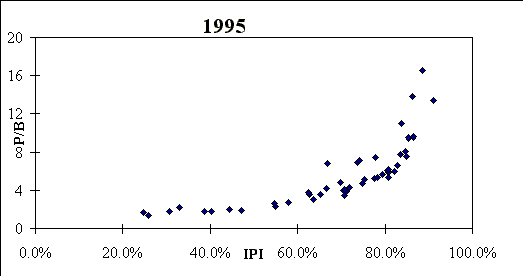
Diagram 1-c: P/B versus IPI
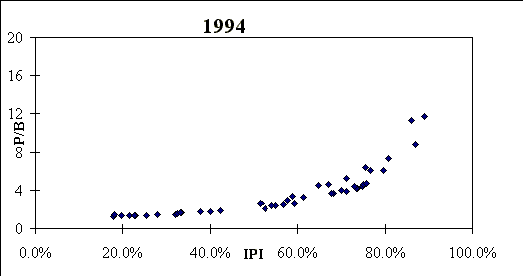
Table 1: Statistical Properties of the Sample
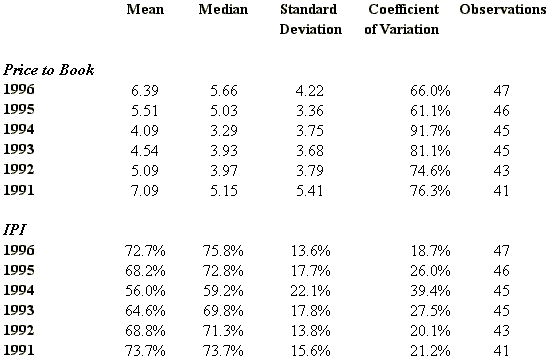
Table 2: Forecast Accuracy of IPI versus P/B.