 (1)
(1)
The distributional behavior for futures price spread
changes is examined through parametric and nonparametric tests
on four different commodities: corn and live cattle, and gold
and T-bonds with two different sample sizes. Data are examined
for selected periods, stable (1992) and unstable (1988). Remarkably
different results were found over commodities, time period, and
sample size. Actual spread changes for the smaller sample size
of gold and T-bonds and of corn produced more normal distributions
as intervals were widened from daily to weekly, while all live
cattle spreads for actual changes were normally distributed.
However, the larger sample size of both gold and T-bonds and the
relative spread changes for both corn and live cattle did not
converge to a normal distribution. The 'best fit' distribution
was tested nonparametrically on all daily spread samples, and
the logistic distribution prevailed, which supported the results
of nonnormality from parametric distributional tests.
The distribution of commodity futures price changes has been widely examined. Several studies (Houthakker, 1961; Mann and Heifner, 1976; Cornew, Town and Crowson, 1984; Blattberg and Gonedes, 1984; Hall, Brorsen, and Irwin, 1989) suggest that the distribution of price changes is not normal, but is leptokurtic. However, there exist relatively few studies investigating the nature and the distributional properties of futures price spread (fps) changes. Identifying the relationships between prices of various futures contracts is crucial in understanding spread trading in futures markets. Spread trading is an arbitrage activity between two futures contracts, and it provides a mechanism for traders to allocate risk among themselves. Any risk transferred from the spot market to the futures market must be absorbed therein (Billingsley and Chance, 1988). These authors suggest that spread trading induces risk-averse futures traders to participate in the futures market, and it supplies liquidity to hedgers because spread positions generally carry less price risk than net positions in the market. Without spread trading, the futures traders who are willing to absorb the risk would supply all of the price insurance demanded by hedgers.
Poitras (1985, 1990) examined the distributional properties of gold fps for 2 different intervals and found the distribution of daily gold fps was not normal, similar to the distribution of futures prices mentioned above, but that fps became more normally distributed as intervals were widen from daily to weekly. In general, the importance of the distribution of futures price or futures price spread changes arises from the fact that most performance norms require that the changes are drawn from a common distribution, usually a normal distribution, with a finite variance. These performance norms typically include measurements of the mean and some measure of variability or risk (Sarassoro, 1985). Thus, examining the probability distribution is important in the analysis of futures prices and futures price spreads since often distributions do not have a mean and finite variance. Futures market participants, especially speculators, can be successful at using the market to the extent of their knowledge of the probability distribution of the price, and can evaluate the risk through the distribution of the changes. Then, the selection of statistical methods is important in the analysis of distribution. In this study, not only is the distribution of changes in fps itself examined, but also the characteristics of the distribution, skewness and kurtosis, will be analyzed. For this reason, the LM test is the best method to investigate the normality of changes in fps because it contains the skewness and kurtosis properties as well as optimum asymptotic power properties and good finite sample performance (Bera and Jarque, 1987).
Although the distribution of changes in futures price or the distribution of changes in futures price spread has generally been found to be nonnormal, no study has identified the actual distribution for those variables. Knowing the appropriate distribution may benefit traders in making appropriate trading decisions and in understanding the risk in the futures market.
Therefore, using parametric and nonparametric distributional tests, this paper extends Poitras' (1990) analysis of the distribution of changes in fps to additional commodities and data, and identifies the 'best-fit' distribution for changes in fps. Specifically, we will examine the fps for gold, Treasury bonds, corn, and live cattle, and deliberately examine data characterized by low and high volatility.
By comparing the results of this paper with those of Castelino and Vora (1984) and Poitras (1990), we will also be able to observe whether the futures price spread volatility has a positive relationship with the spread length. Increasing spread length increases risks, which means the possible existence of compensating risk premiums (Castelino and Vora, 1984).
This paper is structured as follows: a brief discussion of previous research is provided in the next section; the statistical techniques, selection of data and the spread model are presented in Sections III and IV; detailed results follow in section V; section VI contains general summaries, and concluding remarks.
Various studies have analyzed characteristics of spreads and the distributional aspects of futures prices or of stock returns. While many studies have examined the distributions of changes in price levels and returns of stocks, the distributions of futures price spreads have rarely been examined. Poitras (1985, 1990) might be the first researcher who identified the evidence of convergence of the distribution of futures price spread to normality for three sample periods out of five when the differencing interval was widened from daily to weekly. Poitras (1990) showed the 1982, 1983, and 1985 Dec.-June fps significantly converged to symmetric normal distribution without excess kurtosis for both actual and relative changes in futures price spreads when the spread interval was widened from daily to weekly, but the 1981 and 1984 fps did not converge to a normal distribution. He concluded that more "normal" distributions were produced by widening the differencing interval from daily to weekly.
Regarding the distributional effect of spread length, the shorter the spread length, the more likely that Poitras' (1990) daily results are peaked and fat tailed. Also, futures price spreads' volatility was found to increase directly with the increment of spread length. This result was consistent with the results of Castelino and Vora (1984) who analyzed the effect of spread length on spread volatility for agricultural commodities, and found strong evidence that the volatility of spreads increases with its length. They concluded that wheat, characterized by low variance, would be the most mature and efficient commodity futures market of those examined because low variances on spread would be expected in a well arbitraged market.
Monroe and Cohn (1986) tested market efficiency by investigating whether implied interest rates in gold spreads deviated substantially enough from Treasury bill interest rates from time to time to allow traders to earn profits from speculating on changes in the difference between two rates. They examined the frequency distribution of all differences between the implied gold interest rate and the T-bill rate, and found that this distribution exhibited a wide dispersion, and the differences between the gold and T-bill rates were frequently negative providing significant evidence of market efficiency.
A sizable body of empirical research observes that futures price changes for short time intervals are not normally distributed, but exhibit a high degree of leptokurtosis relative to the normal distribution, and suggests the stable Paretian or a mixture of normal distributions as reasons for the observed leptokurticity. Hall, Brorsen, and Irwin (1989), and Cornew, Town, and Crowson (1984) found that the distribution of futures prices of agricultural, financial, and metal commodities was leptokurtic and hence not normally distributed. Also, Officer (1972) and Hsu, Miller, and Wichern (1974) used stock returns to describe the distribution of rates of returns on common stock. They found that the returns had some properties of a stable process. The distributions have fat tails compared to the normal distribution. While the above studies suggested nonnormality in futures prices and stock returns, Hudson, Leuthold and Sarassoro (1987) found normality for commodity futures price changes. According to their results, futures price changes were found to be random, indicating that futures prices adjust efficiently to information, i.e., when the distributional aspect is considered, their results indicated a move toward normality.
Bera and Mackenzie (1986) investigated through a simulation study whether the LM test and other available tests could detect nonnormality when the alternative tests belonged to the stable family. They concluded the Wald test was most effective in detecting nonnormality.
Historical financial and futures prices and stock returns appear to be nonnormal but exhibit a high degree of leptokurticity. Few studies have tested the normality of futures price spreads, except Poitras (1985, 1990) who tested gold spreads. This study extends his work by utilizing the LM test to see whether futures price spread changes for two agricultural and two nonagricultural commodities follow and / or converge toward a normal distribution when widening the differencing intervals from daily to weekly. In addition, skewness is used to assess symmetry of the distributions and kurtosis for
peakedness and fatness of tails. Potential heteroskedastic problems will be examined by using the variance of futures price spreads. The change in variances will be related to futures price spread volatility or nonstationarity.
Also, the optimal distribution of changes in fps for these four commodities will be found using "Bestfit" software, which tests goodness-of-fit of data. This program has 25 built-in distributions, and it determines the most appropriate distribution by describing the data (Palisade Corp. 1994). The best probability distributions for 6 daily fps are decided by a chi-square test in this program. The most frequent fitted distributions over sample fps will be discussed.
In this procedure, the log-likelihood function is maximized subject to a constraint and a test statistic is constructed from the Lagrange multiplier (LM) for the constrained maximization (Ramanathan, 1993). If the constraint is true, then the slope of log-likelihood function is zero. The LM test tests whether the slope of the log-likelihood function, evaluated at the restricted estimate, is significantly different from zero.
Bera and Jarque (1987) suggest two aspects of the LM test as being useful. First, this test has asymptotic power characteristics (asymptotically efficient) including maximum local asymptotic power on the basis of small sample properties. Second, computation of this test is easy: to calculate the LM statistic, only estimation under the null hypothesis is required.
Assume that there are N independent observations on a random variable x, and that
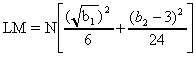
testing the normality of x is of interest. The LM test statistic is given by:
(1)
where 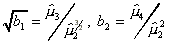 ,
,

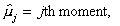
N is a number of independent observation, and
 are respectively the skewness
and kurtosis sample coefficients.
are respectively the skewness
and kurtosis sample coefficients.
This LM test statistic is driven by assuming a probability density
function,  , of the ith random variable,
 , (Bera and Jarque, 1987). The derivative
of the probability density function follows:
, (Bera and Jarque, 1987). The derivative
of the probability density function follows:
 (2)
(2)
The logarithm of the likelihood function of N observations  may be written as:

where  is the unknown population mean
of
is the unknown population mean
of  ,
,  and
and  ,
and
,
and  are parameters.
Here, the hypothesis of normality,  ,
is tested. By using
,
is tested. By using  , we have a score
test which is known as the Lagrange multiplier test. Using these
and equation (2), the LM test statistic (1) can be obtained.
Under this null hypothesis,
, we have a score
test which is known as the Lagrange multiplier test. Using these
and equation (2), the LM test statistic (1) can be obtained.
Under this null hypothesis,  follows a
normal distribution, and LM is asymptotically distributed as
follows a
normal distribution, and LM is asymptotically distributed as  .
If the value of LM is greater than the appropriate significance
point of
.
If the value of LM is greater than the appropriate significance
point of  , then
  is rejected. However, if the value of LM is close to zero, then
the observations can be said to follow a normal distribution.
It is possible to obtain as good an approximation as desired
to the distribution of LM.
is rejected. However, if the value of LM is close to zero, then
the observations can be said to follow a normal distribution.
It is possible to obtain as good an approximation as desired
to the distribution of LM.
The LM test statistic (1) contains two properties of the normal
distribution; skewness and kurtosis. If a vector of x follows
a normal distribution, which has mean ( )
and variance (
)
and variance ( ), then

Equation (3) tells us that the third central moment is zero for
the normal distribution. This moment is used to measure skewness.
If a continuous density function  has
the property that
has
the property that  for all
  ,
where m is the mean of distribution, then
,
where m is the mean of distribution, then  is said to be symmetric around mean. If
  is a discrete density function and has the property that probability
 , then
  is symmetric
too. If
is symmetric
too. If  in LM test statistic is not
equal to zero, normality would be rejected. If
in LM test statistic is not
equal to zero, normality would be rejected. If  is positive, the distribution is skewed to the right, and if it
is negative, the distribution is skewed to the left. The ratio
of the skewness to its standard deviation can be used to construct
tests of significance based on the Student's t table. The standard
deviation is as follows:
is positive, the distribution is skewed to the right, and if it
is negative, the distribution is skewed to the left. The ratio
of the skewness to its standard deviation can be used to construct
tests of significance based on the Student's t table. The standard
deviation is as follows:
SDs= .
.
Equation (4) tells us that the fourth central moment of a normal
random variable is 3 times the square of its variance. A random
variable with a fourth moment larger than 3 times the square of
the second moment has thicker tails than a normally distributed
random variable, which is referred to excess kurtosis, or as leptokurtic
(Davidson and Mackinnon, 1993). In the kurtosis measure test,
if  in the LM test statistic is not equal
to 3, then normality would be rejected. If
in the LM test statistic is not equal
to 3, then normality would be rejected. If  is greater than 3, the observation has thicker tails (leptokurtic
distribution) than a normally distributed random variable. On
the other hand, the observation with
is greater than 3, the observation has thicker tails (leptokurtic
distribution) than a normally distributed random variable. On
the other hand, the observation with  less than 3 has thinner tails (platykurtic) than a normally distributed
random variable. The ratio of the kurtosis to its standard deviation
can be used to construct test of significance based on the Student's
t table. The standard deviation is as follows:
less than 3 has thinner tails (platykurtic) than a normally distributed
random variable. The ratio of the kurtosis to its standard deviation
can be used to construct test of significance based on the Student's
t table. The standard deviation is as follows:
SDk= .
.
By observing  and
and  ,
then fps can be examined as to whether
they departure from normality.
,
then fps can be examined as to whether
they departure from normality.
Chi-Square Test
The  test of goodness-of-fit is defined
as a measurement of how well the sample data fit the hypothesized
probability density function (Palisade Corp., 1994). For a continuous
distribution on a certain interval, the hypothesis is tested against
the alternative that the distribution is not uniform. The chi-square
statistic is as follows:
test of goodness-of-fit is defined
as a measurement of how well the sample data fit the hypothesized
probability density function (Palisade Corp., 1994). For a continuous
distribution on a certain interval, the hypothesis is tested against
the alternative that the distribution is not uniform. The chi-square
statistic is as follows:
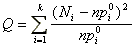 (5)
(5)
where n is the number of observations in a sample,  is the probability such that
  > 0 for
 , and
, and  , k
is the number of k different items in a sample, and
, k
is the number of k different items in a sample, and  denotes the number of observations in item
  ,
and
,
and  . If the null hypothesis is true,
the expected number of observations of type
. If the null hypothesis is true,
the expected number of observations of type  is
is  and is smaller than when the null
hypothesis is not true. That is, when the magnitude of equation
(5) is large, the null hypothesis is rejected. If the null hypothesis
is true, the distribution is uniform, and the sample size n
is large, then Q will have approximately a
and is smaller than when the null
hypothesis is not true. That is, when the magnitude of equation
(5) is large, the null hypothesis is rejected. If the null hypothesis
is true, the distribution is uniform, and the sample size n
is large, then Q will have approximately a  distribution with k-1 degree of freedom (DeGroot, 1989).
If Q is greater than the critical value, then the H0
is rejected. DeGroot (1989) indicate whenever the value of
distribution with k-1 degree of freedom (DeGroot, 1989).
If Q is greater than the critical value, then the H0
is rejected. DeGroot (1989) indicate whenever the value of  is not too small, the
  distribution will
be a good approximation.
distribution will
be a good approximation.
In the program of Bestfit, a lower chi-square value indicates a better fit. Hence, the distribution which has the lowest value of chi-square statistic will have the best fit among 25 different functions or distributions. However, one weakness of this test is how the intervals should be selected. In some situation, different conclusions can be reached (Palisad Corp., 1994) from the same data depending on how the intervals are specified.
Daily and weekly (Friday) closing futures prices were used for the contracts of agricultural commodities (corn and live cattle) and nonagricultural commodities (gold, and T-bonds). Coefficients of variation were calculated for every year from 1986 to 1995 to determine extremes in stability and instability. The highest price volatility was observed for the sample from February 4, 1987 to June 1, 1988. The sample from December 28, 1990 to June 1,1992 exhibits the lowest price volatility. Meanwhile, a smaller sample size was necessary for corn and live cattle due to their seasonal characteristics and the shorter duration of their futures contracts. The data used in this case are May 26, 1988 to November 30, 1988 for unstable period and April 7, 1992 to November 30, 1992 for stable period. To be consistent with our study of the agricultural commodities, we also examined gold and T-bonds with the same (smaller) sample size as for corn and live cattle. Each sample begins with the starting date of the deferred contract of the spread and ends two weeks prior to the first delivery date on the spread's nearby contract.
For T-bonds, a relatively high coefficient of variation was tested for 1992 and a low coefficient of variation for 1988. This behavior is opposite from that of the other commodities, however, the same periods (1988 and 1992) are used for T-bonds for consistency.
In defining futures price spread (fps), three spread lengths are examined depending on the delivery months available: in the case of gold, one year (Dec.-Dec.), six months (Dec.-June), and two months (Dec.-Feb.); for T-bonds, one year (Dec.-Dec.), six months (Dec.-June), and three months (Dec.-Mar.); for corn, one year (Dec.-Dec.), seven months (Dec.-July), and three months (Dec.-Mar.). For live cattle, instead of using one year (Dec.-Dec.) spread length, six months (Dec.-June), four months (Dec.-April), and two months (Dec.-Feb.) are examined because of usually lack of data beyond one year forward. Hence, total of six daily and six weekly sample futures price spreads for each commodity will be examined.
For simplicity, a futures price spread is defined as the difference between two futures prices, and a spread trade comprises a short position in one contract and an equal number of long positions in another contract. Specifically, a futures price spread can be defined as following:
F(t,T); the futures price at time t for deferred delivery at time T
F(t,N); the futures price at time t for nearby delivery at time N
fps(t) = F(t,T)-F(t,N).
Normality of futures price spread will be checked by estimating the distributional parameters, skewness, kurtosis, variance, and by examining the estimated parameters when the differencing interval is widened from daily to weekly. The following transformations for examining distribution of futures price spreads (fps) will be used.
Difference of futures price spread: DPFS = fps(t+1) - fps(t),
and rate of change in futures price spread: 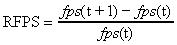 .
.
The main results of normality tests are presented in the following two sections. The first section contains the results of the parametric distributional test on changes in fps (DFPS and RFPS), and the second section contains the results of nonparametric distributional test on changes in fps.
Poitras (1990) analyzed gold fps from 1981 to 1985, without classifying stable and unstable periods, whereas we selected two representative periods, stable (1992) and unstable (1988). We also analyzed the commodities with two different sample sizes. The same parametric distributional tests (LM, skewness, and kurtosis) are performed as in Poitras' study but expanded to four commodities: gold, T-bonds, corn, and live cattle. These tests determine whether the values of LM, skewness, and kurtosis are significantly different from zero, zero, and three respectively, which are the best signals concerning normality. In order to examine the distribution, we must assume that the variance of the underlying futures price spread changes is finite. Results are summarized in Tables I through IV.
Gold fps changes in Table I do not converge to normal distribution when spread intervals are widened from daily to weekly as determined in the LM, skewness, and
kurtosis tests. Only one spread length of each transformation (1992 Dec.-Dec. DFPS and 1992 Dec.-June RFPS) does not reject the null hypothesis of a normal distribution for weekly interval, but rejects the null hypothesis for daily interval in these three tests. Meanwhile, five spreads for each DFPS and RFPS do reject the null hypothesis of normality, showing significantly high coefficients of the LM test for both daily and weekly intervals: three for unstable period and two for stable period. These results imply that changes in gold fps are neither normally nor lognormally distributed for both daily and weekly intervals. This feature is usually due to significantly negative skewness combined with fat tails, which is consistent with Poitras (1990) who showed the distributions of five daily and two weekly fps changes are negatively skewed and fat tailed. Our results of skewness test in Table I show that the distributions of five daily and one weekly DFPS and five daily and two weekly RFPS are significantly negatively skewed, that is, to the left with a long tail in that direction. The kurtosis tests are similar with the distributions of all cases being significantly leptokurtic except two weekly intervals during the stable period (Dec.-Dec. DFPS and Dec.-June RFPS). The degree of leptokurtosis decreases as intervals are widened from daily to weekly in all cases. Thus, the combination of significant asymmetry and leptokurtosis causes the distributions of gold fps not to generally converge to a normal distribution when intervals are widened from daily to weekly, a result dissimilar to Poitras(1990).
As in the results of gold fps changes, the trend of convergence to normality has not been found for most cases of T-bonds' fps changes when differencing intervals are widened from daily to weekly as shown in Table II. However, an interesting contrast was found. All T-bonds' fps changes for stable period (1988) reject the null hypothesis of normality, producing significant coefficients of LM, skewness, and kurtosis. Meanwhile, two DFPS (Dec.-Dec. and Dec.-Mar.) and one RFPS (Dec.-Dec.) for the unstable period (1992) do converge to symmetric normal distribution without excess kurtosis as intervals are widened from daily to weekly.
Nonnormality of T-bonds in the LM test is due to the combination of skewness and fat tails. However, the direction of skewness is totally different between DFPS and RFPS. The distributions of most DFPSs are skewed to the left while those of most RFPSs to the right. T-bonds' fps changes also exhibit significant leptokurtic distribution as in the gold fps changes except three 1992 weekly intervals (Dec.-Dec. DFPS, Dec.-Mar. DFPS, and Dec.-Dec. RFPS). From the above results, both daily and weekly changes in T-bonds' fps are neither generally normally nor lognormally distributed.
Unlike Poitras (1990), who showed three out of five gold fps converging to symmetric normal distribution without excess kurtosis, this study found that, in general, for both unstable and stable periods gold and T-bonds do not produce more normal distributions as determined in the LM, skewness, and kurtosis tests for the widened interval. Since there is no consistent sample periods between Poitras' and this study, it appears that the distributional behavior of spread changes over time for nonagricultural commodity fps.
To be consistent with the subsequent analysis on corn and live cattle, parametric distributional tests are performed on gold and T-bonds with a smaller sample size, and the results are summarized in Tables III and IV. Strikingly different results are found from the larger sample size. Most cases of gold and T-bonds either converge to normal distribution by widening intervals from daily to weekly or are normally distributed for both intervals. In the case of gold in Table III, all of DFPS, except 1992 Dec.-Feb., and four out of six of RFPS (all of 1988 and one for 1992) converge to symmetric normal distribution without excess kurtosis when widening intervals from daily to weekly as determined in LM, skewness, and kurtosis tests. A similar situation is found in T-bonds in Table IV. All case of 1992 DFPS and four cases of RFPS (two for 1988 and two for 1992) converge to symmetric normal distribution without excess kurtosis as intervals are widened from daily to weekly. In addition, all case of 1988 DFPS and two cases of RFPS are normally distributed for both intervals. As in the larger sample size of gold and T-bonds, nonnormality is usually caused by the combination of skewness and fat tails. One feature different in the smaller sample size is that leptokurtosis is found as the only reason causing nonnormality in four gold DFPS out of seven cases of nonnormal distribution, one gold RFPS out of eight cases, and three T-bond RFPS out of four cases of nonnormal distribution. For example, the distribution of 1992 daily gold Dec.-Feb. in Table III is symmetric with the value of -0.017 for skewness test but has fat tails with the value of 7.896 for kurtosis test resulting in the high LM value. Unlike the larger sample size of gold and T-bonds, negative skewness does not prevail among the smaller sample size of gold and T-bonds.
The distributional behavior of gold and T-bonds with two different sample sizes display very disparate results. First, for the larger sample size, gold and T-bonds did not converge to normal distribution for widening intervals. This distributional behavior appears to change over the sample period since Poitras (1990) and this study do not analyze overlapping data and have dissimilar results. Secondly, the distributional behavior of gold and T-bonds is very sensitive to the sample size. With the smaller sample size, gold and T-bonds converge to symmetric normal distributions without excess kurtosis as intervals are widened from daily to weekly. For the larger sample size, the combination of negative skewness and fat tails was the main reason for nonnormality while either leptokurtosis alone or the combination of skewness and fat tails was often found as the reason for nonnormality when it occurred in the smaller sample size.
In addition to the distributional behavior, we can examine the effect of spread length on distribution as well as volatility. It is expected that there would be negative correlation between the spread length and nonnormality in daily results because daily fps would be dominated by zeros for shorter spread lengths, and hence the distribution would appear peaked and fat tailed. Again, discrepancy is detected between the two sample sizes. The results of gold and T-bonds with the larger sample size in Tables I and II partially support this expectation in gold DFPS and 1988 RFPS, and T-bonds 1988 RFPS. For instance, the kurtosis test results for 1988 daily T-bonds' RFPS show the coefficients of 11.766, 14.977, and 16.321 as the spread lengths moves from Dec.-Dec., Dec.-June to Dec.-Mar., so that the shorter the spread lengths, the more likely the daily results appear to be peaked and fat-tailed. This type of result occurred in three out of four situations for gold. Meanwhile, nonagricultural commodities with the smaller sample size in Tables III and IV do not show any consistent pattern of negative correlation between spread length and nonnormality except for 1988 gold.
Castelino and Vora (1984) studied the spread volatility, and they found that fps volatility increased with spread length, as did Poitras(1990). However, the spread length effect of volatility in this study is only partially supported for both sample sizes. Volatility decreases as spread lengths are shortened only for both daily and weekly gold 1992 fps, but not for gold 1988 fps nor any T-bonds results in the case of the larger sample size. For example, the standard deviation of 1992 gold DFPS in Table I shows 0.243, 0.146, and 0.140 for daily interval and 0.594, 0.340, and 0.328 for weekly as spread lengths are shortened, while all 1988 gold fps has the largest volatility during Dec.-Feb. which is the shortest spread length, and less volatility during Dec.-Dec. This might be due to the fact that 1988 was apparently unstable so that risk is high regardless of the spread length. The standard deviations of T-bonds' fps in Table II fluctuate as spread lengths are shortened for both periods.
In the case of the smaller sample size, the positive relationship between spread lengths and volatility holds for DFPS of both gold and T-bonds, but not for RFPS of both commodities. As an illustration, the standard deviation of 1988 weekly gold DFPS in Table III has the values of 0.90, 0.48, and 0.20 as spread lengths are shortened from Dec.-Dec., Dec.-June, to Dec.-Feb. However, 1992 weekly T-bonds RFPS in Table IV possesses the same values of 0.02 for those three spread lengths.
As with gold and T-bonds in the smaller sample size, changes in corn and live cattle fps show substantially different results from the larger sample sizes of gold and T-bonds in case of DFPS, but more similar results in case of RFPS. These results are presented in Tables V and VI. Four out of six cases of corn DFPS in Table V converge to the normal distribution without skewness and excess kurtosis as intervals are widened from daily to weekly, and they show a significant discrepancy between stable and unstable periods. All three cases of corn DFPS converge to the normal distribution in stable period (1992) as determined in the LM, skewness, and kurtosis tests, while only one case (Dec.-Dec.) converges in unstable period (1988). Meanwhile, as in the larger sample size of gold and T-bonds, five corn RFPS out of six transformations reject the null hypothesis of normal distribution in the LM test for both daily and weekly intervals. This nonnormality is due to the combination of skewness and leptokurtosis. However, unlike the distributions of gold and T-bonds with the larger sample size which were skewed to one direction (gold fps and T-bond DFPS to the left, and T-bond RFPS to the right), the distributions for corn are skewed in both directions without any consistent pattern. As an illustration, the distributions of 1988 daily corn RFPS are skewed in both directions with values of 10.867, -1.655, and 6.779.
The normality tests on live cattle fps changes demonstrate a unique pattern of results between the DFPS and RFPS as demonstrated in Table VI. While most of weekly DFPS LM test values are larger than those for daily, the results of test statistic do not reject the null hypothesis of normal distribution for both intervals. As determined in LM, skewness and kurtosis, all of both daily and weekly DFPS are distributed as symmetric normal without excess kurtosis. However, we can not say that live cattle fps converge to normal distribution because the coefficients of LM test increase as intervals are widened from daily and weekly. This result may stem from the fact that live cattle, as opposed to the other three commodities analyzed, is nonstorable, meaning there is less linkage between different futures contracts, creating a more normal distribution of spread changes.
Meanwhile, all the distributions of RFPS for live cattle, except 1988 weekly Dec.-April, are skewed and fat tailed, resulting in nonnormality for both intervals. Nevertheless, most of the coefficients of the three tests are reduced as intervals are widened from daily to weekly. Thus, both daily and weekly live cattle futures price spreads are normally distributed but not lognormally. The nonnormality of RFPS for both intervals is usually caused by positive skewness combined with fat tails like T-bonds RFPS in Table II. One daily (1988 Dec.-June) and two weekly intervals (1988 Dec.-June and Dec.-Feb.) are found to have negatively skewed distributions.
In short, from the LM, skewness and kurtosis tests, we found a discrepancy between two transformations of corn and live cattle futures price spreads. In the case of DFPS, there exists a trend of convergence to the normal distribution for corn, and there exists a normal distribution for both daily and weekly data for live cattle. Nonnormal distributions exist for both commodities' daily and weekly RFPS. These results are substantially different from those of gold and T-bonds with the larger sample size that rejected the null hypothesis of normal distribution for most of DFPS and RFPS, but correspond fairly well with those of gold and T-bonds with the smaller sample size.
The distributional effect on spread lengths is partially supported in case of corn and live cattle fps changes in Table V and VI. The negative distributional effect on spread lengths is found in two cases of corn and one case of live cattle. As the spread lengths are shortened, 1988 daily DFPS and weekly RFPS for corn and 1992 daily DFPS for live cattle appear more peaked and fat tailed as shown by the kurtosis tests. Interestingly, there is positive correlation with spread length for 1992 daily and weekly RFPS for corn and 1988 daily DFPS for live cattle.
From the results of the volatility test on corn, the values of standard deviation of each spread length show a decreasing tendency from the unstable (1988) period to the stable (1992) period. For example, daily corn DFPS has volatility values of 5.19, 1.99, and 0.85 for 1988 and 1.81, 0.69, and 0.36 for 1992 as the spread lengths are shortened from Dec.-Dec. to Dec.-Mar. This reduction in volatility over sample periods is the evidence of the variance nonstationarity as Poitras (1990) mentioned. However, the degree of reduction in the standard deviation values of live cattle is not significant over sample periods. Daily DFPS has the standard deviation value of 0.41 in 1988 Dec.-June, and is reduced to 0.21 in 1992 Dec.-June, which means the volatility of DFPS for live cattle is relatively stable over the sample period.
The test of volatility for corn and live cattle fps changes as spread lengths change yields somewhat different result from nonagricultural commodities. This test on corn and live cattle fps produces results similar to the findings of Castelino and Vora (1984) and Poitras (1990). The standard deviation increases with spread length in all cases of corn fps changes and for live cattle DFPS for both periods. As an example, the standard deviation of 1988 corn DFPS in Table V shows 5.19, 1.99, and 0.85 for daily interval and 15.36, 5.93, and 1.98 for weekly interval as spread lengths are shortened. This exception to this pattern is RFPS for live cattle.
From the previous section, all tests of daily fps results in nonnormal distributions which are usually skewed, and peaked and fat tailed except live cattle DFPS. The distribution of daily fps is of interest to spread traders as they manage risks and make decisions about participation in the futures market utilizing such knowledge. Hence, it is valuable to know the correct distribution for changes in futures price spreads.
Nonparametric distributional tests are performed to find out the best fit distribution of the changes in four commodities' fps over time. The lowest value of chi-square test designates the most appropriate distribution among 25 functions built in the program of "Bestfit" (Palisade Corp.,1994).
Table VII summarizes the best fit distributions of changes in
daily fps and their  values with
n-1 degree of freedom for each sample period and each fps.
The logistic distributions prevail for corn, gold and T-bonds,
which are known to be more peaked and fat tailed than the normal
distribution. This finding is consistent with the leptokurtosis,
which is one reason causing daily futures price spread changes
not to be normally distributed as reported in the previous section.
Four cases of both corn and the larger sample size of gold, all
cases of the smaller sample size of gold and the larger sample
size of T-bonds, and three cases of the smaller sample size of
T-bonds do not reject the coefficients at 5% level of significance
and are distributed logistically. For these three commodities,
all one year spread lengths are logistically distributed except
the smaller sample size of T-bonds for 1988. In addition, seven
cases of six and seven months spread lengths over three commodities
are distributed logistically too. Student's t distribution
is occasionally detected as the best fit distribution. Corn Dec.-July
for 1988 and the larger sample size of gold Dec.-June for 1988
are the case of student's t distribution. For two and
three months, logistic distributions are accepted as best fit
distributions four times; one for corn, one for the smaller sample
size of gold, and two for the larger sample size of T-bonds.
Meanwhile, the distributions of gold with the larger sample size
for two months spread (Dec.-Feb.) are found as triangular and
logistic distributions for unstable and stable periods, respectively.
However, the
values with
n-1 degree of freedom for each sample period and each fps.
The logistic distributions prevail for corn, gold and T-bonds,
which are known to be more peaked and fat tailed than the normal
distribution. This finding is consistent with the leptokurtosis,
which is one reason causing daily futures price spread changes
not to be normally distributed as reported in the previous section.
Four cases of both corn and the larger sample size of gold, all
cases of the smaller sample size of gold and the larger sample
size of T-bonds, and three cases of the smaller sample size of
T-bonds do not reject the coefficients at 5% level of significance
and are distributed logistically. For these three commodities,
all one year spread lengths are logistically distributed except
the smaller sample size of T-bonds for 1988. In addition, seven
cases of six and seven months spread lengths over three commodities
are distributed logistically too. Student's t distribution
is occasionally detected as the best fit distribution. Corn Dec.-July
for 1988 and the larger sample size of gold Dec.-June for 1988
are the case of student's t distribution. For two and
three months, logistic distributions are accepted as best fit
distributions four times; one for corn, one for the smaller sample
size of gold, and two for the larger sample size of T-bonds.
Meanwhile, the distributions of gold with the larger sample size
for two months spread (Dec.-Feb.) are found as triangular and
logistic distributions for unstable and stable periods, respectively.
However, the  values are significantly
higher than critical values at 5% level of significance. Thus,
none of 25 distributions built in the program is appropriate for
the larger sample size of gold two months' spreads. For corn
three months spread (Dec.-Mar.), logistic and normal distributions
are detected as the best. This result is consistent with the
Table V, which showed LM test values 392.95 and 2.638 for 1988
and 1992 respectively. In this LM test, we did accept the value
of 2.638 for stable period as the normal distribution, and it
is confirmed that 1992 corn three months spread is normally distributed
by nonparametric distributional test.
values are significantly
higher than critical values at 5% level of significance. Thus,
none of 25 distributions built in the program is appropriate for
the larger sample size of gold two months' spreads. For corn
three months spread (Dec.-Mar.), logistic and normal distributions
are detected as the best. This result is consistent with the
Table V, which showed LM test values 392.95 and 2.638 for 1988
and 1992 respectively. In this LM test, we did accept the value
of 2.638 for stable period as the normal distribution, and it
is confirmed that 1992 corn three months spread is normally distributed
by nonparametric distributional test.
For live cattle DFPS, the normal distribution was not rejected in the parametric distributional test in the previous section, and is found as the best four times in the nonparametric distributional test. The logistic distribution is detected as the best for the other two spreads, 1988 Dec.-June. and 1992 Dec.-Feb.. However, the normal distribution can not be ignored because it is found as the second best with the values of 13.129 and 7.487 respectively, which should be accepted at 5% level of significance too.
In general, the logistic distribution prevails as the best among commodities from nonparametric distributional tests. It may not be the absolutely correct distribution of commodities, however, this distribution as detected in nonparametric tests describes the distribution of commodities better than other distributions.
Parametric and nonparametric distributional tests have been performed on corn and live cattle futures price spread changes in one sample size, and gold and T-bonds futures price spread changes with two different sample sizes. These are examined for selected stable and unstable periods.
Poitras (1990) found that the distributions of both transformations (DFPS and RFPS) for gold futures price spreads have a tendency of convergence to normality in all tests for three out of five sample periods when differencing intervals are widened from daily to weekly. Widening the interval is expected to remove zeros and smaller changes in data, which then produces a more normal distribution.
The distributional behavior has been examined by conducting skewness, kurtosis, LM, and standard deviation tests, using normal distribution as the null hypothesis. Quite disparate results are found. For the nonagricultural commodities, very different results are found between the two sample sizes. The gold and T-bonds with the larger sample size did not produce more normal distribution as intervals were widened from daily to weekly, indicating that the distributional behavior changes over time since data used here and by Poitras (1990) did not overlap. By contrast, many of the smaller sized samples of gold and T-bonds converged to a normal distribution. For agricultural commodities, a discrepancy was found between DFPS and RFPS. In case of DFPS, there was a trend of convergence to a normal distribution for corn and there exists a normal distribution for both daily and weekly live cattle. On the other hand, nonnormal distributions dominate for both commodities' daily and weekly RFPS. Clearly, however, for all the data examined, more weekly intervals are normally distributed than daily intervals, as expected.
For the larger sample size of gold and T-bonds, the combination of negative skewness and fat tails was the main reason for nonnormality. Meanwhile, leptokurtosis alone as well as the combination of skewness and fat tails created nonnormality for the smaller sample size of gold and T-bonds and for corn and live cattle. The nonnormality of distributions leads to the question of the correct distribution. This is of interest to spread traders so they can manage risks more efficiently and make informed trading decisions. This study found that the logistic distribution was the best fit distribution for changes in most daily DFPS. Leptokurtosis, which was a main reason causing nonnormality, was confirmed through detection of a logistic distribution, generally known as more peaked and fat tailed than the normal distribution.
Two spread length effects were also examined, but no consistent results were found. The negative correlation expected between spread length and nonnormality was only partially supported for the larger sample size of gold and T-bonds and for corn and live cattle, but not for the smaller sample size of gold. The spread length effect of volatility was partially supported for nonagricultural commodities, and fully supported for corn and live cattle, consistent Castelino and Vora (1984).
Overall, normal and logistic distributions dominate the changes in futures spreads examined here, but results are clearly sensitive to commodity, sample period, sample size, spread length, differencing interval, and spread definition. Spread traders can expect to find normal distributions more often with weakly intervals than daily, and with nonstorable commodities than storable. Whether the data are relatively stable or unstable does not influence the results. Hence, as traders search for the probability distributions of futures price spreads, each spread is likely to have its own unique characteristics, making it difficult for traders to generalize or find common patterns.
| DFPS | ||||||
| Dec.-Dec. | Daily (N=210) | -0.838* | 6.1* | 108.12* | ||
| Weekly (N=42) | -1.102* | 5.40* | 18.12* | |||
| 1988 | Dec.-June | Daily (N=334) | -2.456* | 27.72* | 8813.6* | |
| Weekly (N=68) | -0.121 | 4.40* | 6.243* | |||
| Dec.-Feb. | Daily (N=250) | -3.178* | 31.61* | 8910.4* | ||
| Weekly (N=55) | -1.093 | 5.927* | 30.58* | |||
| Dec.-Dec. | Daily (N=209) | 0.384 | 8.19* | 238.18* | ||
| Weekly (N=42) | 0.470 | 3.116 | 1.53 | |||
| 1992 | Dec.-June | Daily (N=358) | -0.664* | 11.95* | 1218.7* | |
| Weekly (N=74) | 0.124 | 4.49* | 6.90* | |||
| Dec.-Feb. | Daily (N=292) | -1.199* | 13.25* | 1343.6* | ||
| Weekly (N=61) | -0.096 | 4.75* | 7.61* | |||
| RFPS | ||||||
| Dec.-Dec. | Daily (N=210) | -0.709* | 5.851* | 88.269* | ||
| Weekly (N=42) | -0.974* | 5.055* | 13.693* | |||
| 1988 | Dec.-June | Daily (N=334) | -0.791* | 12.541* | 1297.7* | |
| Weekly (N=68) | 0.433* | 4.234* | 6.922* | |||
| Dec.-Feb. | Daily (N=250) | -1.571* | 16.491* | 1990.7* | ||
| Weekly (N=55) | -1.626* | 9.342* | 116.41* | |||
| Dec.-Dec. | Daily (N=209) | 1.17* | 13.31* | 968.09* | ||
| Weekly (N=42) | 0.636* | 4.128* | 4.937* | |||
| 1992 | Dec.-June | Daily (N=358) | -0.262* | 6.314* | 198.32* | |
| Weekly (N=74) | 0.287 | 3.25 | 1.191 | |||
| Dec.-Feb. | Daily (N=292) | -0.792* | 8.067* | 341.71* | ||
| Weekly (N=61) | -0.331 | 4.638* | 7.675* |
*Indicates the null hypothesis of normal distribution is rejected at 10 % level of significance.
The numbers in parentheses are the numbers of the observation. Stand.Dev is the standard deviation.
| DFPS | ||||||
| Dec.-Dec. | Daily (N=295) | 0.157 | 9.044* | 450.24* | ||
| Weekly (N=60) | -0.445* | 5.069* | 12.69* | |||
| 1988 | Dec.-June | Daily (N=334) | -0.576* | 8.080* | 377.57* | |
| Weekly (N=68) | -0.499* | 6.668* | 40.94* | |||
| Dec.-Mar. | Daily (N=285) | -0.770* | 9.08* | 467.06* | ||
| Weekly (N=59) | -0.470* | 6.581* | 33.71* | |||
| Dec.-Dec. | Daily (N=210) | -0.776* | 7.453* | 194.54* | ||
| Weekly (N=43) | -0.149 | 2.459 | 0.684 | |||
| 1992 | Dec.-June | Daily (N=358) | -0.174* | 4.690* | 44.427* | |
| Weekly (N=74) | -0.432 | 4.159* | 6.444* | |||
| Dec.-Mar | Daily (N=310) | -0.171 | 5.237* | 66.165* | ||
| Weekly (N=64) | -0.284 | 3.705 | 2.185 | |||
| RFPS | ||||||
| Dec.-Dec. | Daily (N=295) | 0.671* | 11.766* | 966.63* | ||
| Weekly (N=60) | 1.278* | 8.413* | 89.566* | |||
| 1988 | Dec.-June | Daily (N=334) | 1.371* | 14.977* | 2100.8* | |
| Weekly (N=68) | 1.435* | 10.924* | 201.25* | |||
| Dec.-Mar. | Daily (N=285) | 1.593* | 16.321* | 2227.6* | ||
| Weekly (N=59) | 1.338* | 10.082* | 140.89* | |||
| Dec.-Dec. | Daily (N=210) | 2.182* | 19.954* | 2681.6* | ||
| Weekly (N=43) | 0.095 | 2.755 | 0.173 | |||
| 1992 | Dec.-June | Daily (N=358) | 0.398* | 8.955* | 538.39* | |
| Weekly (N=74) | 0.744* | 6.308* | 40.564* | |||
| Dec.-Mar | Daily (N=310) | 0.380* | 9.704* | 587.91* | ||
| Weekly (N=64) | 0.309 | 4.444* | 6.578* |
*Indicates the null hypothesis of normal distribution is rejected at 10 % level of significance.
The numbers in parentheses are the numbers of the observation. Stand.Dev is the standard deviation.
| DFPS | ||||||
| Dec.-Dec. | Daily (N=129) | -0.513* | 4.150* | 12.774* | ||
| Weekly (N=26) | 0.237 | 2.976 | 0.244 | |||
| 1988 | Dec.-June | Daily (N=129) | -0.225 | 4.163* | 8.351* | |
| Weekly (N=26) | 0.172 | 2.921 | 0.136 | |||
| Dec.-Feb. | Daily (N=129) | 0.805* | 10.058* | 281.73* | ||
| Weekly (N=26) | -0.375 | 1.989 | 1.717 | |||
| Dec.-Dec. | Daily (N=164) | 0.314* | 9.174* | 263.14* | ||
| Weekly (N=33) | 0.412 | 3.906 | 2.061 | |||
| 1992 | Dec.-June | Daily (N=164) | -0.007 | 6.366* | 77.406* | |
| Weekly (N=33) | -0.213 | 3.135 | 0.274 | |||
| Dec.-Feb. | Daily (N=164) | -0.017 | 7.896* | 163.79* | ||
| Weekly (N=33) | 0.50 | 5.069* | 7.259* | |||
| RFPS | ||||||
| Dec.-Dec. | Daily (N=129) | -0.382* | 4.030* | 8.842* | ||
| Weekly (N=26) | 0.325 | 3.097 | 0.468 | |||
| 1988 | Dec.-June | Daily (N=129) | -0.082 | 4.237* | 8.372* | |
| Weekly (N=26) | 0.259 | 3.115 | 0.304 | |||
| Dec.-Feb. | Daily (N=129) | 1.314* | 13.535* | 633.66* | ||
| Weekly (N=26) | -0.401 | 2.102 | 1.569 | |||
| Dec.-Dec. | Daily (N=164) | 1.240* | 12.924* | 715.14* | ||
| Weekly (N=33) | 0.805* | 4.835* | 8.195* | |||
| 1992 | Dec.-June | Daily (N=164) | 0.832* | 9.809* | 335.74* | |
| Weekly (N=33) | 0.152 | 3.759 | 0.919 | |||
| Dec.-Feb. | Daily (N=164) | 1.072* | 12.004* | 585.39* | ||
| Weekly (N=33) | 1.162* | 7.740* | 38.32* |
*Indicates the null hypothesis of normal distribution is rejected at 10 % level of significance.
The numbers in parentheses are the numbers of the observation. Stand.Dev is the standard deviation.
| DFPS | ||||||
| Dec.-Dec. | Daily (N=130) | 0.194 | 2.880 | 0.898 | ||
| Weekly (N=26) | -0.080 | 2.324 | 0.523 | |||
| 1988 | Dec.-June | Daily (N=130) | 0.121 | 2.858 | 0.426 | |
| Weekly (N=26) | -0.367 | 2.318 | 1.807 | |||
| Dec.-Mar. | Daily (N=130) | 0.025 | 2.520 | 1.262 | ||
| Weekly (N=26) | -0.297 | 2.514 | 0.637 | |||
| Dec.-Dec. | Daily (N=163) | 0.620* | 3.980* | 16.954* | ||
| Weekly (N=33) | 0.638 | 4.309 | 4.594 | |||
| 1992 | Dec.-June | Daily (N=163) | 0.352* | 3.937* | 9.329* | |
| Weekly (N=33) | 0.426 | 3.034 | 1.002 | |||
| Dec.-Mar | Daily (N=163) | 0.476* | 3.993* | 12.845* | ||
| Weekly (N=33) | 0.624 | 3.073 | 2.146 | |||
| RFPS | ||||||
| Dec.-Dec. | Daily (N=130) | -0.375 | 4.064* | 9.169* | ||
| Weekly (N=26) | 0.119 | 1.905 | 1.361 | |||
| 1988 | Dec.-June | Daily (N=130) | -0.290 | 4.133* | 8.766* | |
| Weekly (N=26) | 0.185 | 1.951 | 1.339 | |||
| Dec.-Mar. | Daily (N=130) | -0.116 | 3.653 | 2.606 | ||
| Weekly (N=26) | 0.308 | 2.580 | 0.603 | |||
| Dec.-Dec. | Daily (N=163) | -0.416* | 3.772* | 8.749* | ||
| Weekly (N=33) | -0.185 | 3.403 | 0.412 | |||
| 1992 | Dec.-June | Daily (N=163) | -0.045 | 3.845* | 4.902* | |
| Weekly (N=33) | -0.212 | 2.670 | 0.372 | |||
| Dec.-Mar | Daily (N=163) | -0.238 | 3.423 | 2.757 | ||
| Weekly (N=33) | -0.405 | 2.670 | 1.051 |
*Indicates the null hypothesis of normal distribution is rejected at 10 % level of significance.
The numbers in parentheses are the numbers of the observation. Stand.Dev is the standard deviation.
| DFPS | ||||||
| Dec. 88 | Daily (N=130) | -0.339* | 6.082* | 53.947* | 5.19 | |
| - Dec. 89 | Weekly (N=26) | -0.515 | 3.329 | 1.266 | 15.36 | |
| 1988 | Dec. 88 | Daily (N=130) | -1.142* | 10.911* | 367.22* | 1.99 |
| - July 89 | Weekly (N=26) | -1.383* | 6.244* | 19.694* | 5.93 | |
| Dec. 88 | Daily (N=130) | -0.741* | 11.387* | 392.95* | 0.85 | |
| - Mar. 89 | Weekly (N=26) | -0.915* | 5.560* | 10.724* | 1.98 | |
| Dec. 92 | Daily (N=162) | 0.723* | 6.144* | 80.856* | 1.81 | |
| - Dec. 93 | Weekly (N=33) | 0.679 | 4.216 | 4.570 | 4.23 | |
| 1992 | Dec. 92 | Daily (N=162) | -0.058 | 6.615* | 17.689* | 0.69 |
| - July 93 | Weekly (N=33) | 0.492 | 3.499 | 1.671 | 1.76 | |
| Dec. 92 | Daily (N=162) | -0.216 | 3.452 | 2.638 | 0.36 | |
| - Mar. 93 | Weekly (N=33) | -0.096 | 4.345 | 2.538 | 0.64 | |
| RFPS | ||||||
| Dec. 88 | Daily (N=130) | 10.867* | 121.86* | 79084.3* | ||
| - Dec. 89 | Weekly (N=26) | 1.333* | 6.019* | 17.575* | ||
| 1988 | Dec. 88 | Daily (N=130) | -1.655* | 13.590* | 666.754* | |
| - July 89 | Weekly (N=26) | -0.602* | 7.189* | 20.580* | ||
| Dec. 88 | Daily (N=130) | 6.779* | 72.567* | 27187.3* | ||
| - Mar. 89 | Weekly (N=26) | -4.377* | 21.359* | 448.151* | ||
| Dec. 92 | Daily (N=162) | -3.004* | 23.772* | 3156.06* | ||
| - Dec. 93 | Weekly (N=33) | -1.126* | 9.347* | 62.373* | ||
| 1992 | Dec. 92 | Daily (N=162) | 0.590* | 8.159* | 189.031* | |
| - July 93 | Weekly (N=33) | 1.367* | 6.643* | 28.525* | ||
| Dec. 92 | Daily (N=162) | -0.153 | 3.575 | 2.860 | ||
| - Mar. 93 | Weekly (N=33) | 0.302 | 4.020 | 1.934 |
*Indicates the null hypothesis of normal distribution is rejected at 10 % level of significance.
The numbers in parentheses are the numbers of the observation. Stand.Dev is the standard deviation.
| DFPS | ||||||
| Dec. 88 | Daily (N=130) | 0.206 | 3.455 | 2.038 | ||
| - June 89 | Weekly (N=26) | -0.05 | 2.384 | 0.422 | ||
| 1988 | Dec. 88 | Daily (N=130) | -0.032 | 2.967 | 0.028 | |
| - April 89 | Weekly (N=26) | -0.180 | 2.239 | 0.768 | ||
| Dec. 88 | Daily (N=130) | -0.048 | 2.849 | 0.173 | ||
| - Feb. 89 | Weekly (N=26) | -0.208 | 2.564 | 0.393 | ||
| Dec. 92 | Daily (N=151) | -0.042 | 2.988 | 0.045 | ||
| - June 93 | Weekly (N=31) | -0.267 | 2.717 | 0.471 | ||
| 1992 | Dec. 92 | Daily (N=164) | 0.104 | 3.133 | 0.417 | |
| - April 93 | Weekly (N=33) | -0.332 | 2.268 | 1.342 | ||
| Dec. 92 | Daily (N=164) | 0.112 | 3.410 | 1.492 | ||
| - Feb. 93 | Weekly (N=33) | 0.020 | 3.317 | 0.141 | ||
| RFPS | ||||||
| Dec. 88 | Daily (N=130) | -0.866* | 20.436* | 1663.06* | ||
| - June 89 | Weekly (N=26) | -2.295* | 8.218* | 52.327* | ||
| 1988 | Dec. 88 | Daily (N=130) | 0.563* | 3.539 | 8.43* | |
| - April 89 | Weekly (N=26) | 0.538 | 2.846 | 1.280 | ||
| Dec. 88 | Daily (N=130) | -0.278 | 19.243* | 1430.80* | ||
| - Feb. 89 | Weekly (N=26) | -1.912* | 6.906* | 32.375* | ||
| Dec. 92 | Daily (N=151) | 0.977* | 6.327* | 93.657* | ||
| - June 93 | Weekly (N=31) | 1.186* | 6.101* | 19.684* | ||
| 1992 | Dec. 92 | Daily (N=164) | 7.439* | 86.229* | 48847.4* | |
| - April 93 | Weekly (N=33) | 4.175* | 21.150* | 548.857* | ||
| Dec. 92 | Daily (N=164) | 1.281* | 10.158* | 394.934* | ||
| - Feb. 93 | Weekly (N=33) | 1.285* | 4.986* | 14.507* |
*Indicates the null hypothesis of normal distribution is rejected at 10 % level of significance.
The numbers in parentheses are the numbers of the observation.
Stand.Dev is the standard deviation.
| Distribution |  |
Distribution |  | Distribution |  | |||
| 1988 | 18.643 | 23.624 | 48.930 | ||||
| 1992 | 19.763 | 10.491 | 53.365 | |||||
| 1988 | 9.390 | 2.473 | 12.369 | ||||
| 1992 | 12.626 | 20.431 | 6.281 | |||||
| Gold | 1988 | 51.803 | 326.871 | 555.910* | ||||
| (Large Size) | 1992 | 78.339 | 209.314 | 368.783* | ||||
| Gold | 1988 | 35.787 | 39.786 | 22.932 | ||||
| (Small Size) | 1992 | 80.864 | 58.558 | 48.764 | ||||
| T-Bonds | 1988 | 51.452 | 119.207 | 66.402 | ||||
| (Large Size) | 1992 | 119.491 | 62.962 | 47.260 | ||||
| T-Bonds | 1988 | 4.247 | 28.146 | 260.189* | ||||
| (Small Size) | 1992 | 28.449 | 101.333 | 322.601* | ||||
* Indicates the null hypothesis of the best fit distribution is rejected at 10 % level of significance.
** Indicates that normal distribution is the second best fit with the coefficient of 13.219 for 1988 live cattle, 7.487 for 1992 live cattle, and 9.005 for 1988 T-bonds respectively, which can not be rejected at 10 % level of significance.
Bera, A. and Mackenzie, C. (1986). "Tests for Normality with Stable Alternatives",
Journal of Statistical Computation and Simulation, 25, 37-52.
Residuals", International Statistical Review, 55,
163-172.
Billingsley, R.S. and Chance, D.M. (1988). "The Pricing and Performance of Stock Index
Futures Spreads", Journal of Futures Market, 8,
303-318.
Blattberg, R.C. and Gonedes, N. (1984). "A Comparison of the Stable Paretian
Distribution and Student Distribution as Statistical Model for Prices", Journal of
Business, 47, 244-280.
Castelino, M.G. and Vora, A. (1984). "Spread Volatility in
Commodity Futures: The Length Effect", Journal of Futures
Markets, 4, 39-46.
Cornew, R.W., Town, D.E. and Crowson, L.D. (1984). "Stable
Distributions, Futures Price, and the Measurement of Trading Performance",
Journal of Futures Markets, 4, 531-557.
Davidson, R. and Mackinnon, J.G. (1993). Estimation and Inference
in Econometrics, New York, Oxford University Press.
DeGroot, M.H. (1989). Probability and Statistics, 2nd
Edition, Reading, Addison-Wesley.
Hall, J.A., Brorsen, B.W. and Irwin, S.H. (1989). "The Distribution
of Futures Prices: A Test of the Stable Paretian and Mixture of
Normals Hypothesis", Journal of Financial and Quantitative
Analysis, 24, 105-116.
Houthakker, H.S. (1961). "Systematic and Random Element in
Short-term Price Movement", American Economic Review,
51, 164-172.
Hsu, D.A., Miller, R.B. and Wichern, D. W. (1974). "On the
Stable Paretian Behavior of Stock Market Prices", Journal
of American Statistical Association, 69, 108-113.
Hudson, M.A., Leuthold, R.M. and Sarassoro, G.F. (1987). "Commodity
Futures Price Changes: Recent Evidence for Wheat, Soybeans and
Live Cattle", Journal of Futures Markets, 7,
287-301.
Mann, J.S. and Heifner, R.G. (1976). The Distribution of Shortrun
Commodity Price Movements, Economic Research Service, USDA,
Technical Bulletin No. 1536.
Monroe, M. and Cohn, R.A. (1986). "The Relative Efficiency
of the Gold and Treasury Bill Futures Markets", Journal
of Futures Markets, 6, 477-493.
Officer, R.R. (1972). "The Distribution of Stock Returns",
Journal of the American Statistical Association, 67,
807-812.
Palisade Corporation Editors (1994). Bestfit, Release 1.02,
Palisade Corporation.
Poitras, G.N. (1985). A Study of Gold Futures Price Spreads, Ph.D. dissertation,
New York, Columbia University.
Poitras, G.N. (1990). "The Distribution of Gold Futures Spreads",
Journal of Futures Markets, 10, 643-659.
Ramanathan, R. (1993). Statistical Methods in Econometrics, San Diego,
Academic Press, Inc.
Sarassoro, G.F. (1985). Commodity Futures Price Changes and
Distribution, M.S. thesis, University of Illinois at Urbana-Champaign,
Urbana IL.