Empirical Evidence on the Duration of Bank Relationships
Steven Ongena*
steven.ongena@bi.no
David C. Smith
david.smith@bi.no
Norwegian School of Management
P.O. Box 580
Elias Smiths vei 15
1301 Sandvika
NORWAY
phone: +47 67570801
fax: +47 67570575
First draft: December 1996
Current draft: March 1997
Empirical Evidence on the Duration of Bank Relationships
Abstract
We present evidence on the duration of firm-bank relationships
using a unique panel data set of connections between Oslo Stock
Exchange-listed firms and their banks for the period 1979-1994.
We focus on the determinants of the duration of a relationship
and the causes for ending an existing bank relationship. We find
that duration itself does not greatly influence the likelihood
of ending a relationship: short-lived relationships are as likely
to end as long-lived relationships. We also find firms that maintain
simultaneous multiple-bank relationships are more likely to end
a bank relationship than a single-bank firm and that small, highly-leveraged
"growth" firms are more likely to end a bank relationship
than large, low-leveraged "value" firms.
JEL code: G21, C41
Keywords: banking relationships, hazard models, duration analysis.
Introduction
We use a panel data set containing annual information on the bank
connections for virtually all Oslo Stock Exchange (OSE)-listed
companies for the sixteen-year period 1979-1994 to study the duration
of bank relationships. The driving motivation behind our study
is to shed further light on the notion that (a) banks play a vital
role in resolving information asymmetries that hinder some firms
from obtaining financing and (b) this role arises through the
relationship the bank develops with a firm.
In particular, we focus jointly on the length of bank relationships
and the decision a firm takes to end a bank relationship and possibly
begin another, an event we term a switch. Recent
theoretical papers in banking suggest that the duration of a relationship
itself may influence the decision to end the relationship. For
instance, the repeated provision of bank services through time
may reveal valuable private information about the customer to
the bank. In so doing, an established relationship increases
the array of contracting possibilities, but also increases the
possibility that the bank can use the private information it obtains
to "lock in" the customer to the bank. Our data set
permits us to directly estimate the dependence of the decision
to switch banks on the length of the existing relationship and
thus yields a novel approach to examining implications from recent
theoretical banking papers.
Moreover, the value to a firm of an existing bank relationship
may also vary as a function of the degree of asymmetric information
between the firm and the public, the availability of alternative
monitoring mechanisms and the need and availability of alternative
financing sources. To study these possibilities, we widen our
analysis to model the duration of bank relationships as a function
of a set of exogenous variables meant to proxy for the services
offered by competing banks, the level of uncertainty about firm
value, the financing needs of the firm and the existence of alternative
monitoring sources.
Petersen and Rajan (1994) and Berger and Udell (1995) also study
the importance of the duration of bank relationships. Using the
1988-89 National Survey of Small Business Finances, a large cross-section
of data collected by the U.S. Small Business Administration (SBA),
Berger and Udell (1995) find that the interest rate charged and
collateral pledged on lines of credit is decreasing in the length
of a firm's relationship with its bank. Using the same SBA survey,
Petersen and Rajan (1994) find no relationship between the average
loan interest rate and the length of a firm-bank relationship,
but do find that credit is more readily available to firms with
longer bank relationships.
Besides having a focus different from the earlier studies, our
paper utilizes a new and interesting data set that complements
the detailed survey data used in the Berger and Udell (1995) and
Petersen and Rajan (1994) papers. For example, we derive our
information on bank relationships from a time-series of annual
data. This enables us to observe the beginning, end and evolution
of many of the existing bank relationships through time, as well
as switches by firms from one bank to another. As one "snapshot"
in time, the SBA survey data does not account for the dynamic
characteristic of the bank relationship. Further, as opposed
to a sample of small, mostly family-owned firms as in the SBA
survey, the firms in our data set are publicly traded and include
both large and small firms with varying levels of ownership concentration.
Finally, because it has inherited characteristics of both a European-styled,
"bank-denominated" economy and a regulatory framework
similar to the United States, the Norwegian banking environment
provides a rich experimental setting. Like many European countries,
virtually all debt financing to the corporate sector in Norway
comes in the form of "inside" debt from financial institutions.
In contrast to other European countries, banks are prohibited
from owning large equity positions in the companies they do business
with. Thus, although our sample firms are publicly traded, they
exist in an environment where the primary debt financing source
is "inside" bank debt.
When estimating the duration of a firm-bank relationship, we
are also careful to recognize that our sample is censored;
we are not able to observe the complete history of every relationship.
Many of the bank relationships of listed firms begin before 1979
or continue after 1994, censoring our maximum observable relationship
duration to sixteen years. Firms also list and delist during
the sample period, widening the censoring problem. Not controlling
for censoring in the data can severely bias inferences about the
length of the relationship. For example, we find that although
the average observed firm-bank relationship is seven years, the
expected duration of a relationship, after controlling for the
presence of censored observations, is at least fifteen years and
may be as long as forty years.
Consistent estimation of the duration and likelihood of switching
requires an estimator that is robust to the censored sampling
distribution. We utilize non-, semi-, and fully-parametric estimators
of hazard functions, which describe the likelihood of ending
a given bank relationship, conditional on the length of the existing
relationship. We also analyze the sensitivity of our results
to assumptions about the underlying distribution of durations.
To the extent that these estimators have seen little use in the
financial literature, our paper introduces a relatively novel
methodology and provides evidence on the importance of the use
of censored-robust estimators.
When the hazard function is initially estimated using censored-robust,
non-parametric techniques, we are unable to detect a dependency
between the duration of a bank relationship and the likelihood
that the relationship will end. In other words, we find that
short-lived bank relationships are as likely to be terminated
as long-lived relationships. This observed lack of duration
dependence is inconsistent with the idea that firms become
"locked in" to bank relationships as the relationship
lengthens.
Parametric estimation of the hazard function yields mixed results
on duration dependence. A Weibull specification is unable to
reject the null hypothesis of no duration dependence in favor
of monotonically increasing or decreasing dependence. However,
estimation using a distribution that allows for non-monotonic
duration dependence provides some evidence that firms are increasingly
more likely to end a bank relationship at short durations and
increasingly less likely to end a bank relationship at longer
durations.
The parametric techniques also allow us to jointly estimate the
influence of firm characteristics on the duration of bank relationships.
We find that a firm is more likely to end a relationship, or
equivalently, the expected length of a bank relationship is shorter,
when firms simultaneously maintain a relationship with more than
one bank. This finding is consistent with the argument that competing
banks lessen the ability for one bank to maintain monopoly power
over a firm.
We also find the likelihood of ending a bank relationship is
increasing in the growth potential - as proxied by market-to-book-ratios-
of the firm and the proportion of firm asset's financed with debt
and decreasing in the inflation-adjusted size of the firm. We
observe no statistically significant relationship between the
level of ownership concentration in the firm and the decision
to switch. Taken together, our latter results suggest that it
is the firms most in need of bank services and financing - small,
high-leverage, high-growth - that maintain the shortest bank relationships
and switch most often. To the extent that this reasoning runs
counter to the argument for why bank relationships are valuable,
our results present a challenge to the theoretical banking literature.
The rest of the paper is organized as follows. Section II provides
an overview of the theoretical literature relevant to our investigation.
Section III describes the data used in our analysis. Section
IV introduces non-parametric techniques for analyzing duration
data and presents preliminary results from the non-parametric
estimation of hazard functions. Section V continues the empirical
analysis by describing the use of the proportional hazard
model as a method for studying the influence of exogenous
variables on the hazard rate. Section VI concludes.
Theoretical Literature
A. Information-based Theories
A distinguishing feature of a bank may be its ability to reduce
costly information asymmetries between those seeking financing
and those willing to contribute capital. Leland and Pyle (1977),
Diamond (1984), Ramakrishnan and Thakor (1984), Fama (1985), and
Boyd and Prescott (1986) argue that a bank can monitor and credibly
communicate inside information more efficiently than its individual
depositors or borrowers. Moreover, a bank can help to reduce
the likelihood that a firm will choose poor projects by threatening
not to renew future debt contracts (Stiglitz and Weiss, 1983).
A firm that establishes a relationship with a bank can thus reduce
the uncertainty about future investment projects and obtain debt
financing that would otherwise be unavailable or prohibitively
expensive.
B. Bank Relationships
It is through the progression of a relationship that a bank learns
more about a firm's ability to meet future obligations, both through
past payment histories and other services offered by the bank
(e.g. deposits, clearing and payment services, lines of credit,
etc.). Because of its ability to observe a stream of proprietary
information, the bank has the potential to extract monopoly rents
from its customer. At any point in time, the bank also has the
flexibility to influence a firm's investment choice and to deny
the firm continued financing in the future. Greenbaum, Kanatas
and Venezia (1989), Sharpe (1990) and Boot and Thakor (1994) examine
the association between the temporal nature of a firm-bank relationship
and the dynamic nature of loan pricing, the availability of credit
and the influence of competition.
In Greenbaum, Kanatas and Venezia (1989) one firm can choose
in each period to continue its existing lending relationship or
pay a fixed cost to search for a competing bank. In equilibrium,
the value of the profit function is increasing in the uncertainty
about the firm's future ability to pay. A continuing relationship
implies a reduction in uncertainty about the payment ability of
the firm, making the firm less valuable to the bank and more likely
to switch banks.
Sharpe (1990) studies an economy where banks compete for firms
of varying unobservable quality requiring financing of two-period
projects. Within this environment, a bank has an incentive to
lure firms in the first period with below cost loan rates. A
privately successful firm with a noisy, but low public signal
of success is "captured" by the bank and must pay a
high loan rate because the cost of switching banks is too high.
The strength of the monopoly power is mitigated by a more accurate
public signal of the firm's ability to pay or through the loss
of reputation with new customers.
Boot and Thakor (1994) consider an infinite-period contracting
framework in which banks require pledged collateral in addition
to per-period interest payments. Banks choose the interest rate-collateral
combination that dynamically induces the borrower to expend maximal
effort towards completing a project, while attempting not to lose
the borrower to another bank. Banks offer high interest rate-high
collateral contracts in the early part of a relationship to induce
optimal effort. Once a firm establishes a successful project,
the bank reduces both the interest charges and required collateral
on the project.
C. Bank vs. Capital Market Debt
Rajan (1992) studies an economy where a firm may choose to borrow
from a bank ("inside debt") or from a outside source
such as the bond market ("arm's-length debt"). The
advantage to bank debt arises from the bank's ability to monitor
the progress of a firm's project, its discretion in continuing
the lending relationship and its ability to influence the effort
of the borrower. An arm's-length contract, on the other hand,
allows for no intermediate discretion in reallocating resources
or changing the contract specifications. Rajan (1992) argues
that this rigidity can have a beneficial effect on the borrower's
incentive to expend effort on the project.
Rajan (1992) obtains several interesting results from his model.
First, a firm should forego arm's-length debt in favor of a long
term bank contract when the bank exerts strong bargaining power
over the firm. A bank could have strong bargaining power when
it has strong influence over suppliers, sits on the board of the
firm or when the national economy is denominated by several (possibly
government controlled) banks. Second, high quality firms will
be more likely to forego a bank relationship in favor of the use
of arm's-length debt. Third, the ability for a bank to maintain
a relationship through its reputation (Sharpe, 1990) may be eroded
since high quality firms are more likely to borrow using arm's-length
debt. Fourth, public signals of a firm's ability to pay can increase
the likelihood that a firm remains captured by a bank. Finally,
multiple bank relationships may reduce the chance that a firm
may be informationally captured, but also may lead to excessive
monitoring by the banks.
D. Summary of Empirical implications
To summarize, the theoretical literature provides a stimulus for
the study of firm-bank relationships through time and the likelihood
that a firm may switch banks. Greenbaum, Kanatas and Venezia
(1989) predict that the likelihood of observing a bank switch
is increasing in the duration of the firm-bank relationship, while
the models of Sharpe (1990) and Boot and Thakor (1994) imply that
the incentive for the firm to switch relationships is decreasing
in the duration of the relationship. Sharpe (1990) suggests that
the likelihood a firm switches banks increases as public signals
of the firms ability to pay increases. Competition, in the form
of multiple bank relationships (Sharpe, 1990 and Rajan, 1992)
or arm's-length debt (Rajan, 1992) can, by making the costs of
switching lower, increase the likelihood of observing a switch.
Finally, implicit in the moral hazard models of Boot and Thakor
(1994) and Rajan (1992) is the idea that a bank's ability to induce
value-maximizing effort may be unnecessary if the firm has internal
monitoring mechanisms to effectively steer manager' s efforts.
Data
Characteristics of Bank Relationships
Data Collection and Definitions
We obtain annual data on bank relationships of Oslo Stock Exchange
(OSE)-listed firms for the years 1979 to 1994 from Kierulf's
Handbook, an annual handbook published by Oslo Børs
Informasjon AS, a data-publishing subsidiary of the OSE.
The handbook contains financial and accounting information on
all listed firms, as well as other firm-specific information.
In particular, as part of the listing requirement, each firms
must report on an annual basis its "primary" bank connections,
up to a maximum of four. We identify a firm as switching
banks when it drops one of its banks from the survey or replaces
one of its banks with a new bank. We define the duration
of a relationship to be the number of years we observe a firm
maintaining a bank connection.
Overview of sample
Table 1 presents an annual overview of the number of firms in
our sample along with the number of firms listing, delisting and
the number of firms switching. In a given year, our sample on
average contains roughly 100 OSE firms, representing 97% of the
population of exchange-listed firms. We observe a total of 93
firms switching over the sample period or an average of six per
year. The number of switches roughly doubles in the years 1986-1988,
a period in which substantial deregulation occurred in both Norwegian
financial markets and the Norwegian banking sector. Concurrent
with the increase in the number of bank switches during the crisis
period was an increase in the number of firms delisting. The
number of firms going public increases during the 1983-84 period
and later in the early 1990's, roughly matching periods in which
the level of the OSE market was high.
Table 2 summarizes some of the characteristics of the bank relationships.
The top of Table 2 and Figure 1 provide information on the distribution
of the sample firms by the number of bank relationships maintained
at a given point in time. A firm is defined as having
a multiple bank relationship if the firm maintains more
than one simultaneous bank relationship during the sample period.
Three quarters of the sample firms maintain only one bank relationship
over our sample period, with the proportion increasing in the
1990's. Another 17% of the banks maintain two relationships and
seven percent have three banks. By the end of the sample period,
very few firms have more than three bank relationships.
In our analysis to follow, we define a sample observation as one
firm-bank relationship. The number of firm-bank observations
equals the total number of firms in the sample times the number
of bank relationships maintained by each firm over the sample
period. Our data set contains 401 firm-bank observations.
The middle section of Table 2 categorizes the proportion of 401
firm-bank observations by their observed duration. That
is, this section provides a distribution of the length of bank
relationships for firms listed on the OSE between 1980 and 1994.
The pattern that emerges is interesting. If we only consider
the most obvious, end-of-sample censoring, it appears that only
a small proportion of relationships (8%) last beyond fifteen years.
Furthermore, the median observed relationship lasts six years,
a third of the observed relationships do not last past two years
and fully 85% of the firms appear to have ended a bank relationship
by the tenth year. A first-pass look at the duration data thus
seems to suggest that bank relationships are short-lived and that
censoring affects only a small proportion of the observations.
The bottom of Table 2 gives a breakdown of the type of banks represented
in the sample. The sample firms maintain relationships with 51
different banks. Fourteen of the banks are international
banks, 22 are Norwegian commercial banks, while the remaining
15 are Norwegian savings banks.
The pie-charts in Figure 2 provide some insight into the concentration
of the relationships within the banking industry, by graphing
the proportions of relationships by bank. The charts reveal that,
despite the relatively large number of banks represented in the
sample, the relationships are concentrated. Most importantly,
approximately 75% of the firms maintain a relationship with at
least one of Norway's two largest banks, Den norske Bank and Kreditkassen.
Censoring
The clearest circumstance of censoring is created by the beginning
and ending dates of our sample. We cannot observe the entire
length of relationships that begin before 1979 (a form of left
censoring), nor can we observe the outcome of relationships that
continue as of 1994 (a form of right censoring). However,
the listing and delisting of firms also represent a form of random
censoring, since we are not able to observe a firm's bank
relationship when it is not listed on the OSE. A left censored
observation is created when a firm lists on the OSE, since the
company will typically maintain a bank relationship before it
goes public. Right censoring occurs when a firm delists,
if the delisting is due to a switch to another exchange or if
the firm is taken private again. On the other hand, a delisting
due to a merger signals the end to a bank relationship (if the
merged firm does not use the original bank), as does a delisting
due to liquidation.
Firm-level Data
Motivated by the theoretical literature on bank relationships,
we incorporate firm-specific data that may influence the duration
of, and likelihood of ending, a bank relationship. All financial
statement and stock price data come from databases maintained
by Oslo Børs Informasjon (OBI). Information on equity
offerings (both public and private) are obtained from the datasets
used by Bøhren, Eckbo and Michalsen (1996) and Bøhren,
Eckbo, Michalsen and Smith (1996), while ownership structure information
is collected from company annual reports and Kierulf's Handbook.
The five firm-specific variables we use later in our analysis
our discussed in the following subsections. We match each set
of firm-specific variables to a firm-bank observation using the
value of firm-specific variable in the year prior to end of the
relationship or end the year prior to censoring. Due to data
lost in matching the two data sets, we are left with 263 matched
firm-bank observations. Table 3 contains summary statistics and
pairwise correlation across the 263 observations for the five
firm-specific variables.
Single and multiple bank relationships
Firms with more than one bank relationship may find the cost of
ending one bank relationship to be lower. First, the ability
for any one bank to "lock in" a customer will be hindered
if other banks also maintain valuable private information on the
firm. Second, competition between the banks for loan and clearing
services may induce the firm to shift all services to one bank
and end services with another. The dummy variable MREL takes
the value of 1 when a firm maintains a multiple-bank relationship
at some point during the sample period and takes the value 0 otherwise.
Ownership Concentration
We may expect that a firm with high ownership concentration will
be monitored and disciplined better than a firm with disperse
ownership, thus reducing the need for monitoring services from
a bank. A highly concentrated firm may also have stronger bargaining
power against a bank in negotiating contracts. As a proxy for
the concentration of ownership and possible control, we define
the variable CONC to be the proportion of a firm's equity owned
by the ten largest shareholders.
Size
We use the size of the firm as a proxy for the degree of uncertainty
about the value of the firm. We posit that larger firms are more
likely to be followed by analysts and appear in newspaper articles
in Norway and abroad more often. Furthermore, twenty-two of the
largest OSE firms are listed on the New York Stock Exchange (NYSE),
London Stock Exchange (LSE) and/or NASDAQ trading systems. Listing
on a foreign exchange implies greater dispersion of company results
and possibly stricter reporting requirements then the OSE. We
define the variable SIZE to be the log of end-of-year market value
of equity, deflated by the Norwegian consumer price index (CPI).
Market-to-book ratios
As a measure of Tobin's Q, market-to-book ratios can proxy for
future growth opportunities available to the firm: a high market-to-book
indicates that a firm has strong growth opportunities. If a high
growth ("growth") firm is more likely to require financing
of its projects than a low growth ("value") firm, then
a growth firm will find it more costly to end a relationship with
the bank as its financing source. In addition, because much of
the value of a growth firm is tied up in unrealized investment
opportunities, growth firms may face more adverse selection problems
and therefore be more reliant on bank financing vis-à-vis
the use of arm's length debt. The market-to-book ratio, labeled
Q, is measured as the ratio of the end-of-year market value of
equity plus book value of assets divided by the book value of
assets.
Proportion of Debt
The last firm-specific variable incorporated in our analysis proxies
for the proportion of the firm's assets financed with debt. Given
the heavy reliance in Norway on bank debt, a heavily leveraged
firm is more dependent on bank financing then a mostly equity-financed
firm, possibly making it costlier for the firm to switch banks.
We define DEBT to be the ratio of the book value of debt to the
sum of the market value of equity plus the book value of debt.
Summary Statistics
As is evident from Table 3, roughly 60% of the 263 firm-bank observations
come from firms with multiple relationships. The ten largest
shareholders in the average sample firm owns 68% of the equity
in the firm. The average firm has a real market value of equity
of $18 million (measured in 1994 dollars), finances 54% of its
assets with debt and has a market-to-book value of 1.4. Given
the method for constructing the variables, it is not surprising
that SIZE, Q and DEBT are highly linearly correlated. To what
extent this correlation influences the regression estimates remains
an empirical issue.
Analysis of Duration Data
Introduction
Duration studies focus on the analysis and modeling of data which
involve the passage of time before a particular event occurs.
For instance, the study of duration data has been applied in
the labor economics literature to the length of strikes, the duration
of unemployment, and employment and the time before a pay increase.
In our paper, we are interested in studying the length of a bank
relationship, or the passage of time before a bank relationship
ends. The econometrics of duration analysis has developed primarily
to estimate the distribution underlying the duration data, to
study the dependence of duration on explanatory variables and
to obtain estimators that account for censored observations.
To better understand the analysis of duration data, define T
to be the duration of time that passes before the occurrence of
a certain random event. The passage of time is often referred
to as a spell, while the occurrence itself is often called
a switch. A simple way to describe the behavior of a spell
is through its survivor function,  ,
which yields the probability that the spell duration T lasts
at least to time t (i.e., the survivor function equals
one minus the cumulative distribution function of T).
An alternative way of describing the behavior of a spell is with
a hazard function. The hazard function describes
the likelihood that a switch will occur, conditional on the spell
surviving through time t and is defined by
,
which yields the probability that the spell duration T lasts
at least to time t (i.e., the survivor function equals
one minus the cumulative distribution function of T).
An alternative way of describing the behavior of a spell is with
a hazard function. The hazard function describes
the likelihood that a switch will occur, conditional on the spell
surviving through time t and is defined by

where is the density function associated
with the distribution of spells. Neither the survivor nor the
hazard function provide any additional information that could
not be derived directly from
is the density function associated
with the distribution of spells. Neither the survivor nor the
hazard function provide any additional information that could
not be derived directly from , they are
simply economically interesting ways of examining the distributions
of spell duration.
, they are
simply economically interesting ways of examining the distributions
of spell duration.
The hazard function provides a convenient method for summarizing
the relationship between spell length and the likelihood of switching.
When is increasing in t, the hazard
function is said to exhibit positive duration dependence,
since the probability of ending the spell is increasing in the
spell length. Similarly, negative duration dependence
occurs when
is increasing in t, the hazard
function is said to exhibit positive duration dependence,
since the probability of ending the spell is increasing in the
spell length. Similarly, negative duration dependence
occurs when is decreasing in t.
It follows that the case of constant duration dependence
occurs when
is decreasing in t.
It follows that the case of constant duration dependence
occurs when . Under constant duration
dependence, no relationship exists between spell length and the
likelihood of switching.
. Under constant duration
dependence, no relationship exists between spell length and the
likelihood of switching.
Non-parametric Estimation of Hazard and Survivor Functions
In this section, we introduce a methodology for summarizing and
graphically viewing the sample distribution of bank relationship
duration. The methodology employed is intuitive and robust to
censored observations. Much of the development is taken from
Kiefer (1988).
Let  be the number of bank relationships
with observed duration i and maximum duration j,
where
be the number of bank relationships
with observed duration i and maximum duration j,
where  ,
,  corresponds
to the maximum fixed cutoff (fifteen years in our data set) and
corresponds
to the maximum fixed cutoff (fifteen years in our data set) and
 . An observed duration of zero (
 )
indicates that a firm listed a bank in one year, while both
)
indicates that a firm listed a bank in one year, while both  and
and are
recorded as zero when a firm is listed for only one year. When
are
recorded as zero when a firm is listed for only one year. When
 , the spell is right censored; one cannot
distinguish whether the spell ended that year or continued in
the unobserved future (
, the spell is right censored; one cannot
distinguish whether the spell ended that year or continued in
the unobserved future ( is the number
of censored spells).
is the number
of censored spells).
Define  , and
, and  to be the number spells that have neither been completed nor censored
as of length
to be the number spells that have neither been completed nor censored
as of length  ,
,  .
A natural, non-parametric estimator for
.
A natural, non-parametric estimator for ,
the likelihood that a firm switches banks in the kth year
given that the relationship has lasted k years, is
,
the likelihood that a firm switches banks in the kth year
given that the relationship has lasted k years, is
 , (1)
, (1)
which is the number of switches in year  divided
by the number of relationships that have survived to length
divided
by the number of relationships that have survived to length  .
Note that the estimator
.
Note that the estimator is robust to
right censoring since the denominator in (1) normalizes the number
of switches at length k by the number of uncensored spells
still existing at time k.
is robust to
right censoring since the denominator in (1) normalizes the number
of switches at length k by the number of uncensored spells
still existing at time k.
We define the estimator of the survivor function to be
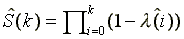 , (2) which is the
Kaplan - Meier (1958) or "product-limit" estimator for
the survivor function. An additional benefit of the survivor
function is the ability to construct approximate standard errors
around the estimates
, (2) which is the
Kaplan - Meier (1958) or "product-limit" estimator for
the survivor function. An additional benefit of the survivor
function is the ability to construct approximate standard errors
around the estimates . The approximate
variance of the survivor estimates is:
. The approximate
variance of the survivor estimates is:
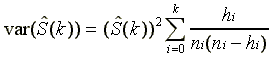 . (3)
. (3)
Estimates of the Survivor Function
Estimates using total sample
Table 4 and Figure 3 jointly provide a first look at the distribution
of the duration of bank relationships through the non-parametric
estimation of the survivor function in equation (2).
Both Table 4 and Figure 3 indicate that adjusting for censored
observations in the data drastically changes the estimated shape
of the survivor function. For instance, the censored-robust estimated
median bank relationship is fifteen years, more than double the
length implied by directly observing the data over the fifteen
year period. Furthermore, when no adjustment is made for censoring,
the survivor function decreases at a quick rate. The estimated
likelihood of surviving beyond five years is 54% and the estimated
chance of surviving past fifteen years is 11%. In contrast, the
robust estimator for the survivor function implies that 85% of
the relationships will last beyond five years and that 63% of
the relationships continue after fifteen years.
Table 4 and Figure 3 also provides some insight into the importance
of duration dependence in the non-parametrically estimated hazard
function. The heavy-dashed line plots the implied censored-robust
estimate for a survivor function calculated under the restriction
that the likelihood of ending a bank relationship is independent
of the duration of the relationship. The two light-dashed lines
plot approximate 95% confidence intervals around the restricted
estimate. The difference between the restricted and unrestricted
estimates is small and lies everywhere within the 95% confidence
bands, suggesting that the likelihood of ending a bank relationship
is not influenced by the duration of the relationship.
Pairwise comparisons of survivor functions
To separately examine their influence of on the conditional likelihood
of switching banks, Figure 4 plots pairwise cohort comparisons
of survivor functions for each of our five independent variables.
In Figure 4a, we plot the cohort of single-bank relationships
against the plot of multiple-bank relationships. To construct
each of the cohorts in Figures 4b-e, we arrange the data from
highest to lowest and split the sample roughly in half to form
a "high" and "low" cohort. For each of the
figures, we also plot 95% confidence bands around the "low"
estimates to gauge the statistical differences in the two categories.
Several interesting patterns emerge from the plots.
First, the plots in Figure 4a suggest that firms with multiple
bank relationships are more likely to end a given bank relationship
than firms with single bank relationships. This result holds
uniformly across all intervals of time, with the difference in
the rate of ending a relationship increasing toward duration of
ten years. For example, the likelihood of a multiple-bank relationship
continuing after fifteen years is 55%, compared with 80% for single-bank
relationships.
Second, small market value firms are more likely to end a bank
relationship than large firms, with the difference in the switching
probabilities being most pronounced for intermediate duration
(4 to 9 years). In fact, Figure 4b suggests that both size cohorts
exhibit non-monotonic duration dependence. For larger firms,
the likelihood of ending a bank relationship decreases for intermediate
duration, relative to both short (< less than 4 years) and
long duration (> 9 years). For smaller firms, the probability
of ending a bank relationship increases over the intermediate
duration. Measured at the longer duration, no statistically significant
difference exists in the survival rate of large versus small firms.
Third, no difference is apparent in the survival rates of the
high and low cohorts measured for ownership concentration and
market-to-book ratios. Plots of the cohorts lie very near each
other, with the large cohort plot lying well within the confidence
bands of the plot of the low cohort.
Fourth, Figure 4e shows high debt firms to be more likely to
end a bank relationship than a low debt firm for duration out
to 12 years, where upon the two cohorts become statistically indistinguishable.
Conclusions regarding the influence of the independent variables
in Figure 4 may be misleading since they do not control for common
variation among the independent variables. In the next section,
we turn to estimating the hazard function within a multiple regression
framework. This framework enables us to quantify estimates of
duration dependence and allows us to jointly estimate the influence
of the independent variables on the conditional likelihood of
ending a bank relationship.
The Proportional Hazard Model
Estimation of the Proportional Hazard Model
Introduction
In this section, we introduce semi-parametric and parametric techniques
for studying the influence of explanatory variables on the duration
of the banking relationship within the context of a proportional
hazard model. The proportional hazard model assumes that
the hazard rate function can be written
 , (4)
, (4)
where X is a set of explanatory variables, is a vector of unknown parameters associated with the explanatory
variables,
is a vector of unknown parameters associated with the explanatory
variables, is a baseline hazard function
and
is a baseline hazard function
and is a non-negative function.
Estimation using the proportional hazard model typically requires
specification of functional forms of and
and .
For example, we could begin by choosing a function that describes
the shape of the baseline hazard
.
For example, we could begin by choosing a function that describes
the shape of the baseline hazard . Define
the integrated baseline hazard to be
. Define
the integrated baseline hazard to be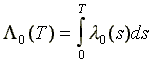 and let
 . Kiefer (1988) shows that, in
the absence of censored observations, the proportional hazard
model can be written as a log-linear regression:
. Kiefer (1988) shows that, in
the absence of censored observations, the proportional hazard
model can be written as a log-linear regression:
 , (5)
, (5)
where follows an extreme value distribution
(Johnson and Kotz, 1970). An appealing feature of equation (5)
is that the coefficients
follows an extreme value distribution
(Johnson and Kotz, 1970). An appealing feature of equation (5)
is that the coefficients have the usual
least squares interpretation of reflecting the partial influence
of each of the variables in X on the conditional likelihood
of ending a spell.
have the usual
least squares interpretation of reflecting the partial influence
of each of the variables in X on the conditional likelihood
of ending a spell.
Specification of the baseline hazard
The shape of the distribution of spell lengths arises from
the specification of the baseline hazard .
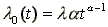
Two commonly-used specifications are the Weibull and the
exponential. The hazard and integrated hazard functions
for the Weibull distribution are:
.
Two commonly-used specifications are the Weibull and the
exponential. The hazard and integrated hazard functions
for the Weibull distribution are:
 ,
,
 . (6)
. (6)
The Weibull distribution allows for duration dependence. When ,
distribution exhibits positive duration dependence, while
,
distribution exhibits positive duration dependence, while implies negative duration dependence. The exponential is nested
in the Weibull as the case
implies negative duration dependence. The exponential is nested
in the Weibull as the case and represents
the testable restriction that the likelihood of switching is independent
of the duration of the spell.
and represents
the testable restriction that the likelihood of switching is independent
of the duration of the spell.
Substitution of the expression for the integrated hazard function
(6) into equation (5) indicates that estimating a Weibull hazard
model is analogous to a linear regression of the log of duration,
scaled by , on the set of variables in
X plus an intercept, with the coefficient on the intercept
representing an estimate of
, on the set of variables in
X plus an intercept, with the coefficient on the intercept
representing an estimate of . Depending
on whether the value is greater than or less than one, the scaling
factor
. Depending
on whether the value is greater than or less than one, the scaling
factor either "speeds up" or
"slows down" log duration time. In the exponential
case, equation (5) reduces directly to a linear regression of
log duration on X.
either "speeds up" or
"slows down" log duration time. In the exponential
case, equation (5) reduces directly to a linear regression of
log duration on X.
The Weibull model restricts duration dependence to be monotonic
over spell lengths. Figures 3 and 4 suggest the likelihood of
ending a bank relationship may increase and then decrease over
the observed duration. The log-logistic distribution,
which allows for non-monotonic duration dependence, has the following
hazard and integrated hazard functions:
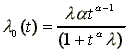 ,
,
 . (7)
. (7)
When in the log-logistic specification,
the likelihood of ending a spell first increases, then decreases
with duration. When
in the log-logistic specification,
the likelihood of ending a spell first increases, then decreases
with duration. When the hazard function
decreases monotonically with duration. A drawback to the log-logistic
distribution is that constant duration dependence is not
included as a special case.
the hazard function
decreases monotonically with duration. A drawback to the log-logistic
distribution is that constant duration dependence is not
included as a special case.
We use all three parametric specifications (exponential, Weibull,
log-logistic) of the baseline hazard to examine the influence
of duration and firm characteristics on the likelihood of ending
a bank relationship. We also consider one model that does not
require specification of a specific baseline hazard.
The Cox (1972) partial likelihood model can be used to
estimate the parameters in without specifying
 .
Let
.
Let 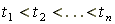 represent an ordering of the duration
from lowest to highest. The conditional likelihood that spell
j ends after length tj is given by
represent an ordering of the duration
from lowest to highest. The conditional likelihood that spell
j ends after length tj is given by
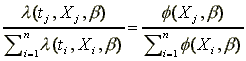 (8)
(8)
under the proportional hazard specification (4). Intuitively,
the partial likelihood function estimates the contribution of
the jth observation to the likelihood that the spell ends
at length j.
Since the partial likelihood model assumes no specific form for
the baseline hazard, it is sometimes referred to as a "semi-parametric"
model and benefits from not being susceptible to biases induced
by specifying an incorrect hazard function.
Incorporating censored data
Accounting for the presence of (right) censored observations can
be accomplished using techniques standard in the literature on
limited dependent variable analysis. Let represent the density function defined over duration and note
that
represent the density function defined over duration and note
that  . Estimation of the proportional
hazard model in the presence on censored data can be accomplished
by maximizing the log-likelihood function
. Estimation of the proportional
hazard model in the presence on censored data can be accomplished
by maximizing the log-likelihood function :
:
 ,
,
or,
 . (9)
. (9)
where dk takes on the value of zero if the kth
observation is censored and one if the duration is fully observed.
The interpretation of equation (9) is intuitively straightforward.
When the kth observation is uncensored, it is used in
the estimation of the density component of (9),  .
When the kth observation is censored, we utilize
the information that the this observation has survived to time
t to estimate the survivor function
.
When the kth observation is censored, we utilize
the information that the this observation has survived to time
t to estimate the survivor function .
In the next section, we report the results from using the parametric
and semi-parametric specifications, adjusted for censoring, to
estimate the influence of duration and our firm characteristics
on the likelihood of ending a bank relationship.
.
In the next section, we report the results from using the parametric
and semi-parametric specifications, adjusted for censoring, to
estimate the influence of duration and our firm characteristics
on the likelihood of ending a bank relationship.
Estimation Using the Proportional Hazard Model
Results with parameterized baseline hazard
We first examine the results of multiple regression estimates
of the conditional likelihood of ending a bank relationship using
alternative specifications for the baseline hazard. For each
specification, the MLE system defined by equations (5) and the
censored-robust (9) is estimated using LIMDEP. LIMDEP defines
the likelihood function in terms of the transformed variable,
 , where heuristically
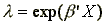 is substituted into equations (6) and (7) in order to estimate
the hazard function. Table 5 reports the slope estimates
is substituted into equations (6) and (7) in order to estimate
the hazard function. Table 5 reports the slope estimates and baseline hazard parameters
 and
and for the exponential, Weibull and log-logistic distributions using
all five explanatory variables.
for the exponential, Weibull and log-logistic distributions using
all five explanatory variables.
The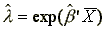 is the estimate of the hazard function
at the mean values of X. The conditional likelihood of
ending a bank relationship in a given year, evaluated at the mean
value of the explanatory variables, ranges between 2.6% (exponential)
and 4.7% (log-logistic). The median length of a relationship
is estimated to be between 26.7 years (exponential) and 21.4 years
(log-logistic).
is the estimate of the hazard function
at the mean values of X. The conditional likelihood of
ending a bank relationship in a given year, evaluated at the mean
value of the explanatory variables, ranges between 2.6% (exponential)
and 4.7% (log-logistic). The median length of a relationship
is estimated to be between 26.7 years (exponential) and 21.4 years
(log-logistic).
Given the estimate of its standard error (0.178), we cannot reject
the hypothesis that the Weibull estimate, ,
is equal to one. Moreover, a likelihood ratio test statistic
using the difference between the log-likelihood values of the
Weibull and exponential cannot reject the exponential distribution
as a null model. This suggests that when we restrict the baseline
hazard to exhibit monotonic duration dependence, we cannot reject
the hypothesis of constant duration dependence.
,
is equal to one. Moreover, a likelihood ratio test statistic
using the difference between the log-likelihood values of the
Weibull and exponential cannot reject the exponential distribution
as a null model. This suggests that when we restrict the baseline
hazard to exhibit monotonic duration dependence, we cannot reject
the hypothesis of constant duration dependence.
Under the log-logistic specification, however, the estimate of
 is statistically greater than one (t-value
= 2.29), implying that the likelihood of ending a bank relationship
first increases in the duration of the bank relationship and then
decreases in the duration.
is statistically greater than one (t-value
= 2.29), implying that the likelihood of ending a bank relationship
first increases in the duration of the bank relationship and then
decreases in the duration.
Independent of the baseline hazard specification, an interesting
and consistent pattern emerges in the estimates of .
If we use a size of 5% as a measure of statistical significance,
then firms are more likely to end a bank relationship when
they maintain more than one bank relationship, are relatively
small and when their market-to-book values are high. Firms with
relatively high debt levels also appear to be more likely to switch
banks, although the statistical significance of the relationship
is weaker (significant at the 10% level). The concentration of
ownership appears to exert no influence on the likelihood of switching
banks.
.
If we use a size of 5% as a measure of statistical significance,
then firms are more likely to end a bank relationship when
they maintain more than one bank relationship, are relatively
small and when their market-to-book values are high. Firms with
relatively high debt levels also appear to be more likely to switch
banks, although the statistical significance of the relationship
is weaker (significant at the 10% level). The concentration of
ownership appears to exert no influence on the likelihood of switching
banks.
Noting that , we can also interpret the
influence of the explanatory variables in terms of their influence
on the expected duration of the relationship. For example, the
estimate of the intercept (-3.682) in the exponential model implies
that the expected length of a bank relationship is
, we can also interpret the
influence of the explanatory variables in terms of their influence
on the expected duration of the relationship. For example, the
estimate of the intercept (-3.682) in the exponential model implies
that the expected length of a bank relationship is years, when all values of X are zero. The estimate
 then implies that multiple-bank relationships are expected to
last only
then implies that multiple-bank relationships are expected to
last only years. Similarly,
  from the exponential implies that a 1% increase in the market-to-book
ratio of a firm reduces the firm's expected duration of a bank
relationship by three years. Likewise, the expected duration
of a relationship increases in the inflation-adjusted size of
the firm and decreases in the proportion of debt held by the firm.
from the exponential implies that a 1% increase in the market-to-book
ratio of a firm reduces the firm's expected duration of a bank
relationship by three years. Likewise, the expected duration
of a relationship increases in the inflation-adjusted size of
the firm and decreases in the proportion of debt held by the firm.
Robustness checks using the partial likelihood model.
In Table 6, we use the semi-parametric, Cox (1972) partial likelihood
model to check the robustness of the distributional assumptions
made above. We also explore the sensitivity of our results to
the adjustment for censoring and to various combinations of the
explanatory variables.
The first line (Model 1) in Table 6 contains the full-scale,
censored robust estimates of the influence of the explanatory
variables on the proportional hazard function. With the exception
of the DEBT variable, the magnitude and significance of estimates
are similar to the estimates in Table 5, suggesting that the results
are not dependent on the specification of the baseline hazard.
Multiple-bank relationships and high Tobin's Q tend to reduce
the duration of a bank relationship, while large firms tend to
maintain longer bank relationships. Both the sign and magnitude
of the DEBT variable indicates that the proportion of debt held
by a firm does not influence the duration of the bank relationship
in the partial likelihood model.
Model 2 is estimated assuming that no censoring occurs, or that
all relationships end with the last observed year of the firm-bank
relationship. When the model does not account for censoring,
inflation-adjusted size remains as a statistically and economically
important explanatory variable. Otherwise, the slope estimates
are very sensitive to the adjustment. For example, the number
of bank relationships is no longer important in estimating the
hazard function, nor is the Tobin's Q variable. Thus, as in the
non-parametric estimation, not accounting for censoring in the
data biases the conclusions of the multiple regression model.
Models 3-6 examine the relative influence of combinations of
the explanatory variables, by excluding some of the variables
from (censored-robust) estimation. Interestingly, the influence
of the multiple bank dummy is diminished when it is the only variable
in the regression (Model 3): the point estimate drops from 0.759
to 0.487 and is no longer significant at the 5% level. The value
of the log-likelihood statistic (27.22) strongly rejects the null
hypothesis that the excluded variables are unimportant in estimation.
The estimates in Model 4 suggest that ownership concentration
adds no statistical explanatory power to the model. The value
of the likelihood ratio test statistic comparing models 3 and
4 is 2.54, which is less than the 5% (one degree of freedom) critical
value of 3.84. Adding the inflation-adjusted size variable to
the multiple-bank relationship variable (Model 5) adds a much
greater degree of explanatory power. The increase in the value
of the likelihood ratio statistic comparing Model 5 to Model 3
is 20.2, which is far out in the right tail of chi-squared distribution.
A likelihood ratio test comparing Models 5 and 1 indicates that
the joint contribution of the ownership concentration, Tobin's
Q and proportion-of-debt variables are marginally significant:
the value of the statistic is 7.42 with an implied p-value of
0.06.
Discussion
Overall, we find that the likelihood of ending a bank relationship
is not strongly related to its duration. For instance, we cannot
reject constant duration dependence using either non-parametric
methods or parametric specifications in which the null of constant
duration dependence can be tested. This result does not support
the intuition suggested by asymmetric information models in which
a bank customer becomes "locked-in" to the relationship.
Nor does the result necessarily support the idea that firms will
be more likely to leave the bank as the relationship lengthens.
The log-logistic specification provides a potential mitigating
explanation for the results on duration dependence. A log-logistic
distribution allows for duration dependence to be non-monotonic
over different spell lengths, a feature not allowed by the Weibull
specification. Estimates based on the log-logistic distribution
are able to reject the null hypothesis of decreasing duration
dependence in favor of a distribution that first decreases in
duration and then increases. This relationship suggests the possibility
that firms find it beneficial to search for the "right"
bank in the early years of a relationship and then become locked
in later in the relationship.
The estimated relationship between the likelihood of ending a
bank relationship (or alternatively the duration of the relationship)
and the explanatory variables is more stable: we find the likelihood
of ending a bank relationship to be increasing (duration of relationship
to be decreasing) in a firm's market-to-book ratio, when the firm
maintains more than one bank relationship and to a lesser degree,
in the proportion of the firm's assets financed by debt. We also
find a strong relationship between the firm's real size, as measured
by the inflation-adjusted log market value of equity, and the
length of a relationship: larger firm's are less likely to switch
banks than smaller firms. Moreover, we find no statistical relationship
between the duration of the bank relationship and the level of
ownership concentration in the firm.
The observation that multiple-bank firms are more likely to end
a bank relationship is consistent with the information-based arguments
that multiple bank relationships will decrease the value of private
information to any one bank, reducing the ability for any one
bank to lock in a customer. The results are also consistent with
the notion that multiple-bank customers find it less costly to
credibly communicate their value to the public, decreasing the
value of holding any one bank relationship.
Our results, however, present a puzzle if we accept that the
other explanatory variables served their intended use as proxies
that indicate: (1) the level of firm uncertainty, (2) the overall
need for financing and (3) the need for bank monitoring.
For instance, we would expect that larger firms would be more
likely to have a higher switch rate (and shorter relationship
duration), if there is less uncertainty about firm value in large
firms and if large firms have a greater array of financing alternatives.
Larger firms are less likely to be locked-in by a bank when exposure
by analysts, regulators and journalists reveals more information
about the firm. For the same reason, a large firm should have
greater access to competitive alternatives to bank financing.
High growth firms, other things equal, should be more dependent
on bank financing to fund investment opportunities. Moreover,
growth firms may be riskier and more susceptible to information
problems, since a larger portion of firm value is related to projects
not yet realized (Martin, 1996). Thus it is also puzzling that
we find that high growth firms are more likely to switch banks
if higher risk, growth firms are more likely to be locked in to
a bank relationship by information asymmetries with the public.
A similar argument holds for firms with high debt financing.
A high-debt financed firm within the bank-denominated Norwegian
economy should find it costlier to leave a particular bank relationship,
if banks maintain monopoly power.
Contrary to the implications from the information-based literature,
our results suggest that firms that are in most need of bank financing
maintain relatively shorter relationships and are more likely
to end a bank relationship than firms where bank financing may
be of a secondary need.
Conclusion
Many of the most interesting theories arising from the theoretical
banking literature focus on the potential for a bank to mitigate
information asymmetries that hinder firms from obtaining valuable
financing. An appealing aspect of this literature comes from
the idea that both banks and firms gain from their ongoing relationship.
Firms which can only credibly communicate valuations at a large
cost, gain from a bank's ability to dynamically improve a financing
contract once the bank has privately observed the payment ability
of the firm. The bank stands to gain from the relationship if
it can "lock in" the firm as a customer and extract
monopoly rents because of the information it learns about the
firm.
The extent to which these theories have been explored empirically
is limited. Petersen and Rajan (1994) and Berger and Udell (1995)
study the importance of the duration of bank relationships and
find somewhat conflicting results. Berger and Udell (1995) find
that the interest rate charged and collateral pledged on lines
of credit is decreasing in the length of a firm's relationship
with its bank and Petersen and Rajan (1994) find that credit is
more readily available to firms with longer bank relationships.
Both papers argue that the favorable contracts terms to older
customers arise through the shared benefits of relationship.
On the other hand, Petersen and Rajan (1994) find no relationship
between the average loan interest rate and the length of a firm-bank
relationship.
Using a new time-series data set based on the bank connections
of OSE-listed firms over the period 1979-1994, we explore the
importance of bank relationships by studying the determinants
of their duration and termination. We first explore the dependency
between the length of a bank relationship and the decision to
terminate the relationship and find no strong link between the
two. This result is important by itself since the relationship-theories
typically suggest a link between the duration of the relationship
and the contracting possibilities available to the firm. We also
explore firm characteristics that may influence the likelihood
of ending a bank relationship. We find that the probability of
ending a relationship increases when firms maintain more than
one bank relationship and as a firm's Tobin Q and debt financing
increases. Firms are less likely to end a bank relationship as
they become larger.
Our results appear to run counter to the theories that suggest
that banks have an ability to lock in customers which have more
difficulty in communicating private valuations, already rely on
bank financing or which are more likely to require financing in
the future. On the contrary, we find that small, highly-leveraged
growth firms are more likely to end a bank relationship than large,
low debt "value" firms. Moreover, the concentration
of ownership in a firm - a proxy for both alternative monitoring
abilities and bargaining power - does not appear to influence
the decision to end a bank relationship. These results may suggest
that the selection of bank services is competitive enough to induce
those most needing bank financing to "shop around".
Drawing too many conclusions from our study would be unwarranted,
since our data set suffers from a number of shortcomings. First,
we are unable to observe the reason for the termination of a firm-bank
relationship. In this paper, we have implicitly assumed that
any termination is initiated by the firm. It is likely that a
bank could also terminate a relationship. A possible avenue for
future research would investigate the sensitivity of observed
bank switches to changes in the banking environment or to bank
characteristics rather than firm characteristics. We are also
unable to observe information specific to the contract between
each firm and their bank: we can only observe that a relationship
exists. Therefore, our study lacks an analysis of the influence
of the cross-sectional variation that is sure to exist in the
debt contracts held by the firm.
References
Berger, A. N. and G. F. Udell, 1995, Relationship
lending and lines of credit in small firm finance, Journal of
Business 68, 351-381.
Bhattacharya, S. and A. V. Thakor, 1993, Contemporary
banking theory, Journal of Financial Intermediation 3, 2-50.
Billett, M. T., M. J. Flannery and J. Garfinkel,
1995, The effect of lender identity on a borrowing firm's equity
return, Journal of Finance 50, 699-718.
Blackwell, N. R. and A. M. Santomero, 1982, Bank
credit rationing and customer relation, Journal of Monetary Economics
9, 121-129.
Boot, A. W. A. and A. V. Thakor, 1994, Moral hazard
and secured lending in an infinitely repeated credit market game,
International Economic Review 35, 899-920.
Borio, C. E. V., 1990, Leverage and financing of
non-financial companies: an international perspective, Bank for
International Settlements Economic Papers 27.
Bøhren, Ø., B. E. Eckbo and D. Michalsen, 1996,
Why underwrite equity offerings? Some new evidence, working paper,
Norwegian School of Management and Stockholm School of Economics.
Bøhren, Ø., B. E. Eckbo, D. Michalsen and D. C.
Smith, 1996, Corporate dividend policy in Norway, working paper,
Norwegian School of Management.
Cox, D., 1972, Regression models and life tables, Journal of the
Royal Statistical Society B 24, 187-201.
Diamond, D. W., 1984, Financial intermediation and delegated monitoring,
Review of Economic Studies 51, 393-414.
Diamond, D. W., 1991, Monitoring and reputation: the choice between
bank loans and directly placed debt, Journal of Political Economy
99, 688-721.
Eckbo, B. E., V. Maksimovic and J. Williams, 1990, Consistent
estimation of cross-sectional studies in event studies, Review
of Financial Studies 3, 343-365.
Fama, E. F., 1985, What's different about banks?, Journal of Monetary
Economics 15, 29-39.
Greenbaum, S. I., G. Kanatas and I. Venezia, 1989, Equilibrium
loan price under the bank-client relationship, Journal of Banking
and Finance 13, 221-235.
Gritz, R. M., 1993, The impact of training on the frequency and
duration of employment, Journal of Econometrics 57, 21-51.
Hodgman, D. R., 1961, The deposit relationship and commercial
bank investment behavior, Review of Economics and Statistics,
August, 257-261.
Jaggia, S. and P. K. Trivedi, 1994, Joint and separate score tests
for state dependence and unobserved heterogeneity, Journal of
Econometrics 60, 273-291.
James, C., 1987, Some evidence on the uniqueness of bank loans,
Journal of Financial Economics 19, 217-35.
Johnson, N. and S. Kotz, 1970, Distributions in statistics: continuous
univariate distributions, Vol.1, Wiley.
Kaen, F.R., and D. Michalsen, 1995, The effects of the Norwegian
banking crisis on Norwegian bank and non-bank stocks, working
paper, Norwegian School of Management.
Kane, E. J. and B. G. Malkiel, 1965, Bank portfolio allocation,
deposit variability, and the availability doctrine, Quarterly
Journal of Economics 79, 257-261.
Kaplan, E. L and P. Meier, 1958, Nonparametric estimation from
incomplete observations. Journal of the American Statistical
Association, 53, 457-481.
Kiefer, N. M., 1988, Economic duration data and hazard functions,
Journal of Economic Literature 26, 646-679.
Klemperer, P. D., 1987, Markets with consumer switching costs,
Quarterly Journal of Economics 102, 375-394.
Lancaster, T.,1979, Econometric methods for the duration of unemployment,
Econometrica 47, 939-956.
Lummer, S. I. and J. J. McConnell, 1989, Further evidence on the
bank lending process and the capital market response to bank loan
agreements, Journal of Financial Economics 25, 99-122.
Martin, K. J., 1996, The method of payment in corporate acquisitions,
investment opportunities and management ownership, Journal of
Finance.
McCall, B. P., 1994, Specification diagnostics for duration models:
A martingale approach, Journal of Econometrics 60, 293-312.
Nilsen, R., 1995, Markedet for risikokapital, in, Vale, B., ed.,
Norske finansmarkeder, norsk penge- og valutapolitikk, Norges
Banks Skriftserie 23, 104-109.
Nilssen, T., 1992, Two kinds of consumer switching costs, RAND
Journal of Economics 23, 579-589.
Nordal, I. A., and M. Nærland, 1995, Financial institutions
in 1994, Bank of Norway Economic Bulletin 1, 69-97.
Petersen, M. A and R. G. Rajan, 1994, The benefits of lending
relationships: Evidence from small business data, Journal of
Finance 49, 3-37.
Petersen, M. A. and R. G. Rajan, 1995, The effect of credit market
competition on lending relationships, Quarterly Journal of Economics,
487-443.
Rajan, R. G., 1992, Insiders and outsiders: The choice between
informed and arm's-length debt, Journal of Finance 47, 1367-1400.
Ramakrishnan, R. T. S. and A. V. Thakor, 1984, Information reliability
and a theory of financial intermediation, Review of Economic Studies
51, 415-432.
Roosa, R. V. , 1951, Interest rates and the central bank, money
trade and economic growth: In honor of John Henry Williams (Macmillan,
New York), 270-295.
Sueyoshi, G. T., 1992, Seminon parametric proportional hazards
estimation of competing risk models with time-varying covariates,
Journal of Econometrics 51, 25-58.
Sharpe, S. A., 1990, Asymmetric information, bank lending and
implicit contracts: A stylized model of customer relationships,
Journal of Finance 55, 1069-1087.
Shockley, R. and A. V. Thakor, 1993, Information content of commitments
to lend in the future: Theory and evidence on the gains from
relationship banking, working paper, Indiana University.
Slovin, M. B., M. E. Sushka and J. A. Polonchek, 1993, The value
of bank durability: borrowers as bank stakeholders, Journal of
Finance 48, 247-66.
Statistical Yearbook of Norway 1996, Statistics Norway, Oslo.
Stiglitz, J. and A. Weiss, 1983, Incentive effects of termination:
applications to credit and labor markets, American Economic Review
73, 1069-1087.
Thakor, A.V., 1995, Financial intermediation and the market for
credit, in: Jarrow, R., Handbooks in OR and MS 9, 1073-1103.
Wilson, P. F., 1993, The pricing of loans in a bank-borrower relationship,
Working Paper, Indiana University.
Wood, J. H., 1975, Commercial bank loan and investment behavior,
Wiley, New York.
Appendix 1. Banks and Bank Mergers in the Sample
| Barclays Bank Plc., London | Midland Bank Mees Pierson N.V.
|
| Bergens Skillingsbank | Morgan Guaranty Trust Co., NY or London
|
| Bergen Bank A/S | National Westminster Bank
|
| Brumunddal Ringsaker Sparebanken | Norges Hypotekinstitutt
|
| Buskerudbanken A/S | Oslo-Banken
|
| Bøndernes Bank A/S | Ringsaker Sparebanken
|
| Chase Manhattan Bank, London or NY | Rogalandsbanken A/S
|
| Chemical Bank, London, Oslo or NY | Royal Bank of Canada, London
|
| Citibank | Sparebanken ABC |
| Credit Lyonnaise | Sparebanken Hedemark
|
| Den norske Bank A/S | Sparebanken Midt-Norge
|
| Den norske Creditbank A/S | Sparebanken Nord-Norge
|
| Fellesbanken A/S | Sparebanken NOR
|
| Finansbanken A/S | Sparebanken Oslo Akershus
|
| First National Bank of Commerce, NY | Sparebanken Sør
|
| Forretningsbanken A/S | Sparebanken Vest
|
| Fokus Bank A/S | Sparebanken Vestfold
|
| Gjensidige Bank | Sparebanken Østlandet
|
| Hambros Bank Ltd., London | SR-Bank
|
| Handelsbanken | Sunnmørsbanken A/S
|
| Kreditkassen | Sørlandsbanken A/S
|
| Landsbanken A/S | Sør-Varanger Sparebanken
|
| Lazard Brothers & Co. Ltd., London |
Telemarksbanken A/S |
| Manufacturers and Traders Trust Co., NY |
Texas Commerce Bancshares, Houston |
| Manufacturers Hanover Corporation, NY | Trondhjems og Strindens Sparebanken
|
| Meldal Sparebanken | Vestfoldbanken
|
| Merging banks | into | Year
|
| Den norske Creditbank A/S | Den norske Bank A/S
| 1990 |
| Bergen Bank A/S | Den norske Bank A/S
| 1990 |
| Buskerudbanken | Fokus Bank
| 1987 |
| Bøndernes Bank | Fokus Bank
| 1987 |
| Forretningsbanken | Fokus Bank
| 1987 |
| Vestlandsbanken | Fokus Bank
| 1987 |
| Rogalandsbanken | Fokus Bank
| 1991 |
| Sørlandsbanken | Kreditkassen
| 1990 |
| Sunmørsbanken | Kreditkassen
| 1990 |
| Sparebanken ABC | Sparebanken NOR
| 1990 |
| Sparebanken Vestfold | Sparebanken NOR
| 1990 |
| Sparebanken Østlandet | Sparebanken NOR
| 1990 |
| Texas Commerce Bancshares | Chemical NY Corporation
| 1987 |
| Chemical NY Corporation | Chemical Banking Corporation
| 1991 |
| Manufacturers Hanover Corporation | Chemical Banking Corporation
| 1991 |
Appendix 2. Constant Duration Dependence
For each estimator of the integrated hazard function  and for each duration
  ,
,  ,
there exists an integrated hazard function
,
there exists an integrated hazard function  with constant duration dependence, for which the hazard rate is
constant and equal to
with constant duration dependence, for which the hazard rate is
constant and equal to
 ,
,
and a survivor function equal to
 .
.
The approximate variance of this survivor function  with constant duration dependence is
 ,
,
for 
 and
and 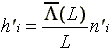
and for 
 and
and 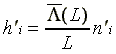 .
.
Hence this specification of the variance takes into consideration
the number of observations and the degree of censoring underlying
the original survivor function,  .
.
To test the null of constant duration dependence against the
alternative of negative duration dependence in period  at
5% level of significance, check
at
5% level of significance, check
 .
.
| Year | Number of Firms in the Sample
| Lists | Delists
| Number of Firms Switching Banks
|
| | |
| |
| 1979 | 100
| | | |
| 1980 | 95
| 5 | 10
| 5 |
| 1981 | 97
| 4 | 2
| 2 |
| 1982 | 102
| 6 | 1
| 6 |
| 1983 | 121
| 21 | 2
| 5 |
| 1984 | 136
| 21 | 6
| 6 |
| 1985 | 129
| 6 | 13
| 3 |
| 1986 | 124
| 7 | 12
| 12 |
| 1987 | 113
| 5 | 16
| 9 |
| 1988 | 105
| 3 | 11
| 12 |
| 1989 | 96
| 8 | 17
| 5 |
| 1990 | 93
| 6 | 9
| 7 |
| 1991 | 105
| 15 | 3
| 6 |
| 1992 | 101
| 10 | 14
| 6 |
| 1993 | 110
| 14 | 5
| 4 |
| 1994 | 122
| 16 | 4
| 5 |
| mean 1979-1994 | 103
| 9 | 8
| 6 |
Notes. The third column lists the number of firms
in the sample listed for the first time on the OSE. The fourth
column lists the number of firms in the sample listed for the
last time on the OSE. Notice that firms can switch more than
one bank, hence the total number of relationships ending in each
year is at least as high as the number in the fifth column in
the table.
| |
| Proportion of firms with multiple relationships
| |
| One Bank | 0.74
|
| Two Banks | 0.17
|
| Three Banks | 0.07
|
| Four Banks | 0.02
|
| |
| Number of relationships for each firm |
|
| Mean | 1.37
|
| Median | 1
|
| |
| Total Number of Firm Observations | 401
|
| Proportion of Observations Censored | 0.77
|
| |
| Distribution of Observed Duration of Relationships, by Year
| |
| < 1 | 0.08
|
| 1 | 0.15 |
| 2 | 0.10 |
| 3 | 0.08 |
| 4 | 0.08 |
| 5 | 0.10 |
| 6 | 0.08 |
| 7 | 0.07 |
| 8 | 0.08 |
| 9 | 0.03 |
| 10 | 0.02 |
| 11 | 0.03 |
| 12 | 0.02 |
| 13 | 0.01 |
| 14 | 0.01 |
| 15 | 0.08 |
| |
| Duration of Observed Relationships, in Years
| |
| Mean | 7.2
|
| Median | 6
|
| |
| Number of Banks in the Sample, by Type |
|
| Domestic - Commercial | 22
|
| Domestic - Savings | 15
|
| International | 14
|
| Total | 51
|
| |
| Banks involved in mergers | 11
|
| |
| Variable | Mean
| St.Dev | Skewness
| Kurtosis | Minimum
| Maximum |
| | |
| | |
|
| MREL | 0.593
| 0.492 | -0.4
| 1.1 | 0.00
| 1.00 |
| CONC | 0.681
| 0.176 | -0.8
| 3.9 | 0.00
| 1.00 |
| SIZE | 7.469
| 1.629 | -0.1
| 2.7 | 3.44
| 12.39 |
| Q | 1.337
| 0.479 | 2.2
| 11.8 | 0.48
| 4.58 |
| DEBT | 0.536
| 0.227 | -0.4
| 2.9 | 0.00
| 0.96 |
| | |
| | |
|
| Variable | MREL
| CONC | SIZE
| Q | DEBT
|
| | |
| | |
| MREL | 1.000
| | | |
|
| CONC | -0.120
| 1.000 | |
| |
| SIZE | 0.155
| -0.083 | 1.000
| | |
| Q | -0.074
| 0.042 | 0.313
| 1.000 | |
| DEBT | 0.168
| -0.083 | -0.148
| -0.567 | 1.000
|
| | |
| | |
Notes. Number of observations: 263. MREL takes the value of
1 when a firm maintains a multiple-bank relationship at some point
during the sample period and takes the value 0 otherwise. CONC
is the proportion of a firm's equity owned by the ten largest
shareholders. SIZE is the log of end-of-year market value of
equity, deflated by the Norwegian CPI. Q is the ratio of the
end-of-year market value of equity plus book value of assets divided
by the book value of assets. DEBT is the ratio of the book value
of debt to the sum of the market value of equity plus the book
value of debt.
| Length in Years | No Adjustment for Censoring
| Adjusted for Censoring |
| No-Duration Dependence
| |
| | |
-2 St.Dev.
| | +2
St.Dev.
|
| | |
| | |
| 0
| 1.000
| 1.000
| 1.000
| 1.000
| 1.000
|
| 1
| 0.871
| 0.960
| 0.948
| 0.969
| 0.990
|
| 2
| 0.764
| 0.947
| 0.909
| 0.939
| 0.969
|
| 3
| 0.662
| 0.893
| 0.873
| 0.910
| 0.947
|
| 4
| 0.605
| 0.877
| 0.839
| 0.882
| 0.925
|
| 5
| 0.544
| 0.854
| 0.806
| 0.855
| 0.903
|
| 6
| 0.434
| 0.828
| 0.775
| 0.828
| 0.881
|
| 7
| 0.388
| 0.813
| 0.744
| 0.802
| 0.861
|
| 8
| 0.327
| 0.771
| 0.715
| 0.778
| 0.840
|
| 9
| 0.247
| 0.721
| 0.686
| 0.754
| 0.821
|
| 10
| 0.202
| 0.709
| 0.657
| 0.730
| 0.803
|
| 11
| 0.175
| 0.681
| 0.629
| 0.708
| 0.786
|
| 12
| 0.141
| 0.649
| 0.602
| 0.686
| 0.770
|
| 13
| 0.126
| 0.649
| 0.574
| 0.665
| 0.755
|
| 14
| 0.114
| 0.629
| 0.548
| 0.644
| 0.740
|
| 15
| 0.107
| 0.629
| 0.523
| 0.624
| 0.726
|
| | |
| | |
| Median duration
| 6
| 15
| | 15
| |
| | |
| | |
Notes. Number of observations: 263.
| Function |
|  |
 |
| | 
| | | |
Median Duration | Log-likelihood
|
| | |
| Intercept | MREL
| CONC | SIZE
| Q | DEBT
| | |
| | |
| | | |
| | |
| |
| Exponential |
| 0.0260
(0.0044)
| 1
-
| -3.682***
(1.114)
| 1.026***
(0.366)
| 0.496
(0.868)
| -0.366***
(0.0928)
| 0.837**
(0.364)
| 1.307*
(0.780)
| 26.67
(4.52)
| -151.25
(3.64)
|
| | |
| | | |
| | |
| |
| Weibull | |
0.0352
(0.0072)
| 1.249
(0.178)
| -3.271***
(0.876)
| 0.816***
(0.298)
| 0.413
(0.657)
| -0.307***
(0.0770)
| 0.672**
(0.279)
| 1.034*
(0.618)
| 21.20
(4.36)
| -149.43 |
| | |
| | | |
| | |
| |
| Log-logistic |
| 0.0467
(0.0087)
| 1.451ªª
(0.197)
| -2.875***
(0.881)
| 0.892***
(0.290)
| 0.272
(0.714)
| -0.354***
(0.0808)
| 0.807**
(0.320)
| 1.23**
(0.622)
| 21.43
(4.017)
| -148.52 |
| | |
| | | |
| | |
| |
Notes. Number of observations: 263. MREL takes the value of
1 when a firm maintains a multiple-bank relationship at some point
during the sample period and takes the value 0 otherwise. CONC
is the proportion of a firm's equity owned by the ten largest
shareholders. SIZE is the log of end-of-year market value of
equity, deflated by the Norwegian CPI. Q is the ratio of the
end-of-year market value of equity plus book value of assets divided
by the book value of assets. DEBT is the ratio of the book value
of debt to the sum of the market value of equity plus the book
value of debt. All estimates are adjusted for censoring. Coefficients
are listed on the first row in each cell and standard errors are
reported below between parentheses. The last column lists the
log of the likelihood L() and the log likelihood ratio test statistic
between parentheses. Based on the log likelihood ratio test statistic,
-2log(L(weibull)/L(expo)), which is asymptotically
2(1), H0: =1 cannot be rejected in the Weibull
model. *** Significant at 1%, ** significant at 5%, * significant
at 10%. ªª Significantly different from one at a 5%
level.
| MREL |
CONC | SIZE
| Q | DEBT
| Medium duration | Log likelihood
|
| | |
| | |
| |
| Model 1 | 0.759***
(0.259)
| 0.758
(0.653)
| -0.384***
(0.078)
| 0.526**
(0.237)
| 0.0622
(0.585)
| 15 | -382.2
|
| Model 2 | 0.145
(0.134)
| -0.007
(0.334)
| -0.205***
(0.042)
| 0.314
(0.153)
| 0.107
(0.374)
| 7.040 | -1236.0
|
| Model 3 | 0.487*
(0.249)
| - | -
| - | -
| 15 | -395.8***
(27.2)
|
| Model 4 | 0.526**
(0.250)
| 1.068
(0.687)
| - | -
| - | 15
| -394.5***
(24.7)
|
| Model 5 | 0.654***
(0.251)
| - | -0.310***
(0.069)
| - | -
| 15 | -385.9*
(7.4)
|
| Model 6 | 0.487*
(0.249)
| - | -
| 0.141
(0.211)
| - | 15
| -395.6***
(26.8)
|
| | |
| | |
| |
Notes. Number of observations: 263. MREL takes the value of
1 when a firm maintains a multiple-bank relationship at some point
during the sample period and takes the value 0 otherwise. CONC
is the proportion of a firm's equity owned by the ten largest
shareholders. SIZE is the log of end-of-year market value of
equity, deflated by the Norwegian CPI. Q is the ratio of the
end-of-year market value of equity plus book value of assets divided
by the book value of assets. DEBT is the ratio of the book value
of debt to the sum of the market value of equity plus the book
value of debt. The estimates in model 2 are not adjusted for
censoring. The estimates in model 1 and 3 to 6 are adjusted for
censoring. Coefficients are listed on the first row in each cell
and standard errors are reported below between parentheses. The
last column lists the log of the likelihood L() and the log likelihood
ratio test statistic between parentheses. The latter statistic
is -2log(L(1)/L(i)), asymptotically 2(n)
, with i=3,..., 6, and n=4 if i=3 and n=3
otherwise. *** Significant at 1%, ** significant at 5%, * significant
at 10%.
Proportion of the firms in the sample having one to four relationships.
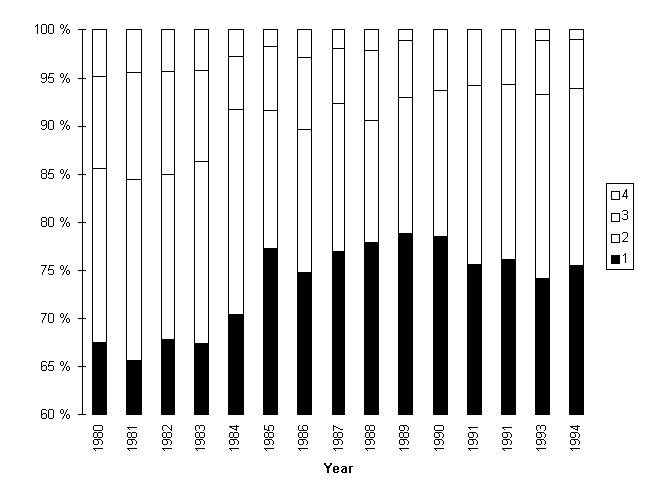
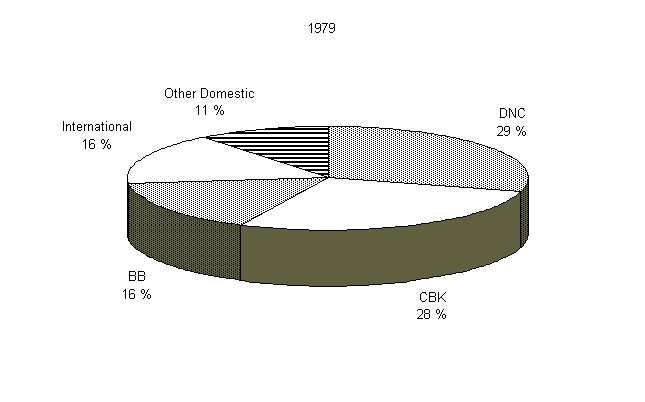
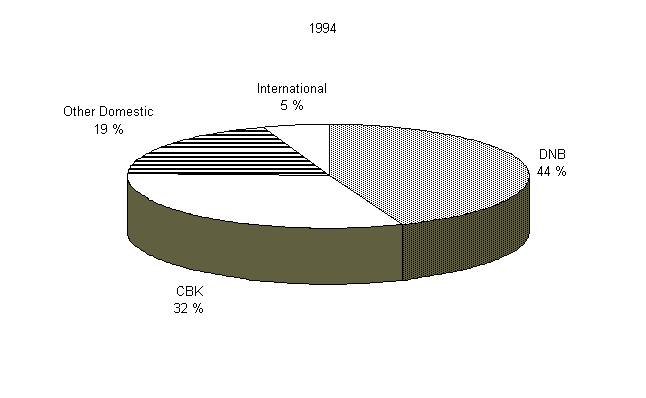
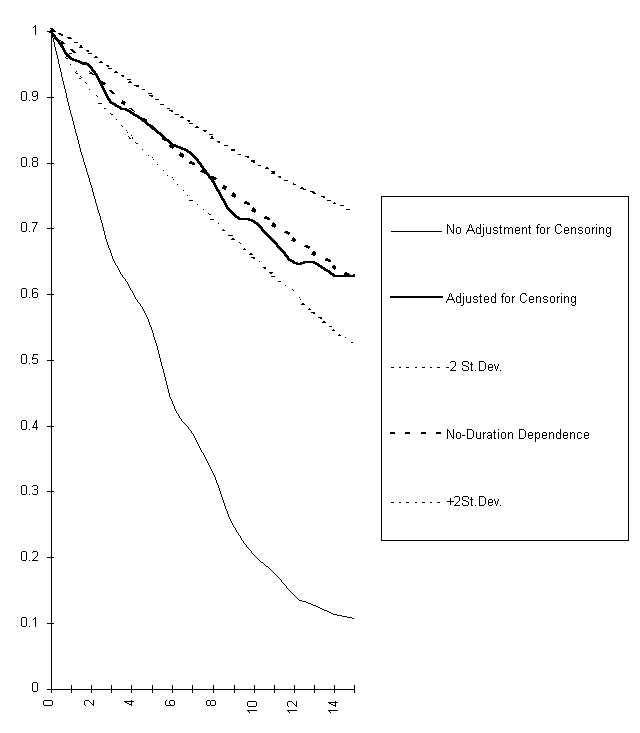
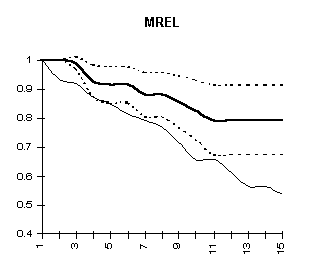
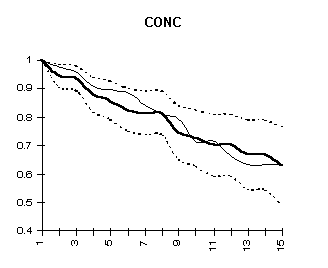
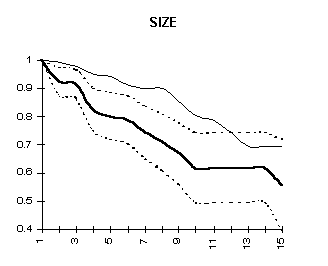


| | |
| Difference in Cohorts
|
| Log Rank
| Wilcoxon |
| MREL | 7.6***
| 6.8*** |
| CONC | 0.1
| 0.5 |
| SIZE | 7.3***
| 10.3*** |
| Q | 0.04 |
0.14 |
| DEBT | 4.9**
| 5.9** |
| | |
Notes. Number of observations: 263. The bold solid
line represents the survivor function of the "low" group
of firms, the other solid line represents the survivor function
of the "high" group. The dashed lines represent a band
of 2 standard deviations around the survivor function of the "low"
group. The stratification sheme for MREL has 107 observations
in the "low" group. These firms have only one relationship.
The cut-off levels in the other stratification shemes are chosen
in order to approximately divide the sample in two equally sized
groups: there are 132 observations with CONC lower than 0.7, 126
observations with SIZE lower than 7.5, 156 observations with DEBT
lower than 0.6, and 135 observations with Q lower than 1.25. ***
Significant at 1%, ** significant at 5%, * significant at 10%.