This paper tries to find a widely accessible measure of liquidity and studies its impact on asset pricing. Using trading turnover as a measure of liquidity and the 1976-1993 Tokyo Stock Exchange data, I find that, cross-sectionally, stocks with higher turnover tend to have a lower expected return. This evidence is consistent with predictions derived from an Amihud-Mendelson type of transaction cost model in which the turnover measures investors' trading frequency. The trading frequency hypothesis also predicts that the cross-sectional expected return is a concave function of the turnover and the time-series expected return is an increasing function of the turnover. The Japanese data supports both predictions.
1. Introduction
This paper tries to find a widely accessible measure of liquidity and studies its impact on asset pricing. Using trading turnover as a measure of liquidity and the 1976-1993 Tokyo Stock Exchange data, I find that stocks with higher turnover tend to have a lower expected return. This evidence is consistent with predictions from an Amihud-Mendelson type of transaction cost model.
In an Amihud-Mendelson type of model, assets have different transaction costs and investors have different trading frequencies. Investors' decision is to choose assets to hold to maximize their net holding returns. In equilibrium, investors with higher trading frequencies will hold assets that have lower transaction costs and therefore obtain lower gross expected returns. If the turnover can measure marginal investors' trading frequencies or the inverse of their holding periods, the model will predict a negative relation between turnover and expected returns.
The difference between this paper and Amihud and Mendelson (1986) is that I choose to derive testable implications on the relation between trading turnover and stock returns whereas Amihud and Mendelson's implication is on the relation between spread and returns. I choose turnover instead of spread because volume data is more accessible and also because the commonly used quoted spread data does not measure the actual transaction cost. Petersen and Fialkowski (1994) find that less than 50% of trades on the NYSE actually occurs at the quoted bid or ask. Taking into account the price change after the trade, Huang and Stoll (1996) estimate the correlation between the realized spread and the quoted spread is insignificantly different from zero.
Given that the quoted spread is a poor measure of the true transaction cost, it is understandable why researchers cannot find a consistent spread-return relation. Using the NYSE stocks, Amihud and Mendelson (1986, 1989) find that stocks with higher quoted spread tend to have higher expected return. Chen and Kan (1989) find the spread-return relation sensitive to the estimation method. Eleswarapu and Reinganum (1993) find that a positive spread-return relation only exists in January. Brennan and Subrahmanyam (1996) and Brennan, Chordia, and Subrahmanyam (1996) find a negative spread-return relation. To find a better measure of the actual transaction costs, Eleswarapu (1996) uses the inside quotes of the NASDAQ stocks and finds a positive spread-return relation.
There are other measures of liquidity used in the literature, but they are not as accessible as turnover. Using the market depth estimated from intraday data as a measure of liquidity, Brennan and Subrahmanyam (1996) find a negative relation between expected returns and liquidity. However, due to the data availability, their sample is restricted to the 1984-1991 period. This data availability problem also limits all the current evidence on the liquidity-return relation to the U.S. data. Using a more accessible measure of liquidity will allow us to check the robustness of the liquidity-return relation using data from other capital markets.
Using turnover to measure liquidity will also allow us to examine the role played by liquidity in the international asset pricing. None of the existing empirical work on international asset returns has examined the liquidity issue even though it seems to be an important consideration for international fund managers.
Using the U.S. data, several authors also find that stocks with higher trading activity tend to have lower expected returns (Brennan, Chordia, and Subrahmanyam, 1996; Haugen and Baker, 1996; Teh and De Bondt, 1996). In measuring trading activity, these authors use different definitions but offer no justifications. Haugen and Baker (1996) use the ratio of the 12-month average trading volume to the market value of equity and the five-year trend in trading volume. Teh and De Bondt (1996) use the annual trading volume. Brennan, Chordia, and Subrahmanyam (1996) use the monthly trading turnover. This paper, on the other hand, provides a theoretical rationale for choosing turnover instead of other measures.
In addition to the trading frequency hypothesis, there are other alternative hypotheses that can explain the negative relation. These alternative hypotheses argue that the turnover can be related to transaction costs even if it has nothing to do with the trading frequency. This paper also provide additional evidence to support the trading frequency hypothesis. The trading frequency hypothesis will predict that the cross-sectional expected return is a concave function of turnover and the time-series expected return is an increasing function of turnover. Both predictions are not implications from other alternative hypotheses but are supported by the Japanese data.
The time-series finding makes this paper related to the literature that studying the time-varying conditional mean of stock returns. Researchers have found that variables related to price levels and interest rates can forecast aggregate stock returns (Campbell, 1987; Campbell and Hamao, 1992; Campbell and Shiller, 1988; Fama and French, 1988; 1989; Fama and Schwert, 1977; Kothari and Shanken, 1995; Rozeff, 1984). Whether this evidence is consistent with market efficiency is still much in debate. This paper offers new evidence on the time-varying conditional mean that a change in trading turnover changes the expected stock return. Since the turnover variable is not constructed from the price level, it is more difficult to use investor irrationality to explain its predictability.
This rest of the paper is as follows. Section 2 discusses the
Japanese data used in the cross-sectional study and presents cross-sectional
evidence on the negative relation between turnover and expected
returns. Section 3 introduces a simple model and derives its
implications on cross-sectional and time-series relations between
turnover and expected returns. Section 4 provides further evidence
on the cross-sectional nonlinear property and time-series relations
to differentiate different hypotheses. Section 5 concludes and
discusses future work.
2. Turnover and cross-sectional expected stock returns
2.1. Data and methodology
I use the Fama-MacBeth 2-step methodology to examine univariate
relations between turnover and stock returns (Fama and MacBeth,
1973). In the first step, I estimate an OLS regression between
cross-sectional excess stock returns and turnover,
rit = 1t + 1t TURNi,t-1
+ eit,
where rit is the annualized excess monthly return in percentage of stock i at month t and TURNi,t-1 is stock i's turnover, the annualized number of shares traded at month t-1 for each ten share outstanding, during the month t-1. In the second step, I estimate the simple average and the weighted average of the time series of the estimated . The weights used is the standard error from the first step regression assuming homoskedasticity and zero cross-sectional correlations.
The lagged monthly turnover used in the first step regression serves as a proxy for the expected monthly turnover. An alternative proxy will be the annual turnover cumulated over the previous twelve months. If the monthly turnover process includes a strong moving-average component, then the annual turnover can better capture the slow decaying property of the monthly turnover. On the other hand, if the monthly turnover behaves more like an autoregressive process, then the lagged monthly turnover will do better. In this sample, the average correlation between monthly turnover and the lagged annual turnover is 0.42 and the correlation between monthly turnover and its own lag is 0.51. When I estimate an ARMA(1,1) process for monthly turnover of individual stock, the average AR coefficient is 0.63 and the average MA coefficient is 0.23. The AR coefficient is significantly positive for 86% of stocks and the MA coefficient is significantly positive for only 45% of stocks. Therefore, on average, the MA component is small and I will use the lagged monthly turnover in regressions.
In estimating regressions, I use monthly returns of individual securities traded on the Tokyo Stock Exchange from April 1976 to March 1993. The raw data is from the PACAP database which covers the 1975-1993 period and is maintained by the University of Rhode Island. I start the sample from April 1976 because the accounting data needed for 1975 is not fully available to investors until the end of March 1976. The sample ends at March 1993 because after that nearly all the depreciation expenses data is missing. To calculate excess returns, following Campbell and Hamao (1992), I use a combined series of the call market rate (1976:4-1977:1) and the one month Gensaki rate (1977:2-1993:3) as the short-term interest rate.
To check interactions between the turnover and other variables,
I also run a multiple regression including firm size, book-to-market
ratio, and cash-flows-to-price ratio.
rit = + TURN TURNi,t-1
+ MKT MKTi,t-1 + BM BMi,t-1
+ CP CPi,t-1.
I do not include the market beta in regressions because previous research find that beta cannot explain Japanese cross-sectional stock returns (Hawawini, 1991; Sakakibara, Yamaji, Sakurai, Shiroshita, and Fukuda, 1988). Since all independent variables are observable, I use individual stocks in regressions to increase the power of tests.
Firm size is the market value of common stocks at the end of month. Banz (1981), Chan, Hamao, and Lakonishok (1991), and Fama and French (1992), among others, find that smaller sized firm will earn higher returns. The book-to-market ratio is the most recent book value of equity available to investors at the end of month t divided by firm size at month t. Chan, Hamao, and Lakonishok (1991) and Fama and French (1992) find that firms with larger book-to-market ratio will earn higher returns. The cash-flows-to-price ratio is the annual net incomes plus depreciation divided by the market value of equity at the end of month t. Chan, Hamao, and Lakonishok (1991) finds that firms with larger cash-flows-price ratio will earn higher returns.
The book value and cash flow will be available to investors at the end of month t if a firm's fiscal year ends before or at month t-3 and it report financial statements on time. Therefore, the accounting numbers are old information compared to the market value. Also, the timing of accounting numbers is different across firms. At any particular month t, some numbers are only available to investors very recently if these firm's fiscal year ends at month t-3. Some numbers, however, can be available eleven months ago if the fiscal year ends at month t-14. One way to deal with this timing problem is to restrict the sample to firms with March as their fiscal year end. I choose not to do so because it will eliminate more than 35% observations and will reduce the power of tests considerably.
Panel A of table 1 lists summary statistics for variables used
in regressions. During this period, the average annualized monthly
turnover is 5.3 shares for every ten share outstanding. Panel
B presents correlation coefficients between variables in their
original and log forms. The numbers show that higher turnover
stocks tend to have lower book-to-market ratios and cash-flows-to-price
ratios. Also, correlation coefficients between equity premiums
and variables in their log forms are greater than those between
premiums and original forms. The only exception is turnover:
the correlation between premiums and turnover is -0.017 and the
correlation between premiums and log turnover is -0.007. Therefore,
in the following regressions, I will measure firm size, book-to-market
ratio, and cash-flows-to-price ratio in their log forms and measure
turnover directly.
2.2. Empirical results
Decile portfolio results
Before presenting the regression results, figure 1 draws the average premiums for decile portfolios sorted on the turnover, size, book-to-market value, or cash flow-to-price ratio. For example, each month, all eligible stocks are sorted based on the previous month's turnover and the first decile portfolio includes stocks whose turnover is within the smallest 10%. The equal-weighted portfolio returns are calculated for each month and the average over the 1976-1993 period is shown in figure 1.
The first thing to notice is that, unlike other sorting criteria, the premium is not uniformly increasing or decreasing in turnover. The premium is more like a concave function of the turnover; it first increases with the turnover until the fifth decile portfolio and then decreases. Also, most of the action seems to occur at the largest turnover decile portfolio. The average annualized premium is -1.96% for the 10th decile portfolio and is 8.11% for the 9th decile portfolio, which has the second smallest average premium. The difference between these two averages is significant at a t value 5.9. The difference is also significant nonparametrically: 60.3% of the monthly difference in premiums is positive that is significantly greater than 50%.
Although the results in figure 1 suggest a nonlinear relation between premium and turnover, I will first estimate a linear relation in this section to compare with results in the literature. I will come back to the nonlinearity in the later sections.
Regression results
Table 2 reports the univariate regression results. The first two columns report results using the whole sample. The number of cross-sectional observations ranges from 1080 to 1572 and the total is 272490. The weighted average estimates are similar to the simple average estimates, but the former is more efficient. The standard deviations of the weighted average estimates are 20% less than the standard deviations of the simple average estimator. Therefore, in the following, I will mainly discuss results using the weighted average estimates.
Over the whole sample period, the weighted average estimate of the price of turnover is -0.37 with a t value -5.2. The estimate is not only statistically significant, it is also economically significant. The -0.37 point estimate means that for a one standard deviation increase in turnover, the annualized monthly return will reduce 4%. The estimate of the price of turnover is also stable over time: -0.38 for the 76:4-84:9 period and -0.36 for the 84:10-93:3 period.
To check the influence of extreme values, I also estimate univariate regressions in restricted samples. In each month, I delete observations having the largest or the smallest 1% (or 5%) turnover and report results in columns 3 and 4 (columns 5 and 6). Compared with results from the whole sample, most point estimates in the trimmed sample are of the same magnitude or more negative. However, the efficiency of the estimators deteriorates very fast in the trimmed sample. For example, deleting 2% extreme observations will increase the standard deviations of the estimates by more than 60%. Overall, regression results seem to be robust to extreme values.
Table 3 reports the multivariate regression results. The magnitude of the price of turnover drops when other variables are introduced. Over the whole period, the weighted average estimate of the price of turnover drops 19% to -0.3 with a t value -4.5. Similar to the univariate regression, I cannot reject the hypothesis that the price of turnover is the same over two subperiods in multiple regressions..
The estimated coefficients on other variables are similar to the literature. Stocks with a lower market value, higher book-to-market ratio, and higher cash-flow-to-price ratio tend to have a higher return. Out of these three variables, the cash-flow-to-price ratio has the most consistent forecasting power for the cross-sectional returns. The book-to-market ratio is only significant during the second period and has no forecasting power during the first period. The size variable is only significant using the simple average estimate. Therefore, overall, the turnover and the cash-flow-to-price ratio are the most important variables in forecasting cross-sectional returns in the Tokyo Stock Exchange.
To check whether the price of turnover has a seasonal pattern,
I also estimate the averages for different months in the year
and report them in table 3. The price of turnover is significantly
negative in March, June, September, November, and December for
either the simple or the weighted average. The weighted average
coefficient estimate in December is -1.0 that is the largest in
magnitude. In contrast, the average for the remaining eleven
months is only -0.24. However, the price of turnover is still
significant even if we delete all Decembers: the t value of the
weighted average is -3.5. Similarly, the significance of other
variables in the regression is not due to any individual month
in the year.
3. Explanations
There are three possible explanations for the negative cross-sectional correlation between stock returns and the lagged turnover. All explanations rely on the existence of transaction costs. Therefore, I will first present a simple model in which trading different assets involve different transaction costs and investors have different trading frequencies. This type of model is first introduced by Amihud and Mendelson (1986) and later studied by Kane (1994).
Assume the economy has three risk-free assets and each has two shares outstanding. The expected returns are Ri, i=1,2,3. Trading these assets involves relative transaction costs Si, i=1,2,3. Assuming S3-S2=S2-S1=S>0 and S1=0. There are two types of investors, type-1 and type-2. Each type has three people but different trading frequency, T1 and T2, at a given interval. Defining liquidity premium ri as the difference between gross returns on assets with positive trading costs and the gross return on the asset with zero trading cost, that is, ri=Rr-R1, i=2,3. Therefore, for an investor type-j, the net expected return by holding asset i will be R1+ri-TjSi, where TjSi is the total trading costs paid during the interval. Assuming that investors are risk-neutral and choose to hold the asset with the highest net expected return.
Amihud and Mendelson (1986) show that the equilibrium in this
economy will display a clientele effect, that is, investors will
not choose to hold all assets, instead they will only hold some
assets. If a type-j investor chooses to hold asset j and j+1,
it must imply that the net returns on asset j and j+1 are the
same and they are higher than net returns on other assets. Therefore,
r1-T1S1 = r2-T1S2 (2.1)
r1-T1S1 > r3-T1S3,
for type-1 investors whose trading frequency is T1
(2.2)
r2-T2S2 > r1-T2S1 (2.3)
r2-T2S2 = r3-T2S3,
for type-2 investors whose trading frequency is T2
(2.4)
Theorem 1 (cross-sectional implications):
Under the economy described, cross-sectionally, (1) investors
with lower trading frequencies will choose assets with higher
transaction costs, (2) the expected liquidity premium ri
is an increasing and concave function of its trading cost, and
(3) the expected liquidity premium is a decreasing and concave
function of its trading turnover.
Proof.
By rearranging inequality (2.1) and (2.3), we have
r1-r2 = T1(S1-S2) and
T2(S1-S2) > r1-r2.
Combining these two inequalities, we have (T1-T2) (S1-S2)<0. Since S1<S2, we must have T1>T2, that is, the investor choosing the asset with lower transaction cost S1 will have a higher trading frequency T1.
In equilibrium, asset 1 will be held by two type-1 investors, asset 2 will be held by one type-1 and one type-2 investor, and asset 3 will be held by two type-2 investors. Therefore the trading turnover (TURN) for three assets in the given period will be T1, (T1+T2)/2, and T2 respectively and TURN1-TURN2 = TURN2-TURN3 > 0.
By rearranging inequality (2.3), we have r2-r1
> T2(S2-S1) > 0. Therefore,
assets with a lower trading volume or a higher trading cost will
have a higher liquidity premium. By rearranging inequality (2.3)
and (2.4), we have r2-r1 > T2(S2-S1)
and T2(S3-S2) = r3-r2.
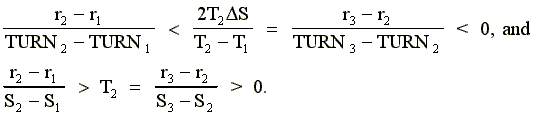
Dividing the inequalities by the difference in trading volume
or cost, we have the following inequalities in terms of the first
derivative,
Therefore, the liquidity premium is a decreasing and concave
function of the turnover; it is also an increasing and concave
function of the trading cost. The relations are drawn in the
following figures.
Amihud and Mendelson (1986) have shown results (1) and (2) in theorem 1. What this paper does is to look at the other side of the coin: the relation between liquidity premium and trading turnover. The trading frequency hypothesis suggests that investors with high trading frequency will choose to trade low-cost assets, which have smaller liquidity premiums. This can explain the empirical results in section 2 using the Japanese data and results in Brennan, Chordia, and Subrahmanyam (1996) and Haugen and Baker (1996).
In the previous economy, if there is only one type of investor whose trading frequency is T, each investor will hold all assets and they must offer the same net returns. Therefore,
r1 - T S1 = r2 - T S2 = r3 - T S3 = 0,
ri = T Si, for all i = 1,2,3. (2.5)
Since trading frequencies for all assets are the same, there is no cross-sectional correspondence between trading frequency and turnover. The cross-sectional liquidity premium is only a linearly increasing function of the transaction cost. However, there are two alternative ways to link the liquidity premium with turnover through transaction costs, the information-based trading hypothesis and the order-processing cost hypothesis. The information-based trading hypothesis argues that, cross-sectionally, a higher turnover stock has a lower probability of information-based trading and will reduce the transaction cost (Easley, Kiefer, O'Hara, and Paperman, 1996). The order-processing cost hypothesis says that, in the presence of fixed costs, a higher turnover can lower dealers' average costs and, by competition, will lower investors' costs.
Under these two alternative hypotheses, the cross-sectional expected liquidity premium is also a decreasing function of its turnover. To distinguish one hypothesis from the other, one has to rely on the nonlinearity property and time series data. The trading frequency hypothesis in theorem 1 suggests that the liquidity premium is a concave function of the turnover. The clientele effect argues that high-turnover stocks are held by investors with high trading frequencies and have low costs. Therefore, increasing turnover is the same thing as reducing costs. Since the reduction in costs is shared by more trading, it will reduce the liquidity premium more than when there is no clientele effect. The information-based trading hypothesis is silent on the function form between turnover and transaction costs, and hence says nothing about the nonlinear relation between the liquidity premium and turnover. Under the order-processing cost hypothesis, the transaction cost is a decreasing and convex function of turnover. For high turnovers, the transaction cost is close to a constant and so is the liquidity premium. Therefore, the liquidity premium should be a convex function of the turnover.
Another way to test between different hypotheses is to use the
time-series data. Regardless of the existence of investor clientele,
the time-series implication from a transaction cost model is the
same as follows.
Theorem 2 (time-series implications):
In a transaction cost economy, over time, the liquidity premium
is an increasing function of both trading frequency and transaction
costs.
Proof:
When there is two types of investors, rearranging equalities (2.1) and (2.3) and recalling that r1=S1=0, we have
r2 = T1S2,
r3 = T1S2 + T2 (S3 - S2) = (T1 - T2) S2 + T2 S3.
The liquidity premiums are increasing functions of the trading frequency and transaction costs. When there is only one type of investor, equation (2.5) gives the same implication.
The trading frequency hypothesis maintains that turnover is a
measure of trading frequency. Therefore, according to theorem
2, the liquidity premium is increasing in turnover over time.
On the other hand, the information-based trading hypothesis has
no implication on the time-series relation between turnover and
transaction costs and the relation between turnover and liquidity
premiums. The order-processing cost hypothesis will still predict
a negative relation in time-series between turnover and transaction
costs. Therefore the liquidity premium is a decreasing function
of turnover.
4. Further empirical results
4.1. Cross-sectional nonlinear relation
To examine the nonlinear relation between the liquidity premium
and turnover, I estimate the following piecewise-linear multiple
regression.
ri = 1 D1i + 2 D2i + 3 D3i + 1 TURNi D1i + 2 TURNi D2i + 3 TURNi D3i +
MKT MKTi + BM BMi
+ CP CPi,
where ri is the monthly excess return for stock i, TURNi is stock i's turnover, D1i is the dummy variable for stocks with the first 30th percentile turnover of each month, D2i is the dummy variable for stocks with the 30th - 70th percentile turnover, and D3i is the dummy variable for stocks with the last 30th percentile turnover. Choosing the 30th and 70th percentile as cut-off points is to make the sample size roughly equal across different groups.
Panel A of table 4 reports the simple average of OLS estimates
of the piecewise-linear regression. Generally, the estimates
suggest that the liquidity premium is a concave function of turnover,
which supports the trading frequency hypothesis. Using the simple
average, the price of turnover is not significantly different
from zero for the first 30% and the middle 40% turnover and is
significantly less than zero for the last 30% turnover. The point
estimate for the high-turnover group is -0.355 with a t value
-4.5, which is close to the point estimate of the simple regression
reported in table 2. The results for two subperiods are similar.
In panel B, the weighted average estimates of the price of turnover
for the middle 40% turnover is also significantly less than zero.
The estimate of the middle-turnover group is -1.002, which is
smaller than the estimate of the high-turnover group (-0.288)
and is not consistent with the trading frequency hypothesis.
However, because the standard deviation estimates are large, one
cannot reject the hypothesis that the price of turnover is equal
over the two regions.
4.2. Time-series relation
In the time series regression, in addition to turnover, I also include two sets of variables. The first set of variables is the equal weighted average of variables used in the cross-sectional regressions. These variables are included to examine whether their cross-sectional forecast ability also occurs in time-series. Kothari and Shanken (1995) find that the book-to-market value can predict future returns.
The second set of variables includes the equal-weighted average of dividend yield, the relative short term interest rate, and the term premium. The dividend yield is the dividends paid over the previous twelve months divided by the stock price at the end of the last month. The relative short term interest rate is the short term interest rate used earlier minus its moving average over the previous twelve months. The term premium is the difference between the yield on ten year government bonds and the short term interest rate. These variables are used by Campbell and Hamao (1992) in forecasting Japanese stock returns and are used by Fama and French (1988, 1989), Fama and Schwert (1977), and Rozeff (1984) in forecasting U.S. returns.
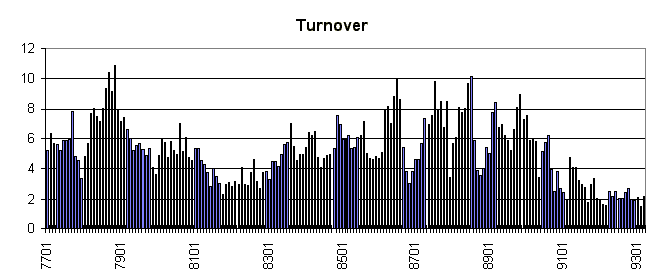
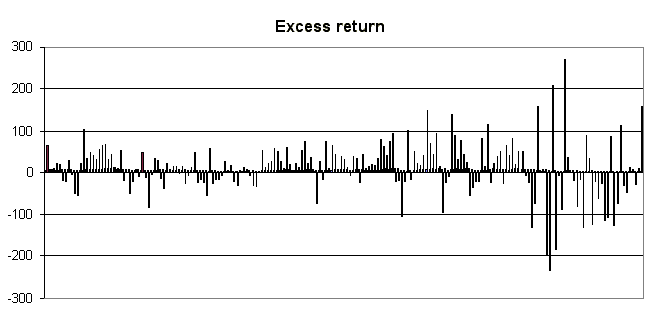
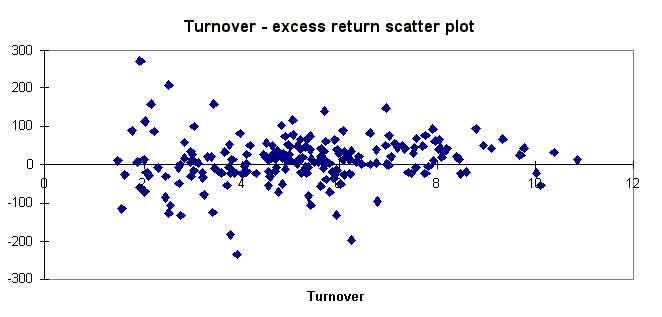
Table 5 reports the summary statistics of variables used in the time series regression. The standard deviation of the market turnover over time is about one fifth of its cross-sectional standard deviation, which reduces the power to detect time-series predictability. We can split the independent variables into two groups based on their persistence. The size, book-to-market ratio, cash flow-to-price ratio, and dividend yield are very persistent, with the 12th autocorrelation coefficient greater than 0.7. On the other hand, the autocorrelations of turnover, short-term rate, and term premium decay much faster. Figure 2 plots turnover and excess returns over the sample period. After 1986, the stock market becomes much more volatile, which will reduce the power of tests. The increase in volatility also coincides with a reduction in turnover after 1990, which makes the volatility to be decreasing in the lagged turnover on the scatter plot. Because markets returns have time-varying volatility, I will report the heteroskedasticity-consistent standard deviations in the following regressions.
Table 6 reports the time series regression results. The estimated coefficient on turnover is always positive and sometimes significant, which is consistent with the trading frequency hypothesis and is not consistent with either the information-based trading or the order-processing cost hypothesis. The point estimate of the coefficient on turnover is between 4.0 and 8.6, which is economically significant. A one-standard-deviation increase in market turnover (1.99) will increase the expected market return by more than 8%. Comparing results for two subperiods, the point estimates are similar but the standard deviation is much larger in the second period, which explains the insignificance during this period.
For other variables in the time-series regression, there is little
consistent forecasting power during this period. A higher size
will predict a higher risk premium, but the coefficient is only
significant at a 0.1 level using the whole sample period. A higher
book-to-market ratio will predict a higher risk premium in the
first subperiod but will predict a lower risk premium in the second
subperiod. The cash flow-to-price ratio can only predict the
risk premium in the second period. The dividend yield, relative
short term interest rate, and the term premium do not have any
predictive power over this period. This is consistent with results
in Campbell and Hamao (1992) where they found that, using local
variables, one cannot predict the Japanese risk premium in the
1981-1990 period.
5. Conclusion and future work
This paper studies the impact of liquidity on asset pricing and tries to find a widely accessible measure of liquidity. The results are encouraging. Using the Japanese data, I find that turnover can forecast expected stock returns and the observed relation is consistent with predictions derived from a transaction cost model. There are some empirical findings, however, are not predicted by the model and deserve future investigations. For example, why should the magnitude of the estimated price of turnover in December be the largest among all months?
References
Amihud, Yakov, and Haim Mendelson, 1986, Asset pricing and the
bid-ask spread, Journal of Financial Economics 17, 223-249.
Amihud, Yakov, and Haim Mendelson, 1989, The effects of beta,
bid-ask spread, residual risk, and size on stock returns, Journal
of Finance 44, 479-486.
Brennan, Michael J., Tarun Chordia, and Avanidhar Subrahmanyam,
1996, Cross-sectional determinants of expected returns, working
paper, UCLA.
Brennan, Michael J. and Avanidhar Subrahmanyam, 1996, Market microstructure
and asset pricing: On the compensation for illiquidity in stock
returns, Journal of Financial Economics 41, 441-464.
Campbell, John Y., 1987, Stock returns and the term structure,
Journal of Financial Economics 18, 373-400.
Campbell, John Y., and Yasushi Hamao, 1992, Predictable stock
returns in the United States and Japan: A study of long-term capital
market integration, Journal of Finance 47, 43-69.
Chan, Louis K. C., Yasushi Hamao, and Josef Lakonishok, 1991,
Fundamentals and stock returns in Japan, Journal of Finance 46,
1739-1764.
Chen, Nai-fu, and Raymond Kan, 1989, Expected return and the bid-ask
spread, working paper 265, Center for Research Security Prices,
University of Chicago.
Easley, David, Nicholas M. Kiefer, Maureen O'Hara, and Joseph
B. Paperman, 1996, Liquidity, information, and infrequently traded
stocks, Journal of Finance 51, 1405-1436.
Eleswarapu, Venkat R., 1996, Cost of transacting and expected
returns in the Nasdaq market, Journal of Finance forthcoming.
Eleswarapu, Venkat R., and Marc R. Reinganum, 1993, The seasonal
behavior of the liquidity premium in asset pricing, Journal of
Financial Economics 34, 373-386.
Fama, Eugene F., and Kenneth R. French, 1988, Dividend yields
and expected stock returns, Journal of Financial Economics 22,
3-25.
Fama, Eugene F., and Kenneth R. French, 1989, Business conditions
and expected returns on stocks and bonds, Journal of Financial
Economics 25, 23-50.
Fama, Eugene F., and James MacBeth, 1973, Risk, return and equilibrium:
Empirical tests, Journal of Political Economy 81, 607-636.
Fama, Eugene F., and G. William Schwert, 1977, Asset returns and
inflation, Journal of Financial Economics 5, 115-146.
Ferson, Wayne E., and Campbell R. Harvey, 1991, The variation
of economic risk premiums, Journal of Political Economy 99, 385-415.
Gallant, A. Ronald, Peter E. Rossi, and George Tauchen, 1992,
Stock prices and volume, Review of Financial Studies 5, 199-242.
Hawawini, Gabriel A., 1991, Stock market anomalies and the pricing
of equity on the Tokyo Stock Exchange, in William T. Ziemba, Warren
Bailey, and Yasushi Hamao ed. Japanese Financial Market Research,
Elsevier Science Publishers B.V.
Haugen, Robert A., and Nardin L. Baker, 1996, Commonality in the
determinants of expected stock returns, Journal of Financial Economics
41, 401-439.
Hiemstra, Craig, and Jonathan D. Jones, 1994, Testing for linear
and nonlinear Granger causality in the stock price-volume relation,
Journal of Finance 49, 1639-1664.
Huang, Roger D., and Hans R. Stoll, 1996, Revenues of immediacy
suppliers versus execution costs of investors: Evidence from the
NYSE, working paper, Financial Markets Research Center, Vanderbilt
University.
Kane, Alex, 1994, Trading cost premiums in capital asset returns
- A closed form solution, Journal of Banking and Finance18, 1177-1183.
Kothari, S.P., and Jay Shanken, 1995, Book-to-market, dividend
yield, and expected market returns: A time-series analysis, working
paper.
Petersen, M., and D. Fialkowski, 1994, Posted versus effective
spreads: good prices or bad quotes, Journal of Financial Economics
35, 269-292.
Rogalski, Richard J., 1978, The dependence of prices and volume,
Review of Economics and Statistics 60, 268-274.
Rozeff, Michael, 1984, Dividend yields are equity risk premiums,
Journal of Portfolio Management 11, 68-75.
Sakakibara, Shigeki, Hidetoshi Yamaji, Hisakatsu Sakurai, Kengo
Shiroshita, and Shimon Fukuda, 1988, The Japanese Stock Market:
Pricing Systems and Accounting Information, Praeger Publishers.
Teh, Lillyn L., and Werner F.M. De Bondt, 1996, Herding behavior and stock returns: An exploratory investigation, working paper.
PREMIUM is the annualized monthly equity premium
of month t in percentage which is the difference between stock
returns of month t and short term interest rates at the end of
month t-1. The short term interest rate used is the unconditional
call rate before February 1977 and is the one month Gensaki rate
(REPO) after that. MTURN is the annualized monthly turnover which
is the number of shares traded during the month divided by the
shares outstanding at the end of the month in ten shares. M is
the market value of equity at the end of month in millions. B/M
is the book-to-market ratio where B is the book value of equity
in millions. C/P is the cash flows-to-price ratio where C is
the net income plus depreciation expenses per share in cents and
P is the closing stock price at the end of month. The sample
period is from April 1976 to March 1993 and the whole sample size
is 272490 stock/month.
| ||||
| PREMIUM | 9.209 | 137.039 | -929.982 | 5056.000 |
| TURN | 5.110 | 10.787 | 0.0004 | 624.855 |
| LOG(M) | 10.551 | 1.607 | 6.016 | 17.479 |
| LOG(B/M) | -0.996 | 0.659 | -8.371 | 2.353 |
| LOG(C/P) | 1.796 | 0.840 | -4.515 | 6.619 |
| TURN | -0.017 | |||
| M | -0.020 | -0.007 | ||
| B/M | 0.036 | -0.218 | -0.142 | |
| C/P | 0.019 | -0.085 | -0.069 | 0.322 |
| LOG(TURN) | -0.007 | |||
| LOG(M) | -0.046 | 0.119 | ||
| LOG(B/M) | 0.035 | -0.296 | -0.280 | |
| LOG(C/P) | 0.035 | -0.172 | -0.339 | 0.561 |
I use the Fama-MacBeth two step procedure. In the first step, I get the OLS estimates by running the following cross-sectional regression for each month from 1976/4 to 1993/3,
E(ri) = + TURN TURNi,
where ri is the annualized excess monthly
return in percentage for stock i, TURNi is stock i's
turnover (number of shares traded for each ten outstanding share)
during the previous month. In the second step, I estimate and
report the simple average or the weighted average (the weight
is the inverse of its standard deviation estimated from the first
step) of the time series of estimates. Numbers in parentheses
are standard deviation. * denotes the coefficient
is significantly different from zero at a 0.1 level and **
denotes significance at a 0.05 level.
| Sample size |
|
|
| |||
| 76/4-93/3 | -0.375**
(0.093) | -0.371**
(0.072) | -0.554**
(0.202) | -0.612**
(0.124) | -0.378 (0.385) | -0.734**
(0.213) |
| 76/4-84/9 | -0.369**
(0.095) | -0.376**
(0.079) | -0.679**
(0.171) | -0.653**
(0.139) | -0.847**
(0.339) | -0.928**
(0.258) |
| 84/10-93/3 | -0.381**
(0.160) | -0.361**
(0.133) | -0.430 (0.368) | -0.556**
(0.215) | 0.091 (0.691) | -0.533 (0.340) |
I use the Fama-MacBeth two step procedure. In the first step, I get the OLS estimates by running the following cross-sectional regression for each month from 1976/4 to 1993/3,
E(ri) = + TURN TURNi + MKT MKTi + BM BMi + CP CPi,
where ri is the annualized excess monthly
return in percentage for stock i, TURNi is stock i's
turnover (number of shares traded for each ten outstanding share)
during the previous month, MKT is the log of market value of equity
at the end of the previous month, BM is the log of the book-to-market
ratio (book value of equity divided by its market value), and
CP is the log of the cash flow-to-price ratio (the sum of earnings
and depreciation divided by the market value of equity). In
the second step, I estimate and report the simple average or the
weighted average (the weight is the inverse of its standard deviation
estimated from the first step) of the time series of estimates.
Numbers in parentheses are standard deviation. *
denotes the coefficient is significantly different from zero at
a 0.1 level and ** denotes significance at a 0.05 level.
The 'test equality' row reports the t value in testing whether
the average are equal over two subperiods.
| 76/4-93/3 | -0.243**
(0.099) | -2.588**
(1.089) | 5.382**
(1.496) | 2.271**
(0.746) | -0.302**
(0.067) | -0.800 (1.020) | 5.690**
(1.292) | 2.473**
(0.667) |
| 76/4-84/9 | -0.327**
(0.083) | -2.180 (1.346) | 1.049 (2.100) | 1.909*
(0.976) | -0.333**
(0.070) | -0.313 (1.231) | 1.832 (1.862) | 2.165**
(0.884) |
| 84/10-93/3 | -0.158 (0.180) | -2.996*
(1.717) | 9.715**
(2.054) | 2.633**
(1.133) | -0.252**
(0.125) | -1.263 (1.622) | 8.920**
(1.742) | 2.770**
(1.001) |
| t value for H0:
76-84=84-93 | 0.565 | 0.374 |
2.950 | 0.484 | 0.853 | 0.467 | 2.780 |
0.453 |
| January | 0.053
(0.235) | -7.585*
(4.043) | 2.475 (3.706) | 3.864*
(2.157) | 0.063 (0.197) | -4.108 (4.215) | 3.714 (3.415) | 4.484**
(1.672) |
| February | 0.629 (0.708) | -9.486**
(3.343) | 2.599 (3.661) | 3.331 (3.409) | 0.079 (0.287) | -9.060**
(3.137) | 3.138 (3.519) | 2.230 (2.723) |
| March | -0.557**
(0.251) | 7.932*
(4.304) | 14.529**
(3.710) | 1.391 (2.772) | -0.279 (0.281) | 6.561*
(3.742) | 13.225**
(3.647) | 1.645 (2.791) |
| April | -0.244 (0.203) |
0.673 (3.876) | 12.999**
(4.089) | 5.798**
(2.803) | -0.193 (0.166) | 1.483 (3.640) | 11.730**
(4.193) | 6.943**
(2.653) |
| May | -0.113 (0.188) |
-12.958**
(2.973) | 1.825 (6.129) | 2.105 (2.539) | -0.211 (0.176) | -10.999**
(3.071) | 3.295 (5.234) | 2.285 (2.594) |
| June | -0.550**
(0.240) | -8.278**
(2.654) | 9.548*
(4.940) | 2.860 (1.875) | -0.673**
(0.237) | -6.539**
(2.359) | 11.057**
(4.784) | 1.087 (1.819) |
| July | -0.048 (0.214) |
-3.394 (4.272) | 8.957 (7.012) | -0.430 (2.460) | -0.318 (0.196) | 0.671 (4.218) | 7.799 (5.404) | 2.140 (2.410) |
| August | 0.051 (0.354) |
3.333 (4.431) | -0.493 (6.301) | -1.468 (2.445) | -0.098 (0.199) | 5.121 (3.845) | 2.641 (5.443) | -0.597 (2.221) |
| September | -0.442 (0.369) | 2.213 (2.641) | 7.061 (5.809) | 2.571 (2.220) | -0.498**
(0.239) | 3.328 (2.723) | 8.187 (5.143) | 3.356 (2.163) |
| October | -0.209 (0.450) | -4.164 (3.492) | -3.691 (5.883) | -0.209 (0.450) | -0.361 (0.334) | -0.563 (3.389) | -1.899 (4.738) | 2.763 (2.182) |
| November | -0.451*
(0.271) | -1.076 (2.754) | 1.365 (3.225) | -1.086 (2.361) | -0.220 (0.222) | -0.122 (2.574) | 1.510 (3.147) | -0.563 (2.220) |
| December | -1.030**
(0.189) | 1.738 (3.591) | 7.405 (5.696) | 2.720 (3.043) | -1.003**
(0.165) | 2.852 (3.181) | 4.985 (4.547) | 3.874*
(2.141) |
| Deleting December | -0.171 (0.105) | -2.981**
(1.140) | 5.198**
(1.553) | 2.230**
(0.768) | -0.244**
(0.070) | -1.192 (1.075) | 5.768**
(1.351) | 2.323**
(0.703) |
I estimate the piece-wise price of turnover using the Fama-MacBeth two step procedure. In the first step, I run the following cross-sectional regression for each month from 1976/4 to 1993/3,
ri = 1 D1i + 2 D2i + 3 D3i + 1 TURNi D1i + 2 TURNi D2i + 3 TURNi D3i + MKT MKTi + BM BMi + CP CPi,
where ri is the excess monthly return
in percentage for stock i, TURNi is stock i's turnover
(number of shares traded for each ten outstanding share) during
the previous 12 months, D1i equals 1 if the turnover
of stock i falls within the first 30th percentile
and 0 otherwise, D2i equals 1 if the turnover of stock
i falls between the 30th percentile and the 70th
percentile and 0 otherwise, D3i equals 1 if the turnover
of stock i is greater than the 70th percentile and
0 otherwise, MKT is the log of market value of equity at the end
of the previous month, BM is the log of book-to-market ratio (book
value of equity divided by its market value), and CP is the log
of cash flow-to-price ratio (the sum of earnings and depreciation
divided by the market value of equity). In the second step,
I estimate and report the simple average or the weighted average
(the weight is the inverse of its standard deviation estimated
from the first step) of the time series of estimates. Numbers
in parentheses are standard deviation of average. *
denotes the coefficient is significantly different from zero at
a 0.1 level and ** denotes significance at a 0.05 level.
| 76/4-93/3 | 5.780
(3.562) | -0.651 (0.916) | -0.355**
(0.079) | |||
| 2.998 (3.432) | 0.057 (0.838) | -0.301**
(0.076) | -2.826**
(1.086) | 4.904**
(1.440) | 2.151**
(0.715) | |
| 76/4-84/9 | 2.787 (3.650) | -1.895 (1.220) | -0.266**
(0.087) | |||
| 1.628 (3.377) | -1.374 (1.080) | -0.265**
(0.085) | -2.164 (1.341) | 0.559 (1.986) | 1.776*
(0.967) | |
| 84/10-93/3 | 8.773 (6.125) | 0.593 (1.362) | -0.444**
(0.131) | |||
| 4.367 (5.991) | 1.489 (1.270) | -0.336**
(0.127) | -3.489**
(1.713) | 9.249**
(2.003) | 2.527**
(1.057) |
| 76/4-93/3 | -0.582
(2.236) | -1.002*
(0.592) | -0.288**
(0.060) | |||
| -2.917 (2.054) | -0.386 (0.544) | -0.259**
(0.057) | -0.932 (1.017) | 5.402**
(1.238) | 2.367**
(0.641) | |
| 76/4-84/9 | -1.235 (2.906) | -1.887**
(0.877) | -0.288**
(0.070) | |||
| -2.429 (2.649) | -1.429*
(0.777) | -0.273**
(0.069) | -0.239 (1.225) | 1.241 (1.753) | 2.012**
(0.871) | |
| 84/10-93/3 | -0.356 (3.256) | -0.346 (0.803) | -0.289**
(0.108) | |||
| -3.084 (2.996) | 0.362 (0.759) | -0.232**
(0.101) | -1.592 (1.619) | 8.666**
(1.687) | 2.706**
(0.943) |
| PREMIUM | 10.293 | 61.361 | -235.183 | 270.489 | 0.059 | 0.038 |
| TURN | 5.268 | 1.989 | 1.484 | 10.858 | 0.816 | 0.333 |
| MKT | 11.592 | 0.806 | 10.298 | 12.888 | 0.991 | 0.878 |
| BM | -0.871 | 0.317 | -1.645 | -0.409 | 0.979 | 0.702 |
| CP | 1.989 | 0.383 | 1.130 | 2.493 | 0.985 | 0.810 |
| DP | 0.970 | 0.380 | 0.341 | 1.559 | 0.988 | 0.834 |
| SR | -0.157 | 1.200 | -3.595 | 5.652 | 0.893 | -0.128 |
| TERM | 0.872 | 1.146 | -3.352 | 3.989 | 0.872 | -0.091 |
I estimate the following time-series regression for
the period from 1976/4 to 1993/3,
rt = 1 + TURN TURNt-1
+ MKT MKTt-1 + BM BMt-1
+ CP CPt-1 + DP DPt-1
+ RF SRt-1 + TERMTERMt-1,
where rt is the excess equal-weighted
market annualized monthly return in percentage at month t, TURNt
is equal-weighted market annualized monthly turnover (number of
shares traded for each ten outstanding share), MKT is the log
of the equal-weighted market value of equity at the end of the
month, BM is the log of the equal-weighted book-to-market ratio
(book value of equity divided by its market value), CP is the
log of the equal-weighted cash flow-to-price ratio (the sum of
earnings and depreciation divided by the market value of equity),
DP is the equal-weighted dividend yield, SR is the annualized
one month interest rate minus the moving average of its twelve
lags, and TERM is the ten year government bond yield minus the
one month interest rate. Numbers in parentheses are heteroskedasticity
consistent standard deviation. * denotes the coefficient
is significantly different from zero at a 0.1 level and **
denotes significance at a 0.05 level.
| 4.006*
(2.381) | 0.012 | ||||||
| 7.530**
(3.345) | 18.881*
(10.386) | 13.165 (45.086) | 40.691 (37.699) | 0.014 | |||
| 4.629*
(2.593) | 11.835 (13.160) | -1.290 (3.833) | -3.963 (3.681) | 0.004 | |||
| 8.129**
(3.699) | 27.543 (20.254) | 18.704 (45.385) | 19.252 (43.130) | 37.651 (61.847) | 0.780 (3.660) | -2.107 (3.850) | 0.002 |
| 3.981**
(1.606) | 0.026 | ||||||
| 8.607**
(2.632) | 6.173 (11.375) | 133.105**
(48.083) | -29.767 (35.261) | 0.077 | |||
| 4.347**
(2.000) | 8.530 (28.149) | -0.183 (2.778) | -1.717 (2.963) | 0.001 | |||
| 4.074 (3.438) | -56.654 (39.393) | 268.684**
(96.100) | 12.999 (54.832) | -195.054 (119.068) | 1.209 (2.680) | -1.984 (3.135) | 0.082 |
| 4.025
(3.465) | 0.004 | ||||||
| 6.540 (5.120) | 91.352 (60.930) | -195.029*
(109.273) | 340.835**
(160.418) | 0.031 | |||
| 6.675*
(3.919) | 89.094 (30.458) | 5.860 (12.253) | -4.618 (10.287) | 0.010 | |||
| 4.480 (4.748) | 216.236**
(83.529) | -388.912**
(154.136) |
358.858*
(185.418) | 485.412 (302.132) | 1.644 (21.923) | -6.977 (15.760) | 0.063 |
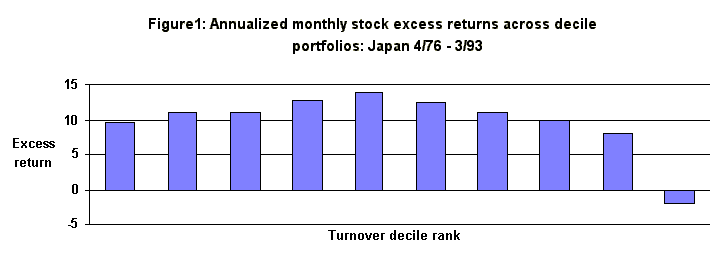
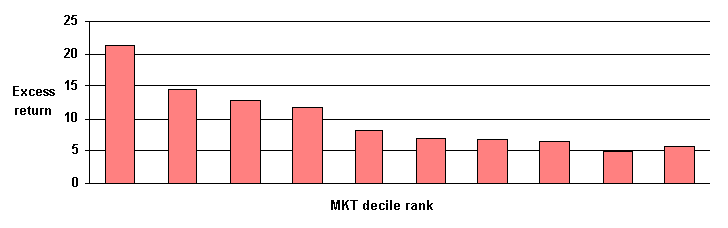
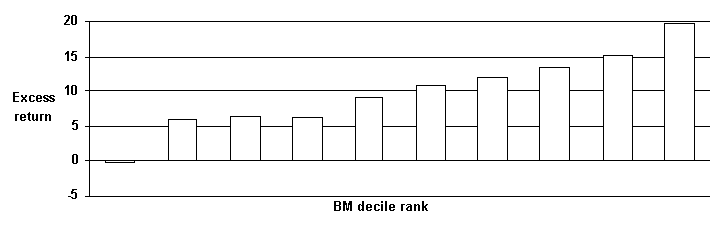
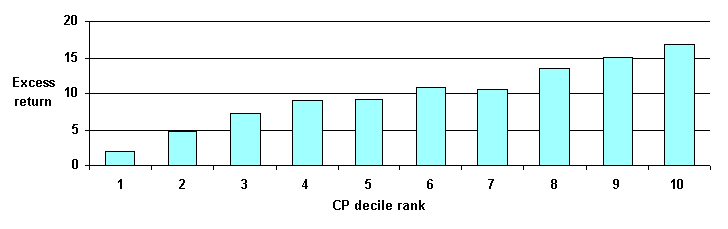
Figure 2. Annualized monthly equal-weighted market average
in Japan: 76/4 - 93/3