 (1)
(1)
Crop Yield and Price Distributional Effects on Revenue Hedging
Abstract
The use of crop yield futures contracts is examined. The expectation being modeled here reflects that of an Illinois corn and soybeans producer at planting, of revenue realized at harvest. The effects of using price and crop yield contracts are measured by comparing the results of the expected distribution to the expected distribution found under five general alternatives: 1) a revenue hedge using just price futures, 2) a revenue hedge using crop yield futures, 3) an unhedged scenario where revenue is determined by realized prices and yields, 4) an unhedged scenario where revenue is determined by realized prices and yields and by participation in government support programs with deficiency payments, and 5) a no hedge scenario where revenue is determined by realized prices and yields and by participation in a proposed revenue-assurance program.
We draw four major conclusions from the results. First, hedging effectiveness using the new crop yield contract depends critically on yield basis risk which presumably can be reduced considerably by covering large geographical areas. Second, crop yield futures can be used in conjunction with price futures to derive risk management benefits significantly higher than using either of the two alone.
Third, hedging using price and crop yield futures has a potential to offer benefits larger than those from the simulated revenue assurance program. However, the robustness of the findings depends largely on whether yield basis risk varies significantly across regions. Finally, the qualitative results described by the above three conclusions do not change depending on whether yields are distributed according to the beta or lognormal distribution.
Crop Yield and Price Distributional Effects
on Revenue Hedging
Viswanath Tirupattur, Robert J. Hauser and Nabil M. Chaherli
Crop producers face both price risk and yield risk. Producers use futures and options markets directly, as well as indirectly through secondary contracts offered by grain merchandisers. However, similar private-sector instruments for managing output risk have not been commonly available. On the other hand, federal agricultural support programs such as deficiency and non-recourse loan programs as well as subsidized crop yield insurance programs have provided output risk management mechanisms. In June 1995, a private-market alternative for production and income stabilization became available in the form of new crop yield futures and options.
Corn yield futures and options began trading at the Chicago Board of Trade (CBOT) in June 1995 on the basis of the USDA reported estimate of the average state yield in Iowa. The value of the contract is the traded yield (in bushels) times $100. There were two expiration months -- September and January -- when the contract is cash settled based on the USDA September and January corn yield reports. In 1996, additional corn yield contracts were added on the basis of Illinois yield, Indiana yield, Ohio yield, Nebraska yield, and U.S. yield. Additional expiration months were also specified.
The use of yield contracts for hedging production is often discussed in one of two contexts. The first context involves the direct use of the contract by the producer. The second context involves the indirect use by the producer through either, for example, elevators offering a forward contract or through insurance companies offering revenue or production insurance. Indeed, the yield contract is often referred to as a "yield insurance contract".
The general purpose of the present analysis is to provide insight
into the potential effects of using the yield futures contract
in conjunction with the price futures contract on the expected-
revenue distribution facing the producer. The model reflects
the expectation of revenue to be realized by an Illinois corn
and soybean producer making planting decisions in March. The
effects of using price and yield contracts are measured by comparing
the resulting expected distribution to the expected distribution
found under five general alternatives: (1) a revenue hedge using
just price futures, (2) a revenue hedge using just yield futures,
(3) a no-hedge scenario where revenue is determined by realized
price and yield, (4) a no-hedge scenario where revenue is determined
by the market and by participating in the former deficiency-payment
government support program, and (5) a no-hedge scenario where
revenue is determined by the market and by participating in a
hypothetical revenue-assurance government support program.
Data and Methods
We analyze the revenue distributions resulting from the use of price and yield futures and from participation in government support programs by simulating the revenue functions in each case. A general description of the approach is as follows. Most of the analysis is done under the assumption that prices and yields follow a lognormal distribution. A vector V, consisting of cash prices and yields of corn and soybeans is generated by using a linear transformation of i.i.d. univariate standard normal variate based on a variance-covariance matrix estimated from central Illinois county level data for corn and soybeans. Futures prices and yields are then generated, conditional on the corresponding cash prices and yields. Thus each pair of cash and futures is assumed to follow a bi-variate lognormal distribution, resulting in another vector FV, consisting of futures prices and yields. Revenue distributions are then found from the two vectors, V and FV. Another general scenario is considered in which the distributional assumption of yield lognormality is changed such that yields follow the beta distribution.
Under lognormality for both yields and prices, we first generate V= (pc, yc, ps, ys), where pc, yc, ps, ys represent cash prices and yields of corn and soybeans with mean vector : and a variance-covariance matrix E; : and E are defined in terms of changes in natural logs, implying lognormality of prices and yields in levels and allowing the use of Choleski decomposition for generating the vector V with the required variance-covariance matrix. The Choleski decomposition means that for every positive definite square matrix (e.g., E), there exists a unique lower triangular matrix T such that TT==E. If X 6 N(0,1) and T is the matrix from Choleski decomposition, then W=TX + : is distributed as N(:,E). We use a matrix of four i.i.d univariate standard normal random variates with a sample size of 10,000 draws each to obtain W. Exponentiating W produces the desired vector V.
A variance-covariance matrix was estimated using sample data on cash prices and yields for Champaign county, Illinois, for the period 1972-93. Yield data were obtained from various issues of the Illinois Agricultural Statistics (Illinois Cooperative Crop Reporting Service) and price data were obtained from the Illinois Agricultural Marketing Service. The estimation was done using log changes in cash prices and yields. The estimated variance-covariance matrix and correlation matrix are reported in Tables 1 and 2.
Futures prices and yields corresponding to cash prices and yields are generated using a procedure suggested by Hull. The procedure is similar to that used for generating the vector V, differing only in the sense that, instead of E, only pairwise correlation coefficients ( Di ) are required. The pairwise correlation coefficients reflect basis risk. When Di is one, there is no basis risk and futures and cash processes are identical. As Di decreases, basis risk increases.
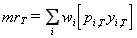
Using vectors V and FV, revenue realizations can
be computed for any given set of expected prices and yields and
policy parameters. Revenue from using just cash markets, mrT
is computed as:
(1)
where wi is the proportion of ith crop (i=1,2)
on the farm and T is the terminal time period. Revenue
from hedging using price and yield futures, hrP-Y,T,
is found by:
 (2)
(2)where hrp,i and hry,i are price and yield hedge ratios, Et (yi,T) and Et (pi,T) are expectations made at time t about terminal yields and prices, Pi,t is the new-crop futures price for crop i at time t, and Yi,t is the yield futures for crop i at time t. The second and third terms in (2) describe the income generated in the price and crop yield futures markets. For example, assume the price hedge ratio is one. The hedge is placed by establishing a short position in the price futures market equal to Et (yi,T)*Pi,t. The hedge is maintained until contract expiration when the futures position is offset at the value equal to Et (yi,T)*Pi,T. Likewise, assume the yield hedge ratio is one. A short position is established in the yield futures market equal to Et(pi,T)*Yi,t , which is offset at Et (pi,T)*Yi.T. In this illustration, where the two hedge ratios are equal to one, a Afull hedge@ is described because the quantity established in the price hedge is the expected yield and the price established in the yield hedge is the expected price. A Apartial hedge@ is described by setting 0<hrp,i <1 and /or 0<hry,i<1. Setting hrp,i to zero results in a Apure@ yield hedge and setting hry,i to zero results in a Apure@ price hedge.
Revenue from participation in the 1990 Farm Bill government support
programs, rdlT,
can be described as:
 (3)
(3)where LR is the loan rate, PgmYi is the program yield, ARP and Flex are the percentages of setaside acres and flex acres, and TP is the target price. The first term describes the revenue payout from the non-recourse loan program while the second term describes revenue from deficiency payments. There are no deficiency payments for soybeans.
Revenue from a hypothetical revenue assurance program, raT,
is described by:
 (4)
(4)
where 2 is the coverage level (proportion) assured under the revenue assurance program and Z is the target gross revenue. Note that the target gross revenue applies to individual crop income as opposed to farm income.
Although the above approach has advantages of tractability, simulating net revenues based on jointly normal or lognormal prices and yields may not reflect the true data generating process well. The assumption of normality in crop yields is of particular concern (e.g., Buccola).
The simulation of independent variables with nonnormal distributions can be done easily for a range of distributions. However, imposing dependence in the construction of continuous multivariate distributions with specified marginal distributions of individual variables is challenging. Johnson and Tenenbein propose a solution to this problem using a weighted linear combination method for constructing families of bivariate distributions F(x,y) with specified marginal distributions F1(x) and F2(x), and a level of dependence specified by Spearman=s coefficient r. A pair of random variables (X,Y) with marginal distributions F1(x) and F2(x) are generated as follows.
Let U = U= and V = cU=
+ (1-c)V=, where U=
and V= are independent
and identically distributed with a common density function g(t),
and c is a constant in the interval [0,1]. Johnson and Tenenbein
provide the required values of c as a function of r and the particular
specification of g(t). Let X=
= H1(U) and Y=
= H2(V), where H1(U) and H2(V)
are the distribution functions of U and V respectively. Now define
the following.
X = F1-1(X=) = F1-1(H1(U)),
Y = F2-1(Y=) = F2-1(H2(V)), (for a positive value of r)
Y = F2-1(1-Y=)
= F2-1(1-H2(V)), (for a negative
value of r).
Since X=, Y= and 1-Y= are uniformly distributed over the interval [0,1], Johnson and Tenenbein note that X and Y will have a joint distribution with marginals F1(x) and F2(x) respectively. Therefore, for the purpose of simulation, all that is required is the knowledge of the two marginal distributions.
We apply this procedure for generating revenue distributions by
drawing from three bivariate distributions relating (1) cash yields
and cash prices, (2) cash price and futures prices and (3) cash
yields and futures yields. We chose the standard normal distribution
for the underlying density function g(t) which is used in the
three random generation procedures. Interdependence between the
bivariate distributions is specified in the simulations using
c with g(t). Levels of c are obtained by solving for it in the
following function of r:
 (5)
(5)
The simulations were performed using SHAZAM (version 7.0) software program using 10,000 trails. An evaluation of the distribution using the Bestfit program (which describes any given sample data using about 25 alternative distributions providing ranks for the best fitting distribution) indicated that corn and soybean yields in Champaign county are best described by the beta distribution. In other words, among the 25 alternative distributions considered, the beta distribution was found to be the best fit for the sample data.
The hedging analyses were conducted under the assumption that an Iowa corn yield contract and an Illinois soybean yield contract can be used. This assumption was made last year, and reflects our (incorrect) prediction about the type of contracts that would be available to Illinois producers in 1996.
Results
Gross revenue realizations are computed for each of the marketing strategies described above. A fixed level of cost, representing all production costs except land costs, is subtracted from each gross revenue realization to compute net revenue realizations. The parameter values used for the simulation analysis are described in Table 3. The resulting distributions are analyzed in two contexts -- hedging effectiveness (HE) and the frequency distribution of net revenue realizations. HE indicates the level of variance reduction achieved through the use of a risk management tool, and is measured here in a way that requires explicit incorporation of basis risk. HE is computed as: [1- (VAR(HR)/VAR(UHR))] where VAR is the variance operator, HR is the hedged revenue and UHR is the unhedged revenue3.
We first illustrate the impact of yield basis risk. Recall that basis risk is reflected in the simulations through Dcp , Dcy, Dsp, and Dsy; i.e., the correlation coefficients between the intra-year changes in the Wiener processes associated with the cash and futures processes of corn prices and yields, and of soybean prices and yields. It is expected that the largest source of basis uncertainty for a Champaign county cash grain farm pertains to corn yield basis. We compute revenue realizations following equation (2) using a range of values for Dcy (0.2 to 1.0) but holding the values of Dcp , Dsp and Dsy constant at 0.973, 0.995 and 0.876. The resulting frequency distributions and the corresponding HE measures are reported in Table 4. As Dcy increases the resulting revenue distribution tightens. Correspondingly, HE increases from 0.23 to 0.92 as Dcy increases from 0.2 to 1.0, indicating that hedging effectiveness for a producer using crop yield futures depends critically on the yield basis risk. It is important to emphasize in this context that, unlike cash and futures prices which tend to be highly correlated, farm yields are not necessarily correlated highly with the state average yield (Iowa for corn and Illinois for soybeans). This implies that even though price basis risk does not vary widely across the Midwest, yield basis risk may vary substantially and thus the effectiveness of the yield hedge for individual producers may vary by location even within the Midwest. The ability to widen the geographical area to reduce basis risk may prove particularly useful when using yield futures. For example, large grain companies or insurers may be able to reduce basis risk considerably by covering large areas, and then offer secondary contracts to producers that reflect this decreased basis risk. In the subsequent analysis, Dcy is fixed at 0.621 which is the estimated correlation coefficient between the changes in corn yields for Champaign county and Iowa.
Above, the hedge ratios for both price and yield contracts are assumed to be one, implying a full hedge. We search for Aoptimal hedge ratios@ for the price and yield contracts by parametrically varying the hedge ratios associated with price and yield for corn and soybeans separately from 0.0 to 1.0 in discrete intervals of 0.1. Values of HE under alternatives parametric assumptions of hedge ratios are presented in Tables 5 and 6. The first column in both tables represents hedging effectiveness using a pure price hedge, and the first row represents hedging effectiveness using a pure yield hedge. For corn, the Aoptimal@ hedge ratios for pure price and yield hedges are 0.6 and 0.4 respectively, resulting in a HE of only 28 percent and 11 percent respectively. For soybeans, the Aoptimal@ hedge ratios for pure price and yield hedges are 0.7 and 0.4 respectively, resulting in a HE of 53 percent and 10 percent respectively. However, if both crop yield and price futures are used, HE increases considerably. In the case of corn, HE increases to about 50 percent using a combination of price (0.7 hedge ratio) and crop yield (0.5 hedge ratio) futures contracts. Similarly, for soybeans, HE increases to 86 percent using a combination of price (0.9 hedge ratio) and crop yield (0.8 hedge ratio) futures contracts. Thus these results suggest that price and crop yield futures can be used together to achieve significant improvements in risk management benefits.
Expected net revenue distributions from cash marketing and various hedging strategies using Aoptimal hedge ratios@ are compared to those resulting from government programs in Table 7 in terms of discrete probability densities. The probabilities associated with the scenario where revenue is determined by just realized price and realized yield (i.e., no hedging or government program participation) are presented in the NMR column. NHR1, NHR2 and NHR3 represent hedging results using both price and yield futures (NHR1), a pure price hedge (NHR2), and a pure yield hedge (NHR3). NRDL and NRA represent the expected distribution associated with a deficiency and loan program (NRDL) and with a revenue assurance program (NRA). When no hedging strategies are used (NMR), the probability of receiving a net revenue of $45 to $70 is 7.5%. When hedging with both price and yield contracts, the probability falls to 0.1%. Examination of Table 7 provides perspective on how the use of price and yield contracts causes the market revenue distribution to collapse. The mean remains at about $134 while, as expected, the distribution becomes progressively tighter with the use of yield contracts (NHR3), price contracts (NHR2), and then yield and price contracts (NHR1).
In a safety-first context where, say, $95 is the threshold level, the probability of receiving less than the threshold level is 24.2% in the no-hedge scenario, NMR. Hedging with the yield contract reduces the probability to 22.3%. The use of just price contracts reduces it to 17.7%, and the use of both contracts reduces it to 8%.
Under 70% revenue assurance, the mean increases slightly from about $134 to $135.5 and the probability of revenue at the lower end of the distribution goes to zero. The probability of receiving revenue less than the $95 threshold is quite high, as much as 24.2%. The overall risk-reduction effect seems minimal. Note that the expected average gross revenue is about $262 per acre and thus the 70% revenue assurance level is about $183. After accounting for non-land costs, the assured net revenue is about $60. Consequently, because of the relatively low threshold levels and because of the offsetting effects of corn and soybeans, the truncating effect on the net revenue distribution is not large.4
The expected distribution associated with participation in the deficiency-payment program (NRDL) is scaled considerably higher than the others, resulting in a mean of about $170. The probability of falling below $95 is 2.3%.
An important point when comparing the free market distributions to either of the distributions involving government programs involves the "stability" of the results across regions. The underlying basis risk of price hedges and particularly yield hedges may vary considerably from region to region, presumably causing the comparative results between non-program and program distributions to be sensitive to location.
Finally, one perspective on the impact of changing the yield distribution assumption from lognormality to beta is offered by comparing the HE results under beta to those under lognormality. Tables 8 and 9 show the results using the beta assumption. The pure price-hedge results are similar to those of Tables 6 and 7 because lognormality in prices is used in all cases, although they are not exactly the same because Arevenue,@ not Aprice,@ is being hedged. For the pure yield hedges, the results under lognormality indicated that a small amount of variance reduction could be obtained by hedging at the 0.4 level. Under beta, pure yield hedges at any level increase the revenue variance. When using both the price and yield contracts, the Aoptimal hedge@ for corn is at the hedge ratios of 1.0 for price and 0.6 for yield (versus 0.7 and 0.5 under lognormality), causing the HE measure to increase to about 39%. For soybeans, the optimal hedge ratios are 1.0 in price and 0.9 in yield (versus 0.9 and 0.8 under lognormality), causing HE to increase to 85%.
Regardless of whether yields are lognormal or beta, the HE measure
increases considerably by using both yield and price contracts
as opposed to using just one of the contracts. However, care
should be taken in the comparison of HE levels across the different
distributional scenarios because the initial variance that is
being reduced has different meanings and because they are at different
levels. Nonetheless, the general results are the same in that
(1) there is little to be gained in revenue hedges from using
just the yield contract, (2) price hedges provide much more revenue
protection than yield hedges, (3) combining the two contracts
increases hedging effectiveness considerably, and (4) the optimal
hedging ratios for the combined contract use are Ain
the same ballpark,@
regardless of whether lognormality or beta is assumed.
Conclusions
We draw four major conclusions from the results. First, hedging
effectiveness using the new crop yield contract depends critically
on yield basis risk which presumably can be reduced considerably
by covering large geographical areas. Second, crop yield futures
can be used in conjunction with price futures to derive risk management
benefits significantly higher than using either of the two alone.
Third, hedging using price and crop yield futures has a potential
to offer benefits larger than those from the simulated revenue
assurance program. However, the robustness of the findings depends
largely on whether yield basis risk varies significantly across
regions. Finally, the qualitative results described by the above
three conclusions do not change depending on whether yields are
distributed according to the beta or lognormal distribution.
References
Buccola, S., ATesting
for Non-Normality in Farm Net Returns.@
American Journal of Agricultural Economics 68 (1986),
pp. 334-343.
Hauser, R.J., P. Garcia and Tumblin. ABasis
Expectations and Soybean Hedging Effectiveness.@
North Central Journal of Agricultural Economics 12 (1990),
pp. 125-136.
Hull, J.C. Options, Futures and Other Derivative Securities,
2nd ed. Englewood Cliffs, NJ: Prentice-Hall Inc, 1993.
Johnson, M.E. and A. Tenenbein, AA
Bivariate Distribution Family with Specified Marginals.@
Journal of American Statistical Association 76 (1981),
pp. 198-201.
Illinois Cooperative Crop Reporting Service. Illinois Agricultural
Statistics, Springfield. Various issues 1965-94.
Tong, Y. The Multivariate Normal Distribution, New York:
Springer-Verlag, 1990.
Table 1. Sample Variance-Covariance Matrix Used to Estimate the Cash Prices and Yields
____________________________________________________________________________
)pC )yc )ps )ys ____________________________________________________________________________
)pC 0.047357
)yC -0.01915 0.047691
)ps 0.035028 -0.01527 0.037954
)ys -0.01369 0.023965 -0.01025 0.019965
____________________________________________________________________________
Table 2. Implied Sample Correlation Coefficient Matrix
____________________________________________________________________________
)pC )yc )ps )ys
____________________________________________________________________________
)pC 1.000
)yC -0.403 1.000
)ps 0.826 -0.359 1.000
)ys -0.445 0.777 -0.372 1.000
_____________________________________________________________________________
Table 3. Parameter Values Used in the Simulations
___________________________________________________________________
Corn Soybeans
___________________________________________________________________
Expected Price ($/Bu): 2.10 5.79
Expected Yields (Bu/Acre) 131.08 42.16
Cash-Futures Correlations:
- price 0.973 0.995
- yield 0.621 0.876
Proportion of acreage in the farm 0.58 0.42
Target price ($/Bu) 2.75 -
Loan rate ($/Bu) 2.00 5.00
ARP (%) 10 -
Flex (%) 15 -
Revenue assurance level 0.70 0.70
Costs per acre ($) 155.20 81.04
(Excluding land rents)
__________________________________________________________
Table 4. Effect of Yield Basis Risk on Net Revenue Probability Density Functions
(Hedging using price and yield futures)
_______________________________________________________________________
Net Dcy Dcy Dcy Dcy Dcy
Revenue (0.2) (0.4) (0.621) (0.8) (1.0)
_______________________________________________________________________
< 45 3.4 2.2 0.8 0.1 0.0
4570 5.3 3.8 2.7 1.0 0.1
70 95 10.4 10.5 8.6 5.9 1.3
95120 17.1 18.1 20.1 21.0 13.2
120145 22.4 25.3 30.1 37.7 63.6
145170 19.4 21.0 24.0 26.4 21.2
170195 13.1 12.8 10.6 6.8 0.6
195220 6.2 4.7 2.6 1.0 0.0
220245 2.0 1.1 0.5 0.1 0.0
>245 0.7 0.3 0.1 0.0 0.0
----- ------ ------ ------ ------
100% 100% 100% 100% 100%
Mean ($) 134.17 134.19 134.20 134.19 134.15
Variance 2199 1696 1144 702 218
HE 0.229 0.406 0.599 0.754 0.923
_________________________________________________________________________
Dcp , Dsp and Dsy are held constant at 0.973, 0.995 and 0.876 respectively.
Table 5. Corn Hedging Effectiveness Estimates using Price and
Yield Futures
HRy | |||||||||||
HRp | 0.00 | 0.10 | 0.20 |
0.30 | 0.40 | 0.50 | 0.60 | 0.70 |
0.80 | 0.90 | 1.00 |
0.00 | 0.000 |
0.053 | 0.088 | 0.107 | 0.109 | 0.095 |
0.063 | 0.015 | 0.050 | 0.131 | 0.230 |
0.10 | 0.089 |
0.145 | 0.185 | 0.208 | 0.214 | 0.204 |
0.176 | 0.132 | 0.071 | 0.007 | 0.102 |
0.20 | 0.161 |
0.221 | 0.265 | 0.292 | 0.302 | 0.295 |
0.272 | 0.231 | 0.174 | 0.100 | 0.010 |
0.30 | 0.216 |
0.280 | 0.328 | 0.359 | 0.373 | 0.370 |
0.350 | 0.314 | 0.261 | 0.191 | 0.104 |
0.40 | 0.254 |
0.322 | 0.374 | 0.408 | 0.426 | 0.427 |
0.412 | 0.379 | 0.330 | 0.264 | 0.181 |
0.50 | 0.275 |
0.347 | 0.402 | 0.441 | 0.463 | 0.468 |
0.456 | 0.428 | 0.382 | 0.320 | 0.241 |
0.60 | 0.279 |
0.355 | 0.414 | 0.457 | 0.483 | 0.491 |
0.484 | 0.459 | 0.418 | 0.360 | 0.285 |
0.70 | 0.266 |
0.346 | 0.409 | 0.455 | 0.484 | 0.498 |
0.494 | 0.473 | 0.436 | 0.382 | 0.311 |
0.80 | 0.236 |
0.320 | 0.387 | 0.437 | 0.471 | 0.488 |
0.487 | 0.471 | 0.437 | 0.387 | 0.320 |
0.90 | 0.188 |
0.276 | 0.347 | 0.402 | 0.439 | 0.460 |
0.464 | 0.451 | 0.422 | 0.375 | 0.312 |
1.00 | 0.124 |
0.216 | 0.291 | 0.349 | 0.391 | 0.415 |
0.423 | 0.414 | 0.389 | 0.346 | 0.287 |
HRp and HRy are hedge ratios for price and yield futures contracts
respectively.
Table 6. Soybeans Hedging Effectiveness Estimates using Price
and Yield Futures
HRy | |||||||||||
HRp | 0.00 | 0.10 | 0.20 |
0.30 | 0.40 | 0.50 | 0.60 | 0.70 |
0.80 | 0.90 | 1.00 |
0.00 | 0.000 |
0.000 | 0.073 | 0.093 | 0.103 | 0.102 |
0.091 | 0.068 | 0.867 | 0.008 | 0.063 |
0.10 | 0.137 |
0.183 | 0.218 | 0.243 | 0.257 | 0.261 |
0.254 | 0.236 | 0.207 | 0.168 | 0.118 |
0.20 | 0.253 |
0.304 | 0.344 | 0.373 | 0.392 | 0.400 |
0.397 | 0.383 | 0.359 | 0.325 | 0.279 |
0.30 | 0.349 |
0.404 | 0.449 | 0.483 | 0.506 | 0.518 |
0.520 | 0.511 | 0.491 | 0.461 | 0.420 |
0.40 | 0.425 |
0.485 | 0.534 | 0.572 | 0.600 | 0.616 |
0.623 | 0.618 | 0.603 | 0.577 | 0.540 |
0.50 | 0.481 |
0.545 | 0.599 | 0.641 | 0.673 | 0.695 |
0.705 | 0.705 | 0.694 | 0.670 | 0.641 |
0.60 | 0.517 |
0.585 | 0.643 | 0.690 | 0.727 | 0.753 |
0.768 | 0.772 | 0.809 | 0.749 | 0.721 |
0.70 | 0.533 |
0.606 | 0.668 | 0.719 | 0.760 | 0.790 |
0.810 | 0.819 | 0.817 | 0.804 | 0.781 |
0.80 | 0.528 |
0.605 | 0.672 | 0.728 | 0.773 | 0.808 |
0.832 | 0.845 | 0.848 | 0.840 | 0.821 |
0.90 | 0.503 |
0.585 | 0.656 | 0.717 | 0.766 | 0.806 |
0.834 | 0.852 | 0.859 | 0.855 | 0.841 |
1.00 | 0.458 |
0.545 | 0.620 | 0.685 | 0.739 | 0.783 |
0.816 | 0.838 | 0.849 | 0.850 | 0.840 |
HRp and HRy are hedge ratios for price and yield futures contracts respectively.
Table 7. Probability Density Function of Net Revenue Under Alternative
Risk Management Mechanisms
_____________________________________________________________________________
Net NMR NHR1 NHR2 NHR3 NRDL NRA
Revenue
_____________________________________________________________________________
< 45 2.2 0.1 1.0 1.8 0.0 0.0
4570 7.5 1.0 4.0 6.2 0.2 7.7
7095 14.5 6.9 12.7 14.3 2.1 16.5
95120 18.9 25.1 21.2 20.1 9.1 19.0
120145 18.6 34.2 24.4 20.3 18.9 18.6
145170 15.0 21.4 17.5 15.3 23.8 15.0
170195 10.7 8.2 10.9 10.7 20.3 10.7
195220 6.0 2.4 4.9 5.8 13.3 6.0
220245 3.4 0.6 2.0 3.0 7.2 3.4
>245 3.2 0.3 1.3 2.5 5.1 3.2
----- ------ ------ ------ ------ ------
100% 100% 100% 100% 100% 100%
Mean($) 134.14 134.16 134.15 134.16 169.53 135.50
Variance 2854 913 1835 2528 1882 2639
_____________________________________________________________________________
Table 8. Corn Hedging Effectiveness under Beta Yields
HRy | |||||||||||
HRp | 0.00 | 0.10 | 0.20 |
0.30 | 0.40 | 0.50 | 0.60 | 0.70 |
0.80 | 0.90 | 1.00 |
0.00 | 0.000 |
0.059 | 0.134 | 0.227 | 0.336 | 0.462 | 0.605 | 0.765 | 0.942 | 1.136 | |
0.10 | 0.083 |
0.040 | 0.021 |
0.098 | 0.192 | 0.302 | 0.430 | 0.574 | 0.736 | 0.914 | 1.109 |
0.20 | 0.149 |
0.121 | 0.076 | 0.015 | 0.064 | 0.159 | 0.271 | 0.400 | 0.546 | 0.709 | 0.888 |
0.30 | 0.198 |
0.186 | 0.156 | 0.110 | 0.047 | 0.033 | 0.129 | 0.243 | 0.373 | 0.520 | 0.685 |
0.40 | 0.230 |
0.233 | 0.220 | 0.189 | 0.141 | 0.077 |
0.004 | 0.102 | 0.217 | 0.349 | 0.498 |
0.50 | 0.246 |
0.264 | 0.266 | 0.251 | 0.219 | 0.170 |
0.104 | 0.021 | 0.078 | 0.194 | 0.328 |
0.60 | 0.245 |
0.279 | 0.296 | 0.296 | 0.279 | 0.246 |
0.195 | 0.128 | 0.044 | 0.057 | 0.174 |
0.70 | 0.227 |
0.276 | 0.309 | 0.324 | 0.323 | 0.305 |
0.270 | 0.218 | 0.150 | 0.064 | 0.038 |
0.80 | 0.192 |
0.257 | 0.305 | 0.336 | 0.350 | 0.347 |
0.328 | 0.292 | 0.238 | 0.168 | 0.082 |
0.90 | 0.140 |
0.220 | 0.284 | 0.330 | 0.360 | 0.373 |
0.369 | 0.348 | 0.310 | 0.256 | 0.184 |
1.00 | 0.071 |
0.167 | 0.246 | 0.308 | 0.353 | 0.382 |
0.393 | 0.388 | 0.365 | 0.326 | 0.270 |
HRp and HRy are hedge ratios for price and yield futures contracts
respectively.
Table 9. Soybeans Hedging Effectiveness under Beta Yields
HRy | |||||||||||
HRp | 0.00 | 0.10 | 0.20 |
0.30 | 0.40 | 0.50 | 0.60 | 0.70 |
0.80 | 0.90 | 1.00 |
0.00 | 0.000 |
0.021 | 0.053 | 0.096 | 0.150 | 0.215 | 0.291 | 0.378 | 0.476 | 0.585 | |
0.10 | 0.134 |
0.124 | 0.103 | 0.072 | 0.029 | 0.024 | 0.089 | 0.164 | 0.251 | 0.348 | 0.457 |
0.20 | 0.247 |
0.248 | 0.239 | 0.219 | 0.188 | 0.145 |
0.092 | 0.028 | 0.047 | 0.133 | 0.230 |
0.30 | 0.339 |
0.352 | 0.354 | 0.345 | 0.325 | 0.295 |
0.253 | 0.200 | 0.136 | 0.062 | 0.024 |
0.40 | 0.411 |
0.435 | 0.448 | 0.451 | 0.442 | 0.423 |
0.392 | 0.351 | 0.299 | 0.235 | 0.161 |
0.50 | 0.461 |
0.497 | 0.522 | 0.536 | 0.539 | 0.530 |
0.511 | 0.481 | 0.440 | 0.388 | 0.325 |
0.60 | 0.491 |
0.538 | 0.574 | 0.600 | 0.614 | 0.617 |
0.610 | 0.591 | 0.561 | 0.521 | 0.469 |
0.70 | 0.500 |
0.559 | 0.606 | 0.643 | 0.669 | 0.683 |
0.687 | 0.680 | 0.661 | 0.632 | 0.592 |
0.80 | 0.489 |
0.559 | 0.617 | 0.665 | 0.702 | 0.728 |
0.744 | 0.748 | 0.741 | 0.723 | 0.694 |
0.90 | 0.456 |
0.538 | 0.608 | 0.667 | 0.716 | 0.753 |
0.779 | 0.795 | 0.799 | 0.793 | 0.775 |
1.00 | 0.403 |
0.496 | 0.577 | 0.648 | 0.708 | 0.757 |
0.794 | 0.821 | 0.837 | 0.842 | 0.836 |
HRp and HRy are hedge ratios for price and yield futures contracts
respectively.