Risk Measurement:
An Introduction to Value at Risk
Thomas J. Linsmeier and Neil D. Pearson*
University of Illinois at Urbana-Champaign
July 1996
Abstract
This paper is a self-contained introduction to the
concept and methodology of "value at risk," which is
a new tool for measuring an entity's exposure to market risk.
We explain the concept of value at risk, and then describe in
detail the three methods for computing it: historical simulation;
the variance-covariance method; and Monte Carlo or stochastic
simulation. We then discuss the advantages and disadvantages
of the three methods for computing value at risk. Finally, we
briefly describe some alternative measures of market risk.
©
Thomas J. Linsmeier and Neil D. Pearson
A DIFFICULT QUESTION
You are responsible for managing your company's foreign
exchange positions. Your boss, or your boss's boss, has been
reading about derivatives losses suffered by other companies,
and wants to know if the same thing could happen to his company.
That is, he wants to know just how much market risk the company
is taking. What do you say?
You could start by listing and describing the company's
positions, but this isn't likely to be helpful unless there are
only a handful. Even then, it helps only if your superiors understand
all of the positions and instruments, and the risks inherent in
each. Or you could talk about the portfolio's sensitivities,
i.e. how much the value of the portfolio changes when various
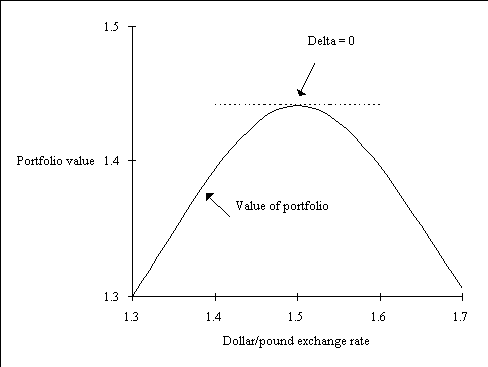
underlying market rates or prices change, and perhaps option delta's
and gamma's. However, you are unlikely to win favor with your
superiors by putting them to sleep. Even if you are confident
in your ability to explain these in English, you still have no
natural way to net the risk of your short position in Deutsche
marks against the long position in Dutch guilders. (It makes
sense to do this because gains or losses on the short position
in marks will be almost perfectly offset by gains or losses on
the long position in guilders.) You could simply assure your
superiors that you never speculate but rather use derivatives
only to hedge, but they understand that this statement is vacuous.
They know that the word "hedge" is so ill-defined and
flexible that virtually any transaction can be characterized as
a hedge. So what do you say?
Perhaps the best answer starts: "The value at
risk is ….."
How did you get into a position where the best answer
involves a concept your superiors might never have heard of, let
alone understand? This doesn't seem like a good strategy for
getting promoted.
The modern era of risk measurement for foreign exchange
positions began in 1973. That year saw both the collapse of the
Bretton Woods system of fixed exchange rates and the publication
of the Black-Scholes option pricing formula. The collapse of
the Bretton Woods system and the rapid transition to a system
of more or less freely floating exchange rates among many of the
major trading countries provided the impetus for the measurement
and management of foreign exchange risk, while the ideas underlying
the Black-Scholes formula provided the conceptual framework and
basic tools for risk measurement and management.
The years since 1973 have witnessed both tremendous
volatility in exchange rates and a proliferation of derivative
instruments useful for managing the risks of changes in the prices
of foreign currencies and interest rates. Modern derivative instruments
such as forwards, futures, swaps, and options facilitate the management
of exchange and interest rate volatility. They can be used to
offset the risks in existing instruments, positions, and portfolios
because their cash flows and values change with changes in interest
rates and foreign currency prices. Among other things, they can
be used to make offsetting bets to "cancel out" the
risks in a portfolio. Derivative instruments are ideal for this
purpose, because many of them can be traded quickly, easily, and
with low transactions costs, while others can be tailored to customers'
needs. Unfortunately, instruments which are ideal for making
offsetting bets also are ideal for making purely speculative bets:
offsetting and purely speculative bets are distinguished only
by the composition of the rest of the portfolio.
The proliferation of derivative instruments has been
accompanied by increased trading of cash instruments and securities,
and has been coincident with growth in foreign trade and increasing
international financial linkages among companies. As a result
of these trends, many companies have portfolios which include
large numbers of cash and derivative instruments. Due to the
sheer numbers and complexity (of some) of these cash and derivative
instruments, the magnitudes of the risks in companies' portfolios
often are not obvious. This has led to a demand for portfolio
level quantitative measures of market risk such as "value
at risk." The flexibility of derivative instruments and
the ease with which both cash and derivative instruments can be
traded and retraded to alter companies' risks also has created
a demand for a portfolio level summary risk measure that can be
reported to the senior managers charged with the oversight of
risk management and trading operations.
The ideas underlying option pricing provide the foundation
for the measurement and management of the volatility of market
rates and prices. The Black-Scholes model and its variants had
the effect of disseminating probabilistic and statistical tools
throughout financial institutions and companies' treasury groups.
These tools permit quantification and measurement of the volatility
in foreign currency prices and interest rates. They are the foundation
of value at risk and risk measurement systems. Variants of the
Black-Scholes model, known as the Black and Garman-Kohlhagen models,
are widely used for pricing options on foreign currencies and
foreign currency futures. Most other pricing models are also
direct descendants of the Black-Scholes model. Even the pricing
of simpler instruments such as currency and interest rate swaps
is based on the "no-arbitrage" framework underlying
the Black-Scholes model. Partial derivatives of various pricing
formulas provide the basic risk measures. These basic risk measures
are discussed in the first appendix to this chapter.
The concept and use of value at risk is recent.
Value at risk was first used by major financial firms in the late
1980's to measure the risks of their trading portfolios. Since
that time period, the use of value at risk has exploded. Currently
value at risk is used by most major derivatives dealers to measure
and manage market risk. In the 1994 follow-up to the survey in
the Group of Thirty's 1993 global derivatives project, 43% of
dealers reported that they were using some form of value at risk
and 37% indicated that they planned to use value at risk by the
end of 1995. J.P. Morgan's attempt to establish a market standard
through its release of its RiskMetrics system in October 1994
provided a tremendous impetus to the growth in the use of value
at risk. Value at risk is increasingly being used by smaller financial
institutions, non-financial corporations, and institutional investors.
The 1995 Wharton/CIBC Wood Gundy Survey of derivatives usage
among US non-financial firms reports that 29% of respondents
use value at risk for evaluating the risks of derivatives transactions.
A 1995 Institutional Investor survey found that 32% of
firms use value at risk as a measure of market risk, and 60% of
pension funds responding to a survey by the New York University
Stern School of Business reported using value at risk.
Regulators also have become interested in value at
risk. In April 1995, the Basle Committee on Banking Supervision
proposed allowing banks to calculate their capital requirements
for market risk with their own value at risk models, using certain
parameters provided by the committee. In June 1995, the US Federal
Reserve proposed a "precommitment" approach which would
allow banks to use their own internal value at risk models to
calculate capital requirements for market risk, with penalties
to be imposed in the event that losses exceed the capital requirement.
In December 1995, the US Securities and Exchange Commission released
for comment a proposed rule for corporate risk disclosure which
listed value at risk as one of three possible market risk disclosure
measures. The European Union's Capital Adequacy Directive which
came into effect in 1996 allows value at risk models to be used
to calculate capital requirements for foreign exchange positions,
and a decision has been made to move toward allowing value at
risk to compute capital requirements for other market risks.
SO WHAT IS VALUE AT RISK, ANYWAY?
Value at risk is a single, summary, statistical measure
of possible portfolio losses. Specifically, value at risk is
a measure of losses due to "normal" market movements.
Losses greater than the value at risk are suffered only with
a specified small probability. Subject to the simplifying assumptions
used in its calculation, value at risk aggregates all of the risks
in a portfolio into a single number suitable for use in the boardroom,
reporting to regulators, or disclosure in an annual report. Once
one crosses the hurdle of using a statistical measure, the concept
of value at risk is straightforward to understand. It is simply
a way to describe the magnitude of the likely losses on the portfolio.
To understand the concept of value at risk, consider
a simple example involving an FX forward contract entered into
by a U.S. company at some point in the past. Suppose that the
current date is 20 May 1996, and the forward contract has 91 days
remaining until the delivery date of 19 August. The 3-month US
dollar (USD) and British pound (GBP) interest rates are  5.469%
and
5.469%
and  6.063%, respectively, and the spot
exchange rate is 1.5335 $/. On the delivery date the U.S. company
will deliver $15 million and receive 10 million. The US dollar
mark-to-market value of the forward contract can be computed using
the interest and exchange rates prevailing on 20 May. Specifically,
6.063%, respectively, and the spot
exchange rate is 1.5335 $/. On the delivery date the U.S. company
will deliver $15 million and receive 10 million. The US dollar
mark-to-market value of the forward contract can be computed using
the interest and exchange rates prevailing on 20 May. Specifically,

In this calculation we use that fact that one leg
of the forward contract is equivalent to a pound-denominated 91-day
zero coupon bond and the other leg is equivalent to a dollar-denominated
91-day zero coupon bond.
On the next day, 21 May, it is likely that interest
rates, exchange rates, and thus the value of the forward contract
have all changed. Suppose that the distribution of possible one
day changes in the value of the forward contract is that shown
in Figure 1. The figure indicates that the probability that the
loss will exceed $130,000 is two percent, the probability that
the loss will be between $110,000 and $130,000 is one percent,
and the probability that the loss will be between $90,000 and
$110,000 is two percent. Summing these probabilities, there is
a five percent probability that the loss will exceed approximately
$90,000. If we deem a loss that is suffered less than 5 percent
of the time to be a loss due to unusual or "abnormal"
market movements, then $90,000 divides the losses due to "abnormal"
market movements from the "normal" ones. If we use
this 5 percent probability as the cutoff to define a loss due
to normal market movements, then $90,000 is the (approximate)
value at risk.
The probability used as the cutoff need not be 5
percent, but rather is chosen by the either the user or the provider
of the value at risk number: perhaps the risk manager, risk management
committee, or designer of the system used to compute the value
at risk. If instead the probability were chosen to be two percent,
the value at risk would be $130,000, because the loss is predicted
to exceed $130,000 only two percent of the time.
Also, implicit in this discussion has been a choice
of holding period: Figure 1 displays the distribution of daily
profits and losses. One also could construct a similar distribution
of 5-day, or 10-day, profits and losses, or perhaps even use a
longer time horizon. Since 5 or 10-day profits and losses typically
are larger than 1-day profits and losses, the distributions would
be more disperse or spread out, and the loss that is exceeded
only 5 (or 2) percent of the time would be larger. Therefore
the value at risk would be larger.
Now that we've seen an example of value at risk,
we are ready for the definition. Using a probability of x
percent and a holding period of t days, an entity's value
at risk is the loss that is expected to be exceeded with a
probability of only x percent during the next t-day
holding period. Loosely, it is the loss that is expected to be
exceeded during x percent of the t-day holding periods.
Typical values for the probability x are 1, 2.5, and 5
percent, while common holding periods are 1, 2, and 10 (business)
days, and 1 month. The theory provides little guidance about
the choice of x. It is determined primarily by how the
designer and/or user of the risk management system wants to interpret
the value at risk number: is an "abnormal" loss one
that occurs with a probability of 1 percent, or 5 percent? For
example, JP Morgan's RiskMetrics system uses 5 percent, while
Mobil Oil's 1994 annual report indicates that it uses 0.3 percent.
The parameter t is determined by the entity's horizon.
Those which actively trade their portfolios, such as financial
firms, typically use 1 day, while institutional investors and
non-financial corporations may use longer holding periods. A
value at risk number applies to the current portfolio, so a (sometimes
implicit) assumption underlying the computation is that the current
portfolio will remain unchanged throughout the holding period.
This may not be reasonable, particularly for long holding periods.
In interpreting value at risk numbers, it is crucial
to keep in mind the probability x and holding period t.
Without them, value at risk numbers are meaningless. For example,
two companies holding identical portfolios will come up with different
value at risk estimates if they make different choices of x
and t. Obviously, the loss that is suffered with a probability
of only 1 percent is larger than the loss that is suffered with
a probability of 5 percent. Under the assumptions used in some
value at risk systems, it is 1.41 times as large. The choice
of holding period can have an even larger impact, for the value
at risk computed using a t-day holding period is approximately
 times as large as the value at risk using
a one day holding period. Absent appropriate adjustments for
these factors, value at risk numbers are not comparable across
entities.
times as large as the value at risk using
a one day holding period. Absent appropriate adjustments for
these factors, value at risk numbers are not comparable across
entities.
Despite its advantages, value at risk is not a panacea.
It is a single, summary, statistical measure of normal market
risk. At the level of the trading desk, it is just one more item
in the risk manager's or trader's toolkit. The traders and front-line
risk managers will look at the whole panoply of Greek letter risks,
i.e. the delta's, gamma's, vega's, et cetera, and may look at
the portfolio's exposures to other factors such as changes in
correlations. In many cases they will go beyond value at risk
and use simulation techniques to generate the entire distribution
of possible outcomes, and will supplement this with detailed analyses
of specific scenarios and "stress tests."
The only environment in which value at risk numbers
will be used alone is at the level of oversight by senior management.
Even at this level, the value at risks numbers often will be
supplemented by the results of scenario analyses, stress tests,
and other information about the positions.
In the balance of this chapter we describe the three
main methods for computing value at risk numbers: historical simulation,
the variance-covariance or analytic method, and Monte Carlo or
stochastic simulation. We then consider the advantages and disadvantages
of the three methods, how they can be supplemented with "stress
testing," and a brief discussion of some of the alternatives
to value at risk. Appendices to the chapter review option delta's
and gamma's and explain the concept of "risk mapping"
which is used in the variance-covariance method. First, however,
we need to discuss a fundamental idea which underlies value at
risk computations.
FUNDAMENTALS: IDENTIFYING THE IMPORTANT MARKET
FACTORS
In order to compute value at risk (or any other quantitative
measure of market risk), we need to identify the basic market
rates and prices that affect the value of the portfolio. These
basic market rates and prices are the "market factors."
It is necessary to identify a limited number of basic market factors
simply because otherwise the complexity of trying to come up with
a portfolio level quantitative measure of market risk explodes.
Even if we restrict our attention to simple instruments such as
forward contracts, an almost countless number of different contracts
can exist, because virtually any forward price and delivery date
are possible. The market risk factors inherent in most other instruments
such as swaps, loans (often with embedded options), options, and
exotic options of course are ever more complicated. Thus, expressing
the instruments' values in terms of a limited number of basic
market factors is an essential first step in making the problem
manageable.
Typically, market factors are identified by decomposing
the instruments in the portfolio into simpler instruments more
directly related to basic market risk factors, and then interpreting
the actual instruments as portfolios of the simpler instruments.
We illustrate this using the FX forward contract we introduced
above. The current date is 20 May 1996. The contract requires
a US company to deliver $15 million in 91 days. In exchange it
will receive 10 million. The current US dollar market value of
this forward contract depends on three basic market factors:  ,
the spot exchange rate expressed in dollars per pound; rGBP,
the 3-month pound interest rate; and rUSD, the
3-month dollar interest rate. To see this, we decompose the cash
flows of the forward contract into the following equivalent portfolio
of zero-coupon bonds:
,
the spot exchange rate expressed in dollars per pound; rGBP,
the 3-month pound interest rate; and rUSD, the
3-month dollar interest rate. To see this, we decompose the cash
flows of the forward contract into the following equivalent portfolio
of zero-coupon bonds:
Position | Current $ Value of Position
| Cash Flow on Delivery Date |
| Long position in 91 day denominated zero coupon bond with face value of 10 million
|
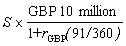 | Receive 10 million
|
| Short position in 91 day $ denominated zero coupon bond with face value of $15 million
|
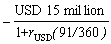 | Pay $15 million
|
The decomposition yields the following formula, used above, for
the current mark-to-market value (in dollars) of the position
in terms of the basic market factors rUSD
, rGBP, and  :
:
 .
.
Because this is an over-the-counter forward contract subject to
some credit risk, the interest rates are those on 3-month interbank
deposits (LIBOR) rather than the rates on government securities.
Similar formulas expressing the instruments' values in terms of
the basic market factors must be obtained for all of the instruments
in the portfolio. Once such formulas have been obtained, a key
part of the problem of quantifying market risk has been finished.
The remaining steps involve determining or estimating the statistical
distribution of the potential future values of the market factors,
using these potential future values and the formulas to determine
potential future changes in the values of the various positions
that comprise the portfolio, and then aggregating across positions
in order to determine the potential future changes in the value
of the portfolio. Value at risk is a measure of these potential
changes in the portfolio's value.
Of course, the values of most actual portfolios will depend upon
more than three market factors. A typical set of market factors
might include the spot exchange rates for all currencies in which
the company has positions, together with, for each currency, the
interest rates on zero-coupon bonds with a range of maturities.
For example, the maturities used in the first version of JP Morgan's
RiskMetrics system were 1 day, 1 week, 1, 3, 6, and 12 months,
and 2, 3, 4, 5, 7, 9, 10, 15, 20, and 30 years. A company with
positions in most of the actively traded currencies, and a number
of the minor ones, could easily have a portfolio exposed to several
hundred market factors.
This dependence on only a limited number of basic market factors
typically remains implicit in the historical and Monte Carlo simulation
methodologies, but must be made explicit in the variance-covariance
methodology. The process of making this dependence explicit is
known as "risk mapping." Specifically, risk mapping
involves taking the actual instruments and "mapping"
them into a set of simpler, standardized positions or instruments.
We describe this process when we discuss the variance-covariance
method below, and in Appendix B.
VALUE AT RISK METHODOLOGIES
Historical simulation
Historical simulation is a simple, atheoretical approach that
requires relatively few assumptions about the statistical distributions
of the underlying market factors. We illustrate the procedure
with a simple portfolio consisting of a single instrument, the
3-month FX forward for which the distribution of hypothetical
mark-to-market profits and losses was previously shown in Figure
1. In essence, the approach involves using historical changes
in market rates and prices to construct a distribution of potential
future portfolio profits and losses in Figure 1, and then reading
off the value at risk as the loss that is exceeded only 5% of
the time.
The distribution of profits and losses is constructed by taking
the current portfolio, and subjecting it to the actual
changes in the market factors experienced during each of the last
N periods, here days. That is, N sets of hypothetical
market factors are constructed using their current values and
the changes experienced during the last N periods. Using
these hypothetical values of the market factors, N hypothetical
mark-to-market portfolio values are computed. Doing this allows
one to compute N hypothetical mark-to-market profits and
losses on the portfolio, when compared to the current mark-to-market
portfolio value. Even though the actual changes in rates and prices
are used, the mark-to-market profits and losses are hypothetical
because the current portfolio was not held on each of the last
N periods. The use of the actual historical changes in
rates and prices to compute the hypothetical profits and losses
is the distinguishing feature of historical simulation, and the
source of the name. Below we illustrate exactly how to do this.
Once the hypothetical mark-to-market profit or loss for each
of the last N periods have been calculated, the distribution
of profits and losses and the value at risk, can then be determined.
Performing the analysis for a single instrument portfolio
We carry out the analysis as of the close of business on 20 May,
1996. Recall that the forward contract obligates a U.S. company
to deliver $15 million on the delivery date 91 days hence, and
in exchange receive 10 million. We perform the analysis from the
perspective of the US company. Even though our example is of
a single instrument portfolio, it captures some of the features
of multiple instrument portfolios because the forward contract
is exposed to the risk of changes in several basic market factors.
For simplicity, we assume that the holding period is one day
(t=1), the value at risk will be computed using a 5 percent
probability (x=5%), and that the most recent 100 business
days (N=100) will be used to compute the changes in the
values of the market factors, and the hypothetical profits and
losses on the portfolio. Because 20 May is the 100th business
day of 1996, the most recent 100 business days start on 2 January
1996.
Historical simulation can be described in terms of five steps.
Step 1. The first step is to identify the basic market factors,
and obtain a formula expressing the mark-to-market value of the
forward contract in terms of the market factors. The market factors
were identified in the previous section: they are the 3-month
pound interest rate, the 3-month dollar interest rate, and the
spot exchange rate. Also, we have already derived a formula for
the US dollar mark-to-market value of the forward by decomposing
it into a long position in a pound denominated zero coupon bond
with face value of 10 million and short position in a dollar denominated
zero coupon bond with face value of $15 million.
Step 2. The next step is to obtain historical values of the market
factors for the last N periods. For our portfolio, this
means collect the 3-month dollar and pound interbank interest
rates and the spot dollar/pound exchange rate for the last 100
business days. Daily changes in these rates will be used to construct
hypothetical values of the market factors used in the calculation
of hypothetical profits and losses in Step 3 because the daily
value at risk number is a measure of the portfolio loss caused
by such changes over a one day holding period, 20 May 1996 to
21 May 1996..
Step 3. This is the key step. We subject the current portfolio
to the changes in market rates and prices experienced on each
of the most recent 100 business days, calculating the daily profits
and losses that would occur if comparable daily changes in the
market factors are experienced and the current portfolio
is marked-to-market.
To calculate the 100 daily profits and losses, we first calculate
100 sets of hypothetical values of the market factors. The hypothetical
market factors are based upon, but not equal to, the historical
values of the market factors over the past 100 days. Rather, we
calculate daily historical percentage changes in the market factors,
and then combine the historical percentage changes with the current
(20 May 1996) market factors to compute 100 sets of hypothetical
market factors. These hypothetical market factors are then used
to calculate the 100 hypothetical mark-to-market portfolio values.
For each of the hypothetical portfolio values we subtract the
actual mark-to-market portfolio value on 20 May to obtain 100
hypothetical daily profits and losses.
Table 1 shows the calculation of the hypothetical profit/loss
using the changes in the market factors from the first business
day of 1996, which is day 1 of the 100 days preceding 20 May 1996.
We start by using the 20 May 1996 values of the market factors
to compute the mark-to-market value of the forward contract on
20 May, which is shown on line 1. Next, we determine what the
value might be on the next day. To do this, we use the percentage
changes in the market factors from 12/29/95 to 1/2/96. The actual
values on 12/29/95 and 1/2/96, and the percentage changes, are
shown in lines 2 through 4. Then, in lines 5 and 6, we use the
values of the market factors on 5/20/96, together with the percentage
changes from 12/29/95 to 1/2/96, to compute hypothetical values
of the market factors for 5/21/96. These hypothetical values of
the market factors on 5/21/96 are then used to compute a mark-to-market
value of the forward contract for 5/21/96 using the formula
 .
.
This value is also shown on line 6. Once the hypothetical 5/21/96
mark-to-market value has been computed, the profit or loss on
the forward contract is just the change in the mark-to-market
value from 5/20/96 to 5/21/96, shown in line 7.
This calculation is repeated 99 more times, using the values of
the market factors on 5/20/96 and the percentage changes in the
market factors for days 2 through 100 to compute 100 hypothetical
"mark-to-market" values of the forward contract for
5/21/96, and 100 hypothetical mark-to-market profits or losses.
Table 2 shows these 100 daily mark-to-market profits and losses.
Step 4. The next step is to order the mark-to-market profits
and losses from the largest profit to the largest loss. The ordered
profits/losses are shown in Table 3, and range from a profit of
$212,050 to a loss of $143,207.
Step 5. Finally, we select the loss which is equaled or exceeded
5 percent of the time. Since we have used 100 days, this is the
fifth worst loss, or the loss of $97,230, and is shown surrounded
by a box on Table 3. Using a probability of 5 percent, this is
the value at risk.
Figure 1 which was discussed previously shows the distribution
of hypothetical profits and losses, with the value at risk indicated
by an arrow. On the graph, the value at risk is the loss that
leaves 5 percent of the probability in the left hand tail.
Multiple instrument portfolios
Extending the methodology to handle realistic, multiple instrument
portfolios requires only that a bit of additional work be performed
in three of the steps. First, in Step 1 there are likely to be
many more market factors, namely the interest rates for longer
maturity bonds and the interest and exchange rates for many other
currencies. These factors must be identified, and pricing formulas
expressing the instruments' values in terms of the market factors
must be obtained. Options may be handled either by treating the
option volatilities as additional market factors that must be
estimated and collected on each of the last N periods,
or else by treating the volatilities as constants and disregarding
the fact that they change randomly over time. This has the potential
of introducing significant errors for portfolios with significant
options content. Second, in Step 2 the historical values of all
of the market factors must be collected. Third, it is crucial
that the mark-to-market profits and losses on each instrument
in the portfolio be computed and then summed for each day, before
they are ordered from highest profit to lowest loss in Step 4.
The calculation of value at risk is intended to capture the fact
that typically gains on some instruments offset losses on others.
Netting the gains against the losses within each of the 100 days
in Step 3 reflects this relationship.
What determines the value at risk?
In order to understand the next methodology, it is useful to discuss
the determinants of the value at risk in the simple example above.
The value at risk of $97,230 was determined by using the magnitudes
of past changes in the market factors or their variability, the
number of contracts in the portfolio (which was simply 1), the
size of the forward contract (i.e., the quantities of dollars
and pounds to be exchanged), and the sensitivity of its mark-to-market
value to daily changes in the market factors. The number of forward
contracts and its size translate into the face values of the zero
coupon bonds into which it was decomposed, while the sensitivity
of its value to changes in the market factors is captured by the
sensitivities of the zero coupon bonds. The role of each of these
is straightforward. More variable market factors, greater numbers
of contracts, larger contracts, and contracts with greater sensitivities
all result in a greater value at risk.
The value at risk is also determined by the comovement between
the changes in the prices of the zero coupon bonds into which
it was decomposed, or the extent to which changes in the value
of the long position in the pound denominated bond are offset
by changes in the value of the short position in the dollar denominated
bond. This is determined by the extent to which dollar and pound
interest rates, and the dollar/pound exchange rate, move together.
Variance-covariance approach
The variance/covariance approach is based on the assumption that
the underlying market factors have a multivariate Normal distribution.
Using this assumption (and other assumptions detailed below),
it is possible to determine the distribution of mark-to-market
portfolio profits and losses, which is also Normal. Once the
distribution of possible portfolio profits and losses has been
obtained, standard mathematical properties of the Normal distribution
are used to determine the loss that will be equaled or exceeded
x percent of the time, i.e. the value at risk.
For example, suppose we continue with our example of a portfolio
consisting of a single instrument, the 3-month FX forward contract
introduced above, and also continue to assume that the holding
period is one day and the probability is 5%. The distribution
of possible profits and losses on this simple portfolio can be
represented by the probability density function shown in Figure
2. This distribution has a mean of zero, which is reasonable because
the expected change in portfolio value over a short holding period
is almost always close to zero. The standard deviation, which
is a measure of the "spread" or dispersion of the distribution,
is approximately $52,500. A standard property of the Normal distribution
is that outcomes less than or equal to 1.65 standard deviations
below the mean occur only 5 percent of the time. That is, if
a probability of 5 percent is used in determining the value at
risk, then the value at risk is equal to 1.65 times the standard
deviation of changes in portfolio value. Using this fact,

This value at risk is also shown in Figure 2. From this, it should
be clear that the computation of the standard deviation of changes
in portfolio value is the focus of the approach.
While the approach may seem rather like a "black box"
because it is based on just a handful of formulas from statistics
textbooks, it captures the determinants of value at risk mentioned
above. It identifies the intuitive notions of variability and
comovement with the statistical concepts of standard deviation
(or variance) and correlation. These determine the variance-covariance
matrix of the assumed Normal distribution of changes in the market
factors. The number and size of the forward contract are captured
through the "risk mapping" procedure discussed below.
Finally, the sensitivity of the values of the bonds which comprise
the instruments to changes in the market factors is captured in
Step 4.
Risk mapping
A key step in the variance covariance approach is known as "risk
mapping." This involves taking the actual instruments and
"mapping" them into a set of simpler, standardized positions
or instruments. Each of these standardized positions is associated
with a single market factor. For example, for the 3-month forward
contract the basic market factors are the three month dollar and
pound interest rates, and the spot exchange rate. The associated
standardized positions are a dollar denominated 3-month zero coupon
bond, a 3-month zero coupon bond exposed only to changes in the
pound interest rate (i.e., it as if the exchange rate were fixed),
and spot pounds. The covariance matrix of changes in the values
of the standardized positions can be computed from the covariance
matrix of changes in the basic market factors. This is illustrated
in Step 3 below. Once the covariance matrix of the standardized
positions has been determined, the standard deviation of any portfolio
of the standardized positions can be computed using a single formula
for the standard deviation of a sum of Normal random variables.
The difficulty is that the formula applies only to portfolios
of the standardized positions. This creates the need for risk
mapping. In order to compute the standard deviation and value
at risk of any other portfolio, it must first be "mapped"
into a portfolio of standardized positions. In essence, for
any actual portfolio one finds a portfolio of the standardized
positions that is (approximately) equivalent to the original portfolio
in the sense that it has the same sensitivities to changes in
the values of the market factors. One then computes the value
at risk of that equivalent portfolio. If the set of standardized
positions is reasonably rich and the actual portfolio doesn't
include too many options or option-like instruments then little
is lost in the approximation.
Performing the analysis for a single instrument portfolio
We again illustrate the various steps involved using a portfolio
consisting of a single instrument, the 3-month FX forward contract
to deliver $15 million on the delivery date 91 days hence, and
in exchange receive 10 million. The method requires 4 steps.
Step 1. The first step is to identify the basic market factors
and the standardized positions that are directly related to the
market factors, and map the forward contract onto the standardized
positions.
The designer of the risk measurement system has considerable flexibility
in the choice of basic market factors and standardized positions,
and therefore considerable flexibility in setting up the risk
mapping. We use a simple set of standardized positions in order
to illustrate the procedure. A natural choice corresponds to
our previous decomposition of the forward contract into a long
position in a 3-month pound denominated zero coupon bond with
a face value of 10 million and short position in a 3-month dollar
denominated zero coupon bond with a face value of $15 million.
As indicated above, we take the standardized positions to be
3-month dollar-denominated zero coupon bonds, 3-month pound denominated
zero coupon bonds that are exposed only to changes in the pound
interest rate (i.e., as if the exchange rate were fixed), and
a spot position in pounds. By decomposing the forward contract
into a dollar leg and a pound leg, we have already completed a
good bit of the work involved in mapping the contract. We need
only to finish the process.
The dollar leg of the forward contract is easy. The value of
a short position in a dollar denominated zero coupon bond with
a face value of $15 million can be obtained by discounting using
the dollar interest rate. Letting X1 denote
the number of dollars invested in the first standardized position
and using a negative sign to represent a short position, we have
 .
.
The pound leg must be mapped into two standardized positions because
its value depends on two market factors, the 3-month pound interest
rate and the spot dollar/pound exchange rate. The magnitudes
of the standardized positions are determined by separately considering
how changes in each of the market factors affects the value of
the pound leg, holding the other factor constant. The dollar
value of the pound leg is
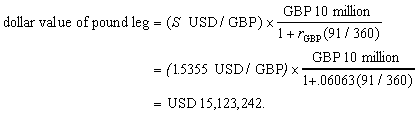
Holding the spot exchange rate  constant,
this has the risk of
constant,
this has the risk of 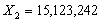 dollars invested
in 3-month pound bonds. Holding the pound interest rate constant,
the bond with a face value of GBP 10 million has the exchange
rate risk of a spot position of
dollars invested
in 3-month pound bonds. Holding the pound interest rate constant,
the bond with a face value of GBP 10 million has the exchange
rate risk of a spot position of 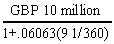 pounds
(its present value), or $15,123,242. Hence the dollar value of
the spot pound position is
pounds
(its present value), or $15,123,242. Hence the dollar value of
the spot pound position is 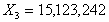 . The equality
of X2 and X3 is not coincidence,
because both represent the dollar value of the pound leg of the
forward contract. The dollar value of the pound leg of the contract
appears twice in the mapped position because, from the perspective
of a US company, a position in a pound denominated bond is exposed
to changes in two market risk factors.
. The equality
of X2 and X3 is not coincidence,
because both represent the dollar value of the pound leg of the
forward contract. The dollar value of the pound leg of the contract
appears twice in the mapped position because, from the perspective
of a US company, a position in a pound denominated bond is exposed
to changes in two market risk factors.
Having completed this mapping, the forward contract is now described
by the magnitudes of the three standardized positions, X1,
X2, and X3. Appendix B sketches
a mathematical argument which justifies this mapping.
Step 2. The second step is to assume that percentage changes
in the basic market factors have a multivariate Normal distribution
with means of zero, and estimate the parameters of that distribution.
This is the point at which the variance-covariance procedure captures
the variability and comovement of the market factors: variability
is captured by the standard deviations (or variances) of the Normal
distribution, and the comovement by the correlation coefficients.
The estimated standard deviations and correlation coefficients
are shown in Table 4.
Step 3. The next step is to use the standard deviations and correlations
of the market factors to determine the standard deviations and
correlations of changes in the value of the standardized positions.
The standard deviations of changes in the values of the standardized
positions are determined by the products of the standard deviations
of the market factors and the sensitivities of the standardized
positions to changes in the market factors. For example, if the
value of the first standardized position changes by 2% when the
first market factor changes by 1%, then its standard deviation
is twice as large as the standard deviation of the first market
factor.
The correlations between changes in the values of standardized
positions are equal to the correlations between the market factors,
except that the correlation coefficient changes sign if the value
of one of the standardized positions changes inversely with changes
in the market factor. For example, the correlation between the
first and third market factors, the dollar interest rate and the
dollar/pound exchange rate, is 0.19, while the correlation between
the values of the first and third standardized positions is  because the value of the first standardized position moves inversely
with changes in the dollar interest rate. Appendix B formalizes
this discussion.
because the value of the first standardized position moves inversely
with changes in the dollar interest rate. Appendix B formalizes
this discussion.
Step 4. Now that we have the standard deviations of and correlations
between changes in the values of the standardized positions, we
can calculate the portfolio variance and standard deviation using
uses standard mathematical results about the distributions of
sums of Normal random variables and determine the distribution
of portfolio profit or loss. The variance of changes in mark-to-market
portfolio value depends upon the standard deviations of changes
in the value of the standardized positions, the correlations,
and the sizes of the positions, and is given by the standard formula
 .
.
The standard deviation is of course simply the square root of
the variance. For our example, the portfolio standard deviation
is approximately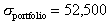 .
.
One property of the Normal distribution is that outcomes less
than or equal to 1.65 standard deviations below the mean occur
only 5 percent of the time. That is, if a probability of 5 percent
is used in determining the value at risk, then the value at risk
is equal to 1.65 times the portfolio standard deviation. Using
this, we can calculate the value at risk:
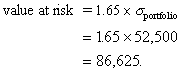
As was discussed above, Figure 2 shows the probability density
function for a Normal distribution with a mean of zero and a standard
deviation of 52,500, along with the value at risk.
Realistic multiple instrument portfolios
Using a 3-month forward contract in the example allowed us to
sidestep one minor difficulty. If the market risk factors include
the spot exchange rates and the interest rates at 1, 3, 6, and
12 months, what do we do with a 4 month forward contract? It
seems natural to write a formula for its value in terms of the
4-month U.S. dollar and British pound interest rates, just as
we did with the 3-month forward. But doesn't this introduce two
more market factors, the 4-month dollar and pound interest rates?
The answer is no. The 1, 3, 6, and 12 month interest rates are
natural choices for market risk factors because there are active
interbank deposit markets at these maturities, and rates for these
maturities are widely quoted. In a number of currencies there
are also liquid government bond markets at some of these maturities.
There isn't an active 4-month interbank market in the U.S. dollar,
the British pound, or any other currency. As a result, the 4-month
interest rates used in computing the model value of the 4-month
forward would typically be interpolated from the 3 and 6-month
interest rates. (The interpolated 4-month rates might also depend
on rates for the other actively quoted maturities, depending upon
the interpolation scheme used.) Through this process, the current
mark-to-market values of all dollar/pound forward contracts, regardless
of delivery date, will depend on the spot exchange rate and the
interest rates at only a limited number of maturities. As a
result, value at risk measures computed using theoretical pricing
models depend upon only a limited number of basic market factors.
The 4-month forward just mentioned could be handled as follows.
We suppose that the forward price is 1.5 $/, and that the contract
requires a U.S. company to deliver $15 million and receive 10
million in four months. The first step is to decompose the forward
contract into pound and dollar denominated 4-month zero coupon
bonds just as we did with the 3-month forward. Next, the 4-month
zeros must be "mapped" onto the 3 and 6-month zeros.
The idea is to replace each of the 4-month zeros with a portfolio
of the 3 and 6-month standardized positions that has the same
market value and risk, where here "risk" means standard
deviation of changes in mark-to-market value, which is proportional
to value at risk. An instrument with multiple cash flows at different
dates, for example a 10-year gilt, would be handled by mapping
the 20 semi-annual cash flows onto the 6 and 12-month, and 2,
3, 4, 5, 7, 9, and 10-year pound denominated zero coupon bonds,
the standardized positions. Each cash flow would be mapped onto
the two nearest standardized positions.
The second section of Appendix C uses the 4-month dollar denominated
zero to illustrate one way to perform this mapping. Appendix
C also describes how options are mapped into their "delta-equivalent"
standardized positions.
Relatively minor complications of realistic portfolios are that
standard deviations and correlations must be estimated for all
of the market factors, and the portfolio variance must be calculated
using the appropriate generalization of the formula used above.
Monte Carlo Simulation
The Monte Carlo simulation methodology has a number of similarities
to historical simulation. The main difference is that rather than
carrying out the simulation using the observed changes in the
market factors over the last N periods to generate N
hypothetical portfolio profits or losses, one chooses a statistical
distribution that is believed to adequately capture or approximate
the possible changes in the market factors. Then, a psuedo-random
number generator is used to generate thousands or perhaps tens
of thousands of hypothetical changes in the market factors. These
are then used to construct thousands of hypothetical portfolio
profits and losses on the current portfolio, and the distribution
of possible portfolio profit or loss. Finally, the value at risk
is then determined from this distribution.
A single instrument portfolio
Once again, we use the same portfolio of a single forward contract
to illustrate the approach. The steps are as follows.
Step 1. The first step is to identify the basic market factors,
and obtain a formula expressing the mark-to-market value of the
forward contract in terms of the market factors. This has already
been done: the market factors are the 3-month pound interest
rate, the 3-month dollar interest rate, and the spot exchange
rate, and we have already derived a formula for the mark-to-market
value of the forward by decomposing it into a portfolio of dollar
and pound denominated 3-month zero coupon bonds.
Step 2. The second step is to determine or assume a specific
distribution for changes in the basic market factors, and to estimate
the parameters of that distribution. The ability to pick the
distribution is the feature that distinguishes Monte Carlo simulation
from the other two approaches, for in the other two methods the
distribution of changes in the market factors is specified as
part of the method. For this example, we assume that that percentage
changes in the basic market factors have a multivariate Normal
distribution, and use the estimates of the standard deviations
and correlations in Table 4.
The assumed distribution need not be the multivariate Normal,
though the natural interpretations of its parameters (means, standard
deviations, and correlations) and the ease with which these parameters
can be estimated weigh in its favor. The designers of the risk
management system are free to choose any distribution that they
think reasonably describes possible future changes in the
market factors. Beliefs about possible future changes in the market
factors are typically based on observed past changes, so this
amounts to saying that the designers of the risk management system
are free to chose any distribution that they think approximates
the distribution of past changes in the market factors.
Step 3. Once the distribution has been selected, the next step
is to use a psuedo-random generator to generate N hypothetical
values of changes in the market factors, where N is almost
certainly greater than 1000 and perhaps greater than 10,000.
These hypothetical market factors are then used to calculate N
hypothetical mark-to-market portfolio values. Then from each of
the hypothetical portfolio values we subtract the actual mark-to-market
portfolio value on 20 May to obtain N hypothetical daily
profits and losses.
Steps 4 and 5. The last two steps are the same as in historical
simulation. The mark-to-market profits and losses are ordered
from the largest profit to the largest loss, and the value at
risk is the loss which is equaled or exceeded 5 percent of the
time.
Multiple instrument portfolios
Just as with historical simulation, extending the methodology
to handle realistic, multiple instrument portfolios requires only
that a bit of additional work be performed in three of the steps.
First, in Step 1 there are likely to be many more market factors,
namely the interest rates for longer maturity bonds and the interest
and exchange rates for other currencies. These factors must be
identified, and pricing formulas expressing the instruments' values
in terms of the market factors must be obtained. Again, options
may be handled either by treating the option volatilities as additional
market factors that must be simulated, or else treating the volatilities
as constants and disregarding the fact that they change randomly
over time. Second, in Step 2 the joint distribution of possible
changes in the values of all of the market factors must be determined.
This joint distribution must include the option volatilities,
if they are to be allowed to change. Third, similar to historical
simulation, to reflect accurately the correlations of market rates
and prices it is necessary that the mark-to-market profits and
losses on every instrument be computed and then summed for each
day, before they are ordered from highest profit to lowest loss
in Step 4.
WHICH METHOD IS BEST?
With three methods from which to choose, the obvious question
is: which method of calculating value at risk is best? Unfortunately,
there is no easy answer. The methods differ in their ability
to capture the risks of options and option-like instruments, ease
of implementation, ease of explanation to senior management, flexibility
in analyzing the effect of changes in the assumptions, and reliability
of the results. The best choice will be determined by which dimensions
the risk manager finds most important. Below we discuss how
the three methods differ on these dimensions, and Table 5 summarizes
the differences. We also discuss a closely related issue, the
choice of the holding period t.
It may be that the best choice is not to use value at risk at
all. Nonfinancial corporations might find that value at risk's
focus on mark-to-market profit or loss over a holding period of
t days doesn't match their perspective. Rather, they may
be more interested in the distributions of quarterly cash flow
over the next perhaps 20 quarters, and how these distributions
are affected by transactions in financial instruments. This suggests
a "cash flow at risk" measure, which we briefly discuss
below when we describe alternatives to value at risk. Finally,
as described below, companies with exposures to only a few different
market factors may find simple sensitivity analyses to be adequate.
Ability to capture the risks of options and option-like instruments
The two simulation methods work well regardless of the presence
of options and option-like instruments in the portfolio. In contrast,
the variance-covariance method works well for instruments and
portfolios with limited options content but is less able to capture
the risks of options and option-like instruments than the two
simulation methods. The limitation of the variance-covariance
method is that it incorporates options by replacing them with
or mapping them to their "delta-equivalent" spot positions
(see Appendix B). This amounts to linearizing the options positions,
or replacing the nonlinear functions which give their values in
terms of the underlying rates and prices with linear approximations.
For instruments or portfolios with a great deal of options content,
the linear approximations may not adequately capture how the values
of the options change with changes in the underlying rates and
prices.
In the variance-covariance method, the problem of adequately capturing
the risks of options and option-like instruments is least severe
when the holding period is one day (t=1). Large changes
in the underlying rates or prices are unlikely over such a short
holding period, and the linear approximation in this method works
well for small changes in the underlying rates and prices. As
a result, the variance-covariance method works well even for positions
with moderate options content provided the holding period is short.
However, over longer holding periods, for example two weeks or
one month, larger changes in underlying rates and prices are likely
and value at risk estimates produced using the variance-covariance
method cannot be relied upon for positions with moderate or significant
options content.
The simulation methods work well regardless of the presence of
options in the portfolio because they recompute the value of the
portfolio for each "draw" of the basic market factors.
In doing this, they estimate the "correct" distribution
of portfolio value, though this statement must be qualified.
The distribution of portfolio value generated by Monte Carlo simulation
depends upon the assumed statistical distribution of the basic
market factors and the estimates of its parameters, both of which
can be "wrong" and therefore lead to errors in the calculated
value at risk. Similarly, the distribution of portfolio value
generated by historical simulation will be misleading if the prior
N days from which the historical sample was drawn were
not representative.
A final risk measurement issue related to options and option-like
instruments is the ability of the value at risk methodologies
to incorporate the fact that option volatilities are random and
option prices change with changes in volatilities. As indicated
previously, the variance-covariance method also does not capture
these features of options very well. In contrast, Monte Carlo
simulation can incorporate, in principle, the facts that volatilities
are random and option prices change with volatilities by extending
the simulation to include a distribution of volatilities, though
this typically is not done in actual implementation of this methodology.
Historical simulation also can incorporate changes in option
prices with changes in volatilities if option volatilities are
included as additional factors and collected for the N
day period used in the simulation.
Ease of implementation
The historical simulation method is easy to implement for portfolios
restricted to currencies for with data on the past values of the
basic market factors are available. It is conceptually simple,
and can be implemented in a spreadsheet because pricing models
for financial products are now available as spreadsheet add-in
functions. The principal difficulty in implementing historical
simulation is that it requires that the user possess a time series
of the relevant market factors covering the last N days
or other periods. This can pose a problem for multinational companies
with operations and local currency borrowing in many countries,
or with receivables and other instruments in a wide range of currencies.
While spot exchange rates are readily available for virtually
all currencies, obtaining reliable daily market interest rates
for a range of maturities in some currencies without well developed
capital markets can be difficult.
A range of vendors offer software which computes value at risk
estimates using the variance-covariance method, so this method
is very easy to implement for portfolios restricted to currencies
and types of instruments covered by the available systems. The
variance-covariance method can be moderately difficult to implement
for portfolios which include currencies and types of instruments
not covered by the available systems. First, estimates of the
standard deviations and correlations of the market factors are
required. Computing these estimates is straightforward if data
are available, but as indicated above reliable market interest
rates may not be available for a range of maturities in all currencies.
Second, and more difficult, instruments must be mapped to the
delta-equivalent positions as described in Appendix B.
"Off the shelf" software is starting to become available
for the Monte Carlo simulation method, making it as easy to implement
as the variance-covariance method for portfolios covered by the
available systems. One difference is that computation times will
be longer with Monte Carlo simulation. For portfolios not covered
by the existing software, Monte Carlo simulation is in some ways
easier, and in some ways more difficult, than the variance/covariance
method. It is easier because it is not necessary to map instruments
onto the standard positions, and it is more difficult because
the user must select the distribution from which the psuedo-random
vectors are drawn, and select or estimate the parameters of that
distribution. Actually carrying out the simulation is not difficult
because psuedo-random number generators are available as spreadsheet
add-ins. However, selecting the distribution and selecting or
estimating the parameters requires high degrees of expertise and
judgment. Another disadvantage of Monte Carlo simulation is that
it for large portfolios the computations can be time consuming.
All three methods require that pricing models be available for
all instruments in the portfolio. While the variance/covariance
method does not directly make use of instruments' prices, options
are mapped to their "delta-equivalent" positions, and
the computation of deltas requires pricing models. The need for
pricing models can pose a problem for portfolios which included
certain exotic options and currency swaps with complex embedded
options.
Ease of communication with senior management
The conceptual simplicity of historical simulation makes it easiest
to explain to senior management. The variance-covariance method
is difficult to explain because to an audience without technical
training because the key step, the reliance on the mathematics
of the Normal distribution to calculate the portfolio standard
deviation and the value at risk, is simply a black box. Monte
Carlo simulation is even more difficult to explain. The key steps
of choosing a statistical distribution to represent changes in
the market factors and engaging in psuedo-random sampling from
that distribution are simply alien to most people.
Reliability of the results
All methods rely on historical data. Historical simulation is
unique, though, in that it relies so directly on historical data.
A danger in this is that the price and rate changes over last
100 (or 200) days is that the last 100 (or 200) days might not
be typical. For example, if by chance the last 100 days were
a period of low volatility in market rates and prices, the value
at risk computed using historical simulation would understate
the risk in the portfolio. Alternatively, if by chance the U.S.
dollar price of the Mexican peso rose steadily over the last 100
days and there were relatively few days on which the dollar price
of a peso fell, value at risk computed using historical simulation
would indicate that long positions in the Mexican peso involved
little risk of loss. Moreover, one cannot be confident that errors
of this sort will "average out." Traders will know
whether the actual price changes over the last 100 days were typical,
and therefore will know for which positions the value at risk
is underestimated, and for which it is overestimated. If value
at risk is used to set risk or position limits, the traders can
exploit their knowledge of the biases in the value at risk system
and expose the company to more risk than the risk management committee
intended.
Other methodologies use historical data to estimate the parameters
of distributions (for example the variance-covariance methodology
relies on historical data to estimate the standard deviations
and correlations of a multivariate Normal distribution of changes
in market factors for which the means are assumed to be zero),
and are also subject to the problem that the historical period
used might be atypical. However, assuming a particular distribution
inherently limits the possible shapes that the estimated distribution
can have. For example, if one assumed that the changes in the
U.S. dollar price of a Mexican peso followed a Normal distribution
with a mean of zero, one would predict that there was a 50 percent
chance that the price of a peso would fall tomorrow even if the
price had risen on each of the last 100 days. Since theoretical
reasoning indicates that the probability that the price of the
peso will fall tomorrow is about 50 percent, regardless of what
it has done over the past 100 days, this is likely a better prediction
than the prediction implicit in historical simulation.
The variance-covariance and Monte Carlo simulation methods share
a different potential problem: the assumed distributions might
not adequately describe the actual distributions of the market
factors. Typically, actual distribution of changes in market
rates and prices have "fat tails" relative to the Normal
distribution. That is, there are more occurrences away from the
mean than predicted by a Normal distribution. Nonetheless, the
Normal distribution assumed in the variance-covariance method
appears to be a reasonable approximation for the purposes of computing
value at risk. An issue unique to the Monte Carlo simulation
method stems from the fact that the designer of the system can
choose the statistical distribution to use for the market factors.
This flexibility allows the designer of the system to make a
bad choice, in the sense that the chosen distribution might not
adequately approximate the actual distribution of the market factors.
Concerns about the reliability of the methods can be partially
addressed by comparing actual changes in value to the value at
risk amounts. This sort of validation is feasible because the
value at risk approach explicitly specifies the probability with
which actual losses will exceed the value at risk amount. It
is performed by collecting a sample of value at risk amounts and
actual mark-to-market portfolio profits and losses, and answering
two questions. First, does the distribution of actual mark-to-market
profits and losses appear similar to the distribution used to
determine the value at risk amount? And second, do the actual
losses exceed the value at risk amount with the expected frequency?
A limitation of this approach to validation is that chance occurrences
will almost always cause the distribution of actual portfolio
profits and losses to differ somewhat from the expected distribution.
Because of this, reliable inferences about the quality of the
value at risk estimates can only be made using by comparing relatively
large samples of value at risk amounts and actual changes in portfolio
value. If validation of this sort is considered essential
a short holding period must be used in computing the value at
risk amounts, because it will take many years to collect a large
sample of monthly or quarterly value at risk amounts and portfolio
profits and losses.
Flexibility in incorporating alternative assumptions
In some situations the risk manager will have reason to think
that the historical standard deviations and/or correlations are
not reasonable estimates of the future ones. For example, in
the period immediately prior to the departure of the British pound
from the European Monetary System (EMS) in September 1992, the
historical correlation between changes in the dollar/pound and
dollar/mark exchange rates was very high. Yet a risk manager
might have suspected that the pound would leave the EMS, and therefore
that the correlation would be much lower in the future. How easily
could she have calculated the value at risk in this "what-if"
scenario using each of the three methods?
Historical simulation is directly tied to the historical changes
in the basic market factors. As a result, there is no natural
way to perform this sort of "what-if" analysis. In contrast,
it is very easy to carry out this sort of "what-if"
analysis in the variance-covariance and Monte Carlo simulation
methods. In these, the historical data are used to estimate the
parameters of the statistical distribution of changes in the market
factors. The user may override the historical estimates, and
use any consistent set of parameters she chooses. The only constraint
is that the user interfaces in some software implementations of
the methods may make this cumbersome.
SUPPLEMENTING VALUE AT RISK: STRESS TESTING AND SCENARIO ANALYSIS
Value at risk is not a panacea. It is a single, summary, statistical
measure of normal market risk. If a probability of 5 percent
and a holding period of 1 day are used in computing the value
at risk, you expect to suffer a loss exceeding the value at risk
1 (business) day out of 20, or about once per month. A level
of loss that will be exceeded about once per month is reasonably
termed a "normal" loss. But when the value at risk
is exceeded, just how large can the losses be?
Stress testing attempts to answer this question. It is a general
rubric for performing a set of scenario analyses to investigate
the effects of extreme market conditions. To the extent that the
effects are unacceptable, the portfolio or risk management strategy
needs to be revised. There is no standard way to carry out stress
testing, and no standard set of scenarios to consider. Rather,
the process depends crucially on the judgment and experience of
the risk manager.
Stress testing often begins with a set of hypothetical extreme
market scenarios. These scenarios might be created from stylized
extreme scenarios, such as assumed 5 or 10 standard deviation
moves in market rates or prices, or they might come from actual
extreme events. For example, the scenarios might be based upon
the changes in US dollar interest rates and bond prices experienced
during the winter and spring of 1994, or the dramatic changes
in some of the European exchange rates that occurred in September
1992. Alternatively, the scenarios might be created by imagining
a few sudden surprises, and thinking through the implications
for the markets. For example, how would the unanticipated failure
of a major dealer affect prices and liquidity in the currency
swaps market? What would be the effect on the Korean won and
the Japanese yen if the North Koreans crossed the 38th parallel?
What would be the effect of such an incident on the U.S. and
Japanese equity markets? In developing these scenarios, it is
important to think through the implications for all markets.
An event sufficiently significant to have a sudden, major impact
on the dollar/yen exchange rate would almost certainly impact
other exchange rates, and likely affect interest rates in many
currencies. A full description of a scenario will include the
changes in all market rates and prices.
After developing a set of scenarios, the next step is to determine
the effect on the prices of all instruments in the portfolio,
and the impact on portfolio value. In addition, companies whose
risk management strategies depend upon "dynamic hedging"
or the ability to frequently adjust or rebalance their portfolios
need to consider the impact of major surprises on market liquidity.
It may be difficult or impossible to execute transactions at
reasonable bid/ask spreads during periods of market stress. Companies
which use futures contracts to hedge relatively illiquid assets
or financial contracts must consider the funding needs of the
futures contracts. Gains or losses on futures contracts are received
or paid immediately, while gains or losses on other instruments
are often not received or paid until the positions are closed
out. As a result, even a well hedged position combining futures
contracts with other instruments can lead to timing mismatches
between when funds are required and when they are received.
Finally, contingency plans might be developed for certain of
the scenarios. Declines in market value, once suffered, typically
cannot be recovered, so contingency plans have little to offer
in this dimension. However, potential funding mismatches created
by the cash demands of futures positions can be managed by arranging
backup lines of credit. The potential importance of this is illustrated
by MG Refining and Marketing (MGRM), a classic example of a firm
which was not prepared to meet the funding demands of its futures
positions. MGRM is a U.S. subsidiary of Metallgesellschaft A.G.,
the 14th largest German industrial firm, and was engaged in the
refining and marketing of petroleum products in the United States.
Among its activities, MGRM used futures contracts and short-term
commodity swaps on crude oil and various refined products to hedge
long-term delivery obligations. In early 1994 it had to be rescued
by a group of 150 German and international banks when it was unable
to meet the funding needs created by staggering losses on its
futures contracts and swaps. Regardless of one's view on the
wisdom of using futures to hedge long-term delivery obligations
and MGRM's risk management strategy, in retrospect it seems clear
that MGRM's failures included the lack of a plan for meeting the
funding demands of its futures contracts.
Scenario analyses are also used to examine the effects of violations
of the assumptions underlying the value at risk calculations.
For example, immediately prior to the British pound's departure
from the EMS in September 1992, all three value at risk methodologies
would have indicated that from the perspective of a U.S. dollar
investor a long position in sterling combined with a short position
in Deutsche marks had a very low value at risk. The low value
at risk would have been a result of the historically high correlations
between the dollar/pound and dollar/mark exchange rates, for all
three value at risk methodologies rely upon historical data.
Yet in September 1992 the position would have suffered a large
loss, because the historical correlations could no longer be relied
upon. This risk could be evaluated either by changing the correlation
used as an input in calculating the value at risk, or by examining
directly the impact on portfolio if the pound fell relative to
the mark. Regardless, the key input to this process is the risk
manager's judgment that the scenario is worth considering.
ALTERNATIVES TO VALUE AT RISK
As indicated above, value at risk may not be appropriate for all
entities. Two alternatives are sensitivity analysis and cash
flow at risk. Sensitivity analysis is less sophisticated than
value at risk. In contrast, cash flow at risk can be considered
more sophisticated than value at risk.
Sensitivity analysis
Companies with exposures to only a few market factors may find
that the benefits of value at risk don't justify the difficulty
of mastering the approach and implementing a system to compute
the value at risk estimates. As discussed next, sensitivity analyses
are a reasonable alternative for sufficiently simple portfolios.
The approach in sensitivity analysis is to imagine hypothetical
changes in the value of each market factor, and then use pricing
models to compute the value of the portfolio given the new value
of the market factor and determine the change in portfolio value
resulting from the change in the market factor. For example,
if the dollar price of a pound increases by 1%, the value of the
portfolio will decrease by $200,000; if the dollar price of a
pound decreases by 1%, the value of the portfolio will increase
by $240,000. There is nothing magical about 1%. Rather, the
computations will typically be performed and reported for a range
of increases and decreases that cover the range of likely exchange
rate changes. Similar computations would also be reported for
other relevant market factors such as interest rates.
When combined with knowledge of the magnitudes of likely exchange
rate or interest rate changes, these sorts of computations provide
a very good picture of the risks of portfolios with exposures
to only a few market factors. In fact, they comprise the most
basic risk management information, and are very closely related
to the delta risk measure discussed in Appendix A. In one form
or another, market risk sensitivities have been available to traders
and risk managers since at least 1938. Their principal limitation
stems from the fact that a sensitivity analysis report for a portfolio
with exposures to many different market factors can easily contain
hundreds or thousands of numbers, each representing the change
in portfolio value for a particular hypothetical change in market
rates and prices. Absent some approach like value at risk, it
is difficult or impossible for a risk manager or senior manager
charged with oversight of trading and risk management activities
to meaningfully read and review sensitivity analysis reports for
portfolios with exposures to many different market factors and
assimilate the information to get a sense of portfolio risk.
Cash flow at risk
As stated previously, cash flow at risk is arguably more sophisticated
than value at risk. As of this writing, it appears to have a
limited, but growing, number of users. Cash flow at risk is a
reasonable choice for nonfinancial corporations which are concerned
with managing the risks inherent in operating cash flows and find
that value at risk's focus on mark-to-market profit or loss over
a holding period of t days doesn't match their perspective.
For example, Merck is a user of both derivatives and cash flow
at risk. The motivation for derivatives usage appears to be the
fact that changes in cash flows due to changes in interest and
exchange rates were negatively impacting R&D programs by causing
shortfalls of funds. Currency and interest rate swaps, appropriately
used, are able to ameliorate this problem. But this motivation
for derivatives usage suggests that the risk measurement system
ought to focus on quarterly or annual cash flows over a horizon
of at least several years. For example, a company in a similar
situation might be interested in the distributions of quarterly
cash flow over the next perhaps 20 quarters, and how these distributions
are affected by transactions in financial instruments.
Cash flow at risk measures are typically estimated using Monte
Carlo simulation. However, there are important differences from
the use of Monte Carlo simulation to estimate value at risk.
First, the time horizon is much longer in cash flow at risk simulations.
For example, values of the underlying market factors might be
simulated for the next 20 quarters. Second, the focus is on cash
flows, not changes in mark-to-market values. This is the distinguishing
feature, and in fact the whole point, of cash flow at risk measures.
Rather than using the hypothetical values of the market factors
as inputs to pricing models to compute changes in mark-to-market
portfolio value, the hypothetical market factors are combined
with the terms of the cash and derivative instruments to compute
hypothetical quarterly or annual cash flows, and their distributions.
Third, operating cash flows are typically included in
the calculation. This is of course essential if the goal of the
risk measurement system is to assess the impact of derivatives
and other financial transactions on companies' total cash flows.
As a result, the "factors" included in the simulation
are not just the basic financial market factors included in value
at risk calculations, but any "factors" which affect
operating cash flows. Changes in customer demand, the outcomes
of R&D programs (including competitors' R&D programs),
and competitors' pricing decisions are a few operating "factors"
that come to mind. Finally, the emphasis is often on planning
rather than control, oversight, and reporting.
A serious drawback is that successful design and implementation
of a cash flow at risk measurement system requires a high degree
of knowledge and judgment. First, the designer of the system
must develop a model of the company's operating cash flows, determining
the important operating factors and how they impact operating
cash flows. This alone may be a major undertaking. Next, this
model of the operating cash flows must be integrated with a model
of the financial market factors. Then the user must select the
statistical distribution from which the hypothetical values of
the "factors" (both operating and financial) are drawn,
and select or estimate the parameters of that distribution. This
can be particularly difficult for the operating "factors."
In contrast with the financial market factors, data on actual
past changes in operating risk factors may not be available to
guide the choice of distribution. Finally, the user must carry
out the computations. Somewhat offsetting the difficulty of the
problem is that the model of the financial market factors can
be relatively crude, as there is no point in refining it to be
more precise than the model of the operating cash flows. Nonetheless,
building a cash flow at risk measurement system is likely to be
a major undertaking.
APPENDIX A
BASIC RISK MEASURES: OPTION DELTA'S AND GAMMA'S
Delta
The delta or is perhaps the most basic
risk management concept. Delta indicates how much the theoretical
price of an instrument or portfolio changes when the price of
the underlying asset, currency, or commodity changes by a small
amount. Therefore it is very closely related to sensitivity analysis.
While originally developed for options, the concept can be applied
to other derivatives, and to cash positions as well.
is perhaps the most basic
risk management concept. Delta indicates how much the theoretical
price of an instrument or portfolio changes when the price of
the underlying asset, currency, or commodity changes by a small
amount. Therefore it is very closely related to sensitivity analysis.
While originally developed for options, the concept can be applied
to other derivatives, and to cash positions as well.
We illustrate the concept of delta using a call option on British
pounds with a strike price of 1.50 $/and 3 months to expiration.
We suppose that the current dollar/pound exchange rate is also
1.50 $/ and the current price of the call option is $0.0295 per
pound. The price of this option will vary as the dollar/pound
exchange rate varies. Figure 4 shows the theoretical price (computed
using the Garman-Kohlhagen model) as a function of the dollar/pound
exchange rate. The graph indicates that if the dollar/pound exchange
rate changes slightly from the current value of 1.50 $/, the change
in the option price will be about one-half as large as the change
in the exchange rate. For example, if the exchange rate changes
to 1.51 $/, the (theoretical) option price will change by $0.0051
to $0.0346. The ratio of the change in the option price to the
change in the currency price,  , is the
option delta. Graphically, the delta is the slope of the line
which is tangent to the option price function at the current exchange
rate. This tangent is shown in Figure 4. Formally, delta is
the partial derivative of the option price function with respect
to the underlying currency price. Letting S denote the
dollar price of a British pound and
, is the
option delta. Graphically, the delta is the slope of the line
which is tangent to the option price function at the current exchange
rate. This tangent is shown in Figure 4. Formally, delta is
the partial derivative of the option price function with respect
to the underlying currency price. Letting S denote the
dollar price of a British pound and  denote
the option price as a function of S, the option delta is
denote
the option price as a function of S, the option delta is

Since delta is given by the ratio of price changes, i.e.
 ,
,
the change in the option price resulting from a change in the
spot price can be calculated from the delta and the change in
the price of the underlying instrument:

For example, if  and the price of a pound
changes by $0.01, the predicted change in the option price is
and the price of a pound
changes by $0.01, the predicted change in the option price is
 . One interpretation of this relationship
is that an option on one pound is equivalent to a spot position
of delta British pounds, because the change in value of a spot
position of delta British pounds is also given by the product
of delta and the change in the spot price of a pound. Loosely,
for small changes in the exchange rate the option "acts like"
delta British pounds. The significance of this for risk measurement
is that one technique for measuring the risk of an option position
is to use the option delta to compute the equivalent spot position,
and then estimate the risk of the equivalent spot position. Most
applications of the variance-covariance methodology for computing
value at risk which we discuss below rely on this technique.
. One interpretation of this relationship
is that an option on one pound is equivalent to a spot position
of delta British pounds, because the change in value of a spot
position of delta British pounds is also given by the product
of delta and the change in the spot price of a pound. Loosely,
for small changes in the exchange rate the option "acts like"
delta British pounds. The significance of this for risk measurement
is that one technique for measuring the risk of an option position
is to use the option delta to compute the equivalent spot position,
and then estimate the risk of the equivalent spot position. Most
applications of the variance-covariance methodology for computing
value at risk which we discuss below rely on this technique.
An important feature of options and option-like instruments is
that delta changes as the price of the underlying asset, currency,
or commodity changes. This is illustrated in Figure 5, which
shows the
theoretical price of a 3-month call option on pounds with a strike
price of 1.50 $/, together with the option deltas. At the current
spot price of 1.50 $/ the delta is approximately one-half, while
for high spot prices the delta approaches one and for low spot
prices it approaches zero. The delta approaches one for high
spot prices because if the spot price is well above the strike
price the option is almost certain to be exercised. An option
that is almost certain to be exercised behaves like a levered
position in the underlying asset or currency. The delta approaches
zero for low spot prices because if the spot price is well below
the strike price the option is almost certain to expire unexercised.
An option that is almost certain to expire unexercised is worth
almost nothing now, and behaves like almost nothing.
The changing delta illustrated in Figure 5 doesn't appear to be
a severe problem for risk measurement. However, for many options
positions reliance solely on delta can be misleading. Figure
6 shows the value of one such position as a function of the dollar/pound
exchange. The portfolio shown in Figure 6 consists of a spot
position in 1 pound along with 2 written 3-month options. At
the spot exchange rate 1.50 $/, the delta of the spot pound is
1 and the delta of the call option is approximately 0.5, so the
portfolio delta is approximately  . Using
a delta of zero to compute the equivalent spot position, we would
conclude that this options position is equivalent to a spot position
of zero British pounds, and therefore has no market risk. But
clearly the position does have market risk, for if the exchange
rate changes in either direction by more than a small amount the
position will suffer a loss.
. Using
a delta of zero to compute the equivalent spot position, we would
conclude that this options position is equivalent to a spot position
of zero British pounds, and therefore has no market risk. But
clearly the position does have market risk, for if the exchange
rate changes in either direction by more than a small amount the
position will suffer a loss.
Gamma
Gamma or  supplements delta by measuring
how delta changes as the price of the underlying asset, currency,
or commodity changes. In Figure 6 delta decreases as the dollar
price of a pound increases, so gamma is negative. (The slope
is positive for $/ exchange rates less than 1.50 $/, and negative
for exchange rates greater than 1.52 $/.) If delta increases
as the dollar price of a pound increases, then gamma is positive.
Gamma is defined as the partial derivative of delta with respect
to the price of the underlying asset, currency, or commodity,
or equivalently as the second partial derivative of the option
price with respect to the price of the underlying asset, currency,
or commodity. Letting S denote the spot price of the underlying
asset and
supplements delta by measuring
how delta changes as the price of the underlying asset, currency,
or commodity changes. In Figure 6 delta decreases as the dollar
price of a pound increases, so gamma is negative. (The slope
is positive for $/ exchange rates less than 1.50 $/, and negative
for exchange rates greater than 1.52 $/.) If delta increases
as the dollar price of a pound increases, then gamma is positive.
Gamma is defined as the partial derivative of delta with respect
to the price of the underlying asset, currency, or commodity,
or equivalently as the second partial derivative of the option
price with respect to the price of the underlying asset, currency,
or commodity. Letting S denote the spot price of the underlying
asset and  denote the option price as a
function of S, the option gamma is
denote the option price as a
function of S, the option gamma is

Delta and gamma together can be used to predict the change in
the option price resulting from a change in the spot price of
one pound using the following formula:

Comparing this to the earlier equation which predicts the change
in the option price using only delta, one can see that when gamma
is negative the change in the option price is more adverse than
that predicted using delta alone. Conversely, when gamma is
positive the change in the option price is more favorable than
that predicted using delta alone
The significance of this for value at risk measures is that the
variance-covariance method typically measures the risk of options
by converting them to their equivalent spot positions using delta
alone and thereby somewhat understate the risk of positions with
negative gammas. The effect will be small for value at risk computations
done using short holding periods, because for short holdings periods
the change in the spot price of the underlying asset is typically
small and the term
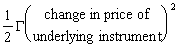
is small. However, the understatement of the risk of negative
gamma portfolios can be significant when value at risk measures
are computed for long holding periods.
APPENDIX B
CALCULATION OF STANDARD DEVIATIONS AND CORRELATIONS OF PERCENTAGE
CHANGES IN THE VALUES OF THE STANDARDIZED POSITIONS
In essence, if the value of the standardized position changes
by x percent when the market factor changes by 1 percent,
then the standard deviation of percentage changes in the standardized
position is equal to x times the standard deviation of
percentage changes in the market factor.
To see this more formally, let X1 denote the
value of the first standardized position, and use the fact that
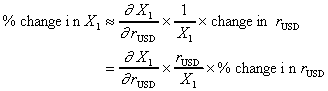
This implies that
 ,
,
where the minus sign appears because  is
negative, i.e., the value of the first standardized position moves
inversely with USD interest rates. Letting
is
negative, i.e., the value of the first standardized position moves
inversely with USD interest rates. Letting  denote the standard deviation of percentage changes in
  and
and  denote the standard deviation of percentage
changes in the dollar interest rate, this can be rewritten
denote the standard deviation of percentage
changes in the dollar interest rate, this can be rewritten
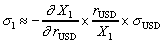 .
.
Similarly, for the other two standardized positions:

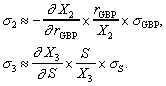
In addition, the signs of two of the correlation coefficients
must be changed because the values of the first and second standardized
positions move inversely with the USD and GBP interest rates.
Due to this, we have  , and
, and  .
The correlation between the first two standardized positions
is unaffected because both move inversely with interest rates,
and
.
The correlation between the first two standardized positions
is unaffected because both move inversely with interest rates,
and  .
.
APPENDIX C
RISK MAPPING
Theory underlying mapping the forward contract into the three
standardized positions
Here we show that the forward contract can be described as a
portfolio of the three standardized positions with the same sensitivities
to the market factors. In other words, they have the same risks.
This is the key to risk mapping. We do this by using first order
Taylor series approximations to represent the changes in the values
of both the forward contract and the portfolio of the three standardized
positions in terms of changes in the three market factors, and
choose the standardized positions so that the coefficients of
the two Taylor series approximations are the same. If the coefficients
of the Taylor series approximations are the same, then (up to
the approximation) the two portfolios respond identically to changes
in the market factors.
First, we consider the forward contract. Let

denote the mark-to-market value of the forward contract. Using
a Taylor series, the change in  can be
approximated
can be
approximated
 .
.
Next, we will write down a similar Taylor series approximation
of changes in the value of the portfolio of standardized positions,
and show that if the standardized positions are chosen appropriately
then the coefficients of the two approximations are identical.
If this is true then
 , implying that (up to the approximation)
the portfolio of standardized positions has the same sensitivities
to the market factors as the forward contract.
, implying that (up to the approximation)
the portfolio of standardized positions has the same sensitivities
to the market factors as the forward contract.
Let  represent the value of the portfolio
of standardized positions. If each of the X's depends
on only one market factor, then the change in
represent the value of the portfolio
of standardized positions. If each of the X's depends
on only one market factor, then the change in  can
be approximated
can
be approximated
 .
.
We need to choose X1, X2,
and X3 so that each depends on only one market
factor and the two Taylor series approximations are identical.
This amounts to choosing them so that 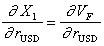 ,
,
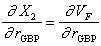 , and
, and  . The
choice that works is
. The
choice that works is
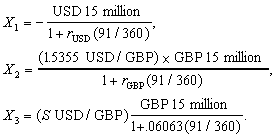
These are three standardized positions we used before to carry
out the risk mapping of the forward contract. As indicated earlier,
they are interpreted as follows. The first, X1,
is simply the value of a position in 3-month dollar denominated
bonds. The other two are more complicated. X2
is the dollar value of the position in 3-month pound denominated
bonds, holding the exchange rate fixed, while X3
is the dollar value of a spot position in pounds equal to the
present value of the pound bonds, holding the pound interest rate
fixed. Note that both X2 and X3
represent the value of the pound denominated bond, but each of
them is exposed to only one of the two market factors that affect
the value of the bond.
Mapping a 4-month dollar denominated cash flow onto the 3 and
6-month standardized positions
The idea is to replace the 4-month cash flow with a portfolio
of the 3 and 6-month standardized positions that has the same
risk or distribution of changes in market value as the original
cash flow. This requires that the portfolio has the same market
value and standard deviation (or variance) of changes in market
value.
To find the market value of the original 4-month cash flow, we
need an interest rate with which to discount it. One way to obtain
a 4-month US dollar interest rate is simply to interpolate using
the 3 and 6-month rates. This amounts to taking the 4-month rate
to be a weighted average of the 3 and 6-month rates, or
 .
.
The present value of the dollar leg of the 4-month forward is
then
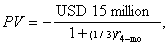
where the 1/3 appears in the denominator because the cash flow
must be discounted for one-third of a year.
The standard deviation of changes in the value of the 4-month
cash flow depends upon the sensitivity of changes its value to
changes in the interest rate and the standard deviation of changes
in the interest rate. In symbols,
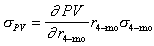 ,
,
where  is the sensitivity of changes in
the value of the dollar leg to changes in the interest rate,
is the sensitivity of changes in
the value of the dollar leg to changes in the interest rate,  is the standard deviation of percentage changes in the 4-month
rate, and
is the standard deviation of percentage changes in the 4-month
rate, and  is the standard deviation of
("absolute") changes in the 4-month rate. The parameter
is the standard deviation of
("absolute") changes in the 4-month rate. The parameter
 can be computed from the 3 and 6-month
rates, the standard deviations of percentage changes in the 3
and 6-month rates, and the correlation between these changes using
standard results for linear combinations of Normal random variables.
can be computed from the 3 and 6-month
rates, the standard deviations of percentage changes in the 3
and 6-month rates, and the correlation between these changes using
standard results for linear combinations of Normal random variables.
Next, introduce a fourth standardized position consisting of
6-month dollar denominated zero coupon bonds, and let  denote the value of the position. The mapping of the 4-month
cash flow onto the 3 and 6-month standardized positions is completed
by finding a portfolio of
denote the value of the position. The mapping of the 4-month
cash flow onto the 3 and 6-month standardized positions is completed
by finding a portfolio of dollars in 3-month
bonds and
dollars in 3-month
bonds and  dollars in 6-month bonds.
This portfolio must have the same value and standard deviation
of changes in value as the 4-month cash flow. Also, the signs
of
dollars in 6-month bonds.
This portfolio must have the same value and standard deviation
of changes in value as the 4-month cash flow. Also, the signs
of  and
and  must
be the same as the sign of the 4-month cash flow. In symbols,
we need to find a portfolio
must
be the same as the sign of the 4-month cash flow. In symbols,
we need to find a portfolio  and
and  such that:

The last equation is needed because the first two equations will
typically have two different solutions for X1
and X4, one of which will involve a negative
sign. The standard deviation of the portfolio with value  is computed using the technique discussed in Step 3 of the section
on the variance-covariance method. Finally, these equations are
solved for X1 and X4.
is computed using the technique discussed in Step 3 of the section
on the variance-covariance method. Finally, these equations are
solved for X1 and X4.
Mapping Options
Options positions typically are mapped into "delta equivalent"
positions in spot foreign currency and the standardized zero coupon
bonds. An option delta is the partial derivative of the option
price with respect to the price of the underlying asset. Letting
 denote the theoretical value of the option
and
denote the theoretical value of the option
and  denote the price of the underlying
asset, the delta is
denote the price of the underlying
asset, the delta is
 .
.
As discussed more fully in Appendix A, the change in the option
price resulting from a change in the spot price can be calculated
from the delta and the change in the price of the underlying asset:

For example, if the option is on 1 million British pounds,  million or 0.5 per pound, and the spot price of one pound changes
by $0.01, the predicted change in the option price is
million or 0.5 per pound, and the spot price of one pound changes
by $0.01, the predicted change in the option price is  million. One interpretation of the equation above is that for
small changes in the exchange rate an option is equivalent to
a spot position of
million. One interpretation of the equation above is that for
small changes in the exchange rate an option is equivalent to
a spot position of  British pounds, because
the change in value of a spot position of
British pounds, because
the change in value of a spot position of  British
pounds is also given by the product of
British
pounds is also given by the product of  and
the change in the spot price of 1 pound. Loosely, the option
"acts like"
and
the change in the spot price of 1 pound. Loosely, the option
"acts like"  British pounds.
Mapping of other options positions is conceptually the same, though
sometimes more complicated. Consider an over-the-counter option
on a 10-year British gilt. Usually, one would say that the underlying
asset is a 10-year gilt. However, recall that we indicated that
the 20 semi-annual cash flows of a 10-year gilt might be mapped
onto the 6 and 12-month, and 2, 3, 4, 5, 7, 9, and 10-year pound
denominated zero coupon bonds. If we took the perspective of
a pound investor, we would interpret the option on the gilt as
an option on a portfolio of these 9 zero coupon bonds, and think
of the option as having 9 underlying assets and nine deltas, one
for each underlying asset. However, the dollar price of the gilt
also depends on the dollar/pound exchange rate. From the perspective
of a dollar investor, there are 10 underlying assets: the nine
pound denominated zero coupon bonds, along with the dollar/pound
exchange rate, and for each we can define a delta. Letting  denote
the dollar value of the gilt and
denote
the dollar value of the gilt and denote
the pound price of the nth pound denominated zero, for
the first nine deltas we have
denote
the pound price of the nth pound denominated zero, for
the first nine deltas we have

 .
.
The tenth delta, the partial derivative with respect to the spot
exchange rate, is
 .
.
The change in the option price resulting from changes in the prices
of the underlying assets is given by
 .
.
The change in  is identical to the change
in the value of a portfolio of
is identical to the change
in the value of a portfolio of  units
of each of the nine pound zeros, along with
units
of each of the nine pound zeros, along with  spot pounds. Exploiting this observation, the option is "mapped"
into this portfolio.
spot pounds. Exploiting this observation, the option is "mapped"
into this portfolio.
To understand why this procedure can be useful, remember that
value at risk is a portfolio level risk measure. It is computed
by assigning a risk measure to each position, and then aggregating
up to a portfolio level measure. A difficulty is that there are
an immense variety of different options. Even if we just consider
ordinary options, wide ranges of both strike prices and expiration
dates are possible, and of course there are both calls and puts.
In addition, there are exotic options which can have virtually
any terms. How can one reasonably assign a risk measure to every
option? The approach in most variance-covariance value at risk
systems is to measure the risk of a set of standardized positions,
and then measure the risk of options in terms of the delta-equivalent
positions.
Explicit risk mapping of this sort is only necessary in the "analytic"
or "variance-covariance" methodology. However, in this
framework it is the key issue in the design of a value at risk
system. To hint at the complexities, consider a second option,
but this time suppose it is a futures option on the British pound
currency futures traded on the International Money Market (IMM)
of the Chicago Mercantile Exchange. It seemed natural to map
the first option on spot pounds into a  -
equivalent spot position. Should the IMM futures option also
be mapped into a
-
equivalent spot position. Should the IMM futures option also
be mapped into a  - equivalent spot position
by using the theoretical relationship between currency spot and
futures prices to reinterpret it as an option on spot pounds?
Or should we introduce a second basic market risk factor, the
futures price, and map the futures option into a
- equivalent spot position
by using the theoretical relationship between currency spot and
futures prices to reinterpret it as an option on spot pounds?
Or should we introduce a second basic market risk factor, the
futures price, and map the futures option into a  -
equivalent futures position? What if we consider another futures
option on a pound futures contract with a different delivery date?
And what about the fact that option and futures prices change
with changes in interest rates? The answers to these questions
are not obvious. Nonetheless, the questions need to be answered
by the designer of a value at risk system.
-
equivalent futures position? What if we consider another futures
option on a pound futures contract with a different delivery date?
And what about the fact that option and futures prices change
with changes in interest rates? The answers to these questions
are not obvious. Nonetheless, the questions need to be answered
by the designer of a value at risk system.
| Table 1: Calculation of Hypothetical 5/21/96 Mark-to-Market Profit/Loss on a Forward Contract Using Market Factors from 5/20/96 and Changes in Market Factors from the First Business Day of 1996
|
| |
Market Factors
| | Mark-to-Market Value
|
| |
$ Interest Rate (% per year)
|
Interest Rate (% per year)
| Exchange Rate
($/)
| of Forward Contract
($)
|
| Start with actual values of market factors and forward contract as of close of business on 5/20/96:
| | |
| |
| (1) Actual values on 5/20/96
| 5.469
| 6.063 |
1.536
| 327,771 |
| Compute actual past changes in market factors:
| | |
| |
| (2) Actual values on 12/29/95
| 5.688
| 6.500 |
1.553
| |
| (3) Actual values on 1/2/96
| 5.688
| 6.563 |
1.557
| |
| (4) Percentage change from 12/29/95 to 1/2/96
| 0.000
| 0.962 |
0.243
| |
| Use these to compute hypothetical future values of the market factors and the mark-to-market value of the forward contract:
| | |
| |
| (5) Actual values on 5/20/96
| 5.469
| 6.063 |
1.536
| 327,771 |
| (6) Hypothetical future values calculated using rates from 5/20/96 and percentage changes from 12/29/95 to 1/2/96
| 5.469
| 6.121 |
1.539
| 362,713 |
| (7) Hypothetical mark-to-market profit/loss on forward contract
| | |
| 34,942 |
Note: The hypothetical future value of the forward contract is
computed using the formula

| Table 2: Historical Simulation of 100 Hypothetical Daily Mark-to-Market Profits and Losses on a Forward Contract
|
| |
Market Factors
| | Hypothetical Mark-to-Market
| Change in Mark- to-Market Value
|
Number
|
$ Interest Rate
(% per year)
|
Interest Rate
(% per year)
|
Exchange Rate
($/)
| Value of Forward Contract
($)
| of Forward Contract
($)
|
| 1 | 5.469
| 6.121 |
1.539
| 362,713 |
34,942 |
| 2 | 5.379
| 6.063 |
1.531
| 278,216 |
-49,555 |
| 3 | 5.469
| 6.005 |
1.529
| 270,141 |
-57,630 |
| 4 | 5.469
| 6.063 |
1.542
| 392,571 |
64,800 |
| 5 | 5.469
| 6.063 |
1.534
| 312,796 |
-14,975 |
| 6 | 5.469
| 6.063 |
1.532
| 294,836 |
-32,935 |
| 7 | 5.469
| 6.063 |
1.534
| 309,795 |
-17,976 |
| 8 | 5.469
| 6.063 |
1.534
| 311,056 |
-16,715 |
| 9 | 5.469
| 6.063 |
1.541
| 379,357 |
51,586 |
| 10 | 5.438
| 6.063 |
1.533
| 297,755 |
-30,016 |
| . |
| | |
| |
| . |
| | |
| |
| . |
| | |
| |
| 91 | 5.469
| 6.063 |
1.541
| 378,442 |
50,671 |
| 92 | 5.469
| 6.063 |
1.545
| 425,982 |
98,211 |
| 93 | 5.469
| 6.063 |
1.535
| 327,439 |
-332 |
| 94 | 5.500
| 6.063 |
1.536
| 331,727 |
3,956 |
| 95 | 5.469
| 6.063 |
1.528
| 249,295 |
-78,476 |
| 96 | 5.438
| 6.063 |
1.536
| 332,140 |
4,369 |
| 97 | 5.438
| 6.063 |
1.534
| 310,766 |
-17,005 |
| 98 | 5.469
| 6.125 |
1.536
| 325,914 |
-1,857 |
| 99 | 5.469
| 6.001 |
1.536
| 338,368 |
10,597 |
| 100 | 5.469
| 6.063 |
1.557
| 539,821 |
212,050 |
| Table 3: Historical Simulation of 100 Hypothetical Daily Mark-to-Market Profits and Losses on a Forward Contract, Ordered From Largest Profit to Largest Loss
|
| |
Market Factors
| | Hypothetical Mark-to-Market
| Change in Mark-to-Market Value
|
Number
|
$ Interest Rate
(% per year)
|
Interest Rate
(% per year)
|
Exchange Rate
($/)
| Value of Forward Contract
($)
| of Forward Contract
($)
|
| 1 | 5.469
| 6.063 |
1.557
| 539,821 |
212,050 |
| 2 | 5.469
| 6.063 |
1.551
| 480,897 |
153,126 |
| 3 | 5.469
| 6.063 |
1.546
| 434,228 |
106,457 |
| 4 | 5.469
| 6.063 |
1.545
| 425,982 |
98,211 |
| 5 | 5.532
| 6.063 |
1.544
| 413,263 |
85,492 |
| 6 | 5.532
| 6.126 |
1.543
| 398,996 |
71,225 |
| 7 | 5.469
| 6.063 |
1.542
| 396,685 |
68,914 |
| 8 | 5.469
| 6.063 |
1.542
| 392,978 |
65,207 |
| 9 | 5.469
| 6.063 |
1.542
| 392,571 |
64,800 |
| 10 | 5.469
| 6.063 |
1.541
| 385,563 |
57,792 |
| . |
| | |
| |
| . |
| | |
| |
| . |
| | |
| |
| 91 | 5.469
| 6.005 |
1.529
| 270,141 |
-57,630 |
| 92 | 5.500
| 6.063 |
1.529
| 269,264 |
-58,507 |
| 93 | 5.531
| 6.063 |
1.529
| 267,692 |
-60,079 |
| 94 | 5.469
| 6.004 |
1.528
| 255,632 |
-72,139 |
| 95 | 5.469
| 6.063 |
1.528
| 249,295 |
-78,476 |
| 96 | 5.469
| 6.063 |
1.526
| 230,541 |
-97,230 |
| 97 | 5.438
| 6.063 |
1.526
| 230,319 |
-97,452 |
| 98 | 5.438
| 6.063 |
1.523
| 203,798 |
-123,973 |
| 99 | 5.438
| 6.063 |
1.522
| 196,208 |
-131,563 |
| 100 | 5.407
| 6.063 |
1.521
| 184,564 |
-143,207 |
| Table 4: Standard Deviations of and Correlations Between % Changes in Market Factors
|
| | | Correlations Between % Changes in Market Factors
|
Market Factor | Standard Deviations of % Changes
| |
Market Factor
|
3-month $ interest rate |
3-month interest rate
|
$/ exchange rate |
| 3-month $ interest rate | 0.61
| | 3-month $ interest rate
| 1.00 |
| |
| 3-month interest rate | 0.58
| | 3-month interest rate |
0.11
| 1.00 |
|
| $/ exchange rate | 0.35 |
| $/ exchange rate | 0.19
| 0.10 |
1.00 |
| Table 5: Comparison of Value at Risk Methodologies
|
| Historical Simulation
| Variance/Covariance | Monte Carlo Simulation
|
| Able to capture the risks of portfolios which include options?
| Yes, regardless of the options content of the portfolio
| No, except when computed using a short holding period for portfolios with limited or moderate options content
| Yes, regardless of the options content of the portfolio
|
| Easy to implement? | Yes, for portfolios for which data on the past values of the market factors are available.
| Yes, for portfolios restricted to instruments and currencies covered by available "off-the-shelf" software. Otherwise reasonably easy to moderately difficult to implement, depending upon the complexity of the instruments and availability of data.
| Yes, for portfolios restricted to instruments and currencies covered by available "off-the-shelf" software. Otherwise moderately to extremely difficult to implement.
|
| Computations performed quickly? | Yes.
| Yes. | No, except for relatively small portfolios.
|
| Easy to explain to senior management? | Yes.
| No. | No. |
| Produces misleading value at risk estimates when recent past is atypical?
| Yes. | Yes, except that alternative correlations/standard deviations may be used.
| Yes, except that alternative estimates of parameters may be used.
|
| Easy to perform "what-if" analyses to examine effect of alternative assumptions?
| No. | Easily able to examine alternative assumptions about correlations/standard deviations. Unable to examine alternative assumptions about the distribution of the market factors, i.e. distributions other than the Normal.
| Yes. |
Figure 1: Histogram of Hypothetical Daily Mark-to-Market Profits
and Losses on a Forward Contract
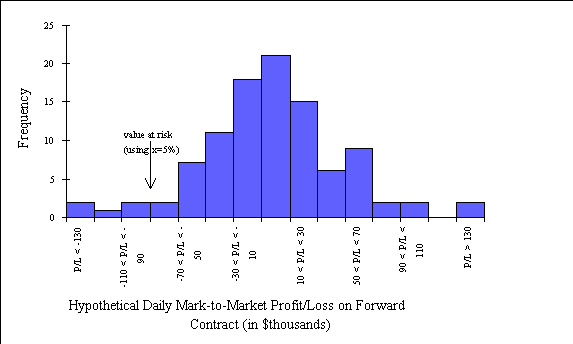
Figure 2: Probability Density Function and Value at Risk Obtained
Using Variance-Covariance Method
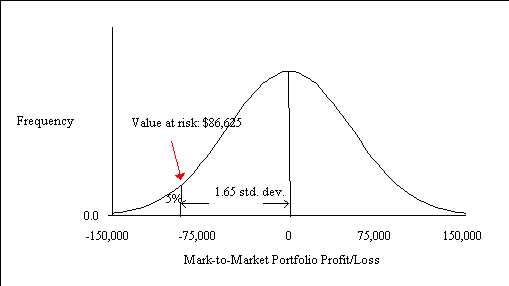
Figure 3: Focus of "Stress Testing"
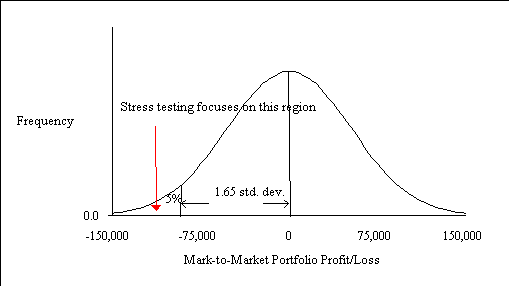
Figure 4: Price and Delta of a Call Option on British Pounds
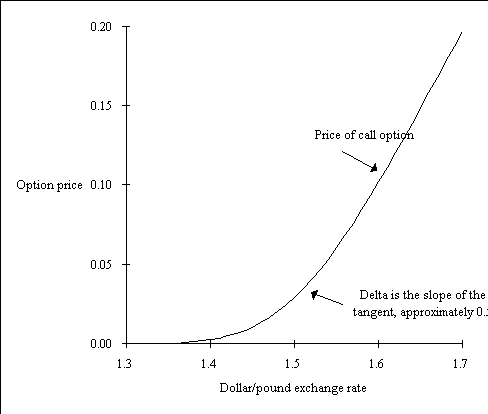
Figure 5: Delta Changes as the Exchange Rate Changes
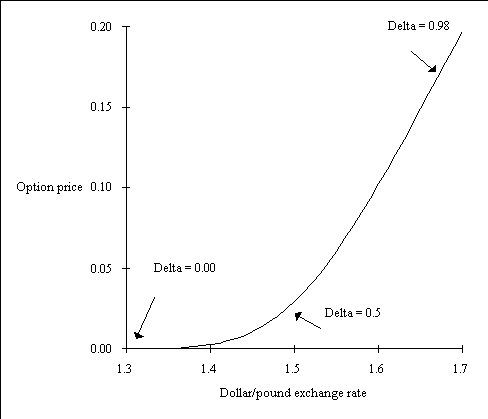
Figure 6: Example of a Risky Portfolio that has Delta = 0