I. INTRODUCTION
Black defines Anoise@ as noninformation (e.g., chart formations, technical signals, and investing fads) and Anoise trading@ as trading on noise as if it were information. The impact and motivations of noise traders have long been debated. Some renowned economists (i.e., Friedman) dismiss these traders as fodder for rational arbitrageurs, while others (i.e., Keynes) assert their impact on long-term market expectations. Traditional arguments rely on simple logic or casual observation; but, recently a rigorous theoretical literature has developed that examines the impact of noise traders on asset price behavior (e.g., De Long, Shleifer, Summers, and Waldmann, 1989,1990a, 1990b, 1991). These models suggest that noise traders can impact market prices and social welfare; furthermore, they can profitably exist within the economy. However, the theoretical specification of noise trader demand is crucial to the models' predictions and subsequent empirical tests (Cutler, Poterba, and Summers, 1989). To date, little work has been done on rigorously describing and quantifying noise trader demand (e.g., Solt and Statman; De Bondt). The purpose of this research is to empirically examine the nature of noise trader demand in commodity futures markets.
Noise traders take market positions based on nonfundamental information. The theoretical demand structure of noise traders has been specified in numerous forms. For instance, Cutler, Poterba, and Summers (1989) specify noise trader demand as a function of past prices. That is, uninformed traders are purely trend-followers with extrapolative expectations. On the other hand, De Long, Shleifer, Summers, and Waldmann (DSSW, 1990a) specify noise trader demand as a function of a random variable, sentiment. In this particular model, noise trader demand is driven by fads, social trends, and whims that stroke market sentiment. The demand function assumed in these models can alter their results. For instance, in Cutler et al.=s (1989) model positive feedback traders can create negative short-run autocorrelation in returns or long-run mean reversion depending on the exact demand specification. Clearly, a realistic demand specification is vital for the correct interpretation and empirical testing of noise trader models. The following research seeks to provide empirical insights as to an appropriate characterization of this demand.
Noise traders are often categorized as retail or small speculators. There has been some attempt to characterize the speculative demand or decision-making process of these investors; however, this research has focused almost exclusively on equity markets. For instance, Solt and Statman examine the sentiment of retail stock investors as captured in the Bearish Sentiment Index compiled by Investor=s Intelligence. This gauge of market sentiment is constructed by surveying market newsletters as to their outlook. Solt and Statman find that this market sentiment index contains no useful information for forecasting market returns. Furthermore, the aggregate sentiment among newsletters is positively correlated with past market returns. Similarly, De Bondt finds that the individual speculators surveyed by the American Association of Individual Investors demonstrate trend-following tendencies. That is, they are most bullish immediately following price increases. Collectively, this work suggests that the retail stock market speculator displays extrapolative expectations.
The following research expands previous work by examining a comprehensive
set of futures markets and explicitly examining the demand structure
of noise traders: Is noise trader demand driven by past prices,
i.e., extrapolative expectations, or is it a function of unobservable
social variables? To confront this issue, the research relies
on two measures of investor sentiment: Consensus=
Index of Bullish Market Opinion and Market Vane=s
Bullish Consensus Index. The sentiment indices essentially gauge
the degree of bullishness (or bearishness) among retail futures
speculators. Assuming that retail speculators do not have private
fundamental information, then their sentiment and, hence, the
indices serve as a proxy for noise trader demand. Using these
data along with returns from a large crosssection of futures
markets, the demand structure of noise traders is directly addressed.
II. MEASURING NOISE TRADER SENTIMENT
Two investment services firms, Consensus Incorporated and the
Market Vane Corporation, compile sentiment indices for futures
markets. Each uses a slightly different methodology, but the
general idea is the same. Market advisory services, newsletters,
electronic bulletin boards, and hotlines are surveyed as to whether
they are bullish or bearish on particular commodities. The number
of services that are bullish is then expressed as a percent of
the total surveyed. The indices are referred to as bullish sentiment.
CONSENSUS= Index of Bullish Market Opinion=
The methodology Consensus uses to compile its bullish sentiment index is quite simple. Consensus publishes a weekly market paper, CONSENSUS: National Futures and Financial Weekly, that contains a sampling of investment newsletters. From the sample of letters that Consensus receives, it compiles a sentiment index with a simple count of the number of bullish newsletters as a proportion all newsletters expressing an opinion. Consensus only considers those opinions which have been committed to publication. The Consensus bullish sentiment index at time t (CBSIt) is expressed as:
For instance, if Consensus receives 100 newsletters that comment on the frozen pork bellies market and 25 of those think that belly prices are going to increase, then the CBSI is 0.25 or 25 percent. The CBSI is compiled each Friday, reflecting the opinions expressed in newsletters that were published during the week. It is released early the following week by recorded telephone message and published in the following Friday's edition of CONSENSUS.
Market Vane's Bullish Consensus Index
The Market Vane Corporation takes a slightly different and more detailed approach to calculating a sentiment index. It receives market recommendations from brokerage firms and market advisors via newsletters, hotlines, and electronic transmission. Each market opinion (for a commodity) is weighted on a scale (B) from zero to eight with 0 and 8 being fully bearish and bullish, respectively. Next, each market letter is weighted according to its perceived influence or following. For newsletters, hotlines, and electronic bulletins this weight (W) is proportional to the subscriber base, and for brokerage firms it is proportional to the number of brokers at the firm. The Market Vane bullish sentiment index (MVBSIt) at time t is:
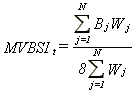
where, Bj is the degree of bullishness on a scale from 0 to 8 for advisor j, Wj is the influence weight assigned to the advisor, and there are a total of N advisors commenting on the market. The index is compiled each Tuesday, reflecting the opinions received since the prior Tuesday. The index is released on the same Tuesday via wire and facsimile.
Noise Traders and Information Sources
As a maintained hypothesis, it is assumed that the indices compiled by Consensus and Market Vane reflect the sentiment of noise traders--not rational or informed market participants. That is, the market views subsumed within the indices are those of small retail speculators who are acting on noninformation: technical trading rules, extrapolation, or old news that is already incorporated into the market price. This maintained hypothesis is supported by reviewing the decision-making rules of small traders and sampling their information sources.
In a 1965 survey of amateur futures speculators, Smidt attempted to classify their trading styles and decision-making criteria. Smidt found that more than one-half of the 349 traders surveyed relied exclusively (or moderately) on price charts to render trading decisions. Only four percent of those surveyed considered themselves information specialists who obtain and use information before it is widely available to other traders. Finally, most amateur speculators surveyed preferred to trade commodities about which they had personal knowledge or advice.
Surveys by the Chicago Board of Trade and Barron's suggest that small speculators do not behave in an entirely rational manner (see also Brennan; Nagy and Obenberger). Draper summarizes the surveys' findings. The surveys suggest that the average futures trader is highly educated, and they trade for the leverage and excitement. Furthermore, their important sources of information include: articles/publications, broker and newsletter recommendations, advisory services, and their own analysis. Consistent with these findings, Canoles' 1990 survey of 115 retail futures traders in Alabama reveals that speculators enjoy the drama and suspense of carrying open positions. Their favorite sources of information are professional trading advisory services and general financial publications. Collectively, these results suggest that retail speculators generally do not bring new information to bear on the markets, and they garnish much of their information from focused media sources such as those surveyed by Consensus, Inc. and the Market Vane Corporation.
Market advisors, brokers, and newsletters provide decision-making information for retail futures speculators; but, are they providing real information, or simply relaying old news and technical comments? Excerpts from an issue of CONSENSUS provide insight as to the information contained within advisors' recommendations and market newsletters.
Many market advisors rely on technical indicators and simply pass
along this information to their retail subscribers.
The (soybean) market is in a sideways pattern between 563 and
547. If the 547 support is taken out, then the market could decline
to 530....Charts suggest the market has confirmed the sideways
pattern and thus we feel comfortable selling and did so today
(Biedermann, Allendale, Inc.).
The major uptrending channel line is at 102-00 today. The strong
close puts the market in a strong position once again. The old
main top at 102-29 was taken out. This means that 101-08 is the
new main bottom. Now that the (T-Bond) market has closed inside
of the uptrending channel the upside potential is 103-17. Long-term
swing chart is still projecting a rally to 103-26 by February
24th (James A. Hyerczyk, Hyerczyk Technical Comments).
Each issue of CONSENSUS is filled with this type of technical
commentary for nearly every futures market. Although much more
rare than technical analysis, some newsletters are fundamental
in nature, relaying government reports, seasonal tendencies, and
pertinent cash market conditions.
The USDA left the 1994-95 ending stocks of soybeans unchanged
at 510 M.B. which suggests that the market will not be as sensitive
to weather as corn or possibly wheat....Seasonally, the market
tends to bottom in late February and work higher into March and
May (Strickler, Bradford & Co., Inc.).
Cash cattle prices reached $75.00/cwt. this week as tight market-ready
supplies and solidarity among feedlot operators forced packers
to bid prices upward....Extremely current marketings enabled them
(feedlots) to drive hard bargains with packers and force prices
higher. This bodes well for the cash market for the next six
to eight weeks (Vaught, A.G. Edwards & Sons, Inc.).
Although they often contain detailed interpretations of relevant supply and demand factors, the fundamental analysis tends to reiterate public information.
The noninformational nature of the market newsletters, coupled
with the evidence that retail investors rely on this advice in
making decisions, supports the maintained hypothesis: the sentiment
indices are valid proxies for noise trader demand. To the extent
that market opinion is correlated across advisors, noise traders
will act in concert (Shleifer and Summers).
III. DATA, METHODOLOGY, and RESULTS
Futures Data and Markets
Weekly futures returns are calculated for the closest to expiration contract where the maturity month has not been entered. Two different time series of futures returns are created to match-up with the sentiment data. First, nearby contract returns are calculated Friday-to-Friday using closing prices. This data series corresponds to that of the weekly Consensus sentiment data. Second, to match the weekly Market Vane sentiment data, futures returns are calculated from Tuesday-to-Tuesday using closing prices. Returns (Rt ) are calculated as the log-relative change in closing prices, ln(pt /pt-1). Weekly data from May 1983 to September 1994 are available for analysis (591 observations).
A cross-section of twenty-eight futures markets is examined to strengthen the studies= general conclusions and to avoid erroneous implications based on the nuances of a particular market. Markets are chosen based on the availability of the futures and sentiment data. To facilitate the presentation of results and for relevant comparisons, related markets are designated into commodity groups. Group classification is based on common production/consumption patterns and expectations concerning the correlation of returns and sentiment among the markets.
The five commodity groups include: grain (corn, wheat, soybeans, soybean meal, and soybean oil); livestock (live cattle, feeder cattle, live hogs, and frozen pork bellies); food/fiber (coffee, sugar, cocoa, orange juice, cotton, and lumber); financial (Deutsche mark, British pound, Swiss franc, Canadian dollar, Japanese yen, Treasury bills, and Treasury bonds); and metal/energy (gold, silver, platinum, heating oil, crude oil, and gasoline). A complete listing of markets and contracts is presented in Table 1.
Summary Statistics
The general characteristics of the sentiment indices are explored with simple summary statistics presented in Tables 2 and 3. The mean sentiment level (% bullish) tends to be fairly neutral at around 50 for the MVBSI (Table 3); however, the CBSI (Table 2) have means that are notably less than a neutral 50. In fact, the mean CBSI is statistically less than 50 at the 1% level (two-tailed t-test) for all the markets except LC and SB. The range of the mean CBSI is from a low of 38.5 for HU to a high of 51.6 for LC. In comparison, the MVBSI means are in a rather narrow range from 47.1 for PB to a high of 55.3 for SB. Although some of the markets have a mean MVBSI that is statistically different than 50, they are in general much closer to and more evenly distributed around 50 than the CBSI means.
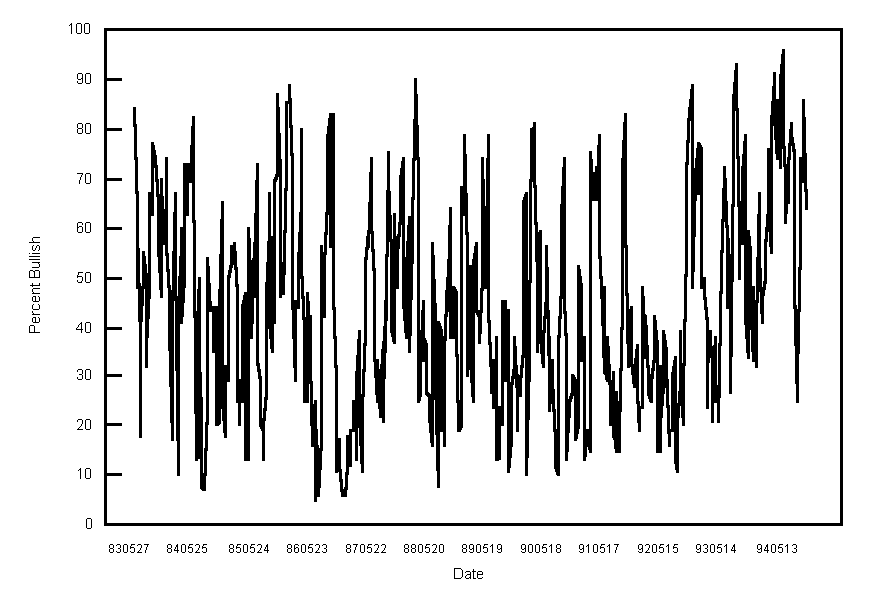
For both sets of indices, sentiment is quite volatile with large standard deviations and extremes of above 90 and below 10. Again, the CBSI are notably more volatile and extreme (especially at lower levels) than the MVBSI. The disparities between the Market Vane and Consensus data sets are likely due to differences in sampling size and procedures. The extreme values of sentiment along with its volatility suggest that the advisors that make-up the indices are reacting to correlated market signals. As an illustration of the sentiment behavior over time, the CBSI for coffee is plotted in Figure 1.
The sentiment data also display a high level of correlation both across the two indices and across markets. As shown in the final column of Table 3, the simple correlations between the CBSI and MVBSI range from 0.596 for FC to 0.799 for GC. This suggests that the two indices capture the sentiment of an alike group of traders that share decision-making criteria. Similarly, the cross-market correlations are strong within commodity groups. Table 4 presents the simple correlation coefficients among related markets. Note, the correlation of sentiment within commodity groups is relatively strong. For instance, the correlation between C and S for the CBSI is 0.631, and it is 0.782 between JY and DM for the MVBSI. These type of correlations are indicative of systematic noise trader demand that covaries across traders and markets (see DSSW, 1990a).
Noise Trader Demand and Extrapolative Expectations
Solt and Statman as well as De Bondt document that retail stock market speculators exhibit extrapolative expectations--becoming more bullish after recent market increases. They demonstrate this with simple OLS regressions of sentiment on past stock market returns. Here, that methodology is refined, and the specific form of extrapolative expectations is tested.
A general method of exploring the linear linkages between and sentiment and price is within the "Granger causality" framework. Hamilton suggests the following direct or bivariate Granger test:
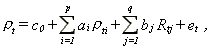
where, Dt and Rt represent noise trader sentiment and futures returns, respectively, and et is a white noise error term.
Causality from returns to sentiment in equation (1) is tested under the null of bj=0 œ j. Specifically, equation (1) is estimated with OLS, and the null hypothesis that Rt does not lead Dt (i.e., bj = 0 œ j) is tested with a Chi-squared test (Hamilton, p. 305)., The aggregate sign of causality (positive or negative) is addressed by summing the impact of lagged returns, 3 bj, and testing if it equals zero using a two-tailed t-test. If 3 bj > 0, then the noise traders are also positive feedback traders or trend-followers. That is, their demand is an increasing function of past prices.
Choosing the appropriate lag lengths (p,q) is of practical significance in performing the causality test (see Thorton and Batten; Jones). As suggested by Beveridge and Oickle, the order of an autoregressive system may best be determined by searching all possible lags for the combination that minimizes a model selection criterion. For example, in (1) the model is estimated by varying the own-lag length of Dt from p=1,2,...pmax, and the lag length of Rt from q=1,2,...,qmax such that a total of (pmax x qmax) regressions are estimated. The p,q lag length combination that minimizes Akaike's information criteria (AIC) is chosen as the final model specification. This purely objective procedure has the advantage of not placing the artificial restriction that p=q. Additionally, it eliminates the uncertainty in multivariate cases of deciding the order in which to enter additional variables into a model. For equation (1), all possible lag-length combinations are estimated with pmax = qmax= 8, and p,q is chosen to minimize AIC.
The estimation results for each market are presented in Tables 5 and 6 for the CBSI and MVBSI, respectively. The results indicate that noise traders are predominately positive feedback traders, i.e., returns lead sentiment and the cumulative impact is positive. In each market examined, the null hypothesis that returns do not lead sentiment is rejected at the 0.01 level. The additive effect of lagged returns is statistically positive (1% level) for every market except PL in the Market Vane data set. Past returns and sentiment levels explain a fairly large portion of the variation in sentiment with the adjusted R-squared ranging from 0.53 to 0.78 in the CBSI models and 0.37 to 0.69 in the MVBSI models. These results are consistent with prior work on sentiment (Solt and Statman; De Bondt) and conjectures that noise traders are often trend-followers.
Close examination of Tables 5 and 6 reveal that the degree of trend-following differs somewhat across commodities and the data sets. For a more general characterization of noise trader demand, the causality test in (1) is estimated by pooling the time series data across the designated commodity groups. The pooled cross-sectional time series models are estimated using the GLS procedure of Kmenta (pp. 616-635) correcting for cross-sectional correlation and heteroskedasticity. The lag-lengths for the pooled regressions are specified by choosing the maximum p and the maximum q from among the individual market specifications within each group. For instance in the CBSI grain group the maximum p is 2 (S and BO) and the maximum q is 2 (C, S, SM, BO); therefore, the pooled grain model's lag structure is 2,2. This specification procedure may over-specify lag structures at the expense of statistical power, but it assures that the model does not suffer from an under-specification bias.
The estimated pooled models are presented in Tables 7 and 8 for the Consensus and Market Vane data, respectively. For each pooled regression, the null hypothesis that returns do not lead sentiment (i.e., bj = 0 œ j) is tested with a Wald Chi-squared test, and the cumulative impact of lagged returns is again tested with a two-tailed t-test (i.e., 3 bj = 0). Concentrating on the CBSI results in Table 7, certain characteristics of sentiment are evident. First, across groups, sentiment follows a fairly strong positive autoregressive process with first-order coefficients around 0.65. Second, statistically significant positive extrapolation is demonstrated at one and two week lags for all the groups, i.e., positive feedback traders have relatively long memories. For instance, in grains, a one percent weekly return results in sentiment increasing by 1.26 percent the following week and 0.376 percent the week after that. For all the groups, the null that returns do not lead sentiment can be rejected at the 1% level, and the cumulative impact of lagged returns is significantly positive (1% level). These results hold for the MVBSI models in Table 8 as well, where again the null hypothesis are rejected for each commodity group.
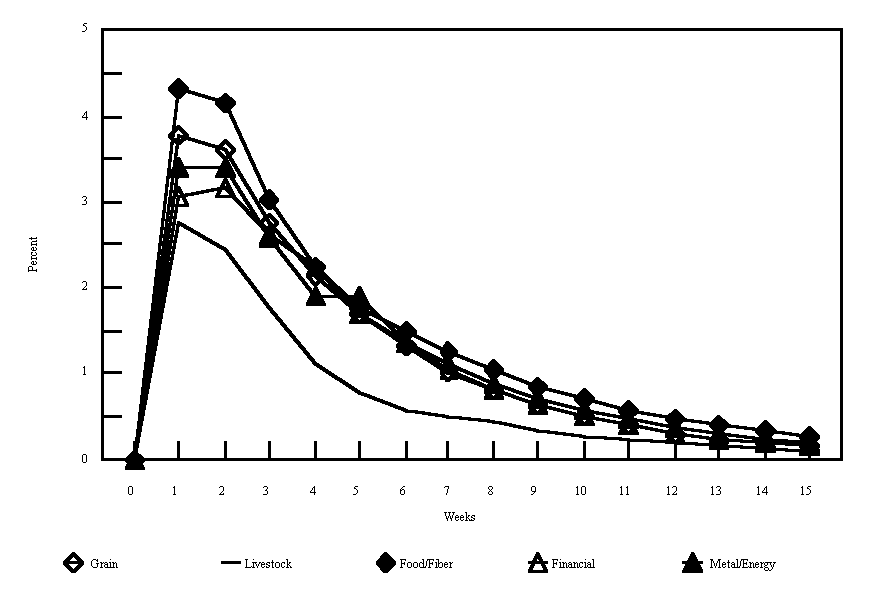
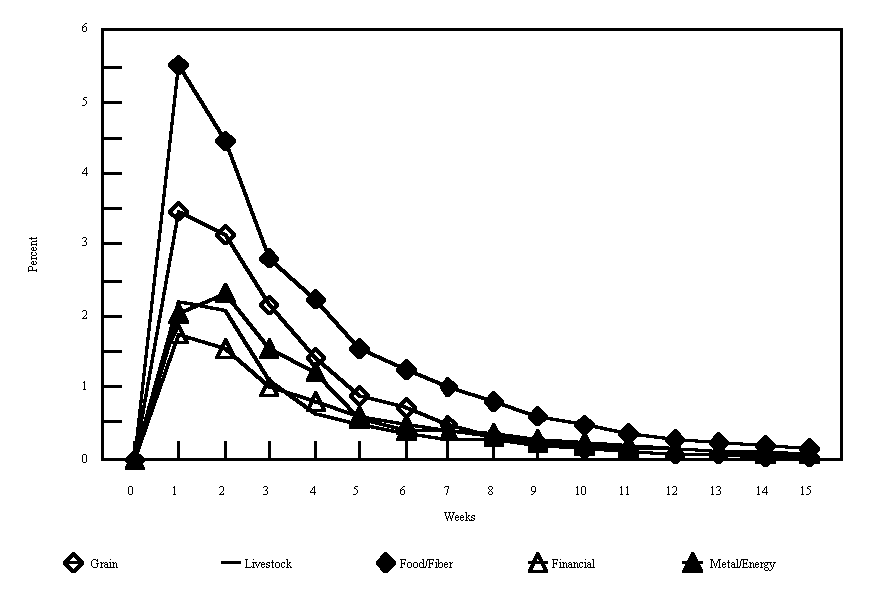
To illustrate the behavior of sentiment when driven by extrapolative
expectations, the impulse response function for a one standard
deviation shock to returns is calculated (see Harvey, p. 234).
Figures 2 and 3 show the impulse response functions for the pooled
CBSI and MVBSI models, respectively. Looking at the CBSI results
(Figure 2), a standard deviation shock in weekly returns causes
the greatest initial increase in food/fiber market sentiment.
Notably, the impact on metal/energy and financial market sentiment
does not reach a peak until two weeks after the initial shock.
All of the response functions decline rather smoothly and at
similar rates, except for the livestock group where extrapolative
effects are less pronounced. The impulse response functions for
the MVBSI (Figure 3) display a greater disparity of demand response
among the groups. Consistent with the CBSI data, the MVBSI data
show that the food/fiber group is most prone to trend-following.
The strength of extrapolative expectations in this group may
arise from a relatively high proportion of uninformed traders
or a scarcity of public fundamental information. In total, the
pooled models strongly suggest that the noise traders subsumed
within the sentiment indices are long-memory positive feedback
traders.
IV. SUMMARY AND CONCLUSIONS
The presented analysis uses commercial market sentiment indices to explore noise trader demand in futures markets. It is maintained that the market sentiment indices adequately measure the demand of retail speculators. Furthermore, these small speculators rely on nonfundamental information in forming their expectations; thus, they are noise traders. The role of extrapolative expectations in noise trader demand is investigated within a Granger causality framework. The results suggest that noise trader demand (i.e., sentiment) is an increasing function of past returns. Furthermore, noise traders have relatively long memories. That is, sentiment is influenced by returns over at least the previous two weeks. The sentiment indices exhibit other characteristics of theoretical noise trader demand. Sentiment is very volatile with many extreme observations, and it covaries across related markets. These characteristics are consistent with systematic noise trader risk that can impact markets (see DSSW, 1990a).
Collectively, the findings suggest that the traders composing
the indices are long-memory positive feedback traders. Clearly,
these traders respond to similar pseudo market signals (i.e.,
past returns), and as a result sentiment moves in unison and takes
large swings to extreme values. These empirical findings have
direct implications for the interpretation and testing of theoretical
models. For instance, Cutler et al.=s
(1989) model generates returns that are positively correlated
if noise traders are short-memory negative feedback traders.
The evidence presented here would shun that scenario in favor
of the results for long-memory positive feedback traders. For
this type of noise trader, their model generates short-run positive
autocorrelation and long-run negative autocorrelation in returns
(i.e., mean-reversion). Perhaps not surprisingly, these are the
anomalous characteristics of asset returns that are considered
stylized facts (see Cutler, Poterba, and Summers, 1991).
Bibliography
Beveridge, S. and C. Oickle. "A Comparison of Box-Jenkins and Objective Methods for
Determining the Order of a Non-seasonal ARMA Model." Journal
of Forecasting. 13(1994):419-434.
Black, F. "Noise." Journal of Finance. 41(1986):529-543.
Brennan, M.J. "The Individual Investor." Journal
of Financial Research. 18(1995):59-74.
Canoles, B.W. "An Analysis of the Profiles, Motivations,
and Modes of Habitual Commodity Speculators." Ph.D. Dissertation,
Department of Agricultural Economics, University of Illinois,
1994.
CONSENSUS: National Futures and Financial Weekly, Consensus,
Inc., Kansas City, Missouri. Volume XXV, Number 7, February 17,
1995.
Cutler, D.M., J.M. Poterba, and L.H. Summers. "Speculative Dynamics and the Role of
Feedback Traders." American Economic Review. 80(1989):6368.
Cutler, D.M., J.M. Poterba, and L.H. Summers. "Speculative
Dynamics." Review of Economic Studies. 58(1991):529-546.
De Bondt, W.F.M. "Betting on Trends: Intuitive Forecasts
of Financial Risk and Return." International Journal
of Forecasting. 9(1993):355371.
De Long, J.B., A. Shleifer, L.H. Summers, and R.J. Waldmann.
"Noise Trader Risk in Financial Markets." Journal
of Political Economy. 98(1990a):703-738.
De Long, J.B., A. Shleifer, L.H. Summers, and R.J. Waldmann.
"Positive Feedback Investment Strategies and Destabilizing
Rational Speculation." Journal of Finance. 45(1990b):379-395.
De Long, J.B., A. Shleifer, L.H. Summers, and R.J. Waldmann.
"The Size and Incidence of the Losses from Noise Trading."
Journal of Finance. 44(1989):681-696.
De Long, J.B., A. Shleifer, L.H. Summers, and R.J. Waldmann.
"The Survival of Noise Traders in Financial Markets."
Journal of Business. 64(1991):1-19.
Draper, D.W. "The Small Public Trader in Futures Markets."
in Futures Markets: Regulatory Issues. Ed. Anne E. Peck.
Washington, D.C.: American Enterprise Institute for Public Policy
Research, 1985.
Friedman, M. "The Case for Flexible Exchange Rates."
in Essays in Positive Economics. University of Chicago
Press, Chicago, 1953, pp. 157-203..
Greene, W.H. Econometric Analysis. MacMillan, New York,
1993.
Hamilton, J.D. Time Series Analysis. Princeton University
Press, New Jersey, 1994.
Harvey, A.C. The Econometric Analysis of Time Series.
Second edition. MIT Press, Cambridge, Massachusetts, 1991.
Jones, J. "A Comparison of Lag-Length Selection Techniques
in Tests of Granger Causality Between Money Growth and Inflation:
Evidence for the U.S., 1959-86." Applied Economics.
24(1989):809-822.
Keynes, J.M. The General Theory of Employment Interest and
Money. New York: Harcourt, Brace, and Co., 1936.
Kmenta, J. Elements of Econometrics. Second edition.
Macmillan Publishing Company, New York, 1986.
Market Vane's Bullish Consensus. Hadady Corporation, Pasadena,
California. Volume 29, Issue 6, 1994.
Nagy, R.A. and R.W. Obenberger. "Factors Influencing Individual
Investor Behavior." FinancialAnalysts Journal. July/August
1994:63-68.
Shleifer, A. and L.H. Summers. "The Noise Trader Approach
to Finance." Journal of Economic Perspectives.
4(1990):19-33.
Smidt, S. "Amateur Speculators." Cornell Studies
in Policy Administration. Cornell University, 1965.
Solt, M.E. and M. Statman. "How Useful is the Sentiment
Index." Financial Analyst Journal. September(1988):4555.
Thorton, D. and D. Batten. "Lag-Length Selection and Tests of Granger Causality Between Money and Income." Journal of Banking And Finance. 17(1985)164-178.
Table 1. Markets and Contract Months.
Market(ticker symbol) Contract Months
Grain
Corn(C)* March, May, July, Sept., Dec.
Wheat(W) March, May, July, Sept., Dec.
Soybeans(S) Jan., March, May, July, Aug., Sept., Nov.
Soybean Meal(SM) Jan., March, May, July, Aug., Sept., Oct., Dec.
Soybean Oil(BO) Jan., March, May, July, Aug., Sept., Oct., Dec.,
Livestock
Live Cattle(LC) Feb., April, June, Aug., Oct., Dec.
Feeder Cattle(FC) Jan., March, April, May, Aug., Sept., Oct., Nov.
Live Hogs(LH) Feb., April, June, July, Aug., Oct., Dec.,
Pork Bellies(PB) Feb., March, May, July, Aug.
Food/Fiber
Coffee(KC) March, May, July, Sept., Dec.
Sugar(SB) March, May, July, Oct.
Cocoa(CC) March, May, July, Sept., Dec.
Orange Juice(JO) March, May, July, Sept., Nov.
Cotton(CT) March, May, July, Oct., Dec.
Lumber(LB) Jan., March, May, July, Sept., Nov.
Financial
Deutsche mark(DM) March, June, Sept., Dec.
British pound(BP) March, June, Sept., Dec.
Swiss franc(SF) March, June, Sept., Dec.
Canadian dollar(CD) March, June, Sept., Dec.
Japanese yen(JY) March, June, Sept., Dec.
Treasury bills(TB) March, June, Sept., Dec.
Treasury bonds(US) March, June, Sept., Dec.
Metal/Energy
Gold(GC) Feb., March, April, June, Aug., Oct., Dec.
Silver(SI) March, May, July, Sept., Dec.
Platinum(PL) Jan., April, July, Oct.
Heating Oil(HO) Jan.-Dec.
Crude Oil(CL) Jan.-Dec.
Gasoline(HU) Jan.-Dec.
*Ticker symbols are presented in parenthesis and used throughout the remainder of the tables when referring to the various markets.
Table 2. Summary Statistics, Consensus Data: May 1983
- September 1994.
Market Mean St. Dev. Min. Max.
C* 45.701 19.916 5 92
W 46.413 20.193 3 91
S 46.783 17.882 12 90
SM 42.501 20.012 5 95
BO 43.992 21.861 5 96
LC 51.584 15.547 15 87
FC 46.998 19.617 6 95
LH 44.332 15.696 13 88
PB 39.716 17.913 4 88
KC 43.992 20.906 5 96
SB 51.279 22.112 5 94
CC 41.755 20.455 4 94
JO 40.294 22.731 6 94
CT 45.981 21.331 7 96
LB 42.181 21.033 5 94
DM 46.876 21.822 4 89
SF 45.205 21.739 3 94
JY 42.701 20.821 3 91
BP 42.870 22.017 0 96
CD 41.591 19.899 0 92
TB 46.619 20.917 5 93
US 44.406 17.525 9 86
GC 43.570 20.630 3 96
SI 43.531 19.254 4 95
PL 44.450 21.641 6 95
HO 39.679 20.469 4 87
CL 40.401 18.471 3 86
HU 38.551 20.674 5 93
*All of the markets have 591 weekly observations, except CL and HU which begin in April 1985 and have 494 observations.
Table 3. Summary Statistics, Market Vane Data: May 1983
- September 1994.
Correlation**
Market Mean St. Dev. Min. Max. Coefficient
C* 53.286 16.343 12 89 0.763
W 52.797 14.715 16 88 0.703
S 52.673 15.429 16 93 0.740
SM 51.321 15.767 12 89 0.718
BO 52.983 15.838 11 89 0.716
LC 52.975 14.680 16 90 0.750
FC 51.418 17.225 5 95 0.596
LH 49.318 15.065 15 87 0.720
PB 47.146 15.018 15 91 0.653
KC 52.526 17.270 11 93 0.721
SB 55.299 16.758 15 91 0.749
CC 49.550 17.481 11 91 0.725
JO 51.602 19.316 5 93 0.716
CT 50.613 16.071 9 88 0.722
LB 50.355 16.503 5 93 0.632
DM 53.044 15.692 15 96 0.770
SF 52.958 15.508 14 96 0.745
JY 52.526 15.186 14 95 0.712
BP 51.051 16.283 13 95 0.745
CD 50.689 15.628 10 97 0.659
TB 51.585 14.711 11 94 0.612
US 50.555 13.085 13 90 0.676
GC 52.673 13.572 16 85 0.799
SI 52.854 13.382 12 92 0.745
PL 52.029 16.263 10 97 0.726
HO 50.871 16.102 10 90 0.673
CL 48.876 16.737 8 95 0.616
HU 49.645 16.384 9 89
0.636
*The Market Vane summary statistics are calculated with 591 weekly observations.
**The final column is the simple correlation coefficient
between the Market Vane and Consensus indices. They are calculated
with 591 weekly observations, except for HU and HO which have
494 observations. All the correlations are statistically different
from zero at the 1% level.
Table 4. Correlation Matrices, Sentiment Across Markets:
May 1983 - September 1994.
The upper (lower) off-diagonal entries are correlations for Consensus
(Market Vane) data.
Simple Correlation Coefficients
Panel A: Grain
Panel B: Livestock
Panel C: Food/Fiber
Table 4 (continued). Correlation Matrices, Sentiment Across Markets: May 1983 -
September 1994.
Simple Correlation Coefficients
Panel D: Financial
Panel E: Metal/Energy
*The correlations are calculated over 591 observations, except for those using the Consensus CL and HU data which begin April 5, 1985 and have 494 observations. The standard error of the estimated correlations is (1/n-3)2, so with n=591 the standard error is 0.04123 and anycorrelation coefficient greater than 0.0809 (0.106) is statistically different from zero at the 5% (1%) level using a two-tailed t-test.
Table 5. Granger Causality Test, Returns Lead Sentiment, Consensus Data.
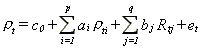
The model is estimated with OLS, and the Wald Chi-squared statistic
tests the null, H0: bj=0 œ
j. The cumulative impact of returns is calculated, 3
bj j=1,2,..,q., and tested against the null, H0:
3 bj=0, with a t-test.
Market p,q P2(q)
p-value 3 bj t-stat. p-value
adj. R2
C* 1,2 39.56 0.000 152.6 4.94 0.000 0.761
W 1,1 63.83 0.000 140.7 7.98 0.000 0.741
S 2,2 23.70 0.000 135.3 4.17 0.000 0.701
SM 1,2 42.64 0.000 172.9 5.45 0.000 0.658
BO 2,2 45.70 0.000 178.5 6.29 0.000 0.653
LC 1,6 73.92 0.000 424.3 5.67 0.000 0.608
FC 4,1 43.17 0.000 266.1 6.57 0.000 0.531
LH 2.2 89.65 0.000 183.8 3.96 0.000 0.675
PB 2,3 54.17 0.000 79.3 3.96 0.000 0.630
KC 3,3 92.76 0.000 211.7 7.65 0.000 0.652
SB 3,2 60.91 0.000 90.2 6.75 0.000 0.782
CC 2,2 81.92 0.000 175.2 7.64 0.000 0.631
JO 5,2 37.82 0.000 175.6 5.71 0.000 0.693
CT 5,2 68.17 0.000 215.8 6.75 0.000 0.715
LB 1,2 63.92 0.000 155.6 6.52 0.000 0.608
DM 2,2 97.44 0.000 379.8 7.23 0.000 0.759
SF 2,3 100.5 0.000 460.7 7.42 0.000 0.769
JY 1,5 73.15 0.000 685.8 6.47 0.000 0.745
BP 4,3 81.07 0.000 466.3 6.52 0.000 0.759
CD 3,2 59.12 0.000 917.5 6.84 0.000 0.688
TB 4,1 66.43 0.000 2194 8.15 0.000 0.679
US 4,2 106.3 0.000 388.3 8.22 0.000 0.727
GC 2,2 71.74 0.000 282.5 7.59 0.000 0.795
SI 4,6 98.77 0.000 201.8 4.71 0.000 0.709
PL 2,2 73.41 0.000 213.4 7.91 0.000 0.703
HO 1,1 51.06 0.000 89.4 7.14 0.000 0.645
CL 4,1 40.55 0.000 65.5 6.36 0.000 0.683
HU 4,2 30.15 0.000 119.2 5.03 0.000 0.587
*All models are estimated over 536 weekly observations, except for those involving CL and HU which are estimated over 438 observations.
Table 6. Granger Causality Test, Returns Lead Sentiment, Market Vane Data.
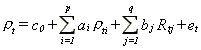
The model is estimated with OLS, and the Wald Chi-squared statistic
tests the null, H0: bj=0 œ
j. The cumulative impact of returns is calculated, 3
bj j=1,2,..,q., and tested against the null, H0:
3 bj=0, with a t-test.
Market p,q P2(q)
p-value 3 bj t-stat. p-value
adj. R2
C* 3,2 22.16 0.000 123.7 4.16 0.000 0.576
W 3,2 52.52 0.000 201.2 6.92 0.000 0.513
S 1,6 39.74 0.000 186.4 3.80 0.000 0.549
SM 2,2 54.78 0.000 145.9 5.82 0.000 0.572
BO 3,3 65.84 0.000 171.9 6.03 0.000 0.591
LC 6,1 54.99 0.000 192.5 7.41 0.000 0.551
FC 6,2 33.29 0.000 305.8 4.90 0.000 0.376
LH 1,2 46.71 0.000 150.9 5.56 0.000 0.549
PB 1,2 39.41 0.000 88.5 5.18 0.000 0.463
KC 5,2 54.91 0.000 145.2 7.17 0.000 0.577
SB 2,3 54.18 0.000 54.7 3.18 0.002 0.598
CC 5,1 47.18 0.000 102.1 6.86 0.000 0.529
JO 2,2 64.21 0.000 172.2 7.44 0.000 0.629
CT 2,1 32.91 0.000 94.8 5.73 0.000 0.644
LB 2,3 63.56 0.000 178.1 6.37 0.000 0.575
DM 1,1 54.60 0.000 181.4 7.38 0.000 0.699
SF 1,1 46.50 0.000 166.3 6.81 0.000 0.645
JY 1,3 33.25 0.000 311.5 4.86 0.000 0.635
BP 2,1 41.83 0.000 164.3 6.46 0.000 0.693
CD 2,1 41.10 0.000 501.5 6.41 0.000 0.597
TB 6,2 28.37 0.000 1651 4.82 0.000 0.610
US 5,4 37.60 0.000 243.3 3.42 0.001 0.601
GC 1,1 17.84 0.000 71.85 4.22 0.000 0.637
SI 4,5 33.19 0.000 94.1 3.01 0.002 0.538
PL 4,6 44.33 0.000 74.17 1.58 0.115 0.618
HO 1,4 25.38 0.000 140.8 4.63 0.000 0.533
CL 5,1 20.87 0.000 54.6 4.56 0.000 0.591
HU 1,4 38.33 0.000 169.5 5.63 0.000 0.466
*All models are estimated over 558 weekly observations, except for those involving CL and HU which are estimated over 539 and 457 observations, respectively.
Table 7. Pooled Causality Test, Returns Lead Sentiment,
Consensus Data.
Independent
Variables Grain Livestock Food/Fiber Financial Metal/Energy
intercept 11.09 12.03 10.45 10.33 10.02
(16.9)* (12.3) (17.0) (16.6) (13.7)
Dt-1 0.664 0.617 0.645 0.692 0.685
(31.2) (26.1) (33.2) (39.2) (32.7)
Dt-2 0.091 0.049 0.028 0.021 0.026
(4.57) (1.78) (1.21) (0.96) (1.02)
Dt-3 0.022
0.044 -0.003 0.029 (0.80) (1.94) (-0.15) (1.15)
Dt-4 0.053 0.011 0.052 0.022
(2.32) (0.49) (3.11) (1.07)
Dt-5 0.026
(1.54)
Rt-1 126.5 95.9 104.0 233.8 94.1
(14.6) (11.6) (18.8) (17.5) (13.8)
Rt-2 37.6 25.9 32.9 79.6 29.5
(4.44) (3.03) (5.64) (5.67) (4.15)
Rt-3 4.09 5.22 28.4 4.64
(0.47) (0.90) (2.01) (0.65)
Rt-4 -5.76 28.5 -1.95
(-0.78) (2.11) (-0.28)
Rt-5 -7.65 -5.93 9.54
(-0.94) (-0.44) (1.38)
Rt-6 -4.67 -3.37
(-0.58) (-0.50)
3 bj 164.1 107.8 142.2 364.6 132.4
(12.8) (4.86) (13.2) (10.7) (7.24)
P2(q)
221.6** 143.9 368.7 364.6 202.7
Buse R2 0.667 0.545 0.683 0.671 0.653
*T-statistics in parenthesis test if the coefficient equals zero, with degrees of freedom equal to N*K-(p+q+1), where N=536 (438 for metal/energy) and K=number of markets in the group.
**All the P2(q) statistics reject that the coefficients on lagged returns are zero at the 1% level.
Table 8. Pooled Causality Test, Returns Lead Sentiment, Market Vane Data.
Independent
Variables Grains Livestock Food/Fiber Financial Metal/Energy
intercept 20.58 19.80 15.77 13.84 14.62
(17.9)* (15.3) (18.7) (17.5) (13.7)
Dt-1 0.518 0.511 0.552 0.622 0.567
(25.1) (22.1) (27.6) (36.1) (27.5)
Dt-2 0.024 0.018 0.090 0.046 0.032
(1.05) (0.73) (3.96) (2.28) (1.36)
Dt-3 0.063 0.017 0.044 0.063 0.054
(3.09) (0.69) (1.99) (3.16) (2.32)
Dt-4 0.044 -0.025 -0.033 0.061
(1.81) (-1.19) (-1.68) (2.60)
Dt-5 -0.016 0.034 0.023 0.006
(-0.68) (2.05) (1.21) (0.30)
Dt-6 0.037 0.009
(1.81) (0.57)
Rt-1 116.5 76.5 83.9 133.3 55.8
(15.5) (9.95) (16.1) (12.6) (9.52)
Rt-2 44.5 33.2 24.6 33.8 32.2
(5.65) (4.24) (4.49) (3.14) (5.36)
Rt-3 15.74 1.91 -3.19 4.93
(2.04) (0.35) (-0.29) (0.82)
Rt-4 0.67 1.01 4.10
(0.08) (0.09) (0.68)
Rt-5 -3.85 -11.4
(-0.52) (-1.94)
Rt-6 3.35 -6.34
(0.47) (-1.09)
3 bj 177.1 109.8 110.5 165.0 79.3
(8.35) (9.74) (10.7) (7.27) (4.98)
P2(p)
258.8** 112.9 264.1 164.8 111.3
Buse R2 0.501 0.389 0.581 0.556 0.518
*T-statistics in parenthesis test if the coefficient equals zero, with degrees of freedom equal to N*K-(p+q+1), where N=558 (457 for metal/energy) and K=number of markets in the group.
**All the P2(q) statistics reject that the coefficients on lagged returns are zero at the 1% level.