L-scaling
Eric Blankmeyer
Department of Finance and Economics
Southwest Texas State University
San Marcos, TX 78666
512-245-3253
Abstract. This paper introduces L-scaling, which computes
scaled scores from multivariate data. We demonstrate the
uniqueness, positivity, and equivariance of the L-scaling
weights. The relationship of L-scaling to ANOVA and
principal components is explained, robustness and
inference are discussed, and an analogy in mechanics is
mentioned. Finally, L-scaling is used to summarize the cost
of living in 15 U. S. cities in 1988.
Copyright 1996 Eric Blankmeyer
L-scaling
1. Introduction.
This paper introduces L-scaling, a technique for deriving
scaled scores or index numbers from a data matrix. The
weights which L-scaling applies to the data matrix have
several interesting properties:
o they provide a least-squares fit to the data, taking full
account of the correlation matrix;
o they are uniquely defined even if the correlation matrix
does not have full rank;
o they are positive if the correlation matrix is positive;
o they are equivariant with respect to a rescaling of the
data;
o they are related to the principal component method;
o they are also related to the Leontief matrix of economics
(hence the name L-scaling);
o they are easily computed by solving a set of simultaneous
linear equations;
o they can also be computed in a robust form that is
resistant to outliers;
o they have analogues in statistical mechanics and
o they can be used to make inferences and test hypotheses.
The paper is organized as follows. This section defines some
notation. In section 2, the L-scaling weights are shown to be the
unique solution to a least-squares problem. In section 3, the
method's resemblance to the Leontief matrix provides a sufficient
condition for the L-scaling weights to be positive; and
the technique is related to ANOVA and principal components.
Section 4 deals with issues of equivariance and robustness. An
analogy in mechanics is mentioned in section 5, while section 6
addresses inference and hypothesis tests. The paper concludes with an
application to the cost of living in 15 U. S. cities in 1988.
Given T joint observations on K variables, it is frequently
useful to consider the weighted average or scaled score:
yt=
SkXtkwk , t = 1,...,T .In matrix notation,
y = Xw = XWe . (1)
In equation (1),
X = a TxK data matrix to be scaled (the input);
y = a column vector of T scaled scores (the output);
w = a column vector of K weights;
e = a column vector of K units (1's); and
W = a KxK diagonal matrix whose nonzero elements
are the weights (w = We).
To simplify the mathematical notation, it is assumed that the
data have been standardized and divided by the square root of T. That is,
R = X'X (2)
is a correlation matrix of order K. This premise is relaxed in
section 4, where equivariance is discussed. Another assumption is
that the K variables are not all perfectly correlated: the rank
of R exceeds one. In applications, the rank of R is usually the
smaller of T and K since there is unlikely to be an exact linear
relationship among the variables.
2. A least-squares problem.
Because the variables are imperfectly correlated, there are
potentially TK discrepancies between the weighted average y and
its components XW. In view of equation (1), L-scaling defines
such a discrepancy as Xtkwk - yt/K. In matrix notation, the TxK
discrepancy matrix is
D = XW - ye'/K
= XW - XWee'/K from (1)
= XW(I - ee'/K) , (3)
where I is the identity matrix of order K. The matrix (I - ee'/K)
is familiar to statisticians; it transforms an array of raw data
into deviations from the sample means. In equation (3), however,
the "data" XW include the observations X and the still unknown
weights W. L-scaling chooses the weights to minimize the sum of
the squared discrepancies. In other words, the weights minimize
the trace (tr) of D'D, just the sum of that matrix's diagonal
elements:
tr(D'D) = tr{[XW(I - ee'/K)]'[XW(I - ee'/K)]}
= tr{XW(I - ee'/K)][XW(I - ee'/K)]'} (4)
since in general tr(PQ) = tr(QP) for conformable matrices.
Moreover, (I - ee'/K) is an idempotent matrix, so equation (4)
becomes
tr(D'D) = tr[XW(I - ee'/K)WX'] . (5)
In equation (5), the diagonal element t of the bracketed
matrix is
SXtk2wk2 - (1/K)SSXtjXtkwjwk , (6)
where the summations over j and k run from 1 to K. Since the X
data are standardized, it follows from equation (6) that the
L-scaling minimand is
tr(D'D) = w'(I - R/K)w . (7)
To avoid the trivial solution (w = 0), (7) must be minimized
subject to a normalization of the weights. L-scaling adopts the
constraint that the weights should add to 1:
w'e = 1 , (8)
Whether the constrained minimum is unique depends on the rank
of (I - R/K) = (KI - R)/K. The matrix is evidently singular if
and only if K is an eigenvalue of R. But then the rank of R is 1,
contrary to assumption; and the K variables collapse to a single
variable. Barring this, the rank of R exceeds 1, the inverse of
(I - R/K) exists, and the L-scaling minimum is unique. This
conclusion is valid whether or not T > K and even if some (but
not all) of the X variables are linearly dependent.
When the quadratic form (7) is minimized with respect to w
and subject to the normalizing constraint (8), the L-scaling
weights are
w = c(I - R/K) -1e (9)
In equation (9), the positive constant
c = 1/e'(I - R/K) -1e (10)
is the Lagrange multiplier for the normalizing constraint; it
is also the value of the quadratic form (7) at its constrained
minimum. The scaled scores y are obtained by substituting (9)
into (1).
3. L-scaling, the Leontief matrix, and principal components
In many applications of scaling, all the correlations are
positive; in other words, the K variables tend to rise and fall
together. While L-scaling can certainly be applied in other
situations, it will be assumed in this section that R is a
positive matrix.
In that case, the array (I - R/K) bears a formal resemblance
to the Leontief matrix, which figures prominently in the economic
theory of production and growth. Such matrices are positive
definite. Moreover, they have positive elements on the principal
diagonal and negative elements elsewhere. Hawkins and Simon
(1949) and Blankmeyer (1987) show that these properties guarantee
a strictly positive inverse. It follows from equations (9) and
(10) that the L-scaling weights are also strictly positive. In
short, R > 0 is a sufficient condition for w > 0. It is not,
however, a necessary condition, since the L-scaling weights will
often be positive even if some correlations are zero or negative.
In some applications, positive weights are desirable since a
negative weight may be hard to interpret. In section 7, for
example, a cost-of-living index will be computed from several
categories of expenditures. It does not seem obvious what meaning
one would give to a negative weight for an expenditure category.
Waugh (1950) shows that the Leontief inverse can be expanded
in power series. For L-scaling the expansion is, apart from the
factor c,
y = X(I - R/K) -1e = Xe + XRe/K + XR2e/K2 + ... +
XRne/Kn + ... , (11)
where n is a positive integer. The sequence converges since Re/K
< e.
The first term in the sequence is Xe, just the row totals of
the data matrix. Term n in the sequence approximates the largest
eigenvector of R if n is a large integer. Accordingly, the
L-scaling solution subsumes two well-known scaling techniques:
the one-way analysis of variance (ANOVA) based on row means and
the first principal component of the correlation matrix.
In fact, if the L-scaling quadratic form is minimized on the
unit sphere (w'w = 1) rather than on the plane (w'e = 1), the
first principal-component is obtained. Specifically, the weights
that minimize on the unit sphere
w'(I - R/K)w
= w'w - w'Rw/K
= 1 - w'Rw/K (12)
evidently minimize -w'Rw or equivalently maximize w'Rw.
4. Equivariance and robustness.
Equivariance means that the scaled scores y are unaltered
when a variable in the X matrix undergoes a change of units. This
result follows if the normalization (8) is generalized:
w's = 1 , (13)
where s is the vector of K standard deviations of the variables
in X. The simple sum of the weights has been replaced by the
inner product of the weights and the standard deviations. It is
easy to see how this renormalization achieves equivariance:
whether or not the data have been standardized, the L-scaling
minimand is
SS(Xtkwk -yt/K)2 -2c(Swksk - 1). (14)
When the derivative of (14) with respect to wk is set equal
to zero,
wk = (SXtkyt/K + csk)/SXtk2_ . (15)
So wk is just the coefficient in the (constrained)
least-squares regression of y/K on variable k. Now it is well
known that least-squares regression is equivariant. Suppose that
variable k is rescaled. If each observation Xtk is multiplied by
some positive constant z, its standard deviation sk is also
multiplied by z. Therefore, in (15) the numerator is multiplied
by z and the denominator is multiplied by z2, so wk is merely
divided by z. It follows from (1) that this change of units has
no effect on the scaled scores y. Accordingly, one may
as well work with the correlation matrix in the first
place, in which case the normalizations (8) and (13) are
identical. Blankmeyer (1994) obtains a similar result for
principal components based on a theorem of Malinvaud (1980, pages
39-42).
If the X matrix may contain outliers, a robust approach is
required. Rousseeuw and Leroy (1987, chapter 7) show how to
compute multivariate means and moment matrices (like R) that are
very resistant to anomalous observations. Their Minimum Volume
Ellipsoid (MVE) is affine equivariant and has a breakdown point
of approximately fifty percent. This means that the estimates are
unaffected by outliers as long as these amount to less than half
the observations.
A limitation of the MVE is its low efficiency at normal
distributions, but there are several ways to deal with that
problem. For example, one can use the MVE to make a preliminary
identification of aberrant data, which can then be discarded,
downweighted, or validated and retained in the sample. Finally,
the familiar least-squares estimates of means and moment matrices
can be applied to the revised data.
Another drawback is the extensive computation required to
estimate the MVE or its variants. Several stand-alone computer
programs are in the public domain at this time (e.g. in Stat.lib
on the Internet). They include Rousseeuw's MINVOL and the
"feasible solution algorithm" of Hawkins (1994). Rocke and Woodruff (1996)
report extensive simulations with MVE and other robust methods; they
also provide a software program.
5. An analogy in statistical mechanics
Farebrother (1987, 1992) has proposed mechanical analogues of
certain statistical techniques including least squares,
orthogonal regression, the L1 norm and the least median of
squares. In this spirit, we remark that the L-scaling matrix
(I - R/K) resembles the "stiffness" matrix, which has a prominent
role in mechanics. Outlining a physical model like Farebrother's,
Strang (1986, 42-44) alludes to the property (I - R/K) -1 > 0:
"Positivity means that when all the forces f go in one direction,
so do all the displacements....In the continuous case we will
find the same property for a membrane; when all the forces act
downwards, the displacement is everywhere down." Strang also
comments (tongue in cheek ?) on Leontief matrices in general:
"A matrix with non-positive off-diagonal elements is an
M-matrix if its inverse is nonnegative. No less than 40
equivalent descriptions have been given without assuming
symmetry: all pivots are positive, all real eigenvalues are
positive, and 38 others. With symmetry this means it is positive
definite."
6. Inference
Having discussed L-scaling as a descriptive technique, we
now sketch an inferential model, focusing on the asymptotic
distribution of the scaled scores y when K is fixed. We are interested
in testing hypotheses about the differences in these scores -- say
yt - yu . Suppose that the observation matrix X is a random
sample from a multivariate normal distribution with zero mean
vector and correlation matrix R. In large samples, R is
estimated with negligible sampling error; the same is therefore
true of w and c. Equation (1) shows that, asymptotically, the main
cause of sampling variation in y is X itself. In other words, each
element of the y vector is approximately a linear combination of
standard normal variables. Moreover, the elements of y are almost
statistically independent since the only source of correlation among
them is the common weight vector w, and its sampling variation is
minor when T is large. Equation (1) also implies that the variance of each
y element tends to
w'Rw . (16)
Accordingly, an hypothesis that two scaled scores are equal
can be tested by the difference yt - yu divided by the square root
of twice (16). If the hypothesis is correct, this statistic has approximately
a standard normal distribution, provided the sample size is large enough.
The preceding analysis is supported by a small simulation study reported
in an appendix to this paper.
7. An example: cost-of-living in U. S. cities.
We now compute a cost-of-living index for 15 U. S.
metropolitan areas in 1988. The exercise is merely intended to
illustrate L-scaling calculations. There is no pretense of
addressing the many difficult research issues that would arise in
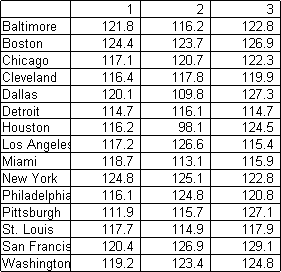
a serious investigation of the topic. Table 1 shows the
three expenditure groups which are to comprise the index. (T = 15
and K = 3).
Table 1. Expenditure groups for selected U. S.
metropolitan areas in 1988 (1982-84 = 100)
(1) food and beverage, (2) apparel and upkeep, (3) entertainment
Source: U. S. Department of Commerce (1990), Tables 698 and 764.
The correlation matrix R is
1.0000 .3150 .2967
.3150 1.0000 -.0036
.2967 -.0036 1.0000
To obtain the L-scaling matrix, we multiply every diagonal
element of R by 1-1/K or 2/3; and we multiply each off-diagonal
element by -1/K or -1/3. The new matrix is then inverted;
(I - R/K)-1 =
1.5735 .2474 .2330
.2474 1.5389 .0340
.2330 .0340 1.5345
As discussed in section 3, the inverse matrix is positive even
though R is not a positive matrix. The minimized sum of squares
is c = .1762, and each weight is a row sum of c(I - R/K) -1. Thus
w' = (.3619, .3207, .3174). When the data in Table 1 are standardized,
the scaled scores y = Xw are shown in the first column of Table 2 below.
Table 2. Cost-of-living indexes for selected U. S.
metropolitan areas, 1988
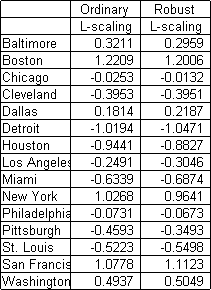
To illustrate an hypothesis test, we ask whether the
cost of living was the same in Boston and Washington DC.
Could the computed difference in column 1 of Table 2 be due to
sampling error ? Although our sample is hardly of the asymptotic
order, we proceed to compute the variance in equation (16); it
is 0.4751, and the square root of twice this number is 0.9748. The
test statistic is therefore (1.2209 - 0.4937)/0.9748 = 0.7459. Considered
as a standard normal variable, this number is not unusually large, so the
hypothesis of equal living costs in Boston and Washington is not rejected
at conventional levels of significance. However, this conclusion is suspect
since the elements of y are unlikely to have the required independent
normal distribution in a sample as small as this one. Incidentally, the
corresponding test statistic for a one-way ANOVA is (1.1970 - 0.5055) /
0.7291 = 0.9484. The two methods, L-scaling and ANOVA, produce
similar y values for Boston and Washington. However, the standard
deviations of the contrasts differ markedly because L-scaling uses
the correlation matrix while ANOVA does not.
To screen for outliers, the MVE was computed with Rousseeuw's
MINVOL program. Taking into account all variables and
observations, the expenditure pattern for Houston is identified as
very anomalous; its robust Mahalanobis distance is quite large.
Dallas and Pittsburgh are flagged as moderately unusual. A
perusal of Table 1 suggests that apparel and upkeep are dispro-
portionately cheap in the Texas cities, while food and beverage
costs are perhaps exceptionally low in Pittsburgh. The correlation
matrix based on the other 12 cities does appear to differ notably
from the full-sample R reported above:
1.0000 .2992 .6332
.2992 1.0000 .5355
.6332 .5355 1.00000
The robust L-scale weights are w' = (0.3291, 0.3137, 0.3572). The
corresponding scores are shown in the second column of Table 2.
To decide whether the two columns differ notably, one should compute
a robust measure of dispersion corresponding to the standard deviation.
The median absolute deviation could be calculated for column 2, or one
could use the more efficient high-breakdown statistics proposed by
Rousseeuw and Croux (1993).
In conclusion, we acknowledge that the literature on scaling
methodology is vast; there is a plethora of techniques for
reducing and describing multivariate data. Our excuse for
introducing still another procedure is that L-scaling has
attractive properties and is related to well known concepts in
statistics, economics, and mechanics.
References
Blankmeyer, Eric. 1987. "Approaches to Consistency Adjustment."
Journal of Optimization Theory and Applications 54, 479-
488.
Blankmeyer, Eric. 1994. "Principal Components and Scale
Dependence." Paper number TM021242 distributed by the
Educational Resources Information Center (ERIC),
Rockville, MD.
Farebrother, R. W. 1987. "Mechanical Representations of the L1
and L2 Estimation Problems" in Yadolah Dodge (editor)
Statistical Data Analysis Based on the L1-Norm and Related
Methods. Amsterdam: North-Holland.
Farebrother, R. W. 1992. "The Geometrical Foundations of a Class
of Estimation Procedures which Minimise Sums of Euclidean
Distances and Related Quantities" in Yadolah Dodge (editor)
L1-Statistical Analysis and Related Methods. Amsterdam:
North-Holland.
Hawkins, David and Herbert A. Simon. 1949. "Some Conditions of
Macroeconomic Stability." Econometrica 17, 245-48.
Hawkins, Douglas M. 1994. "The feasible solution algorithm for
the minimum covariance determinant estimator in multivariate
data." Computational Statistics and Data Analysis 17, 197-
210.
Malinvaud, Edmond. 1980. Statistical Methods of Econometrics.
Amsterdam: North-Holland.
Rocke, David M. and David L. Woodruff. 1996. "Identification of
Outliers in Multivariate Data." Journal of the American Statistical
Association 91, 1047-1061.
Rousseeuw, Peter J. and Annick M. Leroy. 1987. Robust Regression
and Outlier Detection. New York: Wiley.
Rousseeuw, Peter J. and C. Croux. 1993. "Alternatives to the
Median Absolute Deviation." Journal of the American
Statistical Association 88, 1273-1283.
Strang, Gilbert. 1986. Introduction to Applied Mathematics.
Wellesley: Wellesley-Cambridge Press.
U. S. Department of Commerce. 1990. Statistical Abstract of the
United States 1990. Washington, D. C.: U.S. Government
Printing Office.
Waugh, Frederick. 1950. "Inversion of the Leontief Matrix by
Power Series." Econometrica 18, 142-54.
Appendix: A Simulation of the Large-sample Behavior of y = Xw
The simulation was based on the following correlation matrix R (K = 5):
1.000
0.560 1.000
0.460 0.640 1.000
0.420 0.610 0.730 1.000
0.360 0.520 0.610 0.850 1.000
From equation (16), the asymptotic variance of each element of y is w'Rw. For the correlation matrix listed above, computations show that this variance equals 0.6682. A sample matrix X of one thousand observations (T = 1000) was drawn from a standard normal population with the specified correlation matrix. The weights w and the scaled scores y were computed, and the values for y250, y500 and y750 were saved. This sampling process was replicated 1000 times, and the results were averaged:
Item mean variance
y250 0.0318 0.6858 .
y500 0.0109 0.7237
y750 -0.0277 0.6431
The means and variances are therefore close to their theoretical values
(0 and 0.6682 respectively). Moreover, the y values are nearly uncorrelated, as anticipated. The correlations based on 1000 replications were
y250 y500 y750
y250 1.000
y500 0.044 1.000
y750 0.046 0.015 1.000
To examine the normality of the y values, each series of 1000 replications was standardized and its percentiles were computed:
Percentiles of Y250:
Minimum -3.1349662272 Maximum 3.3868069221
01-%ile -2.2635771008 99-%ile 2.3000997935
05-%ile -1.6510098850 95-%ile 1.6331218076
10-%ile -1.2789133398 90-%ile 1.2353421952
25-%ile -0.6520738257 75-%ile 0.6665215838
Median 0.0195509971
Percentiles of Y500:
Minimum -3.4518302265 Maximum 3.1892254907
01-%ile -2.1820584643 99-%ile 2.4140492365
05-%ile -1.7077252083 95-%ile 1.6806021486
10-%ile -1.2650296564 90-%ile 1.2651179280
25-%ile -0.6577554324 75-%ile 0.6353784205
Median 0.0092066145
Percentiles of Y750:
Minimum -3.9126888937 Maximum 3.1864460451
01-%ile -2.3735735447 99-%ile 2.1743808876
05-%ile -1.7210294044 95-%ile 1.5796671591
10-%ile -1.2780010879 90-%ile 1.2595918021
25-%ile -0.6944575422 75-%ile 0.7064393966
Median 0.0140574363
In general, these percentiles are consistent with the theory that each element of y is asymptotically a normal random variable.
Next, the sample size was reduced to T = 100, and 1000 replications were run with the following results:
Item mean variance
y25 -0.0016 0.7026
y50 0.0240 0.7060
y75 -0.0045 0.6772
The correlations were:
y25 y50 y75
y25 1.000
y50 -0.008 1.000
y75 -0.004 -0.058 1.000
The percentiles are shown below.
Percentiles of y25:
Minimum -3.0641586435 Maximum 3.2054790509
01-%ile -2.2607769141 99-%ile 2.3173970833
05-%ile -1.6269838530 95-%ile 1.6801338613
10-%ile -1.2594787954 90-%ile 1.3307414199
25-%ile -0.6945332370 75-%ile 0.6722215321
Median -0.0420984134
Percentiles of y50:
Minimum -2.8748829280 Maximum 3.0130409170
01-%ile -2.1936201853 99-%ile 2.1782654350
05-%ile -1.6517804725 95-%ile 1.6606397887
10-%ile -1.2564622698 90-%ile 1.3072116491
25-%ile -0.7231219330 75-%ile 0.7012371942
Median 0.0085705466
Percentiles of y75:
Minimum -2.9664948228 Maximum 2.8521610229
01-%ile -2.2572829258 99-%ile 2.2654368354
05-%ile -1.6413530153 95-%ile 1.6527581800
10-%ile -1.2818094175 90-%ile 1.3387785164
25-%ile -0.6600528320 75-%ile 0.6556602800
Median -0.0043668779
Despite the smaller sample size, these results also appear to be broadly in agreement with our analysis of the asymptotic behavior of the scaled scores.
The preceding conclusions could be made more formal by the application of standard statistical tests. For example, procedures for testing the mean and the variance of a normal distribution are well known (Morrison 1967, 21-28), while the independence of the elements of y can be examined with a chi-square statistic computed from the determinant of the relevant correlation matrix (Morrison 1967, 111-114). Moreover, the normality of each y element could be investigated via a Kolmogorov-Smirnov test (Siegel 47-52).
Morrison, Donald F. (1967). Multivariate Statistical Methods. New York:
McGraw-Hill.
Siegel, Sidney (1956). Nonparametric Statistics for the Behavioral
Sciences. New York: McGraw-Hill.