Causality among sales, advertising and prices:
new evidence from a multivariate cointegrated system
Francisco F. R. Ramos
Faculty of Economics, University of Porto, 4200 Porto,
Portugal
Tel.: 351-2-5509720; fax: 351-2-5505050; e-mail:
framos@fep.up.pt
Abstract
The main purpose of this paper is to discern the dynamic causal
relationships (in the Granger (temporal) sense) among sales, advertising
and prices in the context of the Portuguese car market. The present
research (based on multiple cointegration tests preceded by various
unit root or non-stationarity tests) is one of the first attempts
at putting the sales-marketing mix analysis within a multivariate
cointegrated system. The results, based on a three-step procedure
(cointegration, VECM and VDCs) confirm that a strong one-way relationship
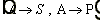 between advertising and sales (prices)
is complemented by a feedback relationship
between advertising and sales (prices)
is complemented by a feedback relationship  between sales and prices.
Keywords: Car market; Cointegration analysis; Granger-causality;
Marketing-mix; Sales; Variance decompositions; Vector error-correction
model
1. Introduction
Basically, two approaches have been used in the past to estimate
the relationship among sales (demand) and marketing-mix variables
at various levels of aggregation. Most commonly, a regression
model is estimated which includes e.g., advertising expenditure
(or a proxy) among its explanatory variables and appropriate dynamics.
The list of such studies is rather long; only Clarke (1976) reviews
69 of them. The second, and more recent, approach is to estimate
a Box-Jenkins time series model as was done by Helmer and Johansson
(1977), Hanssens (1980), Bhattacharyya (1982), and Heyse and Wei
(1985).
The direction of causality is usually assumed to run from advertising
to sales whereas the possibility of an effect of sales on advertising,
whereby advertising budgets are set as a percentage of sales,
although recognized ( Schmalensee, 1972), it has received much
less attention. Ashley et al. (1980) and Heyse and Wei (1985)
present evidence supporting causality from consumption (sales)
to advertising rather than the reverse.
The causal chain (among sales and other marketing activity such
as advertising, price, and promotions) implied by the existing
marketing paradigms still remains ambiguous. The issue, therefore,
as to the dynamic causal relationships (even in the Granger temporal
sense rather than in the structural sense) remains unresolved
and is an empirical one .
In order to empirically resolve the issue of the direction of
causation in a bivariate context, a lot of causality tests have
been applied based mainly on the standard Granger (1969), Sims
(1972), and the modified Sims suggested by Geweke et al. (1983).
But the studies applying these tests suffered from the following
methodological deficiencies:
(i) These standard tests did not examine the basic time
series properties of the variables. If the variables are cointegrated,
then these tests incorporating differenced variables will be misspecified
unless the lagged error-correction term is included (Granger 1988).
(ii) These tests turn the series stationary mechanically
by differencing the variables and consequently eliminated the
long-run information embodied in the original level form of the
variables. The error-correction model (ECM) derived from the cointegrating
equations, by including the lagged error-correction term reintroduces,
in a statistically acceptable way, the long-run information lost
through differencing. The error-correction term (ECTs) stands
for the short-run adjustment to long-term equilibrium trends.
This term also opens up an additional channel of Granger causality
so far ignored by the standard causality tests.
(iii) Moreover, although recently, there has been a beginning
of the application of ECM in causality testing in the bivariate
context, such as Baghestani (1991), Chowdhury (1994), Dekimpe
and Hanssens (1995), Jung and Seldon (1995), Lee, Shin and Chung
(1996), and Zanias (1994), there has been very little attempt
at testing the Granger causality channel in a dynamic multivariate
Marketing context through vector error-correction modelling (VECM),
variance decompositions (VDC) and impulse response functions (IRF).
The primary purpose of this research is to conduct empirical
tests to discern the dynamic causal relationships (in the Granger
(temporal) sense rather than in the structural sense) among sales
and other marketing-mix variables such as total advertising expenditures,
and price in the context of the Portuguese car market.
As mentioned before, at the moment a very few works (only about
three or four) exist on the application of ECM in testing Granger
causality. But even these few works are set in a bivariate context,
and also do not apply the techniques of variance decompositions
and impulse response functions to Granger causality. This study
will make an attempt to improve and extend the existing few ECM-based
works on Granger causality in the following ways:
(a) It will try to discern Granger causality in a car
market in a multivariate framework and within the environment
of vector error-correction modelling. This analysis will also
make use of the techniques - variance decompositions, and impulse
response functions - to unveil Granger causality in marketing
activity in a dynamic context .
(b) The error-correction terms derived from the cointegrating
vectors are arrived through Johansen's multivariate cointegrating
testing procedure (in contrast to much of the pre-existing literature)
which are then used as additional channels in order to identify
Granger causation. Since this procedure identifies multiple cointegrating
relationships and hence error-correction terms, this is an issue
of crucial importance in Granger causality testing in a dynamic
multivariate context.
2. Econometric methodology
The following sequential procedures will be adopted:
Step 1: Cointegration and Causality
The cointegration technique pioneered by Engle and Granger (1987),
Hendry (1986) and Granger (1986) made a significant contribution
towards testing Granger causality. According to this technique,
if two variables are cointegrated (i.e., share a common trend),
the finding of no-causality in either direction - one of the possibilities
with the standard Granger and Sims tests - is ruled out. So long
as the two variables have a common trend, causality (in the Granger
sense, not in the structural sense), must exist in at least one
direction (Granger 1988; Miller and Russek 1990). And this Granger
(or temporal) causality can be detected through the vector error-correction
model derived from the long-run cointegrating vectors .
Step 2: Vector Error-Correction Modelling (VECM) and Exogeneity
Engle and Granger (1987) demonstrated that once a number of variables
(say x and y) are found to be cointegrated, there
always exists a corresponding error-correction representation
which implies that changes in the dependent variable are a function
of the level of disequilibrium in the cointegrating relationship
(captured by the error-correction term) as well as changes in
other explanatory variable(s). A consequence of ECM is that either
 or
or  or both must
be caused by
or both must
be caused by  which is itself a function
of
which is itself a function
of  . Intuitively, if y and x
have a common trend, then the current change in x (say,
the dependent variable) is partly the result of x moving
into alignment with the trend value of y (say, the independent
variable). Through the error-correction term, the ECM opens up
an additional channel for Granger causality (ignored by the standard
Granger and Sims tests) to emerge. The F-test applied to the joint
significance of the sum of the lags of each explanatory variable
and the t-test of the lagged error-correction term (or asymptotic
. Intuitively, if y and x
have a common trend, then the current change in x (say,
the dependent variable) is partly the result of x moving
into alignment with the trend value of y (say, the independent
variable). Through the error-correction term, the ECM opens up
an additional channel for Granger causality (ignored by the standard
Granger and Sims tests) to emerge. The F-test applied to the joint
significance of the sum of the lags of each explanatory variable
and the t-test of the lagged error-correction term (or asymptotic
 -tests applied to the ECT coefficients
jointly) will imply statistically the Granger exogeneity or endogeneity
of the dependent variable. Here, one should acknowledge the concepts
of weak and strict exogeneity within a cointegrated system, where
weak exogeneity refers to ECM-dependence (i.e., dependence upon
stochastic trends) and strict exogeneity to dependence on the
sum of joint lagged differenced variables. F-tests or asymptotic
-tests applied to the ECT coefficients
jointly) will imply statistically the Granger exogeneity or endogeneity
of the dependent variable. Here, one should acknowledge the concepts
of weak and strict exogeneity within a cointegrated system, where
weak exogeneity refers to ECM-dependence (i.e., dependence upon
stochastic trends) and strict exogeneity to dependence on the
sum of joint lagged differenced variables. F-tests or asymptotic
 -tests may be interpreted as within-sample
causality tests but provide little evidence on the dynamic properties
of the system which is given by the variance decompositions and
impulse response functions which may be termed as out-of-sample
causality tests (Bessler and Kling 1985) .
-tests may be interpreted as within-sample
causality tests but provide little evidence on the dynamic properties
of the system which is given by the variance decompositions and
impulse response functions which may be termed as out-of-sample
causality tests (Bessler and Kling 1985) .
Toda and Phillips (TP) (1993) provide evidence that the Granger
causality tests in ECM's still contain the possibility of incorrect
inference; they also suffer from nuisance parameter dependency
asymptotically in some cases (see TP for details). All of these
indicate that there may be no satisfactory statistical basis for
using Granger causality tests in levels or in difference VAR models
or even in ECM. The sequential Wald tests of TP (1993) are designed
to avoid these problems. Asymptotic theory indicates that their
limiting distributions are standard and free of nuisance problems.
Step 3: Variance decompositions (VDC) and Relative Exogeneity
The VECM, F-and t-tests may be interpreted as within-sample causality
tests. They can indicate only the Granger causality of the dependent
variable within the sample period. They do not provide an indication
of the dynamic properties of the system, nor do they allow me
to gauge the relative strength of the Granger-causal chain or
degree of exogeneity among the variables. VDCs which may be termed
as out-of-sample causality tests, by partitioning the variance
of the forecast error of a certain variable into proportions attributable
to innovations (or shocks) in each variable in the system, including
its own, can provide an indication of these relativities. A variable
that is optimally forecasts from its own lagged values will have
all its forecast error variance accounted for by its own disturbances
(Sims 1982).
3. Empirical results
3.1 Data
The data base used for this study is a monthly time series sample
of sales (S), and two marketing-mix variables, for the period
1988:1-1996:6 in the Portuguese car market. The decision variables
included retail prices (P) and total advertising expenditures
(A) for the leader brand (RENAULT) in the car market. The Portuguese
market consists of twenty-five imported car brands, but the top
seven account on average for 80.4% of the total market, with a
standard deviation of 5.48%. The leader is a general brand, presented
in all segments and represents an average market share of 15.9%,
with a standard deviation of 4.95%. The sources of all these data
are, respectively, the Portuguese General Directorate of Transports,
the Guia do Automóvel and the Sabatina for
the sales (in volume), retail prices, and total advertising expenditures
series. The price and advertising variables are expressed in constant
Portuguese escudos.
3.2 Integration and cointegration properties
The usual asymptotic properties cannot be expected to apply if
any of the variables in a regression model is generated by a non-stationary
process. Using unit root tests, I explore the properties of the
S, A, and the P series. If a series contains a stochastic trend,
it is said to be integrated of order d, I(d). Differencing
d times then yields a stationary series.
Table I reports the results of the Dickey-Fuller tests (DF) (Dickey
and Fuller, 1979), Augmented Dickey-Fuller tests (ADF), and Phillips-Perron
tests (PP) (Phillips and Perron, 1988) that the S, A, and P series
might have up two unit roots. In no case is there significant
evidence against the single unit root hypothesis. Thus the null
hypothesis that both series are non-stationary in levels cannot
be rejected. All test statistics for a second unit root, that
is, a unit root in the first differences of the series, are highly
significant. I therefore adopt the alternative hypothesis that
the series are stationary in first differences .
Since the series contain a stochastic trend, I proceed with investigating
whether they share a common stochastic trend. This refers to testing
for cointegration which is a way of testing for a long-run equilibrium
relationship among S, A, and P. Two variables are said to be cointegrated
of order one, CI(1,1), if they are individually I(1)
and yet some linear combination of the two is I(0) (Engle
and Granger, 1987). Under the assumption that a first-order model
is correct, I test whether the estimated residual of the cointegrating
regression is stationary. Specifically, I perform ADF tests in
order to test the null hypothesis that the residual series of
the cointegrating regression is non-stationary. Reporting a value
of -3.70 an ADF test with one lag and with S as the independent
variable rejects the null of no cointegration at the 2.5% level
. Since the cointegrating vector establishes an equilibrium relationship,
the ADF test should not lead to a different conclusion if the
cointegrating equation is estimated with A as the independent
variable. With a value of -3.76 the result confirms this requirement.
Given the low power of standard unit root tests against fractional
alternatives (Diebold and Rudebush, 1991) I apply the semi-nonparametric
procedure suggested by Geweke ans Porter-Hudak (GPG, 1983) to
the S, A, and P series. The GPH test avoids the knife-edged I(1)
and I(0) distinction in the PP test by allowing the integration
order to take on any real value (fractional integration). Table
II reports the empirical estimates for the fractional differencing
parameter. I find no evidence in support of the fractional alternative
for any of my sample series. I therefore conclude that all series
are integrated processes of order one and subsequently apply my
analysis to the S, A, and P changes. This is a necessary step
in order to test the cointegration of the variables. The results
based on Johansen's (1988) and Johansen and Juselius's (1990)
multivariate cointegration tests (Table III) tend to suggest that
these three variables are cointegrated , i.e. have common trends.
In other words, these three variables are bound together by long-run
equilibrium relationships (either one or two as indicated by the
test of null or alternative hypotheses through the maximum eigenvalue
and trace statistics).
Table I. Tests for integration
| Single unit root
| Second unit root
|
| Series | DF
| ADF | PP
| DF | ADF
| PP |
| S | -1.25
| -1.41 | -1.26
| -17.5b | -13.5b
| -17.5b |
| A | -1.84
| -1.78 | -1.81
| -17.7b | -14.2b
| -17.7b |
| P | -1.39
| -1.52 | -1.31
| -18.4b | -15.8b
| -17.9b |
Notes: b Statistically
significantly different from zero at the 0.01 significance level.
The optimal lag used for conducting the ADF test statistic was
selected based on an optimal criterion (Akaike's FPE), using a
range of lags. The truncation lag parameter l used for
PP tests was selected using a window choice of  where the order is the highest significant lag from either the
autocorrelation or partial autocorrelation function of the first
differenced series (see Newey and West, 1987).
where the order is the highest significant lag from either the
autocorrelation or partial autocorrelation function of the first
differenced series (see Newey and West, 1987).
Table II. Empirical estimates for the fractional-differencing
parameter 
| Series |
 (0.50) (0.50)
|
 (0.55) (0.55)
|
 (0.60) (0.60)
|
| Sales (S) | 0.086 (0.513)
| -0.036 (-0.276) | -0.154 (-1.503)*
|
| Advertising (A) | -0.031 (-0.179)
| 0.009 (0.058) | -0.165 (-1.313)*
|
| Price (P) | 0.037 (0.361)
| 0.072 (0.754) | -0.174 (-1.251)*
|
Notes: d
is the fractional differencing parameter corresponding to the
S, A, and P series whereas  is the fractional
differencing parameter corresponding to the S, A, and P change
series (d = 1+
is the fractional
differencing parameter corresponding to the S, A, and P change
series (d = 1+ ).
).  (0.50)
,
(0.50)
,  (0.55), and
  (0.60)
give the
(0.60)
give the  estimates corresponding to the
GPH spectral regression of sample size
estimates corresponding to the
GPH spectral regression of sample size  ,
,
 , and
, and  , respectively.
The t-statistic are given in parentheses and are constructed
imposing the known theoretical error variance of
, respectively.
The t-statistic are given in parentheses and are constructed
imposing the known theoretical error variance of  .
The superscripts ***, **, * indicate statistical significance
for the null hypothesis
.
The superscripts ***, **, * indicate statistical significance
for the null hypothesis  = 0 ( d
= 1) against the alternative
= 0 ( d
= 1) against the alternative  at the 1,
5, and 10 per cent levels, respectively.
at the 1,
5, and 10 per cent levels, respectively.
Table III. Johansen's test for multiple cointegrating vectors
Hypothesized number of cointegrating relationships
H0 H1
| Test statistics
Max. eigenvalue Trace
| Critical values (95 per cent)
Max. eigenvalue Trace
|
 
| 86.65* 79.32*
| 33.46 68.52
|
 
| 45.78* 51.34*
| 27.06 47.21
|
 
| 18.05 21.17
| 20.96 29.68
|
Notes:  indicates
the number of cointegrating relationships. The optimal lag structure
of the VAR was selected by minimizing the Akaike's FPE criteria.
Critical values are taken from Johansen and Juselius (1990). *
indicates rejection at the 95 per cent critical values
indicates
the number of cointegrating relationships. The optimal lag structure
of the VAR was selected by minimizing the Akaike's FPE criteria.
Critical values are taken from Johansen and Juselius (1990). *
indicates rejection at the 95 per cent critical values
3.3 Vector error correction model and Granger causality test
The number of cointegrating relationships found in Table III
will result in a corresponding number of residual series, and
hence error correction terms (ECTs), to be used in the subsequent
vector error correction model (VECM), results based on which appear
in Table IV.
As stated earlier, cointegration cannot detect the direction
of Granger causality, which will be done by an analysis of results
based on estimating a VECM (Table IV). The relative contribution
of the explanatory variables in explaining the variation in the
dependent variable beyong the sample period will be done by variance
decompositions (Table V).
Sales - Results based on the VECM (Table IV) indicates
that in the short run, each explanatory variable (A and P) significantly
Granger-cause sales (as reflected in the significance of the F-tests
of the lags of the explanatory variables), but the proportion
by which the sales (S) variable adjusted endogenously in the short
run to its long-term equilibrium relationship with other cointegrating
variables is nevertheless significant (as evidenced in the significance
of the t-test of the lagged error correction term derived
from the long-term cointegrating relationship). These findings
are further supported by the post-sample VDCs (Table V). A substantial
portion of the variance of S (65%) is explained by its own innovations
(or shocks) in the short-run (say, at 3-month horizon) but only
a small portion (31%) in the long run (say, 12-month horizon);
shocks in other variables (A and P) explain about 40% and 28%
of the shocks in the sales, respectively. One would expect that
the impact of mix-variables will take some time to produce a cumulative
effect on sales.
Advertising - Results based on the VECM (Table IV) indicate
that advertising remains econometrically exogenous, i.e. unexplained
by the explanatory variables incorporated (as evidenced in the
non-significance of both the F-tests as well as the t-tests).
The VDCs (Table V) also confirm that finding, since even after
12-month horizon about 69% of the shocks in advertising are explained
by its own shocks. The frequently used rule of setting advertising
as a percentage of sales does not apply for this particular brand.
Price - The within-sample VECM results (Table IV) indicate
that price was Granger-caused by sales and advertising and by
short-run adjustment to long-term equilibrium trend (as evidenced
in the significance of the F-tests and t-tests). The post-sample
VDCs (Table V) further confirms this finding but reinforce the
role of sales and advertising in explaining a substantial portion
of the variance of prices. About 62% of the shocks in prices (at
the 12-month horizon) are accounted for by the shocks in S and
A.
Table IV. Temporal causality results based on vector error correction
model (VECM)
Notes: The ECTs were derived
by normalizing the two cointegrating vectors on S, thereby
resulting in two sets of residuals. The residuals were also checked
for stationarity by way of unit root testing procedures applied
earlier and inspection of their autocorrelation function respectively.
The VECM was based on an optimally determined criteria (Akaike's
FPE) lag structure and a constant. ***, **, and * indicate significance
at the 1%, 5%, and 10% levels.
Table V. Variance decompositions (VDC´s)
| Variable | Horizons
| Sales (S) | Advertising (A)
| Price (P) |
| Sales (S) | 1
3
6
12
| 100.00
65.25
46.23
31.42
| 0.00
24.75
35.83
40.31
| 0.00
10.00
17.94
28.27
|
| Advertising (A) | 1
3
6
12
| 0.00
5.57
9.68
17.54
| 85.84
81.03
72.38
68.69
| 14.16
13.40
17.94
13.77
|
| Price (P) | 1
3
6
12
| 0.00
4.45
14.17
32.86
| 8.27
12.03
21.59
29.61
| 91.73
83.52
64.24
37.53
|
Notes: Entries in each
row are the percentages of the variance of the forecast error
for each variable indicated in the rows that can be attributed
to each of the variables indicated in the column headings. The
decompositions are reported for one-, three-, six- and twelve-month
horizons. Several alternative orderings of these variables were
also tried, e.g., S - P - A and A - P - S. Such alterations, however,
did not alter the results to any substantial degree. This is possibly
due to the variance-covariance matrix of the residuals being near
diagonal, arrived at through Choleski decomposition in order to
orthogonalize the innovations across equations.
4.Conclusions
The main purpose of this paper is to discern the dynamic
causal relationships (in the Granger (temporal) sense rather than
in the structural sense) among sales (S) and two marketing-mix
variables (advertising and price) at the firm level. The methodology
employed uses various unit root tests, a semi-nonparametric procedure
suggested by GPH, and Johansen's cointegration test followed
by a vector error correction model and variance decompositions
in order to capture both within-sample and out-of-sample Granger-causality
among marketing activity.
The evidence of cointegration rules out the possibility of the
estimated relationship being "spurious" and implies
that Granger causality must exist among the variables in at least
one direction, either unidirectional or bidirectional. The Granger
causality may emerge either through the level of disequilibrium
in the cointegrated relationships (captured by the ECTs) and/or
the changes in the explanatory variables (as tested via the F-statistics
for each). In other words, the VECM allow us to distinguish between
"short-term" and "long-term" Granger causality
(through the significance of the F and t-tests,
respectively). In addition, the VDCs can discern the relative
contribution of each variable in explaining the variation in a
certain variable beyond the sample period.
Apart from pointing to the proper treatement of integrated series
and from obtaining revised results for the sales-mix variables
relationship at the firm level, the following important general
conclusions are drawn. First, in the case of cointegrated variables,
the error-correction term may prove of crucial importance in testing
the direction of causality. Second, a strong one-way relationship
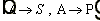 exists between advertising and sales
(prices) is complemented by a strong feedback relationship
exists between advertising and sales
(prices) is complemented by a strong feedback relationship  between sales and prices which are clearly shown for the RENAULT
case.
between sales and prices which are clearly shown for the RENAULT
case.
References
Ashley, R., C.W.J. Granger and R. Schmalensee, 1980. Advertising
and Aggregate Consumption: An Analysis of Causality. Econometrica,
48, 1149-1167.
Baghestani, H., 1991. Cointegration Analysis of the Advertising-Sales
Relationship. The Journal of Industrial Economics, 39, 671-681.
Bessler, D., and J. Kling, 1985. A Note on Tests of Granger Cauasality.
Applied Economics, 16, 335-342.
Bhattacharyya, M.N., 1982. Lydia Pinkham Data Remodelled. Journal
of Time Series Analysis, 3, 81-102.
Chowdhury, A.R., 1994. Advertising Expenditures and Macro-Economy:
Some New Evidence. International Journal of Advertising, 13, 1-14.
Clarke, D.G., 1976. Econometric Measurement of the Duration of
Advertising Effect on Sales. Journal of Marketing Research, 13,
345-357.
Cooley, T. and S. Leroy, 1985. Atheoretical Macroeconomics: a
Critique. Journal of Monetary Economics, 16, 283-308.
Davidson, R. and J.G. MacKinnon, 1993. Estimation and Inference
in Econometrics. Oxford: Oxford University Press.
Dekimpe, M.G. and D.M. Hanssens, 1995. The Persistence of Marketing
Effects on Sales. Marketing Science, 14(1), 1-21.
Diebold, F.X. and G. Rudebusch, 1991. On the Power of Dickey-Fuller
Tests against Fractional Alternatives. Economic Letters, 35, 155-160.
Engle, R. and C. Granger, 1987. Cointegration and Error Correction:
Representation, Estimation, and Testing. Econometrica, 55, 251-276.
Geweke, J.R., R. Meese and W. Dent, 1983. Comparing Alternative
Tests of Causality in Temporal Systems: Analytic Results and Experimental
Evidence. Journal of Econometrics, 21, 161-194.
Geweke, J.R. and S. Porter-Hudak, 1983. The Estimation and Application
of Long Memory Time Series Models. Journal of Time Series Analysis,
4, 221-238.
Granger, C.W., 1969. Investigating Causal Relations by Econometric
Models and Cross Spectral Methods. Econometrica, 37, 424-438.
Granger, C.W., 1986. Developments in the Study of Cointegrated
Economic. Variables. Oxford Bulletin of Economics and Statistics,
48, 213-228.
Granger, C.W., 1988. Some Recent Developments in a Concept of
Causality. Journal of Econometrics, 39, 199-211.
Hanssens, D.M., 1980. Bivariate Time-Series Analysis of the Relationship
Between Advertising and Sales. Applied Economics, 12, 329-339.
Helmer, R.M. and J.K. Johansson, 1977. An Exposition of the Box-Jenkins
Transfer Function Analysis with an Application to the Advertising-Sales
Relationship. Journal of Marketing Research, 14, 227-239.
Hendry, D., 1986. Econometric Modelling with Cointegrated Variables:
An Overview. Oxford Bulletin of Economics and Statistics, 48,
201-212.
Heyse, J.F. and W.W. Wei, 1985. Modelling the Advertising-Sales
Relationship Through Use of Multiple Time Series Techniques. Journal
of Forecasting, 4, 165-181
Johansen, S., 1988. Statistical Analysis of Cointegration Vectors.
Journal of Economic Dynamics and Control, 12, 231-254.
Johansen, S. and K. Juselius, 1990. Maximum Likelihood Estimation
and Inference on Cointegration with Applications to Money Demand.
Oxford Bulletin of Economics and Statistics, 52, 169-210.
Jung, C. and B.J. Seldon, 1995. The Macroeconomic Relationship
between Advertising and Consumption. Southern Economic Journal,
577-587.
Lee, J., B.S. Shin, and In Chung, 1996. Causality between Advertising
and Sales: New Evidence from Cointegration. Applied Economic Letters,
3, 299-301.
Miller, S. and F. Russek, 1990. Cointegration and Error-Correction
Models: The Temporal Causality Between Government Taxes and Spending.
Southern Economic Journal, 57, 221-229.
Newey, W. and K. West, 1987. A Simple, Positive Semi-definite,Heteroscedasticity
and Autocorrelation Consistent Covariance Matrix. Econometrica,
55, 703-708.
Phillips, P.C.B. and P. Perron, 1988. Testing for a Unit Root
in Time Series Regression. Biometrika, 75, 335-346.
Runkle, D., 1987. Vector Autoregression and Reality. Journal of
Business and Economic Statistics, 5, 437-454.
Schmalensee, R., 1972. The Economics of Advertising. New York:
North-Holland.
Sims, C., 1972. Money, Income, and Causality. American Economic
Review, 62, 540-552.
Sims, C., 1982. Police Analysis with Econometric Models. Brookings
Papers on Economic Activity, 1, 107-152.
Toda, H.Y. and P.C.B. Phillips, 1993. Vector Autoregression and
Causality. Econometrica, 61, 1367-1393.
Zanias, G., 1994. The Long Run Causality, and Forecasting in the
Advertising-Sales Relationship. Journal of Forecasting, 13, 601-610.
Zellner, A., 1988. Causality and Causal Laws in Economics. Journal
of Econometrics, 39, 7-21.


