MANUFACTURING firms in developing countries:
how well do they do, and why?
James Tybout
Georgetown University
July 6, 1998
Abstract
The manufacturing sectors of less developed countries (LDCs) have traditionally been relatively protected. They have also been subject to heavy regulation, much of which is biased in favor of large enterprises. Accordingly, it is often argued that manufacturers in these countries perform poorly in several respects: (1) markets tolerate inefficient firms, so cross-firm productivity dispersion is high; (2) small groups of entrenched oligopolists exploit monopoly power in product markets; and (3) many small firms are unable or unwilling to grow, so important scale economies go unexploited.
In this paper I assess each of these conjectures, drawing on plant and firm-level studies of LDC manufacturers. I find none to be systematically supported. Turnover is substantial, unexploited scale economies are modest, and convincing demonstrations of monopoly rents are generally lacking. Nonetheless I find some evidence that protection increases firms’ price-cost margins and reduces average efficiency levels at the margin. Finally, although the econometric evidence on technology diffusion in LDCs is limited, it does suggest that protecting "learning" industries is unlikely to foster productivity growth. All of this suggests that the general trend toward trade liberalization has yielded larger benefits that the traditional gains from trade.
Acknowledgments
This paper was partially funded by the World Bank’s Economic Development Institute. I have benefited from discussions with Mark Dutz, Mark Gersovitz, Bernard Hoekman, Carl Liedholm, William Maloney, Desmond McCarthy, Howard Pack, Mark Roberts, Maurice Schiff, and William Steel. I am especially indebted to John Pencavel and several anonymous reviewers, who have improved this manuscript with many insightful suggestions.
I. Overview
The manufacturing sector is often the darling of policy makers in less developed countries (LDCs). It is viewed as the leading edge of modernization and skilled job creation, as well as a fundamental source of various positive spillovers. Accordingly, although many LDCs have scaled back trade barriers over the past 20 years, the industrial sector remains relatively protected in the typical country (Schiff and Valdez, 1992, chapter 2; Erzan, et al, 1989; Ng, 1997). Governments also promote manufacturing with special tax concessions, and relatively low tariff rates for importers of manufacturing machinery and equipment.
At the same time, many observers believe that the maze of business regulations is unusually dense and unpredictable in LDCs. Summarizing an extensive survey of managerial attitudes around the world, Brunetti, Kisunko and Weder (1997) report that LDC firms generally consider the institutional obstacles to doing business more burdensome than their OECD counterparts. The regulatory problems that they view as more severe include price controls, regulations on foreign trade, foreign currency regulations, tax regulations and/or high taxes, policy instability, and general uncertainty regarding the costs of regulation. Other types of regulation¾ including business licensing and labor laws¾ are not viewed as especially burdensome on average in the LDCs, but constitute major problems in certain developing countries.
Moreover, within the manufacturing sector, it is also often argued that policies favor large firms while inhibiting growth among small firms. In some cases, investment incentives are available only to projects above a minimum scale, and large scale producers are singled out for special subsidies. Even when policies do not explicitly favor large firms, they may benefit relatively more from trade protection, both because their products compete more directly with imports, and because sectors with large, capital-intensive firms lobby the government more effectively. The bias against small entrepreneurs is exacerbated when financial repression is a problem, since credit rationing typically excludes the smallest borrowers first (Levine, 1997; Little, 1987; Tybout, 1984). Finally, large firms are typically better able to absorb the fixed costs of dealing with dense regulatory regimes.
These basic tendencies in LDCs¾ toward industrial sector promotion, dense, unpredictable regulatory regimes, and within industry, toward favoring large-scale enterprises¾ raise a number of fundamental empirical issues. First, do the regulatory regimes and the bias against small producers prevent small firms from growing, and thereby create losses due to unexploited scale economies? Second, if these regimes prevent small firms from threatening the larger incumbents, do LDC industries lack dynamism and competition? That is, have entrenched oligopolies emerged that are neither innovative, technically efficient, nor likely to price competitively? Finally, has trade protection compounded the technical inefficiencies and monopoly power that arise from regulatory regimes? In this paper I selectively take stock of what we have learned about these issues from firm- and plant-level econometric studies over the past decade.
These are difficult questions. One fundamental reason is that the effects of industrial sector policies are intertwined with the effects of other features of the business environment in LDCs. Typically, product markets are small, access to manufactured inputs is limited, human capital is scarce, infrastructure is poor, financial markets are thin, macro volatility is high, the legal system functions poorly, and corruption and property crimes are relatively common. A second reason is that information on the producers themselves is very limited. Detailed studies of producer turnover, pricing behavior, efficiency and spillover effects exist, but their coverage is sporadic, and many empirical issues remain completely unexplored.
Nonetheless, the evidence provides a much better basis for generalization than it did 20 years ago. I shall begin by briefly reviewing some of the distinctive features of the environment in which LDC manufacturers operate. This will serve as background to the discussion that follows, and help to distinguish differences in the performance of LDC manufacturers that trace to structural differences in their economies rather than to the policies designed to influence their behavior. Next, drawing on the available evidence, I will take up the issue of whether small firms have been somehow suppressed, and more generally, whether the LDC business environment in LDCs has bred non-competitive pricing behavior and low productivity. Finally, I will address the question of how trade protection has conditioned pricing, efficiency, and productivity growth.
II. THE BUSINESS ENVIRONMENT: WHAT’S DIFFERENT IN LDCs?
A variety of features distinguish the business environment in developing countries from those typically observed in the OECD. At the risk of over-simplifying, I will begin by mentioning the most striking and widely acknowledged among them.
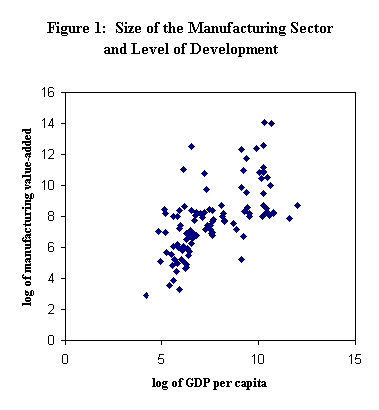
Market size: Although some developing economies are quite large, most are not. Hence, excepting countries like Brazil, China, India and Indonesia, the size of the domestic market for manufactured products is relatively limited (figure 1). Further, among the least developed countries, Engel effects favor basic subsistence needs over all but the most basic manufactured products (figure 2). So when transport costs are significant and the OECD countries are distant, demand for the more sophisticated manufactured goods is small.
Access to manufactured inputs: The menu of domestically produced intermediate inputs and capital equipment is also often limited in developing countries. Thus producers who might easily have acquired specialized inputs if they were operating in an OECD country must either make do with imperfect substitutes or import the needed inputs at extra expense. Indeed, the vast majority of machinery and equipment deployed in developing countries is imported.
Human capital Low rates of secondary education and a scarcity of technicians and scientists also affect the mix of goods manufactured and the factor proportions used to produce them. Similarly, many have argued that flexibility in production processes and the ability to absorb new technologies is directly related to the stock of indigenous human capital (e.g., Nelson and Phelps, 1966; Evenson and Westphal, 1995; Keller, 1996).
Infrastructure Roads, ports, airports, communication facilities, power, and safe water access also tend to be relatively limited in LDCs (World Bank, 1994, figure 1, p. 3, table 1.1, p. 13, and figure 1.1, p. 14). Production techniques are directly affected, and so are the costs of servicing distant markets. Poor transportation networks are particularly limiting in the least developed, more agrarian economies, where consumers are spread throughout the countryside. In instances where infrastructure services are missing or unreliable, some firms must produce their own power, transport and/or communication services.
Financial markets Credit markets are also relatively thin, and heavily skewed toward short-term instruments. Excepting some of the newly industrialized countries, stock markets are nearly irrelevant as a source of new equity funds (Levine, 1997, table 4). The financing constraint binds especially for small firms, which are relatively likely to fail, and which banks find relatively costly to service per unit of funds lent.
Volatility Macroeconomic and relative price volatility is typically more extreme in developing countries. Latin America and Sub-Saharan Africa stand out among the developing countries as the most volatile, but all developing regions do worse than the industrialized countries (The World Bank, 1993; Hausmann and Gavin 1996).
Governance Finally, legal systems and crime prevention are also relatively poor in developing countries, and corruption is often a serious problem (World Bank, 1997; Brunetti et al, 1997). Hence the protection of property rights and contract enforcement can be problematic. Anti-trust policy is also often weak, as are environmental standards (Brunetti et al, 1997).
III. PLANT SIZES AND SCALE EFFICIENCY
Combined with industrial sector policies, the above circumstances (and others I have neglected to mention) lead to several distinctive features of LDC manufacturing sectors. Perhaps the most striking of these is their dualism. Side by side, large numbers of micro enterprises and a handful modern, large scale factories often produce similar products. The small producers frequently operate partly or wholly outside the realm of government regulation, and rely heavily on informal credit markets and internal funds for finance. They are relatively labor intensive, so they account for a larger share of employment than of output.
A. The Size Distribution
The contrast between the size distribution of plants in developing countries and that found in the OECD is dramatic. Table 1 provides some crude comparisons. Note that there is a large spike in the size distribution for the size class 1-4 workers, and it drops off quickly in the 10-49 category among the poorest countries. This is not true in the United States or other industrialized countries. The emphasis on small scale production not only correlates negatively with per capita income levels across countries (Liedholm and Mead, 1987, p. 16, Banerji, 1978), but also within countries through time (Little, et al, 1987; Steel, 1993). Further, the prevalence of micro enterprises is substantially understated because many are invisible to official census takers.
What accounts for this phenomenon? Part of the explanation is that the tax and regulatory regimes create incentives to evade government detection (de Soto, 1989). Rauch (1991) stresses that firms graduating from small, informal status show up on the radar screens of regulators and tax collectors and suffer the consequences. Further, in some cases the "missing middle" of the size distribution has been attributed to policies that explicitly punish small firms for graduating to the medium-sized ranks. On India, which is unusual in the favoritism it has shown to small firms, Little et al (1987, p. 32) write: "Not only would small firms [that graduate] have to cope with a much more difficult licensing policy, but they would also have to contend with higher labor costs (including wages and fringe benefits as laid down by labor laws) and substantially higher excise duties."
But underdevelopment in itself is likely to skew the size distribution toward small firms, regardless of the policy regime. One reason is geography. As noted in section II, the poorest countries tend to be the least urbanized, and transportation networks tend to be underdeveloped. So small, diffuse pockets of demand lead to small scale, localized production. In many countries a majority of the small scale producers are located in rural areas. Also, "farm and non-farm employment often move in opposite directions over the year and are quite complementary" (Liedholm and Mead, 1987, p. 28). Many of the micro enterprises in very poor countries are created as a last resort by people in need of income (Liedholm and Mead, 1995). Thus creation rates are often counter-cyclical, although this need not hold in urban centers (Maloney, 1997).
A second reason is that Engel effects skew demand for manufactured products toward simple items like baked goods, apparel, footwear, metal products, and furniture. All of these products can be efficiently produced using cottage technologies, so there is little incentive to consolidate production in several large plants and incur the extra distribution costs.
Further, in cases where multiple technologies are available for a single product, plentiful unskilled labor and the lack of long term finance create incentives to economize on fixed capital. Since most machinery and equipment must be imported, the trade regime and the lack of local technical support may further militate against factory production in small markets.
Volatility in the business environment¾ both regulatory and macroeconomic¾ has similar consequences. Investments in fixed capital involve long-term commitments to particular products and production volumes. If there is substantial uncertainty about future demand conditions for these products, it often makes sense to choose production techniques that do not lock one in; that is, to rely more heavily on labor (Lambson, 1991; Brunetti et al, 1997).
B. Are small firms scale efficient?
Does the preponderance of small firms imply that scale inefficiency is a serious problem in developing countries? Many have argued that it does, particularly in the simulation literature, where analysts often assume that the ratio of average to marginal cost is above 1.10 for the typical plant. However, survey-based evidence suggests that the potential efficiency gains from increases in plant size¾ induced, for example, by trade liberalization¾ are probably much smaller than these studies suggest.
The evidence on firms with less than 10 workers is very limited because data are difficult to come by. Even when surveys are available, the boundaries of these enterprises are often hard to define because they are part of a household or a farm, or because they are vertically integrated with non-manufacturing activities. Nonetheless, the available studies challenge the notion that unexploited scale economies are a major potential source of efficiency gains.
The simplest studies relate output per worker and output per unit capital to scale. As Little (1987) notes, these studies often treat broadly-defined industries, making inferences problematic. But among four narrowly-defined Indian industries, Little, Mazumdar and Page (1987) find that "it is difficult to detect any systematic variation in labor or capital productivity with firm size." (p. 186)
Studies of micro enterprises that attempt multi-factor productivity measures have often used variants of the social cost-benefit ratio, constructed as the cost of labor and capital at shadow prices, relative to value-added in world prices. As discussed by Leidholm and Mead (1987), these studies have differed in their conclusions, with some finding that small enterprises are at least as efficient as others, and others finding their efficiency relatively low. As for the very small, Liedholm and Mead (1987) do find that one-person establishments are systematically less efficient than others, perhaps because many are created as occupations of last resort for those who cannot find work in the job market.
There have also been some attempts to econometrically estimate production technologies among small firms in developing countries. Little et al (1987) and Ramaswamy (1994) fit production functions to cross-sectional data on small-scale Indian producers, and report returns to scale very close to unity in all of the industries they treat. Hill and Kalijaran (1993) obtain analogous results among small-scale Indonesian garment producers. Similarly, using firm-level African data collected by the Regional Program on Enterprise Development (RPED), Biggs et al (1995) fit the same estimator to four manufacturing sectors in Ghana, Kenya and Zimbabwe. Interestingly, even when the sample is limited to firms with 3 to 20 workers, they estimate returns to scale are very close to unity. And when the entire stratified sample is used for each industry (covering the entire size spectrum), returns to scale are still close to unity in food and textiles/garments, while mild increasing returns are found in wood products and metal products.
Finally, a larger number of studies have econometrically estimated returns to scale using data on plants with at least 10 workers. These have found constant or mildly increasing returns (between 1.05 and 1.10) in the various manufacturing sectors of Latin American, Asian, and North African countries.
It is fair to say that all of these studies are plagued by measurement error problems, omitted variables, aggregation bias, and simultaneity bias (Tybout and Westbrook, 1996; Levinsohn and Petrin, 1997; Tybout 1992a). Nonetheless, their basic message seems consistent with engineering studies: the efficiency costs of being small are not crippling¾ if present at all¾ once the one-worker threshold has been traversed. Put differently, small firms in developing countries tend not to locate in those industries where they would be at a substantial cost disadvantage relative to larger incumbents.
IV. BARRIERS TO ENTRY AND GROWTH IN THE LDCs
Even if the potential gains from scale economy exploitation are small, one might argue that the prominence of small-scale producers in LDCs is symptomatic of other problems. For example, excessive taxation and regulation might keep many firms small and informal, thereby stanching the selection process through which better managers and/or technologies gain market share (e.g., de Soto, 1989). Severance laws and restrictions on the use of temporary workers may also inhibit the expansion and contraction of plants, limiting competitive pressures. Similarly, producer turnover may be dampened by policies that prop up "sick" firms, thereby saturating the market with inefficient producers, and discouraging better firms from entering. Poorly functioning credit markets may further inhibit entry and expansion because they ration small businesses and potential entrepreneurs without collateral.
A. Analytical Models of Industrial Evolution
What might constitute evidence on these relatively subtle effects? Formal models of industrial evolution provide some guidance. These models generally include representations of the processes that generates each firm’s entry, exit, productivity growth, and market share or factor use. In most modern treatments, each dimension of performance is depicted as the optimal behavior of forward-looking entrepreneurs with rational expectations but limited information.
The literature is complex, but Hopenhayn (1992) provides a relatively tractable formulation. In his model, firms differ only in terms of their productivity levels, each of which evolves according to an exogenous Markov process. New firms enter when the distribution from which they draw their initial productivity level is sufficiently favorable that their expected future profit stream, net of annual fixed costs, will cover the sunk costs of entry. Firms exit when they experience a series of adverse productivity shocks, driving their expected future operating profits sufficiently low that exit is their least costly option. All firms are price takers, but the prices of their inputs and outputs depend upon the number of active firms and their productivity levels.
This model shares a number of implications with other representations of industrial evolution developed by Jovanovic (1982) and Ericson and Pakes (1995). At any point in time, an entire distribution of firms with different sizes, ages and productivity levels coexists, and simultaneous entry and exit is the norm. Young firms have not yet survived a shakedown process, so they tend to be smaller and to exit more frequently. Large firms are the most efficient, on average, so their mark-ups are the largest. Nonetheless, despite all the heterogeneity, equilibria in both Jovanovic’s and Hopenhayn’s model maximize the net discounted value of social surplus. Thus market interventions¾ like artificial entry barriers, severance laws, or policies that prop up dying firms¾ generally make matters worse.
Under certain regularity conditions, Hopenhayn shows that an increase in the sunk costs of entry protects incumbent firms from the upward pressure on input prices and the downward pressure on output prices that new entrants create. Thus high entry costs not only reduce the amount of entry, they encourage incumbents with relatively low productivity to stick around, and thereby increase the amount of productivity dispersion among active firms. In addition, the market shares of the largest, most efficient firms rise with entry costs (Hopenhayn, 1992, p. 1142). The shares of the largest firms also respond negatively to market size, since an outward shift in demand scales the entire plant size distribution up or down, without changing its shape or the underlying entry/exit processes.
Policies that inhibit expansion or contraction have similar consequences. Using a variant on the model described above, Hopenhayn and Rogerson (1993) simulate the effects severance laws. They find that increases in the rate at which laid off workers must be compensated increase the degree of persistence in firms’ market shares, increase average firm size, increase price-cost mark-ups, reduce average productivity, and reduce the job turnover rate.
In light of these results, does the evidence suggest that policies inhibit turnover processes relatively more in developing countries, and that industrial efficiency suffers in consequence? In addition to studies of the size distribution of firms, at least three empirical literatures bear on this question. The first summarizes the extent of productivity dispersion, usually in the context of efficiency frontier estimation. The second, relatively recent literature documents the extent of plant turnover, and in some cases relates this turnover to productivity growth. Finally, an older literature on industrial concentration is potentially relevant. Let us take each in turn.
B. Is Productivity Dispersion Higher in LDCs?
In the development literature, formal models of industrial evolution are rarely invoked. Nonetheless, many analysts have studied the amount of productivity dispersion in LDCs. A sampling of results is presented in Tables 2 and 3, and compared to those from a recent multi-country study of the OECD.
Each study is done by estimating the "frontier" production technology, which defines the maximum amount of output, y*, attainable from a given input bundle, x: y* = f(x). Then, for observed combinations of output and inputs at the ith plant (yi, xi), the ratio yi / f(xi) is interpreted either as an efficiency index itself, or as an efficiency index contaminated by measurement error and transitory shocks beyond the control of plant managers. These two approaches are known as the "deterministic frontier" and the "stochastic frontier" approach, respectively. Cross-plant mean efficiency levels, and standard deviations in efficiency levels are the most commonly reported summary measures of an industry’s performance. These bear a negative monotonic relationship to one another in most cases, so I report only the former.
Some caveats are in order. First, these studies are done at differing levels of aggregation. One would expect that the finer the industry, the less dispersion due to pooling heterogeneous technologies. Second, there are differing degrees of measurement error in outputs and inputs. Moreover, most studies describe output in terms of revenue rather than physical product, blurring the distinction between factor productivity and market power. Third, as is well known, the results depend to a large degree upon whether stochastic or deterministic frontiers are used, and upon the assumed distribution of the error terms (Corbo and de Melo, 1986).
Finally, unless they are estimated with panel data, stochastic frontier models separate technical inefficiency from noise by treating ln[yi / f(xi)] as the sum of two orthogonal error components¾ one reflecting inefficiency and the other reflecting measurement error or shocks beyond the control of managers. Typically, the negative of the inefficiency component (hereafter denoted u) is assumed to have a half-normal, gamma or exponential distribution, and the noise component is assumed to have a normal distribution. Greater skewness¾ measured by the negative of the third moment of the compound error¾ thus implies more productivity dispersion. However, the data often imply that the distribution of ln[ yi / f(xi)] is skewed in a way that is inconsistent with these assumptions, so in practice many industries do not fit the model. Such industries are typically dropped from the analysis, and the reported average efficiency levels are based only on the industries that remain.
To control for differences in methodology, I have sorted studies according to whether they presume deterministic or stochastic frontiers, and wherever possible, in the latter case I have used the results based upon the half-normal distribution for the efficiency component of the error term. Among the deterministic frontier studies, there is still some variation in the methodologies across studies because some use linear programming to identify the production function while others use quadratic programming. More importantly, some (like Page, 1980) impose a distribution on the efficiency measures while others do not.
The deterministic frontier studies (Table 2) generally yield lower average efficiency levels than the stochastic frontier studies (Table 3), since the former attribute all unexplained variation in y to inefficiency. Unfortunately, they are also very sensitive to the specific assumptions behind the calculations, and do not appear to convey any clear messages. Notice, for example, that Corbo and de Melo’s (1986) deterministic frontier results imply that Chile was very inefficient relative to other countries, but their stochastic frontier results imply Chile was average. Given this sensitivity, as well as the lack of good comparator studies from industrialized countries, I shall hereafter focus on the stochastic frontier results.
A comparison of the LDC results in Table 3 with those from industrialized countries (listed under Caves, 1995) yields a surprising message. It is often observed that the cross-firm variance in productivity levels is high in developing countries¾ e.g., Pack (1988), Evenson and Westphal (1995), Blomstrom and Kokko (1997). Nonetheless, table 3 suggests that average deviations from the efficient frontier are not typically larger than what we observe in the industrialized countries. The standard methodology, when it "works," yields mean technical efficiency levels around 60 to 70 percent of the best practice frontier in both regions. Hence it is hard to reconcile the studies surveyed with the view that LDC markets are relatively tolerant of inefficient firms.
One exception is Biggs et al (1995), who report an unusually large amount of productivity dispersion in Ghana, Zimbabwe and Kenya. However, these results are based on relatively broadly-defined industries, so they may be a simple consequence of aggregation bias. In a particularly detailed study, Pack (1987) finds average deviations among Kenyan textiles producers comparable to those in other studies, even though his methodology is based on deterministic frontiers. Similarly, Page (1980) finds dispersion levels typical of other countries in his early study of Ghana.
Although the studies summarized in Table 3 do not support the notion that the productivity dispersion is relatively marked in LDCs, most of them are based on out-dated methodologies. With a few exceptions, they rely on of the skewness of the production function residuals to identify efficiency dispersion, and they are based on cross-sectional data. Further, output is usually measured as real revenue, making distinctions between profitability and physical productivity impossible. Better data, and studies that exploit recent methodological developments¾ especially related to panel-based techniques¾ are needed to resolve the issue. Progress in measuring the cumulative costs of productivity gains, including training programs, technology purchases, and R&D efforts, would also be welcome.
C. Plant and Job Turnover in LDCs
The literature on plant and job turnover may be a better place to look for evidence on the strength of competitive pressures in the LDCs. If extensive regulation and taxation combine with credit market problems to keep small firms from challenging their entrenched larger competitors, we should observe few firms graduating from informal to formal status, and markets shares should be relatively stable among the larger firms.
Using consecutive manufacturing surveys or censuses, a handful of studies have documented entry rates, exit rates, net job creation and net job destruction among the population of plants with at least 10 workers. Most firms above the 10 worker threshold participate wholly or partly in the formal sector (e.g., Klein and Tokman, 1996). Hence the entry rates reported in these studies give us a crude sense for rates of graduation from informal status, and the job turnover rates reported give us a crude sense for the stability of market shares among larger firms.
Surprisingly, although Cox-Edwards (1993, p. ii) argues that Latin American countries "have a long tradition of trying to protect employment stability," there appears to be more job and plant turnover in these developing countries than others have found in the United States and Canada (Roberts and Tybout, 1996). For Chile and Colombia, plant turnover figures range from 15 to 20 percent, and the United States, they range between 8 and 13 percent (Dunne, Roberts and Samuelson, 1988). In terms of job creation and job destruction, Chile (1979-86) and Colombia (1977-91) average 25 and 27 percent annual turnover rates, respectively, while the United States (1973-86) and Canada (1973-86) both average around 20 percent (Roberts, 1996, table 2.1). So, at least in these relatively advanced developing countries, turnover is as vigorous as in OECD countries.
Outside Latin America, some analysts have found even more flux in plants and jobs. In Morocco (1984-89), the annual manufacturing job turnover rate was 31 percent, and the average of the entry and exit rate was roughly 10 percent (Roberts and Tybout, 1996). Plant turnover rates are still higher in Taiwan. There, one third to one-half of manufacturing production in 1991 originated from firms that were created after 1986 (Aw, Chen and Roberts, 1997). Finally, studying micro and small enterprises in Africa, Liedholm and Mead (1995) find that turnover rates among micro and small enterprises are very high, ranging from 19 to 25 percent per annum.
In short, the turnover studies available for LDCs suggest that larger firms are routinely challenged by newly founded firms or firms crossing the 10 worker threshold, and that the market shares of formal sector firms are less secure than they are in the OECD. Why is there so much flux in the LDCs? In some cases¾ especially in Latin America¾ it partly reflects relatively the dramatic business cycles found there. But even if one focuses on the minimum of the entry rate and the exit rate, turnover is relatively rapid in the developing countries (Roberts and Tybout, 1996).
Another part of the explanation lies with Engel effects and low levels of human capital, which encourage turnover by skewing the output mix toward simple products with relatively low start-up costs, like baked foods, footwear, apparel, and metal products. The dominance of these sectors and technologies is probably amplified by macro uncertainty, which creates incentives to be flexible in terms of capacity. Finally, the extraordinary turnover rate in Taiwan may trace partly to the ease with which sub-contracting arrangements can be made, and the low entry costs that result (Levy, 1990).
Of course, the turnover studies discussed above are less than definitive. Entry rates simply indicate the rate at which plants with at least 10 workers appear, and job turnover rates don’t reveal which plants in the population are expanding and contracting. It is possible that nearly all of this flux takes place among plants in the 10-50 worker range, and that these moderately small producers never seriously challenge the larger, entrenched incumbents.
Nonetheless, the available evidence suggests that this is not the case. For example, in Indonesia, establishments with 500 or more employees accounted for 56 percent of total manufacturing employment in 1990, but nearly half of this figure was attributable to plants that had begun as small and medium enterprises (Steel, 1993). In Sub-Saharan Africa, while the vast majority of small enterprises remain small, ". . .among those enterprises currently employing 10-50 workers, about half started with less than five workers and subsequently grew." (Liedholm and Mead, 1995, p. 44). There is also evidence that Colombian metalworking firms born with less than 5 workers grew substantially more rapidly than the larger incumbents (Cortes et al, 1987).
The finding that some micro enterprises make their way up the size distribution is consistent with Levenson and Maloney’s (1997) vision of the informal sector. Rather than a residual labor pool created by workers rationed out of formal jobs, they see it as a seedbed for formal sector firms, with the most efficient entrepreneurs voluntarily choosing to submit to taxation and regulation in order to access the services they need for expansion: formal credit markets, the legal system, and publicly administered fringe benefits for their workers.
In addition to studies of more countries, the literature on turnover could be usefully extended by moving beyond entry/exit rates, and estimating year-to-year transition matrices that describe probabilities of movement from any size class (including non-existence) to any other. If there are size thresholds that are relatively difficult to cross in particular LDCs, this should show up in international comparisons.
D. Turnover and productivity growth
High turnover does not, in itself, imply that inefficient producers are rapidly driven from the market. For example, when the Argentine exchange rate regime collapsed in the early 1980s, it left many firms with dollar-denominated debt in serious trouble, and the resulting exit patterns had little to do with productivity (Swanson and Tybout, 1988). It is thus interesting to inquire whether turnover-based productivity gains are present.
In Chile and Colombia, as in developed countries, exiting plants are substantially less productive than incumbents (Liu and Tybout, 1996, Liu, 1993, and Tybout 1992b). Similarly, Taiwanese plants which will exit in the next five years exhibit below-average efficiency (Aw, Chen and Roberts, 1997), and the productivity of exiting Chilean plants begins to deteriorate several years before they actually disappear (Liu, 1993)¾ a phenomenon that Griliches and Regev (1995) dubbed the "shadow of death" effect in their study of Israeli turnover. So there is evidence that a shakedown process is at work.
However, in Chile and Colombia, entering plants are also less productive than incumbents on average. Further, neither entrants nor dying plants account for more than 5 percent of total output in a typical year. So inefficient plants are being replaced with plants that are only slightly more efficient, and neither group is a source of much production. This implies that, if the turnover process were suddenly arrested, the impact on productivity in the first year would initially be small.
Nonetheless, over time the costs of policies that prevent turnover quickly mount for several reasons. First, the "shadow of death" effect suggests that exiting plants are on a downward trajectory, and might well continue to get worse. Second, entering cohorts typically undergo a shake-down period in which the least efficient entrants drop out and the survivors quickly improve their productivity. Liu and Tybout (1996) find that this process brings the average productivity of new cohorts up to industry-wide norms after three or four years in Colombia, and Aw, Chen and Roberts (1997) find similar catch-up patterns in Taiwan, although the process is not complete there after 5 years in some industries. Finally, although the firms turning over account for a small share of production in any one year, the cumulative effects of turnover on the population of plants quickly mount.
The longer term effects of turnover are documented by Aw, Chen and Roberts (1997), who report that after a five year period, the replacement of low productivity plants with new, higher productivity plants accounted for one-half or more of the TFP growth in many Taiwanese industries. Comparisons with Chile, Colombia and the U.S. are difficult because the results depend upon methodology and time horizon. Nonetheless, crude calculations suggest that turnover-based productivity growth has been exceptionally high in Taiwan, and that easy entry and exit help account for that country’s remarkable progress in the past 30 years.
E. Concentration and market power
Unlike studies on productivity dispersion and turnover, industrial concentration studies often suggest that big firms in LDCs enjoy more market power than their counterparts in the developed countries. This reading of the evidence makes sense if cross-country variation in the market shares of the largest firms is generated by associated variation in entry barriers, or if variation in concentration¾ due to exogenous country-specific factors like market size¾ affects the sustainability of collusive arrangements. Simulations of an industrial evolution model with non-competitive market structures verify that when countries differ for these reasons, concentration is positively related to market power and monopoly rents (Pakes and McGuire, 1994).
However, even when firms are price takers and entry barriers are held constant, Hopenhayn’s industrial evolution model predicts that concentration is inversely related to market size. So high concentration in the LDCs need not mean that monopoly power is greater there; it may simply reflect the fact that markets are smaller. (In Latin America, two-thirds of the variation in industrial concentration measures is explained by the logarithm of GDP alone.) Further, the relatively large mark-ups of large firms¾ which are found in both the OECD and the LDCs¾ can be interpreted in the context of industrial evolution models as reflecting their relatively efficiency.
If we eschew concentration ratios as signals of market power, what other evidence is available? Some studies have looked for market power using Schmalensee’s (1985) methodology, which " . . . amounts to asking whether cross-plant variations [in price-cost margins] are due to industry-wide effects or to plant-specific market shares. Efficient plants should be larger and have higher profits, so a positive correlation is generally expected between market shares and price-cost margins, regardless of whether firms have market power. If the degree of market power varies across product groups [due to entry barriers], industry dummies pick up this source of difference in plant-level profitability" (Roberts and Tybout, 1996, p. 196). There are many problems with this methodology too, including the poor correspondence between price-cost margins and economic profits (Fisher and McGowan, 1983). But taken at face value, the results for Chile, Colombia, and Morocco show no more evidence of market power than Schmalensee (1985) found in the United States (Roberts and Tybout, 1996).
The above notwithstanding, it would be foolish to conclude that market power is not an issue in developing countries. For example, in Chile and Colombia during the 1970s, a handful of closely held conglomerates controlled large shares of certain industries, as well as portions of the financial sector (Dahse, 1979; Superintendencia de Sociedades, 1978). Countries that privatize natural monopolies should also be on gaurd, needless to say. The methodologies I have discussed here give one a general sense for the extent of competition, but they are unlikely to detect the pockets of non-competitve behavior that result from these conditions. Careful case studies that collect detailed price data and monitor the behavior of the individual players are probably the only means through which convincing conclusions can be reached.
F. The bottom line
To summarize, because of institutional entry barriers, poorly functioning financial markets, and limited domestic demand, the industrial sectors of developing countries are often described as insulated oligopolies. This characterization does not seem to fit the countries where turnover studies have been done. To the contrary, turnover is substantial, unexploited scale economies are modest, and evidence of widespread monopoly rents is lacking.
Nonetheless, at least three caveats apply. The first is that turnover studies have not been done in the economies most famous for excessive regulation¾ India, Peru and various countries in Sub-Saharan Africa come to mind. Countries where public enterprises are common in the manufacturing sector are also missing from the existing body of evidence. Second, the comparisons that are available¾ relatively unfettered Taiwan with moderately controlled Colombia and Morocco¾ suggest that policies affecting turnover may have had a substantial impact on efficiency and productivity growth. Finally, monopoly power that is localized in one or several industries is unlikely to reveal itself in the type of study I have surveyed here.
Obviously, further documentation of the facts is needed, not only to extend the variety of countries studied, but to delve into details, and to better control for cross-country differences in survey coverage and industry-mix. In addition, there is a need for studies that relate policy to welfare. This will require estimating and calibrating structural models of industrial evolution for the LDCs¾ an endeavor that researchers are only beginning to pursue in the industrialized countries (Pakes and McGuire, 1994; Hopenhayn and Rogerson, 1993).
V. TRADE PROTECTION, MARKET STRUCTURE AND PRODUCTIVITY
Although competition in developing countries may be vigorous, it is nonetheless imperfect. Entry and exit costs matter, and products are differentiated. Further, even when the resulting market power is minimal, learning spillovers and other externalities are surely present in some form. Hence protectionist trade policies, where they still exist, may do more than affect domestic relative prices and inter-sectoral resource allocation¾ they may change intra-industry mark-ups, productivity, or productivity growth. In this section, after briefly recounting the relevant theoretical literature, I consider the firm-level econometric evidence on each possible effect.
A. The Possible Effects of Trade Policy
Static arguments: There are numerous static arguments why trade protection might affect the performance of domestic firms in LDCs. Most involve the effects of trade policy on the competitive pressures that these firms face, the size of the market that they operate in, or both. Firms’ responses often depend upon whether entry and exit barriers are substantial, whether scale economies¾ internal or external¾ are important, and whether protection takes the form of tariffs or quantitative restrictions.
I will limit myself to several examples. Consider a tradeable goods industry with substantial entry barriers, composed of Cournot-competing firms. If the industry has zero net exports under free trade, the main effect of import prohibitions is to eliminate the threat of foreign competition. Domestic firms may exploit their enhanced market power by curtailing production and increasing their price-cost mark-ups, perhaps sacrificing some scale efficiency in the process.
On the other hand, if the industry begins from substantial import penetration, the dominant effect of protection may be to increase the market size for domestic producers. Firms are likely to respond by expanding, perhaps exploiting scale economies as they do so. (Mark-ups may still rise.) In either scenario, the higher profits that result from protection may allow relatively inefficient firms to survive, driving up productivity dispersion. Alternatively, if we drop the assumption of prohibitive entry barriers¾ which seems sensible, given our findings in section IV¾ the higher profits may eventually entice new, inefficiently small domestic producers to enter (Krugman, 1979).
External economies of scale further expand the list of possible effects of trade policy on productivity. Suppose, for example, that the external economies occur at the industry level, and are national rather than global. Then the net effect of trade liberalization depends upon which sectors expand and which contract, as well as the magnitude of traditional gains from comparative advantage effects. It is possible that the losses can outweigh the gains (e.g., Helpman and Krugman, 1985, chapter 3).
Finally, when employee effort is a choice variable, trade policy can affect the amount of "managerial slack" or "X-inefficiency" among manufacturers. The dominant view among development economists is that protection induces managers in import-competing industries to relax and enjoy the "quiet life." In early versions of the argument, protection increases profits among domestic firms. This relaxes the consumption-leisure budget constraint that their managers face, who respond by choosing more of both if they are on the backward-bending portion of their labor supply schedule (Corden, 1974). In more recent treatments, protection affects the payment schedule that owners (principals) must offer to managers (agents) to induce them to reveal their "type." If the cost to owners of truthful revelation rises with protection, they may opt for equilibria at lower output and effort levels, but the effect of protection on effort is sensitive to modeling details (e.g., Vousden and Campbell, 1994).
Dynamic arguments: Further effects of trade policy on performance have been demonstrated in explicitly dynamic frameworks. Again, most anything can happen, depending upon modeling assumptions and the particular policy. One issue that has attracted attention is whether trade protection will induce technologically backward producers to invest in catching up. In theory it may, if it increases the effective market size and the associated pay-off from marginal cost reductions for domestic firms (Miyagiwa and Ohno, 1995, and Rodrik, 1992). On the other hand, protection may facilitate collusion among domestic producers and induce them to collectively stick with backward technologies (Rodrik, 1992). A modest permanent quota may also delay technology adoption because, with continuously binding quantity constraints, foreign suppliers do not cut back their shipments to the domestic market when the home firm becomes more efficient (Miyagiwa and Ohno, 1995).
Catch-up models describe a one-time transition from dated to new technologies, but they do not link trade policies to ongoing productivity growth. For that, theorists have developed general equilibrium frameworks with continual knowledge production and diffusion. In such models, protection changes the relative prices of the inputs involved in product development, it affects the set of imported products that innovators compete with, and it affects the ease with domestic innovators can access foreign technical expertise.
Whether protection reduces ongoing productivity growth in these models depends partly upon the way in which knowledge diffuses (inter alia). Suppose that trade policy does not affect the ease with which foreign knowledge can be accessed, perhaps because it is readily available over the internet. Further, suppose that to build domestic know-how in LDCs, there is no substitute for learning-by-doing in the high-tech sectors and the spillovers it generates. Then trade protection may improve productivity growth and welfare if it promotes the high-tech activities that generate the highest learning rates and the most valuable spillovers.
On the other hand, if domestic producers acquire some of their knowledge through exposure to foreign clients, technologically sophisticated imports, or knowledgeable competitors, protection may slow growth by constricting important channels of knowledge transmission (e.g., Grossman and Helpman, 1991, Chap. 6). Similar comments apply to policies that discourage foreign direct investment if the local presence of multinational plants facilitates technology diffusion.
Overall, the most striking conclusion that emerges from the analytical literature discussed above is that almost anything can happen when a country protects its manufacturers, depending upon the assumptions one invokes. Hence many empiricists have investigated patterns of association between trade policy, pricing behavior, productivity, and productivity growth. Others have attempted to chip away at ambiguities by asking which modeling assumptions best describe the data. Let us now consider the evidence.
B. Openness and Pricing Behavior: The Evidence
One of the more robust results on trade with imperfect competition is that policies that constrain imports tend to increase the market power of domestic producers. To look for evidence of this phenomenon, many researchers have regressed price-cost margins on proxies for import competition or trade protection, usually looking across industries at a point in time. The correlation between import penetration (trade protection) and margins is typically negative (positive), and the typical interpretation is that foreign competition squeezes monopoly rents, or "disciplines" the pricing behavior of domestic producers.
In a variant on this theme, a number of authors have recently used Hall’s (1988) methodology for measuring mark-ups to gauge the effects of import competition on pricing behavior. The typical study regresses output growth on a share-weighted average of input growth rates, and interprets the coefficient on input growth to be a monotonic function of the price-cost mark-up. Allowing the coefficient to shift with trade liberalization, these studies typically find that openness is associated with reductions in price-cost margins, and they interpret this to support the "import discipline" hypothesis.
However, even if one ignores the econometric problems, other interpretations are possible. Suppose that increased import-penetration reflects real exchange rate appreciation, which squeezes output prices relative to input prices in the tradeable goods industries. In the short run, so long as revenues still cover variable costs, all firms¾ competitive or otherwise¾ will produce at lower margins and the competitive sectors will make negative economic profits. Alternatively, suppose that heightened import penetration reflects the removal of trade barriers. Then relative prices have been twisted in favor of exportables and against importables. Stolper-Samuelson effects should drive down the relative price of the input used intensively by the import-competing sectors, which is likely to be capital in the developing countries. Similarly, in cross sectional studies, suppose that protection is attracted to the industries in the country’s comparative disadvantage, which are likely to be capital intensive. These same industries should exhibit relatively high price-cost margins simply because relatively large amounts of capital are used per unit output.
C. Openness and Productivity Levels: The Evidence
Industries with falling trade protection often exhibit falling dispersion cum growing average efficiency (Nishimizu and Page, 1982; Tybout et al, 1991; Tybout and Westbrook, 1995; Harrison, 1996). Similarly, protected industries tend to exhibit heightened productivity dispersion (Haddad, 1993; Haddad and Harrison, 1993). The standard interpretation of these results is that the forces of foreign competition drive inefficient domestic producers to exploit scale economies, eliminate waste, adopt best practice technologies, or shut down.
However, a number of caveats apply. First, simultaneity bias creates the usual problems. Inefficient, influential firms often lobby for protection, and sometimes they succeed. Further, as already discussed, in most firm-level data sets output is measured as revenue divvided by an indusry-wide deflator. So reductions in measured "productivity" dispersion may simply mean that mark-ups have fallen the most among firms with the largest initial margins. That is, when efficiency is equated with low dispersion¾ as it is in the efficiency frontier literature¾ improvements in productivity cannot be distinguished from the mark-up squeeze often associated with trade liberalization. Conversely, if trade liberalization is associated with a major devaluation, the favorable twist in prices for tradeables should increase their profitability, at least in the short run. This looks just like productivity gains if physical units of output cannot be observed.
Going beyond the association between efficiency and openness, a number of authors have attempted to determine why the two are correlated. There is some evidence that internal scale effects are not the main reason. If trade liberalization forces inefficiently small firms down their cost curves, one should observe plant sizes rising in import-competing sectors rise as protection is removed. However, micro panel studies consistently find that increases in import penetration are associated with reductions in plant size, as are reductions in protection (Dutz, 1996; Roberts and Tybout, 1991; Tybout and Westbrook, 1995). Thus liberalization may work against scale efficiency, at least in the short run. The impact on efficiency of these plant size adjustments is probably small, however, since adjustments take place mainly among large plants that are operating in the constant returns range of their cost curves (Tybout and Westbrook, 1995).
Although external scale economies are probably present, they too are unlikely to account for large protection-related efficiency effects. Using plant-level panel data and the methodology developed by Caballero and Lyons (1990), Krizan (1997) finds significant external returns to scale in many Moroccan industries. He then embeds his estimates in a computable general equilibrium model of Morocco developed by Rutheford, Rustrom and Tarr (1993) and simulates the effects of trade liberalization vis a vis Europe. His findings imply that external economies compound the gains from liberalizing, but the effects are quite small. Further, to obtain large efficiency gains or losses one would have to assume implausibly large external returns.
In sum, when trade liberalization improves productive efficiency, it is probably largely due to intra-plant improvements that are unrelated to internal or external scale economies. The elimination of waste, reductions in managerial slack, heightened incentives for technological catch-up, and access to better intermediate and capital goods are all possible explanations, but there is little direct evidence on the importance of any of these. Detailed analysis of task-level efficiency and technological choice within narrowly defined industries¾ before and after a major change in trade policy¾ is probably the most promising direction for further work on the topic.
D. Openness and Productivity Growth: The Evidence
Static and dynamic effects of trade policy are conceptually distinct in that the latter involve a time dimension. However, all responses to policy take time, even those that can be analytically described without a dynamic model. Given the short time periods spanned by micro data, it thus is rarely possible to distinguish transitory one-shot adjustments in productivity levels from lasting changes in the rate of productivity growth. Hence, to assess the relevance of the dynamic analytical models I mentioned in part A, I will limit my discussion to the issue of how technology diffuses.
Technology transfers through trade Other things equal, outward-oriented policies are more likely to facilitate long-run growth if technology diffuses through international transactions. For example, LDCs may acquire new technologies by de-engineering imports, or simply by deploying the innovative intermediate and capital goods that they acquire in foreign markets. They may also learn about product design and new technologies or management techniques from the foreign buyers to whom they export. Once acquired through these channels, new foreign technologies may diffuse to other domestic firms not directly engaged in trade. Are these processes important?
There is very little micro-econometric evidence on the productivity enhancing effects of importing sophisticated intermediate and capital goods, although the fact that LDCs import most of their machinery speaks for itself. Several studies do report a positive correlation between access to imported intermediate goods and performance (Handoussa, et al, 1986; Tybout and Westbrook, 1995), and Feenstra et al (1992) report evidence that Korean firms improved their productivity by diversifying their input bundles. Thus imported capital and intermediate goods may be the most important channel through which trade diffuses technology, but clearly, further work is needed to quantify the effects.
More detailed evidence is available on technology acquisition through exporting. In support of a "learning by exporting" effect, most studies that compare the productivity of LDC exporters with that of others in the same industry and country find that exporters do better. But it is not difficult to write down a model in which firms that are relatively efficient¾ perhaps for the reasons described in the industrial evolution literature¾ self-select into foreign markets. Hence the cross-sectional correlation between exporting and efficiency may reflect causality in either direction, or both.
Several recent studies attempt to address the causality issue by tracking firms through time and asking, first, whether those that became exporters were more efficient beforehand, and second, whether exporters showed improvement relative to industry norms after entering foreign markets. Most find that exporters were substantially more efficient than non-exporters before they started selling abroad, so the higher efficiency of exporters appears to be at least partly a self-selection effect. These studies also find that, in most industries, the efficiency gap between exporters and non-exporters does not grow over time, suggesting that learning is not a general phenomenon. However, firms in several industries do exhibit relative efficiency gains after becoming exporters, so the learning-by-exporting hypothesis cannot be ruled out entirely.
Regardless of whether they acquire their expertise from abroad, technology may also diffuse from exporters to non-exporters in the same country, region or industry through demonstration effects, skilled worker training (and subsequent labor turnover), or expertise imparted to their local suppliers. Looking at the intensity of exporting activity through time, Clerides et al (forthcoming) find that when many firms have been exporting from a particular region, all firms in that region tend to enjoy lower average costs. Spillovers are one interpretation, but this finding may simply reflect the fact that regions with cheap labor or materials are attractive export platforms.
technology transfer through FDI Even if they are not innovative themselves, multinational (MNC) affiliates in LDCs may transfer expertise to locally held firms through the same diffusion channels I mentioned in connection with exporters. Indeed, FDI does seem to bring relatively efficient technologies into host countries: most studies find that foreign-owned firms are more productive than their domestically owned competitors. But it is unclear how extensively these technologies diffuse among domestically owned firms. Case studies suggest that substantial diffusion occurs (Blomstrom and Kokko, 1997). Further, firms in sectors with relatively high MNC presence tend to be more productive in Uruguay, Mexico, Morocco and Venezuela (Kokko et al, 1997, Haddad and Harrison, 1993, and Aitken and Harrison, 1994). On the other hand, when industry effects are controlled for with dummy variables, domestically-held Venezuelan firms actually do worse as the MNC presence in their industry increases (Aitken and Harrison, 1994). Hence cross-sectional studies may suffer from simultaneity bias because MNCs are attracted to profitable sectors, and negative spillover effects may occur in the short run because MNCs siphon off domestic demand and/or bid away high quality labor when they set up shop in the host country (Aitken and Harrison, 1994).
learning-by-doing and learning spillovers If international trade is not an important conduit for technology diffusion, protection may facilitate productivity growth by promoting domestic production in the learning-intensive sectors. Is this argument for protection empirically relevant? In developing countries, technology acquisition often amounts to adapting existing methods to local circumstances (Evenson and Westphal, 1995). Hence, instead of focusing narrowly on R&D or technology purchases, the rate at which firms generate knowledge may be better proxied by the intensity with which they rely on engineers, technicians, and scientists¾ hereafter ETS employees. If protection encourages learning and productivity growth, one would thus expect that it helps ETS-intensive firms, and that these firms exhibit rapid productivity growth and/or generate positive spillovers.
However, it is not obvious that productivity growth and learning spillovers are greater among import-competing manufacturers than among non-tradeables or export-oriented producers. Arguably, the best documented case of spillovers in LDCs is the Green Revolution. Further, within each industry, the firms that export¾ and thus the firms that benefit from openness¾ tend to be more skill-intensive than others (Batra ant Tan, 1997; Revenga and Montenegro, 1997; Clerides et al, 1998).
The presumption that ETS-intensive firms exhibit the most rapid efficiency growth is also tenuous. Firms with high ETS intensity do tend to get more output per unit bundle of capital and labor (e.g., Page, 1980 and 1984; Little et al, 1987; Cortes, et al, 1987; Biggs et al, 1995). But the fact that ETS workers are more productive need not signal relatively rapid learning-by-doing, much less spillovers from one firm to another. In fact, in Colombia and Morocco, ETS-intensive do not exhibit higher productivity growth than other firms (Hunt and Tybout, 1997).
Finally, although common sense and case studies tell us that learning by doing among domestic firms is important, the available evidence suggests that it complements, rather than substitute for, access to the international knowledge stock (Evenson and Westphal, 1995; Basant and Fikkert, 1996). Hence the case for fostering growth by protecting learning industries seems weak.
VII. SUMMARY
The manufacturing sectors of developing countries have traditionally been relatively protected. They have also been subject to heavy regulation, much of which is biased in favor of large enterprises. Accordingly, it is often argued that manufacturers in these countries perform poorly in several respects: (1) markets tolerate inefficient firms, so cross-firm productivity dispersion is high; (2) small groups of entrenched oligopolists exploit monopoly power in product markets; and (3) many small firms are unable or unwilling to grow, so important scale economies go unexploited.
The size distribution and the relatively high concentration ratios associated with LDC manufacturing are sometimes interpreted to support this position. However, these distinctive features may simply trace to the general economic environment. Small geographically diffuse markets and a demand mix skewed toward simple consumer goods lead naturally to large numbers of small plants.
Indeed, other signs of problems that one might associate with a stagnant, inefficient manufacturing sector are missing in the countries where evidence is available. Turnover rates in plants and jobs are at least as high as those found in the OECD, and the amount of cross-plant dispersion in productivity rates is not generally greater. Further, although small-scale production is relatively common in LDCs, there do not appear to be major potential gains from better exploitation of scale economies.
In many countries, therefore, the main manufacturing sector problems may not be of the variety that keep firms small, inhibit entry and exit, and/or create market power. Rather, uncertainty about policies and demand conditions, poor rule of law, and corruption may be the priority areas for reform. These are certainly the areas that managers identify as most problematic in qualitative surveys.
If industries were perfectly competitive in the textbook sense, there would be no intra-industry effects of trade policy beyond adjustments in factor intensities and relative prices. Nonetheless, trade policy does appear to affect intra-industry performance at the margin. There is some evidence that mark-ups fall with liberalization, while efficiency rises. This phenomenon may reflect a number of forces, but scale economy exploitation does not appear to be among them. Finally, although the link between trade policy and long run productivity growth has not been clearly established, the available econometric evidence suggests that protecting "learning" industries is unlikely to foster productivity growth. All of this suggests that the general trend toward trade liberalization has yielded more benefits than the traditional gains from trade.
As for future research, progress on a number of fronts would seem especially useful. First, given the central role that endogenous growth models assign to spillovers, any improvement in our understanding of their form and magnitude should help us to chip away at the mystery of growth. This will probably require new types of surveys that focus more directly on the costs of innovative activity, and that track individual firms over periods of time long enough to deal with impact lags. To the extent that technology diffusion takes place through labor turnover, data sets that merge households responses with those of their employers would also be useful. Progress in this arena is likely to be gradual and painful.
Second, studies that link behavior to uncertainty in the policy regime and the macro environment are scarce, given the importance that LDC entrepreneurs attach to these phenomena. These, too, are often difficult because they are inherently dynamic. In the context of models of entry, exit and investment they involve measuring unobserved threshold and adjustment costs. Nonetheless, in the wake recent theoretical writings on hysteresis (e.g., Dixit and Pyndyck, 1994; Dixit, 1989; Baldwin and Krugman, 1989), some empirical work has begun to emerge.
Finally, least glamorously, and perhaps most importantly, improvements in the quality of data are critical. Better measurement of inputs (including training, R&D, and other non-traditional factors), outputs, and prices are needed if we are to have much confidence in findings on plant-level productivity measures, or simply to document the incentive structure firms face at the ground level. More attention to comparability across countries would also be welcome. Unfortunately, the returns to data collecting and cleaning are very small because these activities do not demonstrate cleverness to the economics profession in any obvious sense. (They are sometimes interpreted to demonstrate the opposite.) Thus data base building is generally under-funded, and in cases where the investments have been made, the results have sometimes been jealously guarded rather than disseminated for widespread analysis.
Bibliography
Abbott, T. A., Zvi Griliches and Jerry Hausman. "Short Run Movements in Productivity: Market Power versus Capacity Utilization," Harvard University, 1989, processed
Aitken, Brian, Gordon Hanson and Ann Harrison. " Spillovers, Foreign Investment and Export Behavior." Journal of International Economics, August 1997, 43(1/2), pp. 103-132.
Aitken, Brian and Ann Harrison. "Do Domestic Firms Benefit from Foreign Direct Investment? Evidence from Panel Data." PRD Discussion Paper 1248. Policy Research Department, The World Bank, Washington D.C.
Aw, Bee-Yan and Geeta Batra. "Technological Capability and Firm Efficiency in Taiwan (China)" World Bank Economic Review, January 1998, 12(1), pp. 59-80.
Aw, Bee-Yan and Amy Hwang. "Productivity and the Export Market: A Firm-Level Analysis." Journal of Development Economics, 1995, 47, pp. 313-332.
Aw, Bee-Yan, Xiaomin Chen and Mark Roberts. "Firm-level Evidence on Productivity Differentials, Turnover, and Exports in Taiwanese Manufacturing," processed, Pennsylvania State University.
Aitken, Brian and Ann Harrison. "Do Domestic Firms Benefit from Foreign Direct Investment? Evidence from Panel Data." Policy Research Working Paper 1248. Policy Research Department, 1994, Washington, D.C.: The World Bank.
Baldwin, Richard and Paul Krugman. "Persistent Trade Effects of Large Exchange Rate Shocks," Quarterly Journal of Economics, November 1989, 104(4), pp. 635-54.
Banarji, Ranadev. "Average Size of Plants in Manufacturing and Capital Intensity: A Cross-Country Analysis by Industry," Journal of Development Economics, 1978, 5, pp. 155-166.
Basant, Rakesh and Brian Fikkert. "The Effects of R&D, Foreign Technology Purchase, and Domestic and International Spillovers on Productivity in Indian Firms." Review of Economics and Statistics, May 1996, 78(2), pp. 187-99.
Batra, Geeta and Hong Tan "Technology and Firm Size-Wage Differentials in Colombia, Mexico, and Taiwan (China)," World Bank Economic Review, January 1997, 11(1), pp. 59-83.
Bernard, Andrew and Brad Jensen. "Exceptional Exporter Performance: Cause, Effects, or Both?" Processed, 1995, MIT, Cambridge, MA.
Bhavani, T.A. "Technical Efficiency in Indian Modern Small Scale Sector: An Application of Frontier Production Function." Indian Economic Review, 1991, 31, pp. 149-166.
Biggs, Tyler, Manju Shah and Pradeep Srivastava. Technological Capabilities and Learning in African Enterprises. World Bank Technical Paper No. 288, Africa Technical Department Series, 1995. Washington, D.C.: The World Bank.
Biggs, Tyler and Pradeep Srivastava. Structural Aspects of Manufacturing in Sub-Saharan Africa: Findings from a Seven Country Enterprise Survey. World Bank Discussion Paper No. 346, 1996.
Bigsten, A., P. Collier, S. Dercon, B. Gauthier, J.W. Gunning, A. Isaksson, A. Oduro, R. Oostendorp, C. Pattillo, M. Soderbom, M. Sylvain, F. Teal and A. Zeufack. "Exports and Firm-Level Efficiency in the African Manufacturing Sector," processed, 1997, University of Montreal.
Blomstrom, Magnus and Ari Kokko. "How Foreign Investment Affects Host Countries," World Bank PRD Working Paper No. WPS-1745, March 1997.
Brown, Drucilla, Alan Deardorff and Robert Stern. "A North American Free Trade Agreement: Analytical Issues and a Computational Assessment," 1991, Economics Department, Tufts University, Medford, MA.
Bruch, Mathias and Ulrich Hiemenz. Small- and Medium-Scale Industries in the ASEAN Countries: Agents or Victims of Economic Development? 1984, Boulder, CO: Westview Press.
Brunetti, Aymo, Gregory Kisunko and Beatrice Weder. "Institutional Obstacles to Doing Business: Region-by-Region Results from a Worldwide Survey of the Private Sector." April 1997. World Bank Policy Research Working Paper No. 1759. Washington, D.C.: The World Bank.
Caballero, Ricardo and Richard Lyons. "Internal versus External Returns to Scale in European Industry," European Economic Review 1990, pp. 805-830.
Caves, Richard, Sheryl D. Bailey et al. Industrial efficiency in six nations. Cambridge and London: MIT Press, 1992.
Chen, Tain-jy and De-piao Tang. "Comparing Technical Efficiency Between Import-Substitution-Oriented and Export-Oriented Foreign Firms in a Developing Country." Journal of Development Economics, 1987, 36, pp. 277-289.
Clerides, Sofronis, Saul Lach and James Tybout. "Is Learning-by-Exporting Important? Micro-Dynamic Evidence from Colombia, Mexico and Morocco." Quarterly Journal of Economics, forthcoming.
Corbo, Vittorio and Jaime de Melo. "Measuring Technical Efficiency: A Comparison of Alternative Methodologies with Census Data," in Ali Dogramaci, ed., Measurement Issues and Behavior of Productivity Variables. 1986, Boston: Kluwer Nijhoff Publishing.
Corden, W. Max. Trade Policy and Economic Welfare. Oxford: Clerendon Press, 1974.
Cortes, Mariluz, Albert Berry and Ashfaq Ishaq. Success in Small and Medium-Scale Enterprises: The Evidence from Colombia. 1987. New York: Oxford University Press.
Cox-Edwards, Alejandra. Labor Market Legislation in Latin America and the Caribbean Latin America and the Caribbean Technical Department. Region Studies Program, report No. 31. December 1993. Washington, D.C.: The World Bank.
Dahse, Fernando. Mapa de la Extrema Riqueza: Los Grupos Economicos y el Proceso de Concentracion de Capitales. 1979. Santiago: Editorilal Aconcagua.
de Melo, Jaime and David Roland-Holst. " Industrial Organization and Trade Liberalization: Evidence from Korea." In Robert Baldwin, ed., Empirical Studies of Commercial Policy. Chicago: University of Chicago Press for the National Bureau of Economic Research.
Demsetz, Harold. "Industry Structure: Market Rivalry and Public Policy," Journal of Law and Economics, 1973, 16, pp. 1-9.
de Soto, Hernando. The Other Path: The Invisible Revolution in the Third World, New York: Harper-Row, 1989.
Devarajan, Shanta and Dani Rodrik. "Pro-competitive Effects of Trade Reforms: Results from a CGE Model of Cameroon." European Economic Review,1991, 35, pp. 1157-84.
Dixit, Avinash. "Entry and Exit Decisions Under Uncertainty," Journal of Political Economy, June 1989, 97(3), pp. 620-38.
Dixit, Avinash and Robert Pindyck Investment Under Uncertainty. Princeton: Princeton University Press, 1994.
Dunne, Timothy, Mark Roberts and Larry Samuelson. "Patterns of Firm Entry and Exit in U.S. Manufacturing Industries." Rand Journal of Economics, 1988, 19(4), pp. 495-515.
Dutz, Mark. "Oligopolistic Firms’ Adjustment to Quota Liberalization: Theory and Evidence," in Mark Roberts and James Tybout, eds., 1996, op cit.
Eastman, Harry, and Stefan Stykolt. The Tariff and Competition in Canada. Toronto: McMillan, 1967.
Ericson, Richard and Ariel Pakes. "Markov-Perfect Industry Dynamics: A Framework for Empirical Work." Review of Economic Studies, 1995, 62, pp. 53-82.
Erzan, R. Kuwahar, K., Marchese, S. and Vossenaar, S. "The Profile of Protection in Developing Countries," UNCTAD Review, 1989, 1(1), pp. 29-49.
Evenson, Robert and Larry Westphal. "Technological Change and Technology Strategy," in T.N. Srinivasan and Jere Bherman, eds., Handbook of Development Economics Volume 3. 1995. Amsterdam: North-Holland.
Feenstra, Robert, James Markusen ad William Zeile. "Accounting for Growth with New Inputs: Theory and Evidence," American Economic Review (Papers and Proceedings), May 1992, 82, pp. 415-21.
Fikkert, Brian and Rana Hassan. "Returns to Scale in a Highly Regulated Economy: Evidence from Indian Firms," IRIS India Working Paper No. 12, 1996, The University of Maryland, College Park, MD.
Fikkert, Brian and Ashoka Mody. "Innovation in Cities: Evidence from Chinese Firms," processed, 1997, The University of Maryland.
Fisher, F. and J. McGowan. "On the Misuse of Accounting Rates of Return to Infer Monopoly Profits," American Economic Review, 1983, pp. 82-91.
Foroutan, Faezeh. "Turkey, 1976-85: Foreign Trade, Industrial Productivity, and Competition," in Mark Roberts and James Tybout, eds., 1996, op cit.
Foster, Andrew and Mark Rosenzweig. "Learning by Doing and Learning from Others: Human Capital and Technical Change in Agriculture." Journal of Political Economy, 1995, pp. 1176-1209.
Gauthier, Bernard and Mark Gersovitz. "Revenue Erosion Through Tax Exemption and Evasion in Poor Countries." Journal of Public Economics, June 1997, 64(3), pp. 404-424.
Greene, William. 1993. "Frontier Production Functions," September 1993, Working Paper EC-93-20, New York University, Stern School of Business.
Griliches, Zvi and Haim Regev. "Firm Productivity in Israeli Industry." Journal of Econometrics, 1995, 65, pp. 175-203.
Grossman, Gene, ed. Imperfect Competition and International Trade. MIT Press Readings in Economics, Cambridge and London: MIT Press, 1992.
Grossman, Gene and Elhanan Helpman. Innovation and Growth in the World Economy. 1991. Cambridge, MA: MIT Press.
Jammal, Yahya and William Steel. "Dynamics of Growth in Large and Medium Scale Manufacturing, 1975-90," DSP Working Paper No. 194. Jakarta Development Studies Project II, 1993.
Haddad, Mona. "How Trade Liberalization Affected Productivity in Morocco." PRD Working Paper WPS 1096, February 1993, The World Bank.
Haddad, Mona and Ann Harrison. "Are There Positive Spillovers from Direct Foreign Investment? Evidence from Panel Data for Morocco." Journal of Development Economics, 1993, 42, pp. 51-74.
Hall, Robert E. "The Relation Between Price and Marginal Cost in U.S. Industry," Journal of Political Economy, October 1988.
Handoussa, Heba, Mieko Nishimizu and John Page. "Productivity Change in Egyptian Public Sector Industries after the ‘Opening,’ 1973-1979" Journal of Development Economics, 1986, pp. 53-73.
Harrison, Ann. "Productivity, Imperfect Competition, and Trade Reform: Theory and Evidence." Journal of International Economics, 1994, 36, pp. 53-73.
Harrison, Ann. "Determinants and Effects of Foreign Direct Investment in Cote d’Ivoire, Morocco, and Venezuela," in Mark Roberts and James Tybout, eds., 1996, op cit.
Hausmann, Ricardo and Micheal Gavin. "Securing Stability and Growth in a Shock-Prone Region: The Policy Challenge for Latin America," in Ricardo Hausmann and Helmut Reisen, eds., Securing Stability and Growth in Latin America: Policy Issues and Prospects for Shock-Prone Economies. 1996. Paris: OECD.
Head, Keith, and John Ries. "Rationalization Effects of Tariff Reductions," The University of British Colombia, Faculty of Commerce, processed, 1997.
Helpman, Elhanan, and Paul Krugman. Market Structure and Foreign Trade: Increasing Returns, Imperfect Competition and the International Economy. Cambridge, MA: MIT Press, 1985.
Henderson, Vernon and Ari Kuncoro. World Bank Economic Review, 10(3), September 1996, pages 513-40.
Hill, Hal and K.P. Kalirajan. "Small Enterprise and Firm-Level Technical Efficiency in the Indonesian Garmet Industry." Applied Economics, 1993, 25, pp. 1137-1144.
Ho, S. Small Scale Enterprises in Korea and Taiwan. World Bank Staff Working Paper No. 384, 1980, Washington D.C.: The World Bank.
Hopenhayn, Hugo. "Entry, Exit and Firm Dynamics in Long-Run Equilibrium." Econometrica, 1992, 60, pp. 1127-50.
Hopenhayn, Hugo and Richard Rogerson. "Job Turnover and Policy Evaluation: A General Equilibrium Analysis," Journal of Political Economy, October 1993, 101(5), pp. 915-938.
Hossain, Shaikh. "Allocative and Technical Efficiency: A study of Rural Enterprises in Bangladesh." Journal of Development Economics, 1984, 16, pp. 129-152.
Hunt, Julie and James Tybout. "Does Promoting High Tech Products Spur Development?" processed, Georgetown University, 1997.
Jones, Charles. "R&D-Based Models of Economic Growth," Journal of Political Economy, 1995, 103, pp. 759-784.
Jovanovic, Boyan. "Selection and the Evolution of Industry." Econometrica, 1982, 50, pp. 649-70.
Kalirajan, K.P. and Y.K. Tse. "Technical Efficiency Measures for the Malaysian Food Manufacturing Industry." Journal of Development Economics, 1989, 27, pp. 174-184.
Keller, Wolfgang. "Absorptive Capacity: On the Creation and Acquisition of Technology in Development," Journal of Development Economics , April 1996, 49(1), pp. 199-227.
Klein, Emilio and Victor Tokman. Regulation and the Informal Economy. Boulder: Rienner Publishers, 1996.
Kokko, Ari, Ruben Tansini, and Mario Zejan. "Trade Regimes and Spillover Effects of FDI: Evidence From Uruguay," May 1997, processed, Stockholm School of Economics.
Kraay, Aart. "Exports and Economic Performance: Evidence from a Panel of Chinese Enterprises," processed, 1997. The World Bank, Development Economics Department, Washington D.C.
Krishna, Pravin and Devashish Mitra. "Trade Liberalization, Market Discipline, and Productivity Growth: New Evidence from India," processed, 1997, Brown University.
Krizan, C.J. "External Economies of Scale in Chile, Mexico, and Morocco: Evidence from Plant-Level Data." Ph.D. Dissertation, 1997, Georgetown University Department of Economics.
Krugman, Paul. "Increasing Returns, Monopolistic Competition and International Trade," Journal of International Economics 1979, 9, pp. 469-79.
Krugman, Paul. "The Narrow Moving Band, The Dutch Disease, and the Consequences of Mrs. Thatcher: Notes on Trade in the Presence of Scale Economies," Journal of Development Economics, 1987, 27, pp. 41-55.
Krugman, Paul. "New Trade Theory and the Less Developed Countries." In Guillermo Calvo, ed., Debt, Stabilization and Development: Essays in Honor of Carlos Diaz-Alejandro. 1989. New York: Basil-Blackwell.
Lambson, Val. "Industrial Evolution with Sunk Costs and Uncertain Market Conditions." International Journal of Industrial Organization, 1991, 9, pp. 171-96
Lee, Norman. "Market Structure and Trade in the Developing Countries," in Gerald K. Helleiner, ed., Trade Policy, Industrialization and Development: New Perspectives. 1992. Oxford: Clarendon Press.
Lee, Lung-Fei and William Tyler. The Stochastic Frontier Production Function and Average Efficiency." Journal of Econometrics, August 1978, 7, pp. 385-289.
Leidholm, Carl and Donald Mead. Small-Scale Industries in Developing Countries: Empirical Evidence and Policy Implications. 1987. MSU International Development Paper No. 9, E. Lansing, Michigan: Michigan State University, Department of Agricultural Economics.
Leidholm, Carl and Donald Mead. GEMINI Action Research Program I, Final Report: The Dynamic Role of Micro and Small Enterprises in the Development Process. September 1995. Bethesda, Maryland: GEMINI.
Levenson, Alec and William Maloney. "The Informal Sector, Firm Dynamics and Institutional Participation," February 1997, processed, The University of Illinois.
Levine, Ross. "Financial Development and Economic Growth: Views and Agenda," Journal of Economic Literature, June 1997, 35(2), pp. 688-726.
Levinsohn, James. "Testing the Imports-as-Market-Discipline Hypothesis." Journal of International Economics, 1993, 35, pp. 1-22.
Levy, Brian. "Transactions Costs, the Size of Firms and Industrial Policy: Lessons from a Comparative Case Study of the Footwear Industry in Korea and Taiwan," Journal of Development Economics, November 1990, 34(1-2), pp. 151-78.
Levinsohn, James and Amil Petrin. "Productivity, Industry Dynamics, and International Competition: A Structural Econometric Approach." August 1997. Processed, The University of Michigan, Department of Economics.
Little, Ian. "Small Manufacturing Enterprises in Developing Countries," World Bank Economic Review, January 1987, 1(2), pp. 203-136.
Little, Ian, Dipak Mazumdar and John M. Page, Jr. Small Manufacturing Enterprises: A Comparative Analysis of India and Other Economies. New York: Oxford University Press, 1987.
Liu, Lili. "Entry-Exit, Learning and Productivity Change: Evidence from Chile." Journal of Development Economics, 1993, 42, pp. 217-42
Liu, Lili and James Tybout. "Productivity Growth in Colombia and Chile: Panel-based Evidence on the role of Entry, Exit and Learning," in Mark Roberts and James Tybout, eds., 1996, op cit.
Maloney, William. "Labor Market Structure in LDCs: Time Series Evidence on Competing Views," May 1997, processed, The University of Illinois.
Meller, Patricio. "The Patterns of Industrial Concentration in Latin America," Journal of Industrial Economics, September 1978, 27, pp. 41-47.
Miyagiwa, Kaz and Yuka Ohno. "Closing the Technology Gap Under Protection," American Economic Review 1995, 85(4) pp. 755-770.
Mody, Ashoka, Rajan Suri, Jerry Sanders and David VanZoest. "International Competition in the Footwear Industry: Keeping Pace with Technological Change," The World Bank Industry and Energy Department, Industry Series Working Paper No. 51, December 1991.
Nelson, Richard and Edmund Phelps. 1966. "Investment in Humans, Technological Diffusion, and Economic Growth," American Economic Review 56(2) pp. 69-75.
Nelson, Richard and Sidney Winters. 1982 An Evolutionary Theory of Economic Change. 1982. Cambridge, MA: Harvard University Press.
Ng, Francis. "A Profile of Tariffs, Para-Tariffs, Non-Tariff Measures, and Economic Growth in Developing Countries," processed, 1996, International Trade Division, International Economics Department, The World Bank.
Nishimizu, Mieko and John Page. "Total Factor Productivity Growth, Technological Progress, and Technical Efficiency Change: Dimensions of Productivity Change in Yugoslavia,: Economic Journal 1982, 92, pp. 920-36.
Olley, Steven and Ariel Pakes. "The Dynamics of Productivity in the Telecommunications Equipment Industry." Econometrica, November 1996, 64(6), 143-205.
Pack, Howard. "Productivity and Technical Choice: Applications to the Textile Industry." Journal of Development Economics, 1984, 16, pp. 152-176.
Pack, Howard. Productivity, Technology, and Industrial Development: A Case Study in Textiles. 1984. New York: Oxford University Press.
Pack, Howard. "Industrialization and Trade," in Hollis Chenery and T.N. Srinivasan, eds., Handbook of Development Economics, Volume I. 1988. Amsterdam: North-Holland.
Pack, Howard and Larry Westphal. "Industrial Strategy and Technological Change: Theory versus Reality." Journal of Development Economics 22, 1986, pp. 87-128.
Page, John, Jr. "Technical Efficiency and Economic Performance: Some Evidence from Ghana." Oxford Economic Papers, July 1980, 32, pp. 319-339.
Page, John. "Firm Size and Technical Efficiency: Applications of Production Frontiers to Indian Survey Data." Journal of Development Economics, 1984, 16, pp. 129-152.
Pakes, Ariel and Paul McGuire. "Computing Markov-Perfect Nash Equilibria: Numerical Implications of a Dynamic Model Differentiated Product Model, Rand Journal of Economics, Winter 1994, 25(2), pp. 555-589.
Pitt, Mark and Lung-Fei Lee. "The Measurement and Sources of Technical Inefficiency in the Indonesian Weaving Industry." Journal of Development Economics, 1981, 9, pp. 43-64.
Pursell, Garry. "Industrial Sickness, Primary and Secondary: The Effects of Exit Constraints on Industrial Performance." World Bank Economic Review, 1990, 4, pp. 103-114.
Ramaswamy, K.V. "Technical Efficiency in Modern Small-Scale Firms in Indian Industry: Applications of Stochastic Production Frontiers." Journal of Quantitative Economics, July 1994, 10, pp. 309-324.
Rauch, J.E. "Modeling the Informal Sector Formally." Journal of Development Economics, 1991, 35, pp. 33-47.
Revenga, Anna and Claudio Montenegro. "North American Integration and Factor Price Equalization," in Susan Collins, ed., Imports, Exports and the American Worker, Washington, D.C.: The Brookings Institution Press, 1997.
Rhee, Yung, Bruce Ross-Larson and Garry Pursell. Korea’s Competitive Edge: Managing the Entry into World Markets. 1984. Baltimore: Johns Hopkins U. Press.
Rivera-Batiz, Francisco and Luis Rivera-Batiz. "Effects of Direct Foreign Investment in the Presence of Increasing Returns due to Specialization. Journal of Development Economics, November 1990, 34, pp.287-307.
Roberts, Mark and James Tybout. "Size Rationalization and Trade Exposure in Developing Countries, " in R. Baldwin, ed., Empirical Studies of Commercial Policy, Chicago: U. Chicago Press for the NBER, 1991.
Roberts, Mark and James Tybout. Industrial Evolution in Developing Countries: Micro Patterns of Turnover, Productivity and Market Structure. 1996. New York: Oxford University Press.
Rodrik, Dani. "Imperfect Competition, Scale Economies, and Trade Policy in Developing Countries," in Robert E. Baldwin, ed., Empirical Studies of Commercial Policy. 1988. Chicago: University of Chicago Press for the National Bureau of Economic Research.
Rodrik, Dani. "Closing the Technology Gap: Does Trade Liberalization Really Help?" in G. Helleiner, ed., Trade Policy, Industrialization and Development: New Perspectives. Oxford: Clarendon Press, 1992.
Rutheford, Thomas, E. Rustrom and David Tarr. "Morocco’s Free Trade Agreement with the European Community: A Quantitative Assessment." World Bank Working Paper No. 1173, 1993.
Schmalensee, Richard. "Do Markets Differ Much?" American Economic Review, 1985, 75, pp. 341-51.
Schiff, Maurice and Alberto Valdez. The Political Economy of Agricultural Pricing Policy. Volume 4: A Synthesis of the Economics in Developing Countries. 1992. Baltimore: Johns Hopkins U. Press.
Sinha, Rajeeva. "Foreign Participation and Technical Efficiency in Indian Industry." Applied Economics, 1993, 25, pp. 583-588.
Steel, William. "Small Enterprises in Indonesia: Role, Growth, and Strategic Issues," DSP Working Paper No. 194. Jakarta Development Studies Project II, 1993.
Stewart, Francis and Ejaz Ghani. "Externalities, Development and Trade," in Gerald Helleiner, ed., Trade Policy, Industrialization and Development: New Perspectives. Oxford: Clarendon Press, 1992.
Stokey, Nancy. 1988. "Learning by Doing and the Introduction of New Goods," Journal of Political Economy 96: 701-717.
Swanson, Eric and James Tybout. "Industrial Bankruptcy Determinants In Argentina," with Eric Swanson, Studies in Banking and Finance (supplement to the Journal of Banking and Finance), 1988, 7, 1-27.
Superintendencia de Sociedades. Conglomerados de Sociedades en Colombia. 1978, Bogota: Editorial Prescensia.
Tybout, James. "Interest Controls and Credit Allocation in Developing Countries," Journal of Money, Credit and Banking, November 1984, 474-487.
Tybout, James. "Making Noisy Data Sing: Estimating Production Technologies in Developing Countries," Journal of Econometrics, July-September 1992a, 53, pp. 25-44.
Tybout, James. "Linking Trade and Productivity: New Research Directions," World Bank Economic Review, May 1992b, 6, pp. 198-211.
Tybout, James, Jaime de Melo, and Vittorio Corbo "The Effects of Trade Policy on Scale and Technical Efficiency: New Evidence from Chile," Journal of International Economics 31 (November 1991), 231-250.
Tybout, James and M. Daniel Westbrook. "Trade Liberalization and Dimensions of Efficiency Change in Mexican Manufacturing Industries," Journal of International Economics, August 1995, 39(1/2), pp. 53-78.
Tybout, James and M. Daniel Westbrook. "Scale Economies as a Source of Efficiency Gains," in Mark Roberts and James Tybout, eds., op cit.
Tyler, William. "Technical Efficiency in Production in a Developing Country: An Empirical Examination of the Brazilian Plastics and Steel Industries. Oxford Economic Papers, November 1979, 31(3), pp. 477-95.
Tyler, William and Luing-Fei Lee. "On Estimating Stochastic Frontier Production Functions and Average Efficiency: An Empirical Analysis with Colombian Micro Data. The Review of Economics and Statistics, August 1979, 61(3), pp. 436-438.
United States Bureau of the Census. Census of Manufacturing, 1977.
Vousden, Neil and Neil Campbell. "The Organizational Cost of Protection," Journal of International Economics, 1994, 37, pp. 219-238.
Wade, Robert. Governing the Market: Economic Theory and the Role of the Government in East Asian Industrialization. 1990. Princeton, N.J.: Princeton University Press.
Westbrook, M. Daniel and James Tybout. "Estimating Returns to Scale with Large, Imperfect Panels: An Application to Chilean Manufacturing Industries." World Bank Economic Review. 1993, 7, pp. 85-112.
World Bank. World Development Report 1994: Infrastructure for Development 1994. New York: Oxford U. Press.
World Bank. The East Asian Miracle. 1993. New York: Oxford U. Press.
World Bank. Adjustment in Africa: Reforms, Results and the Road Ahead. 1995a. New York: Oxford U. Press.
World Bank. World Development Report 1995: Workers in an Integrating World. 1995b. New York: Oxford U. Press.
World Bank. World Development Report 1997: The State in a Changing World. 1997. New York: Oxford U. Press.
Young, Alwyn. 1991. "Learning by Doing and the Dynamic Effects of International Trade," Quarterly Journal of Economics, May 1991, 106, pp. 369-405.
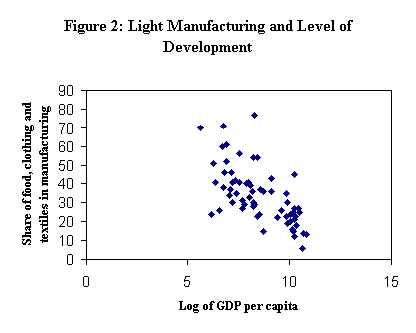
Source: Author’s calculations based on World Development Indicators, 1997.
Table 1: The Distribution of employment shares across plant sizes
|
Number of Workers |
||||||||||||||
|
1-4 |
5-9 |
10-19 |
20-49 |
50-99 |
>99 |
|||||||||
|
United States, 1977a |
1.18 |
1.74 |
3.59 |
8.74 |
10.10 |
74.65 |
||||||||
|
Indonesia, 1986b |
44.2 |
17.3 |
38.5 |
|||||||||||
|
Korea, 1973c |
7.9 |
22.0 |
70.1 |
|||||||||||
|
India, 1971d |
42 |
20 |
38 |
|||||||||||
|
Tanzania, 1967 d |
56 |
7 |
37 |
|||||||||||
|
Ghana, 1970 d |
84 |
1 |
15 |
|||||||||||
|
Kenya, 1969 d |
49 |
10 |
41 |
|||||||||||
|
Sierra Leone, 1974 d |
90 |
5 |
5 |
|||||||||||
|
Indonesia, 1977 d |
77 |
7 |
16 |
|||||||||||
|
Zambia, 1985 d |
83 |
1 |
16 |
|||||||||||
|
Honduras, 1979 d |
68 |
8 |
24 |
|||||||||||
|
Thailand, 1978 d |
58 |
11 |
31 |
|||||||||||
|
Philippines, 1974 d |
66 |
5 |
29 |
|||||||||||
|
Nigeria, 1972 d |
59 |
26 |
15 |
|||||||||||
|
Jamaica, 1978 d |
35 |
16 |
49 |
|||||||||||
|
Colombia, 1973 d |
52 |
13 |
35 |
|||||||||||
|
Korea, 1975 d |
40 |
7 |
53 |
|||||||||||
|
Taiwan, 1971 b |
29.1 |
70.8 |
||||||||||||
a
source: United States Bureau of the Census (1977).b
source: Steel (1993)c
source: Little et al (1987, Table 6.5)d
source: Liedholm and Mead (1987)Table 2: Deterministic Frontiers, Average Efficiency Levels by Industry
|
Industry: |
Little et al (1987) or Page (1984), India Translog, linear prog. |
Cortes, et al (1987), Colombia Cobb-Douglas |
Ramaswamy (1994), India, Cobb-Douglas, linear prog. |
Corbo and de Melo (1986), Chile Cobb-Douglas, linear programming |
Tyler (1979) Brazil, Cobb-Douglas, linear programming or quadratic programming |
Pack (1984), relative to UK best practice, CES (subs. elasticity of 0.5)
|
Page (1980), Ghana, Cobb-Douglas with gamma distribution |
|
Food Processing |
0.58 |
0.401 |
|||||
|
Shoes |
0.424 |
0.367 |
|||||
|
Printing |
0.645 |
0.334 |
|||||
|
Soap |
0.579 |
0.344 |
|||||
|
Machine Tools |
0.688 |
0.56 |
0.432 |
0.372 |
|||
|
Agricultural Machinery |
0.349 |
0.445 |
|||||
|
Plastic Products |
0.608 |
0.332 |
0.48 or 0.65 |
||||
|
Steel |
0.435 |
0.57 or 0.62 |
|||||
|
Motor Vehicles |
0.638 |
0.312 |
|||||
|
Textiles: Spinning |
0.225 |
0.70 (Kenya) 0.73 (Philippines) |
|||||
|
Textiles: Weaving |
0.68 (Kenya) 0.55 (Philippines) |
||||||
|
Saw Mills |
0.370 |
0.710 |
|||||
|
Furniture |
0.743 |
Table 3: Stochastic Frontiers: Average Technical efficiency by Industry *
|
Rataswamy (1994), small- and medium-scale Indian firms
|
Bhavani (1991), small Indian firms
|
Hill and Kalirajan, (1993), small Indonesian firms.
|
Biggs et al (1995), Ghana, Kenya, Zimbabwe |
Pitt and Lee (1981), Indonesian firms** |
Tyler and Lee (1979), small and medium-scale Colombian firms
|
|
|
Food |
0.67
|
0.642 |
||||
|
Textiles and Garments |
0.626 |
0.46
|
(weaving only) min: 0.618 max: 0.766 |
0.554 (apparel) |
||
|
Footwear |
0.558 |
|||||
|
Wood and Furniture |
0.42
|
0.984 (furniture) |
||||
|
Metal Products |
0.719 (structural metal products) |
0.51
|
0.987 |
|||
|
Machine Tools |
0.727 |
0.704 (agric. hand tools only) |
||||
|
Plastic Products |
0.820 |
|||||
|
Motor Vehicles |
0.846 |
*All figures are estimates of , where the inefficiency measure u is assumed to follow a half-normal distribution.
** Differences in estimated average efficiency reflect differences in the way that labor is measured, and whether plant characteristics like size and foreign ownership dummies are included in the production function.
Table 3: Stochastic Frontiers, con’t.*
|
Food processing |
0.713 |
0.73 |
||||
|
Shoes |
wrong skewness |
|||||
|
Printing |
wrong skewness |
|||||
|
Soap |
0.627 |
|||||
|
Machine Tools |
wrong skewness |
|||||
|
Agricultural Machinery |
0.751 |
|||||
|
Plastic Products |
wrong skewness |
|||||
|
Motor Vehicles |
wrong skewness |
|||||
|
Textiles: Spinning |
wrong skewness |
|||||
|
Textiles: Weaving |
wrong skewness |
|||||
|
Saw Mills |
0.652 |
|||||
|
Furniture |
wrong skewness |
|||||
|
Japanese manuf., cross-industry average of 144 industries |
0.699 |
|||||
|
Korea, cross-industry average of 128 industries |
0.672 |
|||||
|
UK, cross-industry average of 72 industries |
0.680
|
|||||
|
Australia, cross-industry average of 91 industries |
0.699
|
|||||
|
United States, cross-industry average of 67 4-digit industries |
0.671 |
|||||
*Refer to note on previous page