Productive Consumption and Growth
in Developing Countries*
November 1997
Thomas Steger
Fachbereich 5, VWL I
University of Siegen
Hölderlinstraße 3
D-57068 Siegen, Germany
e-mail: steger@vwl.wiwi.uni-siegen.de
Abstract: Productive consumption
enables the satisfaction of current needs and, at the same time,
increases the productive potential of labour. Theoretical as well
as empirical evidence suggests that productive consumption is
primarily relevant to low-income countries. From the perspective
of growth theory, the productive consumption hypothesis is of
fundamental interest because it modifies the "harsh"
intertemporal consumption trade-off traditionally assumed. The
analysis of the productive consumption hypothesis within a simple
endogenous growth model reveals the following implications: (a)
the possibility of a poverty-trap, (b) the rule of optimal consumption
turns into a modified Keynes-Ramsey rule, (c) the (effective)
IES is not only based on preferences but in addition on the technological
possibilities to enhance human capital due to productive consumption,
(d) a rising saving rate, and (e) transitional dynamics to an
asymptotic balanced growth equilibrium.
Keywords: Productive Consumption, Human Capital, Growth in DCs
JEL-Classification: D9, E21, I0, O1, O4, O41
Contents
1 Introduction 12 Productive consumption: an Overview 32.1 Empirical evidence 32.2 Theoretical approaches 72.2.1 Preliminary remarks 72.2.2 Consumption and the probability of survival 82.2.3 Consumption and labour productivity 103 The importance of productive consumption for growth 133.1 A linear growth model with productive consumption 133.1.1 The human-capital-enhancement-function 133.1.2 The model 153.1.3 Implications 193.2 Simulation results 264 Summary and Conclusion 325 Appendix 336 References 35
- Introduction
The common interest of nearly all development and growth theories
is the fundamental concept of a "harsh" intertemporal
consumption trade-off: Current consumption inevitably reduces
future consumption possibilities in a with-or-without sense. This
is true for the early "low-level-equilibrium-trap" theories
[Nelson (1956) and Leibenstein (1957)], the neoclassical growth
theory [Solow (1956), Swan (1956), Ramsey (1928), Cass (1965),
and Koopmans (1965)] as well as the endogenous growth theories
[e.g. Lucas (1988), Romer (1990), and Rebelo (1991)].
In contrast, already since the fifties the possibility of productive
consumption was recognised within development literature [Winslow
(1951), Nurkse (1953), and in addition Wheeler (1980), Gersovitz
(1983)]. Productive consumption enables the satisfaction
of current needs and, at the same time, increases the productive
potential of labour. As a consequence, the potential for the satisfaction
of future needs rises. Two interpretations of the productive effect
of consumption can be distinguished: First, a rising level of
per capita consumption can be considered to increase the efficiency
of labour; this interpretation underlies the traditional efficiency
wage theory [Leibenstein (1957), Stiglitz (1976), and Bliss and
Stern (1978)]. Second, a rise in the level of per capita consumption
can, on the other hand, be interpreted as increasing the stock
of human capital [Blaug (1987)].
Gersovitz (1988) distinguishes three forms of productive consumption:
(a) nutrition, (b) health, and (c) education. All three forms
serve the satisfaction of current needs, and, consequently, can
be labelled as consumption expenditures; though occasionally this
might be assessed differently in the case of education. Simultaneously,
the efficiency of labour or - depending on the interpretation
- the stock of human capital increases. From this point of view,
the underlying consumption expenditures can be classified as productive.
Gersovitz (1988) expresses this notion as follows: „Health
and nutrition expenditures share some attributes of educational
ones; they affect welfare beyond the period when they are made.
To a much greater extent than in the case of education, however,
these expenditures also affect current well-being, and it would
be impossible to devise a convincing allocation of these expenditures
between current and future consumption. For instance, at low nutritional
levels, food consumption has joint effects on current and future
well-being and productivity."
For developing countries (DCs) special characteristics of preferences
and technology exist, which are relevant to growth probably. For
example, intertemporal preferences are usually assumed to exhibit
a constant time preference rate though a negative relation between
the time preference rate and per capita income seems reasonable,
especially for the lower range of income. With respect to technology,
the effect of enhancing the stock of a productive input (human
capital) as a consequence of consumption activities presents a
further characteristic relevant to growth, which is almost completely
ignored in the context of growth theory. After reviewing empirical
evidence for a positive nutrition-productivity relation, Fogel
(1994) stated recently: "Although largely neglected by
theorists of both the "old" and the "new"
growth economics, these factors can easily be incorporated into
standard growth models." The growth model presented in
section 3 is an attempt to incorporate the productive consumption
hypothesis into a simple endogenous growth model.
From the perspective of growth theory, the productive consumption
hypothesis seems to be of fundamental interest because of two
reasons: First, productive consumption essentially modifies, that
is partially eliminates, the intertemporal consumption trade-off.
Second, theoretical as well as empirical evidence suggests a systematic,
that is negative relationship between the level of per capita
consumption and the marginal productive effect of consumption.
Concentrating on the importance of productive consumption for
economic growth does surely not intend to neglect the importance
of other factors that undoubtedly influence growth and development,
e.g. the stability of the political system, the openness of the
economy, or the development of the financial sector.
The rest of this paper is organised as follows: In section 2,
a brief outline of the current theoretical and empirical work
on the subject "productive consumption" is given first
of all. In section 3, the hypothesis of productive consumption
is specified in the form of a "human-capital-enhancement-function"
and then integrated into a simple endogenous growth model. The
transition process to an asymptotic balanced growth equilibrium
is illustrated by means of a simulation. Section 4 summarises
the main results and concludes with some final considerations.
- Productive consumption:
an Overview
- Empirical evidence
The relation between labour productivity as well as output growth
on the one hand and nutrition, health, and education on the other
hand has been analysed empirically mainly against the background
of two different questions: (a) In the wake of the traditional
efficiency wage theory, it was attempted to uncover empirical
evidence supporting or refuting the impact of nutrition and health
expenditures on labour productivity within the framework of microeconomic
empirical analyses. (b) On the other hand, the contribution of
nutrition, health, and education to output growth was examined
on a macroeconomic level using the methodology of growth accounting.
These empirical investigations were partly motivated by the question
whether a development strategy primarily focusing on the satisfaction
of basic needs prevents an economy from growing or even stimulates
growth [Hicks (1979), Wheeler (1980), and Barro and Sala-i-Martin
(1995), chapter 12]. Some selected empirical investigations and
their most important results are outlined in the following.
Microeconomic analyses
On the basis of microeconomic cross-sectional data for small-scale
farming enterprises in Sierra Leone (1974/75), Strauss (1986)
estimates the coefficients of an agricultural Cobb-Douglas production
function. The production function is
specified to account for a dependence of the agricultural workers'
efficiency upon daily nutrient intake per worker. The approach
takes into account the simultaneity of household choices, the
levels of variable farm inputs and it considers the possible influence
of other variables on agricultural output, e.g. land quality.
The coefficients of nutrient intake show the expected positive
sign and are highly significant. The positive impact of nutrient
intake on labour productivity is especially
marked at low levels and decreases with an increasing level of
calorie intake. The estimation results of Strauss (1986) imply
remarkably high values for the output elasticity of nutrition
at low levels of calorie intake. The corresponding values vary
from 0.49 at a daily intake of 1500 calories via 0.34 at the sample
mean value for a daily calorie intake up to 0.12 at a daily intake
of 4500 calories. Accordingly, at the mean value of daily calorie
intake, an increase by 1 percent results in a rise in output by
0.34 percent.
Deolalikar (1988) investigates, based upon Strauss (1986), the
relation between labour productivity in agriculture as well as
the wage rate of rural workers on the one hand and individual
calorie intake per day and weight-for-height (kg per cm) on the
other hand by using panel data for 240 households in different
rural areas of southern India (1976-77 and 1977-78). In this case,
the weight-for-height variable is interpreted as a medium-term
indicator of the nutritional status as well as an indicator of
the health status. The results are not unambiguous: The coefficients
of calorie intake per day are not significant, while the coefficients
of weight-for-height prove to be significant. However, Deolalikar
does not interpret these results as an evidence against a nutrition-productivity
relationship: "What the empirical results then suggest
is that, even if the short-run effects of nutrition on labor productivity
are insignificant, the medium-run effects are large and positive.
...Another interpretation may simply be that weight-for-height
is a better indicator than average daily calorie intake."
In the context of a mesoeconomic study, Ram and Schultz (1979)
analyse the relation between the health status and labour productivity
in agriculture on the basis of data for different Indian states.
The rate of mortality is employed as an indicator of the health
status in such a way that a decrease in the rate of mortality
is interpreted as an improvement in the health status. Ram and
Schultz regress the percentage change in rural labour productivity
on the percentage change in the rate of mortality for the period
from 1958 to 1967. This single regression explains 28 percent
of the interstate variation in agricultural productivity; the
corresponding coefficient has a value of 0.3 and is highly significant.
Consequently, a reduction in the rate of mortality by 1 percentage
point increases the labour productivity by 0.3 percentage points.
Macroeconomic analyses
On a macroeconomic level, Wheeler (1980) examines for 54 DCs the
relation between the growth rate of output on the one hand and
the growth rate of different indicators for the nutritional status
(calorie availability per day), the health status (life expectancy
at birth), and education (adult literacy rate), on the other hand,
for the period from 1960 to 1970. For this purpose, Wheeler formulates
a simultaneous four-equation model, consisting of a macroeconomic
production function and one equation for nutrition, health, and
education, respectively (which are called "welfare equations").
The production function includes capital in addition to labour
in efficiency units as inputs, with the latter again depending
on the level of nutrition, health, and education. The three "welfare
equations" represent the level of nutrition, health, and
education as a function of per capita income as well as some exogenous
variables. By this formulation, a mutual causality between the
growth rate of output on the one hand and the change in nutrition,
health, and education on the other hand can be taken into consideration.
Wheeler finds a strong labour augmenting effect of the nutrition
and health variables in the determination of the change in output
for "poor countries". The parameter estimates imply
elasticities for labour in efficiency units with respect to nutrition
of 11.14 and for labour in efficiency units with respect to health
of 7.13. Multiplying these elasticity values with the value of
the output elasticity with respect to labour in efficiency units
yields the output elasticities for nutrition ( )
and for health (
)
and for health ( ). These values are several
times higher than the microeconomic elasticities of Strauss (1986).
A possible interpretation is based on the assumption of positive
external effects of labour efficiency: Well nourished, healthy,
appropriately educated, and economically active individuals at
the same time increase the productivity of other economic active
individuals. Surprisingly, Wheeler finds no significant influence
of the education variable on the growth rate of output; not even
at the 10 percent level of significance. Furthermore, the analysis
of the productive contributions of nutrition, health, and education
reveals a strong influence of nutrition and health especially
for low per capita incomes and a decreasing marginal contribution
with a rise in per capita income, while the positive influence
of education increases with a rise in per capita income. Wheeler
summarises his econometric analysis
with the words: "Thus, the available data are shown to
be consistent with the notion that some basic needs expenditures
can legitimately be regarded as investments in human capital."
). These values are several
times higher than the microeconomic elasticities of Strauss (1986).
A possible interpretation is based on the assumption of positive
external effects of labour efficiency: Well nourished, healthy,
appropriately educated, and economically active individuals at
the same time increase the productivity of other economic active
individuals. Surprisingly, Wheeler finds no significant influence
of the education variable on the growth rate of output; not even
at the 10 percent level of significance. Furthermore, the analysis
of the productive contributions of nutrition, health, and education
reveals a strong influence of nutrition and health especially
for low per capita incomes and a decreasing marginal contribution
with a rise in per capita income, while the positive influence
of education increases with a rise in per capita income. Wheeler
summarises his econometric analysis
with the words: "Thus, the available data are shown to
be consistent with the notion that some basic needs expenditures
can legitimately be regarded as investments in human capital."
The above-mentioned results are confirmed by Hicks (1979) insofar
as he finds within the framework of different multiple regressions
on the basis of cross-sectional data for 69 non-oilexporting DCs
(1960-73), without exception, a strong and significant influence
of different "basic-needs" indicators (life expectancy
at birth, adult literacy rate, primary school enrolment rates)
on the growth rate of real per capita income. Finally, the results
of a broadly designed cross-sectional analysis by Barro (1991)
are pointed out, according to which life expectancy at birth,
interpreted as a nutrition and health indicator, is positive and
highly significant for the explanation of the growth rate of real
per capita income; whereas the results for various indicators
of the educational status are not unambiguous.
Lastly, Fogel (1994) estimates the importance of a nutrition-productivity
relationship for the development process of Britain. He concludes
that improvements in nutrition explain 30 per cent of per capita
income growth between 1790 and 1980. One third of this effect
is assigned to increased labour force participation while the
remaining two thirds are assigned to an increased labour productivity
in production.
- Theoretical approaches
- Preliminary remarks
Traditional efficiency wage theory assumes a positive relation
between the level of consumption and the efficiency of labour.
This hypothesis bears far-reaching theoretical implications with
respect to the labour market: Profit-maximising producers are
willing to pay that wage rate which minimises labour cost per
efficiency unit of labour; this wage is called the efficiency
wage. If the market-clearing wage rate lies below the efficiency
wage, unemployment arises. The efficiency wage theory is, above
all, an approach to explain the widespread phenomenon of rural
unemployment in DCs [Stiglitz (1976) and Bliss and Stern (1978)].
The implications of a positive relationship between consumption
and the efficiency of labour or in other words the implications
of the productive consumption hypothesis for the consumption/saving
behaviour were hardly analysed within the economic literature.
Gersovitz (1983) represents an important exception.
He discusses two complementary approaches, which explicitly analyse
the importance of productive consumption for the consumption/saving
behaviour within the framework of a two-period model. Both approaches
are based on the idea that consumption might have a second positive
effect in addition to the direct satisfaction of current needs.
This consists in an increase in the probability of survival and
in an increase in the efficiency labour. Both approaches offer
the possibility to derive a positive relation between the average
saving rate and income on a sound microeconomic foundation. On
account of the exceptional importance of both approaches for the
theoretical analysis both are outlined in their essential features.
- Consumption and the
probability of survival
The crucial hypothesis of this model is a positive relation between
the standard of living and the probability of survival for the
lower range of income. Consequently, consumption increases welfare
in two different respects: The satisfaction of current needs means
a (traditional) direct utility effect. The indirect utility effect
of consumption consists in an increase in the probability of survival.
The importance of this additional consumption effect falls with
an increase in the standard of living.
The individual considered exists for two periods (presence and
future) and solely receives income in the first period. This income
( ) is divided up between current consumption
(
) is divided up between current consumption
( ) and savings (
 );
future consumption (
);
future consumption ( ) equals current savings
multiplied by an interest rate factor (
) equals current savings
multiplied by an interest rate factor ( ):
):
 , (2.1)
 . (2.2)
The probability of surviving the first period ( )
increases with the level of consumption during the first period,
furthermore a concave and twice continuously differentiable "survival-probability-function"
is assumed:
)
increases with the level of consumption during the first period,
furthermore a concave and twice continuously differentiable "survival-probability-function"
is assumed:
 , with
  and
and  .
(2.3)
.
(2.3)
The individual chooses  and
and  ,
in order to maximise the expected lifetime utility (
,
in order to maximise the expected lifetime utility ( ),
),
 , (2.4)
with respect to (2.1) and (2.2). The instantaneous utility function
[ ] is also assumed to be concave and twice
continuously differentiable. Application of the Lagrangian method
yields the first-order conditions for an interior solution (
] is also assumed to be concave and twice
continuously differentiable. Application of the Lagrangian method
yields the first-order conditions for an interior solution ( ):
):
 . (2.5)
For an optimal solution, the marginal gain in welfare due to an
increase in current consumption equals the marginal gain in welfare
due to an increase in future consumption. The left-hand side of
(2.5) shows the marginal increase in welfare resulting from current
consumption, which consists of two components. A (marginal) increase
in current consumption causes the expected lifetime utility to
rise according to the marginal utility of current consumption
[ ] and, additionally, according to a rise
in the expected future utility, resulting from an increase in
the probability of survival [
] and, additionally, according to a rise
in the expected future utility, resulting from an increase in
the probability of survival [ ]. The right-hand
side of (2.5) shows the marginal increase in welfare due to an
increase in future consumption. The probability of experiencing
the future is, of course, considered for the calculation of the
expected value.
]. The right-hand
side of (2.5) shows the marginal increase in welfare due to an
increase in future consumption. The probability of experiencing
the future is, of course, considered for the calculation of the
expected value.
Gersovitz discusses two threshold effects: Below a subsistence
level of consumption ( ), survival is impossible
[
), survival is impossible
[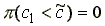 ]. If income does not exceed this value,
saving is zero,
]. If income does not exceed this value,
saving is zero,  . A second threshold effect
appears as soon as the initial level of consumption exceeds a
value above which no further influence on the probability of survival
exists,
. A second threshold effect
appears as soon as the initial level of consumption exceeds a
value above which no further influence on the probability of survival
exists, 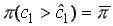 . Without this "survival
effect" of consumption (
. Without this "survival
effect" of consumption ( ), condition
(2.5) turns into the usual optimum condition:
), condition
(2.5) turns into the usual optimum condition:
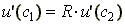 . (2.6)
As long as the utility function is isoelastic and the interest
rate equals zero, a positive relation between the average saving
rate and income exists, provided that:
 , where
  and
and  ,
(2.7)
,
(2.7)
and  denotes the elasticity of utility.
Condition (2.7) is fulfilled whenever the elasticity of the marginal
probability of survival with respect to consumption (
denotes the elasticity of utility.
Condition (2.7) is fulfilled whenever the elasticity of the marginal
probability of survival with respect to consumption ( )
is greater than one. Provided that the marginal probability of
survival declines sufficiently fast in response to current consumption,
the individual is willing to increase future consumption more
than proportionately as income rises, thereby increasing the saving
rate.
)
is greater than one. Provided that the marginal probability of
survival declines sufficiently fast in response to current consumption,
the individual is willing to increase future consumption more
than proportionately as income rises, thereby increasing the saving
rate.
- Consumption and labour
productivity
As mentioned above, the traditional efficiency wage theory assumes
a positive impact of the individual wage rate on the efficiency
of labour. In this context, a higher wage rate is implicitly assumed
to induce an increase in the level of consumption. Due to a "physiological-technological"
relationship a higher productivity per man-hour results. By means
of a second model, Gersovitz (1983) analyses the resulting implications
for the individual saving behaviour. He describes the productive
consumption effect and its possible implication for the saving
behaviour as follows: "Greater current consumption adds
to utility directly and indirectly by increasing income, thereby
creating a bias against saving".
The crucial hypothesis of consumption
( ) enhancing the efficiency of labour
(
) enhancing the efficiency of labour
( ) is represented by a concave and twice
continuously differentiable "effort-function". Thus,
it is supposed in accordance with efficiency wage literature,
that consumption increases the efficiency of labour without any
delay:
) is represented by a concave and twice
continuously differentiable "effort-function". Thus,
it is supposed in accordance with efficiency wage literature,
that consumption increases the efficiency of labour without any
delay:
 , with
  .
(2.8)
.
(2.8)
The individual considered exists for two periods, the entire income
is received exclusively during the first period and experience
of the second period is - in contrast to the former model - certain.
Current and future consumption are chosen in order to maximise
total utility,
 , (2.9)
subject to the constraints,
 , (2.10)
 . (2.11)
In this case  denotes the wage rate per
efficiency unit of labour [i.e. the wage rate per man-hour in
relation to one unit of efficient labour (
denotes the wage rate per
efficiency unit of labour [i.e. the wage rate per man-hour in
relation to one unit of efficient labour ( )],
)],
 the efficiency of labour, so that
  represents the wage income and
  all components
of non-wage income. The first-order condition for an interior
solution reads:
all components
of non-wage income. The first-order condition for an interior
solution reads:
 . (2.12)
Taking into consideration the presumed positive marginal utility,
condition (2.12) can only be fulfilled if the following inequality
holds:
 or
or  . (2.13)
The interpretation of condition (2.13) is as follows: Saving necessarily
means a reduction in current consumption. Consequently, the efficiency
of labour and, therefore, the wage income decreases in accordance
with the effort-function. The condition  means that further saving (renunciation of current consumption)
by one unit can only be reasonable if the induced fall in income
turns out to be smaller. The bias toward current consumption in
the case of low incomes becomes clear if (2.12) is transformed
to:
means that further saving (renunciation of current consumption)
by one unit can only be reasonable if the induced fall in income
turns out to be smaller. The bias toward current consumption in
the case of low incomes becomes clear if (2.12) is transformed
to:
 . (2.12a)
For comparably low incomes and, consequently, ceteris paribus
low consumption levels,  is relatively
high, and the value of the right-hand side of (2.12 a) is relatively
small. Hence, a low marginal utility of consumption in the first
period (left-hand side) and, taking into account the concavity
of the utility function, a comparably high level of current consumption
results. This effect disappears with a rise in income and for
is relatively
high, and the value of the right-hand side of (2.12 a) is relatively
small. Hence, a low marginal utility of consumption in the first
period (left-hand side) and, taking into account the concavity
of the utility function, a comparably high level of current consumption
results. This effect disappears with a rise in income and for
 (2.12 a) turns into the usual optimum
condition.
(2.12 a) turns into the usual optimum
condition.
The average saving rate rises with income provided that the following
condition holds:
 ,
,
with  ,
,  and as
before
and as
before  . (2.14)
Provided that the individual has no non-wage income ( ),
),
 is a sufficient condition for the saving
rate to increase with income. Accordingly, the marginal attractiveness
of current consumption as a result of the efficiency and wage
increasing effect must fall sufficiently fast.
is a sufficient condition for the saving
rate to increase with income. Accordingly, the marginal attractiveness
of current consumption as a result of the efficiency and wage
increasing effect must fall sufficiently fast.
- The importance of productive
consumption for growth
- A linear growth model with productive
consumption
- The human-capital-enhancement-function
The above-reviewed empirical studies investigating the relationship
between labour productivity and output growth on the one hand
and nutrition, health, and education on the other hand clarify
two essential points:
- A rise in the level of nutrition, health, and education increases
the productive potential of labour, and
- with an increasing level of nutrition, health, and education,
the importance of the marginal effect on the productive potential
of labour decreases.
Nutrition and health expenditures are clearly made in order to
satisfy current needs and can be classified as consumption; in
the case of education, this does not follow unambiguously. In
fact, a considerable part of the educational activities may not
be considered as pure pleasure and is probably conceived as a
traditional investment activity.
To analyse the implications of productive consumption in the context
of growth, the productive consumption effect is interpreted as
enhancing the stock of human capital. This central hypothesis
is specified in the form of a human-capital-enhancement-function.
In its intensive form, this concave and twice continuously differentiable
function reads: , with
  and
and  . (3.1)
In this case  denotes the stock of human
capital per capita at time
denotes the stock of human
capital per capita at time  ,
,  consumption per capita,
  the depreciation
rate of human capital, and
the depreciation
rate of human capital, and  the population
growth rate, respectively. Equation (3.1) represents the equation
of motion for the average stock of human capital. As a result
of productive consumption activities, the stock of human capital
per capita increases according to the function
the population
growth rate, respectively. Equation (3.1) represents the equation
of motion for the average stock of human capital. As a result
of productive consumption activities, the stock of human capital
per capita increases according to the function  ,
while it decreases due to depreciation and population growth.
Consequently,
,
while it decreases due to depreciation and population growth.
Consequently,  can be designated as the
gross human-capital-enhancement-function. The positive, but decreasing
marginal human-capital-enhancement-effect of consumption [
can be designated as the
gross human-capital-enhancement-function. The positive, but decreasing
marginal human-capital-enhancement-effect of consumption [ ,
, ]
appears justified by the empirical evidence. The "smooth"
shape may not be reasonable at an individual level. However, this
assumption hardly appears problematic at an aggregate level, that
is if (3.1) is interpreted in the sense of an average human-capital-enhancement-function.
]
appears justified by the empirical evidence. The "smooth"
shape may not be reasonable at an individual level. However, this
assumption hardly appears problematic at an aggregate level, that
is if (3.1) is interpreted in the sense of an average human-capital-enhancement-function.
On account of its static character, the traditional efficiency
wage theory was forced to assume that consumption increases the
efficiency of labour without any delay. In contrast, equation
(3.1) indicates a human-capital-enhancing-effect of consumption
for the next period. The above-stated formulation of the human-capital-enhancement-function
means that human capital is formed exclusively as a result of
productive consumption. Consequently, formal education as far
as it represents an investment decision and learning-by-doing
effects are ignored. The representation of productive consumption
effects together with, for example, formal education is naturally
possible within the framework of a comprehensive production function
for human capital: . (3.2)
The first term on the right-hand side equals the production function
for human capital corresponding to the Uzawa-Lucas model.
Several authors have recently incorporated a subsistence level
of consumption into different growth models by means of Stone-Geary
preferences [Rebelo (1992), Ben-David (1994), Easterly (1994),
Sarel (1994)]. The concept of a subsistence level of consumption
can be related to the human-capital-enhancement-function. The
subsistence level of consumption can be interpreted to denote
the income level below which survival is impossible, that is the
physical minimum of existence. The subsistence level of consumption
can be considered to represent the minimum gross enhancement of
human capital to cover depreciation. The differences between the
concept of subsistence consumption and the human-capital-enhancement-function
are the following: (a) the former represents a modification of
the standard preference formulation while the later represents
a modification of the technological opportunities, and (b) the
human-capital-enhancement-function continuously accounts for productive
consumption effects beyond the subsistence level.
The hypothesis of productive consumption in the form of equation
(3.1) or (3.2) is not an assumption which serves primarily for
abstraction, that is reducing the complexity of the real world.
It rather constitutes a crucial assumption for the growth model
presented in the next section, which focuses on important aspects
of capital accumulation and growth in DCs.
- The model
The linear growth model [Romer (1986), Barro (1990), Jones and
Manuelli (1990), Rebelo (1991); in addition see Barro and Sala-i-Martin
(1995), chapter 4] is a fairly simple endogenous growth model.
Due to its simple structure, it shows very clearly the conditions
for permanent growth as well as the main implications of the endogenous
growth theory. Permanent growth is guaranteed by constant returns
to scale in the factors that can be accumulated as well as a sufficiently
high marginal productivity of these factors. The steady-state
growth rate is determined by technology and preference parameters,
so that internationally different parameter values can explain
internationally different growth rates. A special feature of the
linear growth model is that the steady-state is realised at any
point in time; consequently, transitional dynamics do not exist.
In the following, a modified linear growth model extended by productive
consumption is presented in a general form using continuous time
notation.
Every representative household has access to a one-sector production
technology with capital [ ] as the only
input, which is employed to produce an output good [
] as the only
input, which is employed to produce an output good [ ]
that can be used universally for investment or consumption purposes.
The production function in its intensive form reads:
]
that can be used universally for investment or consumption purposes.
The production function in its intensive form reads: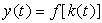 with
with  and
and  .
(3.3)
.
(3.3)
The production function is linear homogeneous and, hence, the
marginal productivity of capital ( ) is
constant. The absence of diminishing returns is crucial for the
generation of endogenous growth and can be justified mainly by
two interpretations: First, capital is thought to exhibit positive
spill-over effects or, second, capital can be interpreted broadly.
Following this second interpretation, capital is defined to encompass
physical as well as human capital. In addition, both types of
capital can be additively aggregated if they are assumed to be
perfect substitutes in production:
) is
constant. The absence of diminishing returns is crucial for the
generation of endogenous growth and can be justified mainly by
two interpretations: First, capital is thought to exhibit positive
spill-over effects or, second, capital can be interpreted broadly.
Following this second interpretation, capital is defined to encompass
physical as well as human capital. In addition, both types of
capital can be additively aggregated if they are assumed to be
perfect substitutes in production:  .
(3.4)
.
(3.4)
Physical capital per capita [ ] increases
as a consequence of the renunciation of consumption, taking into
account the rate of depreciation (
] increases
as a consequence of the renunciation of consumption, taking into
account the rate of depreciation ( ) as
well as the rate of population growth (
) as
well as the rate of population growth ( ):
): .
(3.5)
.
(3.5)
Human capital per capita [ ] is exclusively
formed by productive consumption; the equation of motion for human
capital equals the human-capital-enhancement-function:
] is exclusively
formed by productive consumption; the equation of motion for human
capital equals the human-capital-enhancement-function: .
(3.6)
.
(3.6)
The gross human-capital-enhancement-function  is assumed to be strictly concave and twice continuously differentiable
with asymptotically vanishing first and second derivative:
is assumed to be strictly concave and twice continuously differentiable
with asymptotically vanishing first and second derivative: ,
,
 ,
,  and, hence,
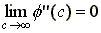 . (3.7)
Using the simplifying assumption of identical depreciation rates,
the equation of motion for the whole stock of capital per capita
reads according to (3.4) as follows: with
with  . (3.8)
Usually, consumption is costly because it fully reduces net investments,
that is the accumulation of capital. In the present context, consumption
partially contributes to the accumulation of human capital. .
Consequently,  can be designated as the
net cost of consumption (ncc) which consists in
consumption less the human-capital-enhancement effect of consumption.
can be designated as the
net cost of consumption (ncc) which consists in
consumption less the human-capital-enhancement effect of consumption.
The representative household is assumed to maximise its dynastic
lifetime utility. The corresponding dynamic optimisation problem
is a concave, infinite time problem of optimal control with one
control [ ] and one state variable [
 ]
as well as a bounded control set:
]
as well as a bounded control set:
where  denotes per capita consumption
at time
denotes per capita consumption
at time  ,
,  the
instantaneous utility function,
the
instantaneous utility function,  the individual
time preference rate, and
the individual
time preference rate, and  the constant
growth rate of population, respectively. The instantaneous utility
function is assumed to be strictly concave [
the constant
growth rate of population, respectively. The instantaneous utility
function is assumed to be strictly concave [ and
and  ] and to possess a constant elasticity
of marginal utility with respect to consumption (
] and to possess a constant elasticity
of marginal utility with respect to consumption (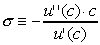 ),
that is a constant intertemporal elasticity of substitution (
),
that is a constant intertemporal elasticity of substitution ( ).
).
The marginal ncc [ ] is negative
as long as the marginal human-capital-enhancement effect of consumption
is greater than one. In this case, it clearly makes no sense to
refrain from consumption and, therefore, saving must be zero.
Moreover, rational individuals would try to dissave whenever this
possibility arises. However, since only human capital has been
accumulated in the past and the transformation of human capital
into consumption goods seems to be impossible, the (state-dependent)
inequality constraint on the control [
] is negative
as long as the marginal human-capital-enhancement effect of consumption
is greater than one. In this case, it clearly makes no sense to
refrain from consumption and, therefore, saving must be zero.
Moreover, rational individuals would try to dissave whenever this
possibility arises. However, since only human capital has been
accumulated in the past and the transformation of human capital
into consumption goods seems to be impossible, the (state-dependent)
inequality constraint on the control [ ]
must be imposed and will turn out to be effectively binding at
early stages of economic development.
]
must be imposed and will turn out to be effectively binding at
early stages of economic development.
The Lagrangian and the current-value Hamiltonian for the maximisation
problem (3.9) read as follows:
 , (3.10)
 .
(3.11)
.
(3.11)
The Hamiltonian (3.11), which represents the contribution of current
output allocated to consumption and investment to the overall
benefit, illustrates the "dual welfare-effect" of (productive)
consumption. The first part shows the direct contribution to utility
[ ]. As already mentioned, productive consumption
reduces the ncc [
]. As already mentioned, productive consumption
reduces the ncc [ ] according to
the human-capital-enhancement-effect of consumption [
] according to
the human-capital-enhancement-effect of consumption [ ].
The second part of the Hamiltonian, representing the net increase
in the capital stock evaluated at the current-value shadow price
(
].
The second part of the Hamiltonian, representing the net increase
in the capital stock evaluated at the current-value shadow price
( ), captures this mechanism.
The application of the maximum principle leads to the first-order
conditions, where  and
and  denote the dynamic Lagrangian multipliers associated with each
of the inequality constraints stated in (3.9):
denote the dynamic Lagrangian multipliers associated with each
of the inequality constraints stated in (3.9): ,
(3.12)
,
(3.12) , (3.13)
 ,
(3.14)
,
(3.14)
 ,
, 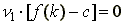 , (3.15)
 ,
,
 . (3.16)
- Implications
The first-order conditions stated above indicate that boundary
solutions have to be distinguished from interior solutions. Furthermore,
within interior solutions, the transition process can be distinguished
from the asymptotic balanced growth equilibrium. In order to illustrate
the implications of the linear growth model with productive consumption,
three ranges are distinguished: The no-saving range, the
transition range and the asymptotic range.
No-saving range
The first-order conditions (3.14), (3.15), and (3.16) imply a
boundary solution with  if the following
weak inequality holds:
if the following
weak inequality holds:
 . (3.17)
As long as the marginal utility of consumption exceeds the marginal
ncc measured in units of utility, an increase in consumption
approaching the upper limit of the control set [ ,
,
 ] seems to be rational and, consequently,
saving is zero.
] seems to be rational and, consequently,
saving is zero.
Within the no-saving range the evolution of the economy is determined
by the equation of motion for capital (3.8), taking into account
that saving is zero: . (3.18)
Note that an increase in capital per capita is possible in the
present model although the saving rate is zero. As a consequence
of the properties of the human-capital-enhancement-function, the
differential equation in the capital stock (3.18) possesses a
stable equilibrium point whenever the sum of the depreciation
rate and the population growth rate is positive. If the stationary
value of capital per capita lies inside the no-saving range, the
economy runs into a poverty-trap: Individuals do not save
during this early stage of economic development and no physical
capital is accumulated. However, human capital is created as a
consequence of productive consumption activities. Because of the
diminishing marginal human-capital-enhancement-effect of consumption,
the net human capital accumulation decreases and may approach
zero before the end of the no-saving range is reached and the
accumulation of physical capital sets in.
The growth rates of consumption per capita and output per capita
are equal to the growth rate of capital per capita: 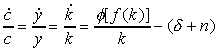 .
(3.19)
.
(3.19)
The growth rate of consumption per capita in (3.19) is independent
of preferences. That is, the intertemporal elasticity of substitution
(IES) is effectively zero within the no-saving range.
Transition range
The first-order conditions (3.14), (3.15), and (3.16) imply an
interior solution ( ) if the following
equality holds:
) if the following
equality holds:  . (3.20)
As soon as the marginal utility of consumption equals the marginal
ncc measured in units of utility, the optimal trajectory
leaves the boundary and runs into the interior of the open control
set [ ,
,  ]; provided
that the poverty-trap did not become binding. Along the optimal
trajectory, equality (3.20) holds as a necessary optimum condition.
Taking into account the definition of the marginal ncc
[
]; provided
that the poverty-trap did not become binding. Along the optimal
trajectory, equality (3.20) holds as a necessary optimum condition.
Taking into account the definition of the marginal ncc
[ ] as well as the concavity of the utility
function and comparing (3.20) to the usual optimum condition [
] as well as the concavity of the utility
function and comparing (3.20) to the usual optimum condition [ ],
it becomes clear that the level of consumption is higher compared
to a situation without productive consumption effects, as one
would expect.
],
it becomes clear that the level of consumption is higher compared
to a situation without productive consumption effects, as one
would expect.
Differentiation of equation (3.20) with respect to time, subsequently
dividing the result by the original relation (3.20), eliminating
the shadow price using equation (3.13), and noting that  is zero for an interior solution yields the optimal growth rate
of consumption per capita:
is zero for an interior solution yields the optimal growth rate
of consumption per capita: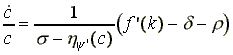 with
with
 . (3.21)
The evolution of the economy in the case of interior solutions
is governed by the differential equations in the state (3.8) and
in the control (3.21). The second expression of the denominator
on the right-hand side of (3.21) denotes the elasticity of
the marginal ncc with respect to consumption [ ].
Corresponding to the nature of the human-capital-enhancement-function,
].
Corresponding to the nature of the human-capital-enhancement-function,
 is negative while its absolute value
decreases with an increasing level of per capita consumption and
asymptotically approaches zero.
is negative while its absolute value
decreases with an increasing level of per capita consumption and
asymptotically approaches zero.
Equation (3.21) is the modified Keynes-Ramsey rule
of optimal consumption/saving. The ratio on the right-hand side
of (3.21) can be designated effective IES (eIES).
It is worth noting that the eIES is not exclusively determined
by the instantaneous utility function but that it is additionally
dependent on the technological possibilities to enhance the stock
of human capital as a result of productive consumption. The eIES
expresses the willingness to substitute consumption intertemporally,
taking into account a change in the marginal utility as well as
a change in the marginal ncc. Along the (infinite) transition
to the asymptotic balanced growth equilibrium the eIES
and the growth rate of consumption per capita increase.
With respect to (3.21), one could argue that productive consumption
has no impact on growth rates if one only assumes the human-capital-enhancement-function
to imply a constant elasticity of the marginal ncc; analogous
to the use of constant intertemporal elasticity of substitution
(CIES) utility functions. The class of human-capital-enhancement-functions
which give rise to a constant elasticity of the marginal ncc
can be shown to be of the following form (see the appendix):
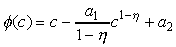 , (3.22)
where  and
and  are
some positive constants and
are
some positive constants and  denotes the
(constant) elasticity of the marginal ncc. However, it
can be shown that (3.22) cannot fulfil the requirements of
denotes the
(constant) elasticity of the marginal ncc. However, it
can be shown that (3.22) cannot fulfil the requirements of  and
and  , stated in (3.7). In addition,
the conventional case of consumption inducing no productive effects
at all can be considered as a special case with
, stated in (3.7). In addition,
the conventional case of consumption inducing no productive effects
at all can be considered as a special case with  ,
,
 and
and  .
.
In order to give a clear economic interpretation of the modified
Keynes-Ramsey rule equation (3.21) is slightly reworded to: .
(3.23)
.
(3.23)
The third term on the right-hand side of (3.23) is the percentage
time rate of change of the marginal utility which represents "the
psychic cost of saving". The last term on the right-hand
side is the percentage time rate of change of the marginal ncc.
Holding an additional unit of capital during a short interval
of time causes a rising consumption profile and induces a rise
of the marginal ncc. Along the optimal path the rate of
consumption at each moment must be chosen so that the marginal
productivity of capital covers four components: The time preference
rate, the depreciation rate, the psychic cost of saving, and in
addition the rise in the marginal ncc.
The saving rate is zero at the beginning of the transition process
and can be shown to converge asymptotically toward a positive
constant, which equals the saving rate of the original linear
growth model (see the appendix and section 3.2, figure 3).
What about the growth rate of per capita income? Whether it decreases
or increases seems not to be unequivocal a priori. Differentiation
of the growth rate of per capita income with respect to time yields: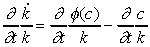 (3.24)
The first term on the right-hand side of (3.24) represents the
time rate of change of the growth rate of human capital per capita
while the second term on the right-hand side of (3.24) represents
the time rate of change of the growth rate of physical capital
per capita (see the appendix). Because no explicit solution can
be found for the differential equation system (3.8) and (3.21),
the time path of the growth rate of capital per capita and income
per capita is analysed by means of a numerical solution (section
3.2).
Asymptotic range
The linear growth model with productive consumption does not possess
a balanced growth equilibrium defined by constant growth rates.
However, its asymptotic properties are characterised by the asymptotic
balanced growth path ( ). Inside the interior
of the control region, the optimal trajectory asymptotically converges
to this
). Inside the interior
of the control region, the optimal trajectory asymptotically converges
to this  , along which the growth rates
of all endogenous variables are identical and constant. In order
to get an idea of the asymptotic behaviour of the extended linear
growth model, consider the growth rate of capital per capita as
time approaches infinity and consumption per capita as well as
capital per capita grow without bounds:
, along which the growth rates
of all endogenous variables are identical and constant. In order
to get an idea of the asymptotic behaviour of the extended linear
growth model, consider the growth rate of capital per capita as
time approaches infinity and consumption per capita as well as
capital per capita grow without bounds:
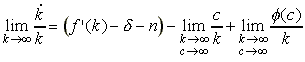 (3.25).
The last term on the right-hand side of (3.25) eventually vanishes
[see equation (5.7) in the appendix]. With respect to the relation
between the asymptotic growth rate of consumption per capita ( )
and the asymptotic growth rate of capital per capita (
)
and the asymptotic growth rate of capital per capita ( ),
three cases can be distinguished in principle: (a)
),
three cases can be distinguished in principle: (a)  ,
(b)
,
(b)  , and (c)
  .
.
In the case of (a), equation (3.25) implies an asymptotic growth
rate of capital per capita equal to  .
However, this would violate a necessary optimum condition, the
transversality condition (stated in footnote 46). In case (b),
equation (3.25) formally implies that the growth rate of capital
per capita tends to minus infinity. In fact, in this case the
trajectory would hit the boundary of the admissible control set
and would subsequently run into the poverty-trap. This can obviously
not be optimal as well. The only remaining possibility is case
(c) with
.
However, this would violate a necessary optimum condition, the
transversality condition (stated in footnote 46). In case (b),
equation (3.25) formally implies that the growth rate of capital
per capita tends to minus infinity. In fact, in this case the
trajectory would hit the boundary of the admissible control set
and would subsequently run into the poverty-trap. This can obviously
not be optimal as well. The only remaining possibility is case
(c) with  , that is the asymptotic growth
path is characterised by identical growth rates of consumption
per capita and capital per capita. Taking into account the disappearance
of the elasticity of the marginal ncc as time approaches
infinity, equation (3.21) shows the asymptotic growth rate of
per capita consumption. The relation
, that is the asymptotic growth
path is characterised by identical growth rates of consumption
per capita and capital per capita. Taking into account the disappearance
of the elasticity of the marginal ncc as time approaches
infinity, equation (3.21) shows the asymptotic growth rate of
per capita consumption. The relation  together with the production function (3.3) imply that all endogenous
variables, that is consumption per capita, capital per capita,
and income per capita, asymptotically grow with the same growth
rate:
together with the production function (3.3) imply that all endogenous
variables, that is consumption per capita, capital per capita,
and income per capita, asymptotically grow with the same growth
rate: . (3.26)
Finally, figure 1 sketches the phase diagram of the extended linear
growth model. The two rays starting from the origin represent
the production function and the asymptotic balanced growth path
( ), respectively. The curve starting from
the origin, running through the second quadrant, crossing the
ordinate, and entering the first quadrant represents the
), respectively. The curve starting from
the origin, running through the second quadrant, crossing the
ordinate, and entering the first quadrant represents the  -locus.
The horizontal broken line marks the level of per capita consumption
for which the marginal human-capital-enhancement-effect of consumption
equals one. The region below this line necessarily belongs to
the no-saving range and the dynamics of the system is governed
by (3.18) and
-locus.
The horizontal broken line marks the level of per capita consumption
for which the marginal human-capital-enhancement-effect of consumption
equals one. The region below this line necessarily belongs to
the no-saving range and the dynamics of the system is governed
by (3.18) and  . Starting with an initial
stock of capital per capita
. Starting with an initial
stock of capital per capita  , which is
chosen sufficiently small to give rise to a boundary solution
at the starting point, the corresponding level of consumption
per capita
, which is
chosen sufficiently small to give rise to a boundary solution
at the starting point, the corresponding level of consumption
per capita  is located on the boundary
of the control set. The optimal trajectory (equilibrium growth
path,
is located on the boundary
of the control set. The optimal trajectory (equilibrium growth
path,  ) moves along the production function
north-east and enters into the interior of the control region
as soon as the marginal utility of consumption equals the marginal
ncc measured in units of utility. However, if this "critical
point" is located north-east in relation to the poverty-trap
coordinates (
) moves along the production function
north-east and enters into the interior of the control region
as soon as the marginal utility of consumption equals the marginal
ncc measured in units of utility. However, if this "critical
point" is located north-east in relation to the poverty-trap
coordinates ( ), the economy would run
into a poverty-trap. Provided that the poverty-trap did not become
binding, the
), the economy would run
into a poverty-trap. Provided that the poverty-trap did not become
binding, the  enters into the interior
of the control region and converges to the
enters into the interior
of the control region and converges to the  (which equals the
  of the linear model)
as time approaches infinity.
of the linear model)
as time approaches infinity.
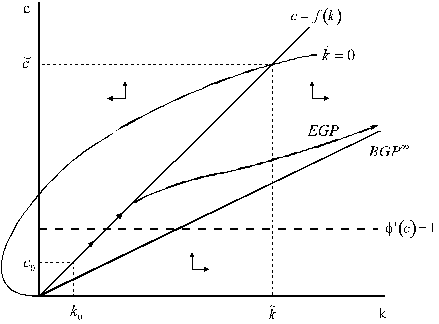 Figure 1: Phase diagram of the linear
growth model with productive consumption
Figure 1: Phase diagram of the linear
growth model with productive consumption
- Simulation results
In order to illustrate the dynamics of the model, the transition
process for an interior solution is simulated. That is, the system
of differential equations (3.8) and (3.21) is approximated numerically
by use of the subroutine NDSolve of Mathematica. The following
functions and parameter values are employed: 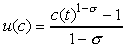 ,
,
 ,
,  ,
,  ,
,
 ,
,  ,
,  ,
,
 , and
, and  (
( ).
).
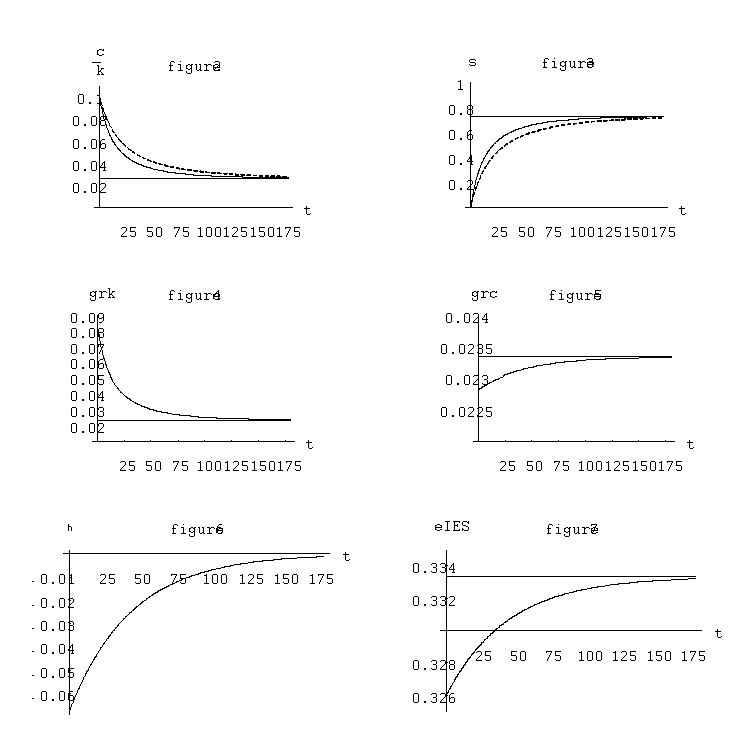
The figures 2 to 7 show the time path of the consumption/capital
ratio ( , the saving rate (
 ),
the growth rate of capital per capita (
),
the growth rate of capital per capita ( ),
the growth rate of consumption per capita (
),
the growth rate of consumption per capita ( ),
the elasticity of the marginal ncc (
),
the elasticity of the marginal ncc ( ),
and the effective intertemporal elasticity of substitution (eIES),
respectively. Several points are worth noting:
),
and the effective intertemporal elasticity of substitution (eIES),
respectively. Several points are worth noting:
First of all, all variables monotonically converge to their asymptotic
steady-state values. The speed of convergence measured by the
use of the consumption/capital ratio according to  is
is  . The broken line in figure 2 shows
the time path of the consumption/capital ratio for the case of
. The broken line in figure 2 shows
the time path of the consumption/capital ratio for the case of
 . The speed of convergence in this case
is
. The speed of convergence in this case
is  . Therefore, the speed of convergence
is inversely related to the efficiency of the human-capital-enhancement
process. The economic reasoning for this result is as follows:
The higher the marginal human-capital-enhancement effect of consumption
the stronger is the bias against saving. Consequently, because
the marginal human-capital-enhancement effect of consumption is
smaller than one for interior solutions the accumulation of (physical
and human) capital is smaller on balance.
. Therefore, the speed of convergence
is inversely related to the efficiency of the human-capital-enhancement
process. The economic reasoning for this result is as follows:
The higher the marginal human-capital-enhancement effect of consumption
the stronger is the bias against saving. Consequently, because
the marginal human-capital-enhancement effect of consumption is
smaller than one for interior solutions the accumulation of (physical
and human) capital is smaller on balance.
Second, Rebelo (1992) argues that an important shortcoming of
a "broad class of endogenous growth models" is that
they cannot explain different growth experiences in the presence
of international capital markets. Provided that some symmetry
with respect to technology and preferences holds, all economies
face the same real rate of return and, consequently, exhibit the
same rate of growth of per capita income. After discussing several
extensions of the basic linear growth model, Rebelo concludes:
"In summary, with the exception of taxation under the
worldwide system, the mechanisms described [...] do not survive
as sources of growth differentials in the presence of international
capital markets." The linear growth model with productive
consumption shows transitional dynamics which survive international
capital markets and identical real rates of return.
Third, as figure 3 demonstrates the (gross) saving rate increases
from zero at the beginning of the transition and converges to
its asymptotic balanced growth value. The solid line is based
on  while the broken line is based on
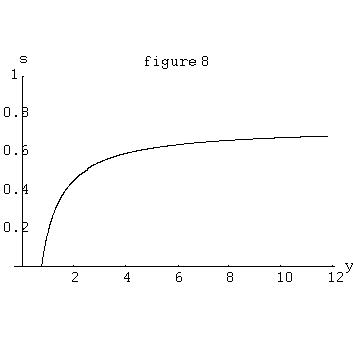
 . The rising time path of the saving rate
in turn implies a positive correlation between the saving rate
and per capita income as figure 8 demonstrates; based on
. The rising time path of the saving rate
in turn implies a positive correlation between the saving rate
and per capita income as figure 8 demonstrates; based on  :
:
The empirical evidence for a positive correlation between the
saving rate and the level of per capita income is overwhelming.
As an illustration of the cross-country result consider the following
table:
| Group of Countries
(number of countries)
| GNP per equivalent adult in 1985 $; 1980-87 average
| Personal Saving as a percent of GDP a
|
| Low-income-countries (16)
| 1,324.4 | 11.2
|
| Lower middle-income countries (16)
| 2,805.8 | 17.1
|
| Upper middle-income countries (11)
| 6,165.5 | 19.5
|
| High-income countries (15)
| 12,292.9 | 21.1
|
Table 1: Personal saving rates and GNP per capita;
classification of economies according to World Bank (1994).
Source: Ogaki, Ostry, and Reinhart (1996), p. 44/45.
a With a few
exceptions 1985-1993 averages; for details see Ogaki, Ostry, and
Reinhart (1996).
Table 1 shows a clearly positive relation between the saving rate
and the level of per capita income, with the largest increase
in the saving rate occurring with the transition from low-income
to lower middle-income countries. Obviously, the relation between
the saving rate and the level of per capita income is non-linear
which is in line with figure 8.
Fourth, the growth rate of capital per capita and thus income
per capita decreases during the transition process (figure 4).
This result is somewhat surprising. Intuitively, a rising saving
rate induces two effects on the growth rate of capital: (a) As
time proceeds a rising portion of output per capita (saving rate)
is used for gross physical capital investment, and (b) a falling
portion of output per capita (consumption rate) can be used for
gross human-capital-enhancements due to productive consumption.
As the marginal human-capital-enhancement-effect of consumption
is smaller than one for interior solutions, one would at first
glance expect that effect (a) dominates effect (b). However, as
(3.24) indicates the crucial point is whether the time rate of
change of the human capital component exceeds the time rate of
change of the physical capital component. Obviously, figure 4
shows that in the present case the time rate of change of the
human capital component dominates the time rate of change of the
physical capital component. That is, the model implies (conditional)
ß-convergence as well as a rising saving rate.
Fifth, figure 6 shows the elasticity of the marginal ncc,
which is negative and asymptotically converges to zero. As a consequence,
the eIES is low at early stages of economic development,
increases and asymptotically approaches a constant (figure 7).
Note that for boundary solutions the IES is effectively
zero [see equation (3.19)]. Several authors have reported empirical
evidence in favour of IES-values which do not significantly
differ from zero in the case of low-income countries [Giovannini
(1985)] as well as empirical evidence in favour of a positive
relation between the IES and per capita income [Atkeson
and Ogaki (1996) and Ogaki, Ostry, and Reinhart (1996)]. The present
model implies a rising eIES during the transition due to
the technological possibilities to enhance the stock of human
capital as a result of productive consumption. From this one can
explain, for example, the negligible effects of financial liberalisation
measures with the objective to increase the real interest rate,
encourage savings and foster economic growth in the case of low-income
countries.
Sixth, King and Rebelo (1993) express very clearly a well-known
quantitative problem of the neoclassical growth model: "Generally,
when one tries to explain sustained economic growth with transitional
dynamics, there are extremely counterfactual implications. These
result from the fact that implied marginal products are extraordinarily
high in the early stages of development". The extended
linear growth model with productive consumption does not bear
this implication. Sustained economic growth with transitional
dynamics is compatible with a constant marginal product of the
reproducible factors.
Finally, the subsequent figure 9 shows the share of human capital
to overall capital, labelled the human capital share (hcs).
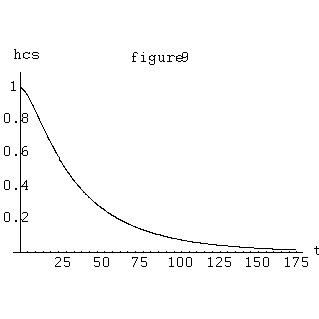
The declining time path of the hcs illustrates the major
importance of human capital which is exclusively accumulated as
a result of productive consumption at early stages of development.
On the other hand, the relative importance of human capital eventually
vanishes as the economy develops.
- Summary and Conclusion
Empirical evidence clearly indicates that productive inputs are
not exclusively accumulated as a result of the renunciation of
consumption. Especially at early stages of economic development,
consumption can in a specific sense be regarded as a source of
the accumulation of a productive input (human capital) and thus
output growth. The model presented above sheds some light on the
importance and implications of productive consumption, capital
accumulation, and growth in DCs. Specifically, the incorporation
of the productive consumption hypothesis into a simple endogenous
growth model reveals the following implications:
- The "harsh" intertemporal consumption trade-off
traditionally assumed is modified. More concrete, the time rate
of change of the marginal net cost of consumption has to
be taken into account for selecting the optimal consumption path.
The optimal rule of consumption turns into a modified Keynes-Ramsey
rule.
- The intertemporal elasticity of substitution is no
longer exclusively based on the instantaneous utility function.
The technological opportunities for enhancing the stock of human
capital as a result of productive consumption additionally determine
the effective IES (eIES). Consequently, the eIES
consists in the marginal elasticity of utility as well as
the elasticity of the marginal net cost of consumption.
- As Gersovitz (1983) has demonstrated within the framework
of discrete two-period models, the saving rate increases with
income if consumption is productive. In contrast to Gersovitz,
this is shown within the framework of a continuous growth model
and no special parameter restrictions are necessary for this result.
- Different growth experiences are explained as a result of
transitional dynamics to an asymptotic balanced growth equilibrium.
The speed of convergence is inversely related to the efficiency
of the human-capital-enhancement process. The model does not imply
unrealistically high values of the marginal product of reproducible
factors for low incomes as all versions of the neoclassical growth
model [see King and Rebelo (1993)]. Neither are identical real
rates of return across economies due to international capital
markets inconsistent with diverging growth rates for different
countries [see Rebelo (1992)].
Generally, there are two theoretical possibilities to explain
different growth experiences. According to the first strand of
models, the empirical data are interpreted to represent a balanced
growth phenomenon and, consequently, these models show the possibilities
of multiple balanced growth paths [e.g. Azariadis and Drazen (1990)].
The second strand of models interprets the empirical picture as
representing a transition phenomenon and emphasises the importance
of transition processes [e.g. Romer (1986)]. The model presented
in this paper is assigned to the second direction. In addition,
with the exception of the poverty-trap it does not possess a balanced
growth equilibrium. However, it possesses an asymptotic balanced
growth equilibrium [see Jones and Manuelli (1990)].
- Appendix
Human-capital-enhancement-functions with
constant 
The elasticity of the marginal ncc is defined as follows:
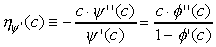 . (5.1)
The class of human-capital-enhancement-functions which imply a
constant elasticity of the marginal ncc is derived as follows:
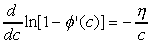 (5.2)
(5.2)
 (5.3)
(5.3)
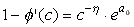 (5.4)
(5.4)
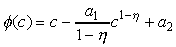 where
where  (5.5)
(5.5)
Asymptotic saving rate
The gross saving rate as traditionally defined reads:
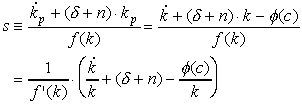 . (5.6)
From the properties of the human-capital-enhancement-function
and L'Hôpital's rule, it follows that the last term on the
right-hand side asymptotically vanishes:
 . (5.7)
Both  and
and  must
be positive and, consequently, (5.7) implies that their ratio
vanishes as time approaches infinity. Equation (3.26) shows that
the growth rate of capital per capita and consumption per capita
are asymptotically identical and constant. Given the set of equations
(5.6), (5.7), and (3.26) it can be shown that the asymptotic saving
rate equals [see Barro and Sala-i-Martin (1995), S. 142/143]:
must
be positive and, consequently, (5.7) implies that their ratio
vanishes as time approaches infinity. Equation (3.26) shows that
the growth rate of capital per capita and consumption per capita
are asymptotically identical and constant. Given the set of equations
(5.6), (5.7), and (3.26) it can be shown that the asymptotic saving
rate equals [see Barro and Sala-i-Martin (1995), S. 142/143]:
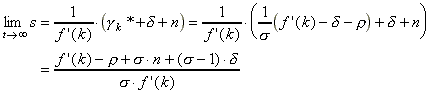 . (5.8)
The steady-state saving rate of the linear growth model with productive
consumption is constant and equals the saving rate of the original
linear growth model.
Growth rate of capital per capita
The growth rate of capital per capita according to (3.8) is
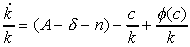 , (5.9)
and its time derivative reads
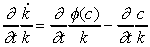 . (5.10)
The growth rate of capital per capita can likewise be expressed
as a weighted sum of the growth rates of physical and human capital:
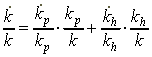 . (5.11)
The first term in (5.10) is closely related to the time rate of
change of human capital
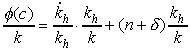 , (5.12)
while the second term in (5.10) is closely related to the time
rate of change of physical capital
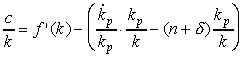 . (5.13)
- References
Aghevli, Bijan B., James M. Boughton, Peter J. Montiel,
Delano Villanueva and George Woglom (1990), The
Role of National Saving in the World Economy - Recent Trends and
Prospects, IMF Occasional Paper No. 67, Washington.
Atkeson, Andrew and Masao Ogaki (1996), Wealth-Varying
Intertemporal Elasticities of Substitution: Evidence from Panel
and Aggregate Data, Journal of Monetary Economics, Vol. 38, 507-534.
Azariadis, Costas (1996), The Economics of Poverty Traps,
Part One: Complete Markets, Journal of Economic Growth, December,
449-486.
Azariadis, Costas and Allan Drazen (1990), Threshold
Externalities in Economic Development, Quarterly Journal of Economics
105 (May), 501-526.
Barro, Robert. J. (1990), Government Spending in a Simple
Model of Endogenous Growth, Journal of Political Economy, Vol.
98, No. 5, Pt. 2, S103-S125.
Barro, Robert J. (1991), Economic Growth in a Cross Section
of Countries, Quarterly Journal of Economics, 106, 2 (May), 407-443.
Barro, Robert J. and Xavier Sala-i-Martin (1995),
Economic Growth, McGraw-Hill, New York.
Becker, Gary S. and Kevin M. Murphy (1988), A Theory
of Rational Adiction, Journal of Political Economy, Vol. 96, 675-700.
Ben-David, Dan (1996), Convergence Clubs and Diverging
Economies, CEPR Discussion Papers No. 922.
Blaug, Mark (1987), Productive and Unproductive Consumption,
The New Palgrave: A Dictionary of Economics, J. Eatwell, M. Milgate,
P. Newman (eds.), The Macmillan Press, New York, 1007-1008.
Bliss, Christopher and Nicholas Stern (1978), Productivity,
Wages and Nutrition: Part I: The Theory + Part II: Some Observations,
Journal of Development Economics 5, 331-398.
Cass, David (1965), Optimum Growth in an Aggregative Model
of Capital Accumulation, Review of Economic Studies 32, July,
233-240.
Deolalikar, Anil B. (1988), Nutrition and Labor Productivity
in Agriculture: Estimates for Rural South India, The Review of
Economics & Statistics, 60, 406-413.
Dorfman, Robert (1969), An Economic Interpretation of Optimal
Control Theory, American Economic Review, Vol. 59, No. 5, 817-831.
Easterly, William (1994), Economic Stagnation, Fixed Factors,
and Policy Thresholds, Journal of Monetary Economics, Vol. 33,
525-557.
Feichtinger, Gustav and Richard F. Hartl (1986),
Optimale Kontrolle ökonomischer Prozesse: Anwendung des Maximumprinzips
in den Wirtschaftswissenschaften, de Gruyter, Berlin, New York.
Fisher, Irving (1907), The Rate of Interest, Macmillan,
New York.
Fogel, Robert W. (1994), Economic Growth, Population Theory,
and Physiology: The Bearing of Long-Term Processes on the Making
of Economic Policy, American Economic Review, Vol. 84, 369-395.
Gersovitz, Mark (1983), Savings and Nutrition at Low Incomes,
Journal of Political Economy Vol. 91, No. 5, 841-55.
Gersovitz, Mark (1988), Saving and Development, Handbook
of Development Economics, Volume I, H. Chenery and T.N. Srinivasan
(eds.) Elsevier Science Publishers, 382-424.
Giovannini, Alberto (1985), Saving and the Real Interest
Rate in LDCs, Journal of Development Economics, Vol. 18, 197-217.
Hicks, Norman (1979), Growth vs. Basic Needs: Is there
a Trade-Off?, World Development , Vol. 7, Nov./Dec., 985-994.
Jones, Larry E. and Rodolfo E. Manuelli (1990),
A Convex Model of Equilibrium Growth: Theory and Policy Implications,
Journal of Political Economy, Vol. 98, No. 5, 1008-1038.
Jones, Larry E. and Rodolfo E. Manuelli (1997),
The Sources of Growth, Journal of Economic Dynamics and Control,
Vol. 21, 75-114.
Kamien, Morton I. and Nancy L. Schwartz (1991),
Dynamic Optimization, The Calculus of Variations and Optimal Control
in Economics and Management, second edition, Amsterdam, North-Holland.
King, Robert G. and Sergio Rebelo (1993), Transitional
Dynamics and Economic Growth in the Neoclassical Model, American
Economic Review, Vol. 83 (4), September, 908-931.
Koopmans, Tjalling C. (1965), On the Concept of Optimal
Economic Growth, in: The Econometric Approach to Development Planning,
North-Holland Publ. Co. and Rand-McNally, 1966 reissue of Pontificiae
Academia Scientiarum Scripta Varia, Vol. 28, 225-300.
Ladrón-de-Guevara, Antonio, Salvador Ortigueira,
and Manuel S. Santos (1997), Equilibrium Dynamics in Two-Sector
Models of Endogenous Growth, Journal of Economic Dynamics and
Control, Vol. 21, 115-143.
Lazear, Edward (1977), Education: Consumption or Production?,
Journal of Political Economy, Vol. 85, No. 3, 569-597.
Leibenstein, H. A. (1957), Economic Backwardness and Economic
Growth, New York, Wiley.
Lucas, Robert E. Jr. (1988), On the Mechanics of Economic
Development, Journal of Monetary Economics, Vol. 22, 1988, 3-42.
Mikesell, Raymond F. and James E. Zinser (1973),
The Nature of the Saving Function in Developing Countries: A Survey
of the Theoretical and Empirical Literature, Journal of Economic
Literature 11, 1-26.
Nelson, Richard R. (1956), A Theory of the Low-Level Equilibrium
Trap in Underdeveloped Economies, American Economic Review 46,
894-908.
Nurkse, Ragnar (1962), Problems of Capital Formation in
Underdeveloped Countries, Basil Blackwell, Oxford; first edition:
1953.
Obstfeld, Maurice (1990), Intertemporal Dependence, Impatience,
and Dynamics, Journal of Monetary Economics 26, 45-75.
Ogaki, Masao, Jonathan D. Ostry, and Carmen M. Reinhart
(1996), Saving Behaviour in Low- and Middle-Income Developing
Countries, A Comparison, IMF Staff Papers, Vol. 43, No. 1 (March),
38-71.
Ram, Rati and Theodore W. Schultz (1979), Life Span,
Health, Savings, and Productivity, Economic Development and Cultural
Change 27, 399-421.
Ramsey, Frank P. (1928), A Mathematical Theory of Saving,
Economic Journal 38, No. 152 (Dec.), 543-559. Reprinted in: Stiglitz,
Joseph E. and Hirofumi Uzawa (eds.), Readings in the Modern Theory
of Economic Growth, MIT Press, 1969.
Rebelo, Sergio (1991), Long-Run Policy Analysis and Long
Run Growth, Journal of Political Economy, Vol. 99, 500-521.
Rebelo, Sergio (1992), Growth in Open Economies, Carnegie
Rochester Conference Series on Public Policy, Vol. 36 (July),
5-46.
Reichel, Richard (1993), Die Sparquote in Entwicklungs-
und Schwellenländern, Determinanten und Möglichkeiten
der wirtschaftspolitischen Beeinflussung, Verlag Paul Haupt, Bern.
Romer, David (1996), Advanced Macroeconomics, McGraw-Hill,
New York et. al.
Romer, Paul M. (1986), Increasing Returns and Long-Run
Growth, Journal of Political Economy, Vol. 94, No. 6, p. 1002-1037.
Romer, Paul M. (1990), Endogenous Technological Change,
Journal of Political Economy, Vol. 98, 71-102.
Rosenzweig, Mark R. (1988), Labor Markets in Low-Income
Countries, Handbook of Development Economics, Volume I, H. Chenery
and T.N. Srinivasan (eds.), Elsevier Science Publishers, 714-762.
Sarel, Michael (1994), On the Dynamics of Economic Growth,
IMF Working Paper 138.
Solow, Robert M. (1956), A Contribution to the Theory of
Economic Growth, Quarterly Journal of Economics, Vol. 70, 65-94.
Stiglitz, Joseph (1976), The Efficiency Wage Hypothesis,
Surplus Labour, and the Distribution of Income in LDCs, Oxford
Economic Papers, July, 28, 185-207.
Strauss, John (1986), Does Better Nutrition Raise Farm
Productivity?, Journal of Political Economy, Vol. 94, No. 2, 297-320.
Swan, Trevor W. (1956), Economic Growth and Capital Accumulation,
Economic Record 32, November, 334-361.
Thirlwall, A. P. (1974), Inflation, Saving and Growth in
Developing Economies, St. Martin's Press, New York.
Wheeler, David (1980), Basic Needs Fulfilment and Economic
Growth: A Simultaneous Model, Journal of Development Economics
7, 435-451.
Wichmann, Thorsten (1995), Food Consumption and Growth
in a Two Sector Economy, Discussion Paper 1996/02, Technical University
Berlin.
Winslow, Charles-Edward A. (1951), The Cost of Sickness
and Health, Genf.
Wolgenmuth, June C., Michael C. Latham, Andrew Hall,
Andrew Chesher and C. W. T. Crompton (1982), Worker
Productivity and the Nutritional Status of Keynian Road Construction
Labourer, American Journal of Clinical Nutrition 36, 68-78.
World Bank (1990), World Development Report 1990: Poverty,
Oxford University Press, New York.
World Bank (1994), World Development Report 1994: Infrastructure
for Development, Oxford University Press, New York.
Yellen, Janet L. (1984), Efficiency Wage Models of Unemployment,
American Economic Review Papers and Proceedings, Vol. 74, No.
2, 200-205.
Zee, Howell H. (1994), Endogenous Time Preference and Endogenous
Growth, IMF Working Paper.
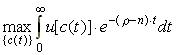

 ,
, 
 , (3.9)