13.11.2002
---------------------------------------------------------------
The author of this note takes it as self evident that prosperity and the provision of "things" (buildings, roads, furniture, furnishings, clothes, machines and equipment of all sorts) go together. Any statement that any region or time is "more prosperous" than another, but uses and enjoys fewer "things", would simply be a contradiction in terms. Ranking countries by GDP per head would give the same result as ranking by "things" per head.
This view, if stated flatly as above, is not observably unusual or controversial. The way people generally speak and act is in line with it. A rich nation is one with splendid buildings, large houses, good roads, large and numerous cars, well-dressed people, and so on. A rich man is generally visibly rich.
If UK and European prosperity continues to exhibit positive real growth on average into the foreseeable future, then there must be a corresponding growth in the use and enjoyment of "things". Thus manufacturing (as well as agriculture, energy provision, and "industry" in general) must also correspondingly grow, subject to the proviso that the necessary "things" are not produced, and imported from, elsewhere.
At this point, it is probably true to say that any audience becomes restive. First, most people are persuaded that domestic manufacturing is in terminal decline, and second, they feel that the proviso regarding imports is a very big proviso indeed. During our lifetimes, we have seen major industries (shipbuilding, cotton textiles, coal mining) evaporate seemingly overnight, landscapes and industrial towns blighted, avalanches of imported goods marked as being made, first in Hong Kong and Japan, and then in nearly every developing country, most lately China. Almost daily, one may read of British manufacturing jobs being "exported" to the Far East. Often, it is argued by serious and well-informed people that this supposed trend towards the extinction of domestic manufacturing is not really a matter for concern.
However, it is simply impossible to import goods without a more or less balancing volume of exports, and, while journalists may talk glibly of exporting services (mainly transport and tourism) rather than, and in exchange for, goods, there is in reality limited scope for this. Thus, while there may be an observable growth in foreign goods in our shops, they must largely be paid for by a growth in the export of domestically produced goods.
How can a perception of decline be reconciled with a reality of growth? The answer is technical advance. More and more "things" can be, and are being, produced by fewer and fewer workers. Our fields are deserted, but produce more food than ever. Our working factories are not yet deserted, but the trend is that way. When journalists (and academics too, unfortunately) write of the "decline" of manufacturing (see footnote), they are really writing of the decline of manufacturing employment, and, since any sector's contribution to GDP is the aggregate income or remuneration of the resources devoted to that sector, this decline automatically mirrors a decline in the fraction of GDP attributable to manufacturing. The decline is thus not an illusion. It is real. But to the general run of commentators, it seems to render invisible that there is an accompanying reality of a growth in the output of "things" or goods which by and large keeps pace with the growth of GDP. In other words, the rate of loss of manpower is more than counterbalanced by the rate of rise of productivity.
The rest of this note summarises the statistical evidence for the accuracy of this view.
When the author of this note began several years ago to think about this subject, he more or less took as read the statistical basis for the growth of manufacturing output. This was due to the monthly publication of tables in the Financial Times (seemingly seldom read by the FT's own journalists) giving "industrial production" indices for the six leading countries. This showed that relative to 1984, the US had increased industrial production by 70% by 2000, the European countries by 30-45% (with the UK comfortably in the middle), and Japan by 25%, despite the universal decline of employment in this sector.
It was only in doing the work for this note that it became apparent that these numbers were new to national statistics around the late eighties, and that the methodology for producing them is neither straightforward nor completely agreed. The thirty or so members of the OECD send their data to OECD headquarters, who publish regular summaries, but the most recent data used by the author, described as being "updated on a rolling basis", covers only 14 of those countries (Germany, France, Italy, UK, Denmark, Austria, Finland, Sweden, US, Japan, Czech Republic, Canada, Korea, Mexico), and as will be seen, is far from complete for these countries. The UK, for example, is one of two countries (the other being Canada) for which there are no entries at all under the heading of "manufacturing production (volume)", and the US, as another example, gives data for this parameter only from 1987 onwards.
The European Union also publishes annual summaries of statistical data, including a measure of industrial (not specifically manufacturing) volume production, from 1960 onwards, for all 15 member countries (Germany, France, Italy, UK, Denmark, Austria, Finland, Sweden, Belgium, Netherlands, Ireland, Greece, Spain, Portugal - Luxembourg is omitted) plus the United States and Japan. The fact that the UK is included in this, when its data for the OECD is defective, will be the subject of later comment.
All of the data described has been used, and will be presented here, albeit in very condensed form.
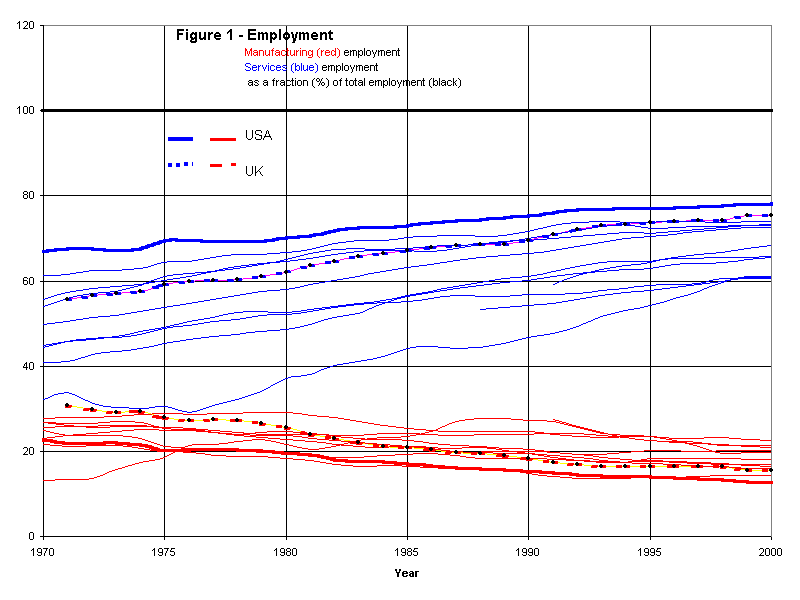
The OECD data show (Figure 1) that the proportion of employment in manufacturing is diminishing in all 14 countries except Korea, where the decline did not start till 1990, and possibly Italy, around 1980. In Korea, both manufacturing and services increased their employment till 1990, presumably by drawing workers from the land.
The statistical evidence for the growth of industrial, including manufacturing, output is universal, unambiguous and overwhelming. According to EU (European Union) data, domestic industrial production in volume terms of the 15 members, taken together, has more than tripled since 1960. The factor is in fact 3.5. This compares with 4 for the US and 8 for Japan. Nor is there evidence of a tailing off in recent years. Nearly all OECD countries increased industrial and manufacturing output by around 25% in the five years 1995-2000. In early 2001, a downturn began, but such downturns are not rare in the historical record - a year or two cannot be taken as setting a trend.
In the author's view, the mere fact of growth of the output of goods (rather than the "decline" often depicted) is not surprising. But his position goes further - that this growth in production is more or less identical with the growth of prosperity. That is, if GDP per head is a good measure of prosperity, the production of "things" should not only grow, but should more or less stay in step with the increase in GDP per head. The two measures should be more or less interchangeable.
The calculations of GDP and of industrial production are two very different things - both involve skilled but nevertheless arbitrary, and in the two cases, different, procedural decisions - and it is not to be expected that the statistical evidence could ever show an exact correspondence. Figure 2 tries to present a huge amount of data in one figure. It shows the European Union data for indices of industrial production by volume for 16 countries, as a ratio of the corresponding indices for GDP. If industrial production kept exact pace with GDP, these curves would all be a single horizontal straight line at 100 on the vertical axis. Evidently, they are not, but if industrial production had any systematic tendency to fall behind as prosperity rose, those curves would in this conglomerate picture (which it should be remembered covers a span of 40 years) show a downward sloping pattern from left to right. In fact, its tendency is neither up nor down.
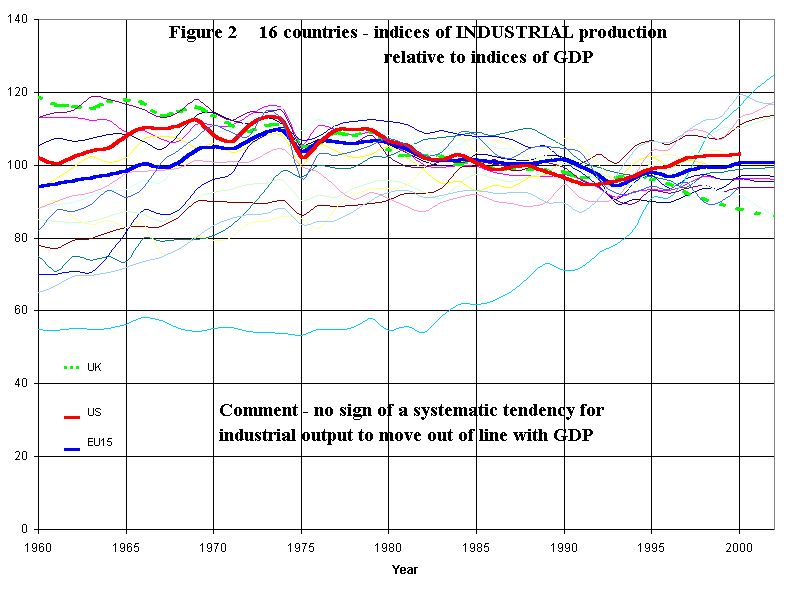
There is some variation between countries. The lowest curve, which is markedly out of line, represents Ireland. When aggregated the result is of course towards the inner region of the cloud of curves. The heavy blue line represents the European Union as a whole. The heavy red curve is for the US.
This figure is a rather strong indication that industrial output will not only increase with prosperity, it will more or less keep pace with it.
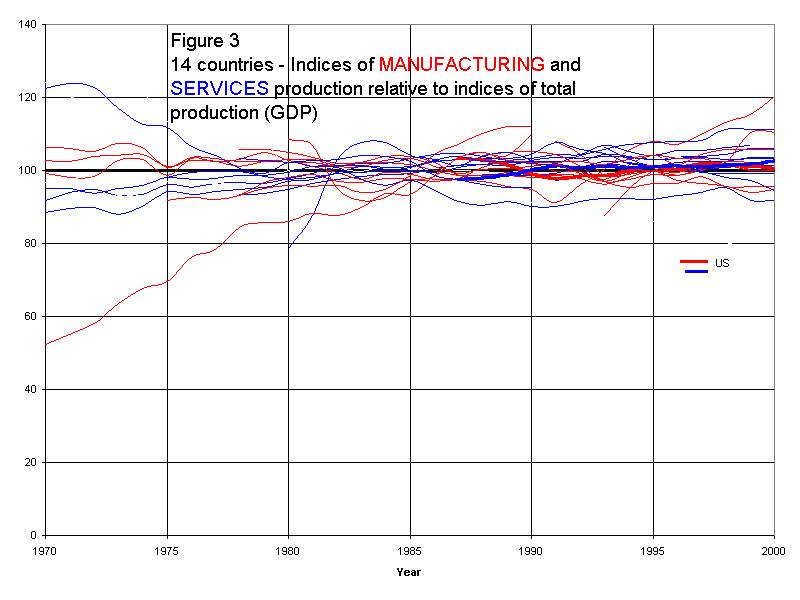
Figure 3 is a similar figure constructed from OECD data, this time for indices of manufacturing (as opposed to industrial) and services output by volume, divided by indices of GDP. As indicated above, the data is visibly incomplete. Of the 14 countries in the OECD dataset, only four present data back to 1970. The UK and Canada have no data at all under the headings of manufacturing or services output by volume. The markedly outlying curves belong to Korea. As with the industrial production data, there is no evidence here of any systematic departure from a general tendency of manufacturing to follow GDP fairly closely.
What has been shown above would in a logical context be enough to confirm that there is no possibility that domestic manufacturing will lose ground to "third world" manufacturing. If domestic manufacturing is not losing ground to the service industries in terms of output, then clearly the common newspaper story of a future in which manufacture is progressively displaced to the far east, to be paid for by our services, cannot have substance. However, it will be reassuring to check this against the statistical evidence.
In the statistics, it is the general practice to specify the "trade" in goods and services, and the current account balance. The latter is the net export surplus in this trade, plus net current financial income. Since the books must always balance, the current account balance has an equal and opposite counterpart, made up largely of loans, the sale or purchase of equities, and direct foreign investment.
Figure 4 shows for eight countries of the European Union (UK, Germany, Italy, France, Netherlands, Finland, Denmark, Ireland) the fraction of exports which is made up of goods (the remainder being services). These plots are shown in blue. The heavy blue line represents a weighted average for the entire European Union. It can be seen that, first, the fraction is very high, around 80%, and second, that it shows little sign of varying over a period of 40 years. Certainly it is not trending downwards, as would be required by the story of increasing reliance for manufactures on cheaper foreign countries If anything, it seems to be edging upwards.
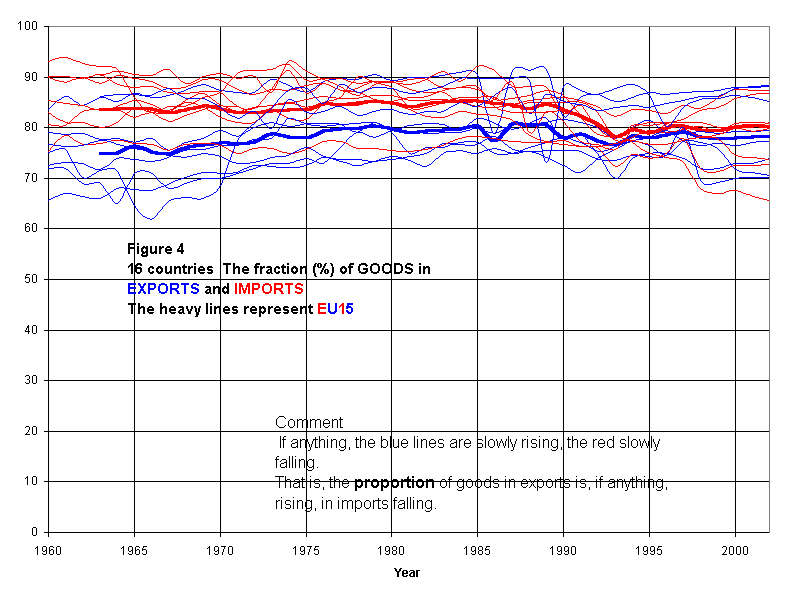
The curves in red are the corresponding data for imports. According to the media story, imports should show an increasing proportion of goods. That is, the red lines should trend upwards. There is no sign of this.
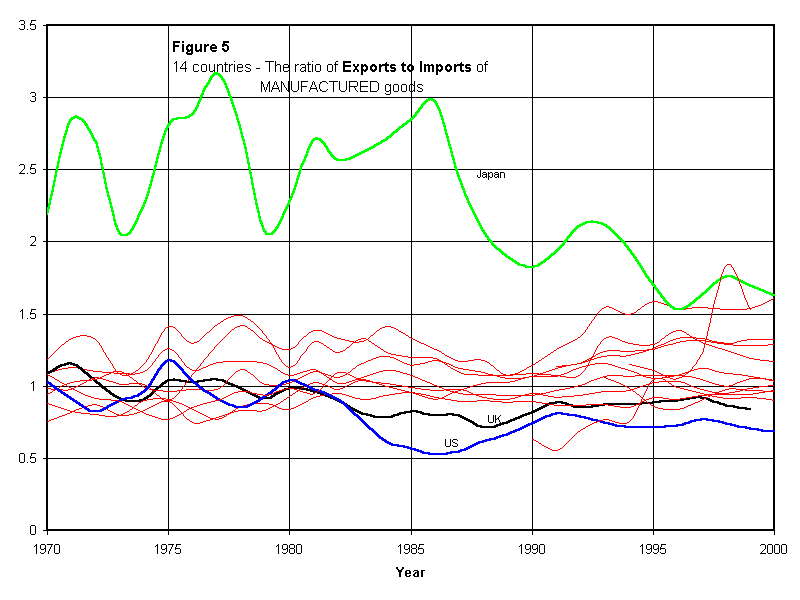
The OECD data allows the narrowing of the category "goods" to that of "manufactures", but there is no information on trade in services, and data is hardly ever given for the complete period of 30 years (from 1970). Figure 5 therefore shows the ratio of exported manufactured goods to imported manufactured goods. Fourteen countries are represented - the US and Japan, eight EU countries, Mexico, the Czech Republic, Korea and Canada. The wildly out-of-line curve refers to Japan. Overall, there is a marked tendency for the data to be consistently in the region of unity, i.e., for exports of manufactured goods to be balanced by the same volume of imported manufactured goods. The United States gives the curve which touches the lowest point, but first, the tendency is to a significant extent reversed, and second, it is well known that the US trade deficit is largely paid for, not by services, but by incoming foreign investment in bonds and equities, much of it from Japan with dollars earned in line with the uppermost curve.
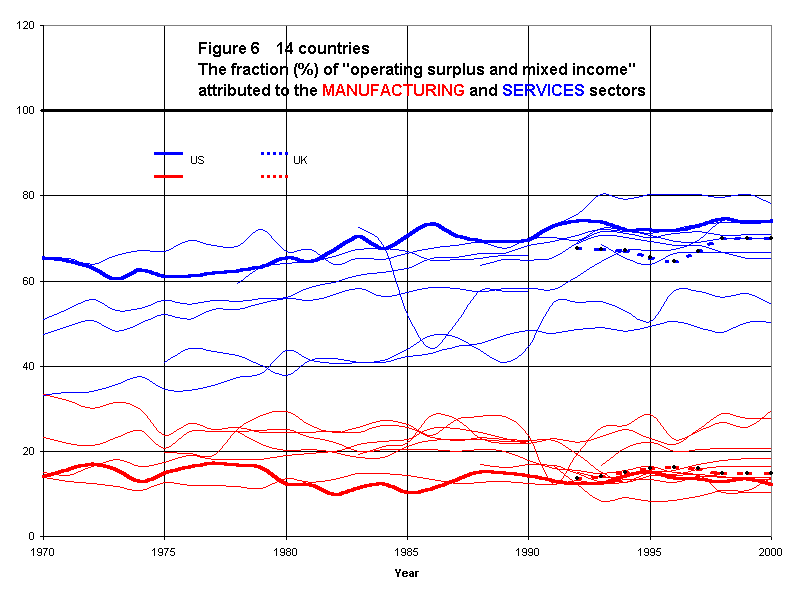
The profitability of manufacturing is not really relevant to output, which is the topic of this note, but Figure 6 is perhaps an interesting and thought-provoking commentary on the persistence both of manufacturing and of national cultures. It shows the fraction of the national "operating surplus and mixed income" which is attributable to the manufacturing and the services sectors (the remainder of the economy being construction, mining, agriculture, etc.). The pattern over time is remarkably consistent. The US has about the lowest fraction attributable to manufacturing, but this is not because it is the advance signaller of a trend, but a seemingly constant feature over 30 years. For other countries, too, there is a tendency towards constancy. The apparently good (and rather puzzling) news for manufacturers is that this fraction does seem to maintain its level, in spite of declining employment and (presumably) revenues.
If the above questions were pursued using only UK data, the task would be near impossible. Or rather, it would lead to conclusions, which can be seen in the overall context to be implausible. The ONS (Office of National Statistics) data for the "volume index of value added" by industrial production rises by a factor of 2 in the years 1960 to 2000. This would at least tend to confirm that industrial production is rising, and, moreover the rise is fairly steady over the whole period. But the GDP of the UK rose by a factor of 2.6 during this time, so that a significant shortfall of industrial production relative to GDP is apparently indicated.
The data for UK industrial production which figures in the Eurostat (as opposed to the OECD) dataset used for Figure 2, is more or less identical with the ONS data (Eurostat have no independent system of data collection). The curve for the UK in Figure 2 is unusual in starting at the top left and proceeding directly to the bottom right of the conglomeration of data. In fact, of the 16 countries involved (including the US and Japan) the ratio of the indices of industrial production to GDP is lowest for the UK at 0.74, and indeed, only 4 countries have ratios less than unity (Belgium, France and Germany being the others).
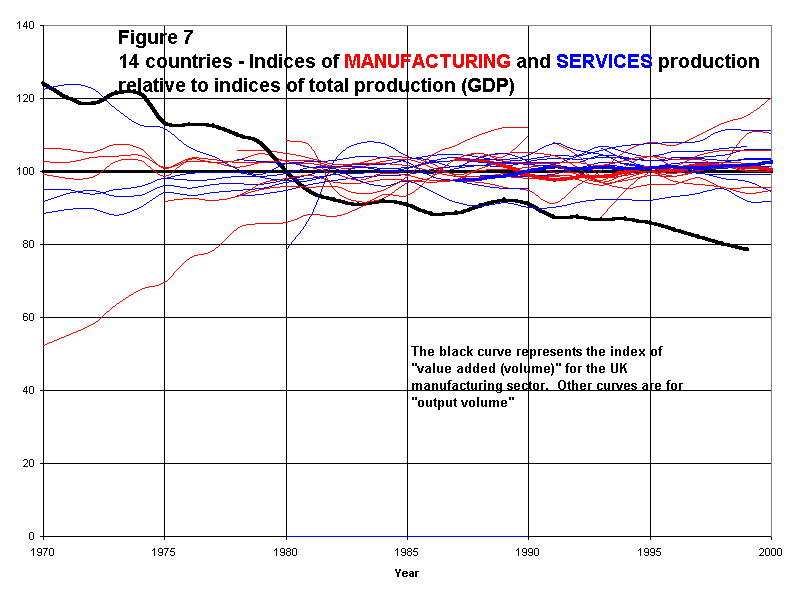
Although no proof can be offered, the author of this note feels that this "outlier" status of the UK may be bound up with the fact that the UK is one of the two countries for which no volume production data is present in the OECD dataset. The OECD classify the UK data as "value added (volume)". If this UK value added index for manufacturing, as listed by ONS and recorded by OECD, is added to Figure 3, where all the other data refers to a volume index of manufacturing output, the result is as shown in Figure 7. It is evident that among the data for 14 countries, it is totally anomalous. Even Korea, which in earlier years is equally out of line, has its data heading in the opposite direction, i.e., that of increasing manufacturing presence. These observations would tend to indicate that the UK index for value added (volume) is not an adequate measure of volume output
The problem with value added data for the present purpose is precisely its advantage as seen by statisticians who assemble national data on GDP. They regard GDP as being the aggregate of all value added. This means that each firm, each employee, must be identified as being engaged in a given sector, sub-sector and sub-sub-sector. Thus, the value added in the manufacturing sector is effectively all the incomes of all the employees, creditors and owners of firms designated as being in that sector. The focus is on the identified people, not the goods. For the ONS, this is a guarantee that there is no double-counting. But in the real world there is a vast amount of double counting. Thus the OECD data show that in 1998, the UK manufacturing sector accounted for 19% of total value added (or of GDP), but for 51% in cost terms. This does not mean that half of GDP is accounted for by manufacturing, because, by the same token, services value added accounts for 71% of GDP, but for 123% of it in cost terms. More than half of the cost or price of a manufactured article, in other words, involves value added by services of all sorts, predominantly transport and retailing, while more than a third of the cost of services finds its way to non-service providers of all sorts. Another example of double counting is the fact that in the same year, exports of goods were valued at 19% of GDP, and yet only around a third of domestic production (8% of GDP by value-added standards) was exported. The ratios involved in those two examples are in the same region. The point which is being laboured here is that to measure the flow of goods, the measure must concentrate on the goods, not on an arbitrary categorisation of people. Presumably, the OECD measure, adopted apparently by the US only in 1987, and not yet adopted by UK statisticians, is designed to do this. A secretary may contribute to manufacture, just as a welder may contribute to services.
The conclusion must be that there is no trustworthy data on the real volume of UK manufacturing. It is certainly going up, and most likely at a rate indicated by other advanced countries. (It would be of interest to do a direct comparison of the UK with other countries using per capita data on, for example, cars, TV sets, square footage of housing and business premises, kilometres of roads, and so on. )
The US conforms extremely well to the notions expressed above. Its relationship to manufacture is exactly the same as that of other advanced countries, But it is several years ahead in its evolution. A look at Figure 1 shows that, 30 years ago, US employment in manufacture was at about the level shown by the most laggard of the 14 OECD countries today. Both Figure 2 (Eurostat industrial data) and Figure 3 (OECD manufacturing data) show that US industrial and manufacturing output keeps almost exact pace with GDP.
1) Based on historical trends, UK and European manufacturing is absolutely certain to exhibit positive real growth on average into the foreseeable future, unless the growth of GDP comes to a halt. Imports of goods will continue to grow, but there will continue to be a close match in the growth of exports of goods. In the light of this, popular stories concerning the export of jobs and the exit of manufacturing from advanced countries are misleading, perhaps to the point of absurdity.
2) The USA is a relevant model for predicting trends in UK and European manufacturing, so far as volumes of manufactured goods are concerned. Any visitor to the US can check with the unaided eye that high prosperity goes with an abundance of "things" of all sorts. The kinds of things must depend to some extent on national tastes and propensities.
The Financial Times of London has a deserved and uncontested, possibly world-wide, reputation for the factual and reliable coverage of all aspects of business. The author of this note has no particular knowledge of the press in general, and has only a reader's knowledge of the Financial Times. But it is probably safe to say that if faulty representation of the facts in any area of business or trade can be associated with the Financial Times, uncontradicted from any academic quarter, then that faulty representation is likely to be very widespread in the UK press, and, no doubt, further afield.
This faulty representation revolves around an elementary observation which was passed over, virtually in a single sentence, in the main text above:
It defies belief that well-informed people should have difficulty with this simple point, but the evidence is that journalists, and some academics, do.
The following instances have been noted in the FT over the last few years. Some of these quotes involve academics.
January 25 1999: "manufactured goods will increasingly be made in East Asia".
August 4 1999: "British manufacturers, judged by their performance over the last two decades, do not seem up to the task"
November 2 1999: "we could have an economy that has no manufacturing - where we sold services to the rest of the world … it's unhelpful to take the line there's something special about manufacturing".
January 23 2000: "There is no reason why Britain should not close its manufacturing capacity. But importing all manufactured goods would cause a huge current account headache"
April 18 2000: manufacturing “cannot afford to dwindle below 20 percent of total output”
January 17 2001: “there is a good deal to learn from the US” where there is “no sentimental hang-up about manufacturing”.
January 15 2002: “the English patient may have become a terminal case”
January 15 & April 22 2002: “relentless slide in manufacturing output”
January 19 & April 22 2002: “since the early sixties manufacturing output as a proportion of gross domestic product has fallen from 33% to 17%”
October 24 2002: “UK manufacturing accounts for a mere 14 percent of total employment” yet we have had “2 per cent of growth a year, regardless of a century of manufacturing decline”
During much of this period, a regular 4-weekly feature in the newspaper tabulated industrial production indices for the US, Japan, UK, Germany, France, and Italy, giving data diametrically at variance with these views. No case was noted of this numerical data ever being cited in textual commentary.
This extraordinary "wrong end of the telescope" view goes very deep. In the author's 1996 WUSTL economics working paper "De-industrialisation", after reviewing the academic literature, it was remarked that "there is almost total neglect, often complete omission, sometimes outright denial, of the fact that industrial output is rising in spite of everything. Martin and Rowthorn (1986), in their preface, referring to a relative and absolute decline in (among other things) manufacturing output, say: 'Since the late 1960's, and especially since the early 1970's, British manufacturing has become caught in a process of progressive and accelerating contraction.'"
It is not putting this matter too whimsically to say that it is rather as if physicists, including eminent ones, were generally to assert that apples fall upwards, and no other scientists came forward to say - no, as a matter of fact they do not.
The general view seems to be the one expressed in one of the above quotations - “since the early sixties manufacturing output as a proportion of gross domestic product has fallen from 33% to 17%”. But these figures do not in fact refer to output at all. They refer to gross value added by the arbitrarily defined manufacturing sector, and gross value added, as a proportion of GDP, is, as a matter of arithmetic and in practice, approximately equal to the fraction of employment engaged in the sector. It has absolutely nothing to do with productivity, or with the physical output of goods from the sector. It is difficult to think of any way in which one could form a "proportion" between manufacturing output and GDP, since a dimensionless ratio requires the numerator and denominator to be expressed in the same units. What one can do is construct plausible indices for each, and compare the evolution of one in time with the evolution of the other. That is what has been done above, and what the OECD output volume index is presumably designed to facilitate.
The media also tend to stress the growing "importance" of services, and the vanishing "importance" of industrial production, as if the latter could eventually be dispensed with. Importance is in the mind of the observer, and most certainly it is not measured in the same units as physical output. Importance tends to go with power, which tends to go with numbers. In the last half-century, the importance and power of British farming has faded for that reason. But it is to be hoped that if one were to say, "The transport, retailing and catering services are now much more important than the goods which are transported, retailed, and served to eat", the inherent absurdity would be apparent. Farmers and industrial workers may be becoming less "important", but food and industrial goods are not.